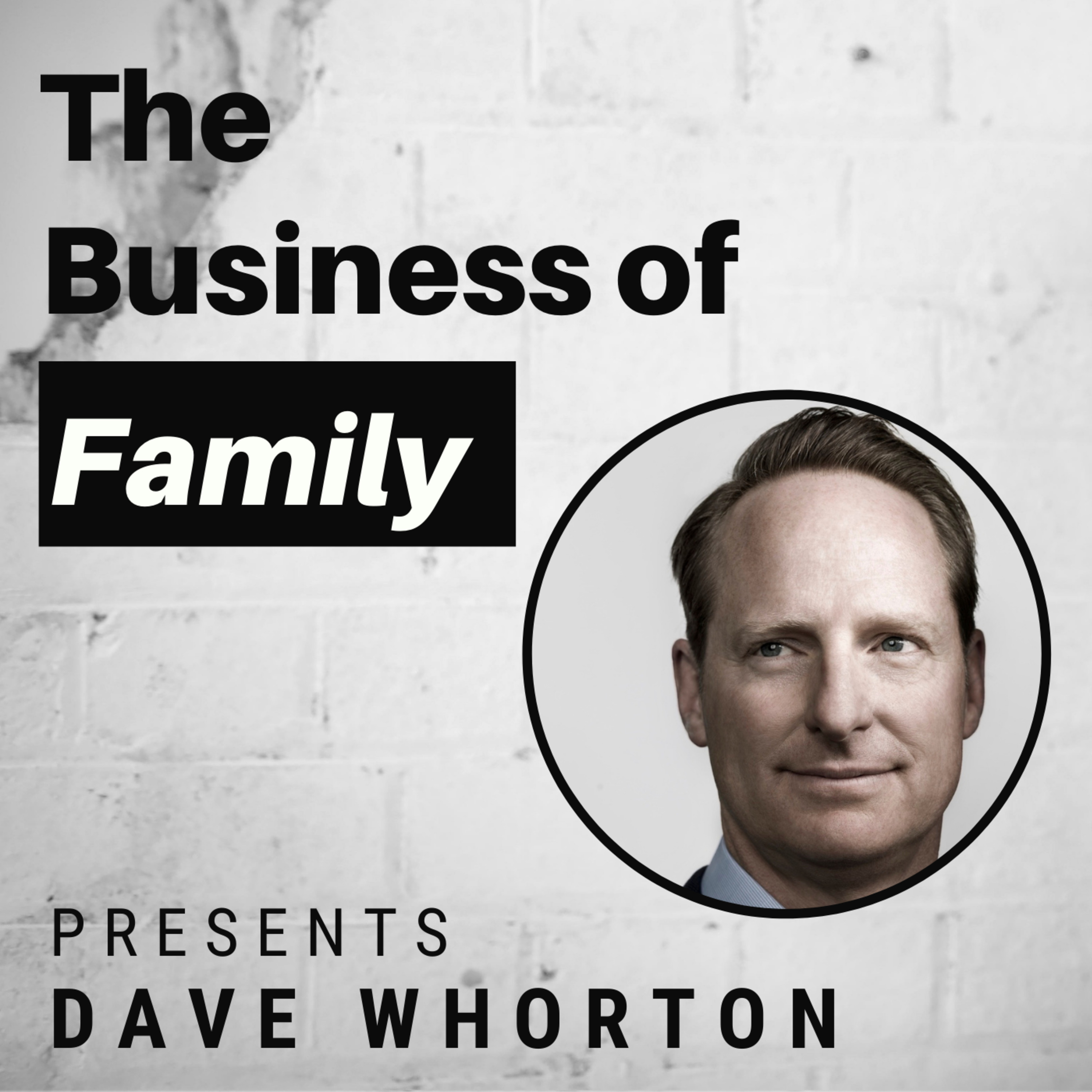
Episode 9 · Season 1
From Built to Sell to Built to Last - The Tugboat Institute Story
Key ideas from this conversation
In the multigenerational companies, founders say the purpose matters more than any one of them, which turns ownership into stewardship.
If you take outside capital, be painfully clear the company will never be sold or listed. Don't even wink.
Write down why you did the deal, so the next generation honours the logic rather than rewriting it.
Read the full show notesBio, standout quotes and the episode timeline
Dave Whorton is an entrepreneur, business leader, education reformer, and investor. Dave founded four companies including Good Technology and Drugstore.com. He also worked for three venture capital firms, Kleiner Perkins Caufield & Byers, TPG, and Interwest.
A small angel investment that Dave made in 2005 opened his eyes to an alternative way of supporting seasoned entrepreneurs who wanted to build large, profitable, innovative businesses that they would run privately for their lifetimes. In 2013 he founded The Tugboat Institute, a membership organisation designed to support Evergreen leaders and their companies over the very long term.
"We believe in the vital importance of humans coming together to create and grow enduring, private businesses that make a dent in the universe." - Tugboat Institute
Standout Quotes
- "How do you help a company have good hygiene? A very important component of that is how you develop the family members into the business" - Dave Whorton [31:40]
- "If you feel your company is deeply purpose-driven and meant to have a significant impact for a long time in the world then you do think naturally about it from a standpoint of stewardship" - Dave Whorton [34:00]
- "How can I take this incredible asset and move it forward before handing it over to the next steward?" - Dave Whorton [34:12]
- "I think it's really important to develop a work ethic in your kids, I don't care what level of wealth you have" - Dave Whorton [45:46]
Key Takeaways
- The 7Ps that makes a company evergreen: Purpose, Perseverance, People First, Private, Profit, Paced Growth and Pragmatic Innovation [21:40]
- Entrepreneurs have to be very clear with CEOs about what they want from their investing partners [39:33]
- Dave describes some qualities that he observed to be common among evergreen leaders which mostly include being introverted and humility [23:42]
- Developing a work ethic at a young age is critically important and also exposing them to the importance of saving [46:07]
Episode Timeline:
- [00:44] Mike introduces Dave and tells us a little about him
- [02:02] Dave shares his backstory and work background in more detail
- [17:16] The Tugboat group and how it's evolved over time.
- [21:40] The 7Ps that makes a company evergreen: Purpose, Perseverance, People First, Private, Profit, Paced Growth and Pragmatic Innovation
- [23:42] Dave describes some qualities that he observed to be common among evergreen leaders which mostly include being introverted and humility
- [30:14] How does Tugboat support generational transitions of family members or other closely held businesses?
- [34:00] if you feel your company is deeply purpose-driven and meant to have a significant impact for a long time in the world then you do think about naturally about it from a standpoint of stewardship; How can I take this incredible asset and move it forward before handing it over to the next steward?
- [39:33] Entrepreneurs have to be very clear with CEOs about what they want from their investing partners
- [45:29] Dave shares his thoughts on generational wealth and legacy building in contrast to a focus on the children developing a work ethic and inheriting nothing.
- [49:25] The failure Dave faced that eventually took him on a journey to where he is today.
Links:
- Seed The Future - Evergreen Movement | Dave Whorton with Tom Bilyeu (IQ50) - YouTube
- Tugboat Institute : We believe in the vital importance of humans coming together to create and grow enduring, private businesses that make a dent in the universe.
- The Tugboat Group : An Alternative Path to Growing Lasting, Private Companies.
- How to Build a Company That Will Last for 100 Years | Inc.com : A growing number of entrepreneurs are ditching the steroid-like growth that comes with outside investment, and building their companies to last.
- Dave Whorton | LinkedIn
- Book: How to Be Rich: Getty, J. Paul : There are plenty of books on making money by men who haven't made much. But if J. Paul Getty, who Fortune magazine called “the richest man in the world,” doesn't know how, who does?
- Book: In Search of Excellence: Lessons from America's Best-Run Companies (Collins Business Essentials) eBook: Peters, Tom : Based on a study of forty-three of America's best-run companies from a diverse array of business sectors, In Search of Excellence describes eight basic principles of management -- action-stimulating, people-oriented, profit-maximizing practices -- that made these organizations successful.
Read the transcript
This transcript was generated automatically and may contain errors, including in names. Listen to the episode for the exact words.
MikeWelcome to The Business of Family. I'm your host, Mike Boyd. Multigenerational wealth creation involves so much more than capital accumulation. The most successful families cultivate values, stories, knowledge and resources to pass on to the next generation, and they do it very intentionally. On this show I sit down with members of some of the world's most interesting business families to hear how they do it. To see where your own family stands, take the Business Family Diagnostic at businessoffamily.net.
Dave Whorton is an entrepreneur, business leader, education reformer, and investor. Dave founded four companies, including Good Technology and Drugstore.com. He also worked for three venture capital firms, including Kleiner Perkins and TPG. A small angel investment that Dave made in 2005 opened his eyes to an alternative way of supporting seasoned entrepreneurs who wanted to build large, profitable, innovative businesses that they would run privately for their lifetimes. In 2013, he founded the Tugboat Institute, a membership organization designed to support evergreen leaders and their companies over the very long term. This is a fascinating conversation with a very humble man. Dave, it's a pleasure to have you with us today. I'm really excited to learn more about your journey.
DaveThanks, Mike. I'm happy to hear.
MikeNow, I would personally describe myself as someone in the small but growing minority of technology entrepreneurs and investors that believe in building bootstrapped, profitable and sustainable businesses, often considered the antithesis of the Silicon Valley VC narrative. You've been an entrepreneur, a brand name VC, and now an evangelist of sustainable and evergreen companies. Can you share with us a little bit about your backstory and how you went from backing startups that were built to sell and now back companies that are built to last?
DaveMy backstory is that I was very fortunate to get a job when I was in high school at a company called Hewlett-Packard. And you may remember that in Tom Peters' very famous book, In Search of Excellence, Hewlett-Packard was the exemplar company for companies of that generation. and a lot of the principles there about how they treated people, how they thought about innovation were pretty important.
And so I spent four summers working there and got exposed to that kind of a company. And I assume all companies were that way. And it's an important thing to understand because this is what brought me eventually to evergreen companies. And so I went to Berkeley as an engineer, came out, worked at Bain & Company for a few years, and then a lot of my colleagues went off to business school.
I didn't quite feel ready to do that yet. And I was helping a couple of startups just think about how they were going to build their companies. I was very, very intrigued by kind of the startup process. And one of those was making industrial CO2 lasers. And I ended up being recruited and joining that company. It was a bootstrap laser manufacturing company and spent the next almost three years acting as its general manager and president.
And so kind of saw the bootstrap experience. Then I ended up going, the company was sold by my partner. I was a very small shareholder in that. And my partner, who was much older and was the inventor of the lasers, made a decision to sell. That was his choice. Very disappointing for me because I thought we had something really significant to build there.
Went to business school and then I was really exposed front center to venture capital. And I was just taken by it. I thought, wow, these amazing human beings helped launch these companies, these incredible companies, you know, into billions of revenue, tens of billions of value. And so I was intrigued. And so I thought going into business school, I would be an entrepreneur coming out of business school. And instead, I ended up being recruited by the premier venture capitalist at the time, John Doerr, who was at Kleiner Perkins. And John had made an investment in Netscape Communications, which was kind of the shock hurt around the world for tech valuations.
And so John reached out to me literally in my first few months at Stanford Business School and said, I've heard good things about you. Didn't really say where from, but I'd like you to consider coming and working for me next summer. And so I spent some time talking to John and the partners there and decided not to work there for the summer.
I decided to work at either Cisco or Netscape. And those are two of the really interesting growth companies at the time and had offers at both. And John encouraged me to go to Netscape. He said, I'm on the board of directors. They gave me an opportunity to introduce you to Jim Barksdale, Mark Andreessen, some of the other key players at Netscape while doing a summer internship, and we'll stay in touch.
So I finished the Netscape experience, and I did reach out to John just to kind of thank him for the encouragement, tell him I had a great summer. I never heard back from him. And then John was presenting at Stanford Business School to about 360 of us, I think called View from the Top. And John saw me in the audience, and it's like, Dave, I got to talk to you.
He called me out in front of everybody and so pulled me aside and says, you need to come and work at Kleiner Perkins and come out and see me again. So he and I spent some time together and we talked about it. I'd been looking, because of my experience at Netscape, at e-commerce as a sector. And I was very interested in starting a company in the e-commerce space.
And so at this point, I was still thinking entrepreneurship. And then I exposed John to some analysis I'd done across a wide variety of industries on what I thought would be most prone to disruption by e-commerce. and one of those was drugstores. And so I thought it'd be very interesting to start an online drugstore. So I started working on the business plan for that.
And through the course of the conversation with John and kind of developing that business idea, he said, look, why don't you come to Kleiner Perkins? We'll incubate drugstore.com at Kleiner Perkins. You cannot be the CEO. You can't be the full-time founder. You can work on it maybe half a day a week. We'll find somebody else to move this business forward.
We will likely back it. And then you can help me with other e-commerce opportunities we're pursuing. So I spent the next three years of my life I got a chance to work very closely with Jeff Bezos in the early days of Amazon. I was the person that led most of the detailed work with Larry and Sergey for the investment in Google.
I wrote the business plan for AutoTrader, and we partnered with Cox to build that property. And then I probably had two dozen companies that didn't work out. But I ended up working very closely with some very successful companies there. And so at kind of this three-year period, John and I had always agreed that I would start a company coming into Kleiner Perkins and that if I did my job well, he would financially back it and he would sit on my board.
So long story short, we did that. That company was good technology. Originally started to be a plug-in into the back of a handspring visor. If you remember that PDA from back then, came after Palm, but it was before the great iPhone. All right. And ours was a music player called the Sounds Good Player. And then we launched that.
At the same time, I was skunk working in my startup, another startup, to do wireless messaging. And that ended up becoming good technology, which was a competitor to RIM and BlackBerry. And we eventually sold that to Motorola for about a half a billion dollars. And so I ran the company for the first year as CEO, brought in a good friend of mine to become older and more experienced to be the CEO.
I became the executive chairman, kind of the key salesperson, key evangelist, key fundraiser. And he ran the business. And so I spent a few years on that. And then I ended up leaving the company. It really wasn't a place for me anymore as executive chairman. And encouraged by John Doerr to start another company. And I chose with two young kids not to do that.
And I was recruited into the private equity industry by a firm called TPG, Texas Pacific Group. I'd gotten to know David Bonderman and Jim Coulter, kind of in my Kleiner Perkins days. And they'd always been kind of tracking me from afar. And they said, look, we'd love to have you come in. help us establish a venture capital practice. We've already started one. We haven't established it yet. And then through that, you can learn a lot about how we think about private equity.
So I ended up being intrigued by this idea, learning about private equity from one of the great private equity firms, just like I learned venture capital from one of the great venture capital firms, came in, had a very successful early investment in a company called Success Factors, bought about 25% for $4 million. And it later went public and then was acquired for a couple billion dollars back in the early days of SaaS. And so that ended up being a very successful investment for TPG. But I found that I was missing something. I didn't feel like I was really helping build meaningful companies from the earliest days. And I'd start developing an opinion that maybe there's a way to think about early stage investing a little bit more like Kleiner Perkins thought
about in the early days of Kleiner Perkins, because I saw a lot of venture capital shifting to larger check sizes, later stage, a lot of pressure on growth. So I ended up starting a firm called Tugboat Ventures, raised $50 million for a first fund, $75 million for a second fund. It went out really to be an old school venture capitalist, more like you would have seen in the 70s and 80s. And my mentors included folks like Burt McMurtry and Roberta Katz and Dave Strohm and others. And they were very intrigued by this too, because at the time I started the firm, there was very little seed stage investing happening. And so I saw a lot of very interesting
opportunities. Ron Conway is about the only person active in the market at the time. And then very quickly, it's like it just overnight, there was a flood of early stage money came in the market. A lot of it with no due diligence, no pricing discipline, uncapped term sheets. And here I am trying to be a value add investor and maybe putting in a million dollars and buying 25% of the company. And so I found myself being out competed in the market on price really quickly. And this is one of these kind of moments of serendipity. When I was starting Tugboat Ventures, a woman came to me who I backed at Kleiner Perkins. I was really with a gentleman
named Doug McKenzie, a partner at Kleiner. And her name was Jessica Herrin. And that company was called Della and James. And I met her at Stanford Business School in the business school competition. We wrote a check, a large check. We helped raise a lot of money. We encouraged Martha Stewart to go on board of directors. It was a wedding registry company. And it was one of these very bright, shiny objects that was looking really good. However, when the dot-com market crashed, the company had not established enough revenues or any sort of profitability to survive it. So long story short, it was a tough, tough process for her. The company has sold multiple times.
So she came to me just around the time I was starting Tugboat Ventures and said, Dave, I really liked your partners at Kleiner Perkins. I don't like your model. And I was a little, what do you mean by that? I said, well, let me talk about my tugboat ventures models, the kinder, gentler venture capital model. And she said, no, the problem is, is that your fundamental objective for me will be to sell my company or take it public. You want to exit me and you want to exit me at a very high valuation. What I want to do is I want to build a business I run for the rest of my life. And I made the terrible mistake of saying, oh, so you want to
build a lifestyle business. And boy, she gave me a tough look. And she goes, no, I'm going to build a company that someday will be worth a billion dollars. It'll do hundreds of millions in revenue. It will be built from its own gas, its own profitability. It's going to be a really nice place to work. And we're going to make a difference in the lives of hundreds of millions of women who will be my consulting partners in this model. And I didn't see it. I said, I don't think you can build a company of that scale today. I don't think it's possible. I think you're going to have to raise at least a quarter billion dollars to build a nationally branded, if not globally
branded consumer company. That's just a rule of thumb. And she said, well, let's talk about the time horizon. We didn't even talk about that. I'm not talking about five to seven years. I'm talking about over my lifetime, over the next 10, 15, 20 years. And you can do that. She didn't say any of these words, but it's got the power of compounding, right? Even lower growth rates compounded over a very long time to build big things. And so this was a seed that was planted in my head before I started Tugboat Ventures. And so as I started really trying to understand this crazy venture environment that I was sitting in five years later, where, you know, checks being written overnight, valuations through the roof, companies being
worth money, levels of valuation I had just not been familiar with in my entire venture career. And just a sense that, you know, so many people were just trying to do this to make money. And so what I decided to do was kind of explore, are there entrepreneurs out there who are trying to build meaningful, lasting companies, do it with good values, where an exit isn't really what's driving them?
You know, and the best way I could identify these people is I went to people in my networks and look, I want to meet entrepreneurs have built reasonably sized companies, tens of millions, 100 millions of dollars, billions, if you can find them, and have for some reason always turned down venture capital and private equity. And to your expertise of my friends, and as you see it doing this well, you know, treating people well, treating customers well, innovating.
And it started really slowly. Like people are like, what are you talking about? I mean, why would you not take venture capital? Why would you not take private? You can't bootstrap companies today. It doesn't work anymore. I kept hearing these things from time to time. Someone said, oh, I know a guy. You need to meet Mac Harman.
He runs a company called Balsam Hill in Redwood City. Largest manufacturer and distributor of artificial Christmas trees. Came out of Stanford Business School. Go talk to him. So I went and talked to Mac. And then I would talk to Lee Rowden. And then I went and I just started having these conversations. And every time I had a conversation, I said, that's terrific.
I mean, I was learning from these, but like, who else do you know? It's like pulling a thread. And then, you know, it just kept pulling and more folks came through and even had a conversation with Clayton Christensen before he passed away. You know, this was quite some time ago and kind of proposed this idea to him.
He said, have you talked to Jim Goodnight at SAS Institute? Now he's ranked in the top 10 best places to work in the country for 20 years. And he sounds, as you described this evergreen idea, I started calling these companies evergreens. He said, it sounds, he's very aligned with that. You should go visit him. So that led to an introduction to Jim Goodnight and visiting him.
And so over the course of a year, I came to the conclusion, boy, I've been blind. There are some incredibly interesting companies out there. They're doing this. They're building profitable, impactful businesses, treating their people well. They're partnering with their customers. They're partnering with their suppliers. And I didn't even see them because they weren't in the entire radar of venture capital or private equity.
And probably in the radar of private equity. These are the folks that private equity guys would love to buy or invest in, but they would never take the calls, right? There's that 50% that was like, you know, the private equity guys call it like, no, no, it's not a conversation I'll ever have with you. So that's what really kind of helped me see this other category of business.
And, you know, Mike, because you do work with many multi-generational family businesses, I was being brought into those conversations, too. And let's make some time with some of the Cargill folks. You know, that's probably the largest, I think, multi-generational family business in the United States. I met the Koch family and had a chance to talk to them about what they've done with Koch Industries.
You know, the Bechtels. I ended up talking to some of the Bechtel folks. I mean, and so these introductions led to like, hey, look, these companies, you know, Dave, you've been focused on entrepreneurs. But this also, I mean, there's third, fourth, fifth, sixth, ninth, tenth generation companies that have been operating to these values. And it's probably why they've been so resilient.
So that's a bit of the backstory. And so for me, it kind of came all back to Hewlett-Packard, which is I suddenly realized, oh my gosh, the heirs, the culture and values of Dave and Bill are really not the current people being backed on Sand Hill Road today. It's these great evergreen companies. They're the ones that have really embodied the spirit, at least that HP had in its first 40 or 50 years of business before it went public.
MikeI think it's fascinating. Also, just the lens through which you see the world. There's probably a few different camps of people in the audience. Those that are in the States, in the VC or PE world that completely resonate with where you came from and how you saw the need to raise venture capital, the need to partner with PE in order to build something of significance. And then there's probably another camp of people listening to this that have always built a family business or have always built something in traditional industries thinking that you sound absolutely absurd that you didn't realize you could build a purposeful, profitable, sustainable company over the long term. So, it's fascinating. And I love to bring
these conversations together for that reason.
DaveWell, yeah, Mike, to build on that, when I was first starting this, I couldn't identify three or four companies would fit this kind of set of criteria, right? Which now we call the evergreen seven Ps, which we can talk a little bit more when you're ready. But it was just a small number. And I assume, okay, well, maybe they exist just in industries where venture capitalists don't participate because otherwise they would be inclined to take the money. And what I see today is there are wonderful evergreen companies in every industry. Amazing. You know, first generation to night generation. They're, you know, run by women, they're run by men, they're run by minorities. I mean, these are just fantastic companies. And yes, I feel very naive. No, I was very naive, you know,
let's say seven, eight years ago when I'm like, are they really out there?
MikeYeah, yeah. It's wonderful to see this Venn diagram coming together, the overlap. That's how I see it. So tell us about the Tugboat group and how it's evolved over time. You started Tugboat Ventures, a VC fund originally, but today you run and have subsequently founded the Tugboat Institute. Let's hear that story.
DaveYeah. So when I was having these conversations with these folks, a lot of lunches and dinners and trying to understand and hear their stories, what I heard a lot of times from them at the end was, hey, are you actually talking to other people who are thinking the same way as me? Because when I read the Wall Street Journal, New York Times, Forbes, Fortune, Business School, these kind of companies are not really being talked much about.
And they only explain that personally that media has shown little interest in what they're doing because they're not venture-backed. And so they kind of said, look, I'd love to talk to some other folks. I started to make connections like, hey, you should talk to so-and-so and you should talk to so-and-so. And I finally came to the conclusion, why don't I just invite all these people to get together?
And so I hosted a two and a half day party in Sun Valley, Idaho. And I basically, I've had experience with YPO and TED and, you know, I also love the outdoors. And so I try to mix those into a two and a half day experience. And so we had talks in the morning, 20 minute talks, where I got different attendees to get up on stage and kind of tell parts of their story, parts of their best practices.
Then we did outdoor stuff in the afternoon, the evenings we celebrated, good food, good wine, you know, eating and playing some games together. And it was amazing. And it was just this incredible bonding experience. I think there's a lot of camaraderie, a lot of gratitude, a lot of, you know, I say gratitude, like thanking the other. Like, I am so grateful to hear that you're evergreen, too, and that you're thinking about building your company this way.
It was very powerful. A gentleman like Mac Harman, who I talked about, Jed York from the San Francisco 49ers was there, for example. So it was just an interesting mix of folks. And at the end of that, I was so moved by the energy and the camaraderie. I said, look, what do you guys want to do with this?
And they said, we should do this again. I said, well, so I schedule out in a year or two. you know what are you thinking and let's do it sooner than that let's do it in like six months so we had a second event uh six months later sun valley resort was actually being remodeled at the time so i said well let's do it somewhere else since we did carmel valley california and i was very nervous about it because i figured the first one's special because it's the first time the second who knows what will happen so the second event ended up being really successful but with a footnote people said don't ever do this in carmel valley again
do it in Sun Valley. We have to get away from Silicon Valley. Just, you can't be that close. You need to kind of remove yourself from it. And at that point, I decided to turn into a membership organization for the first year and a half. I didn't charge anybody anything. I finally said, look, for me to sustain this, I need to make this a business too. And so that became the beginning of Tugboat Institute, a membership organization where people get annual fees, kind of includes participation in the community, events, content, et cetera.
And at the beginning, we continue to add facets to the experience and the learning as time goes based on the feedback of the group, as any good entrepreneur would do. So in the beginning, it was really around a couple of events. Then it became a newsletter. Then it became white papers. Then it became seminars. Then it became forums, like you might see with YPO and Vistage.
And so we continue to kind of wrap that experience and continue enriching that for the members. And so Tugboat Ventures is still part of the Tugboat group. But we haven't made a new investment in venture capital in eight years, and we won't raise another fund. That chapter, you know, not yet closed, but like all good venture capitalists, you'll need to exit those businesses and return capital to your investors, which we will do over time. But it's really shifted the energy towards Tugboat Institute and trying to evangelize these wonderful evergreen companies and build awareness around them.
MikeAnd so I assume that the Tugboat Institute as a business in itself is also evergreen and subscribes to the same principles and values of operating for a very long time?
DaveYeah, we strive for that. We do. Now, we haven't done a good job on the profit P, but we did turn profitable for the first time last year. So seven years in. So I'm not as good as most of the entrepreneurs in the group. They did a better job of getting profitable earlier.
MikeThat might be the VC in you. Allergic to profit.
DaveI think it is. It's just sloppy. Just sloppy. It would be so sloppy.
MikeSo tell me a little bit about these companies. We've talked about their evergreen. You mentioned the seven Ps. What is it that makes a company evergreen?
DaveYeah, so this was really interesting to me. After all these interviews I'd had over the course of a year before that first, Tugboat Institute Summit in Sun Valley, Idaho, I started trying to figure out with the help of a colleague named Chris Alden, And is there a framework that kind of describes what it means to be evergreen?
Because I didn't want this to be so vague that anybody could claim that they were evergreen. And what we ended up doing after the summit is I kind of wrote down seven Ps. And I presented that to the community and said, look, this is what I think I've heard from you that's in common. And these are the seven Ps.
First is purpose, perseverance, people first, private, profit, paced growth, and pragmatic innovation. I said, if I distill down what I think, talk about Venn diagram, what I hear in common is that those seven principles are kind of held in balance. And that's what creates a successful evergreen that could survive for generations. And I put it out as a straw man, a term we used to use back at Bain and Company.
Like, hey, guys, poke holes in this thing. You know, is there one P too many, one not enough? Is it the wrong framework? Here we are seven, eight years later, and it is what it was back then.
MikeIt's incredible. It's terrific. I've done a little bit of research into this area of enduring companies that last at least 100 years. And we had another guest on recently, Vicki TenHaken, who has, as a professor, researched this area as well. And it's actually interesting that the seven principles that you've identified as evergreen are also shared in her research, namely staying private, pragmatic innovation. These aren't companies that just happen to survive. They're very intentional about it, but they're usually very purpose-driven, big participants in the community, giving back. The employees typically tend to be with them for a very long time because of the values and the way they operate.
I think it's a fascinating area to research.
DaveOh, that's awesome.
MikeLet's talk about the people who lead these businesses. Is there something that represents an evergreen leader? Does it attract a certain type of people? Or do you see a wide variance in the types of entrepreneurs that bring these types of businesses together?
DaveWell, so I'm learning this over time. I had a really interesting conversation where two of the women CEOs pulled me aside and said, you know, we're introverts. And you run a pretty immersive program at your events. Like you schedule every minute from the time we wake up to the time we go to sleep. And they were saying, that's hard on us, right?
We need a little more time to pull back, kind of re-energize, and then re-engage the group. And they said, we bet there's a number of introverts in this group. And I said, I don't know, 20%, 25% maybe. And they're like, maybe more. So the next day, I just pulled the group. It was during one of our events.
And I just said, all right, I'm just super curious. This came up in a conversation last night. what if you would think of yourself as an introvert and i gotta describe my understanding from susan keen and what an introvert is uh raise your hand almost all hands went up 80 percent of the people in the room were self-identified introverts and that really struck me but it makes a lot of sense because if you're going to build an evergreen company you're probably not going to get a lot of public praise i mean this is not the de facto standard this is not the thing that gets bankers and accountants and media all celebrating you. I mean, you're kind of quietly building a
business against an important purpose. You're treating people well. There's no big financing events. There's no public display of success that you might see on the kind of venture private equity path. And so that started making sense to me. And the other thing that I found to be very common is just a tremendous level of humility. These are not bullshitters. They're genuine. They say it as they see it. I mean, one of the things I thought was so fascinating, the very first gathering got together was how open the CEOs with each other about their revenues, their profitability, how they're growing, what things are investing and they're working, what things are not working. I had never seen that in a venture capital gathering.
Everybody in a venture capital gathering is perfect. Their business is going great. They're hitting all their numbers. They're up and to the right. They've got another big round a financing company together. And I know that that's not true because I knew, for example, as an insider on Kleiner Perkins, I knew from the reports they provided us which companies were doing well and which ones weren't. But everybody presented themselves as success until they weren't successful. It's kind of fake it before you make it. And this group doesn't demonstrate that.
And I thought it was really interesting to hear them even like saying, gosh, here's something I'm really struggling with. Do you have experience with that before? Because I sure could use some new ideas and people like, Oh yeah, let me tell you a little bit about kind of how I dealt with something similarly. And I just, I was part of what just inspired me. I'm like, Oh my gosh, these people, their humility, their transparency, their openness, their care is phenomenal. So I don't know if that helps, but I'd say that both this kind of many are introverts and many have a, just a, a really, a nice level of humility. It's refreshing and it definitely helps it.
MikeIt sounds like my people, my tribe.
DaveIt's become my tribe. I love these people. I just can't get enough. COVID breaks my heart because I want to see them, see them in person, but at least not this year.
MikeYeah. Yeah. It's tough. One thing I've noticed recently is an increasing number of VC backed software companies have decided to buy out their original investors, remain private, and instead control their destiny. So they start down one path and they've switched to another. I think of the company called Buffer, a social media scheduling tool, as a recent example.
Do you think this is a growing trend that we'll see more of? Or is it just something that I'm seeing more of because it's more visible today?
DaveI don't know. I think it's very rare still. We have two members of Tugboat Institute that bought out the venture capitalist. And in both cases, I was really surprised. One is a gaming company and one is an ed tech company. And the ed tech company was able to do it because they had mission-driven investors. When offered a reasonable return, they said, that's great.
I mean, if you guys want to kind of go independent, be private, you're offering a fair return, we'll take it. And the other one just had a structural agreement at the time they took investment because they were already profitable and growing, that they would have an option to buy back those shares at a kind of predetermined price in the future.
And they chose to do it. But outside that, I can't, out of the couple hundred members of the Institute and probably the three or four hundred evergreen companies I've talked to in the last several years, it's still very rare. I think what makes it so hard is that if you're doing well, the last thing your venture capital or investor wants to do is sell you at a reasonable price.
Because if you're going to buy it back, you're probably going to do it through some amount of debt. It's most likely how you're going to do it. And you want to be, most of these entrepreneurs don't want to put so much debt on their company that they break the company. In fact, most Evergreen entrepreneurs and CEOs have very little debt at all because they see that as the great risk of losing a wonderful multi-generational business, right?
Debt will kill you like no other thing. So, no, I don't. And I wish there would be more good fortune in that. But I think you just – I remember having this conversation with Dave Goldberg, who was the CEO of SurveyMonkey. And it was a wonderful company generating a lot of cash when he was running it before he passed away.
And he and I talked about Evergreen. He talked about he didn't see how he could actually make that happen because the expectations, the investors, the return they would want would be so out of line with what he was capable of funding through debt and other sources. So they ended up basically buying out the earlier investors with new investors who didn't want the company to go public.
So, yeah, I would love to see more. I just I think there's a structural problem. Now, if you're not doing very well and you're what's called living dead in a venture portfolio and you believe in yourself, you can buy it back for pennies on the dollar, the original investment. That could be a way of doing it. But you've got to have a lot of courage.
Absolutely. People have probably been telling you for a long time that you're not very successful and you just have to have enough courage to say, no, I can do this. Take the restriction requirements of the venture-backed model off me. Give me more time and I can build a successful company.
MikeI love it. Nurturing an enduring company for the very long term, beyond even the founding generation, is no easy task. How does Tugboat support generational transitions of family members or other closely held businesses when the time comes?
DaveYou know, we do it primarily through example and case study. And so the wonderful thing I like to say is when you have a couple hundred of these evergreen companies, you probably have all the knowledge you need for almost every problem or situation that arises. And so there's companies in the community that have actually managed successful family transitions, transitions of leadership, transitions of ownership for a very long time.
Like the Hollingsworth and Vose is the oldest company in our community. It's ninth generation. It was founded in 1720, I believe. And it is a dynamic, innovative company. It's one of the largest producers of N95 masks in the world. It's got global operations. It is a leader in substrate materials that are used and filtration materials used in electric cars and fuel systems and water treatment facilities.
I mean, this is an incredible company, but it's transitioned nine times or eight times, working on its ninth. And so incredibly rare.
MikeYeah, absolutely. Incredibly rare.
DaveBut they're very generous in sharing their stories, kind of how things worked, how they had success. And you know, there's people like Spencer Burke at Owen School in St. Louis. And that's what he focuses on. He calls it good hygiene. How do you help a company have good hygiene? And a very important component of that is how you develop the family members into the business, right?
And what roles they should play. And how do you think about voting rights? And I think about ownership transition. So we do, I wouldn't claim that I am an expert at this. I don't think I've claimed that any one member in our group is an expert on this. But what we try to do is expose people to multiple models.
And through that exposure to multiple models, they can decide what makes sense for them. I mean, one of the things that folks have had to get their head around is the idea of a professional manager. Like maybe my children don't and shouldn't be leading this company after four or five generations. How do I create a professional manager model?
And how do I make that? And what role do my children play in the governance and ownership of the business when that happens? So you had to look at that. Others have pursued selling the company outright to employees and just saying, look, you know, our family has owned this for long enough. It's time to let the employees own this.
And so there's direct ownership models out there. There's ESOP models. And so there's a lot of different ways, as you know, this can go. But for those folks that are really interested in keeping it in the family, again, by example, I think we've done the best job of kind of showing the people who have done it, done it well.
MikeI think that's an excellent example, too, to learn by case study. These evergreen businesses that sign up to Tugboat Institute have the intention to grow profitably for 100 years or more. So I'm curious about their take on or your take even on stewardship, this concept of taking care of a business for a limited period of time throughout your lifetime with the intention of passing it on to the next steward who will do the same as sort of a disconnect from direct ownership and more about contribution.
Does Tugboat Institute members live with that philosophy or do they potentially see things a different way?
DaveI think most of the multi-generational members see it that way. And that's why the purpose, P, is so important. You hear things like the purpose of this company is more important than any one of us, is more important than myself, my children, my parents, because we have a very significant contribution that we're making to the world. into society. And so I think that North Star is so important. And if you feel your company is deeply purpose-driven and is meant to have a significant impact for a long time in the world, then you do think naturally about this from a standpoint of stewardship.
This is not about me. It's not about my lifetime. It's about, as you said, how can I take this incredible asset, move it forward, improve it, create something even more valuable before I into the next steward.
MikeOne thing I'd love to touch on, given your vast investment background, is this concept of permanent capital. And particularly as it relates to evergreen businesses that are, by definition, around for a very long time. You talked about taking on debt to potentially buy out VCs or investors that are seeking an exit. If an owner or a steward wanted an investor on board to effectively become a permanent shareholder. Maybe it's for 10% or 20% of the equity. How do you think about the possibility of permanent capital in a structure like that? Because I would imagine there's a challenge in trying to raise a fund that invests in evergreen companies because there's no return of capital. There's no exit event. There's no
timeline or defined timeline on when that happens, you're simply harvesting profits, I assume. Do you have a thought on that? Have you looked at that space?
DaveYou know, I have. It's funny because in that very first gathering we had at Tugboat Institute, I had a few people hold me aside and just say, hey, look, given your venture background, your private equity background, have you kind of thought about how you might make capital available to evergreen companies? And I said, I think there's just some serious roadblocks.
to that happening. But tell me a little more about what condition you're facing. And one condition was a company growing faster than the cash it was generating and not wanting to grow any slower. And so there was kind of a pressure to think about bringing in a partner. Another was buying out a family member who was no longer aligned with the vision for the business and wanting to cash out and wanting to relieve that pressure so the company itself have to be sold, take them out. And then there was the condition of somebody who said, look, I've been reinvesting everything in this business for 20 years. I live in an apartment with my wife and
two kids. My business is worth hundreds of millions of dollars. And most of my colleagues and friends from college and business school, they live in beautiful homes. And my wife finally wants a little more space in a nicer home. So I'd love to take five or 10 off the table, buy a house without a mortgage, you know, in an expensive neighborhood that he lived in. And so those are all very reasonable reasons to try to raise capital. But when I looked at this, and I did go talk to a number of family offices about this, I'd say at least half talked and behaved like a private equity firm. And I found that surprising because I said, wow, you've got generational
wealth. You've got this incredible family business that's sitting kind of as the backbone, the golden goosies, you may say. But you talk as if, and what I found is I kind of got underneath this. A lot of the professionals in the family office were separate from the principals, the family members, and their incentive systems were really set up for exits. So they get paid like a venture capitalist gets paid or private equity on a company being sold, they get some piece of carry in that deal. So when you say to them, hey, look, would you consider investing in a company buying 10%, like you said, for let's say 5, 10, $20 million and getting a modest dividend every year,
maybe 3, 4% of the original capital coming out as a dividend and then letting the underlying asset continue to increase in value through reinvestment. And to a person, they said, no, I would never do that deal because I'll never get paid on it. Now, even if it was good, people were kind of pulling me aside saying, might be good for the principals, not good for me. And so, and I said, well, would you go back and renegotiate your incentive plan? So maybe you get a tail on that.
So even if you leave the firm in 10 years, you get a 20 year tail on a piece of those, like, ah, that's not going to work. That's not going to work. You know, they wanted the money in their pocket too. So that was about half of the folks I talked to. And the other half, I think, and this is, I think you referred to this in an earlier conversation we had, I think the intention is there. They want to get their heads around the idea of like, wouldn't it be great to own a small piece of a wonderful company? We diversify our family away from maybe our core business, which might be steel or restaurants or business services or
hospitals or whatever it may be. But I don't know if they really have the mindset for it, Because in a sense, to pull in your word steward, they have to treat that investment as stewards, too. That investment is not for them. That investment is not for their children. It's potentially for their grandchildren, right? At some point in time, if that company that, let's pick on Enterprise Rent-A-Car, you know, if you'd been investing in Jack Taylor, which was a couple hundred thousand dollars, and you kept that in your family until today, which would now be about, what, 67 years later.
that would that little investment would probably generate a billion dollars of cash flow for you for a year i'm just guessing i don't know for sure um but you would have had to like kind of pass that through and so i think that's part of it i think part of it would have to be a mindset that you're not looking for an exit you're not looking for something to happen within the next 50 100 years you're treating as if i made the investment and it's gone it's just gone you know and i'm doing it behind people i believe in and i have confidence in hopefully you've got a good relationships so they'll call on you when things are not going well and get your advice and counsel
and then on the other hand i think entrepreneurs have to be very very clear and see those about what they expect from their investing partners and be just clear this company will never be sold this company will never be taken public or at least you will have no say in that if i come to you and tell you that yes i made a decision to sell the business i'll let you know but that's not yours to put pressure on or because the thing that happens is you know even investors who are patient capital investors. When something explodes and becomes worth a lot, they suddenly get this orientation like, I want to take it off the table. And they still, both the entrepreneur
and the investor have to understand that's not going to be in the cards. And I think that's been the toughest thing when I've talked to young entrepreneurs who are trying to start evergreen companies and they do want to go raise some outside capital. I said, you just have to be painfully honest with investors. You are not going to go public or sell. You're just not going to do that. You can't even wink. You can't even hint at it. It'll be absolutely clear. And yes, you might say something effective when I start generating excess cash, just as if I was Warren Buffett and I'm generating excess cash, I cannot productively reinvest at a rate of return of 12 to 15 or 20%.
I will start distributing that to owners, including myself and you. And then you and I will go find other productive places to spend that capital. But until then, substantially all this capital will get reinvested in the business. And frankly, you should want that because you can't go into the public markets and get that return anyway. So, but anyway, I think we're going to get there.
I just have a, just a sense. Now, the thing with most evergreen companies, the truth is they just don't need capital. They don't need it. And so, but there will be times that it will arise and hopefully there'll be good partners that arise at those times that will be generational partners, right? Multi-generational partners.
MikeYou've touched on some great points there. I think the incentives are a big issue, as you say, particularly as you get into professional wealth management, the incentives typically just don't align. But usually what I find in talking to founding generation or the principals is that they have an interest in diversification for the family wealth. And a couple of examples I've seen recently was where a family was looking for outside capital to help manage the transition of buying out or pruning the family tree, buying out siblings that weren't involved, weren't contributing. There was one son or one daughter that wanted to take the family business forward and wanted to buy out the others, but simply didn't have the capital, or it was too much of a debt load to pile onto the one
big asset in order to achieve it. And they were looking for models around an equity partner with a long-term time horizon, which might've been 20 or 30 years, but also with the option for the family to ultimately buy out that minority at some point in the future for a predetermined multiple. So I thought that was a really interesting idea.
DaveMike, just to build on that for a second, I think that's actually a very interesting idea. But the one thing I would encourage the family who's taking that investment is it may be okay to keep that partner in too, right? Maybe end up buying out half their interest in 20 years and maybe have an option to buy out another half of the interest another 20 years from there.
Because for that person who's providing that capital, incredibly patient, permanent capital, you also want the tail of compounding really kicks in in the out years. And so it would be nice to be able to enjoy that success over even a longer period.
MikeYeah, and reward that partnership for aligning with values and being there.
DaveExactly.
MikeExactly. The other example I've seen was two very successful first-generation founders that are now the matriarchs and patriarchs of what is a fourth-generation family, but they're still living. And the founders are actually in discussions about effectively swapping 10% of equity between the families to diversify themselves. But the family share similar values. They're run by stewards. They have a very long time horizon, but they want to diversify the industry of the wealth.
So I thought that was a really fascinating one as well.
DaveAnd did they do that? Did they actually pursue that model?
MikeThey're close. They're in the process. So I'm sort of on tenterhooks waiting to see if it actually gets done because you can imagine the politics, the family dynamics, the emotion involved in all of this. But I just thought it's a very interesting idea. I almost hope they pull it off so that we've got a case study for everybody else.
DaveYeah, that would be good too. And one of the things I'd say in that kind of model, you have to go into it hoping the other partner is tremendously successful. And you hope you are too, but you hope they're tremendously successful. And then how are they formed that partnership, that's okay. Because you don't want people looking back 10 or 20 years from now saying, wow, we were both $20 million revenue firm. My firm's now doing 500 million. Yours is doing 50.
We generated all the value on our side because we're the bigger company and you didn't. Well, you can't forget the moment in time. You were diversifying. And part diversifying is that one or the other may end up being much more successful. And so maybe one even fails, Maybe the smaller one fails completely and they still own a piece of the successful company.
I just think it's really important to codify that, you know, why did we do this in the first place and what we're trying to honor here? Because, you know, you can't predict the outcomes.
MikeNo, not at all. And that is absolutely the risk. It's also the potential reward. And I think if anyone can pull it off, it's these multi-generational families that are running what we call the business of family, the family enterprise, very, very strictly with a structure around family meetings, family constitutions, clearly documented decisions about the why and the how and how those decisions were made 50 years ago and why we're honoring that decision because it was the right idea at the time.
and not allowing revisionist history to come into, you know, why on earth did we do that? That was a silly mistake that grandpa made in swapping equity with a business that was much smaller than ours today.
DaveRight. Now that's, that's, yeah, absolutely right. That's good. That's really good.
MikeDave, I'm curious, your thoughts while we're on this topic, what are your thoughts on multi-generational wealth and succession planning and legacy building? Is it something that you're a proponent of, or do you think that children shouldn't inherit anything and they should learn to generate work ethic and good values themselves or somewhere in between?
DaveI think it's really important to develop a work ethic in your kids. I don't care what level of wealth you have. I think that's really important. I think just part of the human condition. You want to contribute. You want to be able to invent. You want to be able to be part of a team. You want to see success and failure together.
And so I think that's just really important. I think developing a work ethic at a young age I think is critically important. and getting your kids working at 15, 16, you know, in jobs, perhaps getting them paid things when they're 9, 10, 11, 12 to get a sense for money and the value of money. I think it's also important with kids to start exposing them to the importance of saving. So like one thing I do with my kids is for every dollar they saved, I matched it a dollar up until the time they went to college.
And so if they had a summer job and made a couple thousand dollars and in the summer they put that in their savings account, I'll put a couple thousand dollars in their savings account. Now, they can't remove any of that money until they get to college. But it's interesting that for both of them, it developed a real savings discipline early in their lives, along with the work discipline also.
So I think that's really important, regardless of whether your family is going to be tremendously wealthy or not. I think you want those values instilled. I don't have an issue with multigenerational wealth. I do think that that carries tremendous responsibility. Right. And I remember reading a book, How to Be Rich. I think it was. And I am so sorry. I'm blanking on it. It was Getty, I believe. And he made a lot of money very early in oil and gas. And his dad kind of pulled him aside and he was spending it on cars and girls and partying in Los Angeles and all this. And he said, I'm just really disappointed in you. Now you've been given this tremendous asset. And his father helped put him
in business. He said, that money is not for that purpose. That money you should be using to help create other great businesses. You know, you have a tremendous responsibility to take those skills you develop as an entrepreneur and educate others and invest in others. And so I think that's back to your earlier thing about investing. If wealthy family members can help support in a generational way, the creation of new great evergreen companies, that'd be a tremendous, tremendous contribution.
so you know you talked about pruning there's different philosophies on that i think that there's a lot of time there's a lot of wisdom in that right keep the ownership fairly concentrated keep it with the people who really understand the business that are involved in it and through that pruning process you're generating wealth also right for the family members getting pruned away and the question is what did they do with those things but i think in general i i don't think anybody admires is the person that has inherited wealth that's wasting it or showing off or you know, doing that. I also think there's a really important role for foundations and charity for these businesses. I think many of these businesses are deeply embedded in their
communities, these evergreen companies, and they're making significant contribution. But I think it is okay for some of that wealth to be generously shared with charities that they believe in, right? And, you know, so part can go into their children, part can go into charities, part can go into investments in great new businesses or supporting existing great businesses.
I guess there's a few thoughts I have.
MikeThey're excellent thoughts. I wish we could go on and on. Dave, you've had incredible success throughout your career from VC to PE and now Tugboat. I'm interested in asking you about failure. How has a failure in your journey helped shape you and set you up for success later on in life?
DaveI've had a number of failures. So it's always a good question, right? I'd say the one that probably, I wouldn't be here today if the failure hadn't happened. That was that when I was running good technology, the intention going into the experience of starting the company was that I would run it, would take it public and be successful.
I'd hire a successful CEO and that would return to Kleiner Perkins and be investing with John Doerr and the partners there. And when I made the decision to hire a replacement CEO to me and become executive chairman, that had ripple effects I didn't expect. I was trying to do what I thought was best for the company. I mean, we were building hardware.
We were building handheld software. We were building server software. We were building software that went in the communications centers of AT&T. We were building software that would actually sit inside enterprises. All this software had to work and coordinate and everything else. And it was well beyond anything I'd ever done. I'd never run a software company before. So the gentleman I hired to do it.
And it led to, over the course of the next couple of years, a conversation that the vision I had for myself returning to Kleiner Perkins to be an investor was no longer available. That just wasn't going to happen. So to me, that was a tremendous disappointment that I thought in doing what I thought was right and staying active in the company, but no longer CEO.
And so if that had been differently, I probably would return to Kleiner Perkins. And who knows, maybe I'd have spent the next decade or two investing at Kleiner Perkins. I don't know. But when that decoupling happened, when I went to work with TPG and realizing I wasn't a private equity type guy, it really set me on this kind of journey that was fairly unique to me.
Right. I couldn't do the safe thing anymore. I couldn't go from to Stanford Business School or Bain or whatever. Now I'm going to go create something from whole cloth and take that risk. And then finding out that that thing I thought I created from whole cloth really wasn't achieving what I hoped to achieve, which in some sense felt like a failure, too.
Which is Tugboat Ventures wasn't becoming what I thought it would be. But it is what opened the door to allow me to see this evergreen community. And boy, I wouldn't want it any other way. I mean, but I had to have, in a sense, both of those things happen to put me in a position to be open to a different way of building businesses.
There's a different way for me to contribute. than kind of how I thought I'd contribute either as an entrepreneur or a venture capitalist. So tough times. I mean, those were very tough times. My wife used to laugh at me. She goes, why are you just so, you're devastated. I said, well, to think that you're going to go back and be one of the small group of people at the most successful venture capital firm in history and have that taken away from you, that's a pretty big disappointment, you know, and failure on my part.
MikeAnd it's an attack on personal identity almost, isn't it? When you have such a clear picture in your mind of what's going to be, and then all of a sudden you have to reinvent and find a new path.
DaveYeah. And I was doing it very well in the Kleiner Perkins environment. But again, I wouldn't change this for anything. I mean, this community, you talked about the tribe earlier. I love these people. I love the way they think about business. I love the way they think about people and their contribution. I mean, it's just, I like to say they're operating at a higher level of consciousness.
They just understand at a more fundamental level what's really important. What's so important is how you engage other human beings, how you raise your children, how you think, as you've said, well, how you think about stewarding a valuable asset. I mean, that's just, it's amazing. Such good people.
MikeI couldn't agree more. Dave, this has been a terrific conversation. I so appreciate you taking the time. And there's so many threads that I'm looking forward to following through on. So thank you for being here today.
DaveYeah, thanks for the interview. I've enjoyed this, Mike. You did a nice job.
MikeThanks for listening to The Business of Family. You'll find the transcript and key ideas from this conversation at businessoffamily.net, along with the Business Family Diagnostic. It's free, and it shows you where your own family stands. And if someone in your family should hear this episode, please send it to them too. I'm Mike Boyd. Until next time, take care.
Keep listening
If this one landed, start here next.
7th Gen Hollingsworth & Vose - Manufacturing Innovation Since 1728
The oldest company in Dave's evergreen community, still innovating.

Lessons from Century Club Companies
The five practices that companies over 100 years old share.
Using the Family Holding Company to invest in Education
Deciding to hold rather than sell.
The Business Family Diagnostic · Purpose
Built to last, not built to sell.
Dave's evergreen founders say the company's purpose matters more than any one of them. Does your family have a written statement of what the family enterprise and its wealth are for?
“Most adult family members could describe our long-term goals in similar words.”

Every family wishes someone had recorded the generation before.
I built Enduring Stories to do it for yours: a guided voice conversation, from home, that keeps your family's voices, values and history.
The newsletter
The most useful things in these conversations are the things families rarely say out loud.
I share them in my newsletter once a week. Sign up to receive the ideas directly and start building the foundations for your family today.