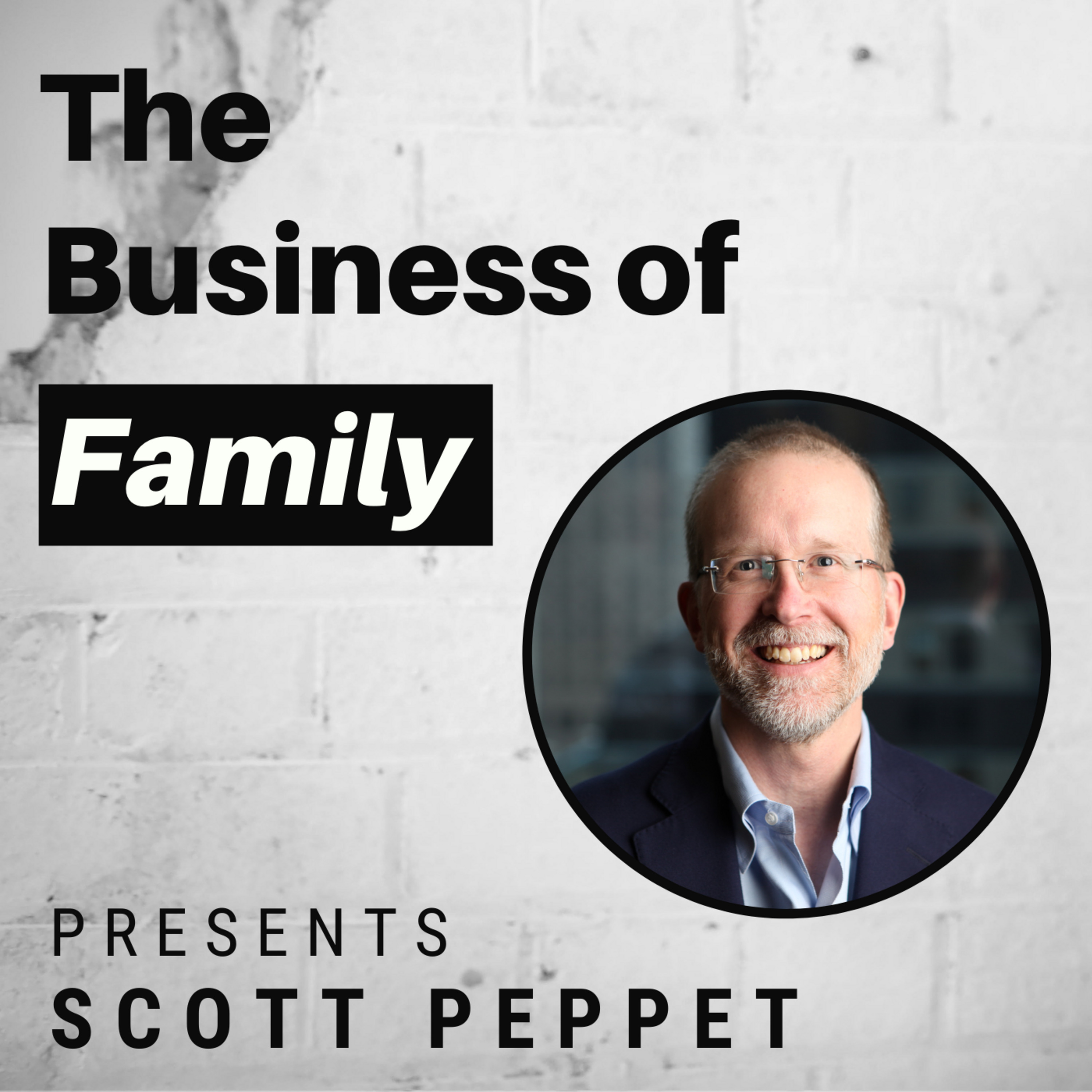
Episode 49 · Season 2
Building a Family-Focused Office for Sam Zell
Key ideas from this conversation
Most family offices should really be called money offices. A family-focused one is measured by the level of trust in the system.
Imagine a year of family meetings where nobody talks about the money.
Families rarely fail from taking too much risk. They fail from taking too little, so protect the risk-taker.
Read the full show notesBio, standout quotes and the episode timeline
Scott Peppet serves as the President of Chai Trust Company LLC, the private trust company that serves as the family office for Sam Zell and his family. Equity Group Investments, a division of Chai trust, provides investment management services on its behalf.
From 2000 to 2018, Scott was a professor of Law at the University of Chicago where he focused on Bargaining, Dispute Resolution, Translational Law, and the complexities of multigenerational family enterprises. Scott speaks regularly on Family Offices, Private Trust companies as well as Intergenerational Leadership while also maintaining an active website.
Scott is a G2 family member. He is Sam Zell's son-in-law, having married Sam's eldest daughter.
Standout Quotes:
- "Business works on short wavelengths and family works on very long wavelengths" - [Peter Evans, Scott]
- "What does it mean to try and help family members really develop and really take ownership, so they can figure out how to deploy what they have?" - [Scott]
- "There are many different kinds of wealth… you probably aren't put on the earth to grow the financial capital, there's lots of professionals who can help you do that" - [Scott]
- "Too often, the implicit message sent to family members is 'this system is really here to steward the money" - [Scott]
- “Families rarely fail for taking too much risk, they fail for taking too little risk” - [Scott]
- "My goal is to create a family-focused office, not a family office, and a trusted company, not a Trust company" - [Scott]
- "If you want to succeed you have to have a family that understands what you're doing" - [Scott]
Key Takeaways:
- Scott is the President of Chai Trust Company, LLC, the private trust company that serves as the family office for Sam Zell and his family. Equity Group Investments, a division of Chai trust, provides investment management services on its behalf. From 2000 to 2018, Scott was a professor of Law at the University of Chicago where he focused on Bargaining, Dispute Resolution, Translational Law, and the complexities of multigenerational family enterprises. He speaks on Family Offices, Private Trust companies as well as Intergenerational Leadership while also maintaining his active website. Scott is a G2 family member, as he is Sam Zell's son-in-law.
- Scott got married to Sam's older daughter 20 years ago while he was already teaching as a Law professor. Since then he got increasingly curious about family enterprises till he fully transitioned into working in the family enterprise. After a few months of knowing each other, they started dating but Scott had no idea about her family wealth till she opened up about it.
- About Sam Zell: Sam is a serial entrepreneur, who first built a business in Real Estate, following which he turned to distressed Corporate Investing in the 80s, and then in the 90s, he created some of the largest REITs in the US today. He has continued to work on REITs and corporate investing since then. He has done several businesses over the years. Sam is also known for his straight talk, always making his stand clear in any discussion. He is also very astute and broad in his thinking.
- As a Law professor, Scott worked on conflict intervention with corporations all over the world. When he started having kids, he got curious about how the family wealth could be managed productively for the family, especially for the kids. Sam encouraged him to work on it. Some authors that stood out in Scott's study were Jay Hughes and John Davis.
- Scott describes the family structure; at the time Scott joined the family, Sam was 59 years, his 3 children were in their 30s, and as of now, there are 9 grandchildren. There was a form of governance structure, a board with his 3 children which wasn't functional as Sam made most decisions. However, now there has been a need to rebuild the structure as the company has evolved and this has been a huge part of Scott's focus since he moved full-time into the family enterprise. He has had to put in a lot of work to fully understand how the family enterprise functions; to make things change in a family system that often moves very slowly, you have to know where you're going. It involves a combination of urgency and patience, while thinking long-term, steps need to be taken early and consistently. Most of the family members are not employees, some of them are on the board. There is one board with both independent and family directors.
- The business continues to be eclectic, investing across all kinds of sectors, especially with the benefit of permanent long-term capital. At the same time, complex actions and decisions can be taken quickly. Also, family learning and development are being built as the kids grow to become adults.
- In the inflationary period currently, the business finds smaller companies that need capital and expertise to grow to the next level; companies that would rather grow their equity than sell to a PE company. These companies are great partners for the business since their interests are already aligned to grow the equity.
- While most families would rather have more joy over more money, the reality is that many family members Scott has met around the world don't have that much joy or self-possessed ability to do things in the world. They often feel enmeshed in a family structure they have little control over. This is not good for the family or the external world that could be benefitting from the good such families could accomplish.
- Laying the foundation for the next generation practically, Scott uses some rules. The first is based on the 5 Capitals; Not everyone is supposed to grow financial capital but they can add to the overall well-being of the family by building on the other forms of capital. Unfortunately, the experience in most families is that stewarding the money is the main goal, which is an implicit frame that must be dissolved. The second one is that each family member should participate meaningfully in every learning experience. Doing this means creating activities or agendas that are not solely about financial capital or the enterprise, although as the kids get older they get interested in the business itself.
- To assess how well you're building human capital, score how often you were talking about money over the last few years in your family meeting. Most times it forms a huge percentage of those meetings, but in a setting where money isn't the focus, there is a push to find other topics that can help people open up. Scott's family has started experimenting with these kinds of meetings interspersed with other activities.
- These kinds of meetings expose several overlapping purposes, help family members connect, offer a chance for content transfer, and contribute to self-development and self-growth. Different topics are often discussed and it becomes obvious how they are related. Listeners are encouraged to check Scott's curriculum diagram on his website.
- There is often a dichotomy between responsible stewards and lazy inheritors, however, managing inherited wealth can be complicated. The general goal is to cultivate engaged owners and integrate financial capital into their lives productively, but there is no concrete formula on how to do it.
- Most family offices should just be Money offices because all their time is focused on financial capital and legal risk such that the family itself is secondary. On the other hand, a family-focused office is there to grow the family's human capital as much as the financial capital.
- Trust companies around the world have become ubiquitous in wealthy families although they often don't have much life in them. However, a trusted company is a part of the family ecosystem which goes beyond managing money to a level of trust-building with the family. That forms the basis of how Scott decides on whether or not progress is being made; 'what is the level of trust in the system?'. Not to downplay the role of financial investment, but there has to be synergy within the system.
- Over the long term, families rarely fail for taking too much risk, they fail for taking too little risk. They focus so much on preservation because they are afraid of taking risks, and they wither in the end. Sam Zell still takes as much risk as he used to, not as a gamble but with a critical assessment of each situation. It is important to preserve the investment company with its risk-taking culture, and at the same time grow a family that can continue such activity over time.
- The family enterprise avoids governing by committee, especially on the investment side, so as to move quickly. Having family members behind an entity is not a bad idea but there's no point in having many family members making every investment decision. In Scott's family enterprise, this bureaucracy is avoided by ensuring decisions are narrowed down to the exact professionals. Other bigger family questions can be discussed by the family as a whole. Mike's family employs Adhocracy which encourages a culture to challenge the slow slide into bureaucracy.
- The team behind the family enterprises consists of about 85 people and functions as one entity that is the trust company, the family office, and the investment management company. There are investment professionals, lawyers, a family office and operations group, and accountants. All of these are interdependent. The company is mostly focused in the US but there are also real estate investments in other countries.
- As an outsider joining the family, it is easy to simply be a critic which will result in pushback from the family. From the onset, Scott acted from a place of love for the family and was concerned with how to continue to build productivity within the family. He intentionally took time to study the family business all the while continuing his profession as a Law professor. He advises inlaws to keep their jobs for as long as possible till they are sure they can add value to the family enterprise. He also understands that being an inlaw comes with restrictions from certain roles, but rather than get overly perturbed about it, he focuses on the ways to be helpful in the family.
- Scott has a background in communication, mediation, and negotiation which has been pivotal in building consensus in the family business. Ultimately, there is no playbook to navigate the complexities in a family enterprise.
- A typical day in Scott's life involves some time spent on investments, working with boards or committees, family learning and development, as well as time spent on management. He has come to understand that his job is to get a grasp of the system as a whole; Sam explained to him that it will change from obligation to opportunity.
- There are a few family heirlooms and the family has also documented some of its history like the story of Sam's family leaving Poland for the US. They do this mostly by putting together short films. It also serves as a way to communicate family values; Sam has always used art to communicate.
- Scott's letter to his kids: We have the capacity as humans to grow into something greater, more awake, and more alive than we are now, into a different kind of existence. This is the uniqueness of being human; the constant evolution makes life wonderful.
Episode Timeline:
[00:46] Meet today's guest, Scott Peppet.
[01:56] Scott's relationship with Sam Zell.
[04:50] How would you describe Sam Zell?
[09:14] Did you develop an interest in how family enterprises function before or after meeting the Zell family?
[12:31] How complex was the family when you joined?
[16:40] Did you have to contend with people with multiple hats in the family business?
[19:00] What does the office look like today?
[21:36] Is there any particular industry that has growing potential now as regards investment?
[24:36] How do you plan to raise the next generation in the family enterprise?
[35:13] Going beyond stewards' first inheritors.
[37:31] Creating a family-focused office and a trusted Company.
[42:06] How do you manage risk in the family ecosystem?
[44:33] How do you fight bureaucracy as the office gets bigger?
[49:01] How big is the family enterprise team?
[51:46] What was it like joining the family and navigating the complexities of a family enterprise?
[55:16] How helpful was your career in Law and conflict resolution in the family business?
[56:51] A day in the life of the President of Chai Trust.
[01:00:46] Is the family intentional about keeping things for historical sake?
[01:04:58] Scott's letter to his kids
Links:
- Scott Peppet's website : Shifting from Obligation to Opportunity - Helping family members integrate and deploy their resources for their own and the world’s benefit.
- Sam Zell - Personal Website
- EGI - Equity Group Investments
- Forbes - Sam Zell
Read the transcript
This transcript was generated automatically and may contain errors, including in names. Listen to the episode for the exact words.
MikeWelcome to The Business of Family. I'm your host, Mike Boyd. Multigenerational wealth creation involves so much more than capital accumulation. The most successful families cultivate values, stories, knowledge and resources to pass on to the next generation, and they do it very intentionally. On this show I sit down with members of some of the world's most interesting business families to hear how they do it. To see where your own family stands, take the Business Family Diagnostic at businessoffamily.net.
I have an amazing conversation to share with you today. Scott Peppet serves as the president of Chai Trust Company, the private trust company that serves as the family office for Sam Zell and his family. Equity Group Investments, a division of Chai Trust, provides investment management services on behalf of it. From 2000 to 2018, Scott was a professor of law at the University of Chicago, where he focused on bargaining, dispute resolution, transactional law and the complexities of multi-generational family enterprises. Scott speaks regularly on the topics of family offices, private trust companies, and intergenerational leadership.
He also maintains an amazing active website at scottpeppet.com. The key distinction to all of this, of course, is that Scott is in fact Samzell's son-in-law, a G2 who has married into the family enterprise and helped navigate the complex system of one of the greatest entrepreneurial minds in this generation. I hope you enjoy this fascinating conversation. Scott, it's fantastic to have you on the show this week. Thank you so much for joining us.
ScottWell, thanks for having me. I look forward to being here.
MikeI'm sure we've got some interesting ground to cover. You are the president of the Chai Trust Company, the family office of Sam Zell and the Zell family. Tell us your relationship to Sam Zell and how you found yourself in this position? I imagine it's you're faced with many interesting challenges every day.
ScottYeah. So Sam is my father-in-law. That's the relationship. I married to Sam's oldest daughter. We met in 2000 and we married in 2001. So it's the last 20 years. That's the short version. How I found myself in this position is a much more complicated. I'll tell a brief version, but happy to get into it. I was a law professor when I met my wife, Kelly, teaching at the University of Colorado Law School, and all on the kind of private side of a law curriculum.
And then over the last 20 years, you know, got increasingly interested in, curious about, focused on family enterprise, family wealth, family offices, how this all works. and eventually about five years ago started to move from being a law professor over into working in our family enterprise and made that switch full-time four years ago.
MikeSo there's a couple of chicken before the egg questions here. I'm curious, did you know who Kelly was and the family she was attached to when you first met her or was that sort of an interesting conversation once you started to unravel, you know, what is this family and all of these pieces?
ScottYeah, no, I didn't at all. We were set up on a blind date, actually. So, I didn't even know she had two children, now my two older daughters. No, I didn't know anything about her. And in fact, we had started dating. We had known each other for a couple of months before we started dating. And then we started dating and I still had no idea, you know, anything about her family.
and we went out to dinner one night about two weeks after we started dating. And she said, there's something I need to tell you. And I thought, oh no, this is bad. There's someone else or you don't really like me or whatever it is. And she said, do you know who Sam Zell is? And I said, no. And I said, but I'm assuming because of her last name, he's related to you.
And she said, yeah, he's my dad. And he said, she said, okay. And she sort of came clean on the whole thing. And she said, do you think that's going to be a problem? And I said, no, not that I can think of, you know, unless you're going to turn into someone else, I think it's going to be fine. And she said, no, no, I'll be fine. And I said, great. And then I met her dad a couple of weeks after that. And that sort of began this whole journey.
MikeYeah. And the rest is history, as they say. So maybe we should pause here for a moment, Scott. We have a very global audience. Obviously, our listeners in the US, I'm sure would be very familiar with the name Sam Zell and others in the real estate industry. But for anyone, just in case they're not familiar. Can you give us a short summary on who is this Sam Zell that you were introduced to as this person dating his eldest daughter?
ScottYeah. So Sam is an entrepreneur, serial entrepreneur, has been in Chicago his whole life and really was first built his business in the real estate world starting in the 60s and 70s, built a huge real estate portfolio across the United States. Then in the 80s, turned to corporate investing, particularly distressed corporate investing. By the end of the 80s, had half of his portfolio in real estate, half in other kinds of corporate investments. Then in the 90s, created what are now some of the largest REITs, real estate investment trusts in the United States, Equity Office Properties, which was a huge office REIT that he sold about 10 years ago, Equity Residential, which is a huge multifamily
apartment REIT, and Equity Lifestyle Properties, which is a very large manufactured housing and RV camping grounds REIT in the United States. So spun up the REIT industry in the 90s, and then has continued ever since then to do both real estate, but also lots of corporate investing all over the world. So, I didn't know any of that. I didn't know any of that. To me, when I met him, he was the father of this girl that I was dating.
MikeWhich is intimidating enough in normal circumstances.
ScottRight, exactly. That's really the hard part, right? And the wonderful thing about Sam and I have a great relationship and we have had since the beginning when we first met, he's an incredibly brilliant and fun and interesting human being. He's also a wonderful grandfather and father-in-law. But the thing that's complex in our world is that, in his world, is that he didn't create a widget or invent a widget and have a widget company. He didn't do one thing and grow it and grow it and grow it. He's done many, many businesses. He's taken, I don't know what the exact numbers, but a dozen or more companies public. He's the chairman of currently, I think, four, but when I met him, five or six public companies in different industries. So, his world
is incredibly complicated. And so, trying to be part of that and trying to be part of the family side of that took some time. It took some study for sure.
MikeSo, I've enjoyed reading Sam's book, Am I Being Too Subtle? And it's quite clear through the book and other interactions or videos of Sam, he's famous for his straight talk. Does that carry through? Is that a public persona or is that just Sam?
ScottNo, that's just Sam. That's just Sam. As Sam likes to say, there's never been a conversation where someone left the room and didn't know where I stood on something. You know, he's, I think, sometimes caricatured as being very tough or, you know, which he really isn't. He's actually a very gentle human being in a lot of ways, but he's not subtle.
He's very direct. He's very clear.
MikeAnd obviously very shrewd, too. You know, he's been tremendously successful.
ScottYes, very shrewd, self-made. And, you know, the thing I find amazing about him is his ability to synthesize and process information. He can pull things from the last 50 years. He can remember everybody's name. He can remember everybody's phone number and where he had lunch with them in 1982. But he can also piece that person or some deal or some piece of information together with something he just read in the newspaper.
That's just, it's astonishing to watch. He continues to do it every day to me, which, you know, it's very humbling.
MikePhenomenal, phenomenal. Well, look, I'm sure we'll touch on it more throughout, but this conversation is about you, not Sam. So I want to come back to your story of the family enterprise piece. You said you ultimately started getting interested and working with families around this idea of governance and enterprising families and how do you build great sort of human capital and that sort of thing.
again, chicken and egg, which came first? Did you meet the Zells and go, wow, this is a big, complex family enterprise? How do these things work? Is there a playbook? Or did you ultimately already have an interest in this area and then see the world through that lens when looking at the Zell family?
ScottIt was really more the former. I mean, my passion, my focus was on conflict resolution and sort of deal making as a law professor and, you know, the consulting work I did, I did a lot of work with corporations all over the world on kind of conflict intervention. But yeah, look, when I met Kelly and when we got married and suddenly I had two stepdaughters and then we had a third, we had a daughter together and, you know, I started asking questions. I started asking her questions. I started asking her dad questions. You know, how is this going to work. I remember saying to him at one point very early, so are any of these kids going to
just inherit a chunk of money when they turn 18? And he said, no. And then he said, well, maybe. And he said, I don't think so. And then he said, go ask the lawyers. And I said, well, I can't go ask the lawyers, right? They won't talk to me. He said, I'll tell them to talk to you. Go figure that out. And it's sort of been that ever since, right? I got very intrigued with how to make this as healthy, as productive for this family and for my family as I possibly could. And what did that mean? And so, I began where the only place an academic knows where to begin. I bought every book I could get my hands on. I read all these books. And then I started
reaching out to all the authors and saying, okay, who seems to know a little bit about this space? And how do you learn from those people?
MikeWho were the standouts, if you don't mind me asking, the authors or the books, which still resonate really strongly with you today?
ScottYeah, I mean, for sure. One of your recent guests, Jay Hughes, was one of the standouts for sure. I read Jay's book, Family Wealth, a long, long time ago, immediately wrote him and said, here are four things I need to talk to you about. And I got an answer back and he said, come up to my house in Colorado and let's talk. And I drove up there a few weeks later and I think we sat on the porch for seven hours or something and talked. And he's been an incredible resource and friend ever since. That was for sure a huge turning point. You know, I spent some time with John Davis and the sort of Harvard Business School family business group. I went to their
course a few different times as a facilitator or I don't remember what they called them, but group discussion leader or something. And, you know, that whole framework and the three-circle model and all that was very helpful. There's been quite a few standouts, but I would say those two are probably the biggest.
MikeYeah, two fantastic resources. I'm curious, you talk about the complexity. You started unraveling the complexity and Sam said, just go figure that out or go and ask those questions, which I think is wonderful. I've spoken to a few G2 members of families or in-laws, and we'll come back to that point, but who have married into a family or joined a family and then started saying, well, how is this going to work? Oftentimes it's the outside insight, which is the most intriguing and the most curious people unravel the challenges. So can you paint a picture for us in terms of when you first joined the family, how complex was the family side? So how many people in the family tree were there,
you know, in terms of, were you already up to three generations and how big and how quickly was it growing? And was there already some level of formality or governance in place? or have you since developed that since you got involved?
ScottSure. So when I joined the family, Sam was 59, now he's 80. So just to put things in context, his three children were at that time in their 30s, now they're in their 50s, my wife being one of the three. And then there were not yet, but there are now nine grandchildren who are today range in age from 30 down to 16, 17.
So, you know, but at that time, some of them weren't even born yet. There was a governance structure, sort of. We are organized as a trust company in Illinois. And so the business was inside of that company. There was a board. His three children were on that board even then. But it was mostly form without much function at that time, because the truth was, you know, their dad was 59 years old. He was doing all kinds of things. He was basically making a lot of the decisions. And so, you know, the governance didn't need to govern all that much.
20 something years later, you know, we've really evolved that whole thing. And, and actually the first thing that got me to leave when I left my professorship and ended up joining this full time, the first thing I was doing was actually rebuilding that governance or revitalizing that governance structure, because it had really been built 20 something years earlier when it wasn't needed. And we really started to get into, okay, now, wait a minute, how does this work? How do the three family lines share this? How do they own it? What does it mean? And we went through that whole process for a couple of years and tried to really, since then, I would say over
the last five years, what we've really been doing is breathing life into that form and giving it function and trying to really make it come alive.
MikeWhich I imagine you've had to be quite intentional about.
ScottYes, for sure. That's a good word for it. Intentional, thoughtful, cautious, but also you have to be very purposeful. I mean, I had spent 15 years poking around in other families and doing consulting with other families. And so, I had a pretty clear sense when I started working on this material, this family, this structure of what I thought would work and what I was hoping we could do. Yeah. And another one of your guests, my friend Peter Evans, likes to say that business works on short wavelengths and families work on very long wavelengths. And so, to make things change and happen when a family system moves often very slowly, you really have to know where you're going, right? You have to kind of say, all right,
we're going to try to push in this direction because it's going to take three years, five years, 10 years to make that shift to turn the boat in this way.
MikeYeah, a great example of intentionality. You're absolutely right. And I think I asked that question simply because when it comes to family governance, these things are not actually easy to implement. It takes a lot of time and effort and consistency over time, discipline over time to actually make this successful. And I think for a lot of families, it's easier not to do it. But ultimately, that's why it comes unraveled later.
ScottYeah, there's this weird combination of urgency and patience that's needed in this kind of work, I think, where you have to be very long-term thinking, but also we're not going to just sit around and wait and not do anything, right? There has to be an urgency around, hey, because it's hard to do, we have to be chipping away at it every year.
MikeYeah, that's a great way to frame it. I like that. So, Scott, when you first got involved, you were evaluating the governance structure that was there already and then ultimately set about breathing life into it, as you say. Was anybody working in the business in terms of the adult children that were around? Was anybody working in any of the subsidiaries, companies or anything like that?
Or were they just sitting on a family board? And did you have to contend with people wearing multiple different hats in terms of that three-circle model of family business?
ScottThat's a good question. Let's see. My brother-in-law had worked inside the family investment company for many years, but by the time I got involved, he had left. So he eventually moved on to do something else completely. And so his role, he was still on the board, but he wasn't working in the business. I do have a nephew who is working in the investment company.
But other than that, no, most of the family members aren't employees. They're not working here. Other than my father-in-law, Sam obviously is here. So no, there aren't a lot that are employees. There are a few that are board members. And then we are increasingly trying to figure out more roles and committees and all that kind of thing that people can play a role in.
But we have a professionalized board. We've always had a professional. Family members are a distinct minority of the board. you know and so it's although they play a role they're not it's not all family
Mikeso family member a minority on the board is that the investment company board you're referring to is there also a family board for for a family enterprise or private family office or anything like that or is it the one board where everybody's interests are aligned and family are minority
Scottyeah at least in the current incarnation those entities are all one entity so the investment company the family office, the trustee is all one thing. And so, there is one board that has some independent directors and some family directors. So, yeah, I mean, ultimately, their interests do have to be aligned. And, you know, we oversee, the board oversees the whole enterprise.
MikeYeah, interesting. And so, the investment company is dealing with other people's capital too?
ScottYes, we have LP Capital alongside our own capital. And I would say it fluctuates in terms of how much we're bringing in LP Capital. It's mostly on a deal-by-deal basis. But yeah, we're managing a fair amount of other people's money.
MikeYeah. And what does the office look like today? I mean, you described earlier that Sam is across so many different things and has this unbelievable ability to connect dots across history, but also different industries, different opportunities. Does the office look like that too? Are there just countless investments and opportunities and things going on, or has it ultimately concentrated somewhat under the professional board?
ScottYeah, I would say it continues to be a pretty eclectic, opportunistic place in the good sense of that word. We're essentially a deal shop. We do a lot of direct investing across all kinds of sectors and industries, across almost any kind of structure. We have the advantage and the luxury of having permanent long-term capital. So we're not fund-driven.
We're not on somebody else's timeframe. And we can be industry agnostic and go where we think there's opportunity. So we're known for being able to do complex things quickly and making decisions quickly and doing the underwriting quickly. And we're very hands-on operators and owners. So we get involved, we grow these companies. We would love nothing more than to hold them for a very long time.
Sam just sold a company called Anixter, which was a public company. I think his first investment in Anixter, I think we held that investment for 34 years or 33 years or something. We just sold another public company called Covanta that was taken private. Again, I think his investment in that was 20-something years. So, you know, if those are total home runs, there's nothing better than having something compound where you're, you know, just sitting there as the owner watching something grow.
So we do a lot of different kinds of stuff. And meanwhile, we're also building the family learning, family services, family development, because like all these families, we are now in the phase of we have an awake cohort of 20-somethings who we want to make sure can lead healthy and productive, good lives and understand what all this is, what is it here for and what's their role in it, if any, and all of that.
MikeOh, that's wonderful. So many questions I want to ask. Let's get into the family development in a moment. But the long-term permanent capital, I think is just such an advantage of family enterprises, family office investing, full stop. It's the ability to take that long view and compound capital, as you say. Is there anything or any particular industry or opportunity which is popping up now with, we're starting to see some gyrations in the market after a very long bull run, does that present opportunity when you're starting to look over a 20, 30, 50-year horizon compared to the short-term movement of markets? I'm curious to see how you see the world from an investment lens looking top-down with a long view.
ScottYeah. I mean, I think we're very focused at the moment on, well, first of all, we're in an inflationary environment, right? So suddenly the question is, okay. I mean, I keep joking and saying to Sam, just remember that the only people in the room who've ever lived in a truly inflationary environment are all over 70, right? I mean, you have an entire generation of investors and people out there, multiple generations actually, from 70, age 70 down to age 25 right now, who have never lived in an inflationary period of any real magnitude.
So the octogenarians at the moment have a huge advantage over the rest of us because they actually remember what this is like. So, you know, we're obviously like everybody else, looking very carefully at what does that mean for our portfolio of companies? How are they doing? What are the wage pressures, all that stuff? You know, we continue to find the deals we're doing, I would say are a phrase Sam has been using as generational investing, which has sort of wonderful multiple meanings. But we keep finding companies that have been, you know, built family companies that have been built and grown by a parent or a parent and a son or whatever, a couple of entrepreneurs and are ready to go to the next level and need both capital,
but also expertise, but don't want to sell to a PE company, a typical PE company, because they know what's going to happen. They're going to get flipped in four years or six years or whatever it is. And they don't want that. They want to grow their equity. And so those are great partners for us. I mean, we, you know, that's what we do. And so we continue to look for those kinds of deals. And that's, that's been, you know, very, very successful for us. And again, it can be almost any kind of a business. But those are the kinds of, that's the moment we typically find a company in when we get involved.
MikeShared values between other long term stewards that need a little hand to the next phase.
ScottYeah. And it's very easy to align interests, right? Because we want to grow the equity. They want to grow the equity. They want to take some money off the table. That's fine with us. Maybe some liquidity helps sort out family arrangements or whatever. But they know that when we say, hey, we'll hold this for 10 or 15 or 20 years, if it's successful, we mean it because we've done it over and over.
MikeYou've got a track record.
ScottYeah. So that's a big advantage for us. Yeah.
MikeAll right. Let's explore the family development side of things. You talked about these 20-somethings that you want to raise great, healthy, rising generation. Sounds great. How do you actually do that?
ScottWhen you find out, send me an email. Yeah, look, I think for me, this is the ultimate motivation of the whole enterprise. I mean, this is ultimately a human endeavor. It's a question of, As I always say, if you have a great big bank account, but you're miserable, the bank account doesn't save you. It's not much redemption. I've never met a wealthy family member in any family system who, if I asked them, would you rather have more money and better tax planning or more joy? They would always choose more joy.
Right. And sadly, and you know, maybe it's, it's a high class problem to have and all those things. But the reality is many of the family members that I've met in different families around the world, often don't have that much joy, they often don't have as much agency and sort of self possessed ability to do things in the world as you would think.
and they often find themselves or feel kind of enmeshed in an architecture that they didn't create and they don't feel they have all that much control over. And so, number one, that's not a great way to live your life, right? That's just kind of a somewhat thin or flat way to live your life. But two, it's not great for the world, right? If wealthy families have huge amounts of potential to do good things in the world, but the members of those families don't really feel empowered or agentic enough to do them, that's not great for society, right? So, you know, for all those reasons, you know, my interest really has been on what does it mean to try to help family
members, you know, really develop and really take ownership so that they can figure out how to deploy what they have.
MikeI think it's a fantastic perspective that you have there and absolutely accurate. When you're laying the foundation for these rising generation members or next generation members, how do you do that in a practical sense? Where do you start? Are you trying to educate them on life skills, for want of a better phrase, or are you trying to educate them around the family enterprise itself and how to be great next generation stewards?
ScottYeah. So I should say, in my view, we're just at the beginning of this process. And there are lots of families that are miles farther along probably than we are. You know, I think the approach we've taken, I guess I've used a couple of rules. The first rule is looking at, you borrowed from Jay and others, the kind of intangible capitals and tangible capitals, right?
So there's human capital, there's social capital. And then there's also financial capital. We have a five capitals model. People break it up lots of different ways when they talk about this. But I've really stressed with our family from the very beginning of all the family learning that we've done that there are many different kinds of wealth, human capital, financial capital, whatever.
you don't have to and you probably aren't put on the earth to grow the financial capital there's lots of professionals who can help do that but that doesn't mean that you can't add to the overall wealth and well-being of the family by growing human capital by growing social capital by doing good philanthropy whatever it is number one and and i think that's really really important in these families because i think too often the implicit message sent to family members is this system, the family office, whatever, is really here to steward the money, right? I mean, really, you people are nice, and we take really care of you, and we're very nice to you and all that as
family. But really, when you really go through the experience, what many, many family members in these systems experience is, they're kind of an accessory to a pile of money. And that is not a pleasant experience. Nobody really enjoys that. So the first thing is try to break that as the frame or the implicit frame on what we're doing. And then the second rule I've used is that every experience, every learning experience we create, each member of the family should be able to participate meaningfully. So when we started family meetings, for example, which was about five years ago, that rule dictated at the time we had a world-class investor who was 75 years old and could talk about anything in the world on the investment side. And then we had a 13-year-old
granddaughter, right? Well, you can't get into the balance sheet if you're going to follow the rule of everybody should participate meaningfully or be able to participate meaningfully. And so we had to come up with a lot of exercises and agendas that were not about the financial capital, were not about the family enterprise. They were about how do you deal with inequality with your friends, you know, and the 13 year old could say, gee, you know, it's really weird when I go to Starbucks, my friends wait for me to pay because, you know, they sort of hang around the cash register thinking maybe that I'll pay. And, you know, her grandmother said, well, you know, that happens to me when I take my friends to dinner, you know, we had a good conversation
about how that happens, you know, and what that means. But we had to look for how to create experiences that were about human capital and growth and all of that. Now, as the grandchildren's generation has gotten a bit older, we are starting to have them asking us more about, okay, now can we start talking about the balance sheet or can we start talking about some of the businesses or how does this work and how does that work? And so we are moving more into, all right, great, Let's do some more on financial capital.
But we've really gone slowly in that respect. And I say to families sometimes when they ask me, well, how do you do this human capital stuff? What I often say is, can you imagine, first of all, look back at your family meeting agendas for the last few years and score what percentage of the time you were talking about the money or about legal risk, but about the money.
And the answer in most family systems is a huge percentage of the time. And I said, so then just as a thought experiment, imagine that for a year or maybe two, you had family gatherings, family meetings, family learning sessions, and you didn't talk about the money ever for a year. And everybody says the same thing to me.
Well, what would we talk about? I said, well, that's the thought experiment, right?
MikeAnd the opportunity.
ScottAnd the opportunity, right? Just imagine three days with your family members, structured with facilitators and great experiences and great stuff and no balance sheet. And people get all tied up in knots about whether that's a good idea or a bad idea. But if you can just think about that as a possibility, I think it really forces people into, okay, what are the other topics that people want to cover?
MikeYeah, no, that's wonderful. And I think that also, you know, something that you touched on there was encouraging the curiosity of the next generation. As you say, as the grandchildren are getting older, then they actually start pulling the information out from you saying, now can we get into, I want to learn about this business or how do we explore this balance sheet or, you know, I want to understand rather than saying when you're 12 or 13 or 14, this is what you need to understand here. Here it is. We're going to, you know, force you to understand it. And so instead you're dealing with people who are intellectually curious and interested. It's a whole lot easier to have those conversations if needed.
And Scott, I want to also follow up on, you mentioned family experiences. You might go away for two or three days and have these family meetings, an agenda that's full of family and not financial or commercial. What does that mean when you go away for three days? Are you talking a family retreat or a family summit of some kind? Are there practical physical experiences as well, where you're getting out and doing things together as well as family meetings? Have you started down that path?
ScottYeah. So we've been experimenting like a lot of families. We've been doing a yearly family meeting. We've been moving it around a bit so that we can go to different places and mix up learning sessions in a room with going for a hike in the Redwoods or whatever. We happened to have an exercise a few meetings ago where we talked about bucket lists, and then we were able to start hitting some bucket list items, small ones, in subsequent meetings.
We've done a bunch of different things. I think there's so many overlapping purposes when families begin these kinds of learning experiences. There's getting to know each other better. There's content transfer, right? Which is, hey, you actually should know these 500 things. There's self-development, self-growth, self-awareness. There's all these things. So you have to kind of, I believe that any curriculum, this is a thing I wrote at one point on my website.
I believe any curriculum is sort of best thought of as kind of a spiral, that there's a set of topics that you can imagine kind of radiating out in a circle from some center. And what you're doing is you're kind of wandering around that circle repeatedly, right? So we're going to hit a little financial literacy, then we're going to go over to conflict resolution, then we're going to do a little on philanthropy, then we're going to move over to a little more on financial literacy.
and as you go around you start to see not only how each of these topics is infinite right you could you could dive into any one of them for a very long time but how they connect and how they really build on each other you have to know a little of trusts to understand some of what we're doing over on the investment side and you have to know some of the investing to understand how a family foundation works and so they all start to interconnect so that's kind of the the approach we've taken. I have no idea. And we try to get creative with how we do it. So it's not just sitting in a conference room with no windows and looking at PowerPoint slides. But again,
we're at the beginning, just like lots of families are at the beginning.
MikeYeah. You mentioned the curriculum diagram on your website, and I've had a good look at it, and I think it's wonderful. And everyone listening should check out scottpeppet.com. I think you've got some excellent materials there. And I actually wanted to ask you about some of that, Scott. some guiding beliefs on the website, which I think are really interesting.
You talk about going beyond stewards versus inheritors, which is two words that we use quite a lot on the podcast. So, I'd love to hear your perspective on that and perhaps challenge our way of thinking around it.
ScottYeah, that's a common sort of dichotomy. There's lots of different words people use for those two categories, but it's a common sort of dichotomy between the responsible stewards and the lazy, lackadaisical inheritors who really aren't being good stewards. I mean, there's lots of, again, there's lots of different labels people put on this. And, you know, I just don't think it's all that helpful. I think this is an incredibly complex arena to live in as a person. Inherited wealth is incredibly complicated for people to deal with and manage and integrate. And they come at it in all kinds of different ways. And they make different degrees or different amounts of progress on the journey of integrating it into their lives and being able to live a healthy life in relationship to it.
So I just think that, you know, we're trying to cultivate engaged owners, we're trying to cultivate. And by the way, the stewards have lots of stereotypes and stories about the about the inheritors and the inheritors have lots of stories about the stewards, right? The stewards think the inheritors are really, they don't show up and they're not interested and they don't do the work. And the inheritors think the stewards are sort of overbearing and pushy and they're constantly telling me, you know, that I'm the, you know, in the raw. I mean, it's, it's the kind of priggish. I mean, there's lots of, there's lots of stories, right? So, trying to break that a little bit, which is, look, we're all trying to integrate.
We're trying to take something that is totally bizarre, which is accumulated financial capital and integrate it into a life in a way that's productive. Nobody has the formula on how to do that. So when you got a family of however many people, how everybody's doing it is useful fodder for everybody else. And if you can make all that discussable and not verboten and off limits, everybody can learn from what others are picking up on as they go through that same process.
MikeIt is an interconnected system, as you say. Yeah. Scott, you have a wonderful line on your website, which really stuck out to me. It says, my goal is to create a family-focused office, not a family office, and a trusted company, not a trust company. Yeah. I love that. Can you expand on, you know, is that something that you've just naturally evolved to over time?
Or is that, again, that outside insight coming into an industry or a perspective in family enterprise and saying, well, actually, why are we doing it that way? Is there a better way? Should we be putting family values before financial values and things like that?
ScottYeah, I mean, I think part of this, both of those phrases, family focused office and trusted company. I don't know, I've started using them probably five years ago or something, and I've been using them more and more, particularly since I got into our family office and started looking from the inside out of the system. So, I mean, I can say a word about both of them. I think family-focused office, there's lots and lots and lots of family offices, obviously, but very few of them, most of them really should be called money offices.
They're not family offices. They're offices that essentially all of their time is spent worrying about financial capital and or legal risk. Those are the two obsessions with good reason. Both those things take a lot of time and a lot of work and they're very hard to do. But the family is almost secondary in that story. And so what I was trying to distinguish with the phrase family focused office is an office that is really there to help the family grow its human capital as much as its financial capital and that it becomes as expert at helping the family do that as it is expert at growing financial capital. Now, we have a long way to go to be that good, but that's the idea.
And trusted company, I don't know, around the world, private trust companies are used in different amounts or different degrees. Certainly here in the United States, they've become ubiquitous in wealthy families. And they're wonderful vehicles. And because you can tailor them to the family's needs. I mean, they're just an amazing structure. And they don't always have much life in them, right? They don't always have much purpose. They can be a little stale.
So, I was really trying to get at, what is this thing, right? What are you trying to be? Sure, you trying to be a trustee, but are you just a corporate trustee? Is that all it is? And the answer really is no, I want it to be a trusted entity, a trusted part of the family ecosystem, where it's not just managing the money and distributing it and checking off the compliance boxes, but it's actually invested in the family and the family trusts it and it trusts the family.
And so, you know, I think that's the metric I would use for how, whether we're succeeding is what is the level of trust in the system between all these different players. And so that's why I started talking about being a trusted company.
MikeIt's almost a healthy ecosystem with all of the parts playing an important role.
ScottYeah. And you really can sort of think about it that way and sort of assess how healthy are all these different parts of the system. At the same time, again, we have a very robust investment company and very robust investment professionals who are working their tails off to invest the financial capital. And there's nothing that I'm saying that detracts from that in any way.
It's just the system has to have synergies. And in particular, I say all the time to our investment team, if you want to succeed, you have to have a family that understands what you're doing. You have to have a family that understands risk. You have to have a family that can understand strategy and stick to a strategy.
It's not a simple thing. right? And so, you have to be focused over there on the human capital side so that you can keep doing what Sam built very successfully on the financial capital side.
MikeAnd you just mentioned risk. I'm curious, I know Sam's got some great phrases there around, you really need to put some risk on in order to get these incredible returns. Has that changed over time? He's 80 now, I think you said, well into his career. does the risk equation change? Do you start taking less risk? Or as you put it into a family office ecosystem, do you start shifting from a really entrepreneurial enterprising perspective to a more preservation of family, preservation of capital perspective? How do you keep that spark of risk alive if that's the right way to frame it?
ScottYeah, it's a great question. This is literally the conversation that Sam and I and lots of others in our system have been in recently, you know, very intently. And I think the answer is somewhat mysterious, right? How do you really maintain a risk-taking appetite over generations? You know, what we know is that families rarely fail because over a long, long period of time for taking too much risk, they fail for taking too little because they get too preservation oriented, you know, too sort of scared and they wither because you know, when there are no decision makers who can actually take risk. I don't think Sam, you know, as much as Sam is known for his entrepreneurship and his risk taking, he's not
a gambler. You know, he's a very calculating, he assesses the upside and the downside and he can figure out when he thinks something is worth it and he'll go for it. He is taking as much risk in that sense today as he was when I met him, for sure. We're still buying companies, we're growing companies, we're doing all kinds of transactions that mere mortals would look at and sort of think, wow, when he was 40 compared to even when he's 80. But the promulgation of that and the the preservation of our, of that deal-making capacity is really front and center for us right now. And again, I think that's where a couple of things, one, you have to keep, you know,
there's lots of family offices that sort of have a, I think in the investment world, there are the sophisticated family offices and then the family offices that are sort of not so, not such the smart money and people sort of look at them a little bit sideways. is, I think that it's important to preserve our investment company as its own identity with its risk-taking culture.
And then it's simultaneously, on the other side of the house, important for us to grow a family that understands and can continue that kind of activity over a long period of time.
MikeDoes bureaucracy play a role in deal speed? I imagine naturally, like any organization, as it gets bigger, it slows down because there's just so many more people to take on the journey, so many decisions to make, or maybe it's decisions by committee is always the thing that you're challenged against, particularly if you're very entrepreneurial. But earlier in the conversation, I think you said, you know, one advantage you have is that you can still move very, very quickly. You can invest, you know, long-term patient or permanent capital and you underwrite and can get to an outcome very quickly.
So how do you fight bureaucracy as the office gets bigger?
ScottYou're really good at this, Mike. You're asking all the really hard questions that nobody ever asks me. That is a really great question. We are pretty allergic to governing by committee. You can govern by committee in a macro sense, but on the investment side, if we're going to preserve what we're good at and be able to move quickly and do the underwriting quickly, you can't bog it down.
So again, we've had the advantage of a world-class entrepreneur for the last 50 years and sitting in the office and somebody, you can walk into his office and say yes or no. And he says, yes. And you know that you've got a yes. How do we preserve that speed and decision-making, you know, into the future? That's a really, really great question. Again, what we really are trying to do is isolate in some ways the direct deal investing activity so that it can preserve that core talent while, you know, all the other things that we do being a trustee in a family office are sort of off to the side.
And so we actually have two brand identity. We have different cultures around those sorts of things. But I think that's a really, really hard question. And we always say there are lots of family offices that want to be limited partners with us. And we're all for that if they can do the underwriting. If somebody is home to make the decision, one of the governance things that I've really stressed in our design thinking, in our thinking about how we structure things You can have family behind this entity.
That's fine. And you can have family involved in the entity. That's also fine. But at the end of the day, there's no interest in having 19 family members or nine family members or whatever making an investment decision. God forbid, right? Everyone gets a vote. That would just be silly, right? And so, what we've done is build structures where things narrow down and narrow down to the appropriate professionals or the appropriate small, small decision-making groups so that we can keep moving. There are other big family questions we can have big family conversations about, but it's not, are we doing this deal tomorrow? That would be very difficult.
MikeJust as a side note, in one of my companies, one of our values is adhocracy, which is the opposite of bureaucracy. And it's actually to encourage a culture throughout the business to challenge when we're creeping into bureaucracy? Because of course, we want to grow and prosper and get bigger and better over time, but we know that bureaucracy will ultimately kill us.
So how do we stay entrepreneurial and agile? And so we've built this culture around actually calling it out and saying, no, how do we take an adhocracy approach to this rather than building layers and layers of decision-making or rules and compliance when it's not needed?
ScottI love that. I mean, I could put that on the wall here because, you know, adhocracy has its strengths and weaknesses too, right? Which is sometimes you can end up being not systematic enough or not disciplined enough or whatever. But boy, is that as close to our mantra as I think you can get. You know, we call it opportunistic.
We call it flexible. But adhocracy is better.
MikeYeah. Well, I think that, you know, bureaucracy and systems and professionalization almost comes naturally. as things get bigger. And so you're fighting against it by reminding yourself of adhocracy over time. That's at least my perspective on it.
ScottWell, and it's nice to have a positive version instead of just, it's better to have something you're aiming towards than to just say, we don't want to be a bureaucracy, right? And we're still relatively small. I mean, one of the things we've also done is just continue to keep the core of the business relatively small, which again allows us to be a little more nimble than we might be if we had gotten really big.
MikeAnd when you say small, you're referring to people, headcount?
ScottYeah, headcount.
MikeCan you share a little bit of that with us? I mean, I don't mind to hear about the financial side, but in terms of headcount running an office of the size that you do, how big is the team? What does it look like on a day-to-day basis in terms of running? You're across so many different things.
ScottAgain, so we are organized as one entity that is the trustee or trust company, the family office functions, and then the investment management company. It's all one thing. About 85 people in that world, I'd say call it plus or minus about 15 investment professionals doing the transactions, a couple of lawyers, a small kind of family office and operations group, and then I always say a thousand accountants.
Um, so we, uh, you know, we have a very sophisticated tax. I mean, one of the things that Sam is known for is, is sophistication with tax. We have a very sophisticated tax group and, and accounting and financial services group. So that all of that is interdependent. There's parts where the accounting and tax, you know, are working on the family, the family's, uh, tax needs or whatever.
Then there's parts where they're working on the corporate, you know, transactional side, but they're doing kind of all of the above.
MikeCurious how global the office is, if at all. What proportion would be domestic US versus international investments and interests? Just when you mentioned tax there, I've spent a bit of time around the world and know how complicated the international tax and cross jurisdictions can be. So just curious to understand how global the office is.
ScottYeah, we are certainly heavily focused in the United States. Sam created an investment firm called Equity International 20 years ago that has invested in real estate platform companies around the world in developing markets and has done some very, very successful investing in Mexico and Brazil and India and a variety of countries, particularly in Latin America. but also in some other parts of the world. But in general, our portfolio is pretty focused on the United States.
MikeYou mentioned earlier when we're talking about the health of an ecosystem of the family, all of the parts need to contribute and play nicely together. I want to come back to the very beginning of our conversation and explore the in-law relationship. You've married into this family now, obviously you're heavily involved in the enterprise and play a key role. But what was it like joining the Zell family and navigating all of this as a married-in spouse, as a second generation married-in?
ScottYeah. Well, you said earlier, sometimes being an outsider has certain advantages and perspective or ability to see things differently. I think that's definitely true if you can use that productively. right so i talk to in-laws all the time and i say you know it's really easy to sit as the sort of insider outsider and be the critic and just sort of man why is this done that way and why is this done that way and blah blah i don't like x or y i said that's you know and that's fine some people like to be the critic um or that's just their role in life but it's it's easy then for a system to kind of push back right which is well you don't really know enough you're not really in the fan
And people sort of get sidelined. You know, that's just not my personality. So my interest from the very beginning was I love this family. I love my, obviously, my wife and my children, but also my father-in-law and my nieces and nephews and brother-in-law and sister-in-law. And so how do we make this as healthy and productive for all of us as we can?
I do think that, you know, it's tricky. I mean, I waited a long time before getting involved formally in any kind of way because it's tricky. I had a career. I was very happy being a law professor. And, you know, I didn't want to mess up my relationships or any of that stuff. So I've often said to in-laws, you know, keep your day job for, you know, a good decade or two and really until you're sure you can add value.
And then, you know, that's the last thing. I think Sam said to me many times, you know, as I was working with other families and learning more and more, okay, you know, towards the five years ago, I'd say, or six years ago, they said, okay, you know, now you really could add value. And that was very enticing. You know, it's just an enormous opportunity. It's been a lot of fun. It's been a whole, you know, learning curve. I I had no idea how to tackle, but I've had to remember that I am an in-law.
This isn't my family of origin. And so at the end of the day, that's another thing I would say as an in-law. I run into in-laws all the time in these systems who get themselves in trouble for, in my view, kind of no real reason, which is there are certain meetings I don't get to go to, right?
There are certain decisions I'm never going to get to make. I've built parts of our system where I've said, you can't be an in-law and be on that committee, right? You got to be like, and that can just bother some people who marry into these systems, but I don't understand why. You know, it's like, why should that be a problem? I'm incredibly content being able to do the parts that I can be helpful with and still recognize that this is, at the end of the day, not my blood family of origin. And therefore, there are certain parts of it that really should be their decisions. It's their legacy. It's their family. So, both things can be true.
MikeIt's a very healthy perspective.
ScottYeah. Well, I mean, I try a little bit, but I think in-laws can be hugely, hugely contributive or contributory, but they have to kind of keep their head screwed on straight and not get confused. Yeah.
MikeHow helpful was your prior career as a law professor, but also I believe you specialized in conflict resolution, negotiation, and other matters. I mean, bringing that into a complex family enterprise must have some advantages, perhaps some disadvantages.
ScottYeah, it was hugely helpful, I think. I had a communication, mediation, negotiation background, and that's a little bit in line with my personality anyway. I think that's been helpful in building consensus and working through the stuff that comes up. I also have a Zen practice and have since I was 15. So I think that's probably been helpful as well. But, you know, I think all those, I laughingly say now, I had no idea that all the stuff I was doing before was actually getting me to the point where I had a shot at doing this job.
I do think this is running one of these family system, you know, family enterprise systems or a piece of it or a family office, very complicated job. And I constantly talk with the heads of other family offices who, you know, say, where, where's the training class? Where's the curriculum? Where's the master's degree I can get that would actually help me do this. So it's just, you know, it's been a fun, a fun thing for me, because it has integrated a lot of that work that I did before.
MikeYeah. And that's the thing. Even when you find the playbook, you learn that every family is unique and it applies in different ways. And ultimately, you have to embark on that journey as your own family enterprise and evolve over time, taking the best bits from others.
ScottYeah, for sure.
MikeCan you share with us a day in the life, please, Scott, as president of this fairly substantial single family office and investment company? What does it look like? What does that role look like on a daily basis?
ScottYeah, that's a great question. The truth is, And like a lot of us, I'm completely controlled by my calendar at this point. So the day in the life is mostly whatever my calendar tells me I have to do. But no, there's a variety of things, right? So there's a portion of my time, I'd say probably a quarter or a third of my time, something being spent on investments.
There's probably a quarter of my time spent on what I would just generally call governance, whether it's working with the board and committees and family members and all of that. There's probably a quarter of my time on family learning and family development work, right? So I oversee all of that that we're trying to do. And although it's long wave work, it's really important.
So I spend some of my time on that. And then about a quarter of my time, it's probably really more than that on management, right? Just keeping the machine moving. So, yeah, that's probably a day in the life. And increasingly, I would say when I started doing this four or five years ago, I had much more control over my calendar and could really say, okay, this is what I'm going to focus on this week.
Now, it's not like that at all. But I say to Sam, I finally figured out that my job is trying to get my hands around the whole system and the whole universe that he's created. And it's a very complex universe. And so, it's just on any given day, there's always something I've never heard of before, never thought of before that we got to try to figure out.
And that's why it's been fun.
MikeMakes sense of. Yeah. Yeah. Makes sense of. It'd never be boring. I imagine.
ScottIt's never boring. No. It's never boring. And another one of the sayings on my website is something that Sam said to me years ago, which is, I really believe, he said to me one night, I was talking all about family enterprise and how complicated it is and what are we going to do about this and what are we going to do about that?
And he said, you know, at some point, this is going to change for you from being about obligation to being about opportunity. And I kind of nodded and said, oh, yeah, yeah, opportunity. But I had absolutely no idea what he was talking about. and it took me a year or two, but I finally figured it out, right? Which is, I really was driven to a lot of these topics at first out of fear. I was, boy, is this going to screw up my kids? Is this going to, you know, how are we going to do this? This is really a lot of obligation.
And that's fine. It's not a bad motivation, but it's a constricted motivation. There's an upside to this, right? Which is the fun and the platform and the creativity and what you just said, right? It's never boring. And it wasn't until he really pushed me on that and I kind of opened my eyes to, oh, wow, this really is an opportunity.
This really could be fun that it became something I really wanted to do and not something I felt I was supposed to do or had to do just because nobody else was going to do it, right?
MikeGreat reframing. And I think also I'd add to that platform, the opportunity is also impact and the amount of people, lives, communities that you can impact through investments, philanthropy, or otherwise?
ScottAbsolutely. Me or his grandchildren or his great-grandchildren, whatever. Yeah. I mean, that impact that we have in the world, the jobs we create, the businesses we grow, the philanthropy that we do, all of that stuff is just unbelievable.
MikeI love to ask, Scott, I love to ask families about traditions, heirlooms, how they're intentional about documenting their history. And there's sort of three topics wrapped up in one, but Sam's always been so public. There's a lot of history, a lot of media books and things that covers parts of his life and journey. But I'm curious if there's anything on the family side where you're intentional about keeping things for historical sake or things that have become heirlooms or mementos or carry meaning and storytelling within the family.
ScottYeah, it's a wonderful question. There are a few family heirlooms. There's a bracelet that Sam wears that I think is probably incredibly precious because his parents fled Poland literally on the eve of the Germans invading Poland in World War II and escaped from Poland ultimately to the United States. and they carried with them his sister, who was a baby at that time. They put one diamond in the sole of her shoe that she carried across the world for 18 months before they got to the United States. And that diamond is in that bracelet. So I would say, yes, there are some heirlooms that are very precious to people. We have been really intentionally trying to document some of the
family's history. So for example, that story of Sam's parents escape from Poland, we made a 35 minute animated, very beautiful animated film about their story and their escape to the United States. They had a memoir that he had created, had them interviewed before they passed away years ago. But we turned that into a very cool, very beautiful animated feature that we showed the family and actually showed all our employees, which was a lot of fun.
So we have been looking for ways. We're similarly starting to do some film production of parts from, not really parts from his book, but stories from his life that are not telling the story of his life, but are picking up deals or picking up nuggets from pieces of the last 50 years and diving into a transaction, for example, and going out and interviewing people and putting together short films about those, which are also a lot of fun.
So we're doing some of that. It's a big task. It's a big task. But again, it's fun. I mean, it's creative.
MikeYeah. It's hard to get around to, right? Everyone agrees that it's a wonderful idea, but actually getting that done is tricky. And so I love to ask families how they do it in case there's an intentional, disciplined, systemized approach or whether it's ad hoc. And, you know, I think there's no better way to communicate the family's values and the way they make decisions and what was important at the time.
As you say, diving into a specific deal, interviewing Sam on that perspective, not just telling us about the deal, but his thought process of how it all came together, I think is ultimately what you want to capture in the storytelling.
ScottYeah, what I was going to say, we've had the advantage that, you know, Sam has used creativity and art his entire career to communicate. He's known for these wonderful animated music boxes that he used to send out to 700 friends every year that would tell his predictions about the next year. Every time he took a company public, he used to go to Wall Street with an artsy T-shirt that told the story of the company.
He's always used art in his communication. And so we have a creative team here, and I've been able to take advantage of that. But we also just have that tradition. I mean, one of our trustees about a year ago said, Sam communicates through art. And that really rang a bell for me. And so that's why we've been using film and trying to find really creative directors and animators and producers to do this stuff so that it's not just a talking head.
Here's a person droning on about this deal. It's really put together and really fun and interesting. which we have the luxury to do with a creative team. So that's been a lot of fun.
MikeYeah, I can imagine it has. Scott, you've been very generous with your time, but I think we're actually a little bit over. So allow me to ask our final question if I can. Imagine you're writing a letter to your children. What is one lesson or idea that you don't think many parents would mention, but you consider important to understand?
ScottIt's such a wonderful question. And I'm probably drawing on my own sort of Zen practice and history, but I would say that what I would write to my children is that we have the capacity as humans to grow into something greater and more awake and more alive and more integrated and more developed than we are now. And to change states, like water turning into ice or something, to actually grow, not just be better at a thing, like you get better at golf or better at tennis, but to actually grow into a different kind of existence, a different kind of being.
And that's the uniqueness of being a human. And it's why being a human being is so precious. and it really makes life that constant evolution makes life so much more wonderful right conflict dissipates and anger soothes and relationships sweeten and work becomes play and all this stuff changes as we go through that evolutionary process and for me that's the core of what keeps me alive is that constant evolution into something, trying to get to a little deeper, a little better understanding of how this all works.
MikeIt's a beautiful perspective and belief system, Scott. Thank you again so much for generously sharing all of these wonderful stories with us. I hope that there's another opportunity because I didn't even get through maybe a quarter of the questions that I'd love to ask. You've got such a wonderful story and way of telling it. So thank you again for making the time.
ScottAnytime. I really appreciate it. And like I said, you asked the best questions of any interviewer I've ever seen. So I'd love to talk further.
MikeOh, that's very high praise. Thank you. I guarantee there are more questions to come. Thanks, Scott. To find more episodes of the Business of Family podcast, go to businessoffamily.net. Thanks for listening to The Business of Family. You'll find the transcript and key ideas from this conversation at businessoffamily.net, along with the Business Family Diagnostic. It's free, and it shows you where your own family stands. And if someone in your family should hear this episode, please send it to them too. I'm Mike Boyd. Until next time, take care.
Keep listening
If this one landed, start here next.
Olympic Medalist, G2 Family Office Founder, Social Entrepreneur & Owner of a WNBA Team
An investment office built so the children run their own lives.

The St Louis Trust Company Multi-Family Office
A multi-family office on writing policies before there are names attached.
Family Wealth: Keeping It in the Family
The capitals framework Scott built on.
The Business Family Diagnostic · Stewardship
A family office, or a money office?
Scott judges the office by how much it helps the family grow, and by the level of trust in the system. Do the adults in your family understand, in broad terms, how its wealth is invested and why?
“Our advisers work from one shared picture.”

Every family wishes someone had recorded the generation before.
I built Enduring Stories to do it for yours: a guided voice conversation, from home, that keeps your family's voices, values and history.
The newsletter
The most useful things in these conversations are the things families rarely say out loud.
I share them in my newsletter once a week. Sign up to receive the ideas directly and start building the foundations for your family today.