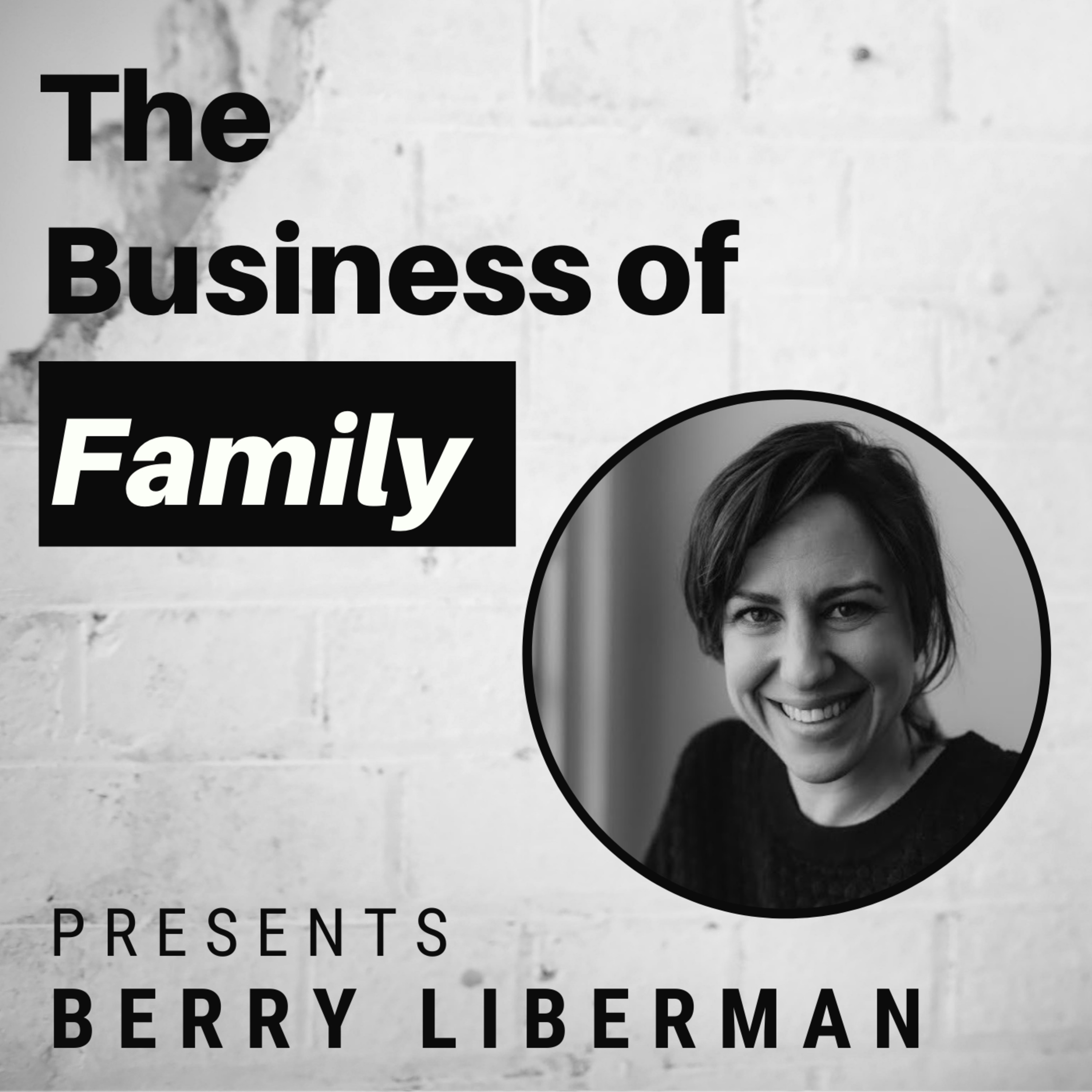
Episode 35 · Season 1
Using Financial Capital as Force For Good in the World
Key ideas from this conversation
She separated her assets from the family's slowly and with care, so everyone could still sit at her mother's Shabbat table.
At 14 she made a deal with her family: look after everything, and she would step up at 25. She spent the years between preparing.
Philanthropy as a whole-portfolio question: what is the entire balance sheet for, cash included?
Read the full show notesBio, standout quotes and the episode timeline
With one of the most recognisable family names in Australian business circles Berry Liberman is using her financial capital to make a positive impact in the world. Her family office, Small Giants, is 100% invested in Impact ventures - challenging the traditional notion of "do anything to make it and then give it all away" philanthropy.
Berry Liberman is the co-founder and Creative Director of Small Giants and the Publisher and Editor of Dumbo Feather magazine.
Small Giants was founded in 2007 to create, support, nurture and empower businesses that are contributing to the world in a meaningful way. Dumbo Feather is a labour of love. Designed, edited and printed in Melbourne, Australia, it is a quarterly journal highlighting the stories of extraordinary people, living lives of passion and commitment to changing the world we live in.
"We spent our first decade growing a collective of businesses committed to positive change, including Impact Investment Group, The Sociable Weaver, Dumbo Feather and The School of Life. Our focus has been moving capital from the old economy to the next. We’ve sought to prove that a business can be profitable while remaining purpose driven and ensuring value for all stakeholders, including the environment. Likewise, we’ve found time and time again that value can be created without investing in extractive industries."
Standout Quotes:
- "Family was Business, and Business was family, it was one thing" - [Berry]
- "Both my parents in a way saw work as service, you contributed to the society that you were lucky enough to live in" - [Berry]
- "When you go to your grave, you go with only one thing, and that's your name" - [Berry]
- "If you know your shadow self, there isn't anything that can take you by surprise " - [Berry]
- "I wanted to do big work, and I didn't want to be afraid, and I knew that the thing that scared me most was everything that was happening on the inside of me" - [Berry]
- "One of the things about family businesses is they're often a massive spaghetti ball, and all of the spaghetti is interwoven into all the other spaghetti and it's very hard to separate" - [Berry]
- "Business and Financial capital can be a force for good in the world" - [Berry]
- "We didn't have the language for it at the time but we had the intuition, that growth at any cost, that the extraction economy, was coming to an end" - [Berry]
- "Money in families is complicated, and Family Business is complicated, and it's never about the money, it's about the people and the relationships and the emotional maturity of those people" - [Berry]
- "We are the custodians, not of financial capital that is our entitlement, but the financial capital that is handed from one generation to the next, much like fresh air and fresh water, we are custodians" - [Berry]
- "Impact investing is a paradigm shift, it's not an asset class, and once you make that shift in your mind, you can't do anything but invest that way" - [Berry]
- "You are the company you keep" - [Berry]
- "I would tell them not to hate anyone, ever, and to love hard, I don't think you lose anything when you love" - [Berry]
Key Takeaways:
- In a true 'rags to riches' story of how the family clothing business began, Berry describes how her grandfather alongside the family, used to recycle the unsellable silk stockings discarded by a company, and eventually caused a shift in demand in his favor.
- Berry shares that she was raised perceiving business as fun, and something that involved the whole family. Unfortunately following the crash in 1991, the impact weighed equally upon the family.
- She narrates how she was able to forge her path outside the norm, because there was very little attention on her, especially following the passing of her father and ensuing family changes.
- As for her psychotherapy, It became clear there was a need to answer pertinent questions about herself and sort through unresolved issues personally. "I wanted to do big work, and I didn't want to be afraid, and I knew that the thing that scared me most was everything that was happening on the inside of me". She also disclosed that ultimately she wanted to be her own person but she didn't want to do it at the expense of family harmony.
- By the time Berry stepped in to join the family business, seeing how it was being run, she knew she wanted to do things differently.
- Narrating the events surrounding the inception of the company "Small Giants", Berry highlights the deep concern that was born following her knowledge of very critical climate issues, and this ignited a passion to create a better world for her kids to live in.
- It's an intergenerational project and the main goal is to become a good ancestor if you're a person of privilege and you have the resources.
- Much like with the financial capital that is handed from one generation to another in family businesses, we are also custodians of the fresh air and water handed down to us.
- Mike shares that the phrase "Stewardship" comes from environmental sustainability and so aptly applies in the context of this conversation.
- Berry explains that Philanthropy means "love of humankind" and in her view should be a whole portfolio vision; love of humankind with everything you have.
- "The Doughnut Economy" by Kate Raworth: This book describes a metaphor that likens the outer part of a doughnut to the bounds of the environment, and the inner part to society. Kate suggests living in the sweet spot between the bounds of ecology and human flourishing, such that you can engage in business but with more accountability built-in.
- The pillars of investments by Small Giants include Food and agriculture, Energy, Finance, and the Built environment.
- While Berry admits that little effort has been put into planning for the future as regards her kids being involved in the family office, she notes that doesn't want them to do Small Giants necessarily. She would rather they had the same freedom she had, to go on their journey, with full support to become themselves fully.
- Berry emphasizes the importance of talking to her children; "No topic is out of bounds, and I will let myself be challenged by my children because they've got a pretty good compass"
- Recent research shows that Kids that know where they come from, and particularly the trials and tribulations of prior generations, are usually resilient as a result.
- From Berry to her kids: "I would tell them not to hate anyone, ever, and to love hard, I don't think you lose anything when you love"
Episode Timeline:
- [00:50] About today's guest, Berry Liberman.
- [02:26] Berry describes her family origins.
- [09:03] What were the key building blocks along the path to the growth of the business empire?
- [14:56] Could you tell us where you started, and what you wanted to do with your wealth as regards the impact you wanted to have on the world?
- [25:33] Berry describes the structure at the family table when she stepped in.
- [38:54] What are some of the impact investments you have made?
- [41:51] How do we ensure there is a return so that we can keep on doing good?
- [47:32] Small Giants' Pillars of Investment
- [51:18] Do you anticipate your kids getting involved in the Small Giants family office?
- [56:46] Has the documentation of your family history been intentional so far?
- [59:46] A letter from Berry to her kids.
Links:
- Small Giants — Who We Are : Small Giants Academy is a storytelling platform and education institution dedicated to the transition to a more just and sustainable society.
- Dumbo Feather magazine : Berry Liberman is the the Publisher and Editor of Dumbo Feather magazine
- Skoll | Berry Liberman : Berry Liberman BIOGRAPHY
Read the transcript
This transcript was generated automatically and may contain errors, including in names. Listen to the episode for the exact words.
MikeWelcome to The Business of Family. I'm your host, Mike Boyd. Multigenerational wealth creation involves so much more than capital accumulation. The most successful families cultivate values, stories, knowledge and resources to pass on to the next generation, and they do it very intentionally. On this show I sit down with members of some of the world's most interesting business families to hear how they do it. To see where your own family stands, take the Business Family Diagnostic at businessoffamily.net.
Today's episode is incredibly fun and incredibly inspiring. I had the opportunity to sit down with Berry Liberman, a member of one of Australia's most prominent generational families, who has taken a different path from her family, a different path in life to try and have the greatest possible impact she can on the world. Berry Liberman is the co-founder and creative director of Small Giants, her family office, the publisher and editor of Dumbo Feather magazine, and a mum to three of the cutest kids in the world, she says. Small Giants was founded in 2007 to create, support, nurture, and empower businesses that are contributing to the world in a meaningful way. Dumbo Feather is a labour of love. Designed, edited, and printed in Melbourne, Australia, it is a quarterly journal
highlighting the stories of extraordinary people living lives of passion and commitment to changing the world we live in. Strap yourself in for an incredible conversation. You're going to love this story from Berry Liberman. Barry, thank you so much for being here on the show this week. I'm really looking forward to this chat.
BerryThanks, Mike. It's awesome to be chatting to you in Singapore and me in Melbourne. That's so fun.
MikeYeah, it is. It is. Now, the Liberman family name is quite well known within Australia in terms of wealthy families and prominence in terms of business and other endeavours. But your story, I think, is really interesting in the way that or the direction that you've taken your investing, your impact on the world. And I can't wait to explore this story.
But before we dive right into that, can you take us back to where it all began, where this story began, at least for the family in Australia and the origins of some of the family story, please?
BerryYeah, absolutely. Is one podcast enough? Yeah, so I think if I'm going to tell an amazing legacy story about family and history and place, I just want to acknowledge that I'm speaking to you from Boon Wurrung country, which is the home of the Kulin Nation in Australia, and I pay my respects to their elders past, present and emerging.
And I live with enormous gratitude that we get to live, work and play on this land. It's a very, very special country. And I know my grandparents felt the same. You know, they were survivors of the Holocaust, so my family are Jewish on both sides. On my mum's side, they arrived from Russia in the late 1800s to Carlton, Melbourne.
It's a classic Jewish community story. My grandmother was apparently born on the table, kitchen table in Carlton, and it was a thriving Jewish community here at that time. And my dad was born on the floor of a displaced persons camp after the Holocaust, so 1948, and his brother, Bari, was born 12 months before him. And it sort of blows my mind that after that kind of trauma and tragedy and collective trauma that they would rebuild their lives, but they did straight away and my family were lucky enough to get the boat to Melbourne, Australia.
And so, yeah, a pretty amazing story, very, very lucky. I know that for a lot of the Jewish community in Melbourne, it was as far away from Europe on the map that they could get, you know, and they didn't speak for language but they had a lot of gumption and pretty unbelievable entrepreneurial spirit. And it was actually my mum's dad who helped my dad's dad land in Melbourne and sort of, my mum's dad was a Melbourne lawyer who spoke Yiddish and he would meet a lot of the Jewish refugees coming off the boat in Melbourne and help them settle, find a place to live and set up a business and all that stuff. So that was quite an amazing coming together of them. And so
they'd known each other for many, many years. And my dad's family, the Liberman side, just have an incredible rags to riches story. My grandfather apparently used to wander the streets of Melbourne CBD. So they were in refugee housing, wherever that was. I can't actually remember where that was, which is shocking. I should know the details, but they were in housing all of the family together with these young babies.
And my grandfather would walk the streets of Melbourne Central Business District trying to familiarise himself with this new and foreign land. And he knew he wanted to be close to wherever the action was. So he went straight into Melbourne CBD and he used to smoke and walk apparently. And I think he and his brother had a burger stand, a hamburger stand.
So they would flip hamburgers. And in his spare time, he would wander the incredible cobblestone laneways like Flinders Lane and all those back streets of Melbourne, which at the time were manufacturing and hosiery and clothing manufacturing, which in Yiddish they call schmatters. So it was the schmatter trade. And my grandfather saw these bags of, bags, bags and bags of rubbish put outside the factories and he opened them up and they were full of silk stockings. And to him, he was a refugee. He was like, what is this amazing stuff doing in the bin? And they had a small nick or a tear or imperfection. And so they weren't good for sale on the shop floor. And my grandfather went to the foreman and he said, would you mind
if I took them home? It must have been very broken English. And he said, yeah, of course, wondering what this refugee wants to do with all this rubbish. And my grandfather used to take bags and bags home to my grandmother and the other women who they'd all come together as young kids from Poland. And the women sat on the floor and repaired the little nicks and the little holes and the ladders in the hosiery. And then my grandfather, before he would start flipping burgers, would be at the top of Collins Street as the secretaries poured in from wherever they were coming in from. And he would sell them the stockings as seconds for half the price of what
they had to buy new ones for. And for many of them, silk stockings were a week or two worth of wages. So they all looked for my grandfather to buy those seconds that had a slight something that they didn't mind about. And as the legend goes, one day my grandfather went to pick up those bags of stockings. He'd been doing this for some time and they were shredded. And what they realized was my grandfather had actually shifted the market and had caused some trouble to the traditional manufacturers and had shifted the pricing. But it was too late, of course, being who he was and who my grandparents were, he hadn't spent a single dime that he had earned in that time. And he'd
saved up enough to buy the machines to make the hosiery.
MikeOh, that's incredible.
BerryAnd so I was born my family's sort of first foray into business, which was clothing manufacturing.
MikeA truly rags to riches story. And I always love hearing refugees who come to new countries and create a life for themselves in what is the most extraordinary and difficult circumstances. So hats off to them. Thank you for sharing that story.
BerryIt's a cool story. And team effort, you know, it was a real family business from the first day and Australia wasn't, I know that my grandparents and their whole generation just couldn't believe how wonderful Australia was and they felt so lucky to be in this very new land to them. It wasn't like Europe with all its prejudices and class structures. This was a new place and for them, I think it just was hope.
MikeIt is the lucky country, that's for sure. So where does the story go from there as they get into clothing manufacturing? Obviously, the empire, if I can call it that, has grown substantially since then. So what were the key building blocks along the way that created each step change?
BerryYou know, there's the romantic version of that story, and then there's the other version.
MikeThen there's the real version.
BerryThose are true, you know, which I love about stories. I'm one of the youngest of the third generation. So if you count my dad as the second generation and my grandfather as the first, but it's not that straightforward. My dad and his brother then grew up as Melbourne boys. They were young enough that my grandfather wanted them to get an education. He didn't have one.
And both boys went to Melbourne High and then they had to go to uni and then they were allowed to come into the family business. And there was no other option for them, of course. And when they came into the business, the business expanded into other industries and other sectors. And And yeah, the family had extended into an extensive property portfolio.
And what's nice about that story is my grandfather owned many of the buildings in the CBD that when he was a younger man, he had walked those streets looking for his opportunity to make himself in the world. So it was pretty incredible. They built an incredible, diverse family business. And, you know, I also, I'm always really conscious to say that a part of my legacy, a big part of my legacy was fossil fuel.
We had a fossil fuel company, fossil fuels and plastics manufacturing and traditional banking. So that's the unromantic side of 20th century legacy from a business family. and my dad, my uncle and my grandfather, just family was business and business was family. It was one thing. They really weren't separate. And I often say that there should have been a place set at the table for the business because it was a character that we talked about all the time and it was a member of the family to me in my consciousness.
MikeSorry to jump in, but the business was family and the family was business. Is that shared in a positive light or a negative light or both? You know, is it just how it was?
BerryIt's just how it was. You know, my dad was inspired by his work. He loved working with family. There was no other concept of how you did business in my family. You did it together. It was to build the family's fortune together. It was all in one pot. It wasn't differentiated and you didn't have other choices, but at the same time it was fun, it was entrepreneurial, really creative, big picture thinking.
They were doing dynamic work around the world. I think it was a hugely creative endeavour and I was raised with a father who had an incredible work ethic, obviously, and my mum as well. My mum was working from when I was a baby and I think both my parents in a way saw work as service. you contributed to the society that you were lucky enough to live in and I think they felt that very much that reciprocity with Australia and that love of building industry and creating businesses and my dad loved walking the floor of the manufacturing hosiery business it just excited him and so yeah I think I was raised perceiving business as fun and deeply creative
but when the crash happened, which was 90, what was it? When was the big crash? There was one in...
Mike91?
BerryYeah, the one in 91. There was one in the 80s as well, but the one in 91 was brutal and I saw the flip side of all of that success, which is when the shit hits the fan and the thing that my grandfather used to do was make massive deals on a handshake. That was the other thing that I learned from my family business was back then relationships were everything.
And my dad said to me, I can't believe the things I remember from what he said to me, but he said to me, you know, when you go to your grave, you go with only one thing and that's your name. And it was an amazing thing to say because he died very young. Dad was 45 when he died and I was 14, which I think the stress of the crash and the pressure that he was under at that time caused that. And so I saw the cost of business done in that way, growth at any cost, go, go, go, you owe as much as you have, you know, to sort of, I guess that was a real reckoning for me to ask, what was the purpose of capital?
What was the purpose of business? And that cost was obviously too high in my eyes. and from the age of 14 to about 25 there was a big reckoning for me around those questions but yeah maybe you wanted to ask me something else.
MikeI want to ask you a hundred things but first I just want to acknowledge and say I'm incredibly sorry to hear of your loss that must have been unbelievably difficult and still difficult today but at such a sensitive age too I can't imagine. So it has shaped your worldview, not only the work ethic by the sounds of it, but also capital, as you said, and the types of endeavors that you ultimately came into the world passionate about and the contribution you wanted to make.
As you were telling the stories earlier about where your family has come from, in my mind, I was just constantly thinking, standing on the shoulders of giants. That phrase was right there for me. And ironically, your family office is called Small Giants. So can you tell us a little bit about Small Giants, if you're ready, but also where you started at maybe around the age of 25 and what you started to do with your wealth and the impact that you wanted to have in the world?
BerryWell, it's a fun story. I'm the youngest girl in my family and I grew up in a patriarchy. So that's the unromantic side of the story. girls had a certain role and boys had a different role. The boys went in the business and the girls cleaned up the dishes and served dinner on a Friday night. So it was a shock, I think, how well the girls all performed at school and then the uni and there was this sort of feminist reckoning. And being the youngest girl, in some ways, I was lucky because no one was watching.
I was the creative one and a bit off with the fairies and I was a daydreamer and I think that that gave me some space and time to develop who I was without pressure and from the age of 14 I said to my family, my brother and my sister and my mum, look I'd like to take some time to just do my thing. So if you can all take care of everything for me, when I'm ancient and 25, I'll step up to the plate. So I went to the College of the Arts and I became a filmmaker in Hollywood and I like worked on film sets and I just, I had a ball.
MikeLived the dream.
BerryI lived the dream. I worked really hard, but I wanted to be an artist and I wanted to be creative and to make things with my hands and to hang out with other artists.
MikeWas there any leadership, was there any role models within the family that had taken that path or was this very, very new for a business family that were largely focused on enterprise and you were off in this creative direction?
BerryYeah. I mean, most of the kids, I mean, none of us are kids anymore, but the kids in my generation, everyone was, they're pretty smart cookies and they all became lawyers. So everyone did law, law commerce, whatever it was. You did a combination of things that would just enable you to either work in the family business or whatever, do your own thing in business.
But like I said, no one was really watching. And after Dad died, the rules changed. Things really profoundly changed. And what also happened with my father's death was my grandfather got Alzheimer's as a result of the shock. So he was deteriorating already. but the shock of my father's death just sort of really he took it very hard and so in many ways what there was a day before dad died and there was life after and life after was just so different that I felt in some ways free no one was watching everyone I think was just in some ways surviving emotionally and my uncle was managing the family affairs in many ways on his own, which was,
it must have been an unbelievably challenging time for him. But I was a kid, you know, so I sort of got into my own world and I was allowed to. And yeah, it was an outlier, but like I said, no one was watching and I didn't care. And my mum, you know, I talk a lot about my dad and my grandfather, but my mum's a legend and she's a powerful force in my life and a role model.
And she's been my role model. Mum had a master's in fine arts and was an art curator and she was working on, she's a photographic book publisher. So she worked on some of the A Day in the Life series. And from that moment when dad died, mum was my main business role model. She was a powerful force in the art world and in the publishing world. And she was blazing her own trail. And I watched her just, she's an amazing, creative and visionary. So she was my role model.
And that was really, really lucky because mum used work as a way to express her feelings. And I got to see this kind of very constructive way of working, which wasn't in service to the business. It was in service to something more in service to almost community in a way, the way mum worked. And so, yeah, I went on that path and I did all of that. And at the ripe old age of 25, I stepped onto the family board, which was pretty funny. That was- Was that a bit of a shock?
It was a big turning point. Yeah, my film career was just starting to take off. And at the age of sort of 24, 25, it was this unbelievable turning point. I met my future husband, one thing, and he's a remarkable human being. That's Danny Almagor. He is an aerospace engineer. And when we got together, he decided to be the founder of Engineers Without Borders Australia.
So he started this humanitarian engineering not-for-profit. And I'd never met anyone like him. And he was talking to me about social justice and environmental justice and changing the world. And I'd never really come from a lens like that. I was a bit shocked. I was like, can you do that? Is that a thing we can do? Is that allowed?
Is that allowed? And he was just this amazing radical. I'd say almost a socialist radical, which is pretty funny that he ended up with me. I call it the great irony of his life. And I stepped on the family board. So I kind of inside of that relationship, I realized that I had to have a reckoning with my inheritance and the legacy that I'd been gifted with because it was actually a really big part of who I was and I couldn't ignore it and become an artist and pretend it didn't exist.
And at the same time, I began therapy. And so all those things happened at once, I think very much for an incredible reason and purpose. and the therapy was, I did psychoanalytic psychotherapy, which means I was on the couch three days a week for 15 years from that moment. And I treated it like the university of my soul.
I had to go deep and broad and wide and I had to go back into ancestry and legacy and I had to go forwards. Like who did I want to become? Who was I and who did I want to become? And those were deep questions I felt compelled by anyway. But once I stepped up to the plate in terms of the family business, there was so much in there that I needed to unpack. And yeah, what an amazing, rich time that was for me.
MikeIt must have been an incredible time of transformation, but it also would have been very, very difficult, I imagine.
BerryI don't know if it was difficult so much as it was time. There comes a moment in your life where you ready to take your life? There was a willingness.
MikeBoth hands.
BerryYeah. And in some ways, it was hard to leave my life in film. I definitely gave that up to turn towards all of this work. But in some ways, I knew I couldn't bifurcate my life. I couldn't pretend that one half of it didn't exist while I invested in the other. And yeah.
MikeWas it self-motivated in the beginning there when you wanted to reach out for therapy at the same time as coming back to the family board and coming back to Australia, I assume, as well. Was that sort of knowing that you needed to work through your past and where you've been and where you're going, or was that also with the support of family and saying, let's help Barry find her path as well?
BerryOh, no, not at all. It was very... I'd been working with some of the best people in the film industry in LA, and the people who were working on the films I admired the most, which were the meatiest, I thought the most profound films being made at the time, they were all advocates of working on your inner life because then you have the capacity to lead from a stronger place. It was very much based on the philosophical idea of know thyself and love thyself and then if you know your shadow self, there isn't anything that can take you by surprise. And when you've, I kind of, it's analogous to Lord of the Rings. When you've been in the swamp and the mud and the mire, and you've
been lost and you've gotten yourself out of that place, you've come to know yourself enough and you've skilled up enough that you can really, there's nowhere you can't go. You're strong enough because you know who you are. That's something I wanted for myself. And I knew that the work I was about to do by reckoning with my inheritance and the legacy of that, that was going to be really big work. And it was daunting. And I had no skills, no tools to do it. So for me, it was just skilling up. It was time for me to become a grownup. And that meant that I couldn't be afraid of my own shadow. And if I'm going to go into a boardroom with a whole lot of scary bankers and
family members, I needed something holding me up other than just gumption. I wanted to be a person, I wanted to do big work and I didn't want to be afraid. And I knew that the thing that scared me the most was everything that was happening on the inside of me, whatever stories I was telling myself.
MikeIt was incredibly powerful. Yeah.
BerryFelt like a worthy thing to do. And I had had it modelled for me by mentors of mine in Los Angeles whose work I admired. And I saw them working with, you know, 60 actors on set. And they had this power and this connection to some kind of resource inside themselves that was calming and very rich, fertile soil for other people to flourish.
Like it was a leadership that I saw modelled. And I thought, oh, my God, I want that, whatever that magic sauce is. But there's no way out but through on that stuff. So, yeah, therapy was my way through.
MikeVery powerful story. Thank you for sharing that. Tell me now, arriving at the family board table, with all of this ahead of you, but arriving at the family board table, what was that like? Was it a family business? Was it a family council with various holdings underneath? How was it structured at the time when you were sort of coming to the table for the first time at the age of 25?
BerryIt was pretty intimate still. We were in our old family offices. And by that time, the portfolio had changed so much. My siblings had been driving the design of that. And we had a CEO at the time. And we were doing like the business looked nothing like it did when dad was alive. And for me, it didn't resonate. The content of the portfolio didn't resonate. And the way that we were investing, I just didn't relate to the how of it. I didn't love the culture either in the office. I had changed so much and I'd done so much in the world that it felt to me like, and as I did more and more of my own work, it was really time to
differentiate and to be individual selves. So if there had been any nostalgia for me about being in business together, that was very quickly dispensed with because I just immediately knew, nah, I want to do my own things. I'm inspired by other stuff. Like kudos to my siblings who are legends and I'm grateful to them for what they held while I didn't. That was pretty unreal.
but what I knew by the time I stepped on there and I was listening to the conversations is I want to do this so differently.
MikeHow did that go? Was that about trying to shape the narrative, shape the conversation around the family board table to convince or inspire the family to head in another direction or was it about breaking away or hiving off a piece and saying, all right, well, here's my inheritance. I'm going to go and do my thing and you guys do your thing.
BerryEveryone would probably approach that really differently. Like anyone listening to me right now would, one of the things about family businesses is they're often a massive spaghetti bowl and all of the spaghetti is interwoven into all the other spaghetti and it's very hard to separate. That's a really big journey and a really big process because you're not only separating assets and companies, it's so complex, you know, and I'm talking 26 years later after my father passed where I am now.
So this is one of those, it's not an overnight story. This takes a huge amount of time. But I knew I wanted to do things. Danny and I definitely had started to design a vision. And what our vision was, we saw that business and financial capital could be a force for good in the world. And that we wanted, because when Danny was working at Engineers Without Borders, the One thing we identified was that the not-for-profit sector cannot fix the problems the economy creates.
If you've got a $53 trillion hole, you can't fill it with $100 million. The economic paradigm itself, and this became very apparent to us in the 2008 crash, where we were talking about a whole lot of things that were going on, and I said, the emperor has no clothes. How is this thing still running our world, the economy?
and the way that that paradigm and that beast has been understood. And, you know, my dad was a fan of Milton Friedman and he read Ayn Rand and he was all that stuff, you know, and bless him, he didn't live long enough to have the conversations with me that I would love to have with him today. You know, I'd wrestle him hard on all of that.
MikeI bet.
BerryBut we didn't have the language for it at the time, but we had the intuition that growth at any cost, that the extraction economy was coming to its end. And that for me as a legacy child who comes from fossil fuels inheritance, I wanted to turn that into renewables. To me, that was fun. That was creative. And I had no interest in the extraction economy like to me I was like clearly we're done with that everyone like I didn't understand why it was so slow and and people were jumping on board the the next economy ship you know yeah and I don't know if I'm answering your question am I answering your
Mikequestion though you were talking about you couldn't believe how everyone wasn't getting on board the uh the new ship
Berrywell I guess it hadn't really it hadn't the the next economy language we have now it was a nascent idea at the time. The game changer for us, you are asking me, because I want to answer the questions you're asking, because you're asking, I understand people are listening to this and wondering, well, how did she break free? How does she break free? It's a different answer for everyone. And the reason why, if we get back to why I did therapy, was because I wanted to ultimately be my own person, but I didn't want to do it at the expense of family harmony.
My mum had lost enough. And I know that money in families is complicated and family business is complicated. And it's never about the money. It's about the people and the relationships and the emotional maturity of those people. And every family is different. And I wanted to get from one word to another word. I wanted to get from disempowered to empowered. That's what I wanted. And I wanted to do that where we could all still go to my mum's for Friday night Shabbat dinner and sit around the table and break bread together. And Danny and I were absolutely on the same page. So with that in mind, that process took time and it was done compassionately.
And at times it was faster and at times it was slower, but there was 100% intention by the both of us that we would be separate and doing our own thing with our own lens and our own kind of mission within a certain amount of time. Like we were very focused on that. That was definitely going to happen, which was definitely hard for some family members. They didn't understand that. We don't come from that culture, but I saw it as a very healthy thing and something to work towards. And so while we began with advisors from my dad's generation and who knew my dad, old advisors, those advisors. So we're actually going to play and catch up with where
we were before, which is I was eight months pregnant with our first child and Dan was still at Engineers Without Borders and we went to see a documentary called An Inconvenient Truth and Al Gore predicted what would happen to our world. And I was bawling my eyes out. I was breathless. I started to panic. But to be honest, I didn't realise, despite being exposed to Engineers Without Borders and I knew about potable water and I knew so many things that were happening around the world. I didn't know the climate crisis was so dire. And that documentary scared the living shit out of me. And I was about to give birth to our first baby. And I said to
Danny, listen, I have to leave the cinema. I can't watch this. And he grabbed me by the hand as I was standing up and he said, sit down, we're going to watch this together. And when we get to the end, we're going to talk about what we're going to do about this wow that's powerful and i was like we're two little people what can we do about this this is bigger than us and that was the real day of reckoning where small giants was born because we said can we use all of our resources all of our financial capital our creative capital our intellectual capital our social capital, our love capital, can we live with all of those in service to the world we want to
leave our children? And that's when Small Giants was really born. And that has not changed for either of us as our deep commitment. And, you know, those were the days when I would hear about triple bottom line investing for impact investing was the term. You know, you can invest with a triple bottom line, people, planet, profit. I was like, all in favour say aye, I'm in, let's do it.
And I thought we had solved the problem of the world because if you follow any of the problems that we are facing, you have to follow the money. That's all the way upstream is the economy itself and the rules of the game are designed to destroy our living ecosystem, this incredible planet that is this random blue dot in the galaxy we get to live on that has the perfect conditions for life.
And yet we've designed an economic system that destroys community and destroys our living ecosystems. And could we use financial capital and business in service of life? And that's been the funnest, most creative ride ever. And that's what Small Giants was created for.
MikeAnd so you did. Amazing.
BerryNo, we didn't. There's no digital stuff. You know, what I realised is, you know, I would have loved to have fixed it. You know, that's a great fantasy. I just want to fix it. And what I realised is it's an intergenerational project. And the main goal is that if you're a person of privilege and if you have resources, the goal is to become a good ancestor.
MikeI love that.
BerryAnd to leave things not only better than you got them, because clearly we're all in a bit of a mess right now. And we have to rethink our systems. And we can't turn a blind eye. And privilege actually won't protect you going forward. With the destabilisation of our politics, with artificial intelligence and the world of tech being unregulated, unethical, new structures that are affecting collective consciousness.
and there are so many layers, not least of which is the biosphere itself, the planet, and the fact that we're now talking about who has fresh water, fresh air, arable land, stable climate. We were talking about it when we got on this call.
MikeYeah, we were.
BerryI just cannot think of a better thing for our economy to be in service to. And the old paradigm of growth at any cost, where there is hero worship of billionaires. I think that that day is done and we are in the middle of that reckoning. And to anyone listening to this podcast, if you're in family business, the fastest moving, most dynamic capital is family money, family offices. And we are living through the largest transfer of wealth in the history of humankind. It's in the trillions of dollars that hand over from one generation to the next. And we get to be the good ancestors of tomorrow. We are the custodians, not of financial capital that is our entitlement. The financial
capital that is handed from one generation to the next, much like fresh air and fresh water, we are custodians. And we are just a moment in time, in the arc of time. And what we gift our children is not money, but the conditions in which they live. And we're at a crossroads and we have a time limit now. And if you're not a big corporation, but you have a big bank balance, these are the things that should be considered now. And impact investing is the sort of blanket term for that kind of lens over your investing. And Danny and I are 100% impact investors so our entire portfolio has been for the last 12 years an impact portfolio and that
that's everything our cash everything and um we don't hedge you know i think you and i could have a big conversation around risk assessment because most people are like oh i'll sure i'm like totally up for it i'll do it you do it first yeah you lead the way and then i'll do it yeah we have a false a false calibration around risk. But anyway, we can talk more about that.
MikeI love all of the language that you're using from being a great ancestor to being custodians. We talk a lot on this podcast about stewardship and caring for something for a brief moment in time and hopefully passing it on in better condition to the next generation. And the phrase stewardship actually comes from environmental sustainability, sustainability of the land.
We just borrow the term to talk about generational assets, generational wealth, and other forms. So I love to see you weaving this together and adding a lot more color to the conversation and a lot more inspiration too. Can you tell me how you started Small Giants and then ultimately some of these initial investments, impact investments you have made?
I think it's staggering that you are 100% in impact investing. And I want to pull on that thread too. But what does it look like? what are some of these businesses? What are some of these investments for the benefit of the audience?
BerryI want to answer the second part first. So it's not staggering and I'll tell you why.
MikePlease.
BerryOnce you have the intention, your work is done. If your intention is to hedge, I'll do the foundation portfolio first in impact. But the main corpus of the family's wealth will keep it where it is because we're used to our dividends the way they are. And most people think impact is a discounted asset class, but it's not an asset class. And that's a really important distinction. Impact investing, call it what you will. I'm sure it's the wrong language for what it really is. Impact investing is a paradigm shift. It's not an asset class.
And once you make that shift in your mind, you can't do anything but invest that way. A friend of ours in the US gave us this term and it's harrowing, but true for most people. Most people have 95% of their portfolio invested in rape and pillage and 5% of their portfolio in what they call philanthropy, usually less, usually less than 1%.
But if the meaning of the word philanthropy is love of humankind, then you cannot call what you're doing philanthropy. You can call it that you sometimes give some of your money away. to me philanthropy as a concept should be whole portfolio vision love of humankind with everything you have and in that case there's no wiggle room ah but I'm just going to do a little bit of you know over here because it's a high yield I'm not trying to be purist I sound purist and I know that that probably sounds hardcore I'm pretty hardcore I am a bit of a pirate I think stakes are high enough that we can stop avoiding accountability on these issues. It's enough now.
MikeSo let me ask about sustainability. You know, if you're coming at it from this purist perspective and we're trying to...
BerryI'm not a purist. Oh my God, if we say purist, everyone's going to turn off the podcast. Keep listening. There's a journey. There's a journey. You know, the deeper you go, the deeper it is.
MikeSo in order to shock people awake into considering it from this perspective, which I think is incredibly inspiring. How do you ensure that the concept of philanthropy isn't just this idea of charity where I'm giving money away, but instead I'm making a difference in a sustainable way where I'm investing in impact investing, making a return, so I'm still here tomorrow to make an even bigger impact? Can you talk to me a little bit about that sustainability? How do we make sure there is a return so that we can keep on doing good and it's not just about gifting financial capital and giving it away in a charitable sense.
BerryYou have to do, first of all, a lot of therapy to understand the spaghetti of language you just used.
Mike15 years?
BerryYou just, yeah, like say 15 years. Well, for me, it was that, you know, there's shortcuts now, which is like this conversation, right? There isn't a distinction between gifting, there's a lot of power, power dynamics and unconscious biases and power dynamics in conceiving yourself as the keeper of the wealth who will sometimes dispense with some of it to people who impress you or things you don't care about. First of all, you have to care about something. So once you've articulated what you care about, and for me, my circle of care is quite broad now. The more I care about, the more I care about, the more I care about.
I think some people are afraid to care too much. So I'm just going to give anyone listening to this permission to care a lot about what's happening in our world right now. And then to say, don't worry so much about what you will lose. Because if you are good at business and you are good at investing, all you're doing is changing your lens. And that's what I mean by there's a inappropriate risk analysis. You can't externalize the risk to the biosphere, to our atmosphere. You can't externalize those things from your balance sheet.
It's unacceptable and it's not true. And with social instability ever increasing, I just think any portfolio that's not an impact lens portfolio in the next 10 years is going to be in trouble and it's less fun. I'm just going to say maybe lots of people listening to this would argue with me. So I think you have to dare to care a lot and to steer your portfolio in service to what you and your family care about. And families in business, it comes from care and love and custodianship and the idea of intergenerational wealth transfer.
We have to be talking about more than just money, inherently talking about more than just money. and I can say from the front lines I've done very well. There's not been a discount to my portfolio. In fact, we've outperformed the market because when you talk about the next economy, you're talking about all the emergent infrastructure like renewables. Fossil fuel now, those assets are stranded assets. They're being written off in the billions and trillions by banks around the world. Whereas the money that's going into renewables is exponential year on year. So I think that what we're really talking about is a very crunchy mindset that's lagging behind the reality of the moment. All you need to do is begin that first step towards asking the questions.
how can we become 100% impact? Not the philanthropic foundation money, the whole corpus, because that's where the power is, because that's where the damage happens.
MikeAnd that's where you can have the greatest influence.
BerryThat's where you can have the greatest impact and influence. And there's an amazing new metaphor that has been, it's really been great for us to have the metaphor. Kate Raworth is an Oxford economist and she talks about the donut economy and that's an amazing book to read if you're a big nerd and you love reading books on economics and when she talks about the donut economy she's she's asking this magnificent question that the donut the outside of the donut is the bounds of the environment the planetary limits and the inside of the donut is society so she's asking can we live in the sweet spot between the bounds of the ecology and towards human flourishing?
So the next economy is based on that premise, not an endless growth curve, which never shows the endless depletion curve upon which it depends, but a circular economy that has very different principles at play. So you can still be an entrepreneur, you can still have a growth portfolio, you can still do all the fun stuff that business enables, but without the dark side, with some accountability built in.
I don't know, maybe also everyone here would like to hear about B Corporation. Like one of the things is becoming, you are the company you keep. And so for us, we love the B Corporation movement. We were the first B Corp in Australia and we brought B Lab to Australia. Now there are, I think, 400 businesses in Australia and New Zealand that are B Corps.
And that's a network of businesses that are committed to these principles, ethical business, business as a force for good, and financial capital in service to the planet and community. It just like-
MikeMakes sense.
BerryMakes sense to me. I don't know. I don't want to hang out with Gordon Gekko. That's just not my jam.
MikeYeah. I don't blame you. I want to understand from a practical sense, how you've invested in an impact way. So my understanding is small giants has about 30-odd businesses or 30-odd investments under its umbrella. What are some of those, to give the audience a great example of the way in which you're using financial and other forms of capital to have the greatest impact?
BerryWe need a whiteboard, Mike. I want to show you on the whiteboard. Ask me a more direct question, the how. For example, it's a very deep philosophy, our investing philosophy, but we have pillars that we invest in. So maybe that's a really easy way to talk about it. We invest in food and ag, the circular economy, energy, finance, and the built environment. So those are our five pillars. And under that, go for your life. It's endless fun in there. So we've got a sustainable and affordable building company and we build 10, 9 and 8 star homes in Australia. We also do property finance for best in class sustainable office buildings. We also build renewables infrastructure and that's through
one of our finance arms. So that's in the energy sector. And then we have a big regenerative ag portfolio. So, you know, I'm really passionate about soil and water and food. And so across the board, we've either had to create the products or we've invested in other people's products like, yeah, everything from super funds to banking. So one of the things to know about our philosophy is we're not specialists. We like being across the different sectors because it's more funner.
And we're just, that suits our spontaneous creative personalities, Dan and I, and our team as well. We're just like interested in all the sectors and one sector crosses into the next sector. So one of our other businesses, which is just like so rad and exciting, is a seaweed bioremediation business. So we can clean wastewater.
MikeWow. Okay.
BerryWith seaweed. And I love nature-based solutions for carbon drawdown. That stuff really excites me because, of course, the planet itself, trees and seaweed and algae, was designed to stabilise the environment and to draw down carbon. So we should really be investing in these natural technologies to get us back to a temperate climate on Earth.
MikeAnd so what percentage of the portfolio would you say you had an entrepreneurial hand in creating or bringing to life? And what percentage are just investments made to back great technologies or great teams that are pursuing something?
BerryOh, my God, this is an entirely subjective answer. You're asking, I describe small giants as a feeling because I'm feeling based in my sort of approach to things. Oh, God, percentage. You know, actually, we're doing at the moment our impact report. And that's the first time we've done an impact report on small giants. We do it in our individual businesses.
We've got an impact VC business that have done a giant leap that did an amazing impact report and impact investment group, which is our financial services business. We've done a rad, inspiring impact report, but we've never done one for small giants because that's our family office, you know, and that's 15 years of doing stuff. but we're doing it now. So I'll be able to give you a non, not subjective answer to that question.
But what do I reckon it's been? It feels like it's been 60% direct investing and building product.
MikeIncredible.
BerryIt feels like that, but that could just be me exaggerating.
MikeBut you're in there, you're involved, hands are dirty and you're having fun.
BerryYeah, yeah, yeah. We either take a board position, a chair position, or we've got the business running out of our building in Melbourne. Yeah.
MikeI want to change tacks now, come back to the family structure, the family governance side of things. Now that yourself and Dan have taken your own approach, what does the future look like in terms of how you're structuring the family? Do you anticipate your kids getting involved in small giants as a family office? Do you anticipate them joining your own family board one day? Are those parts of your planning? Are the values cemented and discussed at the dinner table?
BerryIt's so interesting that you're asking that because I've been listening to your other podcasts. And as much as I'm the perfect example of why you should talk to your kids and prepare them and legacy plan as a family, I don't think I've done it with my own kids. that's not entirely true Dan Dan thinks about it a lot like we've done really amazing things like with our wills we wrote a letter to each one of the kids when they were little and and we should be updating those letters write them a letter a year probably but I'm a bit of a loose unit I'm not very good at process so I have to remember to do things and we're pretty busy and I forget
which is no excuse but I was really moved by some of your other podcasts hearing how beautifully and profoundly the families were handing not only values through intergenerationally but practicing it and having some structures but I'm an unstructured person by nature my poor kids so what I would say is that we Danny and I do family business the way I was raised in it which is it's part of our family and our family's part of it you know there's a deep values and deep beliefs. And I know my kids are getting that via osmosis, like I did. We have an organic farm and the kids work at the farm and they love that. You know, they understand that. There's a shop at the
farm and they work in the barn door selling the produce to customers and interfacing with them. And so that sort of is an amazing experience and a really gentle and beautiful way for them to understand, I guess, commerce and, well, the whole cycle really. To answer your question, you know, my eldest is 13 and it's starting, you know, I think we're starting to have that next level of conversations. But when, as, you know, dad died so tragically and so instantly, I don't take for granted a single day of this incredible privilege of being alive.
and I would just, I've listened to some of your podcasts and been in awe of the families that are brave enough to have conversations that empower the next generation. One of your podcasts, a gentleman was saying how they have a seven-year-old come to the family meetings and that really challenged me. I was like, yeah, why not have the seven-year-old? My youngest is eight.
that he's actually a really smart little unit, my youngest. He's amazing. It's got a really amazing lens on the world. And that's really made me take a pause. And I took some notes and I thought it's time for us to start having those empowering conversations with the kids because I don't want them to do small giants necessarily or anything. I want them to have the freedom to go on the journey I went on, free from all the structures and the expectations, but fully supported to become themselves fully. And that is challenging with strong parents and strong grandparents and like big personalities in the legacy chain.
MikeYeah, it is.
BerryBut that's okay. You've got to push up against something to become who you are. And I hope the kids feel loved enough at a deep enough place in them that they will take that opportunity and really go on their own journey. The hardest part for me as a Jewish mother is letting them, letting them do that. You know, I challenge myself to let them be free and to not micromanage their experience of the world. And suffering is a part of that. We have to, as parents, witness our kids suffer and work through it without trying to fix it because I know that dad's death was pivotal to me becoming who I am that the suffering of that made me the person I
am now I don't take anything for granted because of that and I would never wish on my children degree of suffering I don't know let's chat to you in 20 years and we'll see if I I got any of that right but but you know what I do do with the kids we talk to them yeah we talk to them nothing no topic is out of bounds and I will let myself be challenged by my children because they've got a pretty good compass and if they call me up on something they're usually pretty right and even though I might be cross in the moment at being called out by these little people I've worked on my ego enough to apologize and I feel like those sorts of things create
enough space and air for the next generation to become who they need to become.
MikeYou touched on briefly there, the legacy or the line that they come from and pushing up against that. Do your children have a great sense of the family story? And I guess the question I'm really asking is documenting the family story, keeping the storytelling alive and passed down from generation to generation. Is that something that's intentional?
BerryYou know, I'm looking through my study window right now and the reason the doorbell rang is because my mum and my stepdad have just brought Willow a massive bunch of flowers for her birthday and they're standing out there handing legacy to her in the moment and we're still a very close family and my mum always tells the kids stories. I think that's really powerful.
I'm a bit mortified to say I don't think I've shared much maybe it's just been in the hustle and the bustle of life and babies and businesses and and just like so into it and last night I was in bed with Willow and she was asking me questions and I just started talking and telling her stories and she's like you rarely tell stories from your childhood and so maybe it's an age thing but I feel like I should share more stories.
But no, there's no, I'm talking to you more than I probably tell the kids.
MikeThat's all right. Send them a copy of this.
BerryIt's pretty funny, isn't it? My sister is a really different personality to me. She's got photos all over her house and photo albums and meticulous in the years. And like I love going to her house because I remember everything when I go to, you know, she's the keeper of the memories. and there's always that person in any family.
How come you asked that question?
MikeIt's come up in so many conversations with these generational families and also some recent research that says that kids that know where they come from and particularly the trials and tribulations of prior generations, the kids are more resilient as a result because they understand what prior generations who are a part of them have been through and what they've overcome or how they've prospered.
And so I'm really big on this concept of story storytelling and family storytelling because it keeps showing up. As I keep talking to generational families, it just keeps coming up in lots of different ways. So now I ask about it.
BerryI love that. I don't know why. It just made me think like we had the lockdown in Melbourne, the 100-day lockdown. It was really, really severe. And we were actually out of Melbourne. We flew back into Melbourne for the lockdown. And one of the reasons that we came back for it was that I wanted the kids to experience solidarity. I wanted them to experience what I thought was an unbelievable moment in history. And it had a lot of suffering in it. I wanted them to participate in that because it was collective. It was a collective experience and just a taste of something their great grandparents knew very, very well. So anyway, that's interesting, but I like the idea of consciously sort of taking them through the story.
MikeIn time for our final question, if I can squeeze one more in, Barry. Imagine you're writing a letter to your children. What is one lesson or idea that you don't think many parents would mention, but you consider important to understand?
BerryI would tell them not to hate anyone ever and to love hard because I don't, yeah, I don't think you lose anything when you love.
MikeThank you, Barry. You are a giant. Thank you so much for sharing as you have. This has been a lot of fun. I've learned a lot and I so cherish the transparency with which you've shared it. It's been beautiful.
BerryThank you. Thanks, Mike.
MikeThanks for listening to The Business of Family. You'll find the transcript and key ideas from this conversation at businessoffamily.net, along with the Business Family Diagnostic. It's free, and it shows you where your own family stands. And if someone in your family should hear this episode, please send it to them too. I'm Mike Boyd. Until next time, take care.
Keep listening
If this one landed, start here next.
Olympic Medalist, G2 Family Office Founder, Social Entrepreneur & Owner of a WNBA Team
Another second-generation family office founder with a social purpose.
Separating the Family Conglomerate After 111 Years
Going separate ways in business while staying one family.
Using the Family Holding Company to invest in Education
Deciding what a family's capital is for, before the next generation arrives.
The Business Family Diagnostic · Purpose
What is a family's capital for?
Berry's family office answers it with the whole balance sheet. Could the adults in your family describe what the family's business and wealth are for, in similar words?
“In the last two years, we have talked as a family about what we want to be true in twenty years.”

Every family wishes someone had recorded the generation before.
I built Enduring Stories to do it for yours: a guided voice conversation, from home, that keeps your family's voices, values and history.
The newsletter
The most useful things in these conversations are the things families rarely say out loud.
I share them in my newsletter once a week. Sign up to receive the ideas directly and start building the foundations for your family today.