Episode 47 · Season 2
Separating the Family Conglomerate After 111 Years
Key ideas from this conversation
A family council doesn't guarantee anything. Trust, full transparency and being just and fair have to come first.
Unanimous consent felt safe, and meant the group couldn't move when opportunities came. Every owner needs a way out.
No free rides for the next generation: years of work outside, a job won on your own, then an application to a competency board.
Read the full show notesBio, standout quotes and the episode timeline
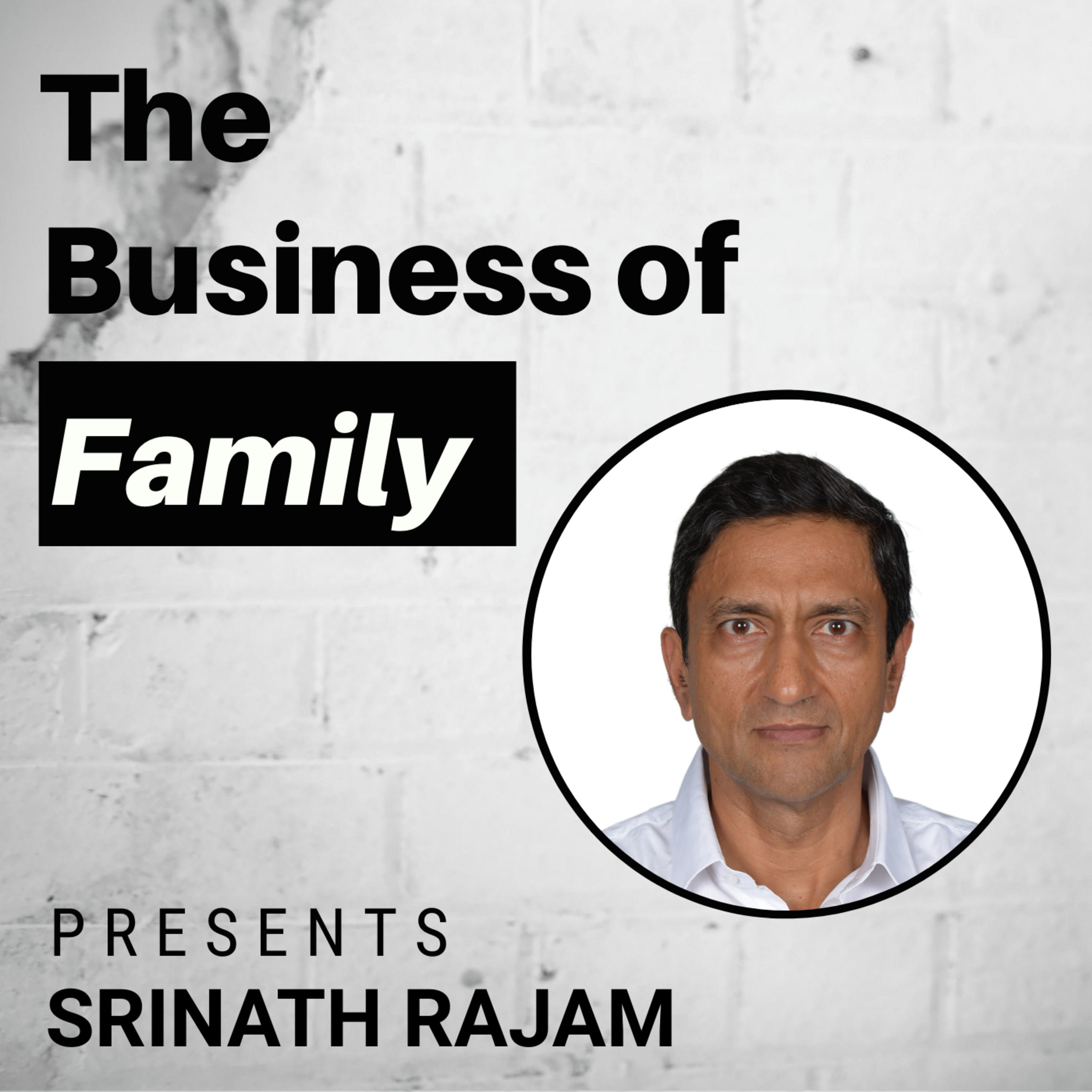
Srinath Rajam is a Director at TVS & Sons, Chairman at Kwik Patch, and one of the four sons of the high profile TVS group of companies. The TVS Group is a long-standing family business, running for over 110 years, which has interests in everything from auto components through to finance. Now after over a century in business, the TVS group has decided to amicably separate. Srinath talks about this historical event and how by keeping it amicable, it sets the stage for the next phase of growth.
Standout Quotes:
- "The process of how you manage a company is not taught anywhere; the process for how you manage people is not taught anywhere so these are things you need to learn by watching" - [Srinath]
- "Unless all of us are good human beings, we cannot work in a group" - [Srinath]
- "If the family is not in one piece... the businesses are going to fall apart" - [Srinath]
- "I don't worry about control, I worry about what's best for the business" - [Srinath]
Key Takeaways:
- Srinath is a 4th generation member of the TVS and Sons Family. He talks about a historic date when the family will finally be breaking up the company and separating after 111 years. Unlike many families which split with resentment and animosity, this breakup is rather amicable which sets the stage for growth in the next phase.
- The seeds for the separation started in 1974, although from the onset, at a point when the Founder of the company had his influence waning as a patriarch, there was already a lot of mistrust. It was in 1974 that it became clear that there was no future for the company to continue as one large family which is now manifesting.
- Over the 48 years since the first conversation was had about splitting up, the company has lost opportunities to advance in IT, however, they were able to structure the core competence of the existing companies.
- The first phase was in 1927 when the company became the dealer for GM in South India. The next phase was automotive component manufacturing which continues to be the most profitable aspect of the business. The third phase is a two-wheeler operation, which is the largest and most valuable company. Most recently, the supply chain has also been racked up, which is the TVS Supply Chain.
- About the two-wheeler operation: in 1972, as a young teenager, Srinath had discovered what looked like an electric bicycle which his grand-uncle was creating as a cheap way for people to move around. The engineers had said it would not be possible, but he invested energy, time, and money in it based on his conviction. By 1978, he passed on 10 days before the company was opened. The group was also into all sorts of automotive industries.
- The strategy for the separation was that whoever is managing will continue to look after business till the separation, then the valuation was done in 2014, and the difference would be settled in cash. The Indian legal system encourages families to have such a business understanding, which was not initially accepted by all 64 shareholders but with persuasion, they agreed to implement it. The company also has very strict requirements regarding competence and experience to join in the business such that family members are not guaranteed an automatic seat.
- Some of these requirements for joining the family business include Graduation from an Ivy League school, a minimum of 3 years of work experience outside the family business with no help getting the job. These and more only qualify members to apply, after which a competency board will assign a mentor who looks after the possible future leaders, and then they can grow from there. These new family members entering into the business start with a small responsibility like one of the smaller subsidiaries and are mandated to only report to a professional, not their parents.
- Based on these requirements, most family members are only qualified to apply by their early 30s, which is beneficial for the company because emotional maturity is also critical.
- Although G4 wasn't particularly groomed for management, they intend to identify those things they lacked and make them available for G5. Since the process of managing companies or people is not taught anywhere, G5 has to be properly introduced by participating as observers in top review meetings. Most of the methods and practices being implemented to groom G5 are ideas from John Ward.
- Even though many families apply all sorts of family governance structures, not many are successful, meaning those structures do not guarantee anything. The question is "How do you make this work?". The first requirement is trust; without trust, none of these things can work. Next is transparency, and the third is to be Just and Fair. People working together must be good people who like being around each other. Additionally, fairness, compassion, and carrying people along, have been more efficient than any of these structures.
- To address the issue of power grabbing in the 60s, a change in the business system was made such that no decision can be made without the unanimous consent of the members present. It protected the person managing the subsidiary such that they could not be fired easily but the bureaucracy at the same time restricted opportunities for risk and growth. Hence the success of the group depended on the competence and ambition of the people running each company. However, while the trust was lost and growth was delayed, the companies held on better to funds for reinvestment which promoted overall growth. This however created problems and resentment from the shareholders.
- When John Ward came along, he increased the dividends to the non-working shareholders from 10 to 25%. Dividend taxes were also removed from the income. His approach was to make the family happy knowing that most of their problems could be addressed with cash. Some of the dividends were also used to take care of the educational needs of non-working shareholders.
- The family has about 80 shareholders, and after the break-up, things will fragment, and there will not be the usual large family get-togethers. Nonetheless, there will still be some rearrangement because some of these small businesses will come together to work to be more efficient. The strength of emotional bonds will also determine the interaction between these subsidiaries in the future.
- Unlike the previous structure of the large family where there was no exit clause, Srinath's family business will have one for the shareholders. The company will also take advantage of the newfound freedom from the bureaucracy of unanimous decisions, to take risks and opportunities to grow.
- In Srinath's family enterprise now, G4 members are only allowed to pass the shares to the linear descendants. Spouses, sons-in-law, and other members cannot enter the family business. This doesn't necessarily guarantee any birthright for the G5; some G4 members have donated all their shares to charity. The G5 is guaranteed to get no more than a decent standard of living and good education.
- When it comes to lineage, no differentiation is made between sons and daughters, it is simply a factor of competence. TVS has a balance between business and compassion, rather than overly tilting in any direction.
- Unfortunately, the larger family has never compiled books, photographs, or formally tried to document the family history; this has been a huge disappointment. However, Srinath's uncles tell him not to worry about the past, but to focus on what he can now do in the future.
- The logistics business was a brainchild of Srinath's cousin, Danesh, and started 10 years ago. The business supplies anything anywhere and unlike FedEx, they can design something and assemble it at the destination. The Rajam family only is entitled to the IPO; they are buying out the shareholding of everyone else.
- One of the most important things to imbibe is to be fair and just, whether at work or in personal relationships. It goes a long way to make people trust you and builds the energy of people around you.
- From Srinath to his children: Firstly, be fair and just, be a good person. Secondly, you must add value to the community; do not chase wealth, chase the creation of jobs. Be a positive person always.
Episode Timeline:
- [00:46] Meet today's guest, Srinath Rajam.
- [02:29] What led to this amicable speciation agreement?
- [05:50] What are the main pillars that have made up the conglomerate over the last 100 years?
- [07:58] About the two-wheeler operation.
- [13:46] How have you decided where and how to draw the lines in separating this conglomerate?
- [16:38] What are the requirements for family members to join the business?
- [19:52] Are there comparisons between the success or failure of G4 and that of G5?
- [21:26] Where did the inspiration for this approach towards onboarding come from?
- [23:26] What formal family governance structures do you have in place?
- [26:28] What method hasn't worked well in keeping the family together?
- [33:56] How big was the wider family assembly?
- [37:46] After the split up, will you carry on the current family structures to your Family Enterprise?
- [40:34] How do succession and shareholding occur in your new family enterprise?
- [42:36] How do you view lineage in terms of sons and daughters?
- [45:47] After the separation, how does the thread of family history and storytelling continue?
- [49:18] Discussing the family logistics business.
- [54:36] From Srinath to his children.
Links:
- kwikpatch.com | India : Srinath Rajam is the Chairman and CEO of Kwik Patch (a JV with MYERS Industries, USA) and Director in TVS Mobility .
Read the transcript
This transcript was generated automatically and may contain errors, including in names. Listen to the episode for the exact words.
MikeWelcome to The Business of Family. I'm your host, Mike Boyd. Multigenerational wealth creation involves so much more than capital accumulation. The most successful families cultivate values, stories, knowledge and resources to pass on to the next generation, and they do it very intentionally. On this show I sit down with members of some of the world's most interesting business families to hear how they do it. To see where your own family stands, take the Business Family Diagnostic at businessoffamily.net.
This week, we are spoiled to enjoy the conversation with Srinath Rajam, a fifth generation member of the TVS and Sons family, an enormous Indian conglomerate. He speaks to us today on what is actually a momentous and quite historic date for the firm in that it is the separation date when the family is breaking it up into pieces and separating after 111 years.
This is an incredible story. I hope you enjoy it as much as I did. Srinath, it's wonderful to have you with us on the podcast this week. Thank you again for making time. I know today is a significant date for you.
SrinathYes, it is. Actually, it is the end of the 111-year-old TVS group. TVS was founded in 1911. And today is the day when all the final settlements are being made.
Miketruly a momentous occasion. And, you know, I think we really picked a fabulous day to actually have this chat.
SrinathSo 100, 111 years old, 9 billion USD, 101 plus companies, global. And to end on a wonderful note, because I would like to say that many families split in a very acrimonious way, but we had one of the most amicable, friendly settlements, which really sets the stage for growth in the next phase, which I think will happen.
So we are smaller groups, but I'm sure we'll be far more vibrant, flexible, nimble. And I think the future is going to be even better.
MikeSo this is amazing. You're a fourth generation family member within the TVS group of companies. What led to this amicable separation agreement, which you are finalizing today? I mean, that's quite historic after 111 years to decide to split it up and separate. Why do that in the first place? And then I want to hear about how you've managed to do it amicably.
I think it's just wonderful.
SrinathHow we plan to do it amicably, really no one knows. But let's just say that we are blessed. The seeds for the separation started off in 74, right? When the company was actually founded in 1930, I mean, it was founded, Rajam, my grandfather, was the eldest son. TVS was the founder. And he was a wonderful, wonderful patriarch and also acted as the chairman of the group and the patriarch of the family.
Now, in the South Indian context, and this is true pretty much anywhere in the world, families need a patriarch. patriarch. They need a leader that everybody can actually look up to. When his influence began to wane, and we are actually a business family, right? When his influence began to wane, the seeds of mistrust were sown. Power grabbing started. So I'd say in 74 is when we all knew, not me, but the elders knew that there is no future left in working as a group.
Because when there's no trust, forget about risk appetite, forget about value add, forget about breaking free from the golden cage. These are all two, three, and four. But when the trust factor goes away, that's when it's time to actually separate. And the siege of that was sown in 74. and the first formal discussion was actually held in 76.
So it took us, let's say, 45 years to actually get it done.
MikeWell, in the scheme of things, it's pretty quick given that you've been around 111 years. So I was going to say that that initial seed was sown 48 years ago and today is the separation date. I mean, that's quite incredible that you've managed to stay together successfully for so long, even though the seeds were sown in 74 or 76.
You've managed to operate successfully for another 45 odd years before ultimately reaching this conclusion today.
SrinathYes. Along the way, we missed a lot of great opportunities, especially in the IT sector, telecom, because the structure was not nimble enough to move fast and take big risks. However, on the flip side, We were forced to concentrate on what were the existing companies and build them. So there's always a flip side to it. So we might not have created an awesome amount of wealth, but the companies that we had, we stuck to the core competence and made them stronger and made them world-class players.
So there's always a plus and minus to both sides.
MikeAnd when you say the core competence, these core businesses, can you elaborate for us what they were? So for those not familiar with TVS, I mean, it's an enormous conglomerate, but what are the main pillars that have made up the conglomerate over the last 100 years?
SrinathOkay, the first breakthrough came in 1927 when my grandfather, grandfather T.S. Rajam, persuaded GM that we should be the dealers for GM in South India, which is at that time Chevy, Buick, Cadillac. I think these were the three brands. Leyland came in later, and that was the start of the dealerships, and it still is one of the largest operations.
The second phase came in terms of manufacturing, led by the fourth son, T.S. Srinivasan, an absolute genius. And I will later on tell you the story of how the two-wheeler operation started. But he was the one who started automotive component manufacturers. The major companies today, LucasTVS, Sundaram Clayton, Brakes India, Sundaram Fasteners, Wheels India, were all started over a 10-year period between 1960 to 1967-68.
These companies still continue to be the most profitable companies in the group. And clearly, manufacturing is one of our strengths. The next phase after that came in 1978, which is the two-wheeler operation. And that's a fabulous story, which I will talk about later. Today, the largest and most valuable company, TVS Motors. And lately, we have ramped up the supply chain, TVS Supply Chain, which is also a group of 75 companies globally in the supply chain and logistics going for an IPO in June.
Big IPO, one of the biggest that the Indian stock market has seen.
MikeThat's incredible. And I bet you've got some interesting stories about supply chain and logistics from the past two years during the pandemic as well. I imagine it's been a challenging space and now to be leading into an IPO. That's a great story.
SrinathLet me just give you a wonderful story about the two-wheeler operation. And in fact, I was the only one to actually experience this. This was way back in 1972. The first phase was over, right? Manufacturing was over. Now the second phase. And like I said, the late Mr. T.S. Srinivasan, my grand uncle, absolute genius. So now the second phase was actually rolled out.
So in 72, I walked into his house. I was in school then, right? I was in school. I went up to the table out there and I saw something which looked like an electric bicycle. And I asked him, I said, you know, what's this? He said, that's a moped. I said, what is a moped? And he said, that's a Dutch company called Batavus.
And I'm going to make it here in India. I said, what for? Right? He said, have you seen the number of people in India waiting at bus stops? I said, yes. How will they move? They need a cheap way to move. And I said, okay. And I said, but in India, we need to make it where the husband will drive, the kid will stand up in the front, and the wife sits at the back.
So I need to really make sure this works. and also it has to go up 3%, 3% gradient. I really thought the man was completely, you know, local. No market survey, no research, nothing. Just the strength of his conviction. A year later, the best, I mean, the best engineers were actually put together. A team was formed. They went out, they came back and they said, this is, sir, we just cannot do this.
We can't make it twin, you know, twin seater, go up the, you know, go up the gradient, this fuel efficiency. And like many others have done in the past, he said, sorry, it can be done. And you are the guys who are going to do it. In 1978, 10 days before the factory was to be inaugurated. Okay.
At that time, he bought 200 acres of land. the investment, 200 acres of land, the investment in this operation was equal to four years of cash flow. Now, think about that, right? Four years of cash flow was invested in this operation. That is what you call a true entrepreneur. No market survey, just pure guts and conviction. 10 days before he died, okay, before the factory was inaugurated, he actually passed away.
And the mantle passed on to his 27-year-old son, who had just come back from the U.S., just about a year's experience, my uncle, Venu Srinivasan. At that time, Venu managed a company with just over 1.5 million U.S. dollars. 1.5 million US dollars in 78 was the top line of the companies Venu managed, just that company. Because at that time, we were all isolated, right?
By 78, everybody was split. Good management, a combination of luck, of course, right? We all need that. But you need to have good skills. Today, Venu's family alone is probably worth 4, 5 billion US dollars. And the top line exceeds $3 billion. It's a global operation today.
MikeThat's incredible. And how many two-wheelers would you manufacture in, say, an annual period today?
SrinathI think globally, if you look at the factories that they have in India, they have, I think, two, they have in Nigeria, Indonesia, now Norton also, and now they're looking at South America, I would say something like about 400,000, 500,000 a month, something like that. India is the second largest two-wheeler manufacturer in the world, probably the largest, I think.
But the Japanese consider India to be competition, that's it.
MikeAnd you started the story by saying that you walked in and saw this, what looked like an electric bicycle. I'm curious, fast forward 50 odd years, are you developing electric two-wheelers again or did they ultimately become petrol engines?
SrinathWe have the complete range of scooters, mopeds, motorcycles. In the last six months, we have made two acquisitions in Europe of bicycles with an e-motor, premium brands. Okay. So you might want to say, you know, back to where we actually started. But it's a strategy of TVS Motors to really go after the premier brands, Swiss brands. So that's what we're trying to do.
MikeSo that's obviously a huge business within the group, but the group is also in tires and brakes and all sorts of automotive industries. Is that right?
SrinathCorrect. It was. Let's remember, we are not a group as of today. So it was, right?
MikeAnd this leads to my next question. You're talking separation, right? Separation is today. The group amicably separates today. But it doesn't sound like you're exiting the group. You're not separating by liquidating everything and everyone's taking a share of cash. You must be breaking up the business units somehow, are you? Is your family retaining a certain number of the business units or a certain sub-industry within automotive?
How have you decided where and how to draw the lines in separating this conglomerate?
SrinathGood question. In 76, we said, whoever is managing will continue to look after the business until we actually separate. So it was done on the lines of management. So when we actually worked out the valuation of each of the companies in 2014 or 2015, we took that value. And if it was plus or minus for each part, we just settled in terms of cash.
So the final cash settlement is happening right now, February 4th. So that's how we actually split. So whatever was the 2014 valuation is what we work with, right? Now, the Indian law, the Indian legal system, the Indian taxation, allows and encourages families to have this kind of a business understanding. So it is what you'd call a business rearrangement. And the other part is that 100% of the shareholders of the main parent company have all agreed, which is another incredible
Mike100% completely amicable.
SrinathTotally. Well, indeed, I mean, a few needed to be, yeah, a few needed to be persuaded, but that's our style. We cannot ramrod family. One needs to be patient. One needs to, you know, work with them slowly, you know, take them along, carry them along. And that's what we did.
MikeSo quantify that for me, please. How many individual shareholders are we talking about across the wider family group? I mean, it's 111 years old. There must be a number.
Srinath64, including that's five generations.
MikeSo your G4 and the fifth generation is already participating in the businesses or about to come in?
SrinathYes. The G5 Rajam, we have three already working. There are eight G5. Five have not qualified or have clearly said they are not interested. The three are working now. One more is likely to join, but that's about it. I don't see anything more than four because we have some very strict competence and experience guidelines which John Ward actually gave us. So we have to stick to those. We just cannot allow somebody to walk in just because he's my niece or daughter or son.
MikeThis is getting into an area that I love to explore. So as a family, it sounds like you've set some criteria in place in terms of the emerging generation, the next generation coming through in terms of the criteria they need to meet before they can join the family business.
Srinath100%.
MikeWhat does that entail? Are you talking, you know, educated overseas, experience elsewhere, you know, a certain number of years experience or something else entirely?
SrinathAll of the above. You have to start with top undergrad and grad school. Ivy League types would certainly help. You need to have five years, minimum of three years, but preferably five years work experience outside the business. You need to get the job on your own with no help. You need to be sure you have at least a couple of promotions.
and once all these have been satisfied, you can then apply. It's not an automatic walkthrough. You can apply. Then we have a professional competency board which looks after the top tier, the top one, two, and three tiers, leaders, future leaders. So you can join that and then you are assigned a mentor and then you go on from there.
You're not given the top slot straight away. It takes at least about, the longest G5 is now run about three years. So since we have so many subsidiaries, we slowly start by giving them responsibility for one of the smaller ones, right? P&M responsibility. We always assign and attach a mentor and a good advisory board. These are essential.
And they will not report to the parent.
MikeOh, wonderful. So you've got a support structure around them to sort of shepherd them through and mentor them through their own development. But there's no free rides by the sound of it. They have to ultimately report to someone else in the family or perhaps some other managerial line. And they have to have quite a bit of external experience before even applying.
SrinathThey have to report to a professional, right? Day to day, they have to report to non-family person.
MikeYeah, that's fantastic. And so translating that into the time period, a great undergrad, a great postgrad, three to five years working experience elsewhere, promotions, all of those things, you're not really entering the family business until about the age of 30, early 30, something like that. Does that sound right?
SrinathLate 20s, early 30s. About 30, yes. because we assign a lot of importance, Mike, to emotional maturity also. And that takes a while because if you're going to be walking in at 30, within three, four years, you're going to be dealing with people who are 40, 50, 55, 60. So you need to, at 25, 28, you're hot-headed, right?
You need to give it a little time. So we feel that around 30 is good. Some people faster, some people slower. But let's be clear, we are doing this for the first time. G4 was not really meant off, right? So we are doing this for the first time.
MikeYeah, G4 was not. And how did that work? I mean, are there interesting comparisons that you can make between the success or failure, if I can use that word, of G4 versus what you're putting in place for G5? I mean, has this come about because you struggled to onboard G4 correctly? Or is this just a level of developing, maturing, and a level of sophistication as the business and the family has grown?
SrinathVery simple, Mike. The mistakes we made as G4 and whatever we did not have as G4, we are giving G5. Everything which I said right now, right? Mentor, reporting, board of supervisory board, reviews, competency boards, feedback, everything which we didn't have. We were just thrown into the deep end. We were taught nothing. The process of management is critical.
The process of how you manage a company is not taught anywhere. The process of how you manage people is not taught anywhere. So these are things that you need to learn by watching and observing and participating. So we invite G5 to sit in, even on board meetings. They sit in at the back quietly. They can't talk. They make notes and they see what's happening.
They participate in top-level review meetings. So it's a part. It's something which we never had. So that's exactly what we're doing.
MikeAnd tell me where all of this came from. It's phenomenal. I love that you've taken this approach, but where did the inspiration for this come from? I think you mentioned that you've had some help from John Ward from Kellogg in the past. Did he help set you on a path in terms of formal family governance that included how to onboard G5 or has it developed over time?
SrinathI would say 80% of what we're doing right now is due to John Ward and John Ward only. I mean, he was absolutely phenomenal. See, the beauty about John is that he comes across with what I call implementable ideas. Consultants come along with these things that you just absolutely cannot do. But John Ward, he understands family so well.
And he worked across the globe. I think he retired about 10 years ago at least. and John Ward has been singularly responsible for whatever we are doing at this point in time and we are eternally grateful to John. One of John Ward's prodigies, I mean, if I may use the word, Kelly LeCouvie works with us now. Kelly is based out of Toronto, I think, and Kelly is also fabulous.
She works with us on the family side, family councils, all that stuff, shareholders agreements, the family side. Kelly is also really good. And we just took a pause now because we had to get the partition done, but we'll be back to work with us. She worked with us for two years and she's also working with a couple of other family branches, do the same thing.
MikeThat's amazing. And very high praise by the sounds of it. So I'm sure there's some people in the audience listening to this now who are jotting some notes there that could benefit from this in their family group.
SrinathOh, absolutely.
MikeYou mentioned some of the formal structure that you have, family council is in place. What other things have they helped you implement that have led you successfully to G5?
SrinathG5 specifically?
MikeSorry, I'd love to learn more about the formal family governance structures that you have in place. So you have a family council, a family constitution, or a charter, I'm assuming. You've got some rules around who can work in the business and what experience they have to have before they can join. What does that look like? What other documents or procedures have you developed over time that have served you well?
SrinathOkay. All of what you mentioned, Mike, But let me add this. Whatever you said, you can go to the net, you can get all the information which you have on the net. There are many families who have all this family, councils, governance structures, all this stuff. They have moderators who come in and help them out, etc. But yet, how many of them really are successful? Not many.
So this does not guarantee anything. Having a family council in place does not guarantee anything. So let's take a step back and say, okay, how do you make this work? I think that's a cord that one needs to crack, right? So right from the start, the first thing has to be trust, right? Without trust, none of the stuff will work.
Second, you have to be very clear that there has to be 100% transparency. That has to be there. Third and probably the most important is to be just and fair. If you're not a good person, if you're not just and fair, nothing will work, right? You have to be just and fair. So unless all of us are good human beings, we cannot work in a group.
When you sit down across the table, you must want to, you must be happy to be there. You must like the person whom you're seeing. So without this trust, so we work a lot, not so much on family councils and all these strict stuff. Okay, let's say you have that. And I say, no. What are you going to do?
You can't force me or anybody else to do anything. So you need a lot of trust. You need to be just. You need to be fair. You need a large dose of compassion. You need to carry people along. These are trades which are far more important than looking at rigid shareholders' agreements, rigid structures, and this is the way it's going to work, and this is the way it's not going to work.
Nobody wants that. Nobody's going to go by that. So we work a lot on these things. We've always done that. And that's one of the reasons why we've stayed as one family for 111 years.
MikeCan I ask what hasn't worked well?
SrinathWhat hasn't worked well? let's take two things, business side and the family side. Business side, which did not work well, was power grabbing, which took place in the late 60s. That was the seeds of mistrust. As a result of that, the holding company structure was changed where no decision can be made without the unanimous consent of all the members present.
Now, what that did was it protected the person managing a subsidiary or a group company. He could not be fired. He or she could not be fired. At the same time, we could not take risks. So the success of the group depended on the competence and the personal ambition of the people running each of the individual companies.
Incredibly, they all did well. But incredibly, 99% of them did well. But it completely destroyed the trust and it completely prevented us from taking risks. We would have been twice the size.
MikeIt added a level of bureaucracy.
SrinathYes. For example, Suzuki came to India in 81. The total sales of cars in India at that time was like 30,000 cars a year or something, 40,000 cars a year. I mean, some diddly number. And they said they're going to make 100,000 cars a month, not 30,000 cars a year or 50,000, 100,000 a month. They came down and they said, TVS, you guys are superb.
We want you to move and set up automotive competent manufacturing next to us in Delhi. Okay, close to that. Guess what happened? We didn't go because we just couldn't go. We just couldn't move. It was what you call gridlock. Now think about that, right? We would have been not 8 billion. We would have been 25 billion or something right now.
So that's a great opportunity missed. Huge. This is one. We missed the IT boom. We missed the telecom boom because each individual company just did not have the resources to take the risks. But as a group, we could have easily done that. So we missed some massive, you know, we could have been thrice the size. Now, on the flip side, what was not good for the family was each group company was holding cash.
And why not? Because they knew if they send the cash up in the form of dividends, it would never come back. They knew that if they send the cash up…
MikeThey'd have to fight to have their own funds back to reinvest.
SrinathExactly. They knew that if they send the cash out, there is no chance of asking anybody for help. It's each man on his own. Now, that made companies stronger. That lowered the level of debt. So there's a flip side to both, right? Focus on what you do best, but you missed some fabulous growth opportunities. And it did not take care of the shareholders.
The non-working shareholders were shafted. And that caused a lot of resentment for a long time until John Ward came along.
MikeHow did he, I mean, I'm sure it's a very long, you know, there's lots of things he did, but was there something that he did there to help resolve that, particularly for the non-working shareholders?
SrinathTwo things. One was, he said, look, you've got to look after members of the family, particularly the non-working shareholders. So our payout ratio up until then was about 10%. He increased that to 25% minimum. And he said, you want to pay more, that's up to you. So straight away, right, our dividends went up two and a half times, right, from 10 to 25%, which is huge.
The taxation in the early 90s and the mid-90s, dividends was taxed at the normal rate of income tax, which is not fair. Dividend tax was actually removed. So pretty much overnight, our incomes went up 10 times. Not two times or three times, 10 times. Now that made everybody happy.
MikeHard for a family member to complain.
SrinathExactly. So once you've paid somebody, you've increased their income 10 times, you cannot take it back, right? So John did a fabulous thing, right? Everybody is now, you know, that is good. And it's fair and it's just. The next thing is education in the US.
MikeI'm sorry to interject, but I have to say, it's the last thing that you would think. You have an excellent consultant come in, and the first thing he tells you to do is shower the family with cash. And as you explain the story, it makes perfect sense and a great way to align people and reduce some of the bickering or some of the noise around things they weren't happy with.
But it's a great story, I think, in hindsight, that he came in and said, increase the payout ratio, share the cash, make everyone happy.
SrinathBecause he said, if the family is not in one piece, if the family is not really solid, the businesses are going to fall apart. So now you have to take a call, make the family happy. And 90% of all problems can be solved with cash. Now, I don't care if you're in Australia and I'm in, you know, Argentina, we are both 99% the same.
Our spouses have the same wants, needs, the same thing. So that is one. The second one was education. Now, a college degree in the U.S., undergrad and grad, or in, say, Europe, is expensive and unaffordable for a non-working shareholder. The holding company looked after that, right? So 75% of the dividends received was paid out to the shareholders.
25% was actually retained to take care of all these issues, education, charity, guest houses here and there, stuff like that, marketing, trade shows. So we all went to trade shows under the TVS brand. So it paid for all this. So these two things took care of 98%. 8%. So all the murmurs stopped immediately. So that helped. But we were still stuck in a golden cage.
MikeThat education fund must have been fairly significant. I'm just trying to think, I'm just trying to quantify how big, how many children are we talking about?
SrinathI think between 98 and my daughter who graduated from Swiss last year, it was I think about something between 15 to 20. Children. Yeah. It is close to about six to 800,000 US dollars each. That's undergrad, grad, including a plane trip up and down, staying the works. It was six to 800,000 for, I think it was for six years.
MikeYeah, it's quite significant and a great thing for the family group to take on or the holding company to take on as a, you know, I don't know if you call it a formal education fund or the like, but a lot of families adopt that. And I think it's a great way to move the next generation forward. Absolutely. Srinath, how big was the wider family assembly? You mentioned earlier that there was 64 individual shareholders. Was the family about that size or when you count spouses and children and everything else? I mean, are we talking hundreds of people that were sort of under the umbrella of the family group?
SrinathNo, no. about maybe 64 basically covered pretty much everybody, maybe 80 maximum, right? That's about it. Because we are talking only the shareholders of TVS.
MikeAnd after today's separation, will you still have get togethers and celebrations and stay connected as a larger group, even if you're not necessarily in a business group together? Or do you think that things will fragment somewhat?
SrinathThings will fragment. It's good, natural, right? The Rajam family, which was 25% owners, we are now called the TVS Mobility Group. We will be called and we will be out soon with a branding exercise and all that. So we are 16 of us, 15, I think, 15 to 16, the G4 and G5, okay? 15 to 16, a lot more manageable.
MikeAnd so that's your direct family group.
SrinathCorrect. And in G4, we have six of us. So again, it's six of us and the age is 56 to 67. So it's a lot more manageable, right? So we, of course, have our own thing. We started all these get-togethers and all that more than two years ago.
MikeWhat about the other groups?
SrinathMike, let me ask you this. Let's say you're a part of a large family. you're a business family, right? Let's be clear about that, which means business first. Let's say there are four branches. Which branch would you like to meet socially?
MikeProbably the one that I'm in.
SrinathThe one that you're in for sure, right? What about the other three where you have no financial connection?
MikeWell, if you say it's business first, rather than social ties first, I'd probably want to meet with one of the larger or more interesting branches in terms of the businesses they're in as a learning exercise.
SrinathAbsolutely. How can we collaborate and learn and contribute? And that has already started, right? And the next part is that has already started. We just want to wait for three years to five years because there is going to be a rearrangement and coming together of these subgroups because business reasons demand it. and we've learned that working in silos is not the best way.
Now, there's one other very strong reason, and that's emotional. If you are a cousin of mine, Mike, and you ran a huge, huge operation, if I didn't like you, I would not bother reaching out to you. I just would not. That's me. We don't deal with any customer. We don't deal with any supplier who we don't like to work with.
So a strong emotional bond is a requirement. A strong business logic is also a requirement. Both these are met, we will meet. Otherwise, waste of time, right?
MikeSo I'm curious now, everything that we've just talked about, this family governance that you've mentioned councils and constitutions, but also having great relationships with family and strong amounts of trust. Are these structures, things that you're going to carry through to the Rajam family enterprise that begins from today and effectively your phase two TVS mobility, your G4 and G5, are you going to continue operating as if you are a family enterprise with a level of governance?
Or are you going to reimagine yourselves now that you're out on your own? What stays and what changes?
SrinathThe first thing is that we don't assume anything. The needs, aspirations, and how the G5 think is completely different to us. So we recognize that. At the same time, we have to be clear that we have now broken free from the golden cage, which means we are free to do what we are free to, not totally free, but we are much freer to do what we want, take risks and do things which we could never do because there is no such thing as the unanimous, unanimous consent.
It is a very simple majority. That's what we have. A very key part about the golden cage is you must allow people an exit. Nobody had an exit until now. So you must give people an exit clause. So probably the only thing which is defined in our shareholders' agreement is the exit. If you want to exit, at what value and what is the notice period that we need?
For example, if you want the cash quickly, there will be, say, one year, there will be this amount of discount. You want to wait for five years, you will get maybe almost the same thing like that. So the exit is, I think, the very key clause that nobody is, you know, it's no more a golden cage. We have structured the other part is flexibility, to be nimble.
So we lost a lot of opportunity based on the fact that we couldn't move. So we are acting like a PE fund now, literally like a PE fund. We have 20 companies now and we act like a PE fund. We look at the performance exactly like that, right? It's just a portfolio today. We are not worried about our shareholding.
We are not worried about control. None of those things. We're just looking at wealth creation from the business side of it. But that's not the primary goal. And that's not the DNA of the TVS family or us. But we work like a PE fund. Now, that should tell you the whole thing. Very, very merciless in terms of how business is conducted.
Dispassionate, decision-based, data, stuff like that, which is far removed from the earlier one where you had uncles on the board. And if they said, no, it's no, here it's not. Massively different.
MikeYeah. I like it. So tell me how does succession occur and how does shareholding occur? So you've now got a family group with 15 or 16 people in it going forward from today. Is every member a shareholder of some kind or is only G4 shareholders and that passes on to their G5? I I mean, have you contemplated those mechanisms and how it works, or is it birthright or some other structure?
SrinathVery simple. Each of the G4 can pass the shares on to the lineal descendants only, which means our spouses cannot get the shares, nor can spouses even enter the family. Okay? the business also we keep the spouses sons-in-law daughter-in-law all of them out of the business so because uh that's one is it's easier to work and the dna and you know what you learn 30 years you just cannot you know transfer that to son-in-law you know whoever it is so that's how we're going to do it
Mikeso it's a bloodline lineage
Srinathyes lineal descendants only a couple of the G4 have already announced that they're going to give all the shares to charity, which is fine. It's their right. So there's no birthright. There is no right for any of the G5. They should pretty much expect nothing besides a good standard of a decent standard of living. That's their right.
Nothing more. Education, yes, which we have done. All of them, that's been done. A decent standard of living that's being looked after right now. Beyond that, nothing. Hey, we're a business family.
MikeI love all of this structure. I think just the fact that you have answers for these questions is miles ahead of so many other business families who haven't yet contemplated these difficult discussions. So, I don't for a moment take that for granted. I want to ask now, because things have evolved so much culturally in the last few decades, how do you view lineage in terms of sons and daughters?
You know, speaking to other Indian families, you know, shares only ever passed to the eldest son. In more recent years, daughters have come into the mix as well. How do you view that?
SrinathWe do not differentiate between a daughter and a son. To us, it is pure competence. But even if you are competent, you have to have the desire, the work ethic, the emotional IQ. There are so many other things to it. But if you go to a great school, then at least the basics, we know that you have the smarts.
And we can at least look at you. So no question, daughters, sons, no difference at all. Just competence. and it's, you're at work, you're at work. I mean, it is not for life, right? You don't have a job for life. You are evaluated every six months. You have to work. So the, see, you know, Mike, I just want to take a short step here, right?
TVS has never, the family has never pursued wealth, okay, has never pursued creation of wealth as the sole or even the primary objective. You know, come across as talking about wealth and wealth and growth and all that kind of stuff. That is an important part of what we do. But we also have massive social obligations. We run large schools.
Education is a massive thing for us. Creating jobs, creating employment is a huge thing for us. the empowerment of women, the financial freedom to give them the freedom, and especially in a place like India, is a huge thing for us. So these are all not mentioned, but it's something which we do a lot and we spend a lot of cash on all these things.
And there's a lot of compassion also in the way we run our companies. We would not fire, for example, if you were my CEO, I would not fire you. Just like that, you would have the time, you would have the support structure, you have the time to grow. So there's a good mix between business, business, merciless, and compassion.
I think all companies, wherever you are, they could do with a little more of this, this mix and not be so merciless about things. So while we are a PE structure, I think we have the right mix of both. And everybody needs that.
MikeYeah, I think it's wonderful to hear about the way you're contributing, but also the integrity with which you operate and support people in and around the business. Srinath, I want to ask about family history now and family storytelling. It's a topic that I love to ask families about. I mean, the conversation that we're having today is exactly that.
You've told me the story since 1911 through the prior generations, some of the key points in history and your great uncle who was the genius that put you onto the path that you are today. And ultimately today is separation day, although be it amicable. How does this thread of family history and storytelling continue beyond today after the separation?
how does G4 pass these stories down to G5 and keep the spirit and the fabric of the family alive for generations to come?
SrinathTo me, that's one of the biggest disappointments. We have never compiled a book. We have never compiled photographs. We have never, in a formal way, tried to document, preserve all these things. That's been one of the biggest disappointments for many of us. Having said that, when I speak to my uncles, they say, look, in fact, in these words, don't worry about what we have done or the fact that we have, you know, planted trees that have grown 500 feet tall today.
You do what you can and take it forward. Forget the past. That's their view. What do you say? So it is really up to each one. So from the time they're two, three years old, sitting around the dinner table, to learn, imbibe the DNA, you know, being a good person, whatever it is, right? That's it. So unfortunately, nothing.
We don't have anything except what we say and talk and what they see.
MikeDo you think that today's key date presents an opportunity to start afresh with some new, introducing some new family traditions for the Rajam branch?
SrinathI think we have already started to work as a family a couple of years ago. I think we are well ahead of the others. In fact, the other families are actually reaching out to us and saying, what are you doing? How are you doing this? How do you manage the family? How do you manage the business? What are the changes you have made?
You know, all these things, right? Including, for example, all our boards were pretty much not truly independent, diverse boards. We are the first ones to really go out and, you know, now all the other families are doing that today. So change in every, see, the mindset has to be, I don't worry about control. I worry about what's best for the business.
Then you take action. You leave your ownership hat at home. Manage a business like you own 2%. Now, what would you do? So that's how we really, we want to re-emphasize all these things. Everything I'm saying now was said by the elders 30, 40, 50, 60 years ago. Now, we remember that because the first disagreement in the family was in 68 when I was 10 years old.
So I have witnessed that and I've seen the good and the bad. So I'm the one who actually shares a lot of ideas with a lot of the G5. And I also worked with other families in India, many of them, on the family, managing them, mentoring the G5, what could go wrong, all sharing of experiences.
MikeOh, that's fantastic.
SrinathThe importance of being fair and just. You know, there's so many things which are, you know, very, very key.
MikeI'm conscious of time and I want to change tack here briefly. Earlier in the conversation, you mentioned you might want to tell us a story about the logistics business, which is quite large as well. And I didn't want to miss out on that. So would you mind telling us a little bit about the journey that you've had in the logistics business?
I'm curious, particularly if there's been a significant pandemic impact as well.
SrinathLogistics business was the brainchild of Dinesh, my first cousin. He started the business maybe about 10 years ago. It's now a group of 75 companies across the world, and we can pretty much supply anything, anywhere. Unlike, say, FedEx, we can even design something for you anywhere in the world and assemble it for you in your operation, wherever you are.
It is a value-added, a value-add logistics business. So classic case of how you can transform good governance, a good board, competent people to run the show, the family which says, go for it. I mean, everything in place. Here is what you can do. Take a company that was valued at $100 million six years ago to maybe $2.5 billion is a great example of being unshackled from the TVS group.
freed from the golden cage. But it's 100%. It's 100% my cousin Dinesh's vision and his team, of course. And this story is going to be repeated across the group because there are several other very competent cousins, uncles today. This is going to be repeated across the group because we have never really realized the true value of the companies that we run.
MikeAnd because you're separating today, does the wider family group participate in the IPO? Or is this just your cousin's branch of the family that will enjoy that IPO in a few months' time?
SrinathJust the Rajam family, that's it. Rajam family only. Because one of the things that we're doing as a part of the family is that we are actually buying out the personal shareholding of everybody else. So it's a complete cleanup.
MikeA huge amount of work must have gone into that. I think it's amazing that you've reached today.
SrinathOh, six years. Six years. We had to have the separation agreement. We had to have the non-compete. We had to have the brand agreement. And that's a challenge, right? You want to be sure that the legacy of the brand is actually maintained. And that took the longest amount of time. The brand agreement and the non-compete took six years. The valuation took three months.
MikeAmazing. I would have thought that the valuation would take even longer, but I think that speaks to the strength of your family too, as to how you've brought all this together. It's very impressive. So Srinath, we're out of time. I wish I could talk to you for hours more. This is such an amazing story and I'm incredibly grateful.
SrinathI want to say one more thing. Can I?
MikeWell, of course you can, please.
SrinathSee, I just spoke earlier about being fair and just, right? Now, let's say one of the companies which I run has close to 1,000 people, and I'm the union leader. I'm literally the union leader there. Now, what happens is that over the years, I talk to them and I tell them the truth. This is the sales. This is the problems we have.
This is what happens and so on, right? And I don't remember what I say. Now, over the years, they know that when the chairman speaks, it's the truth. You build this bond of trust. You build this bond with them, which is a phenomenal bond. Now, when they get to like you and they get to actually trust you, the energy in the shop floor is massive.
Now, it's not just about when you're fair and you're just to everybody who works with you. that is one of the most important things I just wanted to share as a, you know, last part, whether you're at home, at work, as a friend, whatever you do, right. You need to be just and fair. And if you say something, you must keep it up. So that's very, very key.
I mean, for a thousand people to, they, I am the union leader, literally. Right. So, you know, so that's the trust that they have because I, you know, and it's my obligation. It's not theirs. It's my obligation to pay them more every year. Now, that is what is the bond. It's like a large community. Creating that is critical.
MikeAnd as a business family, that's the contribution you're making. You're lifting an entire community with your contribution.
SrinathCorrect. And in this place, 90% are women. And we teach them today how to use their cell phones to pay their bills, you know, everything, right? We also do that.
MikeSrinath, I have a final question, if I can. And this is a question that I ask every guest. Imagine you're writing a letter to your children. What is one lesson or idea that you don't think many parents would mention, but you consider important to understand?
SrinathIt would be two things, really. And I've mentioned that now. One is to be fair and just. Be a good person. You have to be a good person, first and foremost. That is absolutely, absolutely essential. Second, you must add value to the community. Do not chase wealth. Chase jobs. Chase the creation of jobs. If you have the skills to create jobs, do that.
Because that can help a lot more. And do not ever chase wealth. Personal wealth should just not be on the agenda at all. Be a good person and do something for the community and be a positive can-do person always. I would say these are the three things that I would like to share and leave.
MikeAmazing. Thank you so much, Srinath. This has been an absolute delight. And I really appreciate all of the transparency with which you've shared today, particularly on such a historic day for your family. Thank you again for making the time.
SrinathGreat, Mike. Thank you.
MikeThanks for listening to The Business of Family. You'll find the transcript and key ideas from this conversation at businessoffamily.net, along with the Business Family Diagnostic. It's free, and it shows you where your own family stands. And if someone in your family should hear this episode, please send it to them too. I'm Mike Boyd. Until next time, take care.
Keep listening
If this one landed, start here next.
4th Generation Steward of Dhampur Sugar Mills
Another Indian family that split off and kept relations warm.
Family Politics, Consolidating Power, Going Public & Taking Private
Consolidating a fragmented family shareholding in Singapore.
Negotiating an Exit From the 4th Generation Family Business
Leaving a fourth-generation Indian family business and staying family.
The Business Family Diagnostic · Ownership
The TVS family first talked about separating in 1974.
They separated after 111 years and kept it amicable. Together or apart, the question underneath is the same. Does every adult owner in your family know what they own, and how they could leave?
“The rules for passing ownership to the next generation have been agreed and written down.”

Every family wishes someone had recorded the generation before.
I built Enduring Stories to do it for yours: a guided voice conversation, from home, that keeps your family's voices, values and history.
The newsletter
The most useful things in these conversations are the things families rarely say out loud.
I share them in my newsletter once a week. Sign up to receive the ideas directly and start building the foundations for your family today.