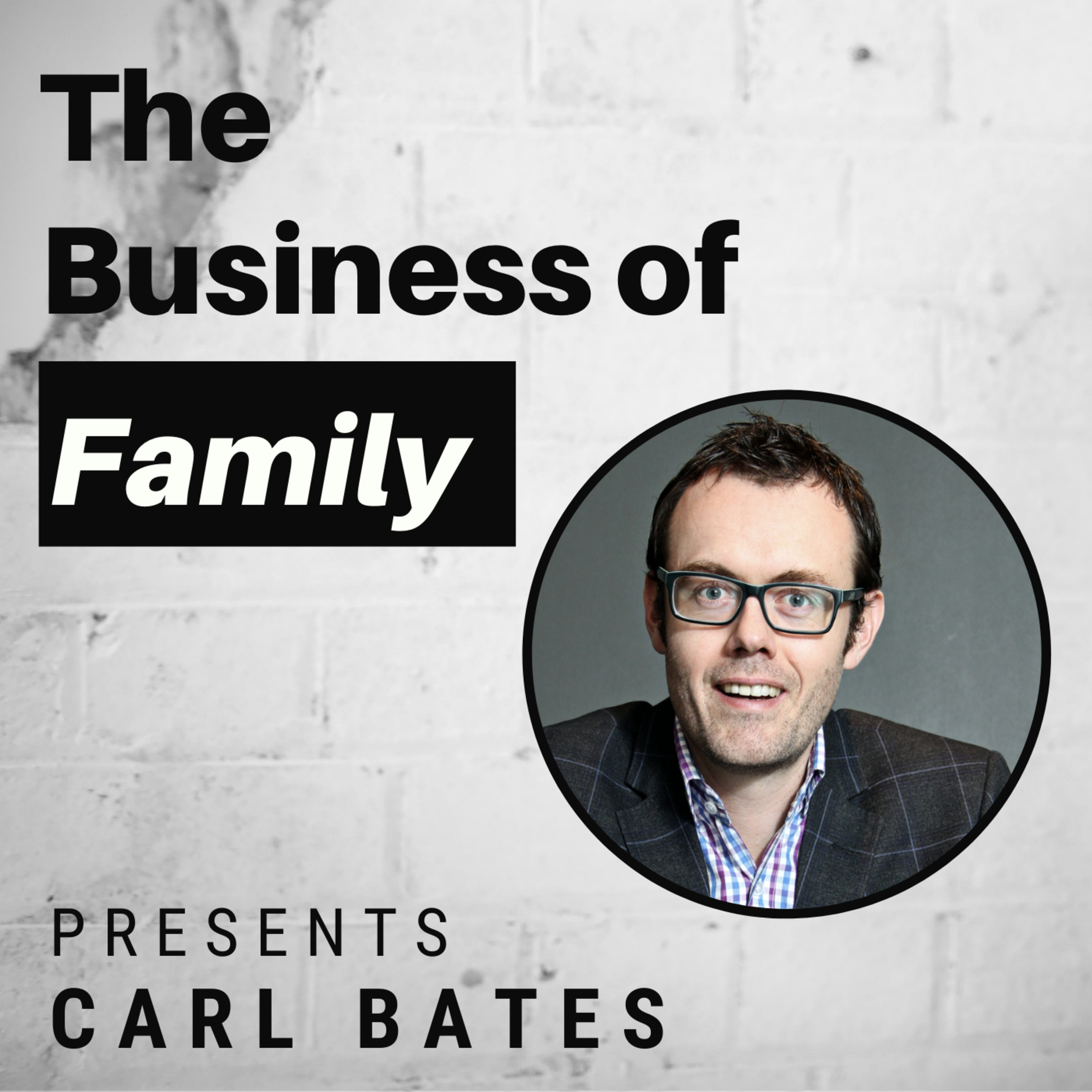
Episode 32 · Season 1
High-Performance Family Boards from New Zealand to Africa
Key ideas from this conversation
Agreements made ten or twenty years before they matter are far less emotional than ones argued over in the middle of a crisis.
His siblings are invited to buy into the family property business now, rather than one day inherit a share of something they don't understand.
Every family constitution he works on starts with one plain question: what does family mean to you?
Read the full show notesBio, standout quotes and the episode timeline
Carl Bates is Africa's leading educator, appointer and guide of High-Performance boards. As the Founding Partner of Sirdar, he is world renowned for his practical understanding of governance and is constantly invited to share his knowledge and insight on the subject - in Africa, Sirdar is the largest provider of independent non-executive directors to private companies and family businesses.
As a G2 entrepreneur, Carl works closely with his Mother and spouse in his family property business in New Zealand, bringing real world insights to his professional service clients. Carl is particularly passionate about how boards can transform and scale-up privately-held and family companies.
Standout Quotes:
- "There's a difference between craftsmanship and entrepreneurship" - [Carl]
- "And I like the term 'Contribution', it's all about what we have to give and finding ways of being more effective in that" - [Carl]
- "I think having a purpose as a business is fundamental to what building longevity in any business is about" - [Carl]
- "In businesses, we can see a direct correlation between the makeup of the group of people at the top and the financial performance of the business" - [Carl]
- "It is a privilege that a family has when they're right at the beginning of the journey, and they make the decision to become a family business... and they put in place the structures at that point because it's a lot less emotional to argue about something that is 10 or 20 years out, than being in the middle of that thing in 20 years time" - [Carl]
- "Families need to define 'well, what does family mean to you?' - [Carl]
- "The larger the number of beneficiaries of the family, the bigger the governance framework needs to be at a family level" - [Carl]
- "There's no such thing as an 'Original Mistake', there are so many families and so many boards around the world who have done this so many times before you, that rather than try and make an original mistake, go and see what other people have done" - [Carl]
Key Takeaways:
- Carl recalls he initially had no desire to live in Africa, a few years after this, he repeatedly had cause to travel there on business and realized he had to stay, creating offices all around Africa which help families and companies to develop their boards of directors.
- Starting University at 15 years and becoming a chartered accountant by 21 years, he had always wondered why even though each generation of his family had successful entrepreneurs, there was no build-up and transfer of wealth to the next generation.
- Knowing most of his great grandparents personally helped instill values that formed the foundation for the role he currently plays in business generally.
- Carl shares that the purpose of his family business is giving people a place to call home.
- Explaining the benefits and process of introducing new family members. Carl notes that the disparity in the energy levels between him, his wife, and other family members, allows for productivity to be maximized in different areas.
- So often the succession planning is focused on when the person passes away, but if we don't take other family members on a journey of understanding the business over time, when the time comes they won't have the understanding of it to enable a successful transition.
- The Contribution Compass is a tool used to understand family members as individuals, their personalities, and predict the expected roles they would play in the family. It is also used in business as a commercial tool since there is a direct correlation between the make-up of business leaders in any business and the success of that business.
- Regarding the formality surrounding the entry of other family members into the family business, Carl discloses that nothing would be gifted and members would have to buy into the business. He also emphasizes the need to legalize every aspect of this entry as he recommends for his clients too.
- I encourage family members to deal with things when they're not topical because that's when it's least emotional.
- Regarding planning ahead for families, the best place to start is to understand that being a shareholder doesn't necessarily mean sitting around the board table. It is also important to understand Family Governance from the perspective of defining what family means to each member.
- The Governance structure is predominantly focused on determining directly family-related issues but the Operational Board side is driven by the underlying Family business. This is where families go wrong; when they cannot differentiate between Family Governance and Governance of a Profit Generation Entity.
- While sometimes the family traditions do serve the purpose of bonding, in other cases, there is some resentment on the expectations from different family members based on such traditions.
- From Carl to his kids: It is important to spend time with your grandparents and great grandparents or people connected to them from that generation because there are threads that enable you to understand how your family has developed, and what the core values or cornerstones of success for you family are, through that time of engagement.
Episode Timeline:
- [00:45] Introducing today's guest, Carl Bates
- [04:00] Carl shares his professional backstory.
- [14:24] The purpose of Carl's family business.
- [16:13] Apart from you and your mother, are there other family members involved?
- [22:39] The Contribution Compass
- [27:56] In terms of families planning ahead, where do we start?
- [30:35] Where does the distinction lie between a Family Council and the Operating Board?
- [34:29] Differentiating between a Family Council and a Family Forum.
- [36:41] What is one of the biggest challenges that families have when trying to put a governance structure in place for the first time?
- [38:08] Comparing an Operational Family Business with one that is just "stewarding the wealth".
- [43:46] How are families celebrating their uniqueness and traditions over the years?
- [48:46] Carl's letter to his kids.
Links:
- Carl Bates : Carl Bates is an entrepreneur focused on creating meaningful economic impact within the countries and economies in which he has the opportunity to participate.
- Sirdar Group : ‘Sirdar’ is the name given to the lead Sherpa on a mountain expedition. Where others view a high mountain as a great challenge or an insurmountable obstacle, the sirdar sees it as a clear path of opportunity. The sirdar builds the right team, chooses the correct route and knows when to go for the summit.
Read the transcript
This transcript was generated automatically and may contain errors, including in names. Listen to the episode for the exact words.
MikeWelcome to The Business of Family. I'm your host, Mike Boyd. Multigenerational wealth creation involves so much more than capital accumulation. The most successful families cultivate values, stories, knowledge and resources to pass on to the next generation, and they do it very intentionally. On this show I sit down with members of some of the world's most interesting business families to hear how they do it. To see where your own family stands, take the Business Family Diagnostic at businessoffamily.net.
Carl Bates is the founding partner of Sirdar, Africa's leader in educating, appointing, and guidance to high-performance boards. He's a leading international entrepreneur, speaker, and mentor, and the global expert on the education and implementation of governance. Carl is particularly passionate about how boards can transform and scale up privately held companies and family companies, and his unique experience as a New Zealander with his own family enterprise based in Africa doing work all over the continent is particularly interesting.
I'm sure you'll enjoy this conversation with Carl Bates. Carl, it's fantastic to have you with us on the show this week. Thank you so much for joining.
CarlThanks so much for the opportunity, Mike. Really a pleasure to be here.
MikeSo you're normally based in Africa, South Africa, I believe, but I'm talking to you in New Zealand today, and I can hear that accent coming through. For the benefit of the audience, can you help us understand where in the world you normally spend your time, how you got there, and what it is that you do, please?
CarlYeah, awesome. So I'm a New Zealander through and through, an absolute All Blacks fan. I have been in Africa, though, for nearly 15 years, just a tad under 15 years. I met my wife in South Africa and got married and had a son, Angus, and we have a house in Johannesburg. Normally, we travel back and forth between South Africa and New Zealand. But I think more recently, as the world has changed as it has, we've had to spend more periods of time in one place. And so at the moment, we're currently in New Zealand, heading back over to South Africa later in the year.
MikeAnd what took you to Africa in the first place, Carl? Was that a holiday or was that work?
CarlSo funnily enough, in 2005, I went on a holiday. I went with a friend and on the way back from South Africa to New Zealand, my friend was talking about how she wanted to live in Africa. And I said, that's great. You know, wonderful. I'm not sure what your boyfriend's going to think about that. And then I said, but I will never live in Africa.
I live in the best place in the world. Why do I want to live anywhere else? And then I think those are called famous last words. And so what happened a couple of years later, I got invited to South Africa to speak on boards of directors and the role of boards and private companies and family businesses. And over the course of about 18 months, I did the trip New Zealand, South Africa 15 times, then realized maybe I should be spending a little bit more time in South Africa and Africa.
And before we knew it, we had offices across South Africa, East and West Africa. and now are the biggest player in supporting family and private companies to create and develop and improve their boards of directors. We talk about the concept of education, appointment and guidance of high-performance boards, but we do that for the corporate sector and for government organizations as well.
MikeInteresting. And so where does the experience and background come from in that world? Were you in that business already in New Zealand or did an opportunity present itself in South Africa. It sounds like you've scaled incredibly. So I want to hear about that story too. But how did you get into the space in the first place?
CarlSo it's a really interesting journey. I got involved at a very young age in our family business. At the time, my dad had a large plumbing firm across the lower North Island of New Zealand. And I could see that there was something about the way he was running it that just wasn't quite right. There was something that I felt as an entrepreneur was missing, but I couldn't quite understand it. And I was very lucky in that I grew up in a family when I was born, I had seven of my eight great-grandparents. I was lucky enough until 2020 to have all four of my grandparents. I still have three of my grandparents alive. And they were all in businesses, everything from butchers and
greengrocers to builders and plumbing and retail stores and everything. They're all entrepreneurs and in business. But I was wondering why it was that from one generation to the next, we weren't building wealth and transfer of wealth and started to really understand this concept I've defined over the years as the difference between craftsmanship and entrepreneurship. And so when I was in my teens, to sort of cut a long story relatively short, I got an opportunity to go to university early.
So I started university when I was 15, went on to complete my chartered accountancy. While I was at university, I got the opportunity to become an independent director of a private hospital, independent private hospital in the town or in the city that I went to university in. And that really started my career of understanding this thing called governance.
And so I had this experience of seeing what my family was doing and starting to understand what they were doing wrong in some ways. And seeing this thing called governance and successful organizations, I went on to be appointed as a independent director of the third largest polytechnic or technical university in New Zealand, and a director of the largest multi-stadium complex in the Southern Hemisphere, all in my 19, 20, 21. And so by the time I was sort of 21, I was a chartered accountant, I had an independent director experience, and then I got appointed as the chief executive of the New Zealand Council on Healthcare Standards. And so I got to have this management opportunity. And of course, there's a story in itself about how I ended up getting that
particular opportunity. But the point was, I got this opportunity to be in a management role and understand how a chief executive interacts with the board. And then it sort of all came together and recognizing that the reason why my dad hadn't scaled his business successfully, and then ultimately when he had a major stroke and that saw the downfall of his business, I could see and understand the role that a good high performance board plays in private companies and family businesses enables them to scale. So by the time I went to South Africa, we were already in this business and in this space and it sort of scaled from there.
MikeWow, there is so much in there that I'd love to follow some threads on. I mean, And you're not an overachiever at all there, are you, Carl? That's amazing. Starting uni at 15 and chartered accountant by what age?
CarlSo I was chartered accountant by the time I was 21.
MikeJust incredible. Incredible. Well done. So it sounds like you had a very, very formative education very early, which has led you down this path. And so did that allow you to sort of refine the path that you wanted to be on sooner than most? Did you find your way in the world sooner or did you still spend a lot of your time in your 20s exploring, trying to find who you were and how you wanted to spend your time in your career?
CarlSo in many ways, I feel like I'm still exploring where I want to play in the world. And I think that that's a conversation that develops as you get older and you get more insight into what it is that you want to be doing and where it is that you want to be contributing. and I like the term contribution.
I think it's all about what we have to give and finding ways of being more effective in that. I think at the core of it, I've always known that I wanted to achieve something in terms of building a family business within our group. I think there's been a lot of family businesses within our family, but nothing consistent and consolidated for a whole variety of reasons.
And I always remember my grandfather who used to say his job in life was to make sure his children were more successful than he was. And so I think I've really taken that mantra. And as I was saying before, I grew up, I had met seven of my eight great-grandparents. I knew five of them reasonably well. And that meant that I got a lot of the sort of values set, the sort of introduction from them. And that's wartime values and all of that coming through. And so I think that sort of created a foundation for what I wanted to carry into the world and the role that I wanted to play.
All of that said, I think in me are the cause of what I am doing, the role of directors, property, which is a big part of what we do as a family, have always been there. And funnily enough, just this weekend just gone, I was clearing out a box out of my mom's garage because she told me I need to get rid of some stuff.
And in it, I found a story I wrote when I was 12 at intermediate school for English and it was entitled The Three Little Pigs and Their Landlord. So clearly at the age of 12, I was thinking about the role property and landlords play, which was just an interesting discovery of maybe where I was as a young individual.
MikeI love that. Carl, you mentioned property has been a big part of the family group as well or your experience. Can you elaborate on that, please?
CarlGreat. So property really, I think, was where we started to come together and building something wider for the family. And it really started with my dad's plumbing firm. He had a fleet of Suzuki vans, if anyone remembers those old, small Suzuki vans. And the story goes that he was going to get $200 scrap for them at the time.
And I said to him, Dad, I reckon I can get you more money per van for these. Let's break them down and sell them off. And he said, no, you can't. You know, I was basically the academic kid. No, I'm not the one that you would expect to get his hands dirty and make things happen. And so he said, well, anything you get above $200 will go halves in.
And I took these things apart and I sold them off for scrap. And essentially, we got enough for a deposit on our first property. And that property we still own. And really, it built from there. We started buying more. I remember being at university and ringing my parents up and saying, I've just brought you a house. You need to go to the bank and do this.
And I think there was a lot of trust from my mom and my dad in the journey I was taking the family on. I think they could see potential and they gave me a lot of rope. I'm looking back and I think if my son comes along to me and says, hey, dad, I've just brought you a property, go and sign a form at the bank.
I would be like, hold on a minute. I'm going to have to really remember what rope my parents gave me. And I don't know if some of it was they just didn't actually realize how much I was doing or if it was really intentional. I probably should sit down and have that conversation with them. And then so by the time I finished Unity, we had this basis of this property business.
And mom and I had started to do some consulting work together for a couple of clients in Wellington and New Zealand. and out of that and on the back of the sort of property boom of the early 2000s, we had a lot of equity in the property business and we went and lost it really quickly, like really quickly.
You start a consulting firm and you say, hey, we've got a property business we can borrow against to make this happen. You quickly see equity turn into wasted cash, right? So we started the business off on the back of the property businesses. I think we burnt a lot of cash in the first year or two, But then we started to find equilibrium.
And what ended up happening, my parents actually got divorced during this period. And my dad then had his stroke and really can't or hasn't been able to work since then in any real capacity. I suppose you could say he's essentially retired now. But that really became the basis of the build of the professional services side of the group.
So our family business, while I'm, I suppose, generation two in the context of building a family business, I'm the first generation because it's my mum and I who really brought the property business together as a unit and built the professional services firm. And we're now in three or four different things in the professional services space under that side of the family business.
So there's really two arms to what we're doing now.
MikeIt's a really interesting mix. And so when you are referring to professional services, you're talking about this governance consulting and the work that you're doing today. Is that what you started back then and have taken on this journey all the way through?
CarlYes. So under the professional services side or our holding company that holds our interests in those businesses, we have Sirdar, which is focused on high-performance boards. We have a company called The Contribution Compass, which is focused in personality profiling and understanding who you are and what your underlying natural energy is. We have the license for a program called Onboard for Africa and the Middle East, which is a platform for boards to effectively utilize and develop their engagement and distribution of papers, voting, all of those things. And we have an interest in a company called the People's Fund, which is particularly focused as a South African business, focused on the development of Black entrepreneurship and funding of Black entrepreneurs in South Africa. So those are the interests at
the moment within the professional services side.
MikeThat's incredible. And I love that word contribution comes back into my mind, listening to all of the things that you're involved in, definitely having an impact there.
CarlI think to that point, Mike, if I can just say very quickly that I think having a purpose as a business is fundamental to what building longevity in any business is about. So on our property side, we have a purpose, which is about giving people a place to call home. And I remember because when I grew up, my parents went through a very hard time initially. I'm the eldest of three children.
And I remember waking up and having Christmas Day in the caravan. And I remember my first day of school, the photos taken in front of the garage door. As we lived in a garage, my mum and dad, Myself and my brother shared a room in a garage that had a room, a living room in a kitchen area.
And it was like a big garage sort of thing. And I just remember this concept of having a place called home. And so our property business, which is currently entirely residential focused, is all about how do you create a space that people can call home? And so we do things, little things in the property side, like if I'm going as a landlord to visit one of our houses, I take my shoes off at the door, not because it's my property I want to look after the carpet.
But because if you come to my home, I'd expect you to take your shoes off at the door. And so when I come to your home, even though it's inverted commas, my home, if you get what I'm saying, I'm going to take my shoes off at the door because that's the right thing to do in the space called home.
And our professional services side, the purpose is all about the idea of creating meaningful economic impact. Because we believe that businesses are the method or the vessel, if you like, for creating opportunity in society. Yes, governments have a massive role to play in that. But if businesses aren't there to create jobs, to create income that pays taxes so that governments can do what they do to develop opportunity in society, there's going to be no society. So at the core of business, I think is critical is to know what your purpose is. And I think that's a big part of the journey we've been going on as a family business.
MikeI love those stories. Thank you for sharing that, Carl. I'm curious now, the family business group that you refer to, you've got the property arm, the professional services arm, and you and your mother really were the founders of that across two generations. Are there other family members involved currently, or do you contemplate other family members being involved from a generational perspective or otherwise?
CarlSo it's an interesting question in two parts. So first of all is, you know, my mom and I very much were the partners that got this off as you referred to. And I think the first part of the story is our spouses coming along. So my mom's new husband, so my stepdad, if you like, and my wife coming into the world of our businesses post them getting off the ground. And what was really interesting about that is When you understand a little bit about this idea of natural energy, my mom and I have a very similar natural energy.
We're high activating drivers. We like to get stuff done. We run at 100 miles an hour and we're people focused. And what we found, for example, in the property business is that we were great at getting the next thing happening. but the execution and the longevity of consistency in terms of property management and the like wasn't happening to the degree it could.
And it was interesting that when both my wife and my mom's husband, so Candice and Adrian, came into the businesses, they brought a different energy that created a different balance. And interestingly enough, Candice has taken over the property management of our property business, so specifically the management of our property managers. and what that's done for my mum is free her up to focus on development and so all of a sudden we're doing a whole lot of development on land we've owned for 20 years because she's been able to be freed up in terms of her natural energy and her focus and sort of what she's great at while Candice has been able to contribute and bring a different energy around the table so
sort of that's been the first part in the family business has been the introduction of spouses if you like. We're about to go through the next part of the introduction of what would be traditionally called Generation 2, which in this business is going to be essentially my brother and my two sisters and their partners. So they're coming into the property side of the business, and we're creating an opportunity for both their initial investment and engagement and opportunity to build into the businesses themselves. But also it's part of a really long-term succession planning approach. And I suppose I see this through the work that I do with family businesses, particularly in Africa and around the world, where we're creating
operational boards and engaging with family councils and constitutions. So often the succession planning is focused on when the person passes away. So for example, in the context of our property business, what happens when or if mum was to pass away? And so you sort of deal with that and you put in place the wills and all of that. But what you don't think about is, well, okay, God forbid tomorrow my mother passed away. All of a sudden, my brother and my sisters would be partners in our property business. But if we don't take them and their spouses on a journey of understanding the business over a long period of time, when that point occurs, because I suppose inevitably it will, they won't have the understanding of it that enables
successful transition. So what we've chosen to do is obviously we've got the wills and all of that stuff done, but we're bringing them in really early in the piece so that we're building their engagement and there's a much better understanding into the future. So that's happening on the property side, we haven't tackled that on the professional services side at this stage.
MikeIt's really, really interesting. So in terms of the onboarding of additional family members, I want to sort of follow that thread a little bit further in terms of some of the work you're doing, because I think you're uniquely placed to have a great understanding of governance structures and preparing in advance, laying the right foundation. And then also having a family group yourself with the same family dynamics challenges that any family has, I imagine. So how do you contemplate siblings getting involved in the business as the next generation? Is that only to occur after your mother leaves the business or passes on? Or is there any interest in getting involved earlier? Have you had to document some rules of engagement and expectations around when and how
additional family members get involved? And then is it entirely through inheritance or is there some other investment or contribution that brings people into the fold?
CarlSo we've taken the approach that all of the siblings have the opportunity. So if you like all of Jen to have the opportunity to get involved now by buying into the business essentially. So there's not going to be a gifting of anything. It is about their contribution. Part of that and part of the reason for doing that now is to build that understanding and insight so that ultimately when there is the succession from my mother's estate to them, they have an understanding of the business.
They know how it's been run. They're seeing the work that's being done. And it's not an all of a sudden, we own X percent of the business and we don't have that insight. And you end up with the debate and the challenge because people haven't been taken on a journey. So we've chosen to start the succession really early, not just in theory, but in practice. So getting them involved, there is an easy way that we've made that possible relative to where each of them are in their life and in their journey and with their spouses or in one case with no spouse. So we've started that now to build a journey over time, if that answers the question, Mike.
MikeAbsolutely. And you also were talking about the natural energy that your mother and yourself share, you know, quite similar and bringing in these additional personalities with your spouses has really helped balance the business and set it up for scale. I imagine that you're using your own tools to discover this. You mentioned personality profiling. Was it the contribution compass and that area of the business? Can you tell me a little bit more about that? Do you typically use it in a family environment or is it more of a corporate tool?
CarlSo we absolutely do. So whether we're working with a board of a corporate organization or a board of a family business, we use the Contribution Compass both to understand the individuals and help family members understand each other, how they're reacting to each other, why they react in particular ways, and what role that person's likely to play within the family.
Are they going to be the peacemaker because that's where their natural energy resides? Or are they going to be the person who's driving things hard and is going to miss the nuances and going to miss the feeling among some family members because they're so focused on a particular direction and train of thought. So we absolutely use it in both. In businesses, we can see a direct correlation between the makeup of the group of people at the top and the financial performance of the business. So I see it as a very commercial tool. As you know, I'm a chartered accountant, so there is an element of a reality and numbers that comes into the way I think about things.
It's not just about sort of theory and ideals. And when I look at something like natural energy, originally, I was very critical of the concept because I'm like, yeah, but show me the balance sheet that goes behind this. And over the 15, nearly 20 years I've been using it, I've really seen how there's such a direct connection.
And I've used it in some big family, global family businesses at family council, family forum level to understand the dynamic. But I just want to answer one other question you asked just before around in the process of bringing in family members, how are we approaching the formality? And interestingly enough, sort of two views on that or two comments really.
One is we're absolutely approaching it with formality. So we have spoken with the lawyers around the formality that would ensure something is legally binding and can be enforceable. And we're going through that process. At the same time, as we're documenting very clearly the intentions and the principles of why we're doing this so that the whole group, both Gen 1 and Gen 2, are all on the same page about the journey that we're going on.
And it's exactly the same way that I would advise a client, so if you like, I'm practicing what I'm preaching, when they implement something like this in their family businesses. I just want to make one other comment, though, or the sort of second part of this, which is around the timing of introducing rules and introducing these approaches.
And I think there's a privilege that a family has when they're right at the beginning of the journey and they make the decision to become a family business or a multi-generational family business. and they put in place the structures at that point because it's a lot less emotional to argue about something that is 10 years or 20 years out than being in the middle of that thing in 20 years time and having the challenge occur. And I always use the example a little bit jokingly, but if you get the sort of concept, if I say to Candice, hey Candice, I'd love to go on a boys weekend in 2023 three, the guys want to go to Germany for the beer fest, Candice is going to go, absolutely.
It's two years out. She's not thinking about what we might be doing or, or, or. But if I say to her, Candice, can I go to Germany, forget COVID for a moment, next week with the boys for a boys weekend, Candice is going to go, well, hold on a minute, Carl. Next weekend, we've got, and what about the cost to go and, and, and?
Now, I'm not saying that Candice is the type of person that says I can't do stuff. We've got a really good relationship in that regard and we find space for each other. But I think the concept's interesting of time. And so I really encourage family businesses to, when it's not topical, deal with it because that's when it's least emotional.
MikeI can just imagine a whole series of people in the audience right now making a note about need to plan the boys trip two years out for the beer trip. I love it, Carl. It's very strategic of you.
CarlMike, can I maybe put it really bluntly? Mum and I call it the drop dead folder. Do you have your drop dead folder? Because it's too late when you drop dead. And I think for many families and even indeed many entrepreneurs, even if you're an entrepreneur sitting there going, I'm going to hold everything until the day I die and then the kids can sort it out.
Are you really doing a service for that next generation? by taking that approach as a side question. But even if you are going to take that approach, what can you put in place now when it's not emotional, when you're not in the hospital bed and people realise there's a whole stack of money or there's whatever is going to come?
What can you get in place now to make those conversations flow well?
MikeLet's follow that. Is there a couple of examples you can provide in terms of what you would recommend maybe someone in a similar position to you puts in place as a foundation at a minimum? In terms of families planning ahead, maybe their first gen, maybe their second gen, but we're planning 20 or 30 years out, what sort of things should we start having or at least having discussions around or documenting early and in advance having policies before need? Where do we start?
CarlSo I think at a really foundational level, the best place to start is to understand the distinction between the operational leadership or operational board of the underlying business and having some form of policy or basis around how a business is governed in terms of the operational activity, the operating business, if you like. And by that, I mean, just because you're a shareholder doesn't mean you get to sit around the board table. Understanding that the role of the board is about ensuring effective governance of the company and therefore there needs to be the makeup of that entity and the structure of that entity that enables scaling the wealth side of the equation. The second is family
governance and the foundations of family governance really would start with a family constitution and what does family mean to you? And I think it's one of the things that I love when people say, it's a little bit like when people say, are they an entrepreneur or they're an entrepreneur? It's like, well, what does an entrepreneur mean? Everyone has a different definition of entrepreneur.
And I think we throw the word family business around like there's a defined definition of what a family business is. Family to you fundamentally means something different to family to me. Family to you might mean that you'll do anything for your family and family comes first and all of that. Family to me might mean, yes, family comes first, but family comes first in my world is sometimes there needs to be a tough lesson because that's the only way the family unit's ultimately going to be stronger. And so often people will use this word family to justify things that actually are very different. And so families need to define, well, what does family mean to you? At the most basic level of, are you a family business that says every spouse is always
a member of the family? Or are you a family business that says it's blood and it's blood only. And so some of those things are really important at that journey and then how transition would occur. So there's lots of good reference points around the basis of a family constitution and I would start there.
MikeI love it. So let's take that and bring it into the world of a large global family enterprise, perhaps a conglomerate of multiple businesses or a family office or other investments. Where does the distinction lie between a family council or some sort of family board and the operating board? You consult and provide services to both, I believe.
How do they interact with each other and what dynamics are at play with that separation of roles and understanding?
CarlSo it's a good question and there's not a sort of clear line. Some families will define it slightly different to others. But the broad scope is that a family council or family forum or even family assembly, and really those terms have general meanings. But in essence, the larger your family or the larger number of beneficiaries of the family, the bigger the governance framework needs to be at a family level.
So if you've got two or 300 family members, and we work with families with that, sort of number, who have some form of interest or beneficial ownership or get out of the family business wealth, then you're going to have multiple levels of your governance structure like an assembly and a council and a forum. If you're a much smaller family, you might just have, for example, a family council.
But in essence, whatever that governance structure is for the family is predominantly about determining directly family-related issues. For example, things like who is a family member? How do family buy in and buy out if they have the ability to do that? How do non-family or non-working family members get contribution from this, if any? Do we support family members who want to go into businesses outside our core?
Family office oversight, those sort of items, education of family members, family member, working family member employment policies. Anything that has the sort of word family member in it somewhere will have some role to play or some contribution that is going to be needed from the family government structure in implementing it. The operational board side of any family is going to be driven by what is the underlying business.
Now, if a conglomerate has a lot of businesses, they might be set up in verticals. There might be a private equity vertical. At the top of that, there's going to be a board of some form for the private equity activities because it's, in essence, a private equity business. On the other hand, there might be one large manufacturing business, which is where all the family wealth comes from.
And aside from that, all they have is a family office. And that's also fine. But the manufacturing board, the board of that manufacturing company inherently requires different people at its leadership than a family office. And I think sometimes family businesses look at these things and they go, yes, but it's ours. So we're going to put all family members around it.
And we're going to put the same family members around the family office as we are the manufacturing business. And I think that that's where families start to go wrong. And not understanding the very clear distinction between family governance and how do you navigate the challenges of a large family business and understanding how to ensure effective governance of an operating entity. And maybe just to be more specific, operating entity might create some confusion for people. Profit generation entity, if that makes sense. Where are you collecting or getting your wealth from?
MikeIt's a great distinction. And what I'd like to to expand upon there is the difference between, say, a family council and a family forum. I understand family assembly is the large assembly of the whole family. There may not be all directors or on any sort of governing council, but usually an assembly is a collection getting the family together once a year or twice a year and communicating the message to the wider group.
I'm curious, though, the distinction between family council and family forum and the roles that they play in a family enterprise?
CarlSo there's no hard and fast rule, but generally the shift would occur as the family gets bigger. So initially we would tend to call something the family forum, and that might be when the family has a number of family members and is a great place to start. So for example, in our family business, we'll start with a family forum, which is essentially all of Gen 1 and Gen 2.
But as Gen 3, and we've got a while before that happens, start coming on stream and getting involved, there might be a point where we go, okay, so we've now gone from, off the top of my head, eight people involved or nine people involved in the family forum to if we include Gen 3 and all of Gen 3, we might have 20 people involved in the group.
And we go, actually, 20 people is too many to effectively govern the family governance or effectively control the family governance. So a family forum is often made up of some form of representation across the entire family, sometimes generational, sometimes cousins, sometimes both. Whereas a family council is an elected body from either the forum or in some cases an assembly.
That's, if you like, like the equivalent of the family's board. So the family council generally, if there is a need for a family council, if there's just a family forum, then to some degree, it's one and the same. But as the family grows, you would create that distinction between your family forum, which is the consultative component to get a wider spread, but not the entire spread. To your point, the assembly might come together once a year or once every two years, or in some large families, it might be less regularly than that, once every three or five years. Whereas the family council is the elected body that says, this is who the board of the operating entities listens to, this is the authority on decision-making around family
governance. And we've agreed as a family that that's where it sits.
MikeWhat would you say is one of the biggest challenges families have when trying to put a governance structure in place for the first time? Because I imagine that not all families plan 20 or 30 years out, putting policies in place before need. Many of them are probably in the throes of a transition or already have substantial wealth or assets or a substantial family in terms of size when they try to implement.
So where are the biggest friction points, would you say?
CarlI think the biggest thing is that so many family businesses work really hard and try really hard to make an original mistake. And the point I'm making is that there's no such thing as an original mistake when it comes to this stuff. There are so many families and so many boards around the world who have done this so many times before you that rather than try and make an original mistake, go and see what other people have done.
Go through the learning of what your role as a director means versus your role as a family member. Take generation two through those processes, sit down with family business consultants or boardroom experts and get the insight to set it up properly. Otherwise, you're going to spend a whole lot of time attempting to make an original mistake. And as I say, you're just never going to make one.
MikeI love that answer. It's great. Great example. How does this differ, if at all, in the context of family wealth when there's no longer any operating assets involved? So maybe I'll just give an example. Maybe great-grandfather founded a business. It was a large manufacturer. At some point, Gen 2 or Gen 3 sold the business, basically turned it into liquid investments.
We've now got a large family office. Maybe there's some professional managers involved helping steward the wealth. What role is family playing at this level, maybe in a G4 context? And what sort of decisions are at play in terms of beneficiaries and access to the wealth and others? I know it's a broad question, but merely just trying to draw some comparison to an operating family enterprise compared to a stewarding the wealth separately.
CarlSo I suppose when I look at it, I look at the fact that stewarding the wealth is still a business. It's in essence an investment business. And so whether that is structured through, for example, a family office, or it's structured through a formal investment company or a combination of both, it still requires the same approach around creating a distinction between the operational board and the family governance.
So, for example, the people who play the role in fulfilling the mandate of the investment company and ensuring the investments, returning what's required to the shareholders, being the family, are a different skill set to determining wealth distribution within the family. And I think sometimes when there isn't an operating business, families get that confused. And I've seen many a family put family members into the wealth stewardship role, tongue tied there, when all that they've been seen is the family wealth destroyed because they've thought that they've been brilliant at creating wealth and they go and invest it in a whole lot of things and all that happens is they destroy wealth so fast it's not funny.
And I think you've got to be really careful to think that just because there's not an operating business and it's all tied up in investments, that there's no need for formal governance, particularly if the numbers are big, on the investment side of that equation. Often what happens in those scenarios, though, is it puts a lot more focus on the how is money stewarded? And how are you ensuring that the right family members are beneficiaries of that?
And I think there becomes a lot more values and family, potentially politics, in those journeys if it's not done well.
MikeHow about other forms of capital? So we've touched on financial capital, but if we're talking about the human and intellectual capital of a family as well, how much of family governance is involved in making decisions about preparing the next gen or supporting the next gen in the most appropriate way possible. And that might be in a really practical sense, like carving out an education fund and deciding to try and support the education journey of next gen members, or it might be about having policies and structures in place to build the life experience and learning opportunities and other forms of life.
Or, and if I can go on, it might be about how we pass on our family history or our value system from the founding generation or from the wider family group. You touched on earlier that you got to know five out of eight great-grandparents, which is quite extraordinary. How do these threads connect and pass down all the way through you to the next gen?
And is there things that families can do to intentionally cultivate that?
CarlSo I think there absolutely are. And I think this is where the role of family councils and family forums, and to some degree, even family assemblies play a part. because they're outside of the business context. And I think sometimes what families do and can be a mistake is they use the inverted commas family business as the training ground for exactly what you've spoken about.
Whereas I think there's a distinction where the family wealth is what can be leveraged to do that. So for example, I remember as a kid, my grandfather got some money when my great-grandmother passed away and he gave $1,000 of it. She had given $1,000 of it to each of her three great-grandchildren. And we got to invest that in the share market.
And before we were allowed to invest in the share market, we had to run a phantom portfolio and demonstrate that we understood. And I was doing it. My brother and sister were too young at the point, so I did it for them. And once I proved that that works, My grandfather literally gave me the $3,000 and we invested it and we did very, very well out of it.
And I think opportunities like that are where a family can consciously build opportunities for the next generation's learning. But I think it requires the matriarch or the patriarch or the founding family members to set out those intentions very clearly and set those principles or those expectations for the family council to implement.
MikeWhat about family rituals or traditions or ways in which families celebrate their differentness? Now, I love to explore this topic because I think it's often these sorts of things that tie families together rather than just a business or the wealth, as you say. What do you see show up from families? And I don't know if this shows up in a governance setting or not, but how are families celebrating their uniqueness and traditions over the years?
CarlI've seen many different families have really different elements to the way they celebrate and operate as families. And it's interesting how sometimes it can be a really valuable family bonding experience. And other times I've seen it in families where it's done because it's done that way. And you get a feeling that there's actually a level of resentment and of challenge that comes out of being dictated to about how the family or what the expectations are of different people.
So we, I suppose, in our family business are going on this journey at the moment. We haven't set this out too much. I think it'll be interesting to see how it develops and how as siblings we agree it'll develop over a period of time. But in our family, we have a long history of spending time as a family on weekends away.
And I'm really keen that as part of our approach to building the family governance side, that there's something that gets built into our journey around that as a family. and I think there's general consensus for it, but we're not quite there yet in terms of the practicalities. And I've seen a lot of families have that sort of thing in their governing documents and governing structures for how they interact and grow as a family.
And I think they're good learning opportunities for passing on those values, particularly when there are events that bring family together. And I think that that's why I'm a supporter of family governance structures, funding those core ritual events, if that makes sense.
MikeSo that might be an annual family retreat or an opportunity for members to get away and build relationships together or to nurture the next gen. Is that what you're saying?
CarlCorrect. Absolutely.
MikeCarl, you're in a unique position as a New Zealander, but spending a lot of time in Africa and working with a lot of African family firms. I'd love to draw some comparison or understand the differences culturally that you see in Africa compared to the West, if I can be so general. What are you seeing as some of the challenges that each exhibit in the context of family governance that maybe the others don't?
CarlIt's interesting. I've spoken in 50 countries around the world on every continent. And so often I get told by people it's different here. And I think in many ways, it obviously is, right? The world is not uniform. That said, I think underlying drivers are the same globally. And if you look at COVID-19 to a degree, it's proven that, right? Every country has focused on what can we do to look after our own?
How do we protect our country and our people? And I think when you look in family businesses, is it's very similar around the world. You know, I've sat in boardrooms in Ghana and Nigeria and Kenya where people have said to me, yeah, but it's different here. And I've sat in family conversations in New Zealand where my grandfather has said, but that's what I want.
And it's exactly the same as the sort of thing or approach I've heard in Kenya. And yes, there might be a different overtness in some places. There might be a different way of discussion. But in essence, I think core of the idea of family when it comes to the, I think generic is probably too strong a word, but the generic approach is very similar around the world.
I think a lot of the nuances or a lot of the differences are driven more by religious differences. So clearly there are some very big differences in the way some religions operate around. family and what impact that has on the approach around family business. And then the other part has been families themselves. I look at the way my family debates and talks about things and the way we approach things.
And when I got married to my wife, I thought, well, that's the way families deal with stuff. And I approached issues in her family exactly the same way I'd approach them in my family and created a bit of a shit stir. And I think that we're both what you would call Western families, if that makes sense. So I think it's much more family specific than maybe we think.
MikeThat's a brilliant example. Carl, it's time for our final question now. And this is a question that I ask all of the guests that come on the show. Imagine you're writing a letter to your children. What is one lesson or idea that you don't think many parents would mention, but you consider important to understand.
CarlHow important spending time with your grandparents and your great-grandparents or people of that generation connected to your family is because there are threads that enable you to understand how your family's developed and what the core values or the cornerstones of success for you and your family will be or have been through that time and engagement. And if I even just look at what my approach was to COVID-19 as a business, both on our property and our professional services side, I can tie a direct connection back to what my great-grandmother used to say to me about the war. Obviously, she was English in the context of the war.
and the point there was, you know, in the middle of COVID-19, the world was saying, this is unprecedented. It's never happened before. It's, you know, the world's never been so cut off, dot, dot, dot. And I just had in the back of my mind, my great grandmother's stories about when my great grandfather went to war and how she had to manage the shop and what happened with money and how she had to find ways of making money and what the time horizons were. And I think if I hadn't have had those opportunities, I would not have been successful and our businesses wouldn't have been successful. And we were lucky in that we did have a successful
2020 and many businesses I know around the world didn't. And I'm very conscious of that when I say that, that we were very blessed with the 2020 that we had. But it came from the opportunity to engage with grandparents and great-grandparents over a long period of time. And I don't know that we appreciate how important that is as younger people.
MikeIt's a fantastic lesson. I'm glad that you've reinforced that. Carl, it's been an absolute delight learning from you today. I really appreciate you taking the time and sharing all that you have with us. I've really enjoyed this discussion.
CarlThank you so much, Mike, and thank you for the opportunity.
MikeThanks for listening to The Business of Family. You'll find the transcript and key ideas from this conversation at businessoffamily.net, along with the Business Family Diagnostic. It's free, and it shows you where your own family stands. And if someone in your family should hear this episode, please send it to them too. I'm Mike Boyd. Until next time, take care.
Keep listening
If this one landed, start here next.
A 5th Generation Member of the Schrage Family, Owners of the 126 Year Old Centier Bank
An emergency transition plan for a family that owns a bank.

The St Louis Trust Company Multi-Family Office
Write the policies while there are no names attached.
Caring for Elders & Why it's Important to Have Daughters
The decision most plans leave out.
The Business Family Diagnostic · Plan B
Carl and his mother keep a drop dead folder.
The wills, and also the intentions behind them, written down while nothing is at stake. Are the senior generation's wills, powers of attorney and key documents current in your family?
“If the family had to leave the country it lives in, it knows where it would go and how.”
Every family wishes someone had recorded the generation before.
I built Enduring Stories to do it for yours: a guided voice conversation, from home, that keeps your family's voices, values and history.
The newsletter
The most useful things in these conversations are the things families rarely say out loud.
I share them in my newsletter once a week. Sign up to receive the ideas directly and start building the foundations for your family today.