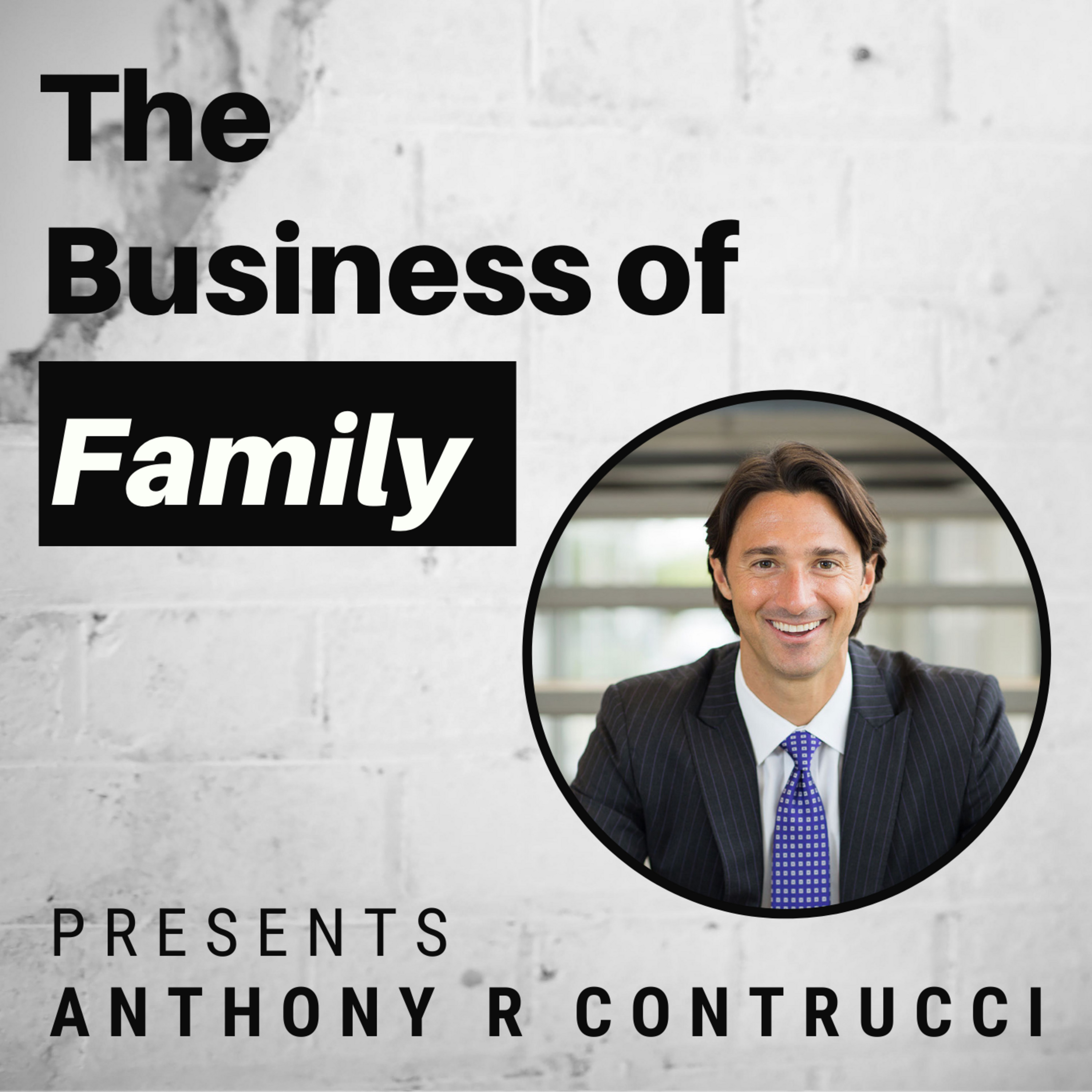
Episode 45 · Season 2
A 5th Generation Member of the Schrage Family, Owners of the 126 Year Old Centier Bank
Key ideas from this conversation
Governance began with a one-page agenda at a quarterly dinner, then mission, vision and values, then small policies.
An emergency transition plan with the communications already scripted and filmed, so the family looks united within hours.
The family book tells the failures as well as the successes, to keep the next generation emotionally connected.
Read the full show notesBio, standout quotes and the episode timeline
Anthony Contrucci is a proud 5th Generation member of the Schrage Family. He serves in many roles within his broader family enterprise including his role as President and Board of Director of First Bancshares, Inc. (FBS) a bank holding company located in Merrillville, Indiana. FBS’s primary operating asset is Centier Bank. Founded in 1895, the Schrage family has owned and operated the financial institution for 126 years. From humble beginnings, today they are the largest private, family-owned bank in the State of Indiana with approx. $5.8 billion in total assets, over 60 branches, and in excess of 900 associates.
As his career has evolved, he has developed a true passion for governance and operations. One of his current focuses is the codification and institutionalization of the key elements that differentiate his family’s enterprise. At its core, this speaks to their desire to remain a purpose driven enterprise focused on the preservation of their servant heart culture for generations to come. This spans the continuum of the impact that they have on their associates, their clients, and the communities that they serve overlayed by a holistic approach which incorporates environmental, social, and governance considerations.
In addition, his passion for governance and operations has evolved beyond that of traditional corporate. For the better part of the last decade, he has led their family’s formalized family governance efforts. As they continue the transition from the 4th to the 5th generation, it was paramount to Anthony, and his generation, that they build the requisite operational and governance structures to ensure success in succession not just for their generation but for generations to come. With the collective support of the 4th and 5th generations, He has allocated a considerable amount of my time establishing their family office and formalized governance structure and framework.
Although he feels blessed to be able to serve his family and family enterprise in a variety of roles, the role he is most proud of is that of a devoted husband and loving father. He is married to his best friend and soulmate, Melissa Contrucci (nee Schrage) and has been blessed with two loving children.
Standout Quotes:
- "I really believe our success as a family kind of exists at the crossroad of this desire to be civically involved" - [Anthony]
- "That formula of putting people before profit is how you build long term sustainable value that transcends generations" - [Anthony]
- "In order to be successful in succession, you have to be intentional and you have to be strategic" - [Anthony]
- "If you think about the destination, you'll never start the journey" - [Anthony]
- "If you're trying to solve a problem that you can solve during your lifetime, you're thinking too small" - [Anthony]
- "Success requires action" - [Anthony]
- "You can't appreciate something if you don't know how hard it was to have or you didn't have to work for it" - [Anthony]
- "During times of dislocation, there's always opportunity" - [Anthony]
- "The most important investment I've ever made is my time in my children" - [Anthony]
- "Never try to replace your net worth for your self-worth" - [Anthony]
Key Takeaways:
- Anthony is a 5th generation member of the Schrage family currently serving in the role of President and Board Director of First Bank Shares, a bank holding company with a primary operating asset "Centier Bank" which was founded in 1895. They are now the largest private family-owned bank in the state of Indiana.
- The Schrage family came over from Germany into the US in the 1800s, and over time the family has always been passionate about the community. This alongside the risk tolerance accounted for the success of the family because being involved with the community helped identify needs and create solutions. The name "Centier" Bank was coined intentionally to represent a century of service, the founding of the bank on Center Street, and that the bank strives to be the premier provider of financial services for the communities. The headquarter is in Merriville Indiana.
- Despite the pandemic, banking is a good business to be in right now. Data from the bank shows that Centier Bank tends to outperform during times of market dislocation or pain. Clients are put even before the shareholders in the business, and this is how long-term sustainable value is built over generations. 2020 has been the best year financially in the history of the bank.
- This success was achieved by consciously and emphatically considering the safety of clients and workers physically while also keeping them confident about their finances. They set out to help communities through different programs, mortgages, credits, and low-interest loans.
- Anthony met his wife and her family at the age of 20 and she was his best friend before becoming his wife. Anthony had no intention of working in the family business but wanted to chart his course in life. He had always been in the financial sector, including commercial banking and investment. Later he started with wealth management in the family business, and then the investment services division. After a while strategic intentional steps were taken to ensure an impact in the community. Currently, Anthony spends time in the financial holding company level, family governance, and the family office.
- Although the family has grown since the first generation, there are 27 family members and 16 shareholders. There is a family assembly every year, and also a family governance structure.
- The goal of the family assembly is both business and to bring the family members closer together. One of the main reasons for starting the family assembly was communication flow. Success and succession in a family business is literally the equivalent of fighting gravity; only about a third of family businesses make it from generation to generation.
- As a broader family, the family meets monthly with specific agendas and occasionally invites subject matter experts. There is also a family business consultant and a family psychologist as well as other subcommittees. There are G5 monthly check-ins with no formal agenda.
- About the Family Portal: While trying to organize family documents that have piled up over many years and made work inefficient, Anthony came up with the idea of the Family Portal. This has been a great tool for increasing efficiency and improving workflow.
- When it comes to starting Family Governance, "you've got to go slow to go fast". Even it is a small start, it's about building the behavior; for Anthony's family, the starting point was about Mission, Vision, and Values. This is where to start to build a foundation with simple things like a code of conduct or attendance policy. It gives some wins and then these goals can be dialed up to more complicated plans.
- The Emergency Transition Planning (ETP): This refers to very detailed planning done such that in the event of the demise of a leader, things can be set in motion to instill confidence in multiple audiences across multiple mediums. It's a succession plan on steroids.
- The family psychologist has been very valuable especially in helping family members communicate effectively. This also includes constructive conflict, which is the most important thing in communication and trust-building. Additionally, having a facilitator around when the family constitution was created was very helpful. However, the values or by-products of this exercise are less important than the journey. Families are encouraged to start this process and take their time.
- After attending a family business conference where he was introduced to the concept of a Family Book, Anthony applied it in documenting the family history to ensure that future generations would understand how hard the journey was. While collating different materials to create the family book, an enormous collection was accumulated and Anthony had the idea to get a corporate historian to manage the collection. This brought the next idea to have a "Centier Museum" for these family artifacts.
- Using the idea of cohesion dynamics which include the family aspect, as well as the business, financial and emotional aspects, Anthony understood that it was paramount to use the family history to keep family members emotionally tethered to the family business. This determines the filter they would use in making decisions regarding the family business because rather than simply thinking like investors, they would think like stewards if they felt emotionally tethered to the family enterprise.
- The 6th generation is currently between the ages of 8-18years. For a long time, the family legacy was the bank, but now there's so much more opportunity for the G6 to get involved with the family enterprise and create an impact.
- Advice for someone looking to lay the foundation for a Family Enterprise: Slow down; "you have to be patient and focus". The other thing is to save; "live below your means and always have reserves because having that additional financial capacity allows you to be opportunistic".
- There has had to be a shift from being a family that operates a business to a family that has an enterprise. "We had the belief for so long that the legacy was the bank but now I believe that the legacy is the culture that fuels the enterprise" Thinking about it this way gives the motivation to lean into Family Governance and Family Office. It also shifts the mindset from being competitive to being more collaborative. All of this takes curiosity, communication, working through conflict, and never being afraid to fail, knowing that growth comes from failure.
- Anthony's letter to his kids: Happiness comes from the important things in life; love, health, the time spent, and experiences created with loved ones. True fulfillment comes from finding something you're extremely passionate about, that is meaningful but extremely hard; if you don't grind, demonstrate grit, fail, and pick yourself up, you will never find fulfillment and self-actualize. If you always lean into what's important in life and push yourself, you'll find that fulfillment.
Episode Timeline:
- [00:46] Introducing today's guest, Anthony R Contrucci.
- [02:01] The history of Anthony's family business.
- [08:16] How is the banking industry right now?
- [12:12] Anthony's entrance into the family and the family business.
- [17:36] The structure of the family enterprise.
- [29:24] How has your governance structure taken shape since its implementation?
- [37:51] Where did you start in terms of Family Governance?
- [41:30] The Emergency Transition Planning (ETP).
- [44:56] Discussing the role of the family psychologist.
- [48:26] How did the family constitution come to be?
- [51:10] About the Family structures put in place to guard the family history.
- [57:50] With regards to the 6th generation, how do you look to the future of the family enterprise?
- [01:00:17] What advice would you give to someone looking to lay the early foundation of a Family Enterprise?
- [01:05:04] Is there a new habit you've adopted that was meaningful to your journey?
- [01:09:12] Anthony's letter to his kids.
Links:
- Centier Bank - A Family-Owned Indiana Bank Since 1895. : Michael E. Schrage, CEO and Chairman of Centier Bank
- How Centier Bank celebrated its 125th anniversary
Read the transcript
This transcript was generated automatically and may contain errors, including in names. Listen to the episode for the exact words.
MikeWelcome to The Business of Family. I'm your host, Mike Boyd. Multigenerational wealth creation involves so much more than capital accumulation. The most successful families cultivate values, stories, knowledge and resources to pass on to the next generation, and they do it very intentionally. On this show I sit down with members of some of the world's most interesting business families to hear how they do it. To see where your own family stands, take the Business Family Diagnostic at businessoffamily.net.
Anthony Contrucci is a proud fifth generation member of the Schrage family. He serves in many roles within his broader family enterprise, including the role as president and board director of First Bank Shares, FBS, a bank holding company located in Merrillville, Indiana. FBS's primary operating asset is Centier Bank. Founded in 1895, the Schrage family has owned and operated the financial institution for 126 years. From humble beginnings today, they're the largest private family-owned bank in the state of Indiana with approximately $5.8 billion in total assets, over 60 branches, and in excess of 900 associates. This conversation, which you're about to hear with Anthony, is a great inspiration for family governance. They have a very sophisticated structure in place, and there is an immense amount of take-home value for those listening
today. I hope you enjoy this conversation as much as I did. Anthony, it's fantastic to have you on the show this week. Thank you again for making time to be here.
AnthonyMike, thanks for having me. I've been looking forward to this.
MikeYou have such an incredible and rich family history, five generations going on six, as I understand it, a family business that's in its 126th year. Tell us all about it. I'm not going to tell a story for you. Please, if you can summarize 126 years in a few minutes, we'd appreciate it. What's the short version?
AnthonyYeah, I will do my best. I don't excel at short typically, but it's a fascinating story. And just for context for your audience, I'm a fifth generation married and member of the Schrage family. And so obviously my name is Anthony Contrucci. I'm Italian. My wife's family's German. And so they came over from Germany in the 1800s. And it's interesting. So Christoph Schrage, who my son is named after, came over to visit from Germany to what today is, obviously Chicago and what today is now Whiting, Indiana in about 1840. And something about that trip, and I kind of was like, I wish I, when people ask you that question, if you could talk to anyone from the past, kind of who would it
be? Christoph's one of those people. You know, what drove him from Germany to the United States originally? What drove him specifically to Chicago? And then ultimately to stumble upon this, just basically land, marshy, really uninhabitable land at the time, which today is known as Whiting and it's a beautiful city, but went, fell in love with it, ended up kind of fast forward a bit, bought his first tranche of land in what today is known as Whiting, went back to Germany, didn't come back for several years until about 1854, I believe it was, when he came back with his wife and his two children. He had a daughter and he had a son. His son was Henry, who would go
on to be our founder of the bank, which today is known as Centier Bank. And so they come back over, they spend some of the time in Whiting, really one of the founding families of the town, and then ended up spending most of their time living actually in Chicago. Henry goes to the war, and when he leaves and he's honorably discharged, he was actually discharged out of Kentucky, ended up saying, well, where am I going to go now? Like, what's next? And the family had now two tranches of land that they had bought in what today is known as whiting. So he ends up moving to whiting, and he's working as a farmer, working for the fields. He's working on the railroad at
the time and just got really involved in the town. And what I think is really fascinating, I'm going to skip over some history here because there's lots of decades leading up to 1895, but I always say this to people, I really believe our success as a family kind of exists, if you will, at the crossroads of this desire to be civically involved.
The family has always been so passionate. We still are today about the community. We want to be a part of that community. We want to be an intimate member of that community that understands what that community needs and is really involved in creating positive impact. And then on the flip side, again, it was this kind of crossroads of this being involved civically, but then also because of just how the family was wired and their risk tolerance that I think we embody today, because they knew the community so well, they knew the known, in many cases, the unknown needs, they just had that risk profile to be entrepreneurial and provide the solution.
So whether it was the first general store in the city of Whiting, whether it was the first post office or serving as the first postmaster, or later on in the family, Walter Sr. serving, God, I think it was four consecutive terms as mayor. I mean, you name it, we're always just so involved in helping to grow this community.
And then again, in 1895, recognizing, oh, Standard Oil's here. The population's at an all-time high. There is no financial institution. There is no bank. I mean, I literally closed my eyes, Mike, and I envision people shoving money under their mattress or digging holes in the backyard because there's no bank. And that's when really the Bank of Whiting was founded.
So several name changes since 1895 went from the Bank of Whiting to then the First Bank of Whiting to then First Bank and then to Centier Bank, which is actually interesting because it's kind of a fabricated name. And the goal there was to accomplish a few things. And one was to recognize a century of service. So that's sent in the, in Centier. Also to recognize that we were founded on Center Street and 119th Street. And then lastly, to recognize that we always strive to be that premier provider of financial services for the communities that we have the opportunity to serve.
So that's kind of how Centier was born. And today, our logo is fireworks because we are always celebrating. So we have a lot of fun together as a family, both the Schrage family and the broader Centier family, because we refer to all of our employees as associates and more importantly, as family. And they actually participate in ownership of Centier through our ESOP, which is something that we are very, very proud of.
So today, Centier is the largest privately held bank in the state of Indiana. We have about a thousand members of that Centier family now, about six billion in total assets and over 60 locations. You're going to find our headquarter located in Merrillville, Indiana, right off of 65 and 30. So if anyone that's listening is ever in the area, come by and say hi.
The highest concentration of our retail locations are going to be really Lake and Porter counties, where you're going to find the most of our branches from a concentration perspective. But we've been growing and expanding throughout the state and really proud that we've been able to bring hometown community banking to so many new communities over the past couple decades now.
So that includes Fort Wayne. We have locations all throughout Tippecanoe County. We have locations all throughout what you call Michiana, so South Bend, which is probably most known for Notre Dame, Elkhart, Mishawaka, and then all throughout central Indiana, including a location in downtown Indianapolis.
MikeAnd it's an amazing story. And there's so much history there to unpack. Before I get into the family business side of things, I just want to ask, how's the banking business at the moment? You know, record low interest rates, you know, big boom post COVID. Is it a good business to be in right now?
AnthonyI would say yes. I mean, it's interesting. We have historically, and again, I have the 126 data points to be able to say this confidently, but we tend to outperform during times of market dislocation or pain. And there's several reasons for that, which I think we may get into later. So I'll pause, but it has been an interesting couple of years.
I know I've personally grown as an individual, as a professional over the past couple of years, but I also think organization has as well. You know, we always put people first and it's interesting. And I'm going to answer your question specifically, Mike, but I think it's important to note as a backdrop to that question that we, the shareholders are third on the totem pole.
And what's interesting and maybe a little bit unique for some of your audience today is that we actually put our associates first. So our center family members are number one on our priority list. Number two is our clients. And number three is the shareholders, is us, you know, the family. And we really believe that that formula of putting people before profit is how you build long-term sustainable value that transcends generations. And that's something that we're really, really proud of. And so when you kind of layer that on top of what just happened over the past two years, I mean, hey, we were afraid.
I mean, honestly, I remember back, it was March of 2019. And I mean, we were literally stress testing our balance sheets, right? We're analyzing our capital position and all of our capital ratios. We're looking at our loan loss reserve. I mean, we were really fearful that we were going to have another great recession and specifically the impact that that had on our industry.
And fast forward, it's been our two best years in history. 2020 was our best year financially. in 2021 is setting up to be now our new best year in history. And what really drove that first and foremost is our people. And so we spent so much time in the beginning, the onset, if you will, this pandemic really just obsessing about what it was going to take to keep them safe, number one.
Then number two, how do we keep our clients safe, both physically, right? Because there was a virus that was scaring all of us tremendously that still continues to scare us. But secondly, How do you keep them not just safe, but confident about their finances? We take that job and that role very, very serious as a trusted advisor and bankers.
And so we put a lot of work into that. And it's amazing when you're just out there trying to do good, you can do really well. And so we were able to really support the communities that we serve through lots of things, including the PPP program that many of you may have heard of, the Main Street lending program. And then just really proud of some of the things that we had been doing to diversify over the years with regards to the bank subsidiary that we're talking about right now.
But our mortgage department, we have a mortgage warehouse lending division. There are a lot of lines of business that performed very, very well in a low interest rate environment. And so again, very, very successful. And of course, as a banker, You know, always, you know, credit risk is a big thing and says the way we underwrite, we have a phenomenal team. And so our balance sheet really held up very, very well.
MikeI'm pleased to hear it. It's fantastic. And I love to see that you're living your values. So, Anthony, I really want to get into the family business side of things. Fifth generation is a huge accomplishment in its own right, but you've married in as a fifth gen, which I think is a further level of complexity and really, really interesting to see how you've joined the family, joined the family business and now play a key role.
Can you tell us a little bit about how long you've personally been involved in the business and what your entrance sort of to the wider family enterprise was. And maybe if I can go further and say, tell us a little bit about the role that you're playing for the family enterprise today.
AnthonyYeah, no. So I think it probably makes sense just to kind of share when I met my best friend and soulmate, my wife, Melissa. Again, I pinch myself every day because I literally married my best friend. And it just makes this journey called life so much more fulfilling and rewarding. And so we've been together, married 15 years.
We'd be going on 16 and we were together three years before that. So it's kind of crazy. I just turned 40. It's like we've almost been together half my life, you know, half our lives, which is such a blessing. And so I was in the family, you know, for many, many years, you know, and for all intents and purposes, I met my wife and her family when I was about 20 years old.
And so I've been around, it's kind of like, you know, it's interesting. I'm almost like, and my brother-in-law, so there's my mother and father-in-law have three daughters. So now there's really kind of three and son-in-laws, if you will. And myself and my brother-in-law, Chris, he met Laura, who's the eldest daughter, around the same time in life too, kind of same age and stage, which is interesting.
So it's almost like part of our lives, we were raised by our parents, but no, part of our lives, we've kind of been raised by our in-laws, which is kind of interesting. But even though I entered the family so early, I really had no intention of working in the family business. I felt very, very fortunate that it was on the table.
And I was always in financial services, but I kind of wanted to trap my own course in life. I've always been a little bit afraid of nepotism, to be honest. And so I really wanted to do my own thing. And my brother-in-law, and not to speak for him, but he really didn't, in the early years, didn't have a desire to work in the family business either.
And so it's interesting. We kind of both started around the same time in life, about 30 years old. So we had several years to go out there and build our own careers and learn and fail and grow and all those really important things. And so I've been physically working in the bank and the broader enterprise now for about a decade. And it has been an interesting decade to say the least.
started, I've always been in financial services, just so some context again, did several things in financial services over the years, actually started in commercial banking and did several different things there. My last role that I really enjoyed was as a private banker for a super regional bank, and then went on to spend several years in the alternative investment space.
And so working with specifically hedge fund managers and on hedge fund management teams, And my specialty at the time was really on kind of client acquisition strategies, capital procurement campaigns. In a world where you really can't market, how do you build relationships and source acceleration capital, if you will? And so did that for several years and just wasn't really finding it very fulfilling.
And we had moved to Chicago. So we were in close geographic proximity to the family business. Before that, we were living in Miami where I spent a lot of my earlier years and just kind of got bit by the family business bug. And so started in wealth management, as you would expect, and spent several years there in a couple of different roles in particular. The last one there was overseeing our investment services division. And then from there, we felt as a family and as a senior leadership team, it was time to really be more thoughtful and intentional about how we were engaging with the community. Again, going back to that history I shared with you, it's always been about the community. I mean, I really believe that we are still here today,
not just surviving, but thriving. Because every single time in our history, when we were literally on our knees, and there have been those times, Mike, and you can read about it in the book, my father-in-law gets very, very candid about it and raw about it, but the community has always been there to pick us back up, to support us during our darkest times. And so we wanted to be even more strategic and intentional as we continue to grow and scale as a business about how we were impacting the community, whether it was corporate giving, volunteerism, financial education, or now even kind of broader themes like, you know, things like ESG. And so I started a
department here at the bank called Community Relations at the time, about six years ago now, five, six years ago now. And that has been just a fantastic journey. And I've really enjoyed that. And then now I'm really, really spending my time is kind of in three different areas. One is at our financial holding company level. So Centier Bank is owned by our financial holding company called First Bank Shares that we actually founded in the 1980s to allow us to continue to grow.
So I'm spending a lot of time there. And I'm sure you have some questions about that later. So I'll pause there. And then I'm spending a lot of my time as well on our family governance. I've had the opportunity because the family's allowed me to lead that effort for us over the past about, say, about eight years now, and then also our family office. So between the family office, the family governance and the holding company, I am pretty busy.
MikeYeah, it certainly sounds like it. You've got the bases covered. And I'd love to hear that you've married into the family, you play an important role, obviously, in the family and the business, but you're also leading the governance efforts, which I think is extraordinary. So I'd love to hear how the family operates, how it's made it to five generations at an enterprise level. But maybe if you can take us through some of the structure first, who owns it? How has it passed down through the family? How have you managed to keep it together in this structure so far?
AnthonyYeah. So as you can imagine, I mean, just since the bank was founded, 126 years of history. And I wish we... I'm kind of the family historian. I geek out on this stuff and I wish I was around a generation ago to get more of the information, if you will. Mike and I were talking before this podcast a bit just about our family dynamic. And it's so interesting because I have the good fortune of being around a lot of G4 or 5, 6 families around the country and around the world and talking to them. And we're just so different. So many of them, they have not just a hundred shareholders in G5 or 6, but hundreds of shareholders. And our family,
think about our ownership composition, again, at the holding company level, the Schrage family as we define it today is my father-in-law, obviously my mother-in-law, and then the three daughters, our three family branches, and then my father-in-law's sister and her three heirs, right? So they're three family branches. And so that, just to kind of quantify that for you, That equates to 27 people, including married-ins, across three generations, of which there are, to the best of my last count, 16 shareholders.
So this is not like your traditional G5 family. On average, I feel like it's like, we have 500 family members and 300 shareholders. It's 27 in 16. And then again, 10% of the bank, I'm using just easy round numbers to make the math work. About 10% is owned by our associates, which we're extremely proud of through our ESOP.
And then about 10% is owned by really other family members. Because if you think back, I mentioned that Henry was our founder. Henry actually had nine heirs originally. Only six survived. Three died very early. Of the six, there were four males, two females. At one point, all four males were actually officers of the bank, which I think is interesting information.
And then again, out of those branches, a couple of them died off relatively early as well. So the family tree is actually one of the projects I worked on, was the family tree. And that was a lot of fun to kind of get a real sense of the broader family. There are other family branches that make up that 10%, but majority of the bank, I'm rounding here again, but about 80% of it is owned by just those two families, my father-in-law and his sister.
And then our broader family branch is actually the majority owner and has the majority of that. So we own about 56% of the bank.
MikeIt's fascinating. So your collective family enterprise, do you refer to that as your family branch in terms of 56% or are you referring to the 80% which is owned with your father-in-law's sister and her branch as well?
AnthonySo yeah, so vocabulary is very, very important, right? So when we talk about our family enterprise, we are referring to the broader family enterprise that includes my in-laws and our three branches. So if I'm speaking, I'll be talking about our family enterprise and I'll say it's four family branches across two generations, right? My in-laws and then our three branches.
Very close with my father-in-law, sister's family. We actually, they're part of our, we have a family assembly every year. And that's something we always look forward to. But day-to-day family governance, we have our own governance structure that just our broader family branch, right?
MikeYeah. So tell me about these family assemblies that include everyone. And then maybe let's step backwards from there down to the governance that you're actually implementing at your broader family branch level.
AnthonyYeah, no, absolutely. So these are really new for us. So we'll be going into our third year in 2022. So what's been really frustrating is we haven't been able to do them in person. We had all of these plans leading up and we had this great schedule and our family has a long history in Culver, Indiana. There's a school there called Culver Military Academies.
And so actually my wife was third generation and her sister is Culver and members of my father-in-law's sister's family, their cousins went there as well. And so we were going to do it there and we had a whole agenda and schedule and unfortunately it had to go virtual. So this year we had, it's a two half day virtual agenda where the first day we kind of spend more on traditional business matters at both the bank and at the holding company level. And there's various presentations on various topics. And then the second day is really spent more on ownership type related topics.
And then actually, interestingly enough, one of the questions I asked kind of closing out the second day was, you know, how can we make this better for next year? And we decided that we wanted to actually go to two different meetings, one in person that we're probably going to do about mid-year. And we'll do that in person.
That'd be our traditional kind of two half day in person with a lot of fun, just family team building type activities. And then later in the year, we'll do a half day virtual.
MikeYeah, excellent. I was going to ask what the family's goal was in hosting these family assemblies, whether it was more about business and updates and presentations, or if it was more about bringing the wider family together and telling stories and sharing values and things like that. It sounds like you've got a nice balance between both.
AnthonyWe strive to balance both. And it's really, I'm glad you made that comment only because it triggered something for me, which is a memory. And even though we're on our fifth generation right now of adults, we really, in many respects, are more of a G1, G2 dynamic. Okay. And let me define that for you. So again, the family tree was really pruned from an ownership perspective throughout those generations pretty quickly. And I would say the generation that did the most of that would be my father-in-law's father and mother specifically.
So she was, you know, so his mother was married in, you know, G3 married in, and she was sharp his attack. And she was really the one, even though Wally, Mike's father, was president, she was the one, from what I've been able to gather, it really kind of pushed him and the family to our family branch to buy out the other family members. Not that there was any conflict, it was just a small bank at the time, right? And so, you know, they just probably figured, I'll take the cash today versus this piece of paper that really doesn't mean much right now.
It wasn't what it is today. And so, she was such a driving force in the family, but Because of that, and because my father-in-law's sister didn't really want anything to do, outside of being a fantastic owner, as loyal as they come, always there to support her brother and the family and the business, you know, never really wanted to be involved from an operational perspective and never wanted to be involved from a governance perspective.
So my father-in-law in G4, which is interesting, is he didn't have to deal with a few things, right? One is that concept of peerage, right? That dance between the now and the next generation because his father unfortunately died when he was very, very young. So my father-in-law would have been, had just a few years in the business. So he had a couple of years of that, a few years of that, but not as long as I know he would have liked.
So he was kind of on his own really young in his 30s. Number one. Number two, never had to deal with siblings in the business because, again, his sister didn't want to be involved. Again, day-to-day or from a governance perspective, but a fantastic shareholder. And then number three, that whole concept of the cousin cohort didn't exist. So in many respects, he is accustomed to really acting more like a G1 founder.
you know, Jenny, he really took the bang from really what was, you know, I'm rounding here again, approximately 30 million in assets up to, you know, 6 billion in assets today. And so, and really was able to do that, obviously with a fantastic team, but from a family perspective alone. And then all of a sudden, now you have, you know, adult G5ers, both his daughters and son-in-laws who are also in the business and, you know, and nieces and nephews. And all of a sudden, you realize you have to start to maybe modify how you communicate and how you move through the world.
And kudos to him. I mean, he has just, for being in his early 70s, has just really challenged himself to adapt to that dynamic, which many can't do. I've seen and heard of anecdotally. So just really just feel very blessed that he's done that. And that was one of the main reasons of starting these family assemblies was communication flow, right?
MikeIt's extraordinary growth, which he has helmed, but also the story you tell about pruning, whether it's happened through circumstance or luck, or whether it's been intentional, you know, buying out family members. I've spoken to a lot of families on this podcast who have pruned intentionally just to try and avoid future conflict or so that the shareholding doesn't get too wide and too difficult to govern.
But I think it's really, really interesting that you're a fifth generation family that has, as you said before, 27 family members, because the families typically outgrow the business. And I think in your case, it's actually gone the other way.
AnthonyYeah. I think they call it zero-sum dynamics, right? And typically businesses are growing incrementally, if you will, and families exponentially. And it has been the opposite for us. And to me, we talk a lot about, and I know the next iteration of this conversation is just the deep dive into our governance, but to me, there's nothing more important. Because to your point, we have such a gift, such an opportunity because we're so small to really create a meaningful framework for future success. I mean, you said it, short sleeves to short sleeves type of thing. I mean, success and succession in family business is literally the equivalent of fighting gravity. Only about a third of family businesses make it from generation to generation. So G1 to
G2, about 33%, G2, G3, about 12, 3 to 4, 3, so on and so forth. And there's lots of reasons for that, right? Which we don't have time for today. But I really believe in order to be successful in succession, you have to be intentional and you have to be strategic. And so if my legacy personally is nothing else one day, hopefully it's that I was able to be a leader in creating the framework to ensure that we can honor our legacy and our pledge of staying not for sale.
Because I was able to, with the family support, to create our family governance, to create the family office, all those structural elements that I really believe you need to be successful long term, in addition to all of the other aspect of cohesion dynamics being that emotional connection, which I know we'll talk about in a second as well, that I'm really passionate about.
MikeYeah, you're absolutely right. Certainly the whole theme of the business of family is learning from families who are practicing with intention, managing their family enterprise, their wider governance structure intentionally for the next generation. These things most often than not do not happen by luck, and they certainly don't happen to the fourth and fifth generation by luck. So, you know, I love that you've joined the family in the fifth generation.
you're already anticipating sixth generation ownership or stewardship. How has that governance structure taken shape that you've implemented over the last, is it decade last or is it more recent than that?
AnthonyYou know, I was going back through our family portal and looking at our anticipation for today's conversation and our first family meeting minute that I have recorded was 2016. So our journey started a little bit before that, but it's just really, it's incredible how far we've come. You know, there's a saying I've heard, and I'm sure you've heard it before in family business, like, go slow to go fast, right?
Be patient. And it's incredible. I mean, going from what were quarterly family meetings over dinner at a restaurant, a private room, to where we are today. Today, for context, I mean, you know, I'm always trying to balance this, make sure it's not too much. And I always remind the family. I'm here to serve you and this is your time.
So I need to know what is going to make this valuable to you. But we meet quite a bit. We meet, so as a broader family, again, mother-in-law, father-in-law, and then the six G5ers. So there's eight are our family council and we meet monthly. We meet for about two and a half hours and our agendas are very specific and very robust.
Quite often, we try to have at least one subject matter expert join us on a quarterly basis. At a minimum, sometimes we'll have two in the quarter. So that is that monthly kind of broader family meeting. We also have G5 check-ins. And I want to pause there for a second because this is where, again, you learn, right?
As you grow. We were meeting actually in a very formalized fashion for a few years. And it got too much, too heavy. So now what we do is we have a monthly check-in and it's on our calendars. And sometimes we talk for 30 minutes, sometimes we talk for an hour. There's no formal agenda. People will just kind of consensus build it in the calendar invite, things they want to talk about.
We kick them around. There's no formal meetings. If there's any tangible takeaways, they'll typically just get kicked to one of the subcommittees, assuming that there's one already in place. And it's really light. But it's really important for us to have that time to be together and to talk just as a generation because not all of us live here in market. So we're not all together all the time in person. We also meet with, we outsource, and we can get to this in a second too, but with our family office, part of it is we outsource some of those kind of high expertise areas to an MFO.
And so with that being said, we meet with them as a broader family about two to three times a year. We also have a family consultant that we work with. One's a family business consultant, The other is actually a family psychologist on the team. And we meet with them about two to three times a year. It used to be quarterly.
Now we've kind of dialed it down a little bit. And then we have our family assembly. And then, like I mentioned, annually. And then throughout the year, we do have various subcommittees on various. I'll answer any questions you have on that as well. But we just kind of meet as needed, depending on projects that we're working on.
MikeCan I just say, wow, there's a lot there to unpack and really inspiring. You're busy. And certainly sounds like you've got some comprehensive governance in place. I was furiously taking some notes because there's so many questions that I want to follow up with, if you don't mind. First of all, back to the very beginning, you mentioned that you checked the family portal to see when the first meeting was held.
Tell me just briefly about the portal. How do you actually coordinate yourselves? What do you use for that? You know, is it file storage? Is it meeting minutes? Or is it something more rudimentary than that?
AnthonyNo, I know. I'm glad you asked the question. And this was something that I'm really proud of. This is something we really started working on in earnest about three years ago now. And again, legacy family, 120 plus six years of history. And so there was just files. I think everywhere would be an overstatement, but things, we tried to centralize things, but it was obviously very paper intensive. And my sister-in-law, for example, doesn't live in market. And so she would need a document and she'd have to reach out to someone to go pull the file, to scan the file. I mean, it was very inefficient, a lot of friction, if you will, right, in our family enterprise system. And so one of my first projects that
the family was excited about was this concept of a family portal. And it was overwhelming at the time, to be honest. It was one of those things like, God, there's just so much to do and we're not done yet. I don't think there's a destination. I think it's just an endless journey. But we really engaged our head of IT within our bank subsidiary to pick his brain on this. And there's lots of kind of turnkey solutions out there. I'm not sure if we can mention names or not on the podcast. Trusted Family is one of them. And I think they do a great job from what I've seen and heard. At the time when we started this journey, it was still earlier in their journey, for example.
So it's like, do you build it or do you buy it? And so after a lot of thought, the bank and our holding company was already in the process of converting to Microsoft Office 365. And so we said, well, why don't we just build it ourselves on 365? Obviously, it's completely separate from our business. And so we did that. And so it has become quite comprehensive. So each family branch has their own family library, if you will. And then there's also a whole nother library for all the shared family assets, as well as all of the family governance. So whether it's our family constitution, all of that's in there with all of our policies that we have. I mean, everything from
any trust document to operating agreement, you name it, it's in there somewhere. And so it's been a great, great tool and really helped create a lot of efficiency for the broader family as well as their family office team.
MikeIf you had your time again, would you use an off-the-shelf solution today? As you said, they were early in their journey when you were building, you know, has it grown into a bit of a beast? Or if someone's listening to this and they're in a similar position, what would you recommend based on your experience?
AnthonyI am so glad you asked that. I promise for the audience, this is not like, I did not tee this up, but I was just, I just got an email from a trusted family. and I will share some of the tools and technology that they have today. And I'm sure there's other solutions like them are pretty interesting. So from the capability of doing surveys that are all kind of baked in. And so, you know, I think it would be a harder decision today. I think when I made the decision and we made the decision a few years ago, it was pretty easy to kind of, let's build it. It is quite the beast. I think it's worth all the time, energy and resources,
but I think it'd be a harder decision to make today. I couldn't tell you what direction I would go because I just haven't really dug into it in a while, but I think it'd be a harder decision with what I know now.
MikeYeah. Thank you. The G5 check-ins you mentioned, are they in addition to the monthly meetings that you're having with the family council? Are they just a separate check-in and both occur monthly?
AnthonyYep. So we meet as a family again, broader family for two and a half hours. Those were always in person. Now, obviously, in the world we're living in today, it's whoever's in town is in person as long as they can be here. That's consistent with our updated attendance policy. And if you're not here, it's okay that you join virtually.
However, we try to follow kind of YPO guidelines almost, you know, to the extent it's like, you know, you need earphones on, quiet space, camera on, you're engaged. Because that was hard. When things first started, when we went to that with the pandemic, you could tell it was some people were distracted, which it's natural. I had to learn how to work differently, right?
When you're sitting here and you're not in a physical meeting and you have emails popping in and it's hard to stay focused. So we've addressed that as a family and definitely think it's getting better.
MikeYeah, that's excellent. And so, you know, I've heard you mention the family constitution, the group of policies you've got, you've updated your attendance policy based on the pandemic. For some in the audience, this is going to sound very sophisticated and probably a little overwhelming. Where did you start? You know, I want to get back and I'm going to pull apart the detail here, but where did you start in terms of family governance?
I assume it has evolved over time and you've added levels of complexity and detail as you've grown.
AnthonyAbsolutely. I mean, if you think about the destination, you'll never start the journey, honestly, especially with this. It is, and again, it's funny because I go to these conferences and meet with other families, and I just feel like we're so far behind still, right, sometimes. So it's like you comment how far along we are, and I'm like, oh my God, we have so much to do and so much, you know, it's like, again, it never ends.
But you got to really, you got to go slow to go fast. Probably the biggest takeaway, Mike, for the audience, as someone that's had the opportunity to kind of be a leader of this effort is to make sure that you are bringing people with you on the journey, right? It's so easy to get out in front and all of a sudden you look back, you're like, no one's here. Like I'm not leading nothing, right? And so it does. And everyone has different levels of passion and excitement about this stuff. And I'm a very passionate person, as you can probably tell. So it's kind of tempering that and making sure you make it manageable and bite-sized. So again, and we started really, really slow. We started with
the quarterly family, broader family meeting, I mean, Mike, if I showed you the agenda, I mean, it was literally on one page and like a few bullet points that were today like so, I mean, just so, I mean, it's such simple things, but it was building the behavior. It was building the comfort, right? Of doing it. And now you fast forward and we have multi-page agendas and we have speakers that come in and it took years to get there. And again, we're still years away from where I want to be. There's a great quote that I always remind myself of and others of, which is, if you're trying to solve a problem that you can solve during your lifetime, you're thinking too
small. And it's always stuck with me. And so it helps me because I have a high sense of urgency. It helps me to kind of relax. Like, hey, all of my goals aren't going to be accomplished for generations, right? Because we do think very big picture, long-term, multi-generationally. But I would start, you asked a question, where we started though, when we got really serious about this with our consultants was on the constitution front was mission, vision, values. I mean, everyone I've ever talked to, that's really where you have to start to build the foundation. It's the foundation of that governance house, if you will.
don't get overwhelmed by these subsequent policies. I mean, we're still not where I want to be with policies, but start with simple things like a code of conduct and an attendance policy. Part of our attendance policy is cell phones and technology and meetings. I mean, I think it's really important to do some what may seem simple policies to start because it gives you some wins and you're learning how to build those together.
And then it's a dial, it's not a switch. Just keep dialing it up. And then next thing you know, you're working on bigger things like accountability matrices. And we just recently finished our first ETP, emergency transition plan, which I think is extremely important for families that are still operating businesses in particular. So they get bigger and bigger, but it takes time. Go slow. I promise. It's worth the wait and it's worth the journey.
MikeYeah, it's fantastic. And I think too, it's often compared that as families get more sophisticated in their governance of their family enterprise, they get closer and closer to public companies in the way they operate because they have the sophisticated structure in place. They have countless policies. There's a rule and a way of doing business that gets developed over time, the bigger the enterprise gets. And I think that that's always an interesting parallel to draw. The ETP, Anthony, that you just mentioned, Is it for the business, the underlying bank emergency transition plan, or is it at the family enterprise level?
AnthonyIt's a both. So there's actually, it's a both and it's a pretty exhaustive document. That's one of the, again, one of the subcommittees that we had, which wanted to make sure we had support from both generations. So my father-in-law was on that as well as a representative from G4. Or obviously, as a business of our size, we have all the business continuity planning in place and all of that.
But for us, ETP is, if dad gets hit by a bus tomorrow, that proverbial bus, what has to happen specifically from a communication perspective to instill confidence? And that confidence has to be instilled in multiple audiences across a multitude of mediums. And the reality is, if something like that would ever transpire, obviously emotions could be running high, not just for our family, because we lost dad, but the entire Centier family.
My father-in-law is celebrating his 50th anniversary at the bank next year. I mean, he loves our associates and they love him. And so it would be a really difficult time if something happened like that. And so we wanted to make sure we had a plan in place ahead of time in the event that ever happened, the unthinkable happened, that we could respond very thoughtfully.
And not just that we had an action plan in place again and how we're communicating to what audiences, but literally all of the creative is already done. We're actually filming next, we were filming in December, actually, our whole generation with my mother-in-law. She'll be there for that. But we have to figure out what is she going to be in?
What is she not going to be in? How do we work with our team that's filming this to make sure we have enough flexibility? And God forbid something happened to mom and dad together. And so we're storyboarding it and we're scripting it. And I mean, everything down to what we're wearing has been thought through. And we're going to have a ton of content that we're shooting so that we in post can kind of synthesize it in the most appropriate manner for the audience and the medium. And keeping in mind that depending on the audience and depending on the medium, various different people will be leading that. So everyone will be, it's to show unity, right?
Cohesiveness, strength, to instill confidence, but different people will be leading it for different audiences. Like who's leading it for the bank, who's leading it for the media, who's leading it for, you know, et cetera. So we had to think through all of that and obviously get consensus from the family because it's like a succession plan on steroids.
MikeIt's just phenomenal. I've never heard a family enterprise take it to that level. But of course, the amount with which you're intertwined with the community and the role that you play, I think it makes so much sense. But the detail that you've gone into to manage communications is just really, really amazing. One more follow-up there, Anthony, on all that you've taken us through. Obviously, we've spoken to people before about how they utilize a multifamily office, which you mentioned. We've spoken to countless family business consultants, and there's various different ways to do that. But we haven't often had a lot of conversations about a family psychologist, which you mentioned. Would you mind expanding on that for us, please, and how you've
engage someone and perhaps what they've taken you through as a family?
AnthonyYeah. I mean, it's, it's interesting. I don't think going into it, I mean, I don't think we're that smart. I mean, it was just, you know, when, when I engaged with the, when I brought the family, a family business consultant to the table, it was kind of, kind of like something that they often do. I mean, unless, unless we're just absolutely mad and he just led me to believe that, which is, could be the case. No, but I mean, all sincerity, you know, a lot of times when I talk to people, that tends to be like, there's someone that really focuses in on the family business enterprise side of things, like all the things we're talking about. They were
part of us. They were a resource for us when we went through this ETP exercise, right? They were the ones that facilitated, the one gentleman who is the actual family business expert was one that facilitated our mission, vision, vision, values exercise and all of that type of stuff. But then, you know, family's messy, right? You know, they always say, you know, your siblings know how to push your buttons because they installed the button, right?
When you were probably six, when they still stole your XYZ. And so it's been really valuable because sometimes I think, you know, and I think everyone can probably, this resonates with probably most people, but sometimes it's just, you can't get out of your own way and it's just how you're communicating. And so I think one of the things that this individual has brought to the table for us, and we all meet together at the same time, so it's not like we have different meetings, but is they can kind of hit pause sometimes and, hey, is this what you're really, this is what I'm hearing? Is it what you're really trying to say? Or, you know, so-and-so, is this how you're understanding? I think this is the intent and clarify if it's not the intent.
And so just the coaching that that person can do on how to communicate, how to provide feedback in a manner that is, how do you always create constructive conflict and not allow that conflict to become destructive? And don't get me wrong, the most important thing in communication and success in family business and building trust is constructive conflict.
Conflict is the fuel. So don't be afraid of it. I think one of the biggest harms in our family was like this for a very long time, and I think we still default back to this, is that whole sense of false harmony. Because we love each other, right? But also, it's a German family, right? So they feel more stoic, and they don't always necessarily share.
And so it's been really healthy to have that person there to kind of help guide you, kind of be those training wheels in how to communicate, how to work through conflict, make sure it's constructive, build consensus. These are tools that are so important. And in fact, these are tools we're trying to instill in the next generation because we obviously know how to learn a little bit later in life.
MikeIt's a terrific insight and I'm sure there'll be people that are taking some inspiration from that. Anthony, you mentioned earlier that you started with the constitution. You started with mission, vision, values. Some families I've spoken to before have often said that in order to derive their values, in order to craft that first version of the document, they've often gone back in time to sort of hear the stories from their elders, to understand their founding journey and what really makes them the family that they are today.
So, I guess I'm touching on a couple of different things. I'd love to hear about how the Constitution came to be, but you also have such a rich history in terms of storytelling and documenting the family's history. Did that play a role in helping you to derive the values which then have ultimately gone on to form the basis of the governance structure?
AnthonyFantastic question, Mike. And what's interesting is all the things I think you said you're going to ask me about in a bit, just about some of the things we've done to document our history. that all actually came after we did this exercise. And keep in mind too, because we did this now a few years ago, keep in mind too, that we only have a G4, right? So we haven't had G3ers around for a really long time. I mean, not since I've been, well before I came into the family, right?
So we're talking decades now. And so the history we have really lived and lives within G4. And so, Yes, absolutely. And they were part of that process. And I do think for your audience, and not that it can't be done, and I'm sure many families have done it successfully, but I found it was really important to have a facilitator there to help with that process.
And again, it was really fun because you start with the ocean of values, for example, and then you really start distilling it down. And it's really more of an art than a science. And what's most important, and my father-in-law and I talk about this a lot, is he has a like me, a very high sense of urgency.
And, but what I reminded him of even back then is, you know, he wanted to kind of get to, okay, what are the values? I'm like, no, no, the values, honestly, the ultimate, the by-product of this exercise is really less important than the journey, than the process. And so, again, I encourage any family that's listening that hasn't been on this journey that is planning on it.
If you're not planning on it, please do it. And if you are going to do it, just again, go slow to go fast and really embrace the process because that's where, again, that communication and you're just – so why is integrity important to you? What does integrity mean to you? Compassion. Like all of our values in our constitution, we actually have definitions. Because again, integrity can mean one thing to one person, but something to someone else. And we really want people to understand how do we as a family interpret that?
MikeYeah, that's a great point. And so let's go back to the family history piece and documenting that. You've used a facilitator, you've engaged G4. I mean, there's so much history there that you didn't want to be lost. And it no doubt informs sort of who you are today. How did you go about that process? You've got some, I almost don't want to spoil it for you, but you've got some incredible structures that you've put in place. Can you tell us about them?
AnthonySo again, Mike, candidly, I mean, where we are today, I pinch myself because I never would have thought we would have accomplished what we've accomplished. It wasn't really, it was more of like a domino effect than anything. And that's one advice I always try to give people when I, when I hear, you know, people, next-geners, whether it's in a family business or just someone I'm mentoring and they're like, I'm just waiting for that opportunity to come. Like you're waiting, like it's going to just come to you. Like success requires action. Like you got to be moving. It's a contact sport.
Good things just happen. They kind of snowball, right? And so it literally, it was the first family business conference I was ever at. And I was at a table with a family out of Chicago that I'm sure many of your viewers would know. And they mentioned that they had just complete a family book. Now this is, again, this is probably seven, eight, eight years ago now, maybe longer.
We just give, and I'm like a family book. I'm like, I don't know what that means. I mean, keep in mind, like a decade ago, no one in our family even knew what family governance was. We never really thought of family business the way we do today or didn't have an enterprise mindset. And so I'm like, what is a family book?
And like, oh yeah, well, we document our family history and we hired this publisher and this author. And I'm like, that's really cool. So I kind of filed it away and we're a very frugal family. And I knew that's probably gonna be very expensive. So I got like, when's the right time to like pull this rabbit out of the hat and waited till we were a few years out from our 125th anniversary, which happened last year.
and so a couple years before that or so, G5 talked about it and we were all in support of it and took it to a family meeting and at first, G4 was a little bit skeptical because I didn't want it to be just be like this braggdocious thing, like look at us and we all said absolutely not.
We want this to be to tell the whole story. We want it to cover all of our successes but more importantly, all of our failures. You need the good and the bad. We want this to, you can't appreciate something if you don't know how hard it was to have, right? Or you didn't have to work for it.
And so we wanted future generations of our family and of our Centier family, all of our, any future associate, wherever they fall within the family enterprise, understand how hard this journey really was and how much love and passion and fear and failure went into it. And so that's really, I think, was the hook that really got them on board G4. And for someone who can be a little bit close to the vest, my father-in-law, I mean, I still cry when I read this book. I mean, just how vulnerable he was. It's so inspiring. And so that was the first domino.
And then from there, we hired this phenomenal publisher. I'm going to give him a shout out, if you don't mind. Tim Connolly from Fenwick Publishing, just become a dear friend of mine and just an amazing man. And he's just so passionate about his projects. And that's what really kind of got us because we did a kind of a more robust RFP for this.
And he was just, it was like, we knew he was the one. And so we're working with him. You know, we're literally digging through back rooms and basements and attics of family locations and corporate locations and finding all this stuff. We had countless assets and artifacts and you name it. And we had this, I call it the war room that was in downtown Whiting in the building that we've been in since 1910.
And we had this huge room with, I mean, I'm telling you, Mike, table after table of piles of stuff, newspaper articles, old call reports, you know, you name it. And I looked at the publisher, Tim, and my father-in-law was on his way. And I said, what are we going to do with this stuff when you're done? Because he was photographing all of it for the book.
And I'm like, what are we going to do with all this stuff? I'm like, it needs to be organized. and cataloged and preserved. And I'm like, I just don't even know where to start. So I got the buy-in from the family and my father-in-law to hire a corporate historian. And to this day, we still have a corporate historian full-time at Centier that does all the history for the bank and for the family. And he just does a phenomenal job for us, Andy. And then that was the second domino. And then from there, I had this other kind of dream that I'd filed away and it was a museum.
And again, one day my father-in-law, and sometimes he answers quick and sometimes he has to think he's a processor and he's coming back to Whiting to meet with you for something else. And I said, you know, now that we're kind of starting to organize all this stuff, wouldn't it be cool if we had a museum? And he's like, that'd be really cool.
He's like, let's do that. So now we have our center museum and it's just been, you know, there's that, there's the Schrage Family Mansion in Whiting that we're really proud to be able to work with the city of Whiting on their restoration and preservation of that. So there's just been a lot of things that we've done. And, you know, I don't want to get lost in the weeds here.
It's not about the things. It's not about the book. It's not about, you know, the museum. It's not about the mansion. They're all really special and really important. But what it's really about, and I really, I live by this, is you have to understand cohesion dynamics. And it's something I learned very early on. And I actually learned this, I went through the Next Generation Leadership Institute at Loyola's Family Business Center and changed my life, 18-month program years ago.
And talk a lot about that and the dynamics of cohesion that you need and part are for the family and part are for the business and part are financial and part are emotional. And so all those assets we just talked about are what my investment thesis is, investing in the family, is that those things are the things that are to keep the family emotionally tethered to, emotionally connected to the family and the business.
Because if you're not emotionally connected to it, then it's just an investment. and your filter in which that you use to look through to make decisions is very different. If you're just putting on an investor hat versus I'm putting on, yeah, I'm an investor, but more importantly, I'm a steward. And there's something here that's so much more important than dollars and cents. And knowing even if you're an heir or an inheritor or the next generation, knowing that you're part of this story, part of this enterprise that is so much bigger than yourself.
MikeWe've talked about it a couple of times on the podcast before that children growing up who know their elders' stories, and particularly stories of resilience or the trials, tribulations, the failures, actually these children grow up more resilient. And so, I love that you've got the family book, which leads me to the next generation. You've got a sixth generation's sort of, how old are they? Are they involved? Do you anticipate they'll be involved? How do you look toward the future of the family enterprise?
AnthonyYeah. So they range between eight now and almost 12, and there's four in our family branch. Now, when I say upside, our broader family branch, right? So that'd be my son, my daughter, my niece, my nephew. If you expand it to that family assembly, there are several others, and there's actually those now, I think 18. I'm trying to remember. So it did eight, almost 18, right? So, and there's actually 11 in G6. So kind of breakdown of our family would be 11 in G6, 12 in G5, and four in G4. But, you know, one of the biggest mindset shifts for us that will lead me to answering your question is how we think about our enterprise. For so long, it was, you know, the legacy was the
bank, at least while I've been around for the past 20 years or so. And really this evolution over the last decade is going from a business mindset to an enterprise mindset is that there's so much more opportunity. So when you say the G6ers could be involved in the enterprise, well, I hope so because there's so much opportunity, right? I mean, there's so much that can be done. I mean, the opportunities really are endless. And I always say the ultimate luxury in life to me is opportunity. And so, you know, my kids in particular, I mean, I raised them, my two favorite words you kind of touched on, it's grit and humility. You know, my daughter,
I always kind of joke, tongue in cheek, she's my grit girl, you know, tons of grit. It's so important to, you know, to fail and pick yourself back up and dust yourself off and keep grinding. And so I definitely think there's a lot of opportunity. And again, that may not be, Michael, you know, day-to-day working in one of our operating businesses, but that may be sitting on the family council or serving as a family council chair or sitting on one of our boards or serving, you know, as a vice chair or a chair.
I mean, there's just, there's so much, the family foundation. I mean, there's so many ways to be involved and so many ways to create impact. And I think that's just one of the blessings of being, of having an enterprise that's relatively broad because it creates a more inclusive environment.
MikeI think that's fantastic and a great way of looking at it. I want to jump topics here now and zoom out a level and say, if someone's listening to this and maybe they're the founder, entrepreneur, G1, and they're listening to all of the governance structures that you have in place, what advice would you give to someone who's perhaps looking to lay the early foundation of a family enterprise, hoping that they're setting themselves up or setting the future generations up for success?
AnthonyIt's an interesting question. And I think it really depends. There's a lot of variables here, right? So age and stage. Some things that come to mind, and I'm thinking of if it's that some late 20-year-old, early 30-year-old, maybe young kids, and they're that entrepreneur that's starting out. I think the first thing I would share with them, and sometimes those who can't do teach, right?
Because I am like, I mean, super high sense of urgency, but, and my father-in-law has really helped me with this, is slowing down. You got to be patient. You got to focus. So I think that'd be the part, the first bit of advice, you know, we ourselves and our book, again, the 125th anniversary book or the family legacy book, as it's also known as is on our website.
So you can go to it, centier.com and under about us, you can read it. But we learned the hard way, specifically late 70s, early 80s. One of the many times you almost lost the bank. And my father-in-law literally in tears in his mother's shoulder, I was the one that lost it all. And that was because he was trying to grow too quick.
And we talk about that a lot as a family, about being patient. And what's really cool is we actually have a very successful independent director on our bank board. And I was talking to him not too long ago, and he's a CEO of a very successful business and said, you know, that's one of the things I learned from your father-in-law is being patient, growing in a very calculated manner.
How that over time, I mean, it just, it's so impactful. So that'd be number one. The other thing would be to always save. One of the lessons I've always learned from my parents and from my in-laws is always live below your means. And in the context of a corporate setting, to always save, right? I mean, obviously, as a bank, we're a little bit different in how we're regulated with capital ratios and all of that, but always building your capital cushion, right? Always having reserves.
And, you know, again, if you want to be a successful multi-generational family business, there's going to be years or decades or longer periods of time that are really hard. And if you want to make it through, and keep in mind, we made it through the Great Depression. We made it through the Great Recession. We made it through a lot of other crises.
And we've seen a lot. And we've always done that because we've always been very, very frugal, you know, very good stewards of capital. And that's important, number one, because you have the reserves to make it through. to the painful periods. But back to your first question when we kicked this podcast off was having that additional financial capacity allows you to be opportunistic. So during times of dislocation, there's always opportunity. So again, it sounds, I don't always like hearing myself say it because obviously there are those in pain during those periods of time, That breaks my heart. But at the same token, being in a position where you have a cohesive United shareholder base, right? I have a big fan of being privately held, can be very nimble.
And then having that financial capacity is really important in order to, and we saw that. I mean, just gosh, how we grew coming out after the Great Recession. Again, United shareholder base, privately held. We were able to recapitalize the bank very quickly and be very opportunistic. and grow tremendously. And so to me, growth is not just about growth, but it's about, hey, we get to perpetuate our legacy. We get to bring hometown community banking to all of these new people and families and communities. And that's what gets me out of bed. That's my why, right? We get to take care of more people because I know we care and I know we're going to take good
care of them. And not all banks, not all companies can say that. So I think that'd be another one. And the other thing is we talked a little about cohesion dynamics, really start to understand that. I think just it's important. It's really helped me kind of frame out how I move through the world in this world of family business.
And I think that's enough probably for now, but there's some things that just kind of jump out at me that I think will hopefully be meaningful to those that are listening.
MikeIncredibly meaningful. Thank you. There's some excellent advice in there. Yeah. I'm curious now to just explore the more recent years in the journey, maybe over the last five years. Have you changed anything in the family dynamic or the way you manage the family or the family's wealth that you say, aha, I wish I knew this sooner? Is there a new habit or a new behavior or something that you've adopted that was really meaningful to your journey?
AnthonySo I kind of touched on it a little bit, but I'm glad you asked. I'd like to expand on it. I appreciate the opportunity. It's really more of a mindset shift, right? I kind of already talked a little bit about this, this mindset shift from being a family that owns a business and operates a business to a family that has this enterprise, this enterprise mindset is the word that they use a lot nowadays. And, you know, we had this belief for so long that the legacy was the bank. And now I really believe, especially, I think it's accelerated this belief in this mindset of the last five years, that the legacy is the enterprise. And at the end of the day, it's not just the
enterprise, but truly the legacy that fuels the enterprise is the culture. And when you think of it from an enterprise perspective, what that's meant for us is that we think about diversification differently. For so many years since I've been in the family, it was almost like, no, no, no, we continue to reinvest in the bank and we still continue to reinvest in the bank.
But we're now, and whereas before, years ago, most of the diversification was happening at the kind of individual family branch level, now we're open to really diversification at a different level, right? In a different context. So that's one thing that that mindset shift changes. The thing is how we think about distributions. Also, because of that, we're recognizing that increasing distributions is important because it allows you then to fuel that diversification, right? And the different buckets that we have and kind of where and how we do that.
When you think of it more from an enterprise perspective, I think it also gives you the fuel to lean into family governance and to a family office, right? Because especially when think of I mentioned we're kind of a little bit more like a G1, G2 dynamic. So all of these things I'm talking about as a next-gen-er, right? G5-er, governance and office, it's just structure.
And what does structure create? Friction, right? I mean, complexity. Do you think basically a G1 likes all of that? Not necessarily, right? In our case, a G4. But when you think about it differently, it allows everyone to really lean into it because they realize how important it is, that it's bigger than just a business. It's about a whole enterprise that you're trying to perpetuate for generations to come. And I think the last thing it does too, Mike, and we talked a little bit about opportunity with regards to our G6 is, I also think it shifts the mindset from maybe what could be more competitive to more collaborative.
And I'll be honest and candid. I mean, we had periods of our journey as a family, as it is today, that was more competitive than it was collaborative in the early years. And that has completely shifted because I really believe we've embraced a different mindset. So those are some of the big things that I take away. And again, if you're thinking about that for that entrepreneur, right?
So back to that original question, what does all that take? It takes curiosity. It takes communication. I don't think there's any other way to build trust than through communication, right? How do you work through conflict? Building EQ across, not just in yourself, but across the whole family. Emotional intelligence is so important and really being self-aware. And again, just never being afraid to fail, knowing that growth comes from failure so often.
MikeAnthony, there's some absolutely phenomenal takeaways here. I really appreciate all of your time, but unfortunately we are pushing the clock, although I could talk to you for hours. It leads me to our final question, and it's one which you know I ask every guest. Imagine you're writing a letter to your children. What is one lesson or idea that you don't think many parents would mention, but you consider important to understand?
AnthonyOh, man, I know you ask this question all the time, and I'm going to try to be as succinct as possible because it's such an important question to me. One of the questions I know you also ask sometimes is the most important investment you've made. And the most important investment I've ever made is my time in my children and that next generation. And so this means a lot to me. I'll actually get emotional talking about this. I want them to be happy people, but I want them to understand that true. I want them to really understand where true happiness comes from and where fulfillment really comes from. And so because of that, I have at eight
and 12 years, I'm sorry, nine now and 12 years old, I have pretty deep conversations, which I'm not sure if they're always picking up on. Sometimes it's like it may go over their head type of thing, but I talk a lot about fulfillment and happiness. I always ask them, what makes you happy? Because one of the things that I have seen, especially with my background in wealth management and financial services, is that people think happiness comes from things and there's nothing more addictive than lifestyle. And what I always check in with them on, and when I do write them letters, I do put this in there all the time, is that happiness comes from the important things in life,
love, health, the time you spend with loved ones, and not just the time, but the experiences you can create with loved ones. And I also talk a lot about fulfillment. And I tell them that you won't even start to be fulfilled until you're in your 30s probably. And that true fulfillment comes from finding something that you are extremely passionate about, that is extremely meaningful, but extremely hard. And if you don't grind and you don't demonstrate grit in your life, and you don't fail and find your bottom and then pick yourself back up and dust yourself back off, and you're not proud of yourself, you will never find fulfillment and you will never self-actualize. I use age-appropriate words for that, but I try to stress to them that
never, and again, in age-appropriate words, is never misconstrue, never try to replace your net worth for your self-worth. And if you always lean in, it's not that you can't have nice things, but if you always lean in to what's really important in life and you always push yourself, you're always growing, you're always striving, you'll find that fulfillment. And I'll tell you, I mean, especially as a next-genner married in or born in, I'll tell you, the imposter's syndrome is real.
The successor's curse is real. And if you don't battle test yourself and grow and develop yourself, it can be a crushing weight.
MikeAnthony, thank you. This has been an absolute delight. As I said, I could talk to you for hours. You've got such a wealth of experience here. I really value you taking the time to share it with us today. Thank you again.
AnthonyThank you, Mike. And thank you to your audience for joining us.
MikeThanks for listening to The Business of Family. You'll find the transcript and key ideas from this conversation at businessoffamily.net, along with the Business Family Diagnostic. It's free, and it shows you where your own family stands. And if someone in your family should hear this episode, please send it to them too. I'm Mike Boyd. Until next time, take care.
Keep listening
If this one landed, start here next.
High-Performance Family Boards from New Zealand to Africa
Writing down intentions while nothing is at stake.

The St Louis Trust Company Multi-Family Office
A St Louis family office on writing policies before there are names attached.
4th Generation Heir to B.Grimm, one of Thailand’s Oldest Business Institutions
Rebuilding a family archive in one of Thailand's oldest businesses.
The Business Family Diagnostic · Plan B
A succession plan on steroids.
The Schrage family scripted and filmed what staff and clients would hear if something happened to its leaders, and both generations signed off. Does your family know who would step in at short notice?
“Wills, powers of attorney and key estate documents are current for the senior generation.”

Every family wishes someone had recorded the generation before.
I built Enduring Stories to do it for yours: a guided voice conversation, from home, that keeps your family's voices, values and history.
The newsletter
The most useful things in these conversations are the things families rarely say out loud.
I share them in my newsletter once a week. Sign up to receive the ideas directly and start building the foundations for your family today.