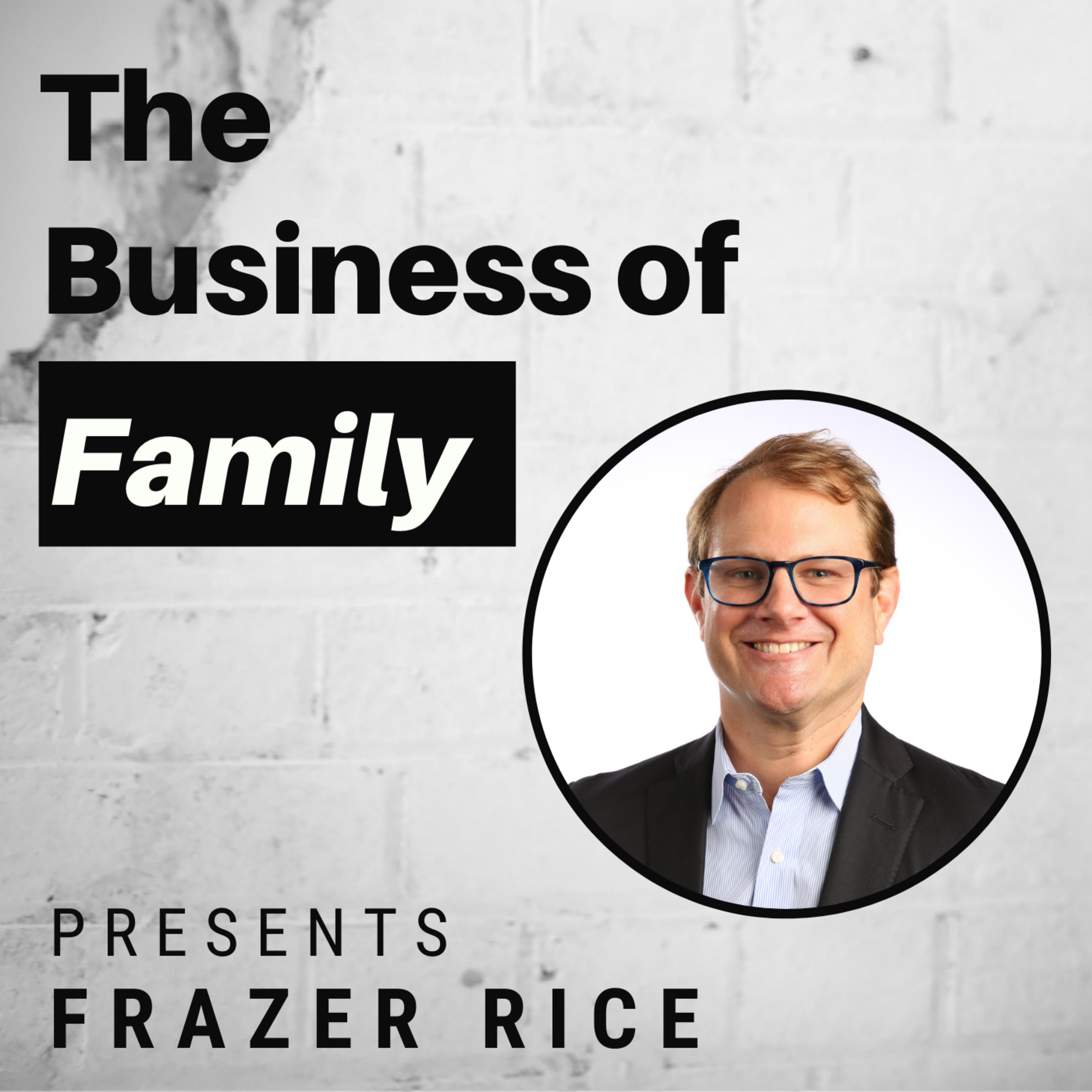
Episode 37 · Season 1
Decision Making for Wealthy Families
Key ideas from this conversation
Each child gives a dollar to a cause of their own. The fourth dollar they have to agree on together.
A holiday fund the siblings invest together: if it does poorly, it's a staycation.
A family bank where the next generation pitches for capital, a mini MBA before they face professional investors.
Read the full show notesBio, standout quotes and the episode timeline
Frazer Rice is a Regional Director for Pendleton Square Trust Company. In that capacity, he focuses on trustee, fiduciary and family governance issues for wealthy families. He is the author and podcast host of "Wealth, Actually" which centers on decision-making for wealthy families The podcast interviews wealth experts and entrepreneurial families and individuals.
Standout Quotes:
- "Something that's happening industry-wide or at least in the US is the concept that being a corporate trustee is a different business than the asset management side of wealth management" - [Frazer]
- "Most of the trust planning is articulating a move at the minimum from Gen 1 to Gen 2" - [Frazer]
- "I view the Trust and the planning around the Trust to be an outgrowth, when done correctly, of a solid communication structure that has been developed within the family" - [Frazer]
- "What the family bank approach is offering to families is a way for them to pass on their intellectual capital...to their human capital, the next generation by having them apply for the financial capital" - [Mike]
- "If the kids see what's important to the other kids early, and attach a dollar manifestation around that, I think that you're building the context so you have fewer blow-ups later on" - [Frazer]
- "I think the most important thing anyone can have in their lifestyle is the ability to be comfortable in their own skin" - [Frazer]
Key Takeaways:
- Frazer shares his background and experiences so far, from college to working in politics, after which he decided to study law and gained exposure while working in different firms. His career started down the path of wealth management when he worked with a Trust company.
- He is also the author of the book "Wealth Actually" and the host of a podcast that discusses topics related to finance and wealth management even though that was not the initial plan for the podcast.
- Pendleton Square Trust is an administrative Trust company that fulfills the function in a Trustee role aimed at helping families get access to good Tennessee jurisdiction.
- 3 main Functions of a Trustee: First is the administrative function which includes safeguarding and reporting on assets, paying the taxes. The Second is the distribution of the asset to beneficiaries. The third function is the investment management of the asset which is excluded at Pendleton, Frazer believes most places don't do everything well.
- A trustee does not have to be a corporation, it can be an individual acting as a trustee with the ability to perform all 3 key functions, however, it may be difficult to find one person who is great at all functions.
- A lot of families would prefer to have more control, and a private trust company allows them to control the aspects they're comfortable with and outsource the rest.
- There is a possible conflict where corporate trustees who also provide asset management services invariably provide their asset management services.
- The most common customer for the company is a US family that is either actively transferring wealth from the first generation to the second generation or generally has a multi-generational approach.
- For those families that have taken their hands off the wheel in terms of managing the wealth, the Trust company operates more like a family office but for those still actively engaged in the continuation of the business, that business becomes the real center of the family office.
- One of the real destroyers of wealth is bad communication amongst the family, this leads to conflict, which leads to litigation and litigation is expensive
- There's a lot of good work that needs to be done ahead of building the structures so that you're not only setting something up that takes care of the money for the family, you're also getting the family ready for the money.
- Family or Shared Philanthropy is one of the tools that helps to work with families as it gets the family members to express their interests and helps them work together while considering the needs of each other.
- The Vacation Fund Concept: This is another tool, and the idea is to have the kids make a joint decision around the investment of money by getting them to plan the vacation based on a particular amount available. It helps identify which kids have aptitude and interest, the aggressive or conservative ones, and other responses exhibited by the kids towards the task. Summarily the kids get involved in financial planning and learn critical points related to it.
- The idea of a Family Bank is putting structure around the request of money for projects so that it forces preparedness in front of real people who have to make a decision. Learning that persuasion is important helps the next generation to deal with the real world.
- It also provides an opportunity to combat the situation of assets growing linearly being overtaken by liabilities growing geometrically, as more opportunities explored can increase the growth of assets.
- There's a big difference between Operational succession and Ownership Succession of a family business, the difference in roles may mean some people get paid more but this needs to be discussed earlier on before the transition period.
- From Frazer to his kids: I think the most important thing anyone can have in their lifestyle is the ability to be comfortable in their skin. The concept of trying to please other people's sense of success is a difficult road because you're never going to please everyone all the time, more so you will be running from things that could be your path to success. o
- Run your own race, be comfortable in your own skin.
Episode Timeline:
- [00:42] Introducing today's guest, Frazer Rice, Regional Director for Pendleton Square Trust Company.
- [07:22] About Pendleton Square Trust Company and Wealth Management.
- [08:42] The 3 main functions of a Trustee.
- [11:17] In the US, do families have to appoint a company to act as Trustee in an administrative capacity.
- [12:12] The concept of a Private Trust Company.
- [18:50] Who would you say is your most common customer?
- [27:58] Frazer shares tools used when working with families.
- [32:47] The Vacation Fund Concept.
- [38:36] Frazer's insight on a Family Bank.
- [47:53] Frazer's letter to his kids
Links:
- FrazerRice : Frazer Rice is a leading private wealth manager, with fifteen years' experience advising millionaire and billionaire families on finances, including fiduciary and estate matters.
- Wealth, Actually : Frazer Rice is the author and podcast host of "Wealth, Actually" The book centers on decision-making for wealthy families
- Pendleton Square | Trust Company : Frazer Rice is a Regional Director for Pendleton Square Trust Company.
Read the transcript
This transcript was generated automatically and may contain errors, including in names. Listen to the episode for the exact words.
MikeWelcome to The Business of Family. I'm your host, Mike Boyd. Multigenerational wealth creation involves so much more than capital accumulation. The most successful families cultivate values, stories, knowledge and resources to pass on to the next generation, and they do it very intentionally. On this show I sit down with members of some of the world's most interesting business families to hear how they do it. To see where your own family stands, take the Business Family Diagnostic at businessoffamily.net.
Frazer Rice is a regional director for Pendleton Square Trust Company. In that capacity, he focuses on trustee, fiduciary, and family governance issues for wealthy families. He's the author and podcast host of Wealth Actually. The book centers on decision-making for wealthy families, and the podcast interviews wealth experts and entrepreneurial families and individuals. Frazer, fantastic to have you with us this week.
Thanks again for joining.
FrazerMike, I'm thrilled to be on. This is a lot of fun.
MikeI am aware of your book and your podcast. I'm so excited that we finally connected and get the opportunity to have a conversation about this topic, which we both obviously find mutually interesting. Can you tell us a little bit about your background, the work that you do, and what brought you this far?
FrazerSure. I started, I came out of college and I worked in politics for three years. I worked for the governor of New York State. I was in economic development. So I was running around New York trying to help locate businesses there or otherwise convince them not to move to lower tax, lower cost places, which as you might expect is a yeoman's work if you're in New York trying to compete with Delaware and Tennessee and other places. But I didn't want to be a civil servant my whole life. So I did what other lost souls do. And I went to law school.
I went down to Emory in Atlanta and had a very good experience there, great education on that front. And I had some pretty interesting experiences while I was there. My first summer, I worked at Merrill Lynch's general counsel's office back up in New York. So I got a little bit of a smattering of issues related to general counsel work, putting out fires, human resource issues, some regulatory. So that was a great little sort of toe in the water with what happens legally. My first or excuse me, my first semester, second year, I worked for the SEC in Atlanta. So So I got a little bit of exposure to the regulatory world.
So that was everything from boiler rooms to companies that were not necessarily doing the right thing in their reporting with the SEC. My second semester, second year was really interesting. I worked for an entertainment lawyer in Atlanta, a fellow by the name of Cliff LeVette. And he worked for Babyface Records. And he had a client, a very famous client, who was just starting to elevate.
and it was just fascinating. And you have sort of a old waspy white guy dropped into the hip hop world. That's probably its own sitcom writing itself. So that was pretty cool. My second summer, I worked at the House Banking Committee in Washington. So I had kind of an interesting legislative look at how things worked on that front.
And then my third year, I worked at the Federal Reserve in Atlanta. So I had more general counsel work and more regulatory work. That third year, I was in Atlanta. a nice place. The work we were doing was really interesting and people were terrific. And I said to myself, if this is as good as the practice of law gets, it's not good enough for me.
And I sort of made the mental flip that I wasn't going to be a lawyer my whole life. Now, I was third year into law school and it seems pretty crazy to sort of figure that out at that time. So I passed the bar, came back up to New York. I worked for my uncle's firm for a law, regulatory law, and some lobbying, which sort of harkened back to what I did back when I was working before law school.
And then I met a fellow by the name of Tony Guernsey, who had started Wilmington Trust's office in New York, basically on the back of his Rolodex and his contacts and his wealth management experience. And that's where my career kind of really sort of went straight into wealth management. I worked for a managing director for about four and a half years, helping to support her book of business.
And that allowed me to learn everything from investment management to trust in the States to other securities issues, taxes, a whole litany of things. She moved on to another firm and I stayed and I was on my own ever since. So I tell people I took care of the ones I have and then I went out and found new ones.
and I was there for almost 16 years and probably year 14. And this is part of the reason why I enjoy podcasting and writing. I felt like that was an itch that needed scratching. I'd had a radio show in high school and was part of a TV show in college. And I sort of set that aside to do some sort of normal career things. And I started a podcast, which you alluded to. And it's to sort of keep it away from the firewall of financial services. I was talking to people about things that I was interested in. And my first guest was an architecture critic, another one who was a writer of Westerns, bankruptcy lawyers, things like that.
And that in particular slowly migrated toward more financial services and more wealth management topics. And so that's the focus of it now. And then I also had a book in me and I wanted to, after really sort of 14 or 15 years congeal a lot of what I'd seen and what I thought constituted good thinking around good decision-making in wealth, both for families and then the advisors around their families. So I wrote Wealth Actually, and it's a little over two years now. It's unbelievable how quickly. So there's a pretty funny story about the title.
my publisher and I were fighting with each other about what the title should be. And each suggestion was worse than the next. And I fell asleep on my couch and I woke up and the channel guide was up and the movie Love Actually was there. And I said, boom, that's it. And I sort of transposed it to Wealth Actually. And then we were off and running. So it's amazing how serendipity sometimes names things. It's like I analogize it to Motley Crue, where people say, where did they get that from?
It was Motley Crue, but they got the umlauts over the vowels by looking at a Lowenbrau can. So that's, in a sense, how I named my book.
MikeAmazing. Amazing. And so today, you've moved, you're over at Pendleton Trust. And it's a topic that I'm really interested in exploring, particularly as a foreigner outside the US. The role of trust companies in wealth management, in generational wealth management, is quite a big deal. from what I understand in the US, less so in some other jurisdictions that I'm familiar with.
Can you tell me a little bit about what that actually looks like and who the core client set is? When they knock on the door, they come to Pendleton or they come to you, what's the first thing that you're doing to help them with and who are these people?
FrazerYeah. So it's a great question. So Pendleton Square Trust, we're an administrative trust company. What does that mean? We sort of fulfill one particular function in the trustee role and responsibility suite and do it in a way that helps families, whether foreign or domestic, for United States purposes, get access to good Tennessee jurisdiction. Many times that has tax implications. Tennessee has no state income tax. There are trust features that allow trusts to be extremely flexible. I can get into that later and also last a long time. And that's usually very interesting to foreign and domestic clients. So basically, when a client gets to us, normally they have gone through their advisors and as part of a larger set of estate planning,
there is a reason for them to avail themselves of Tennessee jurisdiction. Then, let's set aside what those reasons are. They've made the decision that Tennessee is where they want to go and they need a trust company to, in a sense, have a significant nexus to that situs. Then there are sort of three huge functions of a trustee. Number one is that administration component. And that involves everything from safeguarding the assets, custodying the assets, reporting on them, paying the taxes, doing the ins and outs that generally happen.
The second major function is distributing the assets. So within the trust, there's going to be guidelines and language that talks about how assets are going to be distributed to the beneficiaries. We can get involved and be part of that. We can be part of the structure and the decision-making around how assets are distributed to beneficiaries, or that function can be kept with the family or with trusted advisors elsewhere. The third major function, and we don't do this at Pendleton, is the investment management of the assets. When you go to a typical large trust company, all three of those functions tend to be folded into one another. And it's my personal theory that most places don't do everything well. So we're happy to let the investment advisor be
somebody else, especially on the liquid asset side. One thing that makes Tennessee interesting and which in the US, there's a whole sort of vein of law that's developed around this is the idea of an investment direction advisor. This was born out of the idea that corporate trustees were starting to move toward this concept of having a duty to diversify.
So if you're a real estate family or a private equity family or someone who has a specialty in hedge funds or something like that, if you were to set up a trust and have a corporate trustee who had all three of those functions, the investment, the administrative, and the distribution functions together, you were probably going to get a lot of advice on the investment management side saying, we're not comfortable with the concentration of assets that you had.
Families, especially real estate families in particular, they lose their mind over this. They built their empires on real estate. There's a whole set of tax schemes around real estate that make it attractive, and that's where their edge is. And to have somebody else say, you know, this building because we're not comfortable with it, that was creating a lot of friction for families. And so this concept of bifurcating these functions to areas where people have specialty or comfort around the management of those functions developed in the US. And that's why that's a little bit more interesting.
MikeIt is really interesting. A couple of questions or follow-ups there, if you don't mind. In the US, maybe it's a federal requirement, maybe it's a state requirement, but do families have to appoint a trust company to act as trustee in an admin capacity? Or can families actually administer their own trusts in some circumstances?
FrazerGreat question. It's a great way to pull back. A trustee does not have to be a corporation. There are many people who are individuals who act as trustee and perform those three functions, the investment management, the administrative, and the distribution functions of the trusts. And my personal thought is that it's very difficult to find that one person who is great at all three.
It's even harder to find that person who is great at all three and then knows when to quit and then finding another great person to do all that type of thing. So I would say a corporate trustee is sort of interesting to have in that light. Another thing that has started to happen is the concept of a private trust company, where in a sense, you're having the flexibility and the insight into the family dynamics that an individual trustee would have.
But by setting up your own trust company, a private trust company, you're able to borrow from the structure, the decision-making process, the different administrative resources that you might have at a larger corporate situation and bring that in-house. So a lot of family offices who are building that in other capacities, whether on the investment side or concierge services or accounting and those types of things, we're seeing a lot more interest in the private trust company aspect. We're lucky at Pendleton that Tennessee is a really good jurisdiction for that for a variety of reasons, not least of which flexibility, low capital requirements, things like that. And families don't necessarily have to build everything in-house. You can outsource or delegate to companies like ours or others to provide those services so that you're
not having to build everything from the ground up.
MikeInteresting. And I can imagine a lot of family offices really pushing for more control, or at least that feeling of more control. So a private trust company allows them to control the bits that they're confident in and then outsource for the services that they need some support with. Is that a fair summary?
FrazerAbsolutely true. I think that the concept of staying around the things that you have an advantage in or an edge in or managing around a family dynamic that you think it's going to be scary to work with a big corporate situation, that's why that's interesting to a lot of larger families and complex ones too. I think that something that's happened, I think, industry-wide or at least in the U.S. is the concept that being a corporate trustee is a different business than the asset management side of wealth management. And I think as you look out over the landscape, the trust business, in a sense, is lower margin, higher work, and variably higher liability requires really good
people to get things done correctly. And the idea that it's going to be easy to scale, I'm not quite there yet. I think there are a lot of improvements that can be made in technology and so on. But the bigger thought is that you have sort of a possible conflict too, where corporate trustees who also provide asset management services invariably provide their asset management services or their lending capabilities or multiple checking accounts for people, whether they need them or not. That's happened before and it's a sad fact in our industry. And that independence of having someone at the wheel at the administrative side of things and then using best of breed services around the investment management side of it and then having a customized or bespoke
structure in the distribution side of things, I think that's something that's gaining a lot of traction with larger families and ones that are really trying to think not only 10, 25 years down the line, but 50 years down the line so that they're not tied with one thing. The fact of the matter is that most institutions these days, they're probably going to merge or turn over or your person's going to leave.
And that institutional stability that you thought you were getting is probably going to be a little bit shakier than you thought.
MikeYeah, that makes a lot of sense. You mentioned earlier the example of a real estate family being forced to diversify. and it just made me think about a real estate family that still has active participants building wealth through real estate. How many families come and access the services of a trust company like Pendleton Square while they are current gen? And how many families are using trusts instead as a generational wealth tool where they've maybe built the wealth in one gen, the founding gen is aging and they're setting up trusts for children and grandchildren?
What's that distinction? Because in one way, I think of one as a very active style trust with the current generation still building wealth within it. The other is really quite passive and more a planning tool for the next gen.
FrazerYeah, that's a great question too. As I think about it, most of the trust planning is articulating a move at the minimum from gen one to gen two. Occasionally, we see situations where there will be clients in Gen 1 who are building the wealth, who may be using Tennessee jurisdiction as a state income tax play to reduce their tax burden that they might have in a different state.
They may be using it for asset protection purposes or the idea of building up structure so that they have defenses against creditors that are on them in that first generation. Doctors would be a good example of something like that or a high litigation type of scenario. But in general, I think that so that's one cutoff. I think the second cutoff is where you have a family that, if done correctly, I think has done a lot of forethought and communication amongst themselves as to what the goals are going to be for the next generation.
Whether that's for the next generation, philanthropies they support, communities they support, whatever that first generation is thinking they want their impact of their wealth to be. So that's the next component. And then as you move up the line to those families that understand that this is beyond just one generation, this is probably three generations and beyond, they're trying to game out as many situations as possible where the wealth and the values that helped create the wealth persist.
And that is very difficult to do when the personnel are not yet born that are going to be using the wealth or otherwise impacted by it. So you're trying to be a little bit more, for lack of a better word, sort of corporate or structured in the values and the structure with which the wealth is used going forward, in a sense, no matter who is in, no matter who's part of it.
So I would break it down into those three. I think there's sort of a current generation component and there's some sort of wealth tactics around trusts. There's the wealth transfer between generation one and generation two, where there's real knowledge of who generation two is or who they're going to be. And then there's sort of the larger, more corporate, how do I transfer this wealth and how do I build, in a sense, an employee manual around it so that it does what you want it to do and it creates the least amount of havoc.
MikeWho would you say is the most common customer?
FrazerI would say the most common customer for us is a U.S. family that is either transferring from the first generation to the second generation or has that multi-generational approach. So sometimes we have the two and a half issue where the generation three is identified, generally speaking, and we kind of know who the spouses are going to be in that scenario.
But beyond that, we don't know how they're going to turn out. And there's by play in not only amongst siblings in generation two, but between generation one and generation two. And that's probably the most interesting and sort of most by volume situation that we see. That said, I've gotten a couple of phone calls this week from generation one wealth, who in one particular case, it's cryptocurrency generated.
and this person is 30 and no wife, no kids. And we're just trying to help get them thinking about what the future is going to look like. And again, this is how you develop long-term relationships so that they're not just getting a structure, they're getting someone to talk to to help sort of think things through.
MikeThere's certainly a lot of new wealth rushing into the sector and really don't know where to start. So I think it's great to have excellent advisors around you to navigate that. I'm curious whether or not in the States, anyone uses trust or corporate trustees and these vehicles as their family office. And the reason I ask the question is because I've seen it in Cayman Islands, for instance, I've seen it in parts of Asia, where a private trust company is really set up, but still under the control and direction of the family or the founder, and used as the low tax jurisdiction in order to build wealth, even across generations.
Does that happen in the US or do families typically have a more sophisticated structure for a family office?
FrazerWell, I think the bromide is that you've seen one family office, you've seen one family office. So it very much molds to the personality of the wealth generator, in my experience, or the family that's done it. I think the trust company, because the structure is in many ways running the wealth and there are reasons to use trusts, that can be the sort of foundation block upon which the administration of wealth often happens.
That said, I've seen other situations where, in a sense, the investment tail wags the dog. And so for that real estate family, the trusts are sort of tactics behind what's happening at the property management company. That would be my sort of prejudice on that one. And to that end, taken from a different point of view, I would say one of the challenges for any wealth management firm, not just trust companies, is that when someone signs up for a suite of services and engages with someone, you have the issue of scope creep.
And families are very good at understanding what they pay and then getting more out of that than they need to. And when you're starting to get paid big bucks and you want to maintain the trust and the goodwill of your client, you'll bend over backwards for people. And so sometimes you get some situations where you're doing something that may not necessarily be part of your charter and your mission statement, but it's the right thing to do for the client.
And so sometimes structures metastasize accordingly, and then you need to hit the reset button every few years to make sure that it's good business for the people who are providing the services. So to answer your original question, I would say that for those families that have sort of taken their hands off the wheel in terms of managing the wealth, I think the trust company does operate much more as a family office.
For those who are really engaged in the continuation of a family business or other activities that sort of continue to drive wealth creation, I think that becomes the real center of that family office type of that type of family office structure.
MikeYou raise a good point there about operational family businesses. What proportion of customers have illiquid assets like that versus liquid?
FrazerI'd say for us, and I'm ready to be corrected by my boss, but I would say it's at least a third and probably half have something illiquid and operational or are in the process of selling that. We also do a lot of work with RIAs and investment advisors. So we have a lot of work with people who have been liquid for a while. But I'd say a third to a half are in some transition of running a family business or some other illiquid operation, or in the process of figuring out what to do with it.
MikeExcellent. I want to turn now to the softer skills side of things. As you said, you are not investment managers or wealth managers. So you're dealing primarily with the administration of trusts. But what about things like helping families with their family charters or constitutions, mission statements, values, things like that, where they're actually planning for the next gen or multiple generations. Is that part of the service that you're providing and something that you're actively involved with?
FrazerShort answer, yes. In my book, even before I joined Pendleton, I sort of came to the conclusion that one of the real destroyers of wealth, it's not bad investment advice. It's rarely bad tax planning or even geopolitical issues. It's bad communication amongst the family. And when there is baggage or hurt feelings or misunderstandings or lack of information, that's what leads to conflict. Conflict leads to litigation.
Litigation is ultimately expensive. I view the trusts and the planning around the trust to be an outgrowth, when done correctly, of a solid communication structure that has been developed within the family. So that's not to say that everyone who comes to us is wrapped up in a nice bow and everything's perfect and you go in and the trusts are set up and kumbaya, everything moves forward smoothly. That's hardly the case. But I think the really, really good wealth managers, estate planners, wealth advisors, family advisors understand that there's a lot of good work that needs to be done ahead of building the structures so that you're not only sort of setting something up that takes care of the money for the family, you're also getting the family ready for the
money. And if you don't do that second step, that's where things like overspending, hurt feelings as to who is going to take over the family business or not take it over, all sorts of issues that most people associate with trust fund kids and other scenarios like that. That trying to get that communication structure in place so that the family not only understands the how of the situation, but they really understand the why.
You're trying to keep the family enterprises going as long as possible. And there are a lot of natural forces that fight you on that. And if you can somehow have everybody moving in the same direction and being, I guess, sort of ideologically aligned as to why we're doing things, how we're doing things, and then the tactics that implement all of that go forward, you run a much better chance of avoiding the shirt sleeves to shirt sleeves phenomenon.
To me, the equation is the assets are probably growing linearly while the liabilities are growing geometrically. And that natural law is what you're trying to fight. And you can do all the trust work and planning and all that as possible. if those liabilities not only increase geometrically, but go even asymptotically because the siblings are fighting and there's no agreement and you're selling things at a fire sale or dividing assets for strange reasons, stuff like that. That's very difficult to overcome.
And notwithstanding all of that, it's extremely unfortunate because a lot of the good ethos that went into building the wealth has been forgotten. And that's, I think, where we as a trust company we get as involved as the families want us to get involved with or the advisors. And we're very happy to provide the education around the trust capabilities and help to provide really some of the backbone along with the other advisors as far as the why things are being put in place.
Because without that, you lose one of the real attributes and strong attributes that families have. And that's really sort of using the values that got them where they were in the first place.
MikeYeah, I think that's an excellent summary. And it reminded me, last time we spoke, you talked through some of the most interesting tools that you use when working with families, which I think is an interesting point to jump to now because it's really about the how you do this, how you get families thinking about these issues. I'd love if you could cover that off for the benefit of the audience too.
FrazerYeah, so it's really easy to get to say, oh, communicate better. So I took from a colleague of mine at Wilmington, followed by the name of Tom Rogerson. He has a couple of examples, and I've sort of adapted them a little bit. One thing that's interesting, at least in the U.S., from getting kids to understand that the world is a bigger place, for people who have an allowance type of situation for kids, where if you pay a kid $5 a week or something like that and take back $2, you get them to understand that the world has taxes in it.
And when you see that Kim Kardashian makes $100 million this year, that number may not be the actual number. And when you see numbers floating around, that's not necessarily how the world works. So that's a very sort of tiny tactic. I actually got that from a golf pro named Joe Ogilvie, whom I went to college with. And I said, you know, that's terrific.
I love that. What you're talking about as far as the intergenerational communication, I think one thing that's really interesting is the concept of a family philanthropy fund. Now, certainly, it's very easy to set up foundations and do things like that and just immediately go straight to structure. And we do things because we give back and so on.
But I think at a more micro level, an example that I like is the concept of a shared philanthropy fund where you can do it with any amount of dollars you want. But let's say you had three siblings and you had $4 to give away. You can add as many zeros onto the end of this as you want.
But let's say you had three siblings, $4 to give away. Having the three siblings each give a dollar away to a cause that's interesting to them provides data for a few sets of people. Number one, it forces the individual to think about what's important to them and how do I use the wealth for good and some of those types of concepts.
The siblings get an idea of what's important to the one kid. And the one kid has an idea of what's important in the other siblings. The parents get to see some of that too. And to see how each one, given a dollar that they have pure control over, that that provides data, that provides context. And so that context is part of a slow boil that occurs as you're trying to learn more about your kids.
So that's just on the, here's a dollar, give it away in the way you like and keep track of it, that type of thing. But the interesting part is that fourth dollar. And I think where you really start to think about the lessons around that, if you can get the three kids to jointly decide how to give that fourth dollar away, that I think is where the magic really starts to happen.
Because then you're having the three kids interact, not only in terms of compromise, decision-making capabilities, dealing with a joint decision around money in a way that has nothing to do in any large stakes capability with the family wealth or anything like that. They learn how to prioritize their own wishes and wants and take into account other people's wishes and wants.
And then by giving that dollar jointly, they get experience in working with each other. And it's working with each other around a money concept. Done that way, the parents also learn and see who's good at what, who's interested, who's not interested, who has aptitude, who needs help. Those types of things, it's just a nice sort of soup of data that everyone is starting to see. And that helps to build the context around the bigger planning, the more difficult planning later on. And when someone, you know, the worst thing that ever happens is when, you know, the estate is laid out after someone dies and people say, oh my gosh, I got this or that and why and who did this. And if you have some idea about having made decisions within the
sibling ranks, some of that will have made sense, may not solve all the pain points and so on, but that's a good early stage thing that can also be fun. And it's a great way for kids to interact with the rest of society and kind of understand how to have an impact with the wealth. So that's one tool. We can go into questions about that or I can go into another one.
MikeNo, I think it's fantastic. And the other one I want to talk about is this vacation fund concept. We have had a patriarch on the show previously talk about how their grandchildren get involved in, I think it was actually a vacation committee proposing what they should do and how to manage the budget and that sort of thing. You have a similar concept around that, I believe.
FrazerYep. And I have to give Tom Rogerson credit for this because he did that with his family. But the concept is to have a vacation fund. And so for round numbers, let's call it $10,000. And let's say we have the three siblings. I think the concept of it, this is not just sort of understanding how everyone thinks, although you do get some of that together, but you're having the kids make a joint decision around the investment of money. So it's one thing to give away money like in the previous example. That's easy. You have a dollar, you give it away, et cetera. This one, it has not only the interrelationship of the siblings around a money decision, but it has broader accountability,
not just to the siblings, but also the parents. And I think that's important because it gets done well, I think it gets everybody moving in the same direction. And what you end up seeing as part of that data, you see, again, which kids have aptitude and interest. You also see who's aggressive, who's conservative, who's interested in tech, who's interested in cash flow, who's interested in different types of things. And the parents can watch that and see, you know, some people may just not even have the, when I say aptitude, they may just not be able to do it.
and they're kind of along for the ride and they kind of give the functions up to the other two kids, that's good for them to know as far as the estate planning is concerned or in identifying someone who may or may not be interested in the business if the family's wealth is sort of built around that. But it also gives, again, light experience or low ramification experience around potentially bad situations. So if that $10,000 fund is invested in, again, a good example, I guess now would be shorting Bitcoin, I guess, if you could do that. And they said, oh, no, it didn't work. We went from $10,000 to $2,000 and we went on a worse vacation.
That experience, in a sense, is the kids touching the stove once and understanding what over concentration is, understanding what leverage is, understanding what betting against something is. And then by the same token, in a subsequent vacation, if they take the $10,000 and they had a different experience or a diversified portfolio or something like that, and it went up to 12,000 and it got them to do something a little bit nicer or a different experience with something they were a part of, that's another experience. And all of those types of things are different on-the-ground experiences that are not just personal where people are doing it within their own brokerage account and their educations are paid for anyway and stuff like that. This one,
you have accountability, as long as everyone kind of buys into it. You have accountability that if it does poorly, it's a staycation. If it does well, we're going to the Ritz-Carlton. And I think it creates, and it isn't that much money that it's going to harm anything in the broader sort of structure of the ultimate family wealth. But it can be material. And I think it's a really good learning experience.
MikeI think it's also an excellent way of embarking on exploring these types of topics in a way that's not too onerous, right? You're talking about taking a toolbox of tools, applying it and teaching these lessons through things that families are doing anyway, right? Is getting children involved in planning the family vacation that was going to happen anyway, but now they're learning decision-making, risk-reward, trade-offs, et cetera, as you say.
And I think that's an excellent way to spark interest, perhaps in teenagers, perhaps even younger, and getting them involved in bigger decision making as they age.
FrazerYeah, well, and the other part too is if you get them sort of involved in the financing end of it and the investment of the money to get to that point, and then they want to take more ownership of the planning of the actual trip. That's an interesting way to sort of see the values that you're trying to inculcate in the next generation, take actual root in a money decision.
And I think that can be, if you get to that outcome, I think you've done it really well and in a thoughtful way. And I guess the other major point around that that I think is interesting is it's purely on the business side. If you're an investment advisor or you're someone who is advising families and you're trying to figure out how to be relevant to the next generation, this is a good way to do it.
I've told all sorts of RIAs and wealth managers that this is a very low wattage way to go in and have an educational forum to talk about what you do and what value you add. And if you have other questions around these concepts, why they can come to you. And it's a wasted opportunity for those folks who otherwise might say, well, I'm going to go meet the kids and I'll talk to them about stocks and bonds. That gets dry very quickly. You get eye rolls and people looking at their phones and it never quite materializes. If it has a tangible aspect like this, I think it's a great way to maintain the stability of the team that's thinking about the wealth.
MikeNow I want to touch on one of my favorite topics. I believe you've got a similar concept to a family bank. And it's, again, something we've explored on this podcast before, and there's so many different variations of it, but I think it's a really healthy way for families to think about wealth. Can you share with us your insights and concepts around a family bank?
FrazerYeah. So I think one of the concepts is you start moving up the wealth food chain, and you are multi-generational at this point. And I think that there are concepts that the family agrees to, that entrepreneurism is a big reason why the family got where it's going. There are pools of capital that are meant to be grown. And then you have a whole reservoir of talent in these family members who, in many ways, are trying to find their own way. And that can take different forms. But what can be dangerous, I think, is when a next-generation person comes up and says, oh, I'd like $50,000 to start this business. And it's not very structured in its
approach. I think the family bank, it can take many forms, as you said. But in this case, in a family office with, let's say, you're able to have an organization within it with, let's say, anywhere from three to five people who act as a committee in terms of allocating a pool of capital to next generation projects. I think there are a lot of great real world lessons to impart, to have that committee provide us process upon which the next generation has to go through to access those pools of capital so that they're not just given. What does that teach?
It teaches everything from how do you deal with the business plan? How do you deal with raising money? How do you deal with sales? How do you deal with presenting? How do you deal with public speaking? And then the fix can always be in at the end of it. And there can always be a way to sort of fund projects that ultimately were probably going to be funded anyway.
But to have the process of a family bank where, I hate to use the shark tank analogy, but to have to get up in front of a group of people, like people have to do in the real world, and present a business idea, why it's going to make money, how it's going to make money, how you're going to make payroll, how you're, you know, have you thought through, you know, if you formed a corporation around it? Are you protecting the IP around it? How are you going to access the market?
Do you know anything about renting office space? All of these types of things can go through this informal yet formal channel within the family office, within this bank committee, so that they have imparted, they've gotten sort of a mini MBA or sort of entrepreneurship experience before they go out in the real world and trip on themselves making rookie mistakes.
trying to raise money from people who do this for a living, who may not have the resources behind them that the people who are part of a family office or a family of that size have. So I think the concept is really just putting structure around the request of money for projects so that it forces prepared materials, prepared concepts, prepared presentations in front of real people who have to make a decision. And the next generation, if they learn that persuasion is important, they're going to be much, much better equipped to deal with the real world, both within their family office, but also with the different structures that are outside of it.
MikeLove it. And one way I love to look at this is through the lens of Jay Hughes' book, Family Wealth. And really what the family bank approach is offering to families is a way for them to pass on their intellectual capital in the form of how things are done and educating and values to their human capital, the next genitor, by having them apply for the financial capital of the family. And I think that a lot of these things that we're talking about that are tools in the toolbox are really an excellent way to pass on the values and the how-to and the what's important to the family and less about the actual financial capital attached to each one of them.
FrazerNo question. And I would add on to that for the generation up, the first generation or the second generation that would be sort of in the shoes of the family bank, they also are identifying talent and they're also identifying investment ideas that many times they would not. And I talked about that sort of growing assets linearly versus the liabilities growing geometrically. Well, one way to combat shirt sleeves to shirt sleeves is to find a way to grow assets more than linearly.
And many times, you know, the youth of a family office, they're going to be connected with other successful families by and large, or have an opportunity to be around different opportunities that the older generation is just going to miss. And I think it's a great cultural tool to build that intellectual capital, not just transferring values down to the next generation, but transferring business ideas back up. And that to me, I think would be really interesting to family offices as they're trying to surface these things.
MikeReally great point. I like that a lot. I want to flip things now and briefly talk about the negative. I want to understand what goes wrong when things get ugly, when you're talking about family trusts or inheritances. Do you have beneficiaries challenging the trust or asking for more distributions or running out of money, overspending, things like that? Or is all of that largely kept away from your level?
FrazerNo, it happens all the time. And a lot of the tools that we just talked about that try to forestall those issues, they don't always work. And you have people who go their own path, maybe didn't have an understanding of what funds a lifestyle that connotes a family office experience and that the dollars needed to do that. They just have no sense of scale as to what that means.
That often is a big issue. If you need $500,000 a year to get up in the morning, that probably means you need to have $10 million somewhere to generate that 5% return so that your life can go on on automatic pilot, if people are spending down trusts or other structures in advance of that, and then suddenly they get to age 50 or 55 or 60, and $10 million is now more like $2.5 million, well, you're not going to get $500,000 lifestyles out of that and have that last very long.
And so on that front, the tricky part is what structures have been put in place to try to maintain the principle so that lifestyles can be maintained in an inflation environment, which we haven't really had much of lately, but it could come back quickly. Just look at the cost of timber now and people taking out mortgages to put up fences, which is crazy. Inflation can be a big part of that. But I think, too, it gets back to that communication side of things.
wealthy families, families generally don't like to talk about money. And there can be all sorts of unknown damage that's created over the years, not least of which there's sort of the interpersonal damage and baggage that's built up over time where siblings sort of look at each other and one's been favored over another or one's been part of the family business or something like that. And they've made certain choices as to one goes to the Peace core versus one becomes an investment banker. And 20 years later, they kind of wonder why their lifestyles are different. That's ultimately, that's an education issue. And it goes back to even that simple exercise with that shared philanthropy. If the kids see what's important
to the other kids early and attach a dollar manifestation around that, I think that you're building the context so you have fewer blowups later on. But the blowups happen. And I see it oftentimes, we talked about family businesses and so on. To me, there's a big difference. It's a Venn diagram, basically, but there's a big difference between operational succession of a family business and ownership succession of a family business.
You can have family members who are in the operational side of things and others who are not in that side of things. And many times patriarchs or matriarchs try to reflect that difference in the ownership transition. And so the people who are running the business should get paid to do that and probably own a little bit more because they're taking responsibility for it.
Whereas those that are not part of that may own less and may get a smaller distribution. That ultimately, if that isn't gamed out early on, I see a lot of conflict in those types of situations. And that's something that is best not left untalked about until the will is read.
MikeAbsolutely. There's some tremendous takeaways in there. Unfortunately, it's now time for our final question. And as you may know, it's one that I ask all of my guests. Imagine you're writing a letter to your children. What is one lesson or idea you don't think many parents would mention that you consider important to understand?
FrazerI think the most important thing anyone can have in their lifestyle is the ability to be comfortable in their own skin. I think that the concept of doing things for other people, doing things that other people think might be good for you or trying to please other people's sense of what success is, I think that's a difficult road. First of all, you're never going to please everyone all the time. But worst of all, you're going to be running away from things that I think might be your path to success.
And if you don't run your own race and you run somebody else's race, it's not going to work real well. In me personally, I have my book and my podcast and I get more involved with media. And it's been something nagging at me for a long time. And I'm in a traditional, I'm a lawyer also, and work in wealth management and talk about these things. But interweaving what I really like to do on the media side of things with, let's call it the day job, was extremely important to me.
And if I was left at the end of my life wondering what if, I would think that would be a real tragedy. And I won't have that problem, at least not with this particular area. So I would caution or I would just tell someone in a letter to kids and nephews and nieces and family members and things like that.
I would say, just run your own race and be comfortable in your own skin and you'll go pretty far.
MikeIt's a wonderful lesson and a great way to bring this to a close. Frazer, thanks so much. I've learned a heap and I hope we get to do this again. Really appreciate you being here.
FrazerI appreciate it, Mike. This is a lot of fun. Thanks again.
MikeThanks for listening to The Business of Family. You'll find the transcript and key ideas from this conversation at businessoffamily.net, along with the Business Family Diagnostic. It's free, and it shows you where your own family stands. And if someone in your family should hear this episode, please send it to them too. I'm Mike Boyd. Until next time, take care.
Keep listening
If this one landed, start here next.
Building Your Family Bank to Owning an NBA & NHL Team
Running a family bank with written policies and a say that is earned.
Preserving Families and Perpetuating Businesses
Small shared decisions before shared ownership.
The Family Board Meeting
A simple rhythm of one-on-one time with each child.
The Business Family Diagnostic · Engine
A mini MBA, run by the family.
Frazer's family bank asks the next generation to pitch for capital, with a plan and a presentation. When someone in your family brings a new business idea, is there a way to consider it seriously?
“Family members are encouraged to start new things, inside the family enterprise or outside it.”

Every family wishes someone had recorded the generation before.
I built Enduring Stories to do it for yours: a guided voice conversation, from home, that keeps your family's voices, values and history.
The newsletter
The most useful things in these conversations are the things families rarely say out loud.
I share them in my newsletter once a week. Sign up to receive the ideas directly and start building the foundations for your family today.