Episode 11 · Season 1
Building Your Family Bank to Owning an NBA & NHL Team
Key ideas from this conversation
Two ways to borrow from the family bank: a financing loan for a business, or an enhancement loan for education and growth.
Write the policy before the argument, while nobody is upset and there's no name attached.
When a family turns one asset into another, that's a reformat of its capital, not a loss.
Read the full show notesBio, standout quotes and the episode timeline
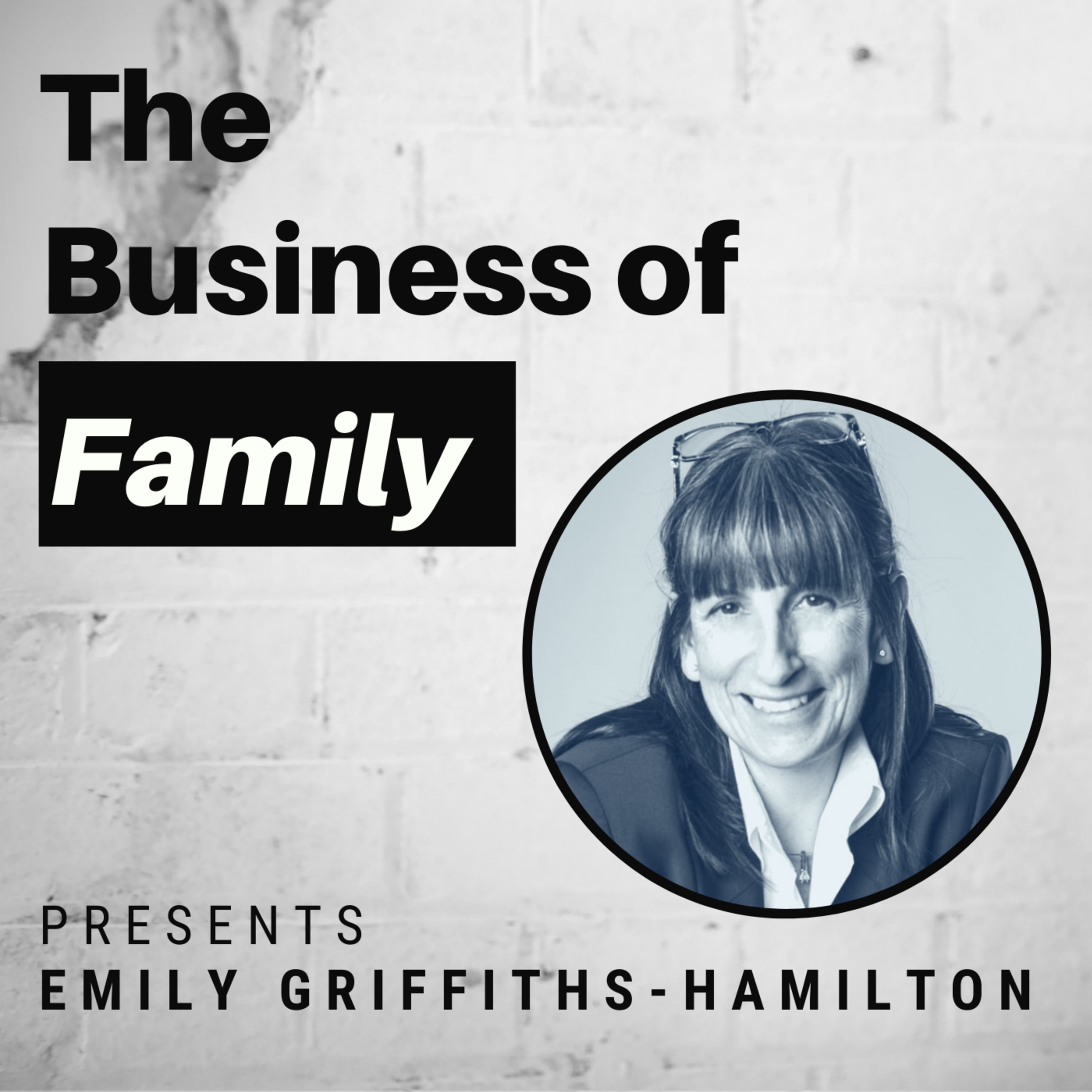
Emily Griffiths-Hamilton brings three generations of experience to the subject of wealth and family-business transition planning.
Her maternal grandfather, veterinarian Dr. William Ballard, was one of North America’s greatest dynamic wealth creators. Her father, Frank A. Griffiths, FCA, built a highly successful sports and media empire. Emily herself, along with her brother Arthur and their partners, has been the co-owner of a National Hockey League (NHL) team, the Vancouver Canucks; a National Basketball Association (NBA) franchise, the Vancouver Grizzlies; and a state-of-the-art-arena.
Emily’s professional training, expertise and unique first-hand experience have given her a deep understanding of the benefits of clear, considered wealth and family-business transition planning.
Today, she is passionate about providing guidance to individuals and families for the effective multigenerational management of family wealth and family businesses.
Emily is the author of two excellent books, Build Your Family Bank and Your Business, Your Family, Their Future, which look closely at the core causes of wealth erosion and failed transition plans and offers a set of strategies for building successful wealth transition plans that will benefit many generations.
Standout Quotes:
- "A legacy lifestyle to me is really anything where anyone is enjoying an affluent life based on someone else's earnings"
- "Earning a voice at the table is critically important as the families get larger because not everybody is necessarily around the table making decisions for the family bank but the family council may be elected members to represent different parts of the families"
- "Life is the reflection of the Choices that you make between your Birth and your Death (life is the C between the B and the D)"
- "The choices that you make are going to be a reflection of the decisions that you make, and if you really want to make the best decisions, think about swapping judgment for curiosity"
- “Curiosity can open your eyes to a world of unlimited imagination and infinite possibilities”
Key Takeaways:
- The process of creating the family wealth was infused into the family DNA added in each generation.
- The issue in a legacy lifestyle is enjoying a lifestyle that someone else is earning the funds to afford you, the cautionary note is to watch for the creep of entitlement issues.
- The traditional approach to wealth transition planning including tax deferment and trust funds fail 70% of the time.
- As long as your human and intellectual components are still strong, the Family bank will keep standing.
- Reasons why 70% of families at each generation fail at wealth transition include a breakdown of communication and trust (60%), the unpreparedness of heirs (25%), lack of shared vision (12%), and failure of professionals (3%).
- Earning a voice at the table is critically important as the families get larger.
- Family bank is not a legal term, it's a philosophical term; it's whatever the family defines it to be.
- 5 reasons to put a Trust in place in Canada: Control, Creditor Protection, Privacy, Probate and Tax.
- Research shows that within 7 years lottery winnings are usually gone which is the same with inheritances.
- If you want to make the best decisions, swap judgment for curiosity
Episode Timeline:
- [00:45] An overview of some of Emily's work.
- [02:16] How the initial family wealth was created and sustained through the different generations as part of the family DNA.
- [05:16] Emily explains the clear distinction between Ownership and Management.
- [05:27] Her contribution to the Family DNA of wealth creation is the Role of Stewardship.
- [08:22] The event leading up to the ownership of the Hockey team reflected a sense of commitment to the community.
- [10:26] Emily narrates the experiences that inspired her career choice of a Family Enterprise Adviser.
- [15:31] The legacy lifestyle defined, with examples from Emily's childhood.
- [19:22] The value of work and its role in Family wealth creation.
- [21:07] The concept of a Family Bank is most appropriate for anyone doing succession or wealth transition planning.
- [22:01] The Foundation and Components of the Family bank approach.
- [27:00] Reasons why 70% of families at each generation fail at wealth transitions.
- [38:56] The value and role of tools like trust structures and tax mitigation strategies in the managing multi-generational wealth.
- [45:03] The similarities between inheritances and lottery wins.
- [53:48] Re-Formatting is a change of investment choice and a Redistribution of wealth to philanthropy are not considered a failure of to transition.
- [55:25] A few surprises from her sons influencing the family bank.
- [01:01:10] Emily's letter to her children.
Links:
- Build Your Family Bank | A Winning Vision for Multigenerational Wealth : Fresh & Accessible Guides to Successful Wealth Transition
- Volunteer Role | The Nature Trust of British Columbia : The Nature Trust of British Columbia took on the daunting task of protecting the natural riches of the province by building a treasury of wild natural areas to conserve iconic and important species at risk.
- Book: Your Business, Your Family, Their Future: How to Ensure Your Family Enterprise Thrives for Generations eBook: Griffiths-Hamilton, Emily : Through extensive research and personal and professional experience as a member of and advisor to family enterprises, Griffiths-Hamilton has developed an unconventional approach that looks beyond narrow business considerations to focus on the critical aspect of every family enterprise—the “family factor.”
- Book: Build Your Family Bank: A Winning Vision for Multigenerational Wealth eBook: Griffiths-Hamilton, Emily : Why do 70 percent of wealth transition plans fail? This is the question that Emily Griffiths-Hamilton sets out to answer in Build Your Family Bank, a book that looks closely at the core causes of wealth erosion and failed transition plans and offers a set of strategies for building successful wealth transition plans that will benefit many generations.
Read the transcript
This transcript was generated automatically and may contain errors, including in names. Listen to the episode for the exact words.
MikeWelcome to The Business of Family. I'm your host, Mike Boyd. Multigenerational wealth creation involves so much more than capital accumulation. The most successful families cultivate values, stories, knowledge and resources to pass on to the next generation, and they do it very intentionally. On this show I sit down with members of some of the world's most interesting business families to hear how they do it. To see where your own family stands, take the Business Family Diagnostic at businessoffamily.net.
Emily Griffiths Hamilton brings three generations of experience to the subject of wealth and family business transition planning. Her maternal grandfather, veterinarian Dr. William Ballard, was one of North America's greatest dynamic wealth creators. Her father, Frank Griffiths, built a highly successful sports and media empire. Emily herself, along with her brother Arthur and their partners has been the co-owner of a National Hockey League team, the Vancouver Canucks, and a National Basketball Association franchise, the Vancouver Grizzlies, as well as a state-of-the-art arena. Emily's professional training, expertise, and unique firsthand experience have given her a deep understanding of the benefits of clear, considered wealth and family business transition planning. Today, she's passionate about providing guidance to individuals and families for the
effective multi-generational management of family wealth and family businesses. Emily, it's fantastic to have you on the show with us today. Thank you again for making time.
EmilyMy pleasure. Thank you for having me. I'm looking forward to this.
MikeShould be lots of fun. I've been looking forward to this conversation actually for some time after reading your books as you have a particularly interesting story around how you arrived where you are today, at least in my opinion. I believe you grew up as a third gen child amid quite significant wealth and you were ultimately drawn into the family wealth advisory business yourself.
Can you tell us a little bit about how the initial family wealth was created and the circumstances around that?
EmilySure. And the interesting thing about how it was created was what we learned in each generation, how it created our family DNA, so to speak. So in the first generation, there was my grandfather, Dr. Ballard, and Dr. Ballard was a veterinarian. And he did something quite unusual at the time, this is during the Great Depression, is he came up with the idea for canned dog food. That seems kind of obvious today, was a big deal at the time. And that started the wealth creation in our family. But what it started in our DNA is that I looked at my grandfather who had a foundation skill set.
He was a veterinarian. He had a job, he had a profession as a veterinarian, but he had a side hustle. And that side hustle was the canned dog food. And that created the first generation of wealth. And then moving into the second generation, my father was a chartered accountant and my other grandfather was a chartered accountant. And so I saw there again, a foundation skill set, happened to be a chartered accountant in his case.
and while he was building his business as a chartered accountant he practiced until he was 62 years of age in public accounting doing all these things that were going to be some of the things we might even be talking about today or you talk about with other families about escape planning and succession planning and taxes and tax planning and controls all those sort of things he had deep knowledge insight that's what he worked in in his career but he had a side hustle along the way. And I won't go into the details how we got into that, but he built a communications and media empire in Canada and tagged onto that a sport franchise, sport and entertainment,
the ownership of our, I'm in Vancouver, British Columbia, our Vancouver hockey club, the Vancouver Canucks, which for Canadians, hockey, kind of a big deal. So that was his side hustle. But I learned something else. We had a third thing added to our family DNA. And in my family, what I learned by watching my father was a very clear distinction between ownership and management.
He owned these companies. He was an engaged, responsible, driven owner, but he wasn't management. He didn't actually work in any of the businesses. So that was the second generation. And the third generation, that's my husband and I. I have foundation skillset. I'm also a chartered accountant. And as a side hustle, I've also been a business owner and builder myself.
And that involved my brother and I taking over ownership This is many years ago of the Vancouver Canucks. But to that, we added with our partners, the McCaws, we added the NBA franchise, one of the first two in Canada, the Vancouver Grizzlies. And we self-financed a state-of-the-art arena for both the hockey club and the NBA franchise in Canada.
So that was, some called it a financial kamikaze mission that we were on. It was definitely a big dream that we made come true. So anyway, so sat in those shoes, but I also understood in our generation with my husband and I, the separation between ownership and management. I was an owner in those businesses. I was not a manager and we're involved in other businesses today. Again, clear distinction between ownership and management.
The fourth part of the DNA, though, that we've added in our generation is the role of stewardship. And that comes to a bit of what we're talking about today and about the family bank, and that we see ourselves that through the generations, because the way things have worked, there has been a flow of an inheritance of one form or another.
And we see ourselves as stewards of those assets for our children and future generations, hopefully in our family. But we live off of the income that we earn. And our children know that. We are stewards of the family bank, but we also are dynamic wealth creators ourselves, my husband and I. So that's what we live off of.
We steward the family inheritance, so to speak. And then as you mentioned, the fourth generation. We have two sons and they are now 29 and 27. And when I wrote the first book, of course, that was five years ago. So, they were that much younger. So, things have evolved again in our family bank, but we have a fourth generation coming along.
MikeThat's terrific. What a wonderful story. One thing I'm curious to clarify, obviously, it's a big name sports team, the Canucks. how did your father come to purchase the ownership of such a sports team was that due to the wealth created by your grandfather originally that was passed down was that part of how the asset was acquired or was your father also such a dynamic wealth creator that he created significant assets in order to get into a business like that because i assume it's it's not a cheap purchase
Emilyno that's a wonderful question so my grandfather's generation there were three daughters and a son and my mother was the youngest child and a daughter and in those days what was very common at the time was primogeniture that the business goes to the first born male so in that family's case he was amply qualified to run the business so he got the business each of the daughters received a sum of money on their 21st birthday and a was it a rolls royce it was something insane at the time and a lump sum of money. So my parents actually used that many, we're talking decades ago, that went towards the first acquisition, which was a radio station in Vancouver, CKNW.
MikeRight.
EmilyHow the purchase of the Vancouver Canucks came about was many years later. And what had happened was that a couple of things happened. One, the Vancouver Canucks was the only publicly traded company that owned a professional sport enterprise. Every other one was private. So, that was a bit of a weird little thing there. The public stock was, I want to say maybe 85% owned by one person. So, it was very thinly 15%. But what that did mean is that the statements were public knowledge. Everyone knew that the Canucks did not make money. So, that was well known. So how that came about was the previous owner had been cooking the books and he was being
sent to jail. So the community approached my father because my father was very involved in the community of Vancouver and it's a business leader and a business builder and that and came to him and said, can you put together, can you find someone to buy this business? Because he was a CA and he was one of the lead CAs in the city and would know who to talk to that would have money and be interested in this kind of investment.
Anyways, he went about doing that, couldn't find anyone to do it. Brought a group of individuals in those days, we can imagine this is 40 or 50 years ago. This is a group of men all around the table. And at the last minute, everyone steps aside and my dad says, well, you know what? I'm committed to this community.
We've always had hockey tickets, two seasons ticket. And because of his commitment to the community, he said, we're gonna take this on as a family. So it wasn't something that I grew up at the table or we talked about or we're going to own a hockey franchise. It was more of a community investment. And that was another legacy that we learned at the dinner table was the importance of community.
And it's a bit like that inheritance issue and the inheritance versus an heirloom. We really saw this as something that we treasured and we respected to do the best by it for the community. We didn't see ourselves as bolstering our egos or any of that sort of thing by it. So that's how it happened. That's how it came about.
He took that investment and because of his skill set and because he was a different kind of owner and such a strong chartered accountant, he ended up doing a lot of work at the NHL at the governor's level. He was one of the ones that was behind the restructuring of the league because the travel times and that didn't make sense if you were on the West Coast versus the fellows that were on the East Coast.
He did a lot of work at the NHL level. And to this day, actually, he's a member of the Hockey Hall of Fame, which is actually, as a Canadian, it's kind of cool.
MikeVery cool. Very cool. What an incredible story.
EmilyThank you.
MikeSo I'm curious, you followed what sounds like family footsteps into the profession as a chartered accountant, but you've also become a family enterprise advisor. Was it your experience being a member of a multi-generational family that drew you to this profession?
EmilyIn all honesty, I actually didn't know the profession existed when I got involved with it. And I had several years ago, I'd entered the investment industry. My husband's been a portfolio manager for now over 30 years. And I joined his team. And once I joined working with my husband, one of the things that he did was he could give me things to read. There was another book. There was another book. There was another book. And one of the books that he gave me was that Roy Williams, Vic Preisser, Preparing Heirs. And it's a smaller book. And one day I sat, I still remember it. It was wintertime in Canada. I sat down in a chair next to the fire, a big fluffy
chair. And you'd think most of you would go to sleep reading a book like that just because it's a business book. But I sat down and I was utterly riveted because for the first time, I began to understand how my father's plans hadn't turned out the way that I think he would have liked them to have turned out. There was an article that was published in the Financial Times at the time.
It was a magazine, a Canadian magazine, but the cover photo was a picture of my dad and my oldest brother and then just a blaring headline and it was Griffiths family saga, lines of descent. And it was just, it was heartbreaking to see. And this is after my father had passed away. It was heartbreaking to read. And so what I knew, and having worked in the profession myself as a CA, what I knew is that this article claimed that my dad had no plans in place.
Now, this is a man who had practiced in the profession for his entire life. I can assure you he had the best traditional plans you could ever possibly imagine in place. In fact, by the time I was 21, I probably had a more complicated personal legal structure most people may ever see in their entire life.
MikeI can imagine.
EmilyYeah. So, it just left me wondering. And then that book is what kind of ignited my interest. And shortly on the heels of reading that book is when I found Family Wealth, Keeping It in the Family, the James E. Hughes book, which is words.
MikeThe classic.
EmilyYeah. Words escape me. he's just a remarkable individual it's a fabulous book and from there I started thinking about these things and with the backdrop of that now being able to better understand perhaps what could have happened differently in my family flash forward to now I'm sitting with other families in the investment industry and they're coming in to talk about their portfolios but they're really also talking about their wealth transitions and my curiosity's peaked and people are talking about things like they've sold the family business. And I'm really curious, well, how did that happen?
And well, we have two sons, they worked in the business, they didn't go to them. Well, how did that go? And so really, those conversations led to me developing the family bank approach.
MikeAnd so I imagine that there's quite some advantages in sitting on both sides of the table, having personal experience as an inheritor and then experience as an advisor as well. that must benefit your clients in being able to, I guess, sympathize for want of a better word and understand what they're going through in making some of these difficult decisions.
EmilyYeah. And I'd maybe 100%. And I'd maybe even add empathize to that also to the sympathize and empathize. And you were right. When I think back on that, I can honestly say I've sat in the seat of a dynastic trust beneficiary from my grandfather and my father's generation. I've sat at the family dinner table to watch how communication unfolded in our family. I've also sat at the business board table of the family enterprises, being asked to join first on the audit committees because of my CA background and eventually at the board table. And then in my own generation as an owner builder myself and know what it's like to own a business, to take a big
risk, to how's it going to work for the next generation, and then as a parent and as a mother. And I'd also add to that one that when I approach this work, I always think, what would have captured my dad's imagination? So sometimes I listen to some other people's approaches. And I think, you know, if you'd walked into our family board table and talked to us like that, or wanted us to go in certain directions, or it wasn't going to happen. So you need to handle this like a business.
I know we're dealing with the human element, but we need to be just a little more. We need to be empathetic, absolutely, 100%. But we also need to be businesslike in the approach, I guess. That would have captured my dad's attention, I think.
MikeSo if you're comfortable sharing this with us, I'd like to frame some experiences from your childhood just for the benefit of the audience that we can then use to discuss your legacy lifestyle concept that you defined in the book. Are you happy to share with us a little bit about the lifestyle that you were afforded when you were growing up?
EmilyCertainly. And definitely one I think would look at that lifestyle and consider it a legacy lifestyle. And I think in the book, I talk about things like in the winter, we would go to a world-class ski resort. And when the springtime would come around and the lines would get really big, my dad would just charter a helicopter and fly us all to the top of the mountain so we can avoid the lift line.
So from that to our summers were always spent boating. My parents were avid boatsmen. When they first met, all they had was a boat. They lived on the boat. And then they did all the boating themselves. And as we got older, when I was in my, oh, I want to say sort of 8 to 12-year-old range, their boat was 136-footer, fully crewed, which in those days, today, not much, but in those days, it was kind of a big deal.
So, and we traveled the world, all over the world. So, we've spent, I mean, everywhere, the Panama, the East Coast, the West Coast, and the Mediterranean, many summers spent in Monaco under the palace there, moored at the beaches of Saint-Tropez during the day. That was our experience. And when you're a child growing up in it, of course, I knew that wasn't normal.
And I knew not everyone was doing that. We weren't out of touch, obviously. At the same time, though, when I work with other families, mine just seems bigger in those days. But a legacy lifestyle to me is really anything where anyone is enjoying an affluent life based on someone else's earnings. So for us, it happened to be a fully crewed yacht.
For someone else, it might be an incredible family's speedboat. So the issue is enjoying a lifestyle that someone else is earning the funds to afford you. And the cautionary note is to watch for the creep of entitlement issues, where kids grow up thinking that, well, this is what I had as a kid, so this is what I'm going to have as an adult.
MikeYou can imagine that that's a big issue for many families, even with a relatively small amount of wealth. There's kids growing up, certainly my kids are growing up with some experiences that I didn't have. And it's that constant grapple with how do you balance great work ethic, strong family values, while at the same time still living the life that I've worked hard to enjoy and affording them opportunities that I'd like them to have.
I think that's the constant wrestle in this industry that families are trying to work out.
EmilyI agree with you. And different for every family, how they're going to grapple or wrap their arms around that one. I think for our family, it was a very conscious effort to have those conversations. Something that we do in our families, we talk about the purpose of money. We don't talk about how much money. We don't talk about the zeros. We don't talk about the financial statements, but we talk about the purpose of money. And in that conversation, and we talk about the family bank, we've broadened the definition. I've heard it in your prior podcast, and of course, it's wonderful from Hughes, the definition of wealth, which was only in the last hundred years recently.
so narrowly defined to be financial wealth. Before that, it was much broader. It was our social capital. It was our vocation. It was our friendships. It was our family. It was our health. It was all these other things. But now we just so much focus on the financial. So, we talk about the purpose of capital. And is it just to buy another X, Y, Z, or is it to invest and grow our human and intellectual capital.
So that's the first thing on the entitlement. The second one is the value of work. So whether we call it a value or not, in our family, it was something that everyone had. First of all, they understood that school was work. It was something I grew up understanding. When I was a child, I went to boarding school.
I went from Monday to Friday. I was a weekly boarder. It was a local school in Vancouver. And on weekends, I came home and weekends was family time. and we were all together as a family. But Monday to Friday, we all went to work. Mine happened to be school. For our children, I was very specific from grade 10 onwards.
They had to have summer jobs. So my boys have never not been working. So I ask families sometimes, what's the downside to work? I've not yet really come across a downside that can't be sort of countered with, Well, is that really a downside or is that actually a positive to work? So, there's so much to be gained from work that whether it's self-development, self-esteem, self-worth, just understanding how money works, seeing where it goes, how much things cost when you're doing it for yourself.
So these sort of conversations and work is really important, I think, to kind of end run the entitlement issue. And then understanding on the entitlement side too that one of the things we talk about with regard to the financial assets in our family is that my husband and I, while we own all the financial assets, we share control of the financial assets with our family bank members.
And our family bank members are my husband and I and our two children because they've earned a voice in the family bank. So we share control, but we're still the owners of the asset. So they have to make their own way in the world, which they are doing.
MikeThat's a great distinction and gives us a basis to discuss your concept of a family bank. You've written two terrific books around the concept. Can you tell us a little bit about what it is and who you consider this approach most appropriate for?
EmilyWell, first of all, let's say who is the most appropriate for really anyone doing succession or wealth transition planning. Because what we know is that the traditional approach, which I mentioned, my dad had brilliantly executed the traditional approach, which mostly focuses on tax deferment or minimization or controlling structures like trust and that fail 70% of the time.
So anyone doing this work will find the family bank approach, the strategy that successful families use.
MikeExcellent. And the family bank, the connotation I get immediately is this is about financial capital. But of course, there's so many more pillars to it than that.
EmilyYeah.
MikeWhat is the foundation of the family bank and what are the key components and how does it all work?
EmilyGreat question. So there is a diagram and I'll kind of try to just describe the diagram. At the base of the family bank are the family shared values and vision. And then the three pillars in the family bank, the only edit I change in the reprint is I actually now have the two outside pillars are the human and intellectual capital in the family.
so I've defined the wealth the human and intellectual capital and the human is the physical and emotional well-being of the family members and the intellectual is all that they know and the middle pillar is the financial and the reason that I put it in the middle is that as long as you're human and intellectual strong your family bank will keep standing the financial is a resource it's money it needs to be managed it flows in and it flows out you get to determine what you turn on and turn off, but it's not the point. It's a human intellectual. Standing above that is governance. Governance is just the way a family organizes itself to continue to make the
decisions, the good decisions that have gotten to where they are today. So, it's just how you organize yourself to continue the family tradition of good decision making. And then on top of that is that little piece that kind of the final like peek in the roof of the house is that little piece that's the structures. So those are the tools and those are like the trust and the tax and those sort of things. The lawyers and accountants, they go in the top bit. So once a family really knows who they are, what they want to achieve, their shared values and vision, have done a full assessment of all the assets in the family, not just the financial, but more importantly,
the human intellectual, have figured out how they're going to make decisions regarding the family bank and have agreed to them and have these policies in a sense, then they go to the accountants and lawyers and go, this is who we are. This is what we want to achieve. This is how we're going to do it. Now give us the paperwork that makes sense, that meets the needs of our
Mikefamily. That's terrific. So it's in essence, flipping around the order of events of what typically happens. I had another podcast recently with Coventry Edwards-Pitt, who's an advisor out of Boston. And she said, most people walk in through the door looking for help with their financial capital or investment advice and walk out with family dynamics and relationship and succession advice as well that they don't necessarily know that they need until the conversation start flowing and realize it's all intertwined.
EmilyYeah. And the other interesting thing about, like you say, flipping it over is that one of the problems or one of the difficulties, there was an interesting statistic is that the average family that when they go to approach this work, work will only spend about six to eight hours working on this topic. And we can get into why that happens, but we can probably all well imagine why that happens.
But one of the reasons is that they see it as a prickly topic because most people try to jump, because if you go to the traditional accountants and lawyers in this work, in many instances, you're driven right down into talking about the numbers. And it's like, you don't need to start there. In fact, I think of when you talk about my work with families and what makes me perhaps resonate with them. Is that something I never ask?
It doesn't matter to me whether there's three zeros or three million zeros. It makes no difference to the human and intellectual, and that's the key to this work. So, flipping it over just puts the emphasis where the successful families go.
MikeSo, a family that's approaching this for the first time and perhaps hasn't been used to this type of terminology, what's a great example for human or intellectual capital that they should focus on or policies that they create to try and nurture that capital within their family, particularly when they approach the conversation thinking that they need to manage their financial capital. And actually, you encourage them to take a step back and start with the human and intellectual. What's an example there that you try and guide them towards?
EmilyTo be honest with you, before I would get to the example, I would explain why the plans fail. Because I think once they understand why the plans fail, then we can get to the examples. So if I go there for a second, what I would say is that I think I mentioned that 70% of plans fail in each generation. And that means that in the first generation, there's 10 families doing this work and seven fail. That leaves three families still in control of the assets. In the second generation, another 70% fails. So that's two, that leaves one family in control of the assets.
And a failure is defined as a family involuntarily losing control of the financial assets due to things like inattention, mismanagement, miscommunication, family feuding, and foolish expenditures. So understanding that right away and then going a little deeper and then answering the question to, well, what causes that 70%? We've heard what it looks like, but what are the underlying causes? And this was that Roy Williams, Vic Preisser book that I read that first got me so interested. And 60% is due to breakdown of communication and trust in families.
25% because the heirs are unprepared. I like to perhaps say that their expectations are unmanaged. 12% because the family lacks a shared vision and 3% because of the failure of professionals. So what that tells us is that the work, that incredibly often expensive work that the accountants and lawyers traditionally do in this area doesn't cause the failure, but the plans fail in spite of that work.
So then we back up when we go, okay, so we have communication and trust. We have unmanaged expectations and lack of a shared vision. So when we're doing the family bank approach, we're first focusing on that shared values and vision. Another reason we do that work first is because that's not a contentious area. It shouldn't be a contentious area, unlike talking about money in the family. So, when we start there and every voice is welcome and it's a positive conversation because we're only looking for positive values, the family starts practicing communicating, start thinking about this stuff. It's not a big formal board meeting. It's just sitting down having the conversation. Maybe there's a facilitator, but it's a place to start.
The second thing about that is that when we know what our shared values and vision are, then we have a framework for the decisions that we're going to make or the policies that we're going to create. So when we get into the policy area, which I think you specifically asked about, then we're looking at creating policies before need, before something becomes emotional, for instance.
So, as an example, now that we kind of have created, we've sat as a family, we've created policies together because we're all in agreement with the decisions about the policies that are being created, then we look at one that could be really emotional and that might be one around marital breakdown.
MikeThat's a great one.
EmilyAre we going to have, I call them in my second book actually, I refer to them as predetermination agreements. So the theory there is that, let's say there's a business, the family owns a business, and perhaps you come from a culture where spouses get to choose each other. For instance, I'm not involved with who my sons date.
But at the same hand, if I don't get a say in who they date, and I completely support who they're dating, whoever they're going to marry, that's all good, but that doesn't mean that I want them to be a business partner one day. So a predetermination agreement, because no matter what, every relationship is going to come to an end, either by divorce or death.
So it's just a fair way. And it's fair if the families agreed to it and they're all on the same page. So predetermination agreement is one of those policies. Another key, key policy, though, and again, before it becomes emotional or before there's difficulty at the table, and I briefly mentioned this earlier, it's about earning a voice. That's an absolutely critical factor for every family to really think about who the decision makers are at the table and how every family would define what's important to them to have a voice at the decision making table.
So there might be many different decision-making tables in a family enterprise. So if it's regarding family matters, there might be a broader definition to earning a voice. But let's say there's a very specific investment council of the family enterprise that's just dealing with stock portfolio type marketable securities, just really, really super specific. Well, you're probably going to want people in there with voices that have some sort of experience and expertise in that industry.
And then people trust the decision-making process.
MikeAnd I imagine that the voice at the table is also critically important as the families get larger because not everybody is necessarily around the table making decisions for the family bank or the family council. There might be elected members to represent different parts of the families. Is that a fair statement?
EmilyA hundred percent. Exactly. At least the families that I've worked, that's exactly what happens, right? They limit the number because as we all know, any of us that have sat on boards, that after a certain number, it just gets too big and unwieldy to make a decision.
MikeI'd love to touch on the concept of a family bank literally. If we briefly talk about the financial side of things, does the bank also operate in terms of loans to the family and interest rates and facilitating those types of things? Or is it simply an analogy that you use to collect all of these sources of family capital together?
So it's literally a financial thing.
EmilyYou are correct. I have had people talk to me about it and wonder if it is a legal term, especially from the United States. And it's not. It's a philosophical turn. So, it's whatever family wants it to be and define it to be. So, for instance, in our family, when we look at just the financial assets, we see that when it comes to the financial assets of the family bank, so those are the assets that we're stewarding from prior generations, that this isn't something to be depleted. This is something that we're going to grow and use for the benefit of the human and intellectual future generations in our family.
So there are two ways in our family to access the financial assets of the family bank. One is financing loans and the other enhancement loans. So the financing loans are the ones where maybe a son comes up with a business idea and wants the family bank to invest in it. Now, in order for that to happen, though, he would have to make it.
And he knows that our boys know all this. So they're aware in the sense that, again, it manages their expectations. but he'd have to make a formal loan to the board of the family bank. It would be just like he was making a loan to the bank. We'd have to see the business projections. We'd have to assess the risk and it would be interest bearing. So absolutely interest bearing. So that's on the financing side. On the enhancement side, so those would be loans that they don't necessarily have to repay, but it has to be enhancing other assets in the family bank being the human and intellectual assets.
MikeSo the first, sorry, the first one, the loan for the business does have to be repaid with interest. The enhancement loans are a separate thing and may not have a repayment. Is that right?
EmilyIn our family, correct.
MikeIn your family, yep.
EmilyCorrect. But you have to make it up. You still have to make a formal application for it. And it has to be voted on by the family bank members. So that part's the same. To date in our family, they have been forgiven loans and they haven't bared interest. But they have to have shown that they're going to lead to our son's development to lead purposeful, independent lives of the family bank. So, there's no coming to the family bank for money to, I don't know, jet somewhere or anything. No, it has to be going for the human or intellectual development. They want to do those other things, those and the money they earn for themselves.
MikeAnd so, would an example of an enhancement loan be something like funding education or upskilling in some career development opportunity.
EmilyExactly. And I think in hindsight, so these are loans that we actually in the end forgave. And I believe in Build Your Family Bank, I state that we gave loans to our sons to do university with the intent that they would be repaid at the end. We came to a family bank decision and we forgave those loans. But it'd be different in different families. In our case, that's where we ended up going in that one. But absolutely, education is an enormous priority. And education, we also broadly define, it doesn't necessarily mean a university education. It's whatever is leading them to a purposeful, independent life.
MikeThat brings up another question for me. This concept of fairness between children or between siblings, if one child heads off to Harvard and has a considerable education expense and another child wants to pursue a trade or some other technical expertise, which costs a lot less, is the second child entitled to the same amount of money from the education fund or the family bank as what it costs to go to Harvard?
EmilyAgain, that's the kind of thing that would differ in every family. Every family would make their own decision around that, but that's exactly the kind of question to figure out ahead of time and communicate it. So there's no hidden surprises.
MikeThat's the policy ahead of Nate.
EmilyCorrect. Absolutely. In our family's case, we believe that, and we've communicated this quite clearly, that fair and equal are not the same thing. We had the same values. We had the same vision. So if people are in different paths to get there and one costs more than the other one, that's fine and they support each other. And we've watched that play out in our family.
So I think what works in our families, they know ahead of time that our boys support and respect each other and they trust the process. There's no favoritism and we support anyone's journey as long as it's purposeful and independent of the family bank. So whether you want to be a butcher, a baker, a candlestick maker, it's absolutely fine with us.
MikeI think it's terrific because what I keep hearing come up is this concept of managing expectations, having some structure in place ahead of time and trusting the process. And to me, what I take from that is that it's very achievable. This stuff is not rocket science, but it's often swept under the rug or ignored or left too late and isn't discussed. But if a family is interested in this and puts the effort into trying to create their own family bank, there's absolutely no reason why they can't do it because it's not necessarily a special skillset required. It's getting together and agreeing and discussing managing expectations upfront. Would you agree?
EmilyYeah. You nailed it beautifully. Thank you. You absolutely nailed it beautifully. I've stood on stages and had people ask, they really want to know what we talk about when it comes to the money. And I've said that talking about money is critical. In the 21st century, no matter who you are, no matter butcher, baker, candlestick maker, everyone's going to have a financial journey.
And if you're not talking about money in the 21st century, I can tell you the banks and the credit cards and the internet and everyone else is talking about it. So like sex, families really have to get ahead of this. And I think where the confusion comes then is that then there's a leap to talking about, well, how much or what's in the bank or what does the financial statement look like, the family financial statement.
And to those things, to my family, I can honestly say, or in those days when I was asked those questions was that my children have never seen our bank accounts. They've never seen our statements. None of our children are under rocks. They know how we all live, right? So whatever we're doing in our lives, they know there's a cost to it of some sort. In our neighborhood or in our community, everyone knows what houses cost because it's talked about all the time. So there's some knowledge there. Now it's backfilling and having them understand whether there's debt or not in any family, right? And how things are financed and really explaining that and then how interest rates work.
So these are the financial conversations that I think need to be having and without judgment. Some people have debt, some people don't. Some people like to live riskier financially, some people don't. But explain it so they know what they're getting into.
MikeOne topic that comes up repeatedly for me when I talk to people about managing multi-generational wealth is they immediately jump to what's the best trust structure or tax mitigation strategy. And I think it comes to me more often than others too, because I'm an expatriate. I'm living in another part of the world. And it's often, where do you have your assets? Which country? Where's the best tax residency? And these sorts of things. And while it's a fascinating conversation, these tools play a role. As you mentioned before, it's certainly not the be all and end all.
But I think that you're in a unique position to be able to comment on this, having developed this family bank approach, but also being a CA yourself. What's the value of these tools and the role that they play when it comes time to actually putting them in place?
EmilyThe really interesting thing about those tools is like you say, okay, put on my accountant hat, we must heed the taxes. We pay attention to the taxes. That's just something we need to do. But having said that, we have to keep in mind the failure rate. For all those complicated tax structures that people put in place, like my dad put in place, the plans still fail 70% of the time.
And what we have is that fabulous proverb that the North American version of it is shirt sleeves to shirt sleeves in three generations. We have barn stall to barn stall. We have clog the clog. We have rice paddy to rice paddy. So it doesn't matter whether you're in a new world economy or old world economy or low tax rates or high tax rates, the failure rate is still the same.
So just first recognizing that they're just tools. They're not the plan. They're just tools. That's the first thing. The second thing is that in Canada, there's really five reasons to put a trust in place. I always, two C's, two P's, and a T. The two C's are control and creditor protection. The two P's are privacy and probate, avoiding probate fees. Do you know what probate?
Sorry, I don't know if that's a universal term.
MikeIt's not a universal term, so it might be worth explaining.
EmilyYeah. Sorry, probate fees are in Canada when someone passes away. If your estate is not in a trust, there's a deemed disposal of all your assets, and whatever that value comes to, there's a fee put on it by the government. So, that's like an estate fee, I guess. It's not that big, but it's there. And the finally is the tax deferment or minimization. And you'll notice that I'm not saying it gets rid of taxes. It just moves the problem down the road a few years when the tax rates are probably going to be higher. Anyways, sidebar. So, there's only sort of five reasons that the accountants and lawyers really promote. But what they really miss is the
brilliance of a trust. If a trust is put in place and you're really looking at what a trust is, and that sort of trust is a suspended period of ownership. So, it's not quite holding the assets personally, and it's not a corporation. It's just a period of time that gets carved out where the assets are held in suspended ownership. To be controlled by the trustees for the benefit of the beneficiaries until the theory is until the beneficiaries are ready to assume ownership.
So trusts are brilliant when there is a trustee or two or three, some trustees there who are able to prepare the beneficiaries for their eventual ownership. But typically what happens in the majority of cases, the trusts are only managed by competent administrators and check writers. So, none of that preparing is going on. So, hence the failure rate.
MikeI think it's a great example because we forget, at least I do sometimes, that trusts in almost every jurisdiction around the world are illegal to operate in perpetuity. They're not designed as a tax deferment tool. They're designed exactly as you describe for trustees to prepare or steward something for the benefit of beneficiaries until they are ready. And trusts typically have a set term. And I don't think we pay much attention to what happens at the end of that term, because typically that's a generation away. And again, that's someone else's problem.
EmilyThat's a wonderful point. And that was, again, a bit of the reasoning behind Williams and Pricer's first work and their look into this research into why plans fail. And what they found is because they'd been working in this area and setting up trusts, Well, 40 or 50 years ago, or for instance, let's say my dad's case, he didn't live long enough to see what happened once the trust expired.
So, because people are living longer, they're finding that the trusts are ending and the devastation is happening. So, they said, okay, wait a second, we were doing these structures for these decades of our early career and these haven't turned out so well. So, that is exactly the point. In Canada, what we have, there's a lot of confusion. I don't think it's often made as crystal clear to clients when they go in that it is not in perpetuity. Not that they use the word perpetuity, but I think people just think, I've dumped my will and there's a trust and I've set up this trust.
and we have a 21-year rule in Canada. Every 21 years, there's a tax event. The trust can roll over for a max of 80 years. This is regular trust. But every 21 years, there's a tax event. So people start getting the call at about five years to go with the questions from their accountants and lawyers going, hey, just to let you know.
And it often comes as a big surprise that, oh, we just thought the assets were growing and they were protected and the creditors couldn't get at them. And if something happened to me, My kids are... So, there's a lot of confusion, I think, around that.
MikeYeah.
EmilyBut you were right. They don't.
MikeIt's a really interesting structure. I think in Australia, the upper limit is 99 years on a standard sort of discretionary trust, but there's no taxable event every 21 years. So, it's a really interesting structure. One thing I wanted to touch on, Emily, was a great analogy that you provide in your book, which is the similarities between inheritances and lottery wins. Would you mind sharing that with us here?
EmilyIt's interesting. There's a lot of really great research what happens when people win a lottery. And I believe the research, if I recall from the top of my head, is that within seven years, the lottery winnings are gone. Just involuntarily gone. And the same, of course, as we're talking about that 70% failure rate with inheritance, it's that same thing.
And I think what would surprise people too, some people think, well, there's so much money, it can't possibly go. Like the lottery winnings, I've seen it time and time. And I'm also left sort of shaking my head, wondering, I can look at some of the things and think, yeah, that was a lot of money. The good accountant in me, but wow.
So, rather when I look at it, so I like to flip that one around and when I'm talking to my kids about this, we talk about rather than the word inheritance, we talk about an heirloom. And when you think about an heirloom, I kind of see two hands gently holding on to some treasured item. It's the heirloom of the values and the vision and the hard work and the let's be respectful of the power of this resource and what we can do to help future generations and what we actually do in our family philanthropically.
So, if we just lost it frivolously, I think we'd be disappointed in ourselves if we hadn't treated it, I think, with the respect that it deserves.
MikeI love that. I think it's a terrific analogy. one thing that makes me think of is family assets or shared common assets particularly as a family grows this is a complex topic for families to navigate i mean let's pick a simple one something like a shared holiday home or a beach house or a ski chalet that's owned perhaps in a trust or somehow by the family bank how do families navigate who pays for it who shares it who cleans it after they've been there. It comes down to such little things. But from my understanding, this is what causes the breakdown in communication or causes the arguments that can really create a rift in a family.
EmilyOn the family cottage or the shared property or insert item, it really takes that communicating. So again, don't start with the conversation about the family cottage and who's going to pay for it and Johnny makes more money than Susie and And how are you going to do that? And who gets the best long weekend in the summer or the winter?
Do not start there. Please, please, please start with your values and your vision. And if you think it's going to be a really prickly conversation, perhaps consider getting a facilitator to help that conversation because that is exactly the kind of conversation. And you're right, it can be as little as something over, you used the cabin last week and you left no toilet paper and the family can come unraveled.
So you really need to think about these things ahead of time so that you're not only building the communication. And this is the, I know I keep saying communication and the really big part of that is the trust. Because when you have the trust, then people are more likely to extend people sort of credit. So you're always looking to build up trust within the family.
And communication is one of the key ways that we go about doing that. So again, that comes to having policies before need. There probably are a lot of the things that you can figure out ahead of time. If the family's working together, they can figure out a way to be flexible around those things. But at the end of the day, it really takes a family leader to make sure they're having a really cold, hard, honest look at the people that are being left to share this asset.
Let's say it's a family cottage or cabin. And don't fool yourself that when you're gone, that suddenly these giant rifts between siblings will magically mend themselves. They might, but they may not. And I know for us with our children, we have a family cabin. And we've talked about this quite a bit about what would happen when we're gone.
And we've made it really clear to them that they have great emotional ties. They both have, our whole family has great emotional ties to our family cabin. but we haven't made it the centerpiece of who we are. It doesn't define us and it doesn't define us as a family. So, we've made it very clear that if they had to or wanted to or it was the right decision to make to let it go after we were gone, not to hang on to it just to please their mom and dad that aren't even around anymore or alternatively, don't let it be the thing that pulls them apart. It's not worth it because at the end of the day, what was important about the cabin
wasn't the physical structure. It's lovely. It's great. It's wonderful. But that's not what made the memories. It was the family being together and spending time together. So that's the thing to hang on and to focus on and not this physical structure. A lot of people get really wrapped up in the, it's my memories and my family cabin. And it's not. The memories are what you have and you create together. The rest is just brick and mortar.
MikeIt's a great example. And it also made me think of some families I've spoken to who are debating whether or not to sell the family business, the multi-generational family business that their grandfather started or something like that. And the guilt around wanting to preserve it, wanting to keep it in the family, but the heirs are focused in other areas or have different skill sets and trying to understand that balance between stewarding financial capital from the sale event of a family business and how that can still bind a family together compared to keeping an actual family business, which has years and years of memories and family members that have played a role in stewarding that.
EmilyAnd I know what that feels like. That's another one of those. When the writing was on the wall that I needed to divest myself of my sport and entertainment investment, the good accountant in me, the good owner was watching the numbers and they were going up at the time. But as we know, when we go into transactions that involve leverage, which we had debt on this transaction, we know that we do financial projections. We did lots of course and lots of what if scenarios and what if the interest rates went up? What if the US dollar or the Canadian dollar tanked to the US dollar because the way the hockey league worked in that and the NBA, we knew we could
survive one of those, the interest rate spiked. We knew it would be tough if the Canadian dollar tanked, but we had a spike in interest rates. We had a tanking of the Canadian dollar and we had what turned out to be looming the first of many NHL lockouts. So that was coming and I said, there are going to be cash calls and this has turned into a multi-billionaire business. I'm not in that position. So that meant that I needed to have a meeting with my brother who was both owner and management and who I loved dearly. And I took him, it was the middle of the day, we met down at GM Place or now Rogers Arena. And I took him out and went out into the stadium and
it was black and dead quiet. It was the middle of the day and we sat down and I said, you know, we need to have a talk. And I think he knew it was coming. And I said, it's time, the numbers we're going to, it's time for us, so we're going to lose everything here. And he looked at me and it was one of the heartbreaking moments. And he looked at me with tears in his eyes and he said, I can't, I have visions of my children. And he had four children, three sons and a daughter working alongside him one day as he did with our dad. And I was heartbroken and he didn't go at
the time with me. He was a few months behind me, but it is a tough, tough decision. But I think for me, it was a little easier because I wasn't also management. It didn't define me as a person. It was a commitment to the community. We did what we set out to achieve. We kept the Vancouver Connects in Vancouver because they wouldn't have been able to stay if we didn't have that new arena.
We built the new arena and didn't burden, it never been done before in North America or since without burdening the taxpayers. So we kind of did, we did what we set out to do. So I was kind of proud of what we'd done. And now this is a business decision, but it was a very, very tough one to make.
But the other thing too is about when we talk about that failure rate and we talk about involuntary loss, what I didn't mention too is that if a family reformats the family capital, then that's not a loss. That's just a reformat. So I went from, I guess, sport and media into financial markets, real estate and collectibles. So it's just a reformat.
And the other one is redistribution. So part of our family bank has been diminished, but that's what we've, mind you, my husband and I usually repay it back from our own earnings into philanthropy. So if you're selling the business and donating half to philanthropy, that's also not considered a failed transition. That's something to be proud of. It's considered a redistribution, not a loss.
MikeAbsolutely. I like the terminology, redistribution and reformat. You put it in much nicer words than I did.
EmilyThat's a very North American thing, right? I mean, when I'm in Europe, you will have families that have been in the wine industry for hundreds and hundreds of years. Or you had the fellow one who was in the shipping industry and then branched out in different lines. But very North American to, you know, what's the next industry?
Our two boys have no interest in accounting. So, Apple's Fall fell much further away from the tree, but they are pursuing incredibly interesting careers. So, I absolutely see 100% another reformatting happening in the fourth generation.
MikeSo, I'm curious, as your sons have joined your family bank, you've got this structure in place, you've got this concept that makes a lot of sense to you, but obviously putting it into practice and seeing how it plays out in your own family is a whole other thing entirely. Have you had any surprises from your own sons coming through and running this process, particularly as you say that they have different interests, different skill sets, they're pursuing a different path in life? How has their approach to joining your family bank influenced the direction of the bank?
EmilyWell, I think I'd maybe start that by saying It was really, it was one of our sons. It was actually the older son who inspired me to continue. I'd already been reading those books and getting interested in that. But it was based on questions that he was having about the family and family wealth that encouraged me to get deeper on this topic and then to develop the family bank approach.
So that was definitely a surprise that it was a wonderful question from him that got the ball rolling. And then I think after that, I would add that when we actually technically started, we started with the values conversation. So, I'd never thought about having a values conversation with my children. That wasn't something that I thought I'd do. I just, when they were really little, you know, newborns, I just wanted them to grow up to be good people.
when they got older that's when I started thinking okay I think we're okay on the good people side now purposeful independent lives is sort of the the mantra that we sort of to drive in there but we started with the shared values conversation so that was another surprise and we have sort of a family tradition when they were little guys that we'd go whenever they needed a haircut and we'd go down city of Vancouver and get their haircut and we'd go for family dim sum around the table for wonderful dim sum. And so anyways, we were going for a family meal and they're in their mid-teens. So they're not university age yet, but they're mid to late high school years.
And I said, okay, guys, I'm going to ask you one question at lunch. I never do this. I've never done this before. We usually just enjoy family lunch. So anyways, I said, I'm going to ask you what you think a value is that we share with the family. What do you guys think? And I cued my husband in also. And we sat at the table and then kind of a little awkward, okay, guys, I'm going to ask the question now. And I went around and what they said was another one of those surprises that A, they really thought about it. They came up with wonderful things I wouldn't have said, but can't disagree with and in fact agree with, and they still stand for us today. So, that was
another one of those surprises. So, if you just try it, it was just such a wonderful grounding moment. Who are we as a family? Who do you think we are as a family? And then we moved on to the vision conversation. So, surprises like that along the way. And I think the third surprise, part of the work that we do together as a group is so that they can see themselves as adults they've become as opposed to the children they were. And I have to remind myself, and I just had an instance of this in the last sort of couple of weeks with one of our sons, is my husband and I remembering to see our sons as the adults they've become,
as opposed to the children that they were. When we think of children, we often find ourselves guiding their decision-making more and sort of influencing their decision-making. And one of our sons made a decision, sort of a career jig recently. And that caused my husband and I in the background, because our sons don't live with us. Well, you know, what about this?
And what about that? And, you know, he should think about this and he should think about that. And then he lives in a different part of British Columbia and he came to visit. And of course, I could see my husband was itching to go, well, what about this? What about that? And then my son explained all his thinking and what his next step was and all the decisions that he made. And I just sat there nodding going, I'm good. It all sounds good.
So those sort of lessons and surprises, but having these conversations and watching them grow into the decision makers that I'm not, I don't remotely think that at any point in the rest of my life that I'm going to feel the need to put a structure in place to control them and their decision making because they are demonstrating time and time again, the ability to make really incredible decisions.
MikeThat must be very rewarding.
EmilyKind of fun is.
MikeBut has any external advisors or mentors or other family members outside of the family bank helped to develop your sons as they've come and joined this process? Or is it something that is very much just within your family?
EmilyTwo notes there, I guess, is very much just within our family on the first. When it comes to mentors, both of our boys have mentors outside the family for both financial matters and for, I want to say career counseling or whatever they have found for themselves. In terms of mentors, I talk about trustees and the really important role of trustees to mentor or to prepare the upcoming generation. It was, again, perhaps another surprise question or something, but it's just about the thinking of these guys. One of them asked, well, okay, neither my brother or I are CAs. We're not finance people. This isn't our deal.
And our family assets are a lot in the financial markets. So, if something happens to you two, who do we talk to? So, that put me on the journey to find mentors, for lack of a better word, people that they relate to. It's great if I relate to them, but it's more important that they can relate to them. And these individuals know our values and know about the family bank and know this topic and what we're trying to achieve here. And they know the markets and they're financially savvy. So they would be able to provide assistance and guidance.
MikeWhich leads us to time for our final question. Imagine that you're writing a letter to your children. What is one lesson or idea that you don't think many parents would mention, that you consider important for them to understand?
EmilyAnd I love this question. Thank you, Mike. And I'm going to push it a little bit and put two items, but they go together. And the first is that, thank you. The first is that life is a C between the B and the D. And the B and the D are birth and death. And the life is the reflection of the choices that you make between your birth and your death.
And that leads to point two. And point two is that the choices that you make are going to be a reflection of the decisions that you make. And if you really want to amp up your decision-making skills and really make the best decisions possible, then really think about swapping out judgment or your opinion or your perspective for curiosity.
because curiosity can open your eyes to a world of unlimited imagination and infinite possibilities.
MikeWow. Really powerful. I love that. And the B, the C between the D, I've not heard that before. That's terrific as well.
EmilyThe B and the D. And it's so true. It's the choices that you make and the choices are the decisions. And if we remove judgment and put in curiosity, the world opens up.
MikeTerrific. I love it. Emily, thank you so much for taking the time to join us. This has been a fantastic conversation and I wish we had twice the time to keep chatting here today.
EmilyOh, and thank you so much, Mike. It's been such a pleasure and I'm so delighted with the work that you're doing and I wish you incredible future success and I'm just thrilled that you're doing this. So, thank you. And thank you for having me. I super appreciate it.
MikeIt's very kind of you. Thank you. It was my pleasure. Thanks for listening to The Business of Family. You'll find the transcript and key ideas from this conversation at businessoffamily.net, along with the Business Family Diagnostic. It's free, and it shows you where your own family stands. And if someone in your family should hear this episode, please send it to them too. I'm Mike Boyd. Until next time, take care.
Keep listening
If this one landed, start here next.

Decision Making for Wealthy Families
A family bank where the next generation pitches for capital.
Family Wealth: Keeping It in the Family
The thinking behind human, intellectual and financial capital.

First Generation Wealth Creator & Living Life Profitably
A leg up, not a handout, written into a family office constitution.
The Business Family Diagnostic · Stewardship
Two ways to borrow from the family bank.
Emily's sons can apply for a business loan or a development loan, each on written terms, and neither for a holiday. Do the adults in your family understand how its wealth is invested, and why?
“There is an up-to-date register of family assets and liabilities that the right people can see.”

Every family wishes someone had recorded the generation before.
I built Enduring Stories to do it for yours: a guided voice conversation, from home, that keeps your family's voices, values and history.
The newsletter
The most useful things in these conversations are the things families rarely say out loud.
I share them in my newsletter once a week. Sign up to receive the ideas directly and start building the foundations for your family today.