Episode 2 · Season 1
6th Generation CEO of Italian Family Business
Key ideas from this conversation
His father's generation put the shares in a trust owned by nobody, a way to protect the business from the family.
Five family executives, one pay packet. Not meritocratic, he admits, and he explains why he changed his mind.
No family member has the right to join: ten years' work outside, an application, and parents never in the room for the decision.
Read the full show notesBio, standout quotes and the episode timeline
Fratelli Cosulich utilises a unique system of family governance to ensure the business survives and prospers from generation to generation. It’s not often we get to hear from a 6th generation family business so I am so excited to share this conversation with the audience today.
Implementing family governance rules that “protect the business from the family” has worked out well for Fratelli Cosulich who have successfully transitioned and prospered for six generations.
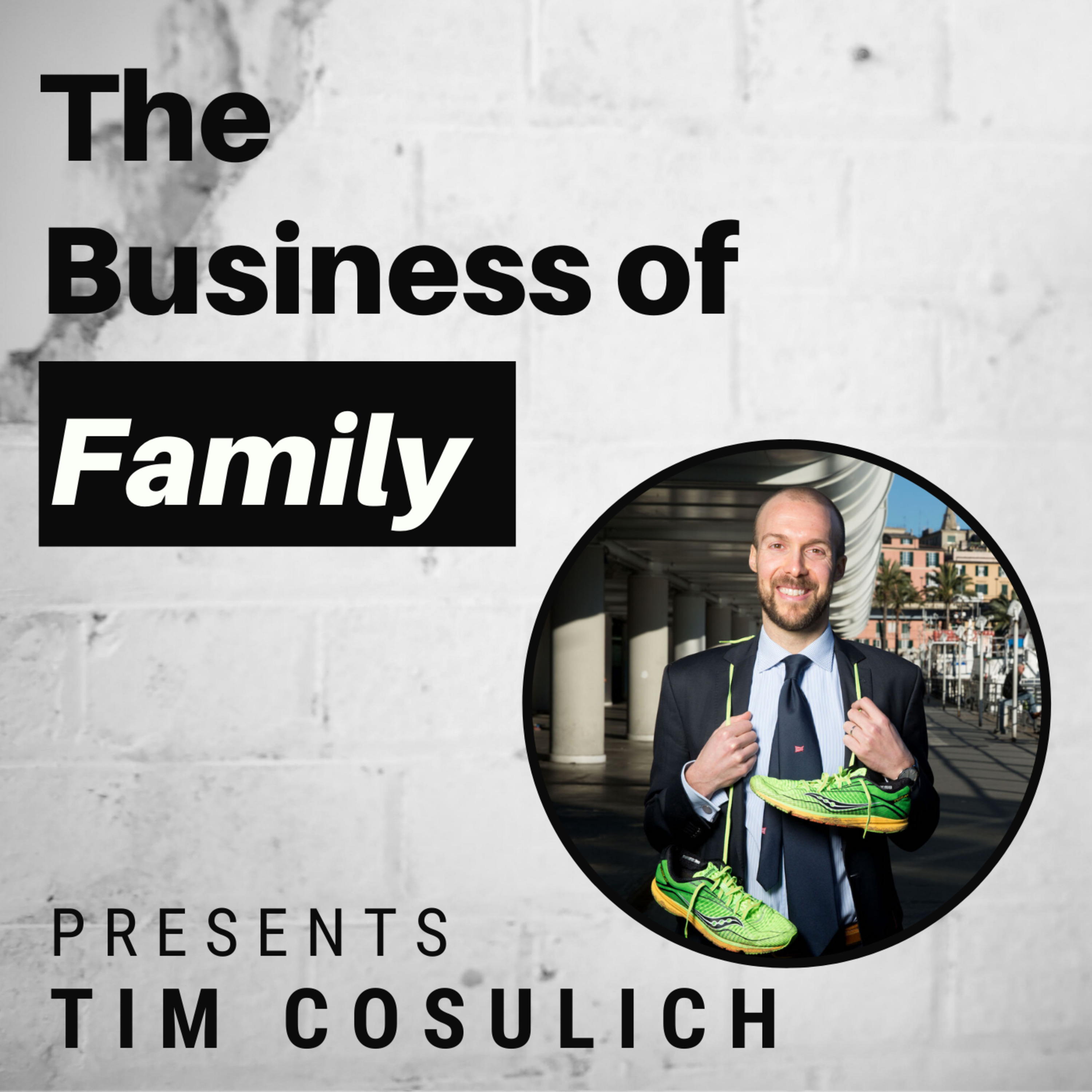
In this episode, we welcome Tim Cosulich, Tim is the sixth generation CEO of Fratelli Cosulich, an Italian shipping group established in 1857. Across more than 160 years, the Cosulich family has seen numerous changes and weathered many challenges. The Group is involved in most aspects of the shipping industry, has a global footprint across 18 countries, more than 1,000 employees and an annual turnover of 1.8bn USD.
Tim explains why the performance of his family business during World War I and World War II cannot be compared with the current pandemic due to the differences in management and time. He talks about the importance of having family values that are translated into the leadership of the family business while still protecting it.
Listen in to learn the process of hiring family members to be part of a generational family business without promoting conflicts of interest. You will also learn the non-meritocratic governance strategy that is good for the overall success of a family business even with its shortcomings.
Key Takeaways:
- Factors that contribute to the success of a family business
- How to keep a valuable relationship between a family business and the founding family
- How to remove the conflict of interest when hiring family members to become part of the business
- The advantage of building an effective leadership style that ensures all family leaders operate as a team
- How to come up with a structure that helps “protect the business from the family”
Standout Quotes:
- “When we select the next generations, it is important that we focus on those who are motivated by similar things and not necessarily by money.”- Tim Cosulich [14:39]
- “I don’t think the business must be run by family members; I think the business must be run by the best people.”- Tim Cosulich [29:09]
- “If you invest in the wrong businesses, you can destroy your business.”- Tim Cosulich [38:18]
- “If I think about my own life and when and where did I really grow and learn things, it’s mostly in my failures, not my successes.”- Tim Cosulich [44:07]
Episode Timeline:
- [0:04] Intro
- [2:06] Tim narrates the resilient history of his family company that has overcome many challenges.
- [5:34] The impact of the Coronavirus on the shipping business and how they’re handling it.
- [7:20] Why leading by example in a family company is a powerful message as opposed to written values.
- [9:07] He explains why his company’s style of governance ensures the company is protected.
- [11:43] How Fratelli Cosulich keeps its principles and relationship with the family.
- [15:55] He explains the process they use in hiring family members and how they were able to eliminate unnecessary rules.
- [19:09] The unique leadership structure that helps the business run smoothly.
- [25:26] The strengths and weaknesses of a non-meritocratic system of leadership that is exercised at Fratelli Cosulich.
- [28:33] Tim paints a possible scenario that would occur if future generations don’t want any involvement with the family business.
- [30:40] Why Fratelli Cosulich has two sets of founders- the ones who founded the physical business and the ones who founded a structure to protect the company.
- [36:12] He explains the advantages and disadvantages of the company’s culture of reinvesting with caution.
- [38:36] Why they do not talk about business at home.
- [43:48] Why Tim wishes minor failures and the spirit of learning for his children in the future.
Relevant Links:
Read the transcript
This transcript was generated automatically and may contain errors, including in names. Listen to the episode for the exact words.
MikeWelcome to The Business of Family. I'm your host, Mike Boyd. Multigenerational wealth creation involves so much more than capital accumulation. The most successful families cultivate values, stories, knowledge and resources to pass on to the next generation, and they do it very intentionally. On this show I sit down with members of some of the world's most interesting business families to hear how they do it. To see where your own family stands, take the Business Family Diagnostic at businessoffamily.net.
This week's guest is Tim Cosulich. Tim is the sixth generation CEO of Fratelli Cosulich, an Italian shipping group established in 1857. Across more than 160 years, the Cosulich family has seen numerous changes and weathered many challenges. The group is involved in most aspects of the shipping industry, has a global footprint across 18 countries, more than 1,000 employees, and an annual turnover of 1.8 billion US dollars. Fratelli Cosulich utilizes a unique system of family governance to ensure the business survives and prospers from generation to generation.
It's not often we get to hear from a sixth generation family business, so I'm excited to share this conversation with the audience today. Tim, welcome to the podcast. Thank you so much for joining us.
TimThank you, Mike. It's a pleasure to be here with you.
MikeLet's dive straight in. So 163 years spanning six generations is an incredible feat. I can imagine the business has weathered many storms throughout that time. And now you're faced with the coronavirus pandemic. Can you give us a brief overview of the founding story, the business lines that you operate in today, and how the family has managed through crisis in the past?
TimYes, absolutely. The group was founded, as you said, in 1857, and we started as a ship owner. We started as a ship owner, and later on, we started diversifying, but still within the ship owning space, so from cargo to passengers. Then World War I came, and the whole fleet was destroyed. So at that point, the decision was to rebuild the fleet and not only rebuild the fleet, but to also build a shipyard in the northeast of Italy, in the town of Monfalcone near Trieste.
And building a shipyard that is now one of the most famous shipyards in the world for cruise ships. However, unluckily for us, World War II came and everything we had was basically nationalized and the shipyard. So the decision, again, was to sort of restart still in shipping, still as ship owners, but also diversifying into other aspects of shipping, trying to leverage the experience that we had developed in the industry and the contact and the reputation.
Ultimately, it's an industry where reputation is very important and people trust you and you have a much better chance to survive and succeed. So the ship owning business restarted, but definitely representing the smaller part of what the group does. And then over time, we developed other businesses within the shipping industry, such as ship agency, fuel trading and fuel physical supply, yacht agency, marine management, catering for ships and platforms.
We provide the crew as well to ships and platform. We do freight forwarding. And then we have an IT company that basically handles all the IT requirements for the group. So it's a relatively diversified group, but 90 plus percent of what we do is shipping related. One of the beliefs, let's say, is that we should stick to things that we know and where we know we can add value.
So it's always trying to find the balance between diversifying, but then still diversifying into something where we think we can add value and not just for the sake of diversifying. So going back to your question, for sure, we did have our share of rebuilding to do. I wasn't there, so I cannot take credit for it or share a lot of wisdom on that. But definitely, in my position today, managing the company, I can see on one hand the confidence that we have having weathered those storms and knowing that it is possible to get a life on the other side.
But then on the other hand, I also feel I wasn't there solving those situations. So I do not necessarily feel equipped myself to handle. I'm doing my best. But of course, past success doesn't necessarily mean that you can continue to succeed. I think it is important to continue to have this learning mindset and always being a student.
MikeThat's an incredible story of resilience. And we're certainly talking about a multi-generational business when you cite two world wars that the business has gone through and you've somehow rebuilt out the other side. I can imagine how that's both encouraging and intimidating when you're in control of the business and facing a crisis yourself. And most recently, the coronavirus has hit.
So has it had a big impact on shipping and your group of companies or is your business relatively stable in this environment?
TimSo it's an interesting question because we are seeing an impact now. So with a bit of delay, I think, compared to other industries. I think with shipping, there is a sort of a time lag for when you actually see the impact of these kind of situations. also consider that even during the various lockdowns that you had around the world goods were still moving although volumes were lower but goods were still moving so for sure we've seen strong declines in certain sectors so obviously our yachting business is is basically well now they are starting a little bit in the Mediterranean but a few months it was completely closed. And we also supply fuel to cruise ships. So as you can imagine, that business for the moment
is gone. So there are pockets of what we do where we have seen a significant impact. But overall, I would say that we are amongst the lucky ones that were not severely hit by the pandemic. Our approach anyway, as a group, has always been to retain all our staff, all our people. As a matter of fact, we've never fired anyone in 163 years because we didn't need those people.
If we fired people, it was always because of performance and never because of kind of headcount reduction. Although it is obviously a bit of a cliche, but we do believe that people are our assets, our key asset. We are a service company. So I think it is implied in that that we are a people's company and the quality of our people is really what we are.
And this is why we try our best to establish what we hope is a special relationship with our people.
MikeWould you say that family values have permeated the business and guided the way that you treat your employees?
TimYeah, that is probably a fair statement. You know, I was always curious why we never had kind of a booklet explaining our values and our principles and so on. And this is coming from someone like me who worked for 10, 12 years in big multinationals, where, of course, you have all these mission statements and a nice book where the leaders of the company share what the values are and so on.
But then I actually quite quickly realized that, first of all, we're not a huge multinational company. We have about a thousand employees. So we are in a situation where the board of directors, family members, we know basically everyone in the group. So we do have a relatively personal relationship with everyone within the group. But then the reason why at this stage, at least or until now, we've never had or needed sort of a booklet where we explain what our values are is that we have to be those values.
So there's six of us at the moment from the family involved in the business. And the reality is that the way we behave, the way we work, the way we act, the way we live has to be that booklet. We have to show with our behavior how we think the company should be run and what the values are.
So that is, I think, a much more powerful message rather than something written on a piece of paper, which, again, can be useful. But I think if you show with your action what you think the behavior and the values should be, that sends a much stronger message.
MikeLeading by example. That's fantastic. Tell me, as the sixth generation of your family business, you've defied the odds and outlasted most other family businesses. What is it about your governance structure or your philosophy that sets you apart?
TimSo there's definitely one number of key differences, but one is that throughout this 163 years, we have always put the business first. And before I get into that, I don't mean that is the right thing to do. As a matter of fact, I think what is important for family businesses is that they have that kind of reflection and discussion on what the priorities are, whether the priority is the family or the priority is the business or the priority is something in between.
But there will be moments in the life of a family business where the needs and the desires of the business will be in conflict with those of the family. There will be years in which the company needs investment. And for that reason, the family will not be able to get dividends, for example. Or there will be moments in which the company cannot hire someone from the family just because that person is from the family.
And so I think these type of conflicts are inherent in family businesses. Our approach to that is that the priority is the business, 100%. And that translates into a number of things. One, for example, is that in 163 years, we've never distributed dividends. So that, of course, gave the company a lot of solidity from the financial point of view, because we have reinvested every year 100% of the profits into the business.
And that also sends, I think, a very strong message to the people within the business, because they see that the owners don't only say that they care about the business, but they literally put all their money into the business. It also sends a strong message to banks, for example, because they see that the shareholders, they're not taking anything out from the company.
So that is one example. Another example is that no family member has the right to join the business. One of the rules is that you, as a family member, you need to have at least 10 years of work experience outside the group. And then once you have that experience, then you can apply to join the business. and you apply and you go through a normal interview process and sometimes you make it, sometimes you don't. And we have plenty of examples of people who were rejected.
So this idea of the priority is the business is certainly something that has had the business going successfully through six generations.
MikeSo you've said something there that I just have to touch on. No dividends in 163 years. Is there a family foundation, scholarships, an education fund a family office how is the family attached to the business
Timyeah so that's that's a very fair question and as a matter of fact it's a question that i i get quite often when i present sometimes our kind of case study at some business schools but the question is often what does the business do for the family and of course the examples you mentioned family office the foundation and so on are some ways in which the business could do something for the family But the answer is the business doesn't do anything for the family.
So there's no foundation, there's no family office, there's absolutely nothing. How did we manage to maintain this connection between the family and the business? I think it's a mix. It's a very fine balance because interestingly enough, not only we have never kind of forced anyone from the family, from the young generations to apply or to join the business.
We have, and when I say we, I mean the previous generations, so not really me, but we have actually actively discouraged family members from joining the business. And the reason for that is that we only wanted those who were really motivated, genuinely motivated to join the business because they were passionate about it, because they were passionate about shipping.
They were passionate about a family business. And we wanted those to join and to apply. Until now, I would say we've been lucky and we never had a shortage of talent from the family. But I think going forward, that will be a challenge. It will be a challenge because number one, shipping, let's be honest, is not the sexiest industry in the world.
So when you compare maybe, you know, joining Fratelli Cosulich and joining Google or Facebook, I can see how a young, talented graduate might think about, okay, maybe Facebook is cooler. And I also get a free lunch, right? Whereas in Fratelli Cosulich, you definitely do not get any of the perks that you would have in this big IT companies. So for sure, that would be a challenge going forward.
But the other aspect is also from a practical point of view and a financial point of view. One of the key ideas, key principles for us is that our motivation comes from the entrepreneurial aspects of what we do. And here I talk mostly based on my personal experience, but I see that similar ideas apply to the other family members involved in the business.
For me, the key motivation is not really money. It's more about building something. is more about being in an entrepreneurial environment where if I have ideas, I can pursue those ideas, where I can take care of people, where I can invest in developing people, where I can also kind of continue the legacy that generations before me built.
So it's a number of things, but money is not really the key driver. Obviously, your remuneration has to be fair and you have to be able to provide for your family and so on, but it is not my main driver and it is not the main driver of the other family members in the business. So that is the other part.
When we select the next generations, it is important that we focus on those who are motivated by similar things and not necessarily by money. When I was thinking about joining the business, I clearly remember sitting with my father and my father telling me, look, you have worked as a strategy consultant for six years and you worked for Maersk for a number of years.
I'm pretty sure you have a good remuneration, But if your plan or your desire is to become a multi-billionaire, this is not the right place. If you join, you will definitely have, let's say, a comfortable life. You will not miss anything, but forget about having a Ferrari, forget about having a private jet or a yacht or anything like that, because it's not going to happen.
And that, to be honest, is fine with me. It's not something I aspire to, but I can see how others might. And I don't think there's anything wrong with that. But I think it clashes a little bit with our values and our way of seeing things.
MikeIt's an incredible story. How do family members join the business? I imagine at six generations, the family would be extremely large now. And you noted that family members have to apply. What does that process look like? What are the rules to join the business?
TimIn the past, we had some very old style rules, I would say. Two rules in particular were that only family members working in the business were allowed to own shares. And the advantage of that rule was that basically you only have committed shareholders, meaning that you don't have shareholders who just wait for the dividend at the end of the year.
You have shareholders who work in the business and understand the needs of the business. The other rule was that only male family members were allowed to join the business and therefore to own shares. Now, leaving aside the fact that obviously this rule was not very clever, very unfair, etc., etc., the only positive implication of that unfair rule was that it did simplify succession in shareholding.
And this is completely unrelated of whether the rule was only male or, for example, only female. It could have been also only female can join the business. But as you know, a family grows like a pyramid. And the more people are involved in this process of succession, whether it's succession in shareholding or succession in management, the more people, the more complex the process is.
So the idea of being able to kind of divide by two the people who had some sort of claim or who could be involved in this process simplified the process a lot. Now, going to your question, what do family members have to go through? It's not like a torture or some sort of medieval right. It's simply you just need to work outside of the group for 10 years and then you can apply.
Of course, what we look for is someone who can contribute to the company. So you don't necessarily have to have an experience in shipping. You can have an experience in different industries. As a matter of fact, one of my sisters will join the group in about a couple of months in one of the subsidiaries of the group.
It's a company that does steel trading. And her experience is in fashion. She worked for Armani for many years. So it's a very different type of experience, but she was deemed good for the job and it was felt that she could contribute. I'm talking in third person because me being her brother, I was not involved in that decision.
That is another rule we have. When there is a family member applying, the father, mother or brother are never involved in the decision whether that person should join or not. So it's always uncles or cousins or kind of more distant relatives deciding whether that person should join. And the rationale for that is that in a family business, you have inherently a lot of conflict of interest.
If you can reduce a little bit the conflict of interest, the level of conflict of interest, then that is probably to the benefit of the business. So in this case, my father and I were not involved in the decision of whether my sister would join the business or not.
MikeTell me how CEO Succession works. How did you get to be where you are today?
TimYeah, that is another interesting question, mostly because we have a very unusual leadership structure. We have a board of directors, which is made of, at the moment, is made of seven people. These seven people are the honorary chairman, who's my uncle, who's about eight years old. And that one is a non-executive position. And again, being a kind of a honorary role, he joins our board meetings and so on, but he's not really involved in the day-to-day of the business.
Then we have a chairman who is my father. And the reason why my father is a chairman is that he's the oldest, except leaving aside the honorary chairman. The rule is that the oldest is the chairman. Just by that, you understand that the fact that you are the chairman doesn't really imply you have specific powers of responsibility because it's simply the oldest is the chairman.
However, your authority is exactly the same as everyone else on the board. And then on the board, we have our group CFO, who is the first and first ever non-family member joining the board. And then there's another four of us who are board members. Now, the reason why the structure is unusual is that the chairman, so my father, and the four board members I mentioned, which is basically my three cousins and myself, the five of us, you can consider us as CEOs, all of us. Because the way we work is that the five of us manage one or more business units in a relatively independent way, but then we take the big decisions together. So this is more or less how it works. The reason why it works is that there's a
lot of, I think, mutual trust amongst us. Nobody has kind of a personal agenda and we all work in the interest of the business and that helps a lot. So it's definitely an unusual structure. How a family member gets into a certain position, a little bit with planning and a little bit with luck, I would say. First of all, when a family member joins the group, there is absolutely no guarantee that that person eventually will join at the board. And that is quite important because I remember when I joined the company, it was about 10 years ago. One of the things I noticed was that every single family member who joined the company up to that point eventually made it to the board.
Now, I tried to put myself in the shoes of a family member joining the company. It is quite easy to assume that since every single family member before you eventually made the board, then you will also make it to the board. So we had a discussion around that. I wanted to have a discussion around it. And we eventually agreed that we should make it very clear to any family member joining the group from that point onwards that it was absolutely not guaranteed that they would join the board eventually.
Not only that, but they should not take it as a failure if they don't eventually join And I think that is quite important because as a family member, you might join the group, you might have the right skill set to be a great manager, to be a great director, but maybe you don't have the skills to be a board member.
So that is something we managed to clarify. And I think so far, it's working quite well. We have now two family members. Well, my sister joined in a couple of months, but then plus another cousin of mine in the business who are not on the board. And I believe that it is clear to them that it is not guaranteed that they will join the board.
So we have a very executive board. All of us are heavily involved in the management of the company. And as I said, you can definitely see us as CEOs of the group. Of course, business units, they have a different weight. They have a different size. They have different, I don't know if importance is the right word, but of course, amongst us, some are managing larger business units than others.
But that is, I would say it just happens. I mean, this is based on my personal experience. When I joined, I took over from one of my uncles, the largest business unit in the business. And I've been managing that since I joined. But there wasn't really a rule for which I should manage one or the other. Let me touch on another point, which is related to this.
It is quite important also to understand the way we are remunerated. Because as I mentioned before, we don't distribute dividends. So basically, our remuneration is our salary and a bonus at the end of the year, depending on how the business does. But the five of us, we make exactly the same. We have exactly the same remuneration. So if you consider that, together with the fact that we all manage different business units, and that the reason why we manage one business unit rather than another is sort of random in a way, That also, I think, explains why we don't have internal arguments or internal discussions about, I should manage this, you should manage that.
When I see a potential client, I naturally think about what the group can do for that client rather than what my business unit can do for that client. So I think this idea of the five of us having exactly the same remuneration in a way helps us truly behaving like a group rather than a set of businesses.
MikeThat comment is something that we hear often in these conversations with family businesses, that there's often a value system around putting either the family first or the business first and acting as a group rather than an individual. So it's really interesting to hear you say that. But I'm curious, in the context of remuneration, I would have thought that everybody earning the same amount, even if they're managing or directly overseeing different size business units, or perhaps performing to a different standard, I would have thought that that would actually cause more conflict if it's not rewarding talent proportionate to their results.
TimYes, and you're absolutely right. The weakness of this model is that it is not meritocratic. In every group of people, in our case, it's a group of five people, you will always have someone performing better and someone performing worse than the others. You will always have someone working harder than others, someone bringing in more business, etc., etc.
So our model is absolutely not meritocratic. And I think that is quite clear. and it is quite clear that it is one of the weaknesses of our model. However, I think the best way to describe it is to refer to a conversation I had with my father again. It was, I think, one week after joining the group.
I remember being in my living room in our apartment in Genoa and asking him whether the current structure was something that he felt was the right one because it was quite clear to me that at that point, at least he was the one contributing the most to the business. He was the one working the hardest of the family members involved at that point. And I thought it was unfair that he was making exactly the same as everyone else. So I asked him, I said, are you happy with this? Do you think it is fair? And he said, look, what drives me is really the possibility of doing a job that I love. I like building something. I like to do
business. The remuneration I have is sufficient for me. I don't miss anything. And that is enough for me. If someone else is working not as hard as I am and is making the same amount of money as I'm making, good for them. That shouldn't make me frustrated or anything. At that time, I 100% disagreed with his idea. But then, I mean, of course, coming from six years in consulting and then another four years working for a large multinational where what you're told is meritocracy and then you should be rewarded based on what you do and how hard you work and so on.
But it was a massive shift. But then I think over time, I started also to appreciate that. And also seeing how so many family businesses collapse, literally collapse because of internal fights. And internal fights are 99% of the time about money, money and power. So the idea that we can kind of forget about that and not stress about who makes the most and whether I should make more, you should make more.
I think it's something that's, yeah, it really helps us focus on our energies on fighting outside rather than fighting inside.
MikeGreat answer. What happens in the scenario where potentially one generation chooses never to join the business? Is that a possibility? One thing I'm thinking of is you're six generations, but I think you've said you've got about six or seven members of the family in the business today. If a younger generation coming through doesn't put their hand up, doesn't find shipping interesting, what happens then?
How do you keep the connection to the family?
TimI think it is a realistic scenario. It can happen. It can happen for the reasons we mentioned earlier. It is something I think about sometimes. And personally, I don't see anything wrong with having a leadership that is made of professionals rather than family members. But of course, if that happens, then we need to find a way to make sure that if in successive generations, we have some family member who is willing to join the business and skilled enough to join the business, that that person comes in.
So I am not dogmatic about that. I don't think the business must be run by family members. I think that the business must be run by the best people. Now, clearly, the current situation shows that we haven't been meritocratic as a group, as a company, because either it's an incredible coincidence that out of 1,000 people, the five most skilled people are all from the family.
That would be an incredible coincidence, right? Or, more likely, we are not meritocratic. There is a preferential path to leadership for family members, but we do have certain standards that family members need to meet in order to be considered for that, let's call it, preferential path. So I think the idea is to make sure that we maintain that standard.
If we don't find any family member who is willing to join the business or who is able to meet that standard, then we need to do what's right for the business. And we need to make sure that there is the right person, whether that person is from the family or not from the family. And then creating opportunities for successive generations to join the business at the later stage.
MikeWhat was the thought process of the founding generation? How did these rules and structures come to be that have survived six generations so far? Is there a family constitution or some sort of guiding document or principles that lays out the intention of the founding generation?
TimNo, the reason, and I would say that all the rules and principles that we observe are all unwritten. And for some reason, we still observe them and we are still kind of aligned amongst each other on what those principles are. So probably it makes sense for us at some point to write them down to make sure that we are all on the same page and that the future generations, they're actually aware of what these ideas are.
But no, there wasn't a constitution. One interesting thought that I was having as you were asking about the founding generation, I think we have two different founding generations in our family business. One is the first generation that created the business. And I guess that the key idea that was passed on from one generation to the other was this business first as opposed to family first.
But then I do consider my father's generation, which is the fifth generation, as in some way also a founding generation. And the reason why I think so is until then, at that point, I refer to about 20 years ago, there were four shareholders, my father and his three cousins. My father owned roughly 60% of the shares and his three cousins owned the remaining 40%.
At that point, those two rules that I mentioned before, only family members working in the business were allowed to own shares and only male family members were allowed to work in the business and therefore own shares. Those were the rules that were observed for succession in shareholding. Shares were transferred from father to son or from father to nephew or whatever for free.
So for us, it might sound strange, but the shares had no value. And to explain that, the shares, you receive them for free. You don't receive dividends while you hold those shares. And then you give them away for free to the next generation. So in reality, the shares have no value. Also because of the way the decisions are taken are not based on how many shares you own.
decisions are taken together at the board level. So the shares for family members literally had no value. However, in the real world, let's say, the shares obviously had value. And when my first generation was basically in a position of owning 100% of the shares, they realized that the model that has worked until then was not going to work in future. It was not going to work in future for some simple reasons. One, as we said, the idea that only male family members could own shares is completely stupid. And also the idea that only family members working in the business could own shares, although I definitely see the merit in it, it is, at least in Italy, it's not legal.
If you have two kids, one working in the business, the other one not working in the business, you cannot tell the one who's not working in the business, I'm sorry, you're not going to get any shares because you don't work in the business. You very likely get sued. So because that model was no longer working then my father's generation they they had to think about a way to continue with the the positive aspects of those rules but eliminating the the negative ones and they came up with the help of consultants of course but they came up with the structure that is what we have now we have a trust that owns the shares and the trust is as you know
an independent entity. Nobody owns the trust. The trust owns the company, the shares of the company. The trust has trustees. And in this case, the trustees are the five of us, family members sitting on the board of the group. So we are at the same time board members and trustees. And then the trust has beneficiaries. The beneficiaries, in our case, is the entire family brothers sisters cousins and so on however the beneficiaries only come into play in certain situations if we distribute dividends which we don't or if we sell the company which we don't plan to so being a beneficiary to be honest doesn't mean much and being a trustee means that you can behave as as an owner but you are not an owner meaning that the shares are not
in your private wealth. And again, although this might sound a little bit strange, that was our way to protect the business from the family. This is a structure that allows us or allows the business to continue on its own and to not be at risk, let's say, of being attacked by the family.
MikeSounds like a true demonstration of stewardship over ownership.
TimYeah, it is because the reality is that my father and his three cousins, they literally gave away the ownership of the business for free. They gave away the shares, they put them in a trust, and that's it. So this is why I do consider them in a way a founding generation.
MikeYeah, it's a great clarification. So the business doesn't distribute dividends, the family doesn't benefit directly financially unless they're remunerated via a salary or a bonus. How does the business reinvest its earnings? How do you consider investment decisions, risk tolerance? Where do you as a group fall on the spectrum from conservative to risk-taking?
TimI think the answer is it depends. As I was mentioning before, we like to invest in businesses that we understand. We don't like to be a financial partner. If you come with a project, which sounds really interesting, but I don't understand a thing about it, we're not going to invest in that type of business. It needs to be a business where we know that we can contribute beyond the financial aspect, where we can contribute with our know-how, with our network connections, whatever it is. But we need to understand the business. Even if we are a minority shareholder, it doesn't matter. We don't necessarily have to be in the driving seat, but we do need to understand the business. So that's probably the first criteria. I would say we're
not too conservative. We are fine with risks. And we do think that that is the essence of entrepreneurship. You have to have some level of risk tolerance, but it has to be an informed risk. You need to be aware of what the risks are. That is probably the key. The other part is that reinvesting all our income into the business, that also means that we do not have to rely on banks too much. Obviously, we work with banks as any other company, but we have a very low debt level. And that is also something that gives us confidence in tough moments like now, because we know that we can rely on our own resources. Of course, since we do not rely
on banks too much, since we're not very leveraged, that also means that normally we would not get involved in huge projects and the fact that we are 163 years old and we are the size we are which is not a huge size so it's a mid-size company that is also i think a demonstration of how generally we are in the middle in terms of how conservative we are if we had been a lot more risk takers we would have grown a lot more and 163 years you can argue you can become much bigger than we are today. But of course, if you invest in the wrong businesses, you can also destroy your business. It is a fine balance.
MikeDoes your family have any keepsakes, objects, documents, or mementos that are meaningful to your history?
TimWe do, but I wouldn't say these objects are particularly meaningful for us. I of ships and very old ships we have some very old not only paintings but very old advertisements that were kind of like paper pictures and so on that are like 100 years old or something like that so those are really cool to uh to see and and every time i go back to italy i i really enjoy going through our you know into different meeting rooms and corridors of the office and and see those posters and pictures so it is something very very interesting and and cool i wouldn't say it's something that is kind of special for for our family it's interesting because precisely because
of what i was mentioning before about not not encouraging family members to join the business because we don't want young family members to think that this is the default option or that this is the easy option to join the business. Because of that, we don't talk about business at home. In my childhood, I don't remember talking about or hearing my father talking about business at Christmas when you meet up with the rest of the family. Business is not one of the conversation topics. It's almost like the business topic is kept almost secret from the rest of the family.
And it's a weird feeling. I remember a funny story. My father telling me that there was so little talk about business at home when he was a child that he always saw my grandfather with train tickets because he was traveling a lot for business. And his assumption was that my grandfather was working at the train station. This is how little business was discussed within the family.
MikeAnd I believe that you have young children of a similar age to my own. How do you think about their potential participation in the business as the seventh generation?
TimYeah, I do have kids of similar age, one and three. And to be honest with you, I do not see them as the seventh generation, which doesn't mean I don't want them to be the seventh generation. I would love for them to, or for both of them or one of them to join the business. but I would only love that if that is really what they want and if they are the right fit for the business. I think it is, and I go back to my own experience, I think it is such an important decision to join your family business. It's a little bit like getting married.
You can get a divorce, but it comes with consequences, mostly on the emotional side. So I do remember when I joined the business about 10 years ago, I pictured it as taking my CV and ripping it apart. I definitely saw that as my last job. And it was a very conscious decision, which doesn't mean that I knew 100% that it was the right decision, but it was definitely a well-thought and reasoned decision.
And it also, at least in my case, it completely changed the perspective I had on my own career in a way. Because if I'm honest, in the first 10 years of my career, the key focus of my career was my own career. So everything was aimed at a fast and successful progress of my career. And the good performance of the company that I was working for in consulting first and later was simply the natural consequence of my own good performance.
So the assumption was, if I have a successful career, that means I'm working well. And that also means that I'm adding value to the company I'm working for. But the key goal was my own career and my own success. the moment i i joined my family business it's almost like from one day to the other my own career for me became completely irrelevant i literally never thought again about my own career the only thing i care about is the success of the company so going back to your your question for my kids i think it really depends what what they want what they're passionate about what they're Also, what their talent is.
If they can add value to the business and they are passionate about it, then I would be delighted for them to join the business. But if they are passionate about something else, I'll be equally delighted for them to try something different. Ultimately, we often think about what we want for our kids and we want them to be happy.
And I don't take it for granted that they're going to be happy working for the family business.
MikeA final question that we ask everyone and a great follow-up to your answer there. Imagine that you're writing a letter to your children. What is one lesson or idea that you don't think many parents would mention, but you consider important to understand?
TimSo if I can cheat a little bit, I will say two lessons instead of one. One is how much you learn from your failures and from your defeats. Because going back to what we were mentioning before, what I was mentioning before about what do we want for our kids, we want them to be happy. And then if I think about my own life and when and where did I really grow, when did I really learn things, it's mostly my failures, not in my successes or when I had some positive moment.
I learned a lot more in my failures. So it sounds a little bit strange, but if I could wish them something is some failures, obviously not some serious ones, but definitely some failures from which they can learn. So that is probably one. The other idea, I think, is also this idea of always being a student and accepting that there's always something that you can learn from everyone.
And the concept of always being a student has, I think, two interesting aspects. One is that, by definition, if you're a student, if you're learning from someone, you accept that there is someone who knows more than you. and that keeps kind of your ego in check. The other part is, well, the big problem to that is that you continue to learn and to grow.
So those would be the two lessons I would give to my kids.
MikeTim, this has been an incredible discussion, extremely valuable. I've learned a ton. It's not often we get to hear from six generations and I really appreciate you sharing your story with us today. Thanks for joining.
TimIt was a pleasure, Mike. Thank you.
MikeThanks for listening to The Business of Family. You'll find the transcript and key ideas from this conversation at businessoffamily.net, along with the Business Family Diagnostic. It's free, and it shows you where your own family stands. And if someone in your family should hear this episode, please send it to them too. I'm Mike Boyd. Until next time, take care.
Keep listening
If this one landed, start here next.

7th Gen Hollingsworth & Vose - Manufacturing Innovation Since 1728
Seven generations, and family members who go the extra mile.
Billionaire Diamond Owner & 4th Generation Co-Guardian
Brothers who govern while professional managers run the business.

Separating the Family Conglomerate After 111 Years
Strict entry rules for the fifth generation of an Indian group.
The Business Family Diagnostic · Ownership
A second founding generation that gave the shares away.
Tim's father and cousins put the shares in a trust, with the whole family as beneficiaries. Have the rules for passing ownership to the next generation been agreed and written down in your family?
“Each adult owner knows what they own.”

Every family wishes someone had recorded the generation before.
I built Enduring Stories to do it for yours: a guided voice conversation, from home, that keeps your family's voices, values and history.
The newsletter
The most useful things in these conversations are the things families rarely say out loud.
I share them in my newsletter once a week. Sign up to receive the ideas directly and start building the foundations for your family today.