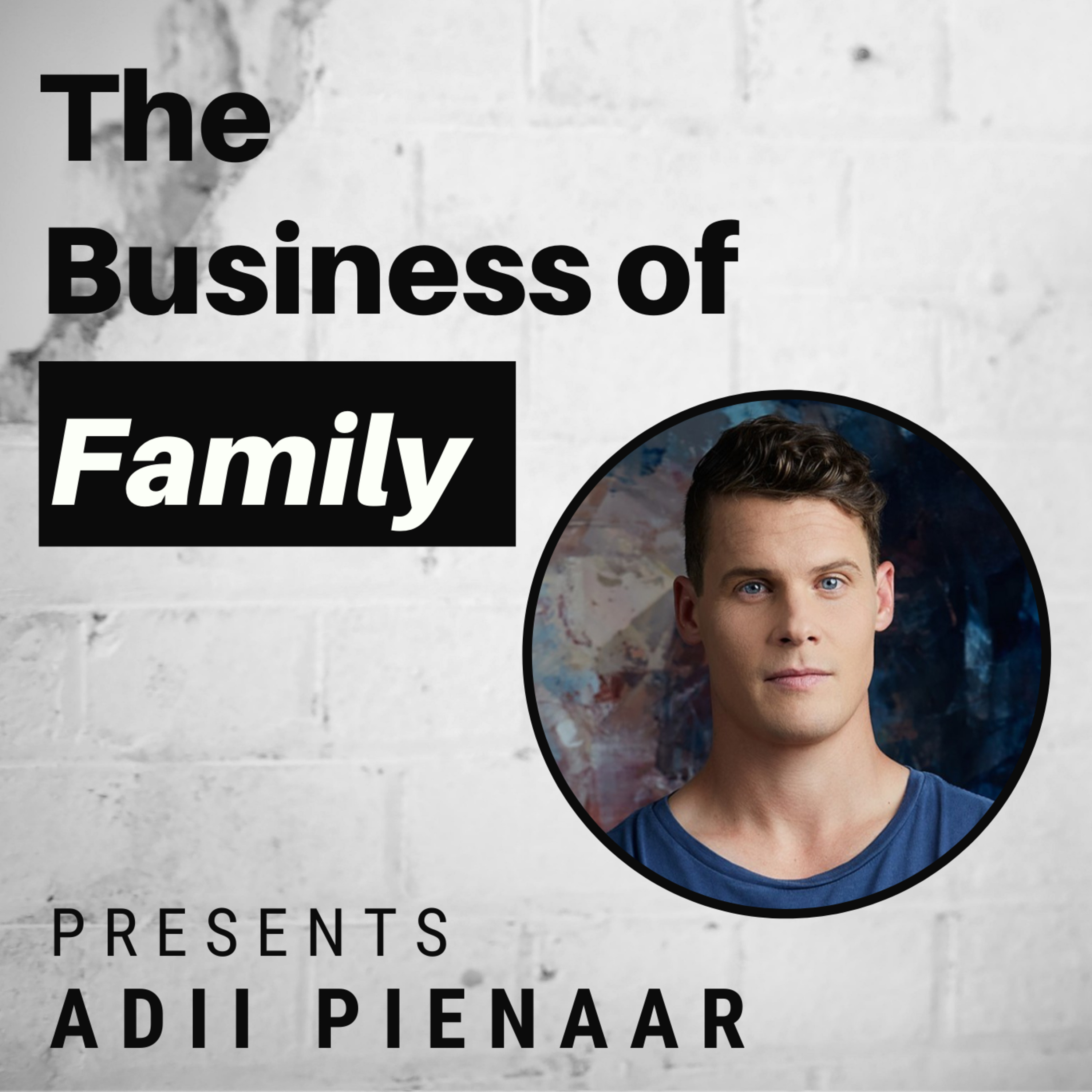
Episode 28 · Season 1
First Generation Wealth Creator & Living Life Profitably
Key ideas from this conversation
His family office constitution commits to backing the children's business ideas, once they've done the work to validate them.
He's open with his young children about the family office, so they don't learn about money from someone else first.
A beach house that made no financial sense, and what it has paid the family in a different currency.
Read the full show notesBio, standout quotes and the episode timeline
Adii Pienaar is the founder of three technology companies, two of which he’s exited so far to create first generation wealth for his family. A prolific reader, writer and maker, Adii brings a refreshing perspective to the way he views family, business and wealth.
I was fortunate enough to preview his new book which was released last month, titled Life Profitability. In Life Profitability, Adii provides you with a new perspective for becoming self-aware, recognising your values, and understanding your impact. An enriched life and successful business are not mutually exclusive. In fact, this book will provide you with the first steps in building a business that is more sustainable with increased options for you, your employees, and your family.
Standout Quotes:
- "The biggest burden I felt was that transition from wealth generation to wealth maintenance" - [Adii]
- "I think in any kind of business partner relationships, as long as everyone is aligned towards the same goal, then everything is hunky-dory, and as soon as someone is not aligned with your process then everything is not hunky-dory" - [Adii]
- "Whatever I do, it should be that truest expression of self" - [Adii]
- "There are multiple things that pull us into different directions on a daily basis but having an awareness of when that happens... that's Mindfulness" - [Adii]
- "I truly believe in transparency for the kids" - [Adii]
- "The family office should serve as a leg up for the trustees and that's the kids, right? it's not a handout" - [Adii]
- "Neither the family office or any of our individual lives should be so rigid like we're constantly trying to fit into a single recipe" - [Adii]
- "The cost of anything we do in life is just Life" - [Adii]
- "I don't care if they miss 99% of it, even if they become 1% of the context of this conversation" - [Adii]
- "The way I think about legacy is, if I were to die tomorrow, the goal would be to have left my kids or anyone who cares enough breadcrumbs about who I really was" - [Adii]
Key Takeaways:
- A major transition point for Adii was moving from wealth generation to wealth maintenance.
- With little information on how to run a family office, he was able to get started by asking questions and got propelled into motion when the law firm got the right people around him to explain the process.
- Adii describes his value system: How can I wake up every single morning and spend my time manifesting the truest expression and version of myself in anything that I do?
- An ideal day for Adii is "being present".
- Adii explains that the main reason he went back into entrepreneurship was he wanted to create again, he was enthusiastic about building a team, and those are his higher values for now.
- While admitting that his kids have a great life especially from the financial perspective, he is concerned not to bring up spoilt kids who can't be individuals with their purpose.
- Adii describes the strategies he uses to help build his kids to become individuals with a backbone: Transparency, which involves letting the kids be fully aware and involved with the ongoings in the family office, as well as the concept of Gratitude.
- The family office should always prioritize business ideas from the trustees.
- Expounding on the concept of 'Paying a Life Dividend': A business that's not just financially profitable but profits your whole life. Adi discusses the relevance of having assets that mean more than their financial value to the family, which is selected by stress testing, effective communication, and evolution.
- It is important to sequence things, rather than doing two things at once and have none getting your full attention.
- Every single minute of our day, we only have finite attention, time, and energy to do anything, so the decision to anything is costing us life.
- Unfortunately, mainstream media has created a narrow definition of success that serves barely 0.1% of the world, but there is a much wider and diverse definition of success for the rest of us, and it is our responsibility to define it.
- To Adii's Children: Do the work, continue learning towards discovering who you are, and figure out how to manifest that in most of the things you do in life.
Episode Timeline:
- [00:45] About today's guest, Adii Pienaar, describing his origin story and path to First-generation wealth.
- [08:22] What does a family office mean to you, and how did you know what to do when you set out to do this for the first time?
- [11:15] How have you and your understanding of value systems evolved?
- [13:55] Adii describes his picture of an ideal day.
- [16:09] His motivation for diving into entrepreneurship for the 3rd time.
- [19:16] How have you explored this concept of multi-generational wealth or the family office?
- [29:46] 'Paying a Life Dividend'
- [37:30] Adii recounts a significant failure with the lessons learned.
- [40:11] About Adii's book: "Life Profitability"
- [49:08] What was the motivation for writing and publishing a book?
- [52:56] How else do you document your history within your family for the next generation to discover?
- [54:36] Adii's letter to his children.
Links:
- Adii Pienaar - Personal Website : Adii Pienaar is the founder of three technology companies, two of which he’s exited so far to create first generation wealth for his family
- CM Commerce: Email automation for ecommerce stores : Adii Pienaar is the founder of Conversio
- WooCommerce - Sell Online With The eCommerce Platform for WordPress : Adii was co-founder of WooThemes/WooCommerce
- Life Profitability: The New Measure of Entrepreneurial Success by Adii Pienaar | Amazon : In Life Profitability, Adii provides you with a new perspective for becoming self-aware, recognising your values, and understanding your impact
Read the transcript
This transcript was generated automatically and may contain errors, including in names. Listen to the episode for the exact words.
MikeWelcome to The Business of Family. I'm your host, Mike Boyd. Multigenerational wealth creation involves so much more than capital accumulation. The most successful families cultivate values, stories, knowledge and resources to pass on to the next generation, and they do it very intentionally. On this show I sit down with members of some of the world's most interesting business families to hear how they do it. To see where your own family stands, take the Business Family Diagnostic at businessoffamily.net.
Adii Pienaar is the founder of three technology companies, two of which he's exited so far to create first-generation wealth for his family. A prolific reader, writer, and maker, Adi brings a refreshing perspective to the way he views family, business, and wealth. In January this year, I was fortunate enough to preview his new book, Life Profitability, which I thoroughly enjoyed. In Life Profitability, Adi provides you with a new perspective of becoming self-aware, recognizing your values, and understanding your impact.
An enriched life and successful business are not mutually exclusive. In fact, this book will provide you with the first steps in building a business that is more sustainable with increased options for you, your employees, and your family. I hope you enjoy this insightful conversation with Adii Pienaar. Aidy, welcome to the show. It is fantastic to have you with us today.
AdiiYeah, thank you for having me, Mike. I'm really excited about this conversation.
MikeI am too. And we've shared a couple of discussions around this business of family topic. And I'm really excited to have you on today as a founder, first gen founder, to talk about what all of this means to you. But before we get into that, let's understand a little bit about your origin story, the businesses you've started, and how you've put yourself into this position of, let's say first generation wealth.
AdiiYeah. And that's an interesting kind of your question, you know, Mike. And I always want to kind of take the perspective from where I'm at today, right? And kind of cast that backwards because when I first found your work, when you didn't even have the podcast, right? So early last year-ish, news that's wrote me, like this whole concept of, you know, the business of family was very, very top of mind for me, right?
And I think that the reason for that and then kind of answer your question directly is I built and sold two software companies. The first one was WooThemes WooCommerce, which I started in the last... I built the first product in the last year that I was at Varsity, spent six weeks with a corporate job that I accepted whilst in my final year studying accounting at Stellenbosch University.
And then that kind of in that subsequent year after those six weeks, kind of eventually kind of formalized WooThemes with my co-founders. Eventually sold out of that, then started Conversio, which was email marketing automation for e-commerce. So very much kind of staying in that software for e-commerce realm and then sold that in August 2019 to Campaign Monitor for what is a kind of life-changing amount of money.
And very much kind of then you're connecting why I started with how I eventually kind of found your work is, you know, from between kind of WooThemes and starting Conversio, that's when we set up, my wife and I set up our family office, right? And Conversio was really, well, kind of the exit from WooThemes, really those seeds that we had put into that, right?
Then Conversio became one of the majority assets there. Eventually, Upon Exit became the majority asset there, which is really why just everything that you've worked on, well, not everything you've worked on, but in terms of the podcast, in terms of your newsletter, the things you've been talking about have been highly prevalent for me.
MikeIt's just incredible. And I appreciate your support from such an early beginning as well. Tell me, I just want to touch back on the timeline here between these two exits. It sounds like they were actually fairly close together. How do you build a software company that fast and exit for pretty substantial dollars? There's probably a few people in the audience that want to try and replicate that.
AdiiYeah. So it's context of timelines here that are in play, Mike. So I left WooThemes and WooCommerce operationally mid-2013, sold out to my business partners, Magnus and Mark. At the time, that transaction concluded at the end of 2013. And Commercio's first version launched November 2014. And then from 2014, so it's a little less than five years between your first version to actually exiting again.
And I think the first story that I would tell is I was supposed to take a proper sabbatical after WooThemes. That's what I told my wife. And that sabbatical didn't materialize. So I think that's the first thing. Probably if you want to condense a timeline, don't take time off. Even though that's not good advice at all. I think hindsight is that's risky because I think kind of burnout is risky there.
but realistically i think the honest answer there is we stumbled onto a very unique idea we work really hard on differentiating ourselves even in a congested space which is kind of marketing software i think it's in internet terms is probably the the most congested competitive corner of the internet right and then we ultimately i think somewhat i would say got lucky in terms of the extent of our exit and the only credit that i would take there in terms of timeline is i had made the decision that I would want to explore kind of, you know, exiting, right? And the family at that stage was still just over 70% kind of owners of the business. So we had, as a family
in the business, we had optionality and we effectively ran a process there. We ran a competitive process, reached out to loads of potential acquirers, got a few parties involved and kind of essentially butting against each other. And that's what kind of got us to a truly kind of incredible kind of multiple on revenue. So I think that is the part, as I said, I'm sure that there's a blueprint there, except for perhaps kind of differentiating oneself. And if you'd really want to sell and you want to sell that quickly, you have to have something of value and then kind of run a process.
MikeSounds like it was a highly productive sabbatical.
AdiiWell, lack of sabbatical, right?
MikeExactly. So yeah. Tell me, was exiting or creating an asset to exit and creating a financial windfall ever the goal? Or was that, was it a result of what came out of the process?
AdiiYeah. So I think the interesting thing is, Mike, when I left WooCommerce, I mean, at that stage, we, I mean, my WooCommerce success was good and in itself, it was really life-changing, right? But the hardest thing at that stage, and again, like I was just to give everyone context as well, this is 2013. So I was 29 at this stage, right? And the biggest burden that I felt on my shoulders at that stage, and my, again, in context, my youngest, Aidy Junior, was about two years old at the time. And the biggest burden I felt was that transition from kind of wealth generation to kind of almost wealth maintenance, right? Or from kind of generate like revenue versus wealth,
like whatever words you want to use. And I found that really hard and I made loads of mistakes along the way. So I think in that first exit, no, like I don't think wealth was part of the consideration really, even though like I had the foresight at that stage to have created the kind in your family office and have that slightly longer term view, right?
It was only really with Conversio where that became the goal, right? Which is, that is why the family office kind of was the primary investor in the company. The family office had the bigger consideration there. The goal there was to eventually exit and for that exit to propel the next phases of what the family office was going to do.
MikeI think it's fascinating. And I'd love to dig in on this a little bit because there's a number of people in our audience that are first-time wealth. They've risen out of, similar to my background, out of a strong middle class, created substantial wealth for the first time, and all of a sudden have to learn the new value system, the new way of the world. How do you compound it? How do you retain it? And then all of a sudden, you're raising children in a way that you never were raised yourself. And there's a whole set of new challenges and also opportunity, of course. So I think it's fascinating. You've made substantial wealth in your 20s and 30s. You've got young kids. You've set up a family
office. What does that look like? What does a family office mean to you? And when you set out to try and figure this out for the first time, who did you turn to? Where did you find resources? How did you know what to do?
AdiiWell, the story here directly is, very concretely, is my exit from WooThemes back in the day was complicated in the sense that, I think in any kind of business partner relationships, as long as everyone is aligned towards the same goal, then everything is hunky-dory. And then as soon as someone is not aligned with that kind of process, then everything is not hunky-dory overnight almost.
So, and Magnus, Mark and I, we chatted last week. We're on good terms today, but there was about two years after that exit that was complicated. So the reason I say that is effectively what happened is the legal firm that I'd used locally in South Africa to help me just kind of negotiate that transaction, put legal terms to it and whatnot.
At the same time that that was going on, I asked them this question of like, how do we, you know, how do we think about succession here? Because at that stage, like I had personally held kind of, you know, as an individual, the shareholding and with themes in my own capacity. And I at least knew from my studies, my business background, that there were alternatisms here.
So they had ultimately connected me with a local bank that had offices both in the UK and in the Channel Islands. And that's where that conversation started. And I think that's where they were able to help me bridge that gap between, hey, here's professional trustees that can run a trust for you, can run a family office for you.
So it initially was just asking those questions and then getting enough kind of in, again, like the law firm ultimately got the right people around the table. I didn't have this list of, hey, we need these three or four people to help us do all of these things. They eventually called people to the table and explained the process to me and kind of ultimately got our buy-in as a family to go ahead with that.
MikeAmazing. And so when you say three or four people, do you end up having people working for you as a single family office or are you in a multi-family office environment where there's shared back office resources with others or more a holding company or some other structure in place?
AdiiYeah, so definitely latter. The professional trustees we use, I think they told me they probably have about 50, 60 kind of families on the books at this stage. So yes, I think they've got some economies of scale there to help service those. I don't think we're at that stage of kind of wealth generation that warrants having a full kind of back office team that runs this thing just yet.
MikeLeave that for the next sabbatical, maybe. Between the first and the second exits, I want to follow up on this because I think it has happened in quick succession. The lessons that you took from one to the next, and now you're building a third software company, how have you evolved and how has your understanding of value system evolved in terms of your purpose, your drive, your motivation now that there's no longer financial stress in life?
AdiiYeah, I think the most existential answer that I have there, Mike, and that's probably what it has come down to for me, is I think if you asked me five years ago, I would not have used these words, even though I now know that these things were truly prevalent then as well, which for me, the biggest goal is thinking through like, how can I wake up every single morning and spend my time this day, this week, this month, this year, just truly kind of, you know, manifesting the truest expression and version of myself in anything that I do, whether it's creating a business, whether it's showing up as a kind of, you know, as a spouse
to my wife or as a dad to my kids, like whatever I do, like it should be that truest expression of self. And again, it hints why like if anyone follows me online, like there's always, I would hope that in anything that I touch, anything that I create, like that's what I'm ultimately trying to do. There is that kind of existential part, whereas that's what I want to do.
And I think I've become clearer about that. And especially going into the third software company is the financial part now is not the primary kind of consideration. Like things for me, for example, you know, that are highly important in this next company is I truly want to optimize for diversity, right? I want to make, like, that's one of the kind of things that I think I can use the company for is to literally within the kind of tech sector, within the startup sector, just create a wider pool of more diverse candidates and give them opportunities, right?
So, like, because that is something that really aligns with my values. So over time, and again, like Conversio was, I wouldn't say I was fighting for survival, but it was that kind of leveling up, right? Whereas as that kind of played out, as Conversio became a success, and even though it wasn't kind of liquid kind of wealth there, like there was at least kind of a bigger likelihood there was going to be a success and eventually there was going to be liquidity and thus breathing room and being able to do these other things.
And those other things I said is I would broadly term them as like, I want to spend my time that kind of where if anyone looks at me like, oh, that's 80, right? And that's a full spectrum 80. Like that's really something that's close to my heart and ego for that matter.
MikeIncredible. I'm curious to understand what that looked like for you. You know, waking up, living your day exactly as you want with your family, creating, living life to the full. What does it actually look like for you? What's an ideal day? And that last exit, did it actually bring that for you? Were you able to cultivate that in your life?
AdiiI think the kind of, when I think about ideal days, Mike, I really think about being present. And I think prior to, you know, and even with Conversio, the start of it, like I think it was retracing my steps probably about a year into it. I got myself into a position where my therapist actually helped me understand that I was constantly in fight or flight mode. And my brain was on fire. And I subsequently backed myself into a bit of a corner where I felt like I should change everything in my life, which would have been disastrous at that stage. And that didn't happen. My therapist helped me walk back from the edge of the cliff
and both my, Sean, my wife, the kids, everyone in my life was gracious enough to essentially give me a second chance, right? And to kind of mend those kind of broken bridges. What I learned through that was, and what my therapist got me into was mindfulness at the time. And the reason I mentioned mindfulness there and coming back to why I mentioned kind of presence is I now know that if I can work in a way, if I can manifest my truest self in a database, it doesn't matter what that actually is, but I can be present in all of those things, then that is a good day. So when I'm with my kids, I want to be with my kids. I want to be able to sit on the floor, play Lego with them. Or if I
go with the run with Adi Jr., I don't want to be interrupted by someone from work pinging me on Slack or having to take a call, right? Or when Jean and I are sharing a glass of wine and philosophizing about the world and our lives, I don't want to be drawn into other things that aren't that important at that stage. So to that extent, even though I'm a creature of habit and I enjoy structure in my daily work and I have some routines there, it's less about that and more about that presence and having that awareness where, you know, things, there are multiple things that pull us into different directions in a daily basis, but having that awareness of when that
happens. And again, that's just, for me, that's mindfulness, having the awareness and then just pulling one's focus and attention back to the most important thing at hand in that moment.
MikeSounds amazing. And I'm curious now, why number three? Why did you dive back in into the world of entrepreneurship? I mean, is that a silly question in itself? Are you wired as an entrepreneur and you just have to keep building? Or is there another itch to scratch or some other reason entirely?
AdiiIs there kind of all of the above? You know, I think one of my bigger learnings just in the last couple of years is that there are things that I'm good at and there are things that I'm not great at, right? So in terms of the family office, for example, post-WooThemes, I try to make many investment decisions or at least influence them, right?
And many, like I did my personal capacity, for example, I would cherry pick shares, I would be kind of public, you know, securities and like, I lost a lot of money, right? Or I would make these kind of small, impulsive kind of angel investments. So one of those learnings there was, you know what, I'm not great at being an investor, right? I'm a builder and I'm an entrepreneur and that's okay. So post-convergio, and again, for context, I spent about 13 months with Campaign Monitor, the acquiring company, kind of, you know, post that. And I eventually kind of there was no timeline based on that but the time i spent there did get me thinking about
what i wanted to do next and i explored many paths there right like becoming more of an active investor maybe kind of you're starting a fund raising some money from other kind of your lps like all like that was interesting that is still interesting to me right but i didn't feel quite ready for that that didn't get me as excited right i also considered kind of because i do some coaching on the side. So maybe some consulting slash coaching, like that path. And I really enjoy that. But I also didn't feel like I could build a business out of that. Similarly, with my book out now, I considered, you know, totally just embarking on this path of becoming a keynote
speaker, you know, publishing books, writing more books, that kind of thing. But the thing in all of those that were lacking for me and why I ultimately opted to create again is firstly, whatever I do, I need to create something, right? Like that's the one part of me that I know. But then there were other things. And the prominent or the most prominent one was I wanted to build a team again, right?
I truly, since I left Campaign Monitor in September last year, right? So it's about four or five months. I really miss my team. And not necessarily my team. Obviously, I miss my team. I've got great relationships there. But I miss having a team. And that's one of the reasons I feel like I could have probably done something else.
It didn't have to be software. But I really wanted to create again. and I wanted to build a team again. Like those are just, thinking through these decisions, like those are things that I just now know they might not be like that forever. Like 10 years time, it might not be that important for me. But for now, like those things are like part of, I would say my higher values as an individual.
And I need to kind of, like for me to be truly happy, I need to scratch that itch or at least kind of honor those values.
MikeIt's a terrific answer. And I think all of the entrepreneurs in the audience are nodding their head in agreement that there's always that need to create regardless of level of success or freedom. But I love the optionality that you've cultivated for yourself in your life. It's amazing. Let's turn back to some of that optionality now in terms of the financial success that you've unlocked. What has it meant for your family? And how have you approached learning about this sort of content for the first time? How have you explored this concept of multi-generational wealth or the family office and the discussions that you have with your wife in terms of, well, what do we do with this? And what impact does it have on our kids? And the reason I ask such a personal question,
if you don't mind, is simply because I think the lens of coming at it for the first time, you know, first gen is particularly interesting. So I'd love to understand your perspective on that.
AdiiYeah. And I think that, you know what the interesting thing, Mike, is that, you know both both jean and myself we were brought up in a way where kind of we never needed anything extra like our parents always i think if you asked jean as well she'd give a similar answer which is they always provided all of our needs very much had a kind of your middle to upper middle class upbringing like nothing wrong there and i remember something my dad told me back in the day which is he always told me that as a parent you always aspire to give your kids more than what you had or better than what you had yourself.
And I think for John and myself, I think the biggest fear, by the way, we have here is that we kind of be very spoiled brats, right? That ultimately get to adulthood at some stage. And they can't be individuals that just have some kind of backbone and some kind of purpose of their own in lives, right? Because the reality is my kids have it really easy and they have a really great life.
And they, compared to the average kid, they've already experienced so many things that like that John and I didn't experience as kids right like my kids have already traveled internationally three or four times right which is no mean feat considering we're all the way down south in Cape Town South Africa right I think I traveled abroad abroad the first time when I was 13 and I was for a rugby tour right so my kids are six and nine today and they've already traveled kind of you know abroad multiple time. So they have a really great life. They, like, there's nothing, like, they will tell me, obviously, otherwise, that there's always more things that they want, right? Whether it's another,
you know, 100 Roblox, right? Or, you know, this Lego or whatever the case is, they have a really great life. And I said, like, for Jean and I, as we think through this, it really is through that kind of trying to mitigate that worst fear, the worst case scenario of, like, essentially kind of, of, you know, reaching or getting the kids to that point where they're just really spoiled brats.
MikeAnd any tips so far on lessons learned or particular tactics you're approaching to try and instill the sort of value system or work ethic, for lack of a better phrase, in kids so young?
AdiiYeah, I think two things that, you know, immediately come to mind that I think we've been really successful with until now. The one is, I truly believe in transparency with the kids. And Jean and I, and again, like for me, like this is something that I learned from my dad. And the example that I have here is when I was probably about 13, 14, 15, during high school, my dad was kind of in his business.
He would get me during school holidays to do data capturing for him, which effectively meant he had not kind of, you know, for a couple of months, he would wait until school holidays so that I could get into Pastel and I could kind of capture source documents for him, right? What was great about that, I mean, it was minimum wage.
and whatnot. I at least got McDonald's. That was the reward, you know, on top of the minimum wage. But what was great about that is whenever I would capture an invoice, I would actually, and I would have a question about it. I would actually ask my dad, like, why are you kind of spending this money on this?
Or what is this for? Or why does this invoice look like different to that? And my dad engaged me on that, which with regards to kind of money and how businesses work, I got some access to information that I didn't even get at university, right? Because university gives you all the kind of theoretical academic knowledge, right? Whereas just in those little interactions, my dad gave me a bit of that kind of behind the scenes kind of context or consideration, which illuminates so much more.
So in that spirit, that transparency is something we try and do with our kids, right? So the kids know that the family office exists, for example. Like the extent that a six and a nine-year-old can understand these things, they know why the family office exists. And we try and encourage them to ask us questions, whether it's about the family office, whether it's about our lives.
I often have, especially with AD Jr., who has a better vocabulary, obviously. I mean, he's slightly older, right? He's nine years old. I have huge philosophical conversations with them about what does it mean to be within your own magic? And how are you going to be your truest self, right? So, again, for me, that's just transparency. I don't really mind whether he understands 1% thereof or 99%.
99%. It's just about that transparency. So I think that's the first thing there. Because the last thing that I want is my kids to get a version of life or money, especially from elsewhere, because that might be subpar and that might not be within kind of our values, right? So truly encouraging that transparency and allowing them to ask questions, I think is important.
The second part to that is like, is gratitude. Like gratitude is something that we just nail into our kids like so very often. Like it's just something like on a daily basis, like there's two or three kind of moments, whether they're big or small, like we will just drumbeat kind of gratitude into them. Like say thanks, we have to say thanks.
Remember like there's so many privilege here, whatever the case is, like whatever the angle is, we try and find those moments to connect it to things that's happening in real time to this bigger thing, which is I need to be thankful for what I have, right? So those again, like with young kids, I think those are the things we've been most successful with until now.
MikeIncredible values. And I love the examples. Thank you. One final question on that topic. Have you thought about inheritance? And do you have a strong opinion either way? Do you think the kids should inherit via the family office? Or are you going to get out there and spend it all before they get a chance?
AdiiOh, so two things that come to mind there, Mike, is one, yes, I always thought that the kids should inherit, right? And, you know, post-exiting conversion, I said, kind of, John and I sat down and I drew her this kind of graph. And I said, if we start spending some of this money now, this is what the graph looks like.
If we don't, like, even if we just don't spend any of that money for the next year, we go to infinity, right? Not really. Like, the exit was life-changing, wasn't infinity. And she looked at me and she said, like, that's crazy. Like, why would we need this to go to infinity, right? Because I've always, I don't know, like, John and I balance each other out kind of quite a bit there.
I'm always the more cautious one, whereas she's more like this year, we should invest in our lives right now. We should have good experiences, not worry too much kind of about the long-term, especially not about infinity, right? And then I think I listened to a couple of months ago, I listened to an episode you did with Richard Eyre, right? And he tells a story about the provocative, and he prefaces it with, he says, the answer is very provocative and it's not meant to kind of allude to anything. But the question is very simply, like, should kids inherit anything?
and I listened, I was on a run along the beach. I had to stand still, not because I was tired, because I was so, like it struck me straight between the eyes. I was like, you know what? Maybe the kids shouldn't need to inherit, right? So I think the kind of ultimately kind of where we are and this interestingly enough is, goes way back to the first kind of, you know, constitution we put into place for the family office, which was always that from the family office, it's the family office should serve as a leg up for the trustees and that's the kids.
right? It's not a handout. And you can't get the handout to buy a Lamborghini. Like that's not within our family values. Neither Jean or myself, we drive nice cars. We do not drive kind of over the top sports cars, right? And nothing wrong with that. If the kids want to do that themselves one day, they can totally earn their own money and buy their own Lamborghini, right? But the family office, for example, like one of the things that we put in there is that the family office should always prioritize business ideas from the trustees, right?
Which means like if they can come to the table and say, listen, I've done the work. I validated kind of this idea. Here's a minimum viable product. Can the family office invest in this and preferably on favorable terms? Then by all means, like the family office should be a leg up there. To that extent, like inheritance, yes, it should be a leg up, not an out, basically.
MikeFor a first gen, you've got an incredible grasp on this by the sounds of it. I love that example. And it immediately made me think of the family bank concept. I don't know if you've listened to that one with Emily Griffiths-Hamilton, but she talks about exactly the same thing, that the financial wealth should be stewarded from generation to generation and passed down.
And ultimately, each generation should have a dynamic wealth creator that actually tops that up. And hopefully, you're handing it down in even greater condition than which you were bestowed. And, you know, that family bank is there to fund viable businesses or to fund education or to fund something that moves the human capital forward and other things that are important to the family.
I just love that concept.
AdiiExactly. Because if you think about it like that, and yes, I did listen to that kind of episode as well, right? And what I love about that is if we talk about kind of moving that kind of the human capital forward, right? If the family office funds those business ventures, it's essentially non-dilutive to that extent, right? Because it literally stays within the family, like air quotes, right?
Which I think is a great way to think about that, right? And again, 2021, we're already seeing that there's in multiple sectors, there's now very different kind of, or there's alternative ways of funding. It's not just bootstrapping versus venture capital or small business loan anymore. There's alternative methods now. And I think to that extent, like having a family office be able to fund the family, like that's just another alternative.
What I love about that is it stays objective somewhat, right? Like there needs to be a business case for that. This is not just to stroke, you know, one of my kids' ego one day and say, sure, here's a couple of, you know, kind of a thousand bucks to start this thing. Like you have to prove that you've done the work, you're going to do the work, someone's going to keep you accountable, right?
I think those things are important.
MikeAbsolutely, it sure is. And speaking of human capital, I once heard you refer to paying a life dividend, which I think is a nice segue into the next topic. Can you tell me what that means? Getting away from financial capital, but paying a life dividend?
AdiiYeah. I think the context to the life dividend, Mike, is I'll give you a concrete example, right? Is this notion of, so my new book, Life Profitability, The New Measure of Entrepreneurial Success. What I want to explore there was kind of how do you build a business that's not just financially profitable in the narrow sense of the word, but truly kind of, you know, build a business that kind of profits your whole life.
And the way I think about kind of life dividends there is that not everything has to have a financial return. Sometimes like you can use a resource, whether it's money or otherwise, to essentially kind of, you know, progress or enhance or empower a different part of your life. So, you know, one of the best things that kind of we did as a family, and I deserve absolutely zero credit for this because I was 100% not keen, but this was Jean's idea, is post kind of conversion, a couple of months, literally like three months afterwards, we were renting a house in a small little beach town, about an hour and a half outside of Cape Town.
And the house was on sale in the market. And Jean said, she's just going to phone the estate agent. And we just find out what is the price. And I was like, why are you even doing this? We're not buying a beach house, right? We own our primary residence. Like we're not buying a beach house. It's not a good financial investment, right?
Especially not now. Let's save some money. And we ultimately bought a really nice place on the beach in the same town. Closed them pretty quickly. Everything happened like stars aligned. And in the last year or so, you know, Mike, that has been for the family. That's just been such a kind of a, just a massive asset. Just when I say asset, like we've built so many new traditions as a family of four, because it's so close to home.
Like we can get there on weekends. Like there's new routines and stuff. And again, financially, it doesn't make sense, right? It's not enhanced the kind of our financial portfolio. But in terms of our life portfolio, like that has added so much value, right? And like, I can almost cast that all the way back to like the first purchase we made post-WooThemes was the primary residence that we're in today, right?
And like, that's like, we're still the same house. We're renovating at this stage. So doubling down on that. But again, like that kind of, that's literally where I feel, you know, a financial transaction and decision starts paying life dividends, right? Because ultimately, if I think about that, that's the home and the foundation from which I built Conversio, right?
And I would not be able to do that and have explored all these other things if that home, and it's not about the building itself, right? It's what happens in the home. If I didn't have that, if it wasn't full, if it wasn't wholesome, and holistic and took care of all of our needs in that kind of wholesome holistic way.
So really, I love that idea of repurposing a financial asset and turning it into something that really generates those life dividends. And I mean, the two examples I used are for kind of actual buildings and homes here. Other families and other individuals, it might mean different things. But in either case, it was not a financial decision. The goal was not a financial reward or outcome.
MikeYeah, it means more to you than the financial cost of the transaction by the sounds of it.
AdiiExactly.
MikeTell me, how do you draw the line on something like that? You used the extreme example before of the family office not funding a Lamborghini, but one could argue that that's a life dividend that brings great joy and satisfaction. So is that just purely through the value system and structure? Or was it simply, we've had this great exit, we want one or two things, then we'll be comfortable and feel safe in our primary residence.
And from there, we'll sort of lock it up and build it.
AdiiYeah. And I guess the best answer, Mike, is probably that it's kind of evolving. You know, I think for John and I both, the only way for us to do this and to chart this course going forward is to almost stress test it. And I think the only way, you know, is conversation, right? So like with Beach House, for example, like that was definitely not on the radar before we had the conversation.
now again like i think that conversation has shifted right and our kind of appetite or needs has probably changed and for always would have changed now right kind of going forward right we there's a different lens through which we would view similar considerations going forward so i think the as the key there is just constant communication and acknowledging that as we're creating this that this will evolve right so and as primary custodians like john and i need to have those conversations. And then for me, it goes back to making sure that there's enough kind of opacity there, transparency with regards to the kids so that they can also build on that.
Like the last thing that I want to do here is like to rule from the grave kind of thing, right? Like I don't believe that neither the family office nor any of our individual lives should be so rigid, like where we're constantly trying to fit into a single recipe, right? Like the one thing I hate, hate is such a strong word, dislike about many kind of, you know, business or self-help books is they propose that there is this single blueprint. You just take that blueprint, here's the 10 steps and it's going to get you to the outcome. And I think life is just way more unique and personalized there, right? Which for me means the kind of our family office,
our value system should always be kind of, you know, signposts along the way and illuminate certain things, but they should not kind of tell you to not do certain things, right? Like we should all make mistakes. Like the one thing, again, my dad loved to say, like he prevented me making many decisions, especially as a young kind of teenager and then a young adult, where he would say, and I would tell him like, dad, why don't you allow me to do this thing? And he said, well, I know it's going to be a mistake. And I was like, dad, I don't agree. Like, you know, maybe you should allow me to make some of my own mistakes. And I
think that's the part where I believe these things shouldn't be rigid. They should be based in core values, but maybe that core value translates differently in 10 years time. And in 10 years time, the core value makes it okay to buy a Lamborghini, right? Like I don't have a concrete example of how that to connect those dots, but I'm at least open-minded enough to know that as things change, like values, well, values can evolve as well, but the way they're applied and thought about like should change, right?
Plus, like I know that I will be challenged in this. 80 junior, nine years old tells me the other day, dad, your generation was totally different than my generation. I was like, in what way, Eddie? And he says, well, dad, for one, we have better TV. And I was like, how is that? And the context there was like, we were trying to get him to just not moan about like going to his drum lessons and his swimming lessons and go for a run, you know, with me on the same day.
And like, that's what he came out with. So I'm sure that this, that from generation to generation, like we will always differ with kind of our predecessors, right? These things need to evolve and they need to be liquid enough to kind of evolve at a time. So as I said, I think the only way there is to take that approach of pretty much lean startup, build, measure, learn methodology.
Like that's how I also think about these things.
MikeThat's fantastic. And he's nine years old and already challenging you on.
AdiiPlease send me all your empathy. Anyone listening, just send me your empathy. Like Adii Jr. is, yes, challenging a human being in the best way possible, by the way.
MikeProbably grow up to be a great entrepreneur like his dad, I imagine. You mentioned your father not wanting to see you fail, but the opportunities that you have to learn from such failure. I'm curious if you have a favorite failure or something that stands out to you that maybe set you up for later success or something that you learned a great deal from.
But is there a favorite failure in your timeline?
AdiiI guess the most prominent one that at least comes to mind there is, you know, after we themes. And again, like the story now, it's interesting how when these stories now get recounted and told, it just kind of proves, and maybe only I'm a sample size of one, but it proves survivorship bias, right? Because everyone forgets these things, even though I'm on record sharing this failure before I publish it, kind of stories on my blog, but effectively what happened was post-wee themes. And I left WooThemes because I wanted to challenge myself again as entrepreneur.
And I started working with something else. It was called public beta at the time, and it was meant to be this kind of online learning community and accountability kind of community for entrepreneurs. And I started working on that at the same time that I ultimately ended up kind of discussing also my financial or equity exit from WooThemes, which was tough.
And I ultimately burnt out. Like I completely, completely, completely burnt out. And it's so much so that I shut down Public Beta. I couldn't. And the day I knew that I was burnt out was when one of my team members asked me a simple question about, like, hey, like, should this button go there? Like, what color should it be?
Like, what do you think? And I just lost it. I completely lost it. I was like, I have zero capacity to even think about this. And I realized how irrational that was in the moment. And I realized that this was a complete, I was just stretched too far. And I said, like at that stage, the kind of the family had already invested quite a bit of money into that.
And it was hard to just shut it down. And I loved the idea at the time as well. And I think kind of if I, in sharing the failure, like one of my biggest lessons learned from that and how that's changed my behavior going forward is really this notion of, I should not try and serve two gods at any given stage because one of them is going to be unhappy with me.
Like I should try and sequence things more. Right. And like, I take that, you know, both, I mean, I talk, you know, spoke about kind of being present and just things I do. Right. That's serving two gods. Right. Like trying to check email on my phone here whilst playing Legos, that's serving two gods, right? Neither of those, you know, gods, you know, small G gods are getting my kind of proper attention or due attention at that stage.
But as I said, that burnout, that failure is something that I remember. There is scar tissue there that has definitely shaped the way that I conduct myself and the kind of decisions I make and have made ever since.
MikeI can imagine. Thank you for sharing that. I think it's very raw and very real. I'm curious now to go back to your book, which I had the pleasure of reading prior to this conversation, Life Profitability. To me, it was a breath of fresh air, particularly, as you say, in the world of business books and self-help that's all formulaic. This is refreshingly new and almost giving readers and entrepreneurs permission to do things their way. Can you tell us a little bit more about life profitability?
AdiiYeah. So I think the way I would almost, I mean, I mentioned life profitability before, right? Which is just at the core is this idea of when, like, whether it's building your own business or whether just your professional career, I think the same applies there is this notion of we do these things, we do work. And at the start of that, I think, I don't think we live to work. Like very simply, I do not think that we're put on this kind of, you know, we've managed to invest it as a human race in this universe to work, right? I think that's a very narrow and silly definition, at least. And the core concept there is then just, if you build a
business, if you grow on this career path, your professional career path, how do you do something that's not just financially profitable, right? And yes, we all need money to pay the bills. So I'm not excluding that. I'm just broadening that definition to say, this needs to be profitable in terms of your whole life. And I think the biggest kind of dichotomy there is this notion of work-life balance, right?
Which immediately kind of proposes that work and life are these completely separate things, independent of each other, and they can keep each other in balance. And the way I'd like to kind of reframe that is to think more about life portfolio, where work is just part of life. And there are many other things that are important there as well, whether it's family and friends, whether it's side projects and hobbies, whether it's your health, right?
I mean, health is something that we always, you know, when you're working hard, we always compromise on health. Like it's health and sleep, right? So really thinking about that life portfolio and thinking about the same way that you would kind of balance any investment portfolio to hedge against or diversify against risk is to truly balance that life portfolio of those things.
And the thing that really got me onto kind of the term life profitability was ultimately a Thoreau, Henry Thoreau kind of quotes, where he says, essentially says, the cost of anything we do in life is just life. And what he effectively just says there is like every single minute of our day, year, whatever, we only have finite kind of tension, energy, time to do anything.
So the decision to do anything is costing us life. And what I unfortunately know, I shared a story earlier about how I got to that edge of a cliff in my life and I rationalized even, because I'm really great at rationalizing, even when I'm wrong, that I needed to kind of get rid of everything in my life, right?
And getting to that moment and just almost looking back, even though I was successful, financially successful, successful as an entrepreneur, there was so much collateral damage, right? Along the way, so many life costs that I ultimately accrued. And that's kind of, that's my biggest hope with the book here is to really just inspire everyone to take that step back and just take that slightly wider lens to what success actually means for you as an individual.
Because again, I mean, when I told the story of public beta and the failure there and the survivorship bias there, like mainstream media, unfortunately, has created this very, very, very narrow, very specific definition of what it means to be successful. And ultimately, like, that probably serves like 0.1% of the population. 0.1% of the population is supposed to be the next Elon Musk or Jeff Bezos, right?
For the rest of us, There's a much wider, much more magical, much more diverse definition of success. The responsibility though is on ourself to define that and figure out what our own kind of unique life profitability actually looks like.
MikeBeautifully said. I'm interested in understanding the scar tissue, the collateral damage that you talked about. How much of that has fed back into the values that you're now bringing into parenting and the business of family and the values that you've outlined in the constitution, has that informed your choices going forward and how you define success for the family as well as the individual?
AdiiYeah, I'm very much so right. I mean, I think, again, like, you're going back to the same thing that my dad told me, right, which is like, you want better for your kids than kind of what you had kind of yourself, right? And I think, you know, those lessons learned, those realizations definitely gets fed back. And I think the beautiful part thereof, the part that makes it truly resilient, Mike, is that those lessons learned, the scar tissue is not just mine, right?
It is now shared scar tissue, right? Because, you know, whether the kids, maybe the kids are too young to have realized, to truly, or at least vocalize like, hey, we remember that time when dad wasn't there because he was constantly working, right? Or when dad was constantly short with us for like a month on end because they wouldn't know necessarily know that I was stressed.
But at least with Jean, like she has that transparency and context about what I was going through. So like with both of us and same thing with her journey, right? And her businesses or just as her kind of her journey as an individual, like we now have that shared or communal scar tissue almost. So those lessons learned, the realizations, the ideas to counter them, right?
That translates into kind of values become this shared communal thing. It's not just kind of this, especially being kind of the male here, right? It's not just the kind of, you know, patriarchal kind of dictator either. It really is about, you know, Jean and I as a, both as individuals, but also as a unit kind of informing that, kind of distilling that, gaining some clarity about that and then feeding it back into that system, which again, I think is all through conversation, that transparency with the kids, like again, age appropriate or not appropriate, but trying to get them involved in that conversation.
Because any lesson that we learned, like that should not be stated as fact. That's also just our experience. But we might have some clarity or some idea or some inspiration about what would this look like if this were to happen again? Or how do we avoid this if something similar did pop up, right? And I think that's the more valuable conversation than being kind of matter of fact, Like, listen, you're like, because I don't agree in pattern matching.
In fact, I think pattern matching makes us kind of robotic and formulaic. And I think that neglects much of the magic of life. So I think it is just, again, going through that process, reflecting and then feeding it back into the system. And then I pay you a word here, but the system, the machine uses machine learning, right?
There's some kind of communal shared intelligence that then forms because those conversations are just had.
MikeI love how you keep coming back to transparency and the amount that you're sharing. And earlier in the conversation, you said, I don't care if they miss 99% of it, even if they pick up 1% of the context of this conversation, it's still important. And it reminds me of conversations we've had on this podcast about the benefit of elders telling stories in the families.
And obviously we're talking about real multi-generational families, but I think it's It's always important to learn the lessons from prior generation stories, but the lessons that the current generation takes from it might be completely different than those who experienced it at the time. And I think that's exactly what you've just described.
AdiiYeah. And if you think about that, Mike, right? I mean, some of the most influential kind of stories that have had an impact on my life in the most recent kind of past are just that, the stories. It's not like, for a while, I got deep into the Stoics, right? And that was my first exposure to Stoic philosophy.
And I got deep into Buddhism, right? And books, in terms of Buddhism, books like Siddhartha by Herman Hesse, Paulo, Coelho's Alchemist, those are two stories about journeys, and they're fictional stories, right? But the stories are the things that resonate. I understand that facts doesn't really matter. It's just a story, right? And the story is just there to inspire or to illuminate different things that we didn't think was otherwise possible.
And again, I like that idea of stories being shared versus trying to distill this down to a very specific blueprint, right? Because that blueprint, again, even if I created a perfect blueprint for something today, it's probably going to be outdated within six to 12 months, right? That's the pace at which the universe moves at this stage. So I would much rather tell stories and then allow the listener to that story to take the value that resonates most with them or is most relevant to kind of what moment they find themselves in.
MikePerfect. And I know you're a voracious reader and you also love to write. I'm curious, after being such a great software entrepreneur, you're lining up to go business number three as well. What was the motivation for writing and publishing the book?
AdiiSo I guess part of this is the most interesting part of my own journey into some... I'm not a Buddhist, right? But there's some of the practices and principles that resonates with me. It's also now this acceptance that I actually think a healthy dose of ego is really good, right? I don't think without ego, I know I wouldn't be doing anything that pushes me forward. I would not be creating and I don't think we would have innovators, disruptors, creators, makers, artists, whatever, right? So I guess, you know, part of why I did the book is just that ego, right? I think I'm really passionate about the idea, right? And many of the ideas have origins in my own journey,
both just as AD, but also just within how we built Conversio and the interactions we had with my team, right? And I would love to get those ideas out there. And, you know, with the book out now, like, I'm most curious about what resonates and how other people apply that, right? So I think that's the first part throughout.
Like, that's definitely the impetus for that. But taking a step back about the why, the bigger thing there for me, Mike, is I often think about my legacy, right? And I often think like, I spent way too much time listening, late night listening to Leonard Cohen with a good glass of red wine and then kind of think about kind of my legacy.
But for me, the book to that extent is like, and the way, by the way, the way I think about legacy is, you know, if I were to die tomorrow, which is sounds totally morbid, right? Right. I, the goal would have been up until tomorrow would be to have left my kids or anyone who cares enough breadcrumbs about who I really was so that they can, if they wanted to, right.
I mean, I like, they should not do this to indulge me because I'm not here anymore then, but leave enough breadcrumbs so that they can retrace my steps and ultimately figure out or create that picture of like who, who I really was. And again, like that speaks to that. Hence why I said, like, as an individual, like my, one of my highest values is that kind of that, how do I manifest the truest version of myself?
And I think the book, you know, I wrote the book in such a way that it really is me. Like I am in that book and like, it's just one of those, well, it's maybe not one, like there's a couple of breadcrumbs there. So with regards to my legacy, like I really wanted that in there as well.
And again, that's more intimate. That's more specific to me, to my family, to those closest to me. So on a micro level, that's what I wanted to do with the book. I said on a macro level, I would love to contribute to just better capitalism, for lack of a better word, right? Where I totally believe capitalism has brought us many good things.
I also see the flaws, right? And I would love for life profitability to be held up as one of those alternative or augmented versions of what capitalism can be if we just broaden its definition a little bit.
MikeWell, I can tell you that in the week or so that the book has been out, it's already been impactful for me. And I can see others online that are already reacting to it. So I have no doubt it's going to be hugely successful, satisfy the ego, I hope. But at the same time, it is actually a wonderful read.
And this concept of legacy and breadcrumbs, I love. I mean, it so resonates with my interest as well. We often talk in my newsletter or on the podcast here about the benefits of documenting family history and again, passing down stories from elders and understanding where we come from. What is the fabric? What is the makeup of this family?
Who have I got in me and why is that important? I'm curious if there are any other ways that you intentionally or unintentionally leave breadcrumbs. How else do you document your history within your family for the next generation to discover?
AdiiYeah. So we probably don't do, as a collective, we probably don't do that good a job of it. Even though I think social media probably makes it a little easier, right? By just kind of your posting and whatnot, assuming that that data is still there in in 10, 20, 30, 40 years time, like you could probably get some insight there.
I mean, one of the things that I personally do, like, is I have a notebook. I have many notebooks and I've now changed it to being digital format. So it should live on forever. And like many of those things are not things I ever intend to publish, but Jean has the details to it and the kids will eventually have details to that.
And again, if I'm not here, then they could recount those kinds of stories, right? Because I'm at least recording it. And I know Jean does something similar to that as well. So I think as individuals, right, and as parents to our kids and as custodians of this first phase of our heritage, effectively, there are bits there. But that's definitely something, I think, as a collective that we could do a better job of making sure that we don't rely on the Facebooks and Instagrams and YouTubes of this world to keep our most precious memories safe.
MikeYeah, absolutely. And even conversations like this one that we're sharing now is another wonderful way that you're sharing your stories and documenting them as you go, even if that's not the direct intention.
AdiiYeah, totally.
MikeSo, Adi, I'd love to keep going, but it's time for our final question. And being a listener of the show, you know it's one that I always ask. Imagine you're writing a letter to your children. What is one lesson or idea that you don't think many parents would mention, but you consider important to understand?
AdiiSo I've touched on this a couple of times and purposely so as well, is I, the one thing that, and we've already started this with our kids at least, right. But it's really like, do the work, continue learning towards discovering who you really are, right. And then figure out like how to truly manifest that in most of the things that you do in life.
I think like having that clarity and by the way, I think key there is, I think it's always a journey, right. I think the meaning of life is to get to know thyself, right? And to manifest that. So I don't think there's a finish line there. But having that clarity, and the sooner one has that clarity, it becomes such a great filter for what is important in life, what to spend time on.
Because otherwise, life will pull you in so many different directions. And I'm not advocating for not exploring and trying things. But knowing who you are, knowing what is important, like truly important. And knowing plus minus where you want to go probably streamlines that journey so much and probably gets you much closer to where you actually hope to get to kind of much sooner or in a much better way than you would have otherwise gotten to that point.
MikeIt's a wonderful lesson. Thank you for sharing all of these lessons and these incredible stories. You're a big inspiration. Thank you, Adi.
AdiiThanks so much for having me, Mike.
MikeTo find more episodes of the Business of Family podcast, go to businessoffamily.net. Thanks for listening to The Business of Family. You'll find the transcript and key ideas from this conversation at businessoffamily.net, along with the Business Family Diagnostic. It's free, and it shows you where your own family stands. And if someone in your family should hear this episode, please send it to them too. I'm Mike Boyd. Until next time, take care.
Keep listening
If this one landed, start here next.

Avoiding the Entitlement Trap of Raising Children in Affluence
The episode that made Adii stop on a beach run and rethink inheritance.
Building Your Family Bank to Owning an NBA & NHL Team
A family bank that lends to the next generation on written terms.

Raised Healthy, Wealthy & Wise
How self-made adults raised with wealth describe what helped them.
The Business Family Diagnostic · Rising gen
A leg up, not a handout.
Adii wrote it into his family office constitution while his children were still young: bring a validated idea and the family will back you. Does your family have a way to consider a new idea seriously?
“The next generation has a clear path to understanding what it will own, whatever role each person chooses.”

Every family wishes someone had recorded the generation before.
I built Enduring Stories to do it for yours: a guided voice conversation, from home, that keeps your family's voices, values and history.
The newsletter
The most useful things in these conversations are the things families rarely say out loud.
I share them in my newsletter once a week. Sign up to receive the ideas directly and start building the foundations for your family today.