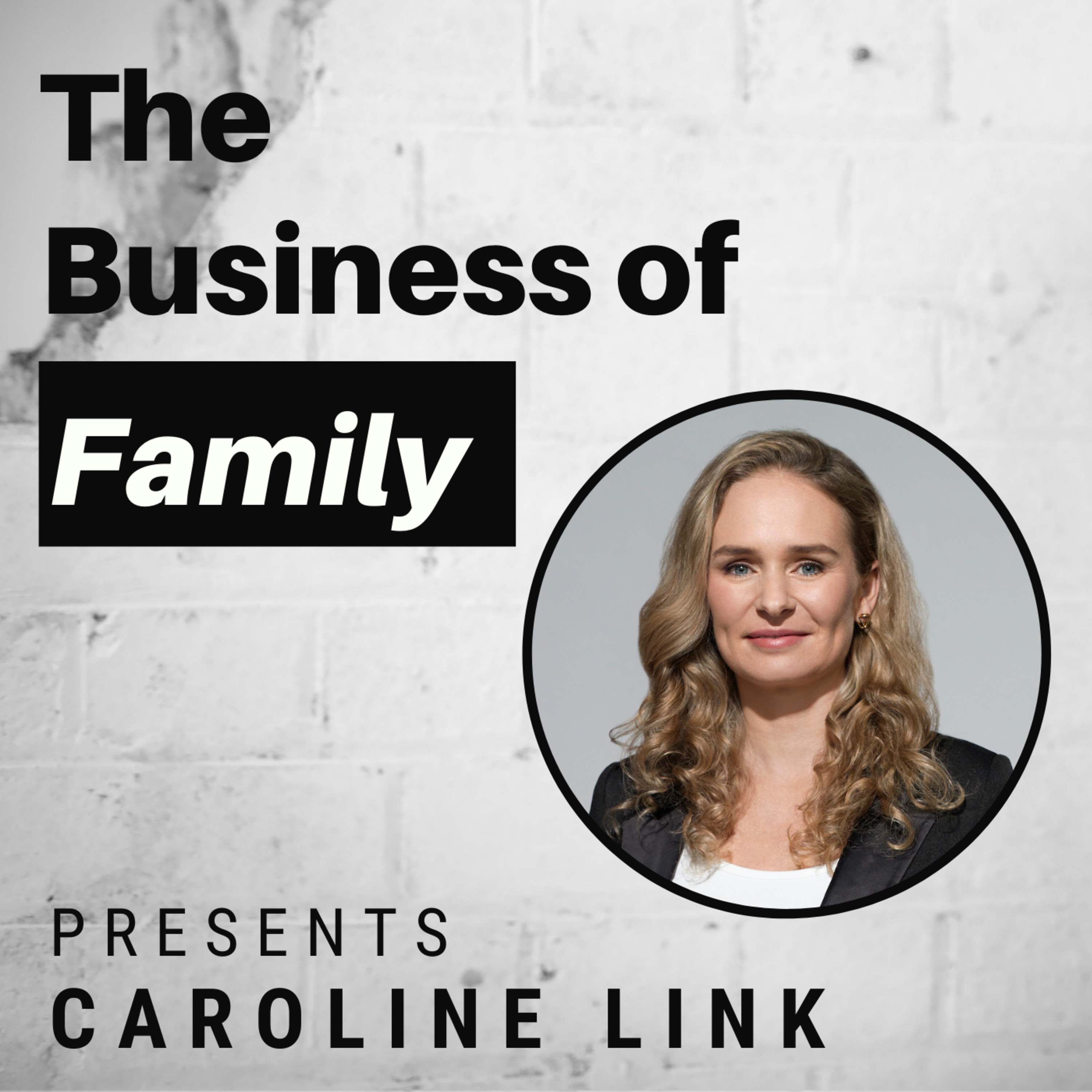
Episode 16 · Season 1
4th Generation Heir to B.Grimm, one of Thailand’s Oldest Business Institutions
Key ideas from this conversation
She and her father did a family business program together and came away with a shared way of talking, not a booklet.
Ownership narrowed at each handover, which she says happened naturally and made succession easier.
Wars and a fire destroyed the records, so the family commissioned a novel and began collecting what survived.
Read the full show notesBio, standout quotes and the episode timeline
Caroline Link, a 4th generation family member who is being groomed to run B.Grimm, one of Thailand’s oldest family-owned industrial conglomerates. Caroline grew up in a family where the common driving value and belief was to conduct business with compassion and in harmony with nature.
Through multiple generations of management, and multiple business areas and geographies, B.Grimm (which was founded in Bangkok in 1878), has managed to cultivate a spirit of innovation and empowerment among its staff.
Standout Quotes:
- “All the family members that are not in the business are just as important because they also form who you are, form your opinions, and influence you in some way” – [Caroline Link]
- “I think the most important thing that we invest in, is our reputation and that is really the most important thing that we have” – [Caroline Link]
- “Being a family business; that really helped in a way because these strong values, they weren’t only passed on when you became a leader within the company, but they were lived in the household” – [Caroline Link]
- “Keep working on yourself, and if you want things to change you have to initiate it and change yourself” – [Caroline Link]
Key Takeaways:
- Caroline explains that the resilience of the family business over time was born from the entrepreneurial spirit in the leaders, as well as a strong culture that is value and purpose-driven
- A family business is different from normal business; families come from a place of love, harmony, and support, and it’s important to look at this dynamic
- Caroline describes that the most important thing the business invests in is “Reputation”, and a lot of the reputation is based on the company's purpose and culture.
- Following an exercise aimed at creating an in-depth definition of the company as a whole, it was realized that the key to the success of the company, even from the founders, was an inherent drive towards helping society and creating value.
- Caroline also shares that a workshop on family values revealed the two main values in her family to be ”Contribution” and “Sense of Freedom”
- It is important to develop a strong sense of self-awareness; keep working on yourself, and if you want things to change you have to initiate it and change yourself
- Find what makes you happy professionally and gives you meaning, and make a contribution
Episode Timeline:
- [00:44] Meeting the guest; Caroline Link, and the B.Grimm company
- [01:29] A brief history on the founding of the B.Grimm Company up to the 3rd generation
- [06:44] Caroline shares that she was lucky her interests were aligned with many fields that the family business was already involved in.
- [08:36] How has the family business remained resilient for such a long time?
- [09:49] How the family has governed itself successfully
- [15:48] Diversifying the family wealth outside of the business
- [16:50] Caroline describes that the family strives to build an archive of the business history even though so much of it has been lost to wars and a fire accident.
- [20:19] What is the most worthwhile investment you have ever made?
- [21:57] Who is B.Grimm?
- [23:16] The two main family values shared by Caroline’s family
- [25:13] The scale of the B.Grimm enterprise
- [28:02] Caroline’s thoughts on the children being a part of the family business
- [31:54] A letter from Caroline to her Kids
Links:
- EN B.Grimm Group – Doing business with compassion for the development of civilisation in harmony with nature. : B.Grimm is one of Thailand’s oldest family-owned industrial conglomerates which Caroline Link is being groomed to run.
- Marking 140 years of success : A FAMILY-OWNED multinational conglomerate founded in 1878 and active in everything from healthcare to real estate, e-commerce, and transport; B Grimm is celebrating 140 years of success with a series of initiatives, among them an exhibition and a book.
- Prestige Online - 40 Under 40 - Caroline Link : Caroline Link is the fourth-generation heir to B.Grimm, one of Thailand’s oldest business institutions, carrying a 142-year-old tradition of “doing business with compassion.”
- The 4 virtues of B.Grimm : By marrying profit, progress and social good, Harald Link has found the secret to keeping the oldest companies eternally young.
- Caroline Link | Tatler Thailand
Read the transcript
This transcript was generated automatically and may contain errors, including in names. Listen to the episode for the exact words.
MikeWelcome to The Business of Family. I'm your host, Mike Boyd. Multigenerational wealth creation involves so much more than capital accumulation. The most successful families cultivate values, stories, knowledge and resources to pass on to the next generation, and they do it very intentionally. On this show I sit down with members of some of the world's most interesting business families to hear how they do it. To see where your own family stands, take the Business Family Diagnostic at businessoffamily.net.
This week's guest is Caroline Link, a fourth generation family member who is being groomed to run B.Grimm, one of Thailand's oldest family-owned industrial conglomerates. Caroline grew up in a family where the common driving value and belief was to conduct business with compassion and in harmony with nature. Through multiple generations of management and multiple business areas and geographies, B.Grimm, which was founded in Bangkok in 1878, has managed to cultivate a spirit of innovation and empowerment among its staff.
Caroline, thank you so much for being with us today to share your story. I'm really looking forward to it.
CarolineHi, Mike. It's my pleasure. Thank you.
MikeI'd love to start with the origin story of B.Grimm and how your family came to be involved. Can you recount for us a brief history, please, of the company's founding up to the third generation?
CarolineOf course, it started with Erwin Müller, who's an Austrian citizen who was working in Thailand. And he was told that his time was over and that he would go back to Austria and he wasn't quite ready yet. So he tried to think of ways that he could stay in Thailand and what kind of a business that he would start.
And what he realized was that there was a lack of modern or Western medicine. And he thought of his close friend, Bernhard Grimm, that was a pharmacist and that maybe he would convince him to come to Thailand and start a chemist shop with him. So that's what he did. And Bernhard Grimm, he was actually a second son of a pharmacist family.
So he didn't have the chance to work in his own family business or inherit it. And I guess he must have been quite adventurous enough to come all the way to Thailand and join his friend, Mr. Miller, in starting this business in Thailand. The company was founded in 1878. And so it started with a single pharmacy store in Thailand.
MikeAnd I assume that the company was then named after Bernhard. How did it then evolve from that single store into what it is today?
CarolineBernhardt, part of the way that he was lured to coming to Thailand was that Evan promised that he would call the company after him. They started out with one company and they managed to sell to the royal court and made a name for themselves as they had very good products and good results. And from there, they had a chance to be able to expand into other products and to become agents.
This happened all during the time of King Chulalongkorn, who had come back from a grand tour in Europe to see what he could bring back to Thailand, to modernize Thailand. And as we were becoming agents for several different companies and different industries, also to the royal court, we then had a chance to expand further into other businesses.
MikeSo can you give us an idea of the business lines that you are in today and a sense of scale for the business and how it's evolved from that one pharmacy store into what I understand is quite a conglomerate today?
CarolineToday, we're in several business areas. Some of them are the original one, which is healthcare, but we're also very strong in the energy business. Our three main areas are energy, industry, and healthcare. Our energy business is actually listed in the Thai Stock Exchange. Our industry business is very diverse as well. We have several large joint venture partners ranging from Babcock Power, Harmon, Carrier, Chubb.
And in the healthcare sector, we are joint venture partners of Mark and Sais, it's almost been 100 years, and Getinge.
MikeAnd how did your family come to be involved? I understand that you're not a direct descendant from Bernhard or Mr. Mueller. So where's the connection and the last three generations? How has that ultimately led to you?
CarolineSo I'm actually a fourth generation family. If you include the founders, it'll be fifth generation. As they were expanding the business and doing well, they obviously needed to hire more people and they were looking to expand their management. and they put an ad into a German newspaper looking for a pharmacist to join their team. And funnily enough, what Bernhard Grimm and my great-grandfather have in common is that they were both the second sons of pharmacist families. So my great-grandfather saw the ad, was just as adventurous as the founder, and made his way to Thailand and joined the management group. And when Bernhard Grimm and Evan Müller decided to retire and go back to Europe, My great-grandfather then bought the shares and became the sole owner.
And from there, he passed it on to his children and down the line. He, as you see, what he did differently also from the others is that he passed it on to my great-grandfather and great-uncle.
MikeCaroline, I'm curious how you found your way into the family business. Were you always destined to join the business or did you start by pursuing your own path?
CarolineSo my father didn't really put any pressure on us to join the business. After a while, after university and my first jobs, I was actually not quite sure which industry I wanted to go into. And our family business is in several industries. So I thought it would be a fantastic opportunity for me to take some time to look into different industries to see then what my heart was beating for the strongest.
And I ended up staying like this. So I didn't get any pressure from my father to join. The only pressure I ever got was to study business. And lucky for me, I actually enjoyed that. And the other personal interests I have are in strategy or sustainability, healthcare and renewable energy. And before joining B.Grimm, I was working with KFW on project finance for renewable energy.
So a lot of my interests and reasons why I really enjoy working are satisfied within B.Grimm. So I'm very lucky in that sense. And so it also kind of made it natural for me to want to stay and want to be with B.Grimm.
MikeExcellent. And no doubt that the company, being as diversified as it is, provided you a lot of opportunity to try different areas of the business and maintain a broad interest.
CarolineYeah, so that's very lucky. I think that I always looked at it as being an opportunity. The possibilities for a family member joining a business that I was able to go into any management meeting, to join board meetings, to talk to any leadership team, to learn from them directly, to have them as mentors. And many of them, when I joined, maybe some of them are retired now, but they've seen me since I'm a child. So it's almost like family and they see me like family.
So it was really a very positive experience. And they, I guess, maybe it's something particular in Asia. Also, they really encouraged a family succession and they were very happy to see that the next generation is there and cares. And they were very supportive in supporting me as well, giving me the benefit of the doubt and maybe not having negative reactions that I might have gotten in any other company, but they just thought, okay, she's learning, she's young, we'll help her through this. So it was really very positive.
MikeIt sounds like an amazing experience and very, very welcoming. So with such a long and rich history, I imagine the company has survived many crises, including world wars, major weather events, and this most recent COVID-19. How has the family and the company sustained for such a long time and remained resilient for such a long time?
CarolineA strong part of it is, I think, the entrepreneurial spirit that each leader had and the family had. So that's very lucky. And that is no doubt also due to the upbringing, I think, coming from family businesses, entrepreneurial background, the kind of resilience that you need. And then also the times that they were in, right? We suffered through the world wars like everybody did.
We were expropriated as German nationals were abroad. And so I think this gave a strong sense of wanting to fight and fight on. And as we were a family or we are a family business that has gone past generations, It's our long-term thinking, I think. And what I also believe is that we have a very strong culture, our leadership and us as owners.
We have a very strong belief in value creation and that we're very value and purpose driven. I think that's really what makes the difference.
MikeYeah, it sounds like you do have a very strong sense of value and purpose, which I'll be keen to explore further in a moment. Turning now to the business of family. how has your family governed itself successfully over four generations to manage these issues of ownership, control, and succession? Do you utilize any family charters or similar documents to align around a shared vision?
CarolineI think what happened with us is maybe we got lucky along the line as well. I mean, the owners, the original founders, they wanted to leave. They handed it over to my great-grandfather. He was only one. Then he was the second son. So he wanted to do it differently because he didn't inherit as a son. And he passed it on to his sons. Actually, one passed away during the war. So he passed it to the two sons. And from the two sons, it went down to my father's generation. And there, again, we were lucky that one side, so my great-uncle actually didn't have any children. And on my father's side, there were five siblings. So then on my father's side,
he ended up buying out his siblings. So now it goes down to myself and my brother. So some people would call it, I don't know, pruning the family tree or something, but I think it kind of happened naturally. And then on my father's side, there are three sisters that have very other interests that weren't looking into it. And then there would have been the potential of my uncle joining, but he also had other interests. So my father had the opportunity to buy out his siblings. And so that made things a lot easier. But of course, as now my brother and I join, that was very much on his mind. And many years ago, somebody gave him, I think, two different
books on the same subject about how do you destroy a family and a family business. And he was very impacted by these books. I mean, it's quite funny to write these kinds of books, but of course, it's very important to discuss the subject, right? And it's a pity that it's a taboo in many, many companies and many families because it's very important to talk about.
And somebody recommended him to go or to look at this family business challenge program by INSEAD. So my father and I ended up going quite early on when it came back to B.Grimm. And it was extremely helpful for both of us because it gave us a platform of which we could build on something that a framework that we could use for our communications around different subjects because we were coming from the same place. We had understood it both together.
We had a chance in this program to discuss it with other families, different generations, with the siblings, with the professional management, with the wife, with the mom, and so on. So it gave us a huge insight of what's going on in other places besides, of course, the case studies that we came through. So that was very useful to look at it for us and what that meant for us. I think one of the other key takeaways was about transparency and communication and that family business is different from normal business, right? Families, they come from a place of love, harmony, and support and it's different. So it's important to look at this dynamic. So that was very helpful for us. And in terms of, they of course talked
about, you know, family charter, constitution, do you have a family council and so on. We have something of a family council that my brother takes care of where we talk regularly as a family. We actually also started talking with each other based on YPO forum, kind of a framework, which is also really useful to have meaningful or deep conversations in a safe kind of haven.
But I think what we also learned that it's not about the final product of having like the booklet that says how you should do things, but the way and how you get there, which was very helpful for us also because I think business mindset of people, you kind of want to check the boxes, get it over with, write something down. But of course, this is not that easy, right?
These are huge discussion, every single topic, you know, who's going to inherit, who's going to lead, what makes you the right leader or not the right leader, and so on and so forth. But it was very great. We didn't end up writing a family constitution per se down, but it was definitely important for us to develop, to become the company that we are today in terms of how we're structured, how I was further developed or coached and mentored, how we are now structuring the company differently, looking forward, considering that I don't live in Thailand. I'm married, I have kids. I want to be a wife, a mother, a career woman. So very important to do that,
I think, as a family. Very helpful.
MikeAbsolutely. It sounds amazing. And And was the course that you attended at INSEAD a simple week or was it a month or was it something that you went to multiple times?
CarolineActually, just a week and just once. It was just my father and I, but I think it would have been great to, it was a good starting point. And then later on, we had, for example, Christine Blondel. She came and she did a workshop with myself, my father again, then with the family, with the management. So we kept on working at it and taking different steps to do so.
and also with different advisors. I think it's a continuous thing. I would go back to it and do it again. I think at this point, I would probably include the rest of the family, especially my brother working there. And my mom would also probably feel very included to join. I don't know if it's so important for the business, but I mean, also that's one of the things that they said, right?
All the family members that are not in the business are just as important because they also form who you are, form your opinions and influence you in some way.
MikeYeah, I love that. I think that's incredibly powerful. So it sounds like it's been formative in your fourth generation, third to fourth generation education and will stand you in good stead going forward.
CarolineYes, definitely.
MikeIf you don't mind me asking, how have you chosen to diversify the family wealth outside of the business? Do you have a family office in place or a similar investment vehicle set up for the benefit of the family?
CarolineWe have not started a family office. We haven't felt that it was necessary yet. We mostly reinvest into our own businesses and into our own companies. We also invest in real estate and some businesses obviously also diversified for that purpose in different countries and sectors. And we deal with several private banks.
MikeInteresting. And I think that your reinvestment back into your primary companies is evident because you have such a long history and such diversification that you can literally see the investments that you've made, which is really exciting.
CarolineYeah, I think it's also our entrepreneurial spirit. It's what we know how to do, what we enjoy doing, and we can see firsthand the fruit of the money we reinvest.
MikeExcellent. Back on the family side now, I'm curious, did your family maintain an archive of its personal and business history over time? With such a long history, how do you ensure that you maintain the stories and occasions throughout all of those years?
CarolineSo sadly, there's no real paperwork left. That was all destroyed over the wars. And then a few years back, actually one of my father's archives burnt down. The only place that there was a fire in the office was a short fuse in the archive. So that was very sad for my father. But we've started a new archive and we're collecting madly all sorts of things.
We actually got a Thai author to write a book about, or a novel about B.Grimm and Thailand's history, the time and period back then. And she found a lot of stories and did a lot of interviews, looked into the, not memoirs, the diaries that great grandfathers and grandfathers wrote. And in the Thai archive, she found a lot of interesting memorabilia and artifacts.
So that was very interesting. And this is all in the book, which is fantastic.
MikeThat's incredible. And so how far does the book go in terms of documenting the history? Where is it up to?
CarolineIt's from the start to before my father's generation starting.
MikeIncredible. And in terms of the efforts that you're now making to build another archive, what sort of things are you placing emphasis on? What sort of documents or artifacts are you maintaining for the future?
CarolineSo documents, old logos. My father's several people that scout for stuff that are dealing in antiquities or collectors themselves and they will find things and bring them to us whether it was an ad you know we used to sell over maltine in thailand there's an advertisement where it says B.Grimm or we used to provide and supply the uniforms and swords for the thai army so we have like old hats and swords for example or little glass bottles from the pharmacy or we have old glasses somebody found like a gift or giveaway that we used to do for the royal court, which was tea and coffee sets in the Thai style. Really the most random and different things because at one point we were
so diversified and we had a department store. So you can find many different things, whatever we come across, we find quite funny. Even I think at one point we found like a black tooth. We were selling these fake teeth, of course, for when you lost your tooth. And back then the Thais were chewing a lot of betel nut. So they would have black teeth. So of course you wouldn't want to replace it with a white tooth. So you had black teeth. So there's a lot of little funny things like that. We have an old Mercedes that I think we supplied as well that we still have. So really we try to do a wide range of what we can still come across and collectors find for us. And then
we will do the day-to-day stuff, whether it's brochures, photographs, whatever.
MikeAmazing. And you're the second family I've spoken to that have started archiving cars and artifacts too. And another family in the Philippines that is investing heavily in their history, which I think is incredible. What is one of the best or most worthwhile investments you've ever made? It could be an investment of time, money, energy, anything at all? What comes to mind?
CarolineTo answer your question, I think the most important thing that we invest in is our reputation. And that is really the most important thing that we have. So at the moment, we're doing quite a lot in terms of communication and branding exercises to make sure that we align that and do that well. But a lot of our reputation is based on our company purpose and culture. So there, we really do a huge deal within HR in terms of hiring the right people, onboarding them well, in the development of the people. We put a lot of emphasis on our values and purpose. So I think that is one of the most important things, that our reputation is tied to our culture and that
we really love that.
MikeHas your culture and purpose always been strong over the generations or is it something that you've invested in heavily in more recent years?
CarolineCurrently, we're investing in it especially a lot because we're expanding very fast, especially in the power business. We're hiring a lot of people in the industry and healthcare now. We also are going to do some fairly big investments. So there again, lots of new teams, new people on board. And I think it's important that they, first of all, was important because these are the reasons that they also came to work for us. This is why they decided to join B.Grimm versus another company. But also our purpose and culture a few years back when I joined, it was also an exercise that we did. We really looked at, you know, who is B.Grimm? Who do we
want to be? And what's important to us? So not only to live it unconsciously through the, by example of the leadership or the owners, but to be much more self-aware and conscious about how we do things and how we communicate things. And so it was a very important exercise. And what we realized is that it was the key to our success and that actually it's been there from the beginning that it was the seed grew from the founders that created a business that was about helping society to creating value. And they immediately from the beginning did a lot of social engagement activities with the communities, with the staff, whether it was for the staff themselves when they
were building the Rangsit canals, giving the malaria medication, whereas others might have not been able to, or building temples for the staff to pray. So that was really from the beginning, and then every generation continued. And I think being a family business, that really helped in a way because these strong values, they weren't only passed on when you became a leader within the company, but they were lived in the household.
So a few years when we were working with Christine Blondel, we actually did a workshop on family values, so not the company values. And one of the main values, we had two big values. One was contribution, which was very interesting. And the other one is a sense of freedom. And I think that's really important for us.
MikeI think that's fantastic. And I was going to actually follow up and ask how you think that your values as a family business or as a family have helped you to build an enduring company over the years. So it sounds like contribution plays a big role in your purpose as well.
CarolineYes, it definitely does. Contribution, I think, is the main part. And especially now, my father likes to talk about it a lot. Sometimes people think like, oh, big businesses, they're here to make money. But this is not what we're here for. The business community is here to create value, to create value for its customers, obviously create jobs for the employees, but also they're an important integral part of our community. And in terms of what this means for us as a family, I think it creates purpose. It creates a personal purpose. If you feel like you can contribute, it creates a mental well-being. If you have a sense of contribution of meaning in life, And that's also what we like to do in the company.
We like to say it again to everybody. And that's why it's important for us when people join us, that they're aligned with our values and culture, that we're really one of a bigger whole. You're not only here to fulfill just your vocational calling, but that you can be a part of something bigger, that we create even larger meaning for all of us when we're working together.
MikeThat's really powerful. I like that a lot. One thing that you touched on there earlier was having such a strong culture was important because you were scaling so quickly and you have a number of new business units. I thought it might be important to pause here for a moment for the benefit of the audience to remind everyone or perhaps introduce the scale of the enterprise today.
Can you give us a sense of how many people you employ across how many countries or geographies that are important to you? Just to give us a size of this operation, when you say it's growing quickly, that's already off a fairly substantial base, isn't it?
CarolineYes. So we're growing very fast, especially in the energy business as we build new power plants. That depends. Not necessarily if it's solar, then it doesn't grow so fast in people. But if it's in gas and every new power plant requires a minimum amount of people. So we're mostly in Thailand, but we're also in Vietnam, in Philippines, Laos, Cambodia, looking into Burma now.
We are in Korea, we're in Germany, in Switzerland, Athens, and keep expanding. So we're not limited, I think, by Thailand anymore, Southeast Asia anymore. We're definitely looking to go outside. The way we do it is definitely strategic as well as opportunistic. And like you said, we're in many different business areas. Our main company that's growing abroad is energy, but we're also abroad, for example, in transportation through our shipping business.
We are also abroad in our cooling business with Baya. In our healthcare business also, we plan to grow outside of Thailand. So we're no longer just in Thailand. However, we're actually not that many people. We're just roughly around probably 2,500 people. We're not doing a huge amount of manufacturing. We're also in manufacturing, but we're not many people.
MikeYeah, it's still a substantial number of people, but for all of the areas that you're in, I thought the number would have been higher. That's interesting. It means that you're running a great and efficient operation by the sounds of it.
CarolineYes, we like the word efficient for sure.
MikeGerman heritage too.
CarolineYes.
MikeAnd so Caroline, I assume you were born in Thailand. Was your father also born in Thailand? Where does the Thai story intersect with your German heritage?
CarolineMy great-grandfather was in Thailand when my grandfather and great-uncle were born in Thailand. And I and my brother were born in Thailand. My father was actually born in Switzerland, in Basel.
MikeOh, interesting.
CarolineI'm born and raised in Thailand. My father was born in Switzerland, raised mostly in Hamburg, and came to Thailand after university.
MikeInteresting. And have you spent much time elsewhere? You mentioned that you studied in Germany, I believe.
CarolineI studied in Spain, actually.
MikeThe majority of your life?
CarolineI studied in Spain. I spent time in Germany for work and for boarding school, but most of my life I spent in Asia and in Thailand.
MikeTerrific. And how do you feel about children inheriting wealth? Do you have a generational plan for your own children? Do you contemplate them joining the business?
CarolineI think it's an opportunity and a responsibility. In our immediate family, it will be two family businesses, so meaning B.Grimm and my husband's family business that he's running. We have three boys. Obviously, we plan to give them the best education that we can. It doesn't mean necessarily whatever it means that fits them. To expose them to be healthy, happy, moral citizens.
And I guess to be aligned with our family values of wanting to contribute and create value. In terms of what this means for them, of course, I mean, I'm older than my parents were when we were born. And I think the gap often is increasing. So it's very important for me, I think, to have an organizational structure that supports them to join if they want to join and are capable to join.
But I think we're going to have to work hard on that because I will be most likely at an age where there need to have been successors after me or different leadership within the organization to then take on or let the kids succeed. I think that's very different maybe from generations before when the parents were younger and it was easier to onboard their own kids.
So that's something that's in my mind for sure. And then my husband, for example, is in the finance sector. So I don't think you can come in from across a different industry. So obviously it will depend on what the likings are of the different children, of their interests and what makes sense. I mean, a lot of things can change from now and another 30 years, right?
So it's definitely in my mind because I want to do the fair and the right thing. And I think also as a mom, I want them to grow up well. So if tomorrow something happened to myself and my husband and all of a sudden they would inherit all of this, I would want there to be something in place so that they're not corrupted by this potential wealth, but that there's a guided way of them taking it on, whether it's a family business or a shareholder or I don't know we'll see how we'll structure it
Mikeyeah that's that's an interesting challenge and I think one that's shared by many families these days the the growing age gap between when parents have children and and that definitely is different generationally so I'll be interested to follow along that story and see how it evolves for you over the years because I think it's not unique I think there's definitely other families out there in a similar position.
CarolineAnd I think this is also an example, like, you know, maybe if we were to go back to the INSEAD thing, maybe it's something that I need to do with my husband, for example, to think about what we want to do for our children, to give us some framework to help us organize or structure things now with that in mind. Or maybe now as too early, it could be done in 10 years. I don't know.
MikeYeah, yeah, absolutely. I mean, I've spoken to some families that are structuring family governance and estate planning for children that aren't even born yet. I spoke to one Chinese family that were buying apartments in Boston ready for their children to attend Harvard and the children aren't born yet. So it's never too early for some to plan, but each to their own, I guess.
CarolineOf course. But it's been great examples, right? And great ideas and things to learn from.
MikeExactly. It's the benefit of peer learning and partly why I do this podcast to just share different case studies and insights from different families because I think that's how we all learn together.
CarolineYes, so interesting.
MikeSwapping stories. It's time for our final question now. Imagine you're writing a letter to your children. What is one idea or lesson that you don't think many parents would mention, but you consider important to understand?
CarolineI think for me, it's important to develop a strong sense of self-awareness, who you are, your strengths, your weaknesses. Keep working on yourself. And if you want things to change, you have to initiate it and change yourself. I think that's been very true for myself and I think it will be helpful for them. Another thing is to be humble, to find what makes you happy professionally, gives you meaning and make a contribution.
MikeI think contribution has been the theme of today and I think B.Grimm sets an incredible example for that. So Caroline, I really appreciate you taking the time to share part of your story with us today and perhaps we can continue the conversation another time. thank you again for sharing as transparently as you have and I think it's really inspiring the story that you're living
Carolinethank you very much for your time and for this opportunity I will definitely tune into your podcast as the subject is very dear to us and important for us as a family business as well so thank you so much it's my pleasure thank you
Miketo find more episodes of the business of family podcast go to business of family.net Thanks for listening to The Business of Family. You'll find the transcript and key ideas from this conversation at businessoffamily.net, along with the Business Family Diagnostic. It's free, and it shows you where your own family stands. And if someone in your family should hear this episode, please send it to them too. I'm Mike Boyd. Until next time, take care.
Keep listening
If this one landed, start here next.
Billionaire Diamond Owner & 4th Generation Co-Guardian
Another fourth-generation family, governing a business across continents from Bangkok.
4th Generation Filipino Pioneering Innovation in Logistics & Agriculture
A fourth-generation Filipino family business finding its next chapter.
A 5th Generation Member of the Schrage Family, Owners of the 126 Year Old Centier Bank
A family book, a corporate historian and a museum.
The Business Family Diagnostic · Story
The family archive burned. They started a new one.
When wars and a fire took B.Grimm's records, the family commissioned a novel and collected what survived. Has your family's founding story been recorded somewhere beyond people's memories?
“The next generation could tell the story of how the family's wealth was made.”

Every family wishes someone had recorded the generation before.
I built Enduring Stories to do it for yours: a guided voice conversation, from home, that keeps your family's voices, values and history.
The newsletter
The most useful things in these conversations are the things families rarely say out loud.
I share them in my newsletter once a week. Sign up to receive the ideas directly and start building the foundations for your family today.