Episode 42 · Season 2
Increase the Value and Maintain the Values
Key ideas from this conversation
Owners often find their will, their agreements and their wishes point in different directions, so every plan starts with where things stand.
Nobody lets go of one vine without another to grab: the senior generation needs a next role, such as leading the family council.
The next generation's job, as he tells them, is to increase the value and maintain the values.
Read the full show notesBio, standout quotes and the episode timeline
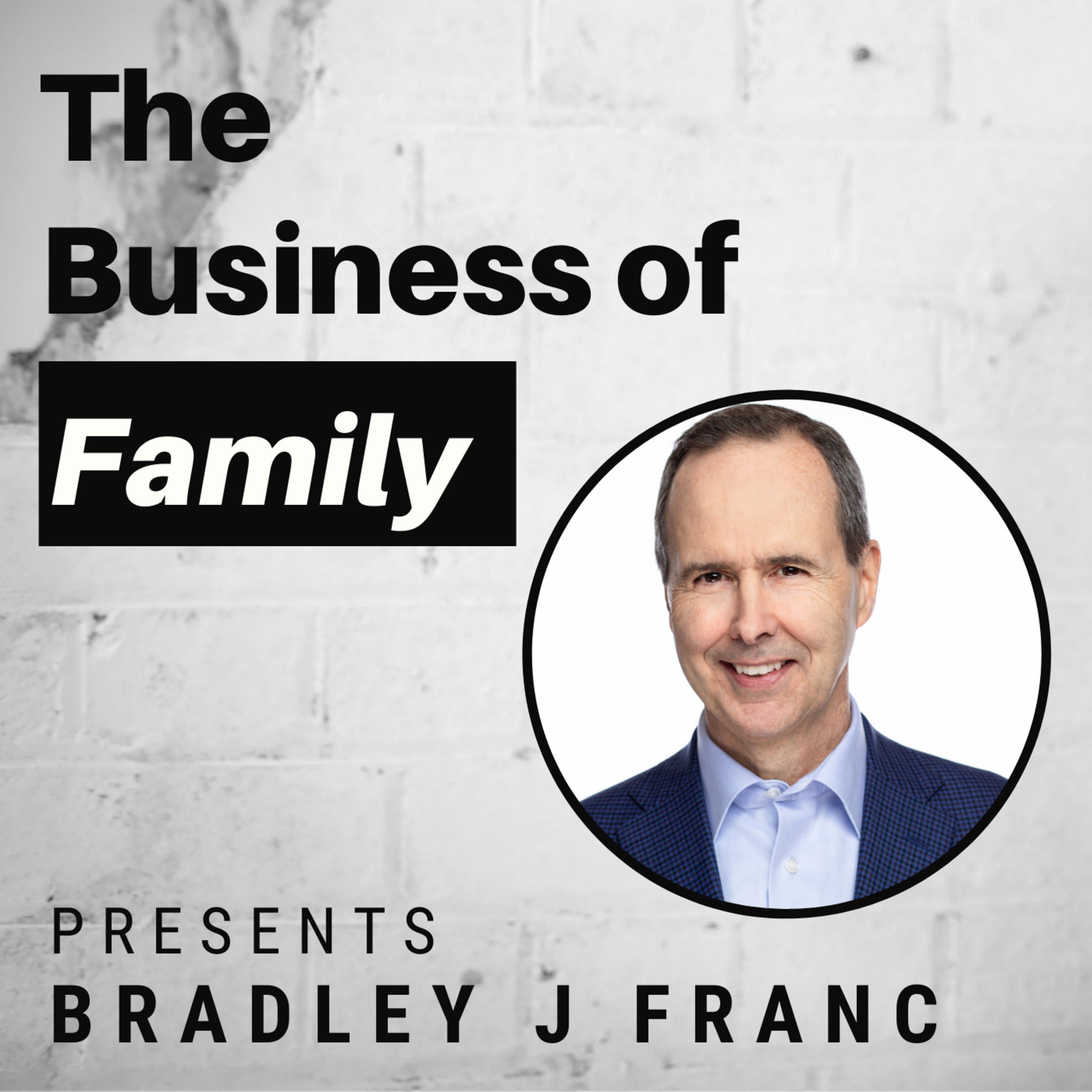
Bradly J. Franc (“Brad”), is the creator and author of the Amazon best-selling book entitled The Succession Solution: The Strategic Guide to Business Transition. His firm The Succession Coach LLC, works with business owners to create as well as execute on their succession plans.
Brad is an attorney, entrepreneur, and business strategist who specializes in the transfer of family and closely-held businesses. He is also a former board member of Catalyst Connection.
Brad began his professional career by becoming a CPA and working for the international accounting firm now known as EY. From there, Brad became an entrepreneurial strategic business adviser and a business lawyer representing every aspect of the closely-held business.
Standout Quotes:
- "Writing is the highest form of thinking" - [Brad]
- "It's not that there's a particular process but you pick a process" - [Brad]
- "The longer you wait, the fewer the options you have, with respect to succession planning" - [Brad]
- "You can't do strategic planning unless you understand the company's culture" - [Brad]
- "It is incredible how many times people think they know what they have, and they don't" - [Brad]
- "Conflict is good, it gets things out" - [Brad]
- "All progress begins with honesty" - [Brad]
- "Most people overestimate what they can do in a year, they underestimate what they can do in ten" - [Brad]
- "If you want to improve something, measure it, if you want to improve something exponentially, measure it and have a report on it" - [Brad]
- "Succession planning is a form of strategic planning" - [Brad]
- "For things to stay the same, things must change" - [Brad]
- "I try to tell that next gen, 'your job is to increase the value and to maintain the values' " - [Brad]
Key Takeaways:
- Bradley is the author of the Amazon bestseller "The Succession Solution" and his firm, 'The Succession Coach' works with business owners to create and execute their succession plans. Brad is now an entrepreneurial strategic business adviser and a business lawyer representing closely-held businesses.
- Brad had started as a CPA with the goal to reduce taxes, and later he went on to go to law school. He realized he was helping but not solving the problem so he merged strategic planning with Estate and Succession planning which formed the Succession Solution.
- Initially, his goal was to simply put down the strategy so he could convince himself that it was feasible, however, he realized someone else could also benefit from reading it. This was how he went ahead to write his book, The Succession Solution.
- After starting a business that had made losses for two years, Brad employed strategic planning and the difference was clear; the business bounced back.
- There are 3 types of succession; Succession of Knowledge, Management, and Ownership. It is unlikely to be able to ensure the succession of management and ownership without the transfer of knowledge. However, more often than not. Succession involves the transfer of ownership with closely held business owners.
- The Succession Solution: Brad usually starts by discussing with the significant stakeholders to understand what is on the ground before getting fully involved. He also ensures the family is willing to cooperate and gets commitment upfront.
- The 6 stages of the succession plan: The first stage is the Purpose stage; identifying the basic values, the vision, and the "Why?". Next is the Discovery stage; understanding where they are before starting. The third step is the Challenge; to identify their strengths, opportunities, and most importantly, the obstacles. Most of the time what people want to get from the 6 steps is certainty because uncertainty creates anxiety.
- Brad emphasizes that conflict is good however, how that conflict is managed is critical. Communication and trust are the reason most companies fail.
- The fourth stage of the succession plan is the Mission stage. This is where the group sets milestones and creates strategies to overcome the obstacles previously identified. The Annual stage is next, and here the group decides steps that need to be taken within the next 12 months, to get closer to the milestones already set. The last stage is the Quarterly Review stage where the question is "what do we do in the next 90 days to get closer to the objective for the Annual stage?"
- The conversation of succession planning is a function of the board, hence, while members of the younger generation can have a personal conversation with their parents as the business leaders, it is fundamentally expected that the board is well suited to answer these questions. It is also helpful to talk to the professionals.
- Giving purpose to the outgoing generation of leaders in the family business is highly essential as it is a part of their transition. A good step is to create a family council for them to transition into, allowing them to offer more insight particularly on the culture and values of the business. The family office and council would also need succession planning.
- Succession planning is a form of strategic planning, as such, families should consider commencing strategic planning right after planning for succession.
- "The job of the incoming generation is to increase the value and to maintain the values" it is the job of the senior leadership to educate the upcoming leaders on the values of the business.
- Lack of planning for succession can ultimately lead to a closure of the business or loss of key employees due to uncertainty.
- Listeners who want to know how to get started with succession planning are encouraged to educate themselves first; Brad's book, "The Succession Solution" is a good resource. With adequate knowledge, they can also discuss with professionals.
- Brad's letter to his children: Never stop reading; if you want to improve yourself, read books.
Episode Timeline:
- [00:45] Introducing today's guest, Bradley J Franc.
- [01:49] Brad shares his backstory.
- [04:21] What inspired you to write your book, "The Succession Story"?
- [05:48] Discussing the importance and role of Strategic Planning.
- [09:06] At what point do you typically get involved in the business?
- [10:46] The Succession Solution (6 stages of the succession plan)
- [26:06] How can the upcoming generation approach the conversation of succession planning with the leader in the business?
- [32:09] Do you also create succession plans for the family council?
- [36:00] Consequences of poor succession planning.
- [40:17] What do you suggest as a first step in succession planning?
- [41:56] Brad's letter to his children.
Links:
- The Succession Solution : Bradly J. Franc (“Brad”), is the creator and author of the Amazon best-selling book entitled The Succession Solution: The Strategic Guide to Business Transition.
Read the transcript
This transcript was generated automatically and may contain errors, including in names. Listen to the episode for the exact words.
MikeWelcome to The Business of Family. I'm your host, Mike Boyd. Multigenerational wealth creation involves so much more than capital accumulation. The most successful families cultivate values, stories, knowledge and resources to pass on to the next generation, and they do it very intentionally. On this show I sit down with members of some of the world's most interesting business families to hear how they do it. To see where your own family stands, take the Business Family Diagnostic at businessoffamily.net.
Bradley J. Franc is the creator and author of the Amazon bestselling book, The Succession Solution, The Strategic Guide to Business Transition. His firm, The Succession Coach, works with business owners to create as well as execute on their succession plans. Brad is an attorney, entrepreneur, and business strategist who specializes in the transfer of family and closely held businesses.
He's also a former board member of Catalyst Connection. Brad began his professional career by becoming a CPA and working for the international accounting firm now known as EY. From there, Brad became an entrepreneurial strategic business advisor and a business lawyer representing every aspect of the closely held business. Brad, it's fantastic to have you join the show this week. Thank you so much for making the time.
BradMike, it's a pleasure. Thanks for inviting me.
MikeSo I want to start with a brief summary of your background, because I think it's particularly interesting as an attorney, but also some experience with EY, from what I understand. Can you help us understand where you started and how it ultimately led to where you are today, please?
BradSure. So I started, as you mentioned, with the firm, which is now EY, an international accounting firm, one of the big four. And then after about four or five years, spending a few years in the audit, a few years in the tax department, I went to law school because I had always wanted to be a lawyer. And for the last 32 years, I've practiced law representing closely held business owners, high net worth individuals. But during the last 25 years, Mike, I've had three separate companies, which I'm proud to say we made the Inc. fastest growing companies nine times. One of them we didn't. I like to say I'm two for three, but we exited one
to a publicly held company and the other a private equity firm acquired us. So I feel as though I can stand in the shoes or sit at the seat of the entrepreneur, lawyer, and CPA.
MikeIt's an amazing combination that I think is pretty rare for someone to have that level experience. And it obviously has set you up to do what you're doing today. Can you tell us how that's evolved to working with closely held businesses and family businesses over the last 30-odd years?
BradSure. It's really interesting as far as I'm concerned. When I started out as a CPA and it was all about taxes, and that was my 900-pound hammer. How can I reduce taxes? And then I became a lawyer and we addressed other issues. How do we protect the assets from creditors? So therein lie, created trust and things like that.
And I found that I wasn't really solving the problem. I was helping, but not solving the problem. Overlay on top of that, the entrepreneurial activity. And what we did is on a quarterly basis, Mike, we would do strategic planning. I brought the idea of strategic planning to my partners because initially we were failing. After the second year, we turned it around and I really attributed it to our cadence of quarterly planning.
So what I did about 15 years ago, I started to merge the strategic planning aspect to the estate planning and succession planning. And that's how I came about creating the succession solution.
MikeSo let's get in and explore it. What prompted you to write the book in the first place? Was it because you were delivering this for clients on a regular basis as you got into professional practice and you wanted an easier way to distribute the message? Or was this almost a way of attracting clients and building the business from there?
BradIt's a couple of things. That's a great question. My law school professor once told me, writing is the highest form of thinking. So I wanted to test the process that I had developed kind of on the back of a napkin, 11.5 by 17 piece of paper. And I started to break it down and I wanted to write it to convince myself.
In addition, I believe it's a product. It's a document that somebody else, a business owner, an advisor could read and help them. So it was one, to prove to myself and two, to help other business owners. Of course, we've all heard the phrase, writing a book is the ultimate business card. I get that, but there was more to it.
And it really helped me also distill down and improve the process when you're forced to write.
MikeYeah, that's a great insight. Before we get into the book itself, I'm curious the types of strategic planning that you were doing in your businesses and what those businesses were. What sort of industries did you operate in and how did the strategic planning help you become more effective as an entrepreneur, as a manager, as a leader?
BradSo this is kind of funny. As a lawyer, a friend of mine, a non-lawyer who worked for ADP, was an executive at ADP, said, hey, Brad, I got this idea for contract lawyers. And I said, that will never work. And he kept bugging me. And I said, okay, let's sit down and create a business plan to see if it, in fact, will work.
and it was his idea and we launched it. And the first year, we lost a bunch of money. The second year, we lost a bunch of money. And somebody came along out of Denver and had a similar business. And he said, Brad, you got C employees, you got D space, you got an A operating system because we were little techies, right?
And then I said, okay, we need to think strategically. We're sort of all over the place. And it was really Stephen Covey's. He has a strategic planning process that we adopted initially. What I tell people, it's the same thing with succession planning. It's not that there's a particular process, but you pick a process. And so we sold that. Interestingly, once we started the strategic planning process, we really started to hit the ball of the park.
And then the last three to five years, we made the Inc. 500 at that point in time. There was a tiny little subsidiary that we had created with respect to real estate closings, where we would have lawyers close real estate transactions. We were doing maybe 100 to 150 a month. I told the company, that's not for sale.
10 years later, that company was doing 5,000 closings a month, and we sold it to a private equity firm. So what we were doing, we were doing real estate closings, scheduling, and placing lawyers at the table. Once again, because our strategic planning process that we sort of developed on our own from Covey and a couple other techniques and strategies, we were very, very disciplined about it.
MikeSo now leading into the succession solution, I just want to qualify that you're working largely with the succession of businesses. Is that right? It's not necessarily the succession of a leader of a family business or of a particular business, but it's more the succession of ownership and control. Is that a right way to view it?
BradYes, but let me put a point on this. And I don't mean to digress, Mike, but what I tell people, succession is three things. There's three types of succession. The succession of knowledge, management, and ownership. I don't think you can do management and ownership without the transfer of knowledge. But sometimes a closely held business owner will bring me in to replace and figure out who the next CEO is.
So I sit on the board, actually, of a large ESOP on the East Coast. They brought me in to help them find the next CEO. Was it internal or external? So that's management. But more often than not, Mike, you're correct. It is the transfer of the ownership with a closely held business owner. But it can actually be one or the other.
MikeSo at what point do you typically get involved in a business? Do people reach out for advice when they're already halfway through and sort of fumbling their way and realize they need some help? Or do you find that a lot of these closely held businesses ultimately identify ahead of time that we're going to need a real plan, we're going to need a strategic plan in order to succeed with succession?
BradYeah, it crosses the waterfront, as you might imagine. I wish they would think about it sooner. They should. The joke that I give people, the longer you wait, the fewer the options that you have with respect to succession planning. But there are all points. I mean, there was a very large development company in Western Pennsylvania, billion dollars in revenue. They had hired a professor to come in and evaluate who the next CEOs would be, who it should be on the board.
He pushed four books in front of them and said, two of these books are your leaders, Two of them aren't. And they did nothing for four years until the family, their hair was on fire, as I like to say. They were really at each other's throats. They brought me in. And the two owners, to your point, Mike, the two owners were not involved in the business.
But there was a large family. It was the third generation. And they were trying to figure out how they could figure this out. And I explained to them my process, brought them in. I'm really happy to report after a year, we had a really good outcome. As a matter of fact, the senior CEO and significant shareholder just spoke on my behalf with respect to how well it went for me.
MikeOh, fantastic. So let's get into the process then. How does it work? Where do you typically start with your succession solution that you've refined over all of these years? I'm really interested to understand your take on this.
BradYeah, so maybe I could ask a question to make sure I'm being responsive. So I have the succession solution roadmap, which I have six stages that I take people through. But I can even talk to you before I even start that process. If you'd like me to explain from the beginning, that might be helpful.
MikeYes, please.
BradYeah. So depending on how frantic a person is and how quickly they need me to get in, What I like to try to do is talk to the significant stakeholders before we get started. Ask them what they would like to get out of this process. What do they think of the culture? I'd like to do some discovery work on what agreements are in place before I get myself too involved.
I also tell people, don't hire me unless you're willing to meet with me four times throughout the year, every quarter. There's a great book called The 12-Week Year. And the author talks about you should plan your life around 12 weeks. It's long enough to get stuff down, but short enough to keep an eye on the ball. And I say to people, look, if you want to fire me after the first meeting, that's perfectly fine.
But succession planning is about planning and executing. I can put together a great plan, but if we don't execute, it's not going to be successful. So I get a commitment up front. Then we normally get the important stakeholders in the room. I like to err on the side of more people versus less people. But sometimes it's important to start small because people get nervous.
And then we work through the six stages of the succession planning process, which I'd be happy to sort of walk you through that if you'd like at this point.
MikeYes, please.
BradAll right. So again, I believe that, to sort of go off script for a moment, that you can't do strategic planning unless you understand the company's culture, as they say, culture, each strategy for lunch, breakfast, and dinner. And you can't have, it's not good enough just to have a culture. You have to have a strategic plan. So I believe what I tried to do with this succession planning process in this roadmap is I've combined the two.
So the first stage I call the purpose stage. And I ask the owners three things within the purpose stage. Number one, let's start with our core principles. What are our basic values that we believe in? I believe, Mike, that's sort of as a definition of your culture. Because we're going to go back to those principles. We're going to go back to those values when there's conflict.
And there's always conflict. And conflict is good, right? You get this stuff out. But then we say, okay, we said at the very, very beginning, when there wasn't a conflict, when we were in our honeymoon period, these were the things that were important to us. employee-centric, honesty, integrity, respect. I mean, these are the common things, but this is not my plan. This is their plan. So, once we have the basic core principles, then what's our vision? As the Bible says, without vision, we all perish, right? We need that north star to look to. What do we ultimately, although we may never get there, what do we ultimately want to get to. It might be for the next generation family members to become the new
owners or a new CEO, whatever it may be, we need a vision. Then I ask them, why? Simon Sinek's great book, Getting to Why. If you have the why, I think, again, at difficult times, you can overcome combat. So I represented a very successful high-tech manufacturing company. And the gentleman was without any family, wasn't married, no children. And he knew that he wanted to have a succession plan. And it was difficult at times. His name was Jim. He became a friend of mine.
And his why, Mike, was his employees. His employees were his family. So every time he's like, what am I doing? Why I can't stay in this? I just want to. And I said, Jim, it's your employees. And so you have to sort of bring it back to that core why. That's the purpose stage. And that's foundational. And by the way, I review that every quarter because we can't forget. We got to keep our eye on the big picture at that point in time. The next stage I call the discovery stage, or in my book, I joke about it's the red dot, right? So I don't like to go to the mall.
I'm not a shopper. I get lost. And so what do I do when I walk into my mall? I look for that big block where that red dot is and says, you are here, right? Mike, it is incredible how many times people think they know what they have and they don't. They may want the company to go to one family member, but their will may say it's divided it equal because I want to be, quote unquote, fair because they think equal is fair.
So we do a deep dive as to where we are. Another terrific book I read last year, Down the Road Less Stupid by Keith Cunningham. And he's a strategic planner. And basically, Cunningham's theory is, look, you set your vision, you identify where you are, you identify your obstacles, because if there were no obstacles, you'd be there. You build a machine to get over the obstacles and you turn the machine on, right?
So vision is a purpose stage. The next one is let's find out where we are before we get started. And then the next is sort of a SWOT analysis, but it's not a SWOT analysis. I ask them, identify your strengths, the opportunities, and most importantly, the obstacles. Another terrific book is called Upside, where these consultants come in and the first thing they do is they look for the risks that the company encounters, the obstacles that are getting their way. So in my one situation with a large real estate development company, the natural CEO, one of the shareholders, couldn't stand him from a family standpoint. He was the right person.
That was a heck of an obstacle. We were able to get over that obstacle when management came in and talked to the shareholder and said, look, we understand there are issues here, But for the good of the company and the thousand employees, we think this is the right person. And that shareholder eventually came around and made the right decision.
So we have our strengths, our opportunities. Opportunities are, you know, one of the biggest things that I hear, Mike, when I interview people as to what they would like to try to get out of this process is certainty, a plan, because uncertainty creates a tremendous amount of anxiety. And so that's one of the opportunities. We'll be able to recruit people.
We'll be able to maintain people.
MikeAnd I assume, too, removing the distraction of fighting over who's in control, who's leading it, who's going to lead it. Some of that uncertainty leads to distraction in the operating business as well. And in the case of the families that I talk to regularly, the wider family enterprise, If we spend all our energy on who's in control, who owns it, who's going to run this in the next gen, you can very easily lose your way on how you got there in the first place.
BradAnd everybody has their own view and acts differently as opposed to having one view toward, all right, I don't like it, but this is the next CEO. This is the next owner. I had a company, an environmental remediation company, where we had three sisters that were vying for control as far as the stock goes. And eventually, the father who owned the company had to put his foot down and said, look, I I know you're going to be mad at me, but I'm making the decision.
And he said to me, someone's got to be captain of the ship. That was his line, right? He picked somebody. They were upset, but they knew he loved them and he talked to them and they got over. And by the way, the company did fantastic afterwards.
MikeBrad, on that point, and I'm sorry to interrupt your flow, but there's another follow-up I'd love to ask. Earlier, you said that conflict is good. It gets things out. Can you elaborate on that? Because I know certainly some people listening will say a whole part of our anxiety and the challenge of talking succession is that we're avoiding conflict.
So what's the benefit to it? And how do you control it so it doesn't just explode?
BradWell, so I am a member of YPO. It's an international organization. And I sent a questionnaire out and I asked that question. So if you're working on your succession plan, what's the one thing you'd like to know ahead of time to get you started. A couple of the comments back to conflict was, I wish I knew that people would be honest with their opinions as opposed to tell me what I think I want to hear.
I tell people all progress begins with honesty. I believe, I know it sounds self-serving, if you have a facilitator, I can ask more hard questions. One, people are normally more respectful when there's a third party in the room. You know, I didn't take your GI Joe when you were six years old, Mike, to get mad at me.
I didn't make fun of you because of your funny looks, whatever the case may be. So I eliminate that and I'm able to control the process. But I think that you have to naturally get this out because when you identify conflict, and it can be in a respectful manner, it's just a difference of opinion. And so how you manage that conflict is really important.
As a matter of fact, I'd suggest to you communication, as I've mentioned in my book, and trust overwhelmingly is the reason most companies fail. It's not tax issues. It's not technical issues. It's the ability to communicate and trust one another.
MikeThat's a great answer. And certainly what we see in family enterprises often, a breakdown in personal relationships is what leads to the wealth destruction. All right, let's go on with your process. I think we're up to uniting around a plan.
BradYeah, we're half done. So as I said, there's six stages. One was the purpose stage. The other one was the discovery. The other one was challenge. And then the next stage I call the mission stage, right? So I say to the group, all right, if we're here three years from today, what would you like to see have happen, right?
And so it may not be that difficult for someone to think three years out. If I said to you, Mike, can you do 100 push-ups tomorrow? It might be more challenging than if I said, hey, Mike, in three years, do you think you get to 100 push-ups, right? So it's a lot easier. Bill Gates once said, most people overestimate what they can do in a year.
They underestimate what they can do in 10, right? So we set forth milestones. I don't like to call them goals because goals are you reach them and you stop. They're milestones. or objectives. Then you say, these are objectives. Once again, let's look at the obstacles that we identified. What can we do to overcome those obstacles? What are the strategies to overcome those obstacles? The next gen is not prepared to be the CEO. Okay, can we get some leadership development? The question I was asked yesterday in the group, what happens if there are three viable next-gen CEOs. My response to them was, you're lucky. Some people don't have any.
And so I would suggest what you do is you develop a criteria, a job description of that CEO. You set some objectives that these folks need to meet and you evaluate them. You have three years to do that. You don't want to ask that question or test that person three days ahead of time. And then if those are our objectives and milestones and these are the strategies, what key results should come from it?
It's not, I feel better. No, it could be we have formed a board of directors with two independent directors. That could be a key result, right? So we go three years out. And then, as you might imagine, the next stage I call the annual stage. That's very creative, isn't it? And I say, okay, this is what we said we're going to do three years from today.
What do we want to do in the next 12 months to get us closer to that three-year milestone? Once again, what's in our way? What are the tactics that we're going to do to overcome them? It might be nothing more than we're going to have a shareholders agreement because we don't have a shareholders agreement in place. and we're going to address inside shareholders and outside shareholders. We're going to permit it. We're not going to permit it. We're going to have a term sheet or an outline of what it's going to be. Whatever it may be, we start breaking it down. What's that old saying, how to eat an elephant, one bite at a time? Once again, key results.
And then the last stage is the quarterly review stage. And this is, I'd mentioned earlier, the terrific book, a 12-week year. And this is where the action happens, in my opinion. We say, okay, what are we going to do in the next 90 days to move us closer to the annual review stage? And then we assign responsible people.
Not that they have to do it all, but they're going to report out in 90 days. And it's funny. What's that old saying? If you want to improve something, measure it. If you want to improve something exponentially, measure it and have to report on it, right? It really motivates people because I'm going to call them out, right?
Not in a mean way. I'll say, Mike, you didn't do this. Is it important? No, Brad, it's not important. Okay, well, let's move on. It's important. Yes, it's important. I was just too busy. Okay, well, let's move it to the next 90 days. I will tell you that oftentimes we accomplish our three-year goals in a year if we keep to the cadence.
And what I do, Mike, is during that quarterly period, I'll follow up with folks. I don't take any of the tasks. This is not my plan. They got to invest themselves. Because if you get someone to invest themselves, they really want to make this thing happen. And then we sort of have the key results. And the last thing I like to try to do is have a little celebration after each quarter to make it kind of fun.
So that's the process.
MikeI love it. I'm curious now to think about how this applies in a context where, you know, whether it's a family business or a closely held business and, you know, relationships are already a little tense. There's already some question over, is the current leader going to move on? Is someone going to retire? Will we get the opportunity? So how would you say a second gen or a third gen approaches somebody who's currently in that leadership position and actually suggests that they get a plan like this underway when they've got to convince the person that's sitting in the seat already? Any tips?
BradThe joke is next gen is to annoy the senior gen and the senior gen is to frustrate the next gen, right? There is a dynamic. And I will tell you, Mike, that what you've got to be mindful of is that senior gen, I won't call them first or second, but the senior gen, they feel as though this is more psychological and I'm not a psychiatrist, I'm more of a CPA lawyer, but there's a psychology that you're being a little too aggressive, take your time, trust me. And that would frustrate me as well, because I'm not saying I can't wait, I need clarity. So I would suggest that you first have a conversation. Hey, dad. Hey, mom.
Hey, uncle. What's your succession plan if you have one, if you don't mind me asking? And then try to do a lot of listening. I don't have one. Or I got it in my mind. Okay. Do you think we should maybe outline it? Talk to senior management just in case something happens. I think you need to be careful with that conversation. Now, the easier approach, and this is what I'm passionate about, Mike, is I believe the board of directors has this responsibility. I believe that that next gen should go to the board and maybe not the mother or father because that can create a dynamic, but an uncle or hopefully a closely held business owner has a couple of independents and ask the question because I think that's a fundamental
responsibility of a board. And then the last approach, just sort of give you some options, is talk to the professionals. If you get a chance to talk to the lawyer, talk to the CPA. I sort of began this process a million years ago. I'm sitting at the NYU Tax Institute as a young lawyer and a woman partner gets up and says, you know whose fault it is? Why so many businesses fail from a succession planning standpoint? She says, she's pointing to us, it's your fault.
So I think that might be another approach.
MikeDo you ever work with clients as part of your succession planning process to also have a post process, a follow-on to help find the senior generation a soft landing or to help put a plan in place to help them transition from whatever role they're playing now into an important role, perhaps in the family office or some other key role for the family or shareholders?
is that sometimes important to help make sure that that person still has purpose?
BradOh boy, that's the truth. The analogy I heard, Mike, I don't know if this is appropriate, inappropriate, but when I was growing, we had these Tarzan moves, right? And Tarzan would swing from vine to vine to vine to get across. That's how he traveled, right? Well, Tarzan didn't let go of a vine unless there was another vine to grab onto, right? And so that senior generation needs to know what vine they're going to reach out for or they're going to fall.
One of the fellows I worked with when he was exiting, he said, Brad, my fear is I'm going to go from he's the man to who's he. And so what we found with some larger family businesses is it's a natural step to leading up the family council or the family office because they have a wealth of information.
They have all the culture of the company and they can help, if not the next gen, the next gen after that, hey, you should be going to school for X, Y, or Z, or this is why we do this. I'm helping a family with that at this point in time, creating a family council so that there's good communication with the non-employee shareholders and that senior gen still sits on the board and they can communicate to them what's going on. So yeah, that's critically important, Mike.
MikeI'm curious to follow up on that one. So if they're creating a family council for the first time, and it sounds like there's an operating business still in existence, is the family council also looking to spread its wings to other parts of the family enterprise? Are they looking to set up a family office or an investment structure? Or is this a family council that's effectively an advisory board to the operating company?
You know, is it trying to keep family members who are historic attached or is it serving a wider purpose?
BradWell, I think it's a combination of a couple of things. I mean, I think initially, because there was so much initial friction, anxiety, anger as to who's going to be in charge and things like that, it was to make sure that there was an open dialogue. So the family council, one of the things that they're going to do is allow to have a board member to be on the board that would report back to the family council.
They'll meet twice a year. They will take... The other nice thing about a family business with the family council is they want to do things together as a family. It's an extended family. They're very close-knit, but they'll go away on a vacation, but a working vacation. So someone will plan that. They will also talk about philanthropy, where we think we should be placing our funds.
And so those types of things. I have another family that has exited and we're setting up the family office. And it's all about investing and helping the other family members. But they no longer have an operating business.
MikeIn working with families who have a family board or a council or even an office, do you work with them to create succession plans for those organizations as well as the operating business? Is it important to talk about succession of the council?
BradAbsolutely. And the family office, because typically, Mike, what I've seen, look, what's that joke? If you've seen one family office, you've seen one family office, right? I think succession planning has to be addressed in the family office because typically it's the senior generation that has exited and their term is not going to be that long in the saddle. And so who's going to be on the board of directors and the one that I'm specifically referring to, there's a foundation. Who's going to be on the foundation? Who's going to select that? There's significant investments. Who's going to be the investment officer. And so we got to work through that because in our situation, that next gen
is in the 40s, 50s, in the 40s and the 50s. So we do work through that. The other thing I'll mention, even though you didn't ask, is what has happened over the last couple of years when I finished a succession plan is they asked me to get involved with strategic plan. And because I believe that succession planning is a form of strategic planning. And I explained to them, you don't need me, but you should take this to that next level because the next CEO, the next owner, they need to set their course.
Their course is their strategic plan. So that's another outgrowth that I see with succession planning that I would suggest people be aware of that that's a natural and a good outcome of a succession plan.
MikeYeah, absolutely. I agree. It's a form of strategic planning, and I think that's a really healthy way to approach it. Brad, earlier in the conversation, you talked about three things that are critical to transition. And one of them that you mentioned was knowledge. It's so important to transition knowledge. And one thing that we talk about on the podcast often with families is the value in documenting family history, in passing down the stories from generation to generation, which is often coming back to that question of why.
Why we do things? What's important to us? How did we get here? I'm curious if that forms part of your sort of knowledge management or knowledge transition plan. How do families do that when they're transitioning ownership and control?
BradWell, I think that this is when there's a bit of a frustration at times because, and by the way, I think it's terrific. I think it's great to set the family history, to see how hard some folks worked, what remarkable things happened. but the other joke that's out there, there's a saying that says, for things to stay the same, things must change.
And so there's a fine balance that needs to be struck. Another book, The Innovator's Dilemma, right? A lot of senior generation folks want to have things stay the same way. They want to put their retirement at risk. It worked for them in the past. And when that next generation comes in with new ideas, I'm not suggesting the fundamental history and the culture, but you have to be flexible.
I try to tell that next gen, your job is to increase the value and to maintain the values. It's a senior gen that I think that has to say, look, this is what we're about. This is our history. And I haven't gone so far, Mike, to document that that normally is already done, or if it's not done, I suggest that they do it.
MikeI like that. What was it? Increase the value and...
Bradmaintain the values.
MikeYeah, that's very nice. I like that.
BradThank you. Thank you.
MikeSo let's flip to the other side now. What happens when it goes wrong? What is terrible advice that you see or terrible behavior that you see when people don't plan succession effectively?
BradWell, what happens, I just unfortunately had a situation where I had to terminate a relationship. And what happened was at family business, senior management was given an opportunity for some ownership, had the meeting, senior owner, majority owner said, this is going great. This is going great. This is going great. Senior management said, they're nodding their head, nodding their head.
I thought it was going well. I got a phone call from both senior managers and said, everything he said to you was a lie. And I said, why didn't you say something in the meeting? Brad, we're minority shareholders. I don't want to lose my job. And there was a substance abuse issue. And so this company is in a really bad way because of these issues. And again, I'm not suggesting this happens a lot, but the senior management is now talking about leaving and starting another business. It'll be devastating. That's the kind of stuff that has and can have it.
MikeWorst case.
BradYeah, worst case. Again, I am fortunate, Mike, and this is why I do my due diligence at the front end. Look, I missed it. I didn't see it. I tell clients, I want to be successful. Anyway, I'm successful if you're successful. So I usually don't take on engagements unless they're willing to do this. But there was another arrangement where three siblings in their 70s, we had an initial meeting and we thought it was going to work.
and one gentleman wanted to sell the company. The other two didn't want to sell the company. He shut the whole process down. And now key employees are leaving. Because once you start this process, right, you set an expectation for senior management. They're worried about their jobs, right? And it's not good. Now, I don't know what's happened. It's been about a year ago that we shut the process down.
But since then, some senior management had luck.
MikeBrad, I'm curious if you ever get involved with picking up the pieces from an estate planning perspective, if maybe the current leader passes before a healthy plan is put into place, and then whether it's inheritors or the next gen or senior management are trying to figure out who's in control, who should be in control, how do we run this thing?
Do you ever get involved in those sort of messy situations when it's too late for strategic planning, but we've got to make the best of a difficult situation?
BradYeah, I have. Probably one of the largest estate administration matters I was ever involved in had that situation. We tried to do planning ahead of time. I don't need it. I'm fine. And I talked to him about liquidity because he had a very large estate. I have all the liquidity I need, not a problem. As you might imagine, he dies unexpectedly.
When does he die unexpectedly? 2007. And the height of the Great Recession and most of his properties, his businesses were real estate. The bank called the loan because a lot of the loans state that when the senior owner dies, it's an event of default. So what we did in that situation, Mike, is we got the troops together and said, okay, let's sort of figure this out first.
What do we got? And we worked with that next generation who did a great job, fending off the banks, fending off some other shareholders, lawyers from one shareholder. You just have to sort of take this one step at a time. It is very, very difficult. We almost lost everything. And this was an estate that was well in excess of nine figures.
And to think about that and to lose it all, right? Because of the Great Recession, banks calling loans, couldn't sell anything, and a bunch of fighting. But we worked through it. And I think you just have to maintain your composure and eventually you get through the process. And it worked out. It eventually did.
MikeAmazing. Amazing recovery by the sounds of it. So, for those in the audience now that have that burning or nagging feeling in the back of their mind that, yeah, succession is really something we need to address. It's something we've been thinking about for a few years, but haven't taken that first step. Where would you suggest is step one? How do you just embark on this journey without it seeming like it's so daunting and going to be a huge process for all involved?
BradSo, what do we do today? Now, I joke with my wife, I can't figure this out. I don't know what to do here. I say Google, right? Google it or go to YouTube, right? So the flip answer, but a serious answer is you educate yourself, right? You do a little bit of education. And that's why I wrote this book. This book is not written for guys like you and me, right? It's written for the business owner. And I believe if they never use my process, that if they do a little educating, and there's a couple of books out there on succession planning, But that's where I would start.
Again, not that you can't talk to your professionals. And that's one approach. You can talk to your CPA. You can talk to your lawyer. You can talk to your financial advisor. That's fine. And that's a place to start. Unfortunately, sometimes that line I used at the very beginning, they've got the 900 pound hammer. You talk to an insurance representative.
I know I'm going to get in trouble for this when I say, what do you need? You need more life insurance. Of course. So you talk to a lawyer. Let's do this sophisticated tax plan and put everything in trust. This is multifaceted, multidisciplined. And so that's why I do a little bit of educating about them.
MikeThat's excellent. Brad, it's time for our final question now. And as you know, on The Business of Family, I ask the same question of all of my guests. Imagine you're writing a letter to your children. What is one lesson or idea that you don't think many parents would mention, but you consider important to understand?
BradAnd never stop reading. If you want to be interesting, read books. If you want to improve yourself, read books. That's the one thing that I would suggest. And by the way, I've told them that about a thousand times.
MikeIt's a fantastic lesson. It certainly served me well, Brad. I love books. So thank you for sharing that with us. And thank you for sharing all of this with us. I've certainly learned something. I think it's fascinating. And I'm sure plenty of people in the audience will pick up your book to take it to the next level as well.
Thank you again.
BradMike, thank you for the invite. It's been a pleasure.
MikeThanks for listening to The Business of Family. You'll find the transcript and key ideas from this conversation at businessoffamily.net, along with the Business Family Diagnostic. It's free, and it shows you where your own family stands. And if someone in your family should hear this episode, please send it to them too. I'm Mike Boyd. Until next time, take care.
Keep listening
If this one landed, start here next.
Work, Money & Meaning: How to Let Go When the Time Comes
Why owners stall on letting go, and what the business gives them.

Second Generation Vietnamese-American Business Woman
A father and daughter handing over control and keeping the relationship.
Appointing a Non-Family CEO & Selling a 5th Generation Business
A fifth-generation family choosing a leader from outside.
The Business Family Diagnostic · Succession
Tarzan never lets go of one vine before he has the next.
Brad's point about leaders who stay too long is a kind one. They need somewhere to go. Does the current leader in your family have a plan for their own next chapter?
“The family has talked openly about when leadership will pass on.”

Every family wishes someone had recorded the generation before.
I built Enduring Stories to do it for yours: a guided voice conversation, from home, that keeps your family's voices, values and history.
The newsletter
The most useful things in these conversations are the things families rarely say out loud.
I share them in my newsletter once a week. Sign up to receive the ideas directly and start building the foundations for your family today.