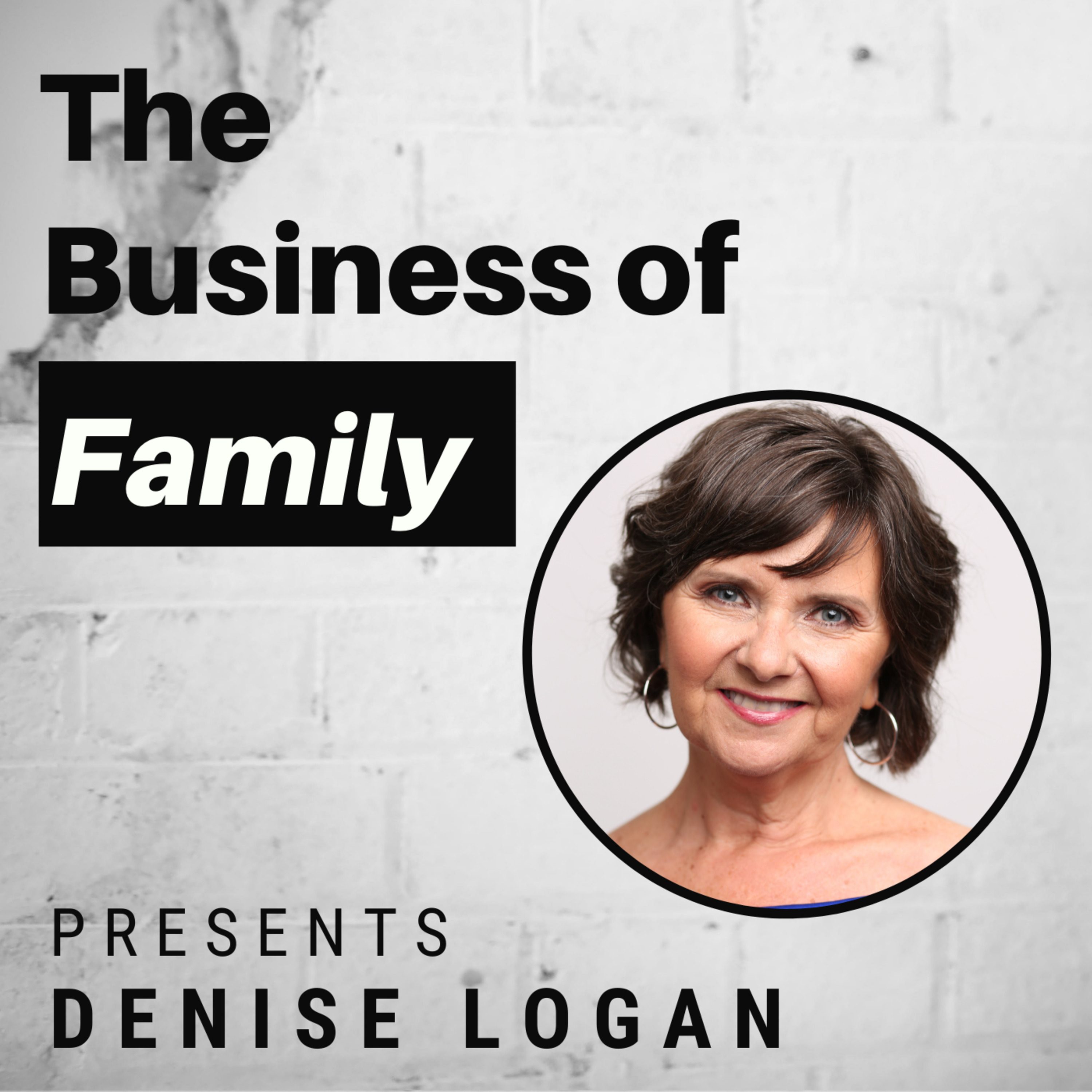
Episode 34 · Season 1
Work, Money & Meaning: How to Let Go When the Time Comes
Key ideas from this conversation
Ask an owner what work provides beyond the money and expect ten to fifteen answers: identity, friends, power, a place to be.
A son was told "not now" for five years. His father had once done the same to his own father.
Eight weeks from closing, an owner demanded far more money. The real reason had nothing to do with the number.
Read the full show notesBio, standout quotes and the episode timeline
An award-winning professional speaker and author of The Seller’s Journey: A Business Fable about Navigating the Emotional Obstacles to Selling Your Business, Denise Logan has addressed audiences on three continents about the psychology of business owners and how to make it easier when the time comes to let go. Known as The Seller Whisperer, she draws upon a twenty year body of work focused on the intersection of work, money, and meaning and how it is reflected in the legacies of today’s business leaders.
She has rightly observed that while work is where we spend the majority of our time, much of it is spent wishing we were somewhere else, doing something else. Divorcing meaning from our work too often leaves us blindly trudging through a mediocre life using money as the miserly arbiter of success in matters of soul and meaning. It leads to an endless chase for more, hoping to outsmart death and desperately prove that our life somehow mattered. Even worse, when work is how we define ourselves and we are faced with job loss or impending retirement, it can seem terrifying.
What happens when your old answer to the question “What Do You Do?” no longer fits? If you thought you are what you do, and suddenly you don’t do it anymore, do you not exist?
Standout Quotes:
- "Every family's dynamic is slightly different and always the same" - [Denise]
- "So as fear starts to escalate, our thinking is disrupted" - [Denise]
- "The best transitions happen 5 years before someone is ready" - [Denise]
- "The reality is that every owner will exit their business, voluntarily or involuntarily... so you will either transition to someone or you will leave your business with it being unprepared" - [Denise]
- "if we look at mortality issues, often the more mortality resistance that someone has , the higher the likelihood is that they will also be avoiding succession planning"
- One of the questions I start early on with an owner is ''what does work provide for you, beyond the money?... where will you get those needs met outside the business?" - [Denise]
- "Succession happens at all different ages" - [Denise]
- "Are we simply creating roles in the business so family members have work to do, as opposed to are they the right people in the business?" - [Denise]
- "Change is hard at first, messy in the middle and gorgeous at the end" - [Mike]
- "Transparency always works, it is always better" - [Denise]
- "The arc of the journey for an owner is the same, whether we're talking about a $50000 hair salon or 500 million-dollar company, the arc of transition that's happening for someone is the same"
- "Transition will happen no matter what, so the question is 'what kind of transition do you want to have as a business owner?'"
- "Success is often determined by how prepared you are rather than just letting it be" - [Mike]
- "Our legacy comes from our daily actions, it is not just the amount of money that we leave behind or the money that we have accumulated" - [Denise]
- "We can often get completely spun up on what our number is, the number is not the number in the bank account, the number is the number of memories that we have left behind because that is truly how we will be remembered" - [Denise]
Key Takeaways:
- Denise started as a mental health professional and then moved into practicing Law where she started her firm but sold because she lost interest in the business. This prompted her to start a road trip till she was invited to help build a friend's business before the sale, an experience that kick-started her work of helping owners transition during the sale of their businesses. It also inspired her book, "The Seller's Journey".
- Using the analogy of a fist, Denise likens the fear center in the brain, 'the Amygdala' to the thumb of the hand, pointing out that while the other fingers could restrict the thumb's movements the same way the frontal cortex can restrict the Amygdala, excessive pressure from the thumb or the Amygdala, in this case, can break free of the restraint, leaving the fear to roam free. This explains the chaotic nature exhibited by people, typical of family dynamics.
- Another description using the hand involves the 5 ways through which fear shows up, the 5 fingers are used to represent them; Fight Flight Freeze Fawn, and Submit. Individually, there are often 2 or 3 of them that function more as natural go-to responses when facing fear, anger, or stress.
- The anchor, Wave, and Island styles of attachment: An Anchor attachment is someone who can tolerate too close or too far. An Island attachment is the type of person who pulls away or isolates themselves when things get rough. A wave attachment describes a person who reacts to disruption by continually checking on others.
- It is necessary to identify needs that are met by the business beyond the money because there is concern about how these needs will be met outside the business, and this could often form the basis for the continuous attachment to the business.
- Addressing the handling of messy parts of the conversation, Denise emphasizes the importance of honesty and transparency in allaying the fears that may misguide people's actions in the family.
- The 'O-MY' syndrome (One More Year) occurs where a seller repeatedly creates reasons to delay their exit from the business whenever they get closer to the agreed time of sale. This is a signal that something else is going on, a different existential crisis and there are needs to be met.
- The moment that you cease to exist is when the last person who has a story to tell about you passes.
- Money matters, but it's not the only thing that matters.
- There will always be a story that is told about you, the question is "is it the story that you would like to have told about you?"
- From Denise to her kids: The way you will know that you were loved was by how you were held and how you were cared for, not by what I left you.
Episode Timeline:
- [00:45] Meet today's guest, "Denise Logan" a.k.a 'the Seller Whisperer'.
- [01:41] An overview of the journey to becoming "the Seller Whisperer".
- [08:48] Denise's 'fist' analogy in describing the role of fear in the brain.
- [11:26] The 5 Appearances of Fear.
- [14:06] The anchor, Wave, and Island styles of attachment.
- [18:06] Do families typically find you when a transition is already underway or as they're contemplating a transition or an exit?
- [33:19] How do you handle the messy aspects of the discussion?
- [45:26] How often do sellers get caught up on a particular figure that they will only sell at?
- [50:35] Discussing the success of transitions generally.
- [01:00:52] A letter from Denise
Links:
- Denise Logan | Speaker, Author, Consultant : Weaving together her background as a lawyer, social worker and business owner has enabled Denise Logan to deftly guide hundreds of business owners and their professional teams as they navigate the complex emotional journey of selling their business and letting go into their own version of what’s next.
- New Book: "The Seller’s Journey" | Denise Logan : A new book by Denise Logan Fewer than 30% of all businesses for sale successfully transition to a new owner and those that do typically take more than nine agonizing months filled with uncertainty. The longer a sale process takes, the more stressful it becomes for the owner & the deal team and the lower the probability of success.
Read the transcript
This transcript was generated automatically and may contain errors, including in names. Listen to the episode for the exact words.
MikeWelcome to The Business of Family. I'm your host, Mike Boyd. Multigenerational wealth creation involves so much more than capital accumulation. The most successful families cultivate values, stories, knowledge and resources to pass on to the next generation, and they do it very intentionally. On this show I sit down with members of some of the world's most interesting business families to hear how they do it. To see where your own family stands, take the Business Family Diagnostic at businessoffamily.net.
Denise Logan is an award-winning professional speaker and author of The Seller's Journey, a business fable about navigating the emotional obstacles to selling your business. Denise has addressed audiences on three continents about the psychology of business owners and how to make it easier when the time comes to let go. Known as the seller whisperer, she draws upon a 20-year body of work focused on the intersection of work, money, and meaning, and how it is reflected in the legacy of today's business leaders.
Denise, welcome to the show today. Thank you so much for making time for us.
DeniseI'm so glad to be with you, Mike.
MikeI'm really excited to hear this story. You and I shared a prior conversation and I was blown away by how the dots connect for your story and what brings you to speaking to us today. So, I'm not going to spoil it, but can you give us the lay of the land and how you arrived at where you are today?
DeniseOh, sure. So in my early life, I was a mental health professional, and then I became a lawyer. And I always say if I was a good mental health professional, I might have kept myself from becoming a lawyer. So I built a law firm in Washington, D.C., and we reached quite a size and I realized that I'd rather put a stick in my eye than go to work one more day. You know, I spent so much time building it and it was what I wanted to do, but I suddenly reached that burnout point, the point where I just said, I'm done.
So I did a super ugly, choppy exit of my own business because there wasn't someone to help prepare me to make that transition. And I got rid of my house and bought a motor home, and I took off. And I thought that would be six months to clear my head, and it turned into several years where I traveled all over North and Central America on my own in a 38-foot motor home with a little car I towed behind and two dogs inside with me.
MikeOh, two dogs as well. Incredible.
DeniseYeah, there are two dogs that went on their way. That's a whole other story we can talk about, what it's like to travel on your own as a single woman through many countries. So I came, when I finally came off the road, and there are all kinds of, we can come back to all kinds of fun stories about what it was like on the road as well.
But when I came off the road, I landed in Arizona visiting with some friends. And I caught up with a longtime friend of mine who had a business that he was preparing for sale. And he said, so you're driving around like a bum doing nothing. I was like, wow, is that what it looks like on the outside?
because on the inside, it's a lot more fun than what you just described.
MikeYou're probably living the dream that most people want to be doing.
DeniseYou know, it's funny when I tell people that I took off in a motorhome, they either lean in and want to know more or they have that quizzical look like, why on earth would you do that? And I often think that's a good descriptor of what the next half hour over cocktails is going to be like with someone. But my friend had this business that he was preparing for sale and he said, why don't you join us? And if you like it, stay. If you don't like it, get in your house on wheels and drive away.
MikeSo what did join us mean? So he invited you to join the business in some capacity?
DeniseYeah, to join the business. So a lot of the work that I had done for the law firm, certainly I was a litigator. I had a case that went before the United States Supreme Court. So there was that. But leading a large business meant that I was also the face of the firm. and that was an interesting transition. So he said, why don't you come and help prepare us for sale, but also help us grow our presence before we do that. And so for the next 10 years, we took that business to the market three times and he was unable to let go.
MikeWow. So if you don't mind me asking, when you first joined the business, was the intention to join and help prepare it for sale? Was that already on the horizon or did that come up during your 10-year tenure at the business?
DeniseThat's a good question. It was something we had talked about, but early on, it was about building, right? It was building in preparation for an eventual sale. But what I saw is over the three separate times that we took the business to the market, his inability to let go started to look familiar to me. And so at the end of that 10-year period, when he still had not been able to exit his business, I left. And I left because I saw there was a pattern. You could be me and wait too long and literally be ready to just hand the business to anyone. Let me out. I've had enough.
I need to go. Or you could be him and go too early and not be prepared. And so when I left, I did a lengthy research study with hundreds of business owners to try to sort out what was going on. What made it easier or more difficult to make that transition? And that was the genesis of the work that I've been doing for the last dozen years as the seller whisperer, where I've stepped in to work with business owners and their advisors to help navigate those emotional obstacles that make it challenging at the time of transition. And it also was the foundation for the book that I wrote, The Seller's Journey, which is all about an owner one year after he
makes the transition.
MikeThat's incredible. So your exit was effectively, you know, rip the bandaid off, get out of here, can't tolerate this anymore. And his was the complete other end of the spectrum and couldn't let go after three attempts. Before we go any further, I'm curious, did he ever sell a business in the years that have passed? He still hasn't let go.
DeniseNo, it's, let's see. So it's 11 years later, almost 12 years, and he's still owning the business. And interestingly, one of the things that we watched happen was after I left the business, you know, I mean, still friendly, there's no hard feelings there, but I watched the business shrink back to the comfort zone that he had been in when I joined the business.
So there's this interesting process about what happens when we think we want something and whether our actions align with that. I see it all the time with owners. I want to sell. I want to sell. No, I don't.
MikeAbsolutely. And with the families that I speak to regularly on the podcast and also from the audience, this topic of transition and the emotional turmoil and stress that comes with it is exactly what you're describing, often magnified by family dynamics or politics or what other people in the family think we should do versus what I think we should do. And this guilt trip of, you know, do we sell the family business or do we try and maintain the legacy and keep it in the family is always a tug of war emotionally for families to try and go through. Have you worked with many multi-gen families that are going through this type of transition?
DeniseAbsolutely. And it's interesting because every family's dynamic is slightly different and always the same. I would say it's exactly the same, only different.
MikeYeah. Different personalities, but the same issues keep showing up?
DeniseWell, our childhood, our family of origin influences a lot of what's going on. And I know you and I may have talked about the dynamics that are going on under the surface in lots of settings. Should we talk about fear and how fear shows up in the process?
MikeLet's dive into it.
DeniseSo I'm going to use a little metaphor and maybe the listeners can do this playing along at home since you and I can see each other. So your hand is like your brain. The thumb is the amygdala. It's the fear sensor in our brain. It is always scanning the horizon, looking for danger. So if you waggle your thumb around a little bit like a lizard, you know, they call this part of our brain, the lizard brain, because it's the oldest part of our brain. And it's a super helpful part of our brain. It's designed to keep us safe, but it's also a little dumb. You know, it can't tell the difference between real danger and imaginary
danger. So if you do this, you tuck your thumb across your palm and you bring your fingers over the front, creating like a little fist. I have a client who calls it a girly fist because no man would put his thumb inside his fist apparently. But what you've created with your thumb inside your little fist is a representation of your brain. So the amygdala is safely tucked in, and the fingers that are wrapped over the top are the prefrontal cortex. It's the thinking part of our brain. If you were to tap your forehead, that's where it is. So if you have your little brain fist and you move your thumb around inside, what do you notice, Mike?
MikeIt's restricted. You can't move around much.
DeniseIt's restricted, right? So when the fear is safely tucked in and your thinking brain is on, you can think pretty clearly. Now, if you move your thumb more aggressively, what do you notice?
MikeFingers are not quite so tight.
DeniseSo as fear starts to escalate, our thinking is disrupted. it. And if the fear sensor gets activated enough, you will flip your lid, literally pop your fingers open into a full hand. Often through the day, I mean, we are all in various stages of fully tucked in and fully wigged out all day long. And so now add on to that. That happens just in our regular life. Now add the stresses of running a business and some family dynamics on, and we can fully understand why over and over we have a high reactivity that goes on in family businesses.
MikeI love that metaphor. I mean, I hope the audience was holding up their hand doing it as you were there too, and I was. It's a great example.
DeniseAnd part of what happens, so now we have our hand, we'll just use another piece that will inform us about a story I think I'll tell. So your hand has five fingers. So if you tick off, there are five ways fear shows up. Fight, flight, freeze, fawn, F-A-W-N, and submit. You probably know some of these, fight or flight.
Freeze, we know that. That's when everything comes to a grinding halt. fawn in a business setting looks like this. I'll totally get you those documents. Yep, I will. I will. Over-promising, people-pleasing. In essence, our brain is saying, I will say anything I need to to be able to calm this situation. And submit, for any of your listeners who have a teenager at home or have had a teenager, you're going to recognize submit.
it. Fine. Have it your way. Whatever. So, we have these five different ways. We are wired to use all of these when fear shows up. But for us individually, there are two or three natural go-to responses that we use. So, for me, I'm wired to use freeze, fawn, flight. That's my pattern.
MikeInteresting.
DeniseI will get eventually to submit or fight if I can't get away. Once you know that about me, you can actually watch it happen. So you can see me freeze. I'm probably going to over talk and people please. And then I'm going to escape. What do you think you use, Mike?
MikeOh, great question. I think I would be fawn first. Definitely prone to over committing. Then I would fight. and eventually submit.
DeniseAh, and for our listeners, right, if you start to think, huh, who am I, like, how do I show up in this dynamic? And if you don't know how you show up, think about your spouse, because you can often spot it very quickly in your spouse, and you can map this in your family members. So, even with your little children, Mike, I'm sure we could map this out.
they already have a pattern that shows up. That's going to play out whenever there is fear, anger, or stress in our businesses, just like it does in our family. So let me give you one other little piece of this. So as babies, we are wired to attach. If we don't attach, we die. That's just the biology of it. And so if you draw three points on a paper, three points across from each other, you'll see, and I'm going to give you three different visuals. The center point, let's call anchor, A-N-C-H-O-R, like an anchor on a boat.
The far left one, let's call island. And the far right one, wave. What we're looking at are different styles of attachment, because as babies, we have to attach. So an anchor attachment is someone who can tolerate too close or too far, right? They can ride pretty steady. And you know people who are anchor. And there's no better or worse. It's just how we are.
So now an island attachment. Think about this. When things get rough, they escape. They go to their island. They pull away. They isolate. They build a moat and then big castle walls, and they pull away. Now the wave person, for a wave attachment, when there's any level of disruption, a wave will rush in. A wave will come in and you'll hear them because they'll say, are we okay? Are we okay? Are we good? Are we good? Me personally, I'm a tsunami.
You're off the charts to the right. I'm definitely a high wave. So when things are disrupted or there's any type of upset in the business, in the family, I'm going to rush in and try to make things right. Can you see how, if we go back to the early part with our poor lizard brain, attachment is a primal need. So, can you see how if there's upset in the business and someone pulls away or someone rushes in, that's going to trigger all of the other behaviors we talked about?
MikeAbsolutely. And multiplied by the fear, as you say, and stress of considering a transition or thinking that you want to transition and then getting involved in the process, that's a completely different story, isn't it? Running through due diligence or going to market and fielding questions. I mean, it's not day-to-day operations as you may have been in for the last 30 years.
It's a completely different context, which you're bombarded with.
DeniseAbsolutely. We're thinking that someone wants you to make a transition that you're not ready for yet, or that you want to make a transition that someone else isn't ready for you to make. So if we go back to the early story that I told about my own preparation to leave, you know, I had wanted to leave my business for quite a while.
And each time I raised it, the folks around me said, oh, you're just burned out. You're just tired. Take a vacation. Get a car. Get a boat. Get something. No one said motor home. That one was off the charts. That was mine. It came from left field. But each time that someone tried to keep me in instead of helping me find a way to get out, that escalated that sense that I was trapped.
And you can imagine what was going on in my little brain. The more that happened, the more compressed it became so that when I couldn't take it anymore. I literally said, I'm out. We're watching it play out right now in the royal family, right? In the UK. I think that's such an interesting dynamic to use just to talk about family business. One of the oldest family businesses in the world. And everyone was like, this is the way it's going to go. And everyone just fall into line and we've watched it play out.
one of the characters was like, I don't think so.
MikeThat's right. One of the oldest dynasties in Western society and talk about generational wealth. And this is what it looks like when the wheels come off, which is very interesting. So tell me, what are some examples of what you see show up when you're dealing with generational families and how do they typically engage you? How do they find you in this world? Is it when a transition is already underway and they're trying to deal with it? Or is it as they're contemplating a transition or an exit of their business and you help them navigate that?
DeniseI think there's when I come in and when I should come in, which are often unrelated. Most advisors will tell you that.
MikeAlmost always too late, I assume.
DeniseThe best transitions happen five years before someone is ready. Because we often think, oh, I'll know when I'm ready. And readiness is an interesting piece, right? The reality is that every owner will exit their business voluntarily or involuntarily, right? We will die at some point. So you will either transition to someone or you will leave your business with it being unprepared.
So the process of transition is one that I think if we look at mortality issues, often the more mortality resistance that someone has, the higher the likelihood is that they will also be avoiding succession planning.
MikeInteresting. So this throws up an interesting point. How much transition work are you doing for people around mortality or around pure succession planning compared to those that are actively choosing to either step down from an operating business or to sell an operating business? Because I think this is quite interesting to explore in the context of multi-generational family businesses in that a lot of the time families are trying to keep it in the family.
and they're trying to identify a suitable successor, either a family member or a professional. But you're still talking about the current leader transitioning out, aren't you? There's still that fear of letting go. There's still that trauma in some cases of letting go. And for these family members, it might be all they've ever known.
DeniseYeah. It comes down. Gosh, we could go in so many directions here, Mike. One of the questions I start early on with an owner is what does work provide for you beyond the money? Because the money is one piece of it. So what else does work provide for you? And we should be able to get somewhere between 10, 12, 15 distinct answers to that question. And the real answer is, where will you get those needs met outside of the business? Because the business is providing more than just money. So if you and I were just to toss out some ideas for listeners to kick them off, right? What's one thing that work provides for you other than money, Mike?
MikeIdentity.
Deniseidentity who am i in the world without my company or without my role this particular role for many of our listeners work is the place that they have friendship their co-workers and their employees and their vendors their suppliers that's where their friends are where will your friendship need get met outside of the business it's a place to go to get away from your spouse for many owners It's, you know what, my spouse wants me to be traveling and I don't want to travel.
So I will double down at work. I heard that in a family recently. It's also that sense of community and sense of contribution. Oftentimes we make our mark through our work. Yeah. It is also a place where we get power, right? At work, you say, I want this done and someone gets it done. At home, maybe not so much.
So as we start to look at and the deeper we go into the list, the more meaningful and more important those needs are to get met. And so what we see is often those are the things that are stirring under the surface for an owner. and they can easily get caught up on things like, I need more money, or my successor can't buy me out, or that person isn't yet prepared enough to take over, when what it really is about is, I don't know who I will be and how I will get these needs met. The best advisors are able to help an owner understand what are those needs because they're not going to go away. I was
working with, and it's interesting because succession happens at all different ages. We often think that succession happens at 58 or 62 or 74. We sometimes have in our mind this timeline. I was working with a business where the current generation was preparing to exit. it was third generation and he was 37 years old 36 37 years old and they had made a decision it's time to leave and for him one day he realized wait who am I going to hang out with all of my buddies have jobs and so he was shooting pool with a close friend of his and he said that to which his friend responded boo-hoo dude I wish I had your sad little problem
But the problem doesn't go away. So, I come back again and again to what is really going on under the surface because we can throw up those red herrings to stop transition, to stop succession. Should I tell you the story of a family that I worked with?
MikeOh, yes, please. Love a good story.
DeniseSo this was a third generation business. Grandfather, father, son in the business. Grandfather was in his 80s, so not so involved in the business anymore. Father was in his 60s, son was in his middle 30s. And the son had gone to the father and said, you will turn this business over to me by the end of the year, or I'm taking all of the clients and starting a new business and driving you under. Oh, that was inartful. That was a different way to express your desire.
So mom and dad, who were not yet ready to retire, had gone to their wealth manager, who invited me into a conversation. And honestly, Mike, I came into that conversation thinking, well, aren't you a young punk? Like, how dare you come in and like threaten your father that way? But I learned a lot once I got inside the dynamics. What I learned was that the son had been trying to have this conversation for five years. And the father had basically said, not now, not now, not now, not now. And eventually, this man had reached the point where naturally, in his own internal development, he needed to know, am I going to succeed you and take over this business, or shall I just spin off and find my own way in the world?
MikeFair question.
DeniseAnd so he finally drew a fine point and said, we are doing this or we're not doing it. I learned some other interesting things about this family when I got involved, which was at the time, the mother had stage four breast cancer. So some of what we were watching play out was the dynamic of fear between these two men who were facing a huge existential crisis and no other way to manage their very strong emotions about losing such an important person to them. And when I met separately with the dad, he said to me, I'm never leaving this business. If I leave this business, it's Jack Daniels and cartoons at 10 a.m. in the morning for me. And I thought, oh, how sad. Unfortunately, what I can tell you
is he was resistant to doing this work. So he was unwilling and unable to dial into how will we make this transition for your son? He had decided that his son needed to just wait until he died and he could take the business then. Unfortunately, what it meant was that the son did peel off and take clients and both businesses are struggling, which is sad. What I learned was that 25 years earlier, the father had done this same maneuver to his father. So why wouldn't the son, who was probably 13, 12, 13, when his own father had done that? So we watch a lot of those interesting dynamics play out in businesses where there is a generational repetition that happens.
I've watched my parent take over this business from their parent in this particular way, and I assume it will happen that way for me. If we come back to the House of Windsor, aren't we watching some of that play out now?
MikeAbsolutely. History repeats.
DeniseI wrote a really fun column a couple of months ago that was just a made-up conversation. I imagined what was going on in the heads of all of those characters, what the queen might be saying, what Prince Charles might be saying, what Prince William and Prince Harry might each be imagining in their own head. And it was meant to be a little tongue-in-cheek, but I heard from so many family businesses, they're like, oh, that's exactly what I think about my father or my son or the other son who's in the business who is not marked for leadership.
But we expect that son to simply toe the line.
MikeIt's great insight. And you will have benefited from so many of these conversations where you've seen these dynamics play out from all sides of the table too, which I think is interesting. So I loved that story that you just shared. I'm curious if you have another one where the transition has been successful, however you define that, but maybe not what the family set out for in the beginning, because they've gone on a journey and found happiness through some other dimension?
DeniseOh, gosh. Let's see. Which direction shall we go? So fourth generation family business. I think the thought was that they would forever own this business. That was certainly some of the parents planning for it. Fourth generation entered the business and realized, I think we have other plans. And one of the things that I think is so fascinating is as businesses transition between generations, we often have more players entering the conversation, right? So it might've started as a patriarch and then there are two or three children and now they're cousins and now they're more cousins. And we look at how complicated a family-run business can be as we get multiple generations. So in this G4, there was quite a lot
of controversy between them about do we stay, do we keep it, who will stay, who will not. Sometimes one of the things that I watch happen is are we simply creating roles in the business so family members have work to do, as opposed to are they the right people in the business? And in this particular setting, we were able to actually sort out a lot of that.
And the business was sold to an outside company. Much of the work that we did there was about solving the grief of G3 that the business was being sold. The grief with letting go of the legacy of the continuing family business. Yeah, and the imaginings that they had about what it would be. So, grief and loss and legacy are such interesting. We come back to the question of mortality and where is that? So, anytime we are making a change, fear gets triggered, right? Uncertainty triggers fear.
anytime we make a change there is a gain and a loss so even if you if your listeners think about you move from one house to a new house that you absolutely love but you get in the new house and there's a part of you that's thinking oh no my favorite restaurant isn't here for takeaway i miss that. And if we can touch into those small existential pieces that happen in our daily life, we can see how that also happens in our businesses and in our families. So there were many of the children in G4 who resented the business. They wanted the rewards of it, but they also felt like the business had always been the favored child.
MikeIt's an interesting point because some families I speak to are all family first. And others that I speak to are actually quite intentionally business first and have rules in their constitution around ensuring the survival of the business rather than imploding for reasons of family dynamics. But I've loved exploring the topic and seeing successful examples at both ends of the spectrum. It's interesting, the individual approach that each family takes.
DeniseAnd I think that's about the intentionality of it, correct? So are you intentionally saying at all times the success of the family will come first or the success of the business? Most family businesses of any generational size are a mishmash between the two. And there is what they say and what they do, which are often different. So we might have a constitution and then we might have behavior. That's where we come back to our little brain fist, where a lot of times what stirs things up is those moments of uncertainty, the time of transition. I have something coming up now that I'm remembering from the past. There's a great quote that I just thought I would share. Change is hard at first, messy in the middle, and gorgeous
at the end. I love that. I've always liked that when I learned that from Robin Sharma, But I just thought in the context, particularly the messy in the middle, makes a lot of sense, doesn't it?
MikeIt does. So when you get involved with these families, Denise, you touched on earlier that oftentimes you should have been involved much sooner, but of course, you're likely engaged right in the thick of things. How do you tend to take the temperature of the room with all of the parties that are at varying states of emotion and fear and understanding of what's going on, and then bring that room together to try and find a way forward? How do you deal with the messy in the middle?
DeniseYou know, we bring a lot of compassion into the space. So, recognizing that what's happening is actually really normal. Often I'm engaged because someone wants someone else to behave. Will you make so-and-so behave? And I often think, oh, sure, but first we might start with how you're contributing to the dynamic. So, early on with every single party, I will do some of the things we did on this interview already. We'll start with the brain hand, right? I want to help people understand, oh, this is how I show up. This is the way I'm naturally wired and the way I contribute and be able to map how everyone else in the confrontation or in, it doesn't even have to be a confrontation. I don't want to have this be that it's always conflict
because even when we're in good communication, those things are playing out anyway. I also do a lot of work around secrets and around deception. So if we think about what happens when you're holding a secret. When you're in the space with someone else, your amygdala is on fire. It is watching for all the signals from everyone else. Have they figured it out? Oh no, what did that look mean? Oh no, do they know? So I'm huge about ending secrets. How do we find a way to say what needs to be said in the room so that everyone is on the same playing field? I was on an interesting panel recently where someone on the panel was talking about how, well, we can't share
when the business is for sale. Like we have, you know, what is the best way to answer that question when an employee asks, is the business for sale? You know, can't you have this whole, there was this complicated answer. You put this person in to answer the question. It was so complicated. I said, or we could simply be transparent.
MikeAnd do you find that that transparency, do you find that it works with employees, other family members, or both?
DeniseTransparency always works. It is always better. Have you ever been, I don't know if you've ever had a dog. Do you have a pet, Mike?
MikeWe never... I do. I have a dog.
DeniseSo then you'll recognize this thing I'm about to say. Your dog hears something that's a little off and he goes, like tilts his head and his ears are listening. That's exactly what's going on inside our body when we hear something that's off. And we have an uncanny sense of picking it up, don't we? And like, that doesn't sound right. And what happens is the more someone else is covering up or lying, the higher our own fear sensor, both the person who is making the deception, their fear is escalating and as the listener our fear is escalating and we're picking it up usually what happens is the reason someone is concealing information or creating a form of
we call it white lies but they're you know i always say it's still a lie and people get very defensive they're like i'm not a liar i'm like but you are telling a lie right now so let's come back to how do we create safety so that you can say what is true. Most people when asked will tell you, I can deal with anything. I just have to know what it is so that we can have solutions.
I also do a fair amount of work around repair. So when we have had a breach in a relationship, which is just a natural result of having any kind of relationship, a friendship in our family, in our business, when there has been hurt or harm, we make repair. And sometimes there's a lot of that to be made. But once we learn that process of how to make repair, we can actually heal a lot of the things that are going on within all of the relationships that make up the business.
Those are important parts to getting towards succession.
MikeCan you elaborate on that for me, please, this concept of repair. Are you trying to heal relationships during the process of transition or is it about trying to lay the foundation to allow a transition to be successful? Or am I misunderstanding entirely?
DeniseI'd sure like to do it before. I'd like to be doing it all through the process of the business running because that's just such a helpful tool, right? There's an interesting, there's an author who wrote a series of books about the five love languages. You may have heard of this, right? So there are five different, and what happens is we often give love in the way we want to receive it. And I'm using love because I think it also applies inside the context of our business. So if we tick off the five love languages, and I won't do justice to his book, but definitely worth reading, right? So, it's quality time, acts of service, words of affirmation, gifts, and let's see if I can remember
the fifth one. That probably isn't important to me. So, if we look at these, there are also five different apology languages that he has mapped out that I often use with clients. So, we'll just use it as an example for you and I. I'm not going to ask you if you've ever done this. We're going to make up a fake husband because we don't want you to have to self-disclose on your own podcast. But a husband who has done something that has upset his wife, and then he brings her flowers, and she is dismissive because what she wants is not a token. She wants to know that you understand how what you did hurt her and your plan to not do it
again. So often in our businesses, just like in our families, we have all of these different coping mechanisms that are playing out. So one of the things that I'll do with a family and a business is help to sort out what has happened and how is each person avoiding or making repair. And perhaps the husband who brings the flowers is actually making repair, but not in a way that the wife can receive it.
MikeIt's a good point. So how does this come up in the context of, and we're using a family as an example, but how does it come up in the context of a business transition of some kind? And how do you manage to put your finger on the pulse of this issue, either requiring repair or the story of repair that's taken place already?
DeniseSo money is in a business setting is often the substitute. Well, I gave you X, you should be grateful. Meanwhile, there's this rub that's underneath that hasn't been addressed. But I gave you money. If the underlying hurt has not been addressed, the money means nothing. In fact, the money feels tainted in so many ways. So if we go back to the story that I told of the son who had made what looked like an unreasonable demand to his father, what we saw there was the father who was scared did not have a plan for his own exit.
And so he continued to simply reward the son year in, year out with compensation, but the son was not getting the things that were valuable to him. So if we use love language, right, he was not getting more autonomy. He was not getting more authority. He was always in a place where he felt like whatever he said, his father would come in and override.
So we look at simple things like it's the crossover between love language. And I only use that because I think it's an interesting tool, not because we really need to use the same love languages, but they show up. He didn't want more money. I think he probably did want more money, if we're honest. But the money was not substituting for the sense of authority that he needed.
MikeFor what was missing. Yeah.
DeniseCorrect. And so we have those kinds of small hurts and big hurts that are going on. So you've been in a public meeting, maybe a meeting with the staff, and one family member calls another out in a public meeting or embarrasses them some way. You know there's going to have to be repair around that. And often it doesn't happen. Instead, it will brew, it'll stew under the surface, or someone will ask for an apology and be brushed off.
so if we come back to remember our little amygdala and our attachment what's going to happen is depending on how successful those folks are at navigating the process of repair one may ask and the other brushes them off and retreats to their island you're going to see this play out in the dynamic. And it is not about removing this pattern because the pattern will continue to play out.
It's about bringing awareness to what's happening so we can say, oh, hey, look what I just did. Oh, and oftentimes, it makes me laugh. Clients who I've worked with for years will say, oh, it's all lizard all the time because the lizard is running the show. And sometimes if we're a thing that I like to do early on when I'm working with any transition is to help all the parties involved in the transition be able to understand how they are personally wired and how they're contributing to the dynamic because then we can just call it up and it isn't about shame right then we can make a little light of it we can say oh did you just get scared right now
and we can actually pause. And, you know, if you think about it, for some people who anger is their go-to emotion, right? We see that one flash quickly, fight, fight. I was talking to a client recently and a new client. And I said, so how does your wife, like, you know how you're wired. How does your wife show up? And he said, fight. And I was like, and if fight doesn't work, she fights harder. And if fight harder doesn't work, she fights harder. And I said, What if we were able to recognize that's not actually anger, that's fear?
How might you interact with that differently if you realized, oh, she's scared right now, or my son is scared because he thinks I'm never going to trust him with the business. And that's why he's making an unreasonable, to me, unreasonable demand.
MikeAnd you gave that example before of the father and son compensating with money. Oftentimes money shows up as this compensating factor that I've given you money, so it should be okay. It shouldn't matter because I've provided. I'm curious now, because money is such a hot topic, I find it's an amplifier for good and bad. I'm curious with all of these exits that you're involved in, all of these business transitions, how many sellers get caught up on a figure in their mind's eye that they just have to have to sell for, whether it's realistic or not?
Do sellers just say, all right, well, I want 50 million or I want 100 million or I want 500 million or I'm not taking it? And is that oftentimes a self-sabotage mechanism to prevent the business from actually selling, from not letting go?
DeniseYep, it is. Money is often not the real thing, which is why early on we talked about what work provides for you other than money. because money is a simple one for a business owner to keep tagging on. So shall I tell you another story?
MikeYes, please.
DeniseSo in this particular transaction, $85 million sale. And you'll hear me talk about different size deals. Really, the arc of the journey for an owner is the same. Whether we're talking about a $50,000 hair salon or a $500 million company, the arc of transition that's happening for someone is the same. So in this one, $85 million sale, eight weeks from close, the seller suddenly announces he will not take a penny less than nine times EBITDA.
Never mind that he had already signed a letter of intent at 6.2. So the investment banker called me and said, I think my seller's gone crazy. I'm like, yeah, it sounds like it. Let's see if we can figure out what scared your fella and what hidey hole he went into and whether we can coax him back out.
So when I met with him, what I learned was that his original plan was to sell the business, buy a sailboat, and sail around the globe. You can get a pretty good boat for $85 million. dollars. And two weeks before he asked for this unicorn, his wife said, I'm not doing that. I do not want to be stuck on a boat with you far away from my grandkids. No way. I'm not doing it.
Can we agree, Mike, he is not coming back to the deal team to tell them the deal is off because my wife won't let me do what I want to do. There's no chance. Instead, he asked for more money. And he asked for more money because it was a way to derail things. They couldn't provide that. And when the deal fell apart, he could be self-righteous about how he was getting screwed over, and then he could walk away. When what it really was about was something much different.
And when we get at what was going on for them as a couple, what I did was I stepped in and did one-on-one work with them individually. And I created a solution where he would buy the sailboat and sail. And every six weeks, she would take one grandchild, fly to where he was. They would do two weeks on land, building memories with the child.
She would fly home and he would sail on. boom the deal was back on track closed on time at its original asking price because it was never about the money what this couple was facing is called relational grief so they had a dream about what life would be like and they had given up so much in the building of this business and their fantasy was we'll work hard and when the business sells we'll have all this money and then we'll travel together and we'll have this life and blah, blah, blah. And as that got closer, what they realized is we don't want the same things. And that's really hard for people to acknowledge. We see it a lot just in the process of regular family life outside of the business
where, Mike, if you and I met, we fell in love, we'd be like, ooh, our life is going to be so great. And then we have a couple of kids and we hardly see each other.
MikeYeah. Then life gets in the way.
DeniseYeah. And then when the last child launches off to university, we see each other and we're like, who are you? I don't know you. And I don't even know if I want to know you. There are lots of couples that end at that point. Same thing with businesses where one or both of the members of the couple or the family can suddenly realize, oh no, it's not going to be like I thought it was. What we'll see often is that the owner doubles down on the business at that point. Instead of dealing with what's really going on, they will say, you know what?
I call it the oh my syndrome. One more year. I'm just going to look a little further out. I have just one other thing I need to do. Those are signals to the transaction advisors or to other members in the family that something else is going on. This person is having a different existential crisis. Can we come to what's under there? What are they really afraid of? And what needs need to get met?
MikeI'm curious how many of these deals and transitions finish with a happy story, like the one that you've just shared with the sailboat, which I love, by the way. I mean, is that common? Because that's quite a creative solution. And it sounds like it came together beautifully in the end. But would you say that transitions, which are so emotive and so difficult, are they successful 50% of the time when you get involved and help families or individuals or 80% of the time?
And is it even fair to try and quantify it statistically like that? I'm just curious, how often does this work?
DeniseTransition will happen no matter what. So the question is, what kind of transition do you want to have as a business owner? Do you want to have a choppy, swirly, messy transition that leaves tragedy in its wake? Or do you want to have the kind of transition that is easier? It's never simple, but can it be easier?
and do you want to leave, sometimes what I will watch is a founder sometimes sets up a dynamic to prove they couldn't do it without me. And what that means is there are other parts of legacy work that need to be done with that person because our legacy is so much more than just our money. It makes me crazy when I'll see something on the news or in the newspaper or online, the biggest mistakes that retirees make, and it's always about money. It's like, oh, they didn't have enough money. Oh, for heaven's sake, they're way bigger issues that come into play.
You know, retirement for us will not be like retirement for our grandparents and our parents. We will not be happy playing golf and waiting for Wheel of Fortune to come on or whatever that show is in the country where you are. But somehow, you know, this comes back to the concept of launching. We do a lot about launching businesses.
And there is a myth that somehow as adults, we will know when it's time to let go. and we will know when it's time to launch. We don't do that with our children. We don't wait until they're 18 and ask them, so what will you do with your life? We're preparing them. We're recognizing the stages along the way. As business owners, we will each leave our businesses by choice or by death, or sometimes because the business collapses because we haven't been willing to prepare for it. There is no reason why we cannot prepare for a healthy and successful transition.
I wasn't skirting the answer to the question you asked me, which was how many. The question is, how engaged will an owner choose to be? This is a choice about how we transition. When I hear an owner say, well, if I leave my business, I always pause them and say, the word is when, not if.
MikeI think it's a great point and really ties in with so many of the conversations we've had on this podcast because the concept of the business of family is about intentionally planning the family side of multi-generational wealth and keeping the values alive, keeping the stories alive, preparing to launch, as you say. And these things happen whether you want it to or not. And success is often determined by how well prepared you are rather than just letting it be.
DeniseAnd thinking about what legacy is, and there are lots of forms of legacy, but I was working with a client several years ago. This was not a family business, but I think it's a relevant story. He was in his 40s and had been diagnosed with a terminal illness. He had young children, and he was bemoaning the fact that he had not yet reached this economic marker that was in his mind, that he needed to reach X, otherwise his life was not a success. And I gave him what at first blush will sound like a morbid exercise to do, but I said, for the next two weeks until we have our next session, I want you to read obituaries. Most people would not assign it to someone who had just been
diagnosed with a terminal illness. We were pretty far. We had done quite a lot of work together. And I said, I want you to read those obituaries. And then when we come back, we'll do the next piece. So in our next call, I said, so I want you to tell me what you remember about the obituaries that you've read. And he said, oh, well, I have a couple here on my desk. I was like, no, no, no.
I don't want you to read them to me. I want you to tell me what you remember. And he could remember very little about these hundred, you know, or 300 word synopsis of someone's life that he read in the paper. And so, I said, now tell me a story about your grandfather. And immediately, a story bubbled up for him. And it was about being in his grandfather's office and on, you know, like he had this story. And I said, now tell me another story. Now tell me another story. Our legacy comes from our daily actions. It is not just the amount of money that we leave behind or the money that we have accumulated. So when we come back to what is the purpose of this business? And if you want
this business to continue on, what is the purpose of that? And what is the mark that you will have left because we are always, always, always leaving a mark. So, you know, we're talking about the number and what is the number. As a young girl, my grandfather had this jar of marbles in his work shed, which my brother and I were fascinated with. We were like, oh, we want those marbles. But we knew those were grandpa's marbles. Like, you know, those were off limits. We were not allowed to touch them. So on Saturdays when I would get to spend time with him, we'd be in the work shed and he'd be doing whatever his task was. And then he
would be ready to close up. He'd wipe his hands on a rag. And before he turned out the light, he would reach in the jar and take one of these marbles out. And then he would shut the light, take my hand, and I'd probably skip across the grass with him to the house. And we'd go in, and I would hear him go in the bedroom and you'd hear him drop the marble in a jar that was in the bedroom.
And then he would wash his hands and come into the kitchen and kiss my grandmother and we would sit down for whatever delicious thing she had made as a treat. And week after week, we watched this play out. And I learned later that when he had been in, we'll call what felt like late life to him, he was in his 60s, a life insurance salesman had come by and had shown him a life expectancy chart. And he was stunned when he saw the number that was on that. And he calculated how much longer, according to that chart, he had to live. And he went out and bought marbles. And he bought a marble for every
week that he had left according to this chart. And he put them in this jar in the shed. And every week when he finished his task that he was doing in the shed, he would take one marble and move it into the bedroom. And on that little walk while I was skipping along and just, you know, being my girly self, he was contemplating what that week had meant as he moved from his workspace to the bedroom he shared with my grandmother and thinking about how he wanted to use the next week that was represented by that marble. And when he died, there were marbles in the shed.
MikeWhat a story.
DeniseAnd we can often get completely spun up on what our number is. The number is not the number in the bank account. The number is the number of memories that we have left behind because that is truly how we will be remembered. We often think I live on through my business. There is a story I heard sometime over the course of the last year that the moment that you cease to exist is when the last person who has a story to tell about you passes. That until that moment, you live on. So isn't it more important the number of memories and stories that we have created that tell about the life we lived and less about money matters. For heaven's sake, it does matter, but it's not
the only thing that matters.
MikeNo. And generational storytelling is, I'm very much into that. I think it's incredibly powerful and the research certainly bears out that it also helps keep families together in a healthy way. Those who share and understand the stories of their elders or their predecessors. And this concept of standing on the shoulders of giants, of those that have walked before us, that are a part of us, who have helped us arrive at this point that we are today, understanding their stories, their trials and tribulations make us stronger, more resilient human beings. And I think that those generational stories are ultimately what's cherished the most.
DeniseThere will always be a story that is told about you. The question is, is it the story that you would like to have told about you.
MikeGreat point. Thank you very much for sharing that. And I think it's a beautiful segue to our final question. Imagine you're writing a letter to your children. What is one lesson or idea that you don't think many people would mention, but you consider important to understand?
DeniseI'm going to answer your question, but I want to tell you it's a it's a special poignant question for me because um i have a little girl who died as a baby
Mikei'm so sorry to hear that
Deniseno it's perfectly fine like it's a really that's such a really interesting question so i think the writing a letter to my child the way you will know that you were loved was by how you were held and how you were cared for, not by what I left you.
MikeI love it. Incredibly powerful. Denise, thank you so much for sharing as generously and entertainingly as you have today. It has been an absolute pleasure to have you with us.
DeniseIt's so my pleasure. I enjoyed it very much.
MikeThank you. Thanks for listening to The Business of Family. You'll find the transcript and key ideas from this conversation at businessoffamily.net, along with the Business Family Diagnostic. It's free, and it shows you where your own family stands. And if someone in your family should hear this episode, please send it to them too. I'm Mike Boyd. Until next time, take care.
Keep listening
If this one landed, start here next.

Increase the Value and Maintain the Values
A succession roadmap, and why the senior generation needs a next role.

Second Generation Vietnamese-American Business Woman
A handover designed around what the outgoing leader loves.

My Ceiling is Your Floor - 2nd Gen Leader of Canadian Health Business
The Business Family Diagnostic · Succession
What does work give you, beyond the money?
Denise asks every owner this before any talk of price or successor, and expects ten to fifteen answers. Does the current leader in your family have a plan for their own next chapter?
“The family has talked openly about when leadership will pass on.”

Every family wishes someone had recorded the generation before.
I built Enduring Stories to do it for yours: a guided voice conversation, from home, that keeps your family's voices, values and history.
The newsletter
The most useful things in these conversations are the things families rarely say out loud.
I share them in my newsletter once a week. Sign up to receive the ideas directly and start building the foundations for your family today.