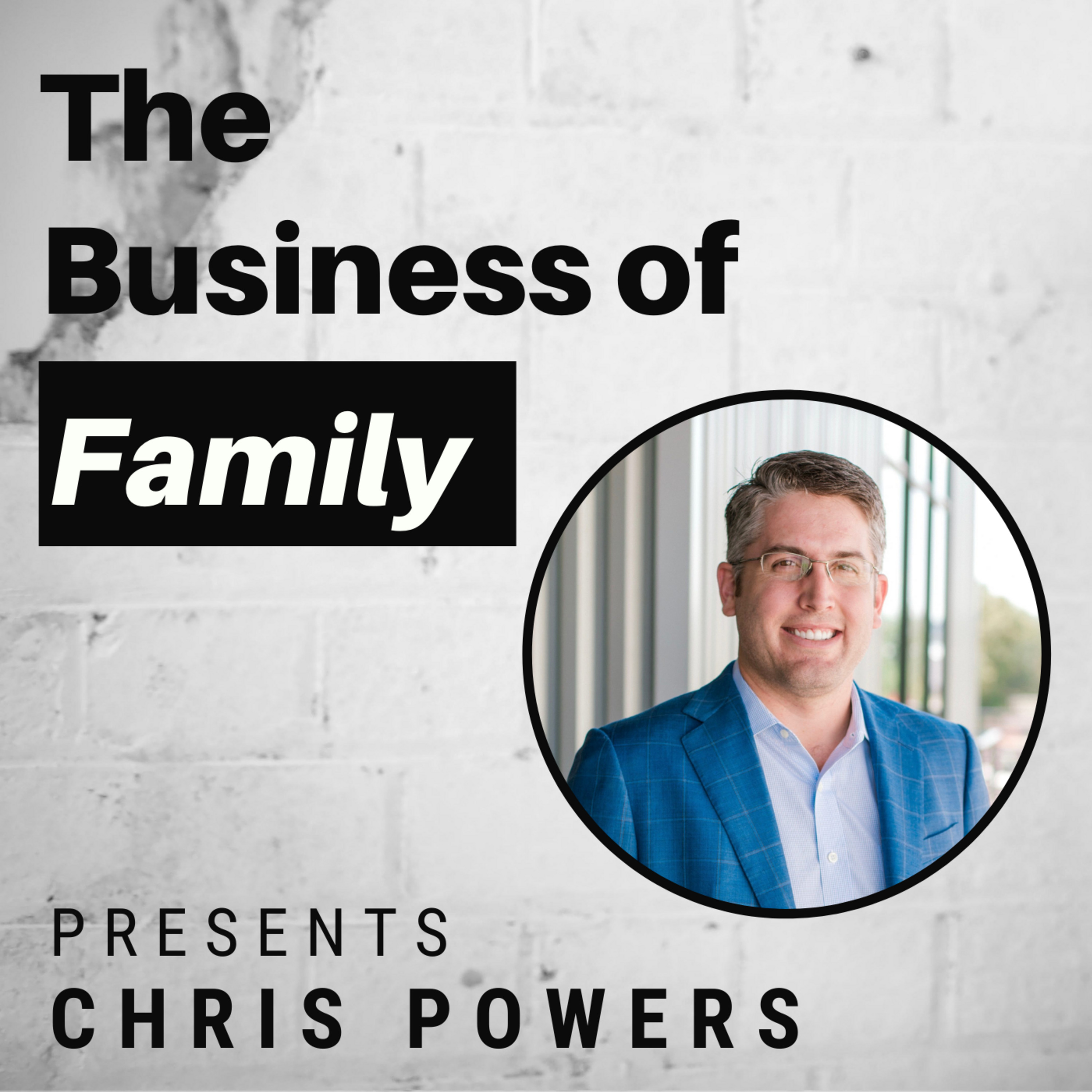
Episode 46 · Season 2
How Big Of An Impact Do You Want To Have?
Key ideas from this conversation
Because his father kept him in the know, Chris was ready to step up for his mother and sister at 25.
Saying no is easy when you can't say yes. The hard part is choosing to say no when you can.
How much is enough depends on how big an impact you want to have, so it's a question about purpose, not a number.
Read the full show notesBio, standout quotes and the episode timeline
Chris Powers is the Founder and Executive Chairman of Fort Capital and the host of The FORT podcast. Chris is a serial entrepreneur with more than 16 years of real estate development and investment experience. Since founding Fort Capital, the company has invested over $1.4B in Class B industrial, commercial, multifamily, student housing, and residential and land development projects.
His drive to always remain curious, desire to connect with and learn from others led Chris to start his podcast, The FORT. In the FORT, Chris talks with leaders of businesses across real estate and a variety of industries and dives deep into ideas and topics that are not regularly discussed. Chris covers each guest's story and explores in detail the critical moments that led to success, failure, growth, and confidence. He has successfully published over 200 podcast episodes.
Standout Quotes:
- "You only are going to be on this earth one time, you really are not coming back again after the first time; let's make the most of it" - [Chris]
- "Everything that you were mad at your parents for when you were a kid, is everything you respect them for when you're an adult" - [Chris]
- "Money never mattered to my dad, being content and serving others did" - [Chris]
- "I think it's a very special thing in life to really want to be good at something" - [Chris]
- "If you're a parent and you actually can't give your kids the things they want, it makes it almost easy; what's tough is when you can give them what they want and you choose not to" - [Chris]
- "How can you expect someone that grew up with everything easy and given to them, to ever have that burning desire" - [Chris]
- "Kids don't learn by words, they learn by actions, so I can say everything I want to my kids but they're going to be watching what I'm doing" - [Chris]
- "You don't keep families together, particularly with the amplification of wealth, if you're not intentionally practicing the values" - [Mike]
- "We're living in a really cool generation where I think we're going to be able to tell our stories to our kids like nobody's been ever been able to do it before" - [Chris]
- "There's just very few people that matter in this world that you remember because of how much money they had, it's really about what they did… you will be defined by how much people remember you" - [Chris]
- "The majority of businesses that do really well hit singles and doubles over and over"
- "When's enough enough?... it depends on how big of an impact you want to have" - [Chris]
- The first great business decision you're going to make is who you marry" - [Warren Buffet, Chris]
- "There's things in life that are either giving us energy or taking away energy" - [Chris]
Key Takeaways:
- Chris Powers is the Founder and Executive Chairman of Fort Capital. He is also the host of the podcast, "The FORT", as well as a serial entrepreneur with over 16 years of experience in Real Estate Development and Investment Experience. Chris is a first-generation entrepreneur with stories that shaped him down to his relationship with his children.
- Chris's dad was a lawyer who valued education, however, after 13 years of being a lawyer, He decided to become a doctor. With two kids and a wife at home, He left law and started medical school at the age of 39 which took place over 8 years with a financial toll on the family. The experience during those years created the foundation for the impression Chris has about money, feeling fortunate to have been more deprived of things than his peers. Chris also learned the importance of doing things in life that give fulfillment.
- Because of the experience of not having money over those years, Chris became an entrepreneur at a young age to get the money he needed. However, Chris has a fear that his success allows him to skip the chances to deprive his kids of the things they should be deprived of.
- Following the passing of his dad, Chris witnessed a turnout at the funeral and stories that depicted the level of impact people felt while his dad was alive. Although it was a traumatic unexpected event, Chris felt equipped at the time to take the reins in the family because his father had trusted him very early on to do things. This taught Chris that there's a level of transparency that is healthy with children, for them to start learning early on how the family operates.
- "If you study people who are extremely successful in life endeavors, there is a common thread among them where they were in a position to really want something while growing up". This has made Chris understand that it is hard but necessary to deprive kids of certain things even when they can be gotten. He is trying to teach his kids not to be overly reliant on his wealth but to forge their path. Additionally, having the nature to treat people very well even from childhood is a good foundation to build on.
- Raising great children amidst wealth is a challenge, and the importance of transparency cannot be overemphasised, especially when it comes to treating people well, or other issues affecting family values. This is important to note because kids learn by watching the actions of their parents, hence the teaching values has to be transparently done through actions. This transparency also translates to work, as Chris tries to make his work fun and appealing to his kids rather than intimidating.
- Chris has been very intentional about leaving content for his children to learn from, especially in recordings and this is one of the motivations for his podcast, "The FORT".
- Currently, Chris is working to create intentional family traditions that build the family experience. The first of these is an annual talk recorded and kept to give the kids later in life.
- Starting Fort Capital: While in school, Chris wasn't particularly trying to make a lot of money but came across someone in Real Estate who helped him learn and start Real Estate deals which resulted in his company "Fort Capital". It is a Real Estate private equity company based in Fort Worth Texas. It is focused on buying Class B industrial and multi-tenant properties, functioning as value-add buyers. As time goes by the desire to sell lessens because there have been great liquidity events from sales and holding cash from sales isn't very impactful anymore. This is beneficial especially for newcomers because Real Estate is a great tax tool.
- It is easy to get overwhelmed by other companies that seem to be doing immensely well, and be tempted to keep taking high chances. However, the majority of businesses succeed by surviving and growing incrementally.
- To be an entrepreneur you need someone supportive even when things aren't so great. Chris recalls how selfless his mum must have been to be supportive of his father's unexpected decision to study medicine. This played a major role in the success of his dad just like his wife plays to get him to where he is today.
- Concerning his view on generational wealth, Chris believes the easy route for a lot of folks with money is to let their kids assume that it's all going to be theirs, as soon as they believe it, whether it's true or not it can alter their lives. He is yet to decide on what he will leave for his kids but currently focuses on shaping their mindset on money. "I want my kids to have something but I want them to earn it and I don't want them to live a life dependent on it; not because I think it would be bad for them to have money but I think it would rob them the joy of living a fulfilled life"
- From Chris to his kids: The way they will be judged when they leave earth is by the impact they've had on others. For them to live a fulfilled life, they need to think each day, "if it was all over tomorrow, what did I leave the world"? An exercise for listeners concerning this is "If you were at your 80th birthday party, write down what you would expect people you care about to say to you". You've got one shot, make it count.
Episode Timeline:
- [00:45] Introducing today's guest, Chris Powers.
- [02:21] Chris describes inspiring life lessons from his dad.
- [12:20] How did you deal with the loss of your father?
- [16:26] How do you create balance with depriving your kids of some things for them to learn key values?
- [28:41] Are you being intentional about creating lessons for your kids to come across one day?
- [33:35] Do you have any intentional family traditions to build rituals around the family experience?
- [35:46] Chris shares his journey to success in his business.
- [45:29] Was there a breakthrough point where you knew you could breathe?
- [48:54] What did you learn from your mother and wife in the role they play to support the family?
- [53:00] Have you started to think about Generational wealth?
- [55:49] A letter from Chris to his kids
Links:
- Chris Powers : As an undergraduate, Chris Powers started buying rental properties and leasing them to fellow Texas Christian University students under the banner Powers Acquisitions LLC. Powers put down roots in Fort Worth after graduating in 2008, and rebranded his real estate endeavors to Fort Capital in 2012. Today, the company’s portfolio boasts 1.5 million square feet and $220 million in assets, and includes industrial, multifamily, and urban properties across Texas. Throughout the day, Powers’ passion for Fort Worth is clear from meetings with business leaders to talks with his own team members.
- Fort capital : Established in 2005, Fort Capital is a forward-thinking investment firm with a focus on real estate and private businesses. They look beyond the usual, and while we seek to provide our investors with superior financial results - their greatest returns are improved lives. Their team is their competitive advantage as they seek meaningful work and relationships.
- The FORT with Chris Powers on Apple Podcasts : The podcasts are the Conversations with leaders in real estate & business. They cover the stories often not publicly discussed.
Read the transcript
This transcript was generated automatically and may contain errors, including in names. Listen to the episode for the exact words.
MikeWelcome to The Business of Family. I'm your host, Mike Boyd. Multigenerational wealth creation involves so much more than capital accumulation. The most successful families cultivate values, stories, knowledge and resources to pass on to the next generation, and they do it very intentionally. On this show I sit down with members of some of the world's most interesting business families to hear how they do it. To see where your own family stands, take the Business Family Diagnostic at businessoffamily.net.
Chris Powers is the founder and executive chairman of Fort Capital. He's also host of the podcast, The Fort. Chris is a serial entrepreneur with more than 16 years of experience in real estate development and investment experience. To date, the company has invested over $1.4 billion in Class B industrial, commercial, multifamily, student housing, and residential and land developments. But most importantly, Chris has some incredible family stories to tell.
Chris is a first-gen entrepreneur, but as you're about to hear, has stories that have shaped him from his parents right through to how he behaves with his children. I think you're really going to enjoy this conversation with Chris Powers. Chris Powers, welcome to the show. I've been looking forward to this for a long time.
ChrisMike, thank you so much for having me. I have too. I'm a big fan of the podcasts that you've put together and this friendship we've made on Twitter.
MikeYeah, I've been looking forward to this. This is exciting. So, Chris, there's so much I want to explore. Obviously, you're an incredibly successful entrepreneur and businessman. I'm going to ask you all about that in a moment. But before we dig into it, I'd love to start with this topic of family. And one of the things that I was inspired to talk to you about today was your father in particular.
because you've shared some pretty touching, beautiful stories about the influence that he's had on your life. I hope you don't mind me just diving right into the deep end here at the beginning of the conversation. But if I open it up nice and broad, can you tell us about your dad, please, Chris?
ChrisYeah, I would love to do that. This will make my week. So my dad was a larger than life figure, at least to me, but I think to a lot of people and I'll share a little bit about him. So he is unique for several reasons. And I think the thing that maybe really resonated on Twitter and some of the stories that I've shared is he was a lawyer for 13 years. He had gone to, he grew up in the Northeast, one of six children, and he was the oldest of six.
And education was very important to him, which is important to everybody, but especially folks in the Northeast. They're very educated. Went to Harvard Law and Harvard undergrad, and he became a lawyer. And he had moved to El Paso, Texas one summer back in the 70s because everybody wants to live in Texas if you live in the Northeast. And I can imagine back then, before there was social media, he probably envisioned cowboys and Indians roaming the Plains. But he took a summer clerkship and he met my mother there who was from El Paso.
And he ended up going on a blind date. They met and got married. And so that's how I was born in El Paso, Texas. So after 13 years of being a lawyer and a partner at a law firm, he came home one day and he said, I really think I want to become a doctor. And I was six years old at the time. So it's not like he was asking me. It was more, I was just along for the ride at that point.
But my mom, something that I really think about a lot now that I'm almost the age that he was when he came home with that news is, one, my mom was unbelievably supportive. You're living a nice life. Your husband's a partner at a law firm. This was in the early 90s. And so the American economy really did well then. But she said, sure. And so, he left and he went to undergrad and got his prerequisites done. And then we moved to go to medical school.
So, in medical school, you have all these young 20-year-olds. And then there was my dad that was 39 years old starting medical school. And for the next eight years...
MikeHe's left the law to do this full-time.
ChrisHe's left law to do this full-time. He has two kids and a wife. And so, I don't want to paint a picture that I grew up in poverty, but we did for eight years relatively live off of no income and any savings that he had created. But he had taken loans out to go to law school. My mom always jokes, as soon as he was done paying off law school loans and getting his feet out from under him, then he decided to go back. So long story short, from when I was seven till I was 15. That's what we did. We moved to Lubbock, Texas, and then back to El Paso for him to do that. And what happened in those eight years as I sit here today, I would
say set a lot of the foundation and seeds for my life. One around money and how we thought about money and why I feel like I was fortunate to grow up probably more deprived of things than a lot of my peers. But the second is the amount of courage that you have to have to be that far in life with a job that is paying you well, a partner at a law firm to say, I'm really going to go ahead and chase something that actually makes me fulfilled and happy. I don't think he was ever fulfilled as a lawyer. And that takes a lot of guts. And so there's two things I think we could talk about based on him, which is how money was for me growing up and what that taught
me about life and what I might not have learned had I not gone through that. And then the second, just this idea that we get so complacent in a lot of our lives. And as time goes by and we build families and there's more risk to doing things, you see a lot of people just stay the course.
And I'm not saying they live unhappy lives, but they don't live fulfilled lives. And one thing he really put on me was like, you only are going to be on this earth one time. You really are not coming back again after your first time. Let's make the most of it. So I'll kind of pause there for a second.
That kind of sets the stage and then we can go into whatever you want to talk about from there.
MikeYeah, I love it. And you've set the stage beautifully, Chris.
ChrisThank you.
MikeAnd what an inspiring man. And this last point about the courage it takes, you know, it's, I'm in a similar stage of life, age at least, and reflecting, you know, two young kids, nice life, et cetera. And to think about going back and retraining and starting again is just so daunting. And you would think too, reflecting that, you know, there's probably lots of people listening to this saying, Harvard Law, law partner, super successful, living a great life.
Why would you want to change that? And so for him to choose to do it of his own accord and go back and chase a passion, I think is just incredibly inspiring. How has that shaped you in growing up and seeing that influence? I think you said it was up to about the age of 15 while he was still studying medicine. So they're pretty formative years for you.
ChrisYeah. And so it's just kind of interesting because we grew up those first seven years. And again, being a partner at a law firm, a lot of the folks that we do, very middle class, upper middle class. And like I said, when this was happening in the 90s, I can remember this. It's kind of crazy that I can remember this. I can remember my mom and my dad even saying at a time that while they were depleting all of their savings to get us through medical school, all of his ex-law partners were crushing it in the stock market. It's like right when he decided to move is when that rally of the 90s and the tech bubble and everything that
happened. And not again, I don't want to paint a picture of poverty, but when you're a medical student, you're making $0. So $0 for four years. And then as a medical student, I think he made $31,000 a year starting or as a resident for four years. So over eight years, I think I've calculated he made like $130,000 in eight years. And so it's kind of weird because it's like forced, not poverty, but you kind of force yourself to be poor. But you had kind of grown up with other opportunities. And so a lot of my peer sets that I knew really well, they were going on vacations and they were getting new shoes instead of used shoes, or they always had the best sports
equipment instead of the used sports equipment. And I remember I was really sad about it for a long time, but my dad never really cared about money. And he always just instilled in me, you have to work for something to get something. But also, your friends are no better off or happier because they're able to buy those fancy new shoes. Now, as a kid, it's like, no, I need the new Air Jordans. I didn't get it at the time. But as I sit here today, all the things that maybe... And I think this is so true for just life in general and as we are as kids and adults. Everything that you were mad at your parents for when you were a kid
is everything you respect them for when you're an adult. And so I could go on, but I would say money never mattered to my dad. Being content and serving others did. And the second part was from a young age, I became an entrepreneur because we literally didn't have the money. So I just had to do things to get the money that I wanted, whether that was odd jobs when I was really young to selling golf clubs on eBay by the time I was in high school to make money. And so I feel so privileged now to have gone through a period in my life where I was deprived of a lot of things that I wanted. And my biggest fear,
which we'll talk about probably later, is the success that I've had in business gives me the opportunity to skip the chances to deprive my kids of the things they should be deprived of. And it's this weird spot to be in. And I know we're going to chat about that. The second part about my dad that I think has really formed who I am, and I said this before, is he didn't care about money, but he cared about helping others. And he cared about being really fulfilled in his life and really kind of prove that out. Like, you don't just say you don't care about money or things of that nature. He literally left a career to go do something he
wanted to do. And I'll end it by saying, and it's not to end on a sad note, he passed away 10 years ago in a bicycle accident. And for a doctor in El Paso, Texas, it was interesting. There was over 2,500 people that came to his funeral. And those were patients, those were colleagues. And this was no, it's not like we sent tickets out for people to come. This is just who felt compelled to come. And I would tell you the stories that I heard about him as a doctor and how he impacted people. Had he stayed a lawyer, I joke, there probably would have been about 10 people at his funeral. And I say that tongue in cheek, but you realize when he followed his path
in life that was going to fulfill him. The amount of people that he touched along the way was truly remarkable. And while I miss him to this day, I think about him every day. It's just something I think about all the time, serving others, living life once, and trying to do things with a purpose and being content.
MikeIt's an incredible story, Chris. And I'm so sorry to hear of your loss. It sounds like your father's had an absolute outsized impact on your life, but also the entire community and hopefully the audience that are listening to this now, he's still having an impact on because I think the journey of one life and pursuing it is not just a phrase he's used, but it's something he's truly lived and demonstrated to others, which I think is just incredible. So I really value you sharing that with us. I'm curious now to sort of follow that thread a little bit more. And I mean, if you don't mind me asking, the loss of your father at a mature age. You would have been an early adult, I imagine. How do you grasp something
like that? How do you take from that and soldier on? And you've obviously got young kids yourself now. A delicate topic. So I'll let you go wherever you want with it. I won't guide you here, but I think there's a lot that people in the audience can take from this if you're prepared to share.
ChrisSo a couple of things. One, he was an accident. So he was perfectly healthy. So this was nothing that I was expecting. I remember getting a call that he had been in a bicycle accident. And 30 days later, after being in the ICU, he passed away. So it was a traumatic event. But what I would tell you is, I was 25 years old at the time. One of the biggest blessings that I see in hindsight, and this goes back to good parenting, is he treated me, one, like a son, but he trusted me really early on. And when he passed away, even though I was 25, and maybe this is because I was an entrepreneur and understood business,
but I really felt like I had the tools to take the lead in the family. So I'm one of two children. I have a younger sister. And almost immediately, I took control of... I say I was like a son and a husband to my mom, and I was like a father and a brother to my sister. And I think a lot of that came from, I was very in the know of a lot of things when he passed away. And I'm not saying that every parent should tell their kids everything. But when you see families maybe with entitled, not entitled, but children that have never really had to do anything, you could see where somebody passing away and a son who's not been in the know of what's going on in the family,
you're just kind of left with a bunch of people that don't know what to do. And again, it's not like we were from this big business where he had people that worked for him and accountants and assistants, and we were kind of trying to figure it out. And so the thing I learned really early on that I will think about with my kids is there's a level of transparency that I think is really healthy with children, not just because of if you die, but for them to start learning early on how the family thinks, how they operate. And I would just tell you the second thing is, I think we can all accomplish a lot more than we think, especially when we're young.
And when I was put in that situation, again, the night before he passed away, I was 25 years old, I was single, I was doing my thing. And the next day, I had to really step up to the plate. And what I would tell you is, one, it was a great honor to do that in his behalf.
But two, I think we all have a little more in us than we think we do when we're called to do something big like that. And not just him, but my mother, through the things they did growing up, really set me up to do that.
MikeThank you for sharing. I think that's really special, but also so much we can take from that. And as I said before, it's such a tragic loss at a difficult age. I'm sorry that you've been through it. Chris, you've mentioned a couple of times that your concern about raising kids as spoiled brats or using the great abundance which you've created to sort of skip some of those steps of sometimes a healthy adversity in children growing up.
Let's follow that thread now. Obviously, it sounds like you grew up wanting some things, but learned some great values around that. Your children maybe don't have to want. how do you reconcile that as a parent now? Because I'm sure you're faced with those micro decisions every day as to whether or not you buy the new shoes or the new outfit or whatever it might be that your kids are asking you for.
ChrisI come at it from a lot of angles. When people ask me why I'm so driven, I usually draw back on these times when I wanted something. And if you'd even take me out of the equation, if you study people that have been successful, and that's not just making a lot of money, that's just successful in sports or just really have a burning desire to do something in the world, there is a common thread with a lot of them.
They all grew up in a position to really need to want, like to really want something. You know, a lot of the Forbes 500 or Forbes 100, you read their stories, they all grew up impoverished and broke. There's something to that. And it's this ability to wake up every day and, you know, have a little bit of discomfort.
And I think a lot of where, especially in America, I can't speak to other countries around the world, but America has even leaned into this idea that, you know, nobody should suffer at all or have this kind of attitude that we need to be given things. And if you talk to generations past, it just wasn't that way. And so then I look at folks in my life that they have a lot of things and they have a lot of resources, but they don't seem very fulfilled or happy. And that terrifies me because I think it's a very special thing in life to really want to be good at something or to want something. And that doesn't have to be money. That can be
wanting to be anything. And so when I think of what has added a lot of joy to my life, it stemmed from an early childhood of wanting a lot of things. And again, the problem was, it's one thing if you're a parent and you actually can't give your kids the things they want, it makes it almost easy. What's tough is when you can give them what they want and you choose not to.
And now as I selfishly, I look at myself and I go, you know, I want to go on that vacation. I want to eat that steak dinner. I mean, I joke all the time, looking at the appetizer section of a food menu was so off limits in my family growing up that it wasn't until my twenties that I even looked at it. My kids will think that the appetizer part of the menu is normal. And I'm not saying that's a bad thing, but it's kind of a metaphor for some of my own selfishness or my own desires to live are going to be things that I can't teach. Those will be things that I'll have
a harder time teaching lessons on. So where do I get with this and how do I think about my kids? I think it's going back to the transparency. I don't think it's smart to hide from my kids what's going on inside the family, whether that be wealth, how we're making decisions. But what I want them to do is be good people in society and treat all people very well.
If you can learn to treat all people very well, and Mike, I'll tell you a quick story from my dad's funeral. And I think about this all the time. That was a very blurry day for me. But there's one thing I remember so vividly. And that was the hospital that my dad worked at came to me after the ceremony. And he said, Chris, I just want you to know that in the last 40 years of me working at this hospital, nobody has ever paid attention to me or cared what I was up to more than your dad did. And that has stuck out to me. And when I think of entitled people, or I think of things of that nature, if you have it in you to treat everybody very well,
that even from a very young age is kind of a foundation that you can build upon. The second is, look, my success and your mother's success will afford you some opportunities that maybe other people won't have. But at the same time, and this is where I'm at right now with it, I want them to know that without living a fulfilled life, and that isn't me telling them you have to go make a million dollars.
It's you have to go live a great life. This money is not necessarily available. I want to take care of the basic needs of your life, but anything above that, and Mike, I struggle with this. I don't know. I'm still in those phases of how I would let them know that. But I do not intend ever for my kids to grow up believing that everything their father or their mother has made will just be theirs.
And they're just kind of waiting on us to wither away. But I think to wrap that kind of anecdote up is how you have them treat people, the transparency you are with, the more transparent you are of why I'm doing this or why we're not doing this, and kind of treating your kids not as adults, but also not as children that need to be deprived of knowing kind of serious things.
some of the families I admire the most started talking to their kids at a very young age. And I want my kids to know that anything that you think is an advantage in life is not because you earned it necessarily, but the things that you will earn, you will earn. But just being born is not earning anything. And that's where they have an opportunity to go make their life for themselves. Because I just think it's very sad when you see people who never get a chance to live their own life because they were born almost as an expectation that they were just the descendant of some other person in their family. So I don't know if I did a great job
answering that. I'm kind of rambling, but that's kind of how I think about it at a very high level right now.
MikeNo, you did an excellent job of articulating that, Chris. And really what you've articulated is the struggle, the struggle of first gen or sometimes second gen and how do raise great children amid wealth when you didn't grow up with it yourself. And I'll go on a slight tangent here, but I interviewed a gentleman by the name of Jim Grubman last year, and he wrote an excellent book called Strangers in Paradise, which talks exactly about this. And it's the concept that people are transported to abundance or transported into wealth during their lifetime, whether they make it through entrepreneurship or they inherit it or otherwise. But this great sort of tragedy of shirt sleeves to shirt sleeves in three generations is simply because you've
grown up with role models like your father, who we've just heard a great deal about, who's inspired you and you've worked hard and you went without and that inspired you to be a great entrepreneur and go and build wealth for yourself. But then your children will watch your journey growing up. Maybe you're already along that journey. They'll get pieces of their value system from your influence. And by the time you get to grandchildren, they probably don't see any of the struggle of you building the wealth originally. And so the challenge is how do we actually transpose, how do we share the values and the beliefs that the first generation had, which was hard work, work ethic, treat everyone well, do what you need to do to build and contribute,
all the way down to the grandchildren or great-grandchildren who don't necessarily see and benefit from all of that inspiration. And so I'm not saying that it's that simple, but it is a key component as to why families do struggle to hold on to wealth because they live completely different lives. And so a lot of people, myself included, are constantly battling with, you know, how do I raise my kids amid relative wealth that I didn't grow up with? And it's a real challenge.
ChrisI'm reading a book right now by Morgan Housel called The Psychology of Money. You've probably heard about it. You might've read it already. But he talks about, he says it in the first chapter, the second chapter, but he says, how can you expect somebody that grew up with everything kind of easy and given to them to ever have that burning desire? And it's not their fault.
And I'm not saying they're bad because they don't have the burning desire. But I think what we all one in life is a meaning and a purpose and a why. And that's stripped away from people when their why or their purpose is your mother and father or your grandfather or this great business. And so one of the things I love most about the work you're doing, and I've listened to, like I said, some episodes leading up to this is I now actually am, because of some of the things you're doing and other things, it's like, it's fascinating to me, these families that can keep it together on and on. And that's where I would love to say one day, 100 years from now,
I did that for my family. But I think it really starts with how people treat other people. And I think it starts with how transparent you are with your family early on. And then the third is, kids don't learn by words, they learn by actions. So I can say everything I want to my kids, but they're going to be watching what I'm doing. And if I'm giving back to society, and I'm charitable and I'm helping others and I'm working hard and I'm going the extra mile, those things will wear off on them, especially if I make them feel included in that.
I think there's a lot of people that do that, but they treat their kids as like this separate entity. And I want my kids from a really young age... I have a desk next to my desk in the office that's a pink little desk that my five-year-old... If she wants to come, she can come hang out with me. I don't expect her to do anything, but I want her to be in my orbit.
And hopefully that turns out to be a good thing. I'm not saying I'm a perfect person, but far from it. But I want her to be at the office, even if she's drawing and messing around. You're coming to work with daddy. Daddy, what's Fort Capital? Or, hey, where does daddy work? Daddy works at Fort Capital. Do you want to work here one day? I don't care if she works here one day. But she tells me all the time, I can't wait to work with you one day. I don't take that as she's going to be this great kid, but it's just like little things to make it fun and not feel...
I think the other thing is I don't want to intimidate my kids by any success that I have. And so you have to make it fun and relatable as the years go by. And again, I'm 34 years old. If I came on this podcast 10 years from now, I might have a totally different message, but it's how I'm feeling right now.
MikeLet's do that in 10 years,
Chrisall right? It's a date.
MikeYou've touched on some great points there. And I love the piece you say that listening to a couple of the podcasts prior and learning from some of the other families in your orbit, it's fascinating to me as well, those that do keep it together. They're absolutely in the minority, right? If you look at the statistics, most families of means either don't keep the wealth together or don't keep the families together. Those that keep it all together with great values for many generations are absolutely as rare as you can find.
And I'm fascinated in exploring that with this podcast. But the reason why it's called the business of family is because it is business. It takes a lot of effort and intention to do this well. You don't keep families together, particularly with the amplification of wealth. If you're not intentionally practicing the values, if you're not intentionally talking to your kids if you're not intentionally hosting family meetings and talking about what's important to you outside of the financial capital, most importantly. So I think you've touched on a really good point there. The other thing that you said was transparency with your kids, which I absolutely love. And it makes me think of another topic that I think we're both pretty
passionate about, which is this concept of generational storytelling and being able to learn from the influences of your elders and sort of leaving breadcrumbs for the next generation to follow. How do you think about that with your kids? And you're obviously putting out a lot of content. You've got your own podcast and various pieces of content that your kids will no doubt be able to stumble across one day. Is that something that is intentional for you?
ChrisYeah. And I think you're going to have this too, whether you've thought about it that way or not. But if you actually go to the first episode I ever released, it's just three minutes kind of talking about the podcast. It was three years ago that I launched it. And I think in the last 30 seconds, I say, hey, by the way, if nobody ever listens to this, it'll be really cool because I'm just going to have a bunch of recorded episodes that my children will be able to listen to so that they know what their dad was interested in at certain stages of his life.
And now I've done 180 episodes. And Mike, there's two things. My dad left me a few, you know, there's a few things, physical items that I have. But the two things I love the most are the two voicemails that I've saved that he left me on my phone, which don't say anything other than, hey, it's dad, call me back, love you.
But hearing his voice is very important. And Mike, if I tell you in like a text, hey, Mike, I love you, or, you know, you're my buddy, you read it one way. But if I say, hey, Mike, I love you. When you hear the inflection, especially of somebody in your family, it means a lot more. And so on one end, I think, man, I have my kids, hopefully they'll want to listen.
But right now they have 100, I think over 200 hours of me talking. But the cool thing is their kids are going to be able to listen to it. Their kids' kids are going to be able to listen to it. And so I'd be lying if I said that in a lot of episodes, there aren't little things that I think about or questions that I ask that I sometimes think there could be somebody 100 years from now in my family listening to this. So I think we have a really unique opportunity in what we're doing to tell those stories. And even though you're chatting with other people about their families, the way you're even crafting questions towards me lets your daughter know what you're interested in.
So the verdict is out how they'll receive it. But I think all the time, and to take it one step further because I do the podcast. I do all the time. I'll grab my phone and just do a little audio. Hey, Palmer, it's dad. You're four years old now. And I just went to your first soccer game and saw you score that first goal. I just wanted to let you know how proud I am.
Well, on her wedding day one day, I don't know when I do it. Maybe I'll give her all these little 30-second clips of how I thought about her. So we're living in a really cool generation where I think we're going to be able to tell our stories to our kids like nobody's ever been able to do it before.
MikeIt's so incredibly powerful. You know, I recorded a video for my daughter when she was in intensive care when she was born. We nearly lost her. And I don't even know really what pushed me to do it. But I was forced out into the hallway, pacing backwards and forwards, waiting for the update on my wife's condition, waiting for the update on my daughter's condition.
And for some reason, I was just overwhelmed with emotion and compelled to record it. I was by myself, you know, it's early hours of the morning and I just, you know, one minute video of me just talking to my daughter who I didn't know on the other side of the wall whether or not she was even alive.
And, you know, there was all these doctors working on her and just everything was beeping and tubes and people were rushing and all those sorts of things. But I'm so glad I recorded that, you know, even for my benefit, but hopefully for her benefit one day too, just to capture that raw emotion is not something you often see. And thank you for reminding me of that. I think it's those special moments and those breadcrumbs, as I mentioned before, leaving for the next year. I mean, that's so much more than any amount of money or anything else that children could inherit, I think.
ChrisIt is. And I think anybody would say this, not just me, but all the success I've had, I would give up all of it to see my dad again. And the, all of these, all these, the success is fun, but I've never met anybody on earth that the day before they died and said, well, I can't wait to take all this stuff with me to heaven or I, or wherever they believe they're going. Or, you know, we, on Twitter, there was that conversation a few months back about the time billionaire, Warren Buffett would rather be me than me be Warren Buffett right now. Warren Buffett has a couple more years left to live, maybe five. I don't know how long. But at some point, enough is enough. And it's all about
the impact. And I know there's some questions you're going to ask at the end, but there's just very few people that matter in this world that you remember them because of how much money they had. It was really about what they did. And that's the message that my kids will always hear from me. you will be measured by how people remember you. And they can define how they want to be remembered.
MikeYeah, I love that. Do you have any, you know, bringing this into the home, do you have any family traditions, whether it's around storytelling or meetings or holiday time of the year or anything like that, that you're trying to do intentionally with your kids to try and sort of build traditions and rituals around the family experience?
ChrisWe haven't done it yet. We're doing it the first time this year. So my wife and I are going to record an episode at the end of this year for my two-year-old and my five-year-old. That's just a recap of the year. So that's one thing. But the second is, and I don't know if she's old enough yet, but my daughter's fifth birthday is coming up and I kind of want to start recording some stuff with her. And again, I'm not going to record her and put her on the button, but record some stuff. And then as she gets older, just say, Hey, let's listen to your five-year-old recording and your six-year-old recording and just let her know how she's been
thinking as she's been growing up. And so you had that question. We don't have anything crazy. It actually, the questions that you sent made me realize like, Hey, we need a tradition or we need something. I asked my wife, we have a certain thing we eat on Christmas Eve and we all dress up and do that kind of stuff. But we don't have anything kind of super unique. And this year will be the first year we do something around the podcast that I'm not going to publicly put these videos, these audios out, I'm going to keep them. But yeah, that's probably the first tradition we'll start doing is kind of this annual talk to our kids that we want to be able to give them
later in life.
MikeI love that. I love it a lot. We write letters to our kids each year. But getting the voice to it and the inflection, as you say, incredibly powerful. So I love the idea of recording them a little reflection on the year and where they're up to and doing a podcast with your five-year-old. Wow. That's really cool. That's really cool. Might have to steal that one too. So Chris, let's turn to you now. And I'm sorry, you've indulged me talking about all of the family side so far, but you're an incredibly successful guy and yourself. I want to hear all about it. I want to hear about Fort Capital. I want to hear about that journey and what brought
you to this point where we're having a conversation about generational wealth. I mean, how did the young guy who wanted the new sneakers get to where he is today?
ChrisOh, man. How long do we have? No. I, again, realized really early on, every time I'd go to my dad and say, hey, I want something. He'd be like, go watch the car 10 times or go do something. Go get a job. Go do something. I don't have the money to give to you. And if you want it, you got to go get it.
So that was early on. So in high school, I had a golf club selling business on eBay. And then I went to TCU for college, which is a private university. A lot of wealthy families send their children there. And a lot of those folks were great friends of mine and still are to this day. And so really early on, I didn't set out to really... Well, I'm going to take one step back. I remember though, as I was growing up, there was my dad, but there was my mom that, again, she was very supportive, but she always told me, if you find something you love to do, go after it. And money isn't going to make you happy, but it will give you freedoms to do things
in life that you can't otherwise do. And it'll give you the opportunity to help a lot of people along the way, whether that be through physical donations or employing people, or you'll just have more resources to help people. So that was always important to me. So then I get to TCU. And what originally is like, I just wanted to make money to do trivial things like go to spring break with my friends and have extra money to go to the bar tab or take girls on dates. I don't know what it was. And so I met a guy my freshman year of college that had just won entrepreneur of the year at TCU. And he had done it by buying real estate as a freshman. And I can learn quickly.
I hunted this guy down and he taught me how to buy houses. And the first year I bought a house my freshman year, zero money down. Actually, it was 3% down, 6% cash back at closing. and you remember the great financial crisis. This was in 04. I got a loan to buy a house with no money down. I lived in it and I rented it to three roommates. And then I went back to countrywide lending. I was my lender and they refinanced. I got a full refi and I pulled $40,000 out of the property six months later as a freshman. So I ended freshman year, I had a fat checking account. And I was so dumb at the time that had you asked me if that was profit,
I would have said yes. It was actually just more debt. But I was only 17 at the time. And I thought, man, I've just made a lot of money. What I didn't realize was I just owed a lot of money. Long story short, I ended up starting a property management business and I leased homes to students. And over the course of four years of college, I owned 12 properties with lots of units.
and I graduated in the downturn. And fortunately, I was in Texas, which was a good market. And I was at a university that was doing really well with parents that had guaranteed student housing leases. So the downturn really didn't hurt me. And I ended up, and I won't go through the full story, but I ended up buying foreclosed houses with a line of credit that I had gotten before the downturn. And then really fast forward, it's been 13 years since I graduated college, We now, this year, we actually crossed a billion dollars of assets that we've acquired.
I got a team of 30 people. I've been in YPO for five years, kind of like you. I've always surrounded myself with just a lot of, I owe my success to one. It starts with wanting it and drive. Don't get me wrong. I'm 34 with a lot of gray hair. Your audience hasn't seen the video.
MikeI can see a lot of wisdom. That's all I can see.
ChrisThese are neighborhood. These are bad developments gone wrong. No, I'm kidding. But I've always wanted it. I've woken up every day. I was telling somebody this the other day. I still wake up every day and I just feel like I have a lot to accomplish. And that's a real positive sometimes. It's also a negative. And tying that back to kids, I think about this a lot too.
My bar for what drive and wanting is set very high. I don't ever want to judge my kids that they don't want something as bad as I want it. that's something that I will, that I still struggle with, even as they're young. The barometer for how I look at them, at some point, I have to be satisfied with what will satisfy them. So again, I dovetailed off there, but back to where we are now.
So it's a real estate private equity company. We're based in Fort Worth, Texas. We have about 30 employees. We buy industrial all over Texas. So we're in San Antonio, El Paso, DFW, Houston, soon to be Austin. We're about to be in Memphis, Tennessee. We're going into Florida. And I've really... One, we've been in a really good market. I've done everything you can do, I think, in real estate. 5 years ago, we decided to be a singular focus company on one asset type, which I can talk to you about what I think about focus and what that can do.
focused compounds. And it changed the trajectory of my business career, my business in general. And it's allowed me at an early age to probably earn more than I probably ever dreamed of earning, which is why I'm having these conversations with you about being smart about it. So we have a great company. And I'll stop there for a second and can answer more about the business. But we're a pure play industrial buyer throughout the Sunbelt of Texas, really.
MikeIt's an incredible amount of scale, Chris. And I'm interviewing from Australia today. And just the scale that you have in Texas alone is really inspiring. We don't have a market as big where you come across PE players with a billion dollars that they've transacted in this part of the world. So I always love hearing the scale stories. Tell me a little bit more about this industrial play. So are you buying and holding? Are you value-add? Do you ever sell them? Or is it opportune based on what you come across? As you said before, there's benefit in focus, which has gotten you to that scale. So I'm curious how you define that narrow focus in industrial.
ChrisYeah. So we buy Class B Industrial, which is denominated by the vintage in which it was built. So 60s to the 90s. And we do multi-tenant properties. So suite sizes anywhere from 2,500 square feet to a couple hundred thousand square feet. But we don't really buy single tenant buildings that are either 100% occupied or 0% occupied. We're really value-add buyers.
So we spend a lot of our time buying off-market. We've built a good mousetrap, I would say, for how to identify properties off-market. And then we're fully vertically integrated. So we own our own property management company. We have over 600 commercial tenants now. So we learn a lot by managing. We have relationships with our tenants. We have daily data that we're able to consume based on our portfolio. We do everything on a deal-by-deal basis. So we're not a fund. We syndicate capital on a deal-by-deal basis. So if I'm raising, call it $15 or $20 million for a deal. We'll send it out to hundreds of investors that we have worked with, and we'll raise that money from them. We have no set time horizon for how long we'll own something. I've
owned something for a couple months, and I have assets that I've owned over a decade. We do not say that we'll hold everything forever. We have the opportunity to if we wanted to. And what I would tell you is, because we've sold and had some liquidity events, the desire to sell kind of lessons and lessons as time goes by. I think for anybody getting started, creating kind of some life-changing moments and some liquidity early on is great.
But as time goes by, one, real estate's an amazing tax tool through depreciation and other ways of avoiding taxes. But the desire to sell kind of inherently you hold longer because selling and taking the cash isn't like a material change to your life. And I would say we're starting to enter kind of that phase where certainly we'll continue to buy and sell or we'll continue to sell.
But as a whole, I would say more of the portfolio will start being held longer and we'll focus more on refinancing assets and continuing to hold.
MikeIt's incredible. And no doubt some really deep core skill sets there on raising cash, identifying off-market opportunities, managing well. I mean, it's almost three or four different businesses within itself, isn't it?
ChrisIt really is. And we actually have talked about that. We have a money raising business. We have a property management business. We have kind of a back office business that I always say could be used for multiple industries. And then we have a finance investment business. Yeah, those are our four. And then really, we have a fifth business, marketing. I think we're good at brand building and marketing and getting our way, building a brand in the markets that we operate.
MikeWas there a time for you personally where you felt like, and for lack of a better phrase, I'm going to say where you felt like you made it? Was there a breakthrough point where you say, all right, I'm making money now. I can stop grinding to the same extent of just trying to get from zero to one. Do you get to a point of scale or do you get to a point of cash flow, or maybe it was a single liquidity event. I don't know. But that point where you break through as an entrepreneur and say, right, I can breathe and we're going to be able to do this again now.
ChrisYeah. It's such a good question. Yeah. There's been some liquidity events that I'd be lying if I said after having those, I felt for the first time, I just don't... At this point in my life, I just don't screw it up. I'm naturally a risk taker. But once you've made a certain amount of money, you start having those thoughts of like, man, just don't screw it up. Don't do something really stupid. I think we're living in a weird generation also where you see all this VC money and these huge valuations and these companies that go public while they're losing billions of dollars a year.
And it's sometimes easy to get enamored with that and really want to keep swinging for the fences. But what I would say to most families, especially the ones that you've built over these generations, Those are the fun things that you see on magazine covers, but the majority of businesses that do really well hit singles and doubles over and over and over and occasionally a home run. Occasionally, maybe they strike out a little bit, but they're not playing this game of boom or bust. They're just playing this game of like survive and incrementally grow.
And so to answer your question is, yes, there's been a couple times that we've sold some stuff that I could take a deep breath. But on the flip side of that, and I literally have this conversation with people all the time, which is like, when's enough enough? And I can't answer that for you right now, unfortunately. I don't know.
It's not that I don't feel fulfilled and I need to go make more money. it's more I don't necessarily always feel fulfilled in my heart that I've even come close to scratching the surface on what I believe I can accomplish because at some point it isn't about the money it's about the the fun and the game and and back to what I said about my mother is like it's fun as you grow because you can impact a lot of people and that is what I'm starting to have a lot more fun with is I now have more time to kind of you know pay it forward and give back. And somebody said on Twitter the other day, how will you know you've had it or
wins enough enough? And my answer, I think in the subtweet was, it depends on how big of an impact you want to have. If you don't really want to help people and you just want to go live on a beach, well, then maybe that's 10 million bucks. But if you want to leave this earth and have had a large impact, maybe it's more. So on one end, the liquidity events surely helped from like, I could take a deep breath. On the other end, I don't think I'll ever really feel like it's over.
MikeIt's a great lens through which you see the world. I think it's fantastic. Chris, I want to jump backwards now, if you don't mind. You've mentioned the role that your mother has played, obviously, in your upbringing and parenting, but also the inspiration you've taken from her. And of course, you're married now and your wife and yourself have a couple of young kids. I'm curious about how you view the role of spouses and partners. We talked a great deal about the influence that your father had on you growing up. But the thing that's sort of ringing in my ears is you said something like your mother just said, okay, and was completely supportive. She was married to a law partner. You were living a nice life. And then you went and
spent eight years while he retrained into medicine. I'm just curious of what did you learn from your mother and potentially from your wife in the roles that they're playing in supporting the family?
ChrisI think not to use a Buffett quote, because those are always easy to go after, but I think he says the first great business decision you're going to make is who you marry. And it's not because of anything more than to be an entrepreneur or to do something that requires maybe extra grit or ups and downs, which building a business is, you need somebody that's supportive. And not just when things are great, but when things maybe aren't so great. And so if there's anything I learned from my mom, I sit here today, and again, I'm not in the exact same situation, but I don't know if I could do what my mom did. I mean, if I'm just being honest, I give her a ton of credit. She was living in her home city
where she was born and raised, and her whole family was there. They had just spent years raising kids and 13 years until he finally became a partner. And then to say, I'm willing to follow you so that you can chase your dream. And I will support that is one of the most selfless acts that I've seen. And my dad would tell you if he was here, it would have never been possible if she had not been there. You also just see why people get divorced or don't work out as a spouse maybe starts working harder, their career is progressing, and they're not able to keep it together at home.
And again, that comes from a supportive wife. So I just have learned that was a very selfless act that even in the moment while I didn't understand, I do now. And as I sit here today, my wife and I, just like every married couple, we have our ups and downs. But there is one thing is she is very, very supportive of me and has always been. It doesn't mean that gives me a free pass to never come home or never be with my kids. That's not support. But it's the support that she wants me to succeed. She wants me to follow my dream. And I don't always have the same calendar that everybody else has. You need somebody that's willing to support it. And so I don't know if
I answered your question, but I would tell you my dad's journey wouldn't have been possible without support. And if I didn't have the support of my wife over the last 12 years, 10 years that we've been together, at the very least, it would have been a much difficult road to get where I am. And I would end it by saying, there's things in life that are either giving us energy or taking away energy. You're never just static. You know that person that when you walk into the room with them, your energy automatically drops, or that person that when you get in the room with them, you hope it never ends. It's hard to show up to work every day when you don't have somebody
supportive at home and show up with a full tank of energy. And so my answer to that question is, my mom taught me selflessness and spouses in general. You very rarely find very successful people and families for generations that don't have somebody that's supportive and letting somebody be maybe a little more selfish than the other, which I would be the selfish person in that regard.
MikeNo, it's a great answer, Chris. Thank you. And I think it's just important to acknowledge oftentimes the greatest supporters behind the scenes don't get the accolades, but they play such a pivotal role in certainly in my life as well. I'm curious now to ask, and we're sort of getting towards the end of the conversation, but you're a first-gen entrepreneur, I think is the way we described it before we started recording today. You've come into wealth during your lifetime and made that with Fort Capital and will continue to. Have you started to think about this concept of generational wealth or multi-generational legacy. I know you're anxious about your kids inheriting wealth or having an expectation to, but at the same time, you're building something
of significance. Where do you think you're going to land on that as you progress with your path?
ChrisI think about it all the time. So this year, we're doing some estate planning and just that process alone for anybody that has not done it, you're asked a lot of tough questions. Who gets what? What happens if so-and-so does this? The good news is you don't have to, especially at our age, make concrete decisions. But it goes back to what we were talking about earlier. When my kids go into the real world, I don't want them to be Chris Powers' daughters.
That's not who they are. They're Palmer and Connor. And I'm part of their journey and their story, but I don't want them to be defined by me. And I just think the easy route for a lot of folks with money is to just let their kids assume that it's all going to be theirs. And that alone, as soon as they believe that, whether it's true or not, it can alter their life. Transparency part comes in. So I'm always going to be transparent with them.
I don't know what I'm going to leave them yet. All I know is that my attention right now is focused on shaping their mind and how they think about money, certainly the money within our family. And then as we get down, I think my wife and I have already had conversations about what are we going to leave to charity versus the kids and how much is enough. I just got done reading The Making of an American Capitalist, the Buffett book on how he started with his kids.
when he first started with his kids, he only gave them $10,000 a year. And then 20 years later, he gave them each a couple million. And then as things evolved, but he was making decisions as they were 67, as his kids were getting into their fifties and sixties. And so I think it's going to be this multi-step decision-making process to see how they're doing and evolving. And again, like all things, I'm going to put a lot of really good people in the mix that are going to help me make these decisions. But I want my kids to have something, but I want them to earn it. And I don't want them to live a life dependent on it. Not because I think it would be bad for them to have
money, but I think it would rob them the joy of living a fulfilled life. And I don't want to be the robber of that joy.
MikeIt's a great perspective and one that I know a lot of people share. So thank you for articulating that so well. Chris, it's time for our final question now, a question that I ask every guest. Imagine you're writing a letter to your children. What is one lesson or idea that you don't think many parents would mention, but you consider important to understand?
ChrisI'm not saying I've already answered it. And I thought a lot about this question, but it really is that the way that they will be judged when they leave earth is by the impact that they've had on others. And it's not going to be how much money they had or how many diamonds they bought or what parties they went to.
Zero people are really going to care about that. And for them to live a fulfilled life, they just need to think about each day, if it was all over tomorrow, is anybody going to care? And what did I leave the world? Because the world's going to give them a lot of things, some good, some bad, but it's going to give them a lot. And I would add one more thing that we did in YPO that I think about a lot. And this might give some of your listeners an interesting opportunity to go do an exercise. But we do this exercise where it basically goes like this.
You're at your 80th birthday party. And I'll tell my kids this one day, but you're at your 80th birthday party. And in the room is your spouse, your children, your coworkers, and some of your best friends. And it's a surprise birthday party for you. You're in this rocking chair, this chair, and you're looking out across the room and it's everybody that mattered to you in life.
And your kids, your wife, your co-workers, and your friends, and maybe somebody from the community that you work with, who knows, are all going to get up and give a speech to you. Now, the exercise is this. You write each of their speeches for them. What is your wife going to say to you at your 80th? What are your kids going to tell you at your 80th? And if you're at a point in your life where you're like, man, I really hope my wife or my kids or my coworkers, I hope that party doesn't happen today because I'm not so sure that they would have a good thing to say at that 80th party.
It really frames what do you want them to say? And then you just work backwards. I want, hey, dad, I just wanted to let you know that the work ethic that you instilled in me was huge and that you were always transparent with me and let me know how you were doing. and you never made me do anything that I didn't want to do, but you always encouraged me to do something that made me happy and blah, blah, blah, blah, blah. Well, it's easy to write that letter. But if they're really going to write that letter, then I got to live up to it. And so that is something that I think a lot about. And at the end of the day, what I really just answered
was, what is the world going to think about me when I leave? And that's something that matters a lot to me. And I think it should matter to everybody. The odds of us even being here are so little that it's just a miracle that we're even here. And to not try and leave a positive dent in the world before you leave is, I don't know, I just can't relate to that. Maybe it's not wrong to not want to care what other people think when you leave. But I think we are all, especially those that have been given a lot, a lot is expected. And that's just kind of how I want my kids to think about it. You got one shot, make it count.
MikeWe talk a lot about legacy on this podcast, Chris, and I think you have just summarized it beautifully with that lesson. So thank you so much. You've been incredibly generous with your very personal sharing and you talk a lot about impact. And I think this episode is just a great example of the impact that you're having and the way you're living your life. So thank you for your contribution and thank you for sharing with us today.
ChrisMike, it's been a pleasure. And I really think what you're doing with this podcast is awesome. I think your kids will enjoy it. Your family will enjoy it. But it really is a good subject to talk about. These things are not widely discussed and you're really leading the charge. So thank you. Thank you.
MikeThanks for listening to The Business of Family. You'll find the transcript and key ideas from this conversation at businessoffamily.net, along with the Business Family Diagnostic. It's free, and it shows you where your own family stands. And if someone in your family should hear this episode, please send it to them too. I'm Mike Boyd. Until next time, take care.
Keep listening
If this one landed, start here next.

First Generation Wealth Creator & Living Life Profitably
Another first-generation founder writing the rules for young children.

Raised Healthy, Wealthy & Wise
Why the struggle parents want to spare their children matters.
Trusted Advisor to Legacy Families & Member of a 7th Generation Family Holding Company
The Business Family Diagnostic · Purpose
How big an impact do you want to have?
Chris asks it of himself whenever someone asks him how much is enough. Could the adults in your family answer it together, in similar words?
“Our family has a written statement of what the family enterprise and its wealth are for.”

Every family wishes someone had recorded the generation before.
I built Enduring Stories to do it for yours: a guided voice conversation, from home, that keeps your family's voices, values and history.
The newsletter
The most useful things in these conversations are the things families rarely say out loud.
I share them in my newsletter once a week. Sign up to receive the ideas directly and start building the foundations for your family today.