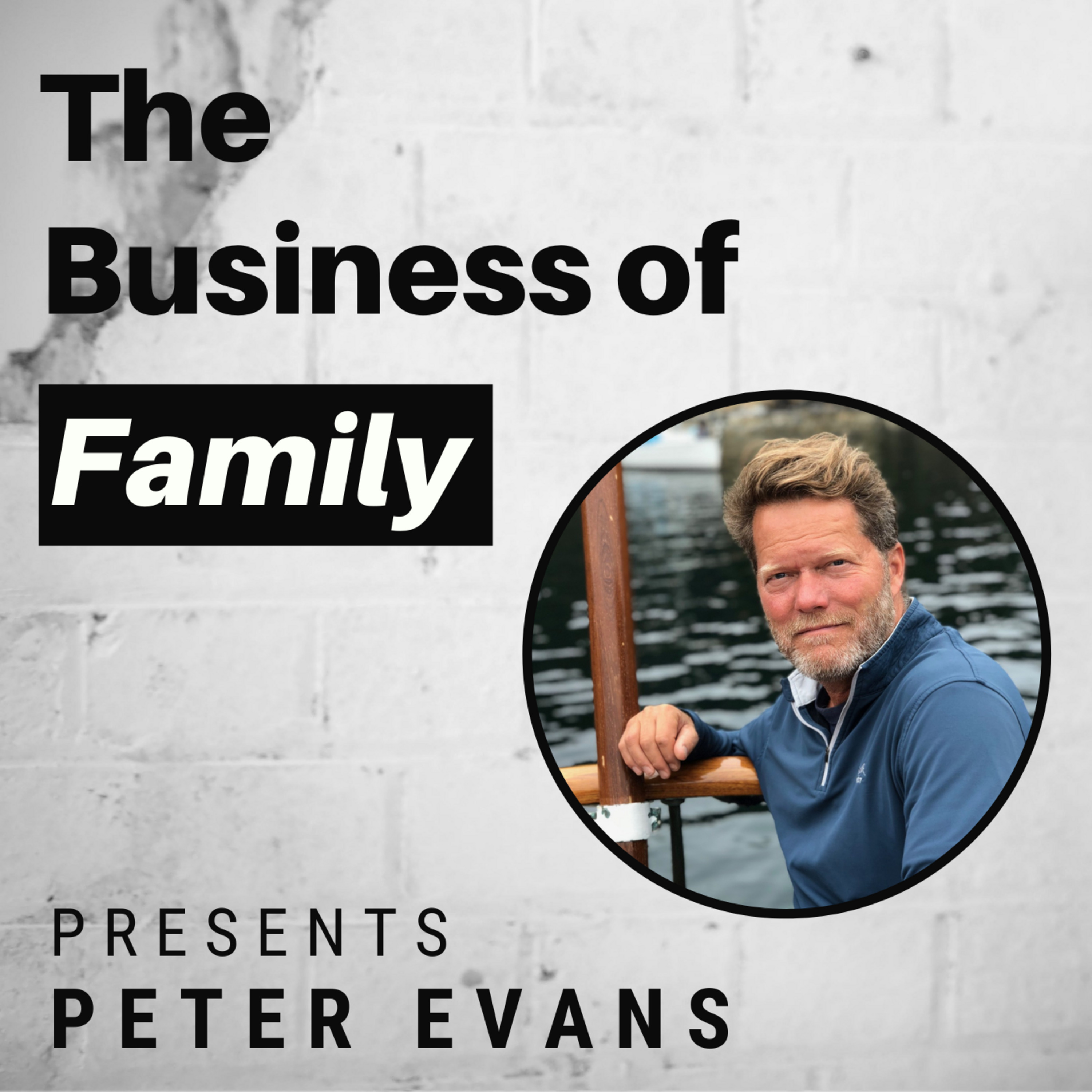
Episode 48 · Season 2
Trusted Advisor to Legacy Families & Member of a 7th Generation Family Holding Company
Key ideas from this conversation
A coming-of-age ritual at 14: an orientation, a luncheon, a front-row seat at the business meeting, and next year the job of teaching the new group.
A generational harvest: about once every 20 years the family sells something significant, so each shareholder has their own liquidity.
Ask elders direct questions. "Tell us about your life" gets little; "what happened in 1942?" gets the real stories.
Read the full show notesBio, standout quotes and the episode timeline
Peter Evans is an advisor, consultant, and speaker to legacy families, family offices, and multigenerational enterprises all around the world. Peter creates the opportunities where affluent families have the greatest chance of flourishing.
Peter is also part of a legacy family himself; he is a 5th generation member of a 7th generation American enterprise established in 1885. Peter married into this family and was astounded by the welcoming and inclusive nature of his wife's large family. The family enterprise is now a holding company with over 500 shareholders, all of whom are family members. Of particular interest are the Family Summits held annually, which are designed to re-engage family members, partake in family traditions and rituals, discuss philanthropy and reset for the year ahead.
Peter shares his experience of what it was like to join a well-established legacy family and how he has used this unique experience to pivot his career and help other legacy families flourish.
Standout Quotes:
- "We can't really plan significantly for longer than 5-10 years, you just learn that along the way, things change; the world changes" - [Peter]
- "I'm really interested in making sure that the family's values are aligned with their actions" - [Peter]
- "To have some sort of formal way of telling stories, I think, is critical" - [Peter]
- "The most important thing you'll do are these rituals" - [Peter]
- "If we have the privilege of having wealth and means, we have an obligation to give back" - [Peter]
Key Takeaways:
- Peter is the 5th generation member of a 7th generation American enterprise established in 1885. He is an adviser, consultant, and speaker to legacy families, family offices, and multigenerational enterprises globally. He became a part of the family when he married his wife and was included.
- The company began as a group of lumber companies started by two brothers who liquidated everything after 45 years to invest with their partner, Friedrich Weyerhäuser in 1901. Peter's family had continued to be involved with the business as it expanded, although there were no male heirs in the second generation, till the 3rd generation. The family later started a private trust company in 1964, at which point they became the 3rd largest retailer of building materials in the US.
- Today with diversification, they are now a holding company with over 500 shareholders, all of whom are family members. Peter's children are already involved with the family business actively and eagerly look forward to partaking in the annual family meetings.
- The Family Summit: This annual family meeting usually runs over 3-5 days, on the same weekend every year, with activities like the coming-of-age ritual and elders’ ritual, Olympic games, business meetings, philanthropy group meetings, and talks by guest speakers. The goal is to make it so interesting that people want to come back.
- Planning Never Stops; the family forms a long-range planning committee every 5 years to have a clean slate to think through everything. A pattern of liquidating a significant resource once every 20 years was also observed; this 'Generational Harvest' would provide liquidity to each shareholder, giving them the freedom to make their own investments.
- The family investments today are largely in Real Estate, like residence halls or low-income housing units, all intentionally inclined towards 'doing well by doing good' which is a value the family holds.
- Peter left his role as president of the family enterprise in 2003 and has since then helped other family enterprises manage their multigenerational interests. He believes families with vast amounts of capital can make decisions that affect millions of lives and works to ensure that these families act in accordance with their values. "I can hold a mirror up to you so that you can begin to see yourself, your family system, and your footprint in the world; the other thing I can do is open the window so that you can look out into the world and see how other families made choices during different transitions"
- Peter's most satisfying work is sitting with family members and watching the interactions; his work is focused on helping build bridges in communication and relationships. His role is a position between being a business consultant, priest, and therapist all of which require a deep level of trust and respect. At its core, his work is about relationships.
- Peter’s role as a 'Personne de confiance': This is a confidential advisor based on their trust, respect, and honesty. The way to get into that role is to come into the family that needs help, taking time to build trust and confidence. Very often Peter has to model a way of doing things like chairing a meeting, inclusion, and effective decision-making while keeping in mind that the goal is to pass on the mantle of leadership. Most of the time, the G2 generation is the one that reaches out to him, however, in some cases when the patriarchs are comfortable giving up authority, this spurs the G2 to take up the mantle and learn how to hand over to G3. Sometimes, the G2 has even already made the transition in their lifetime, adapting to the values and culture while the G3 grows up having a completely different experience.
- Storytelling is critical in documenting family history. Peter uses this both in his family enterprise and while working with others. His family works with a full-time archivist who helps research the lives of people such that detailed questions can be asked and stories can be told more deeply. It also offers an opportunity to share lessons from the failures, trials, and tribulations of family members.
- While still active in his family he was always open to learning from other families and when he left his role, he wanted to be involved in creating the consciousness in families that they can impact the world. Based on Peter's background, he has the experience which gets him into those family spaces after which he starts work.
- From Peter's experience, when it comes to cultural mindsets like having female leaders, and diversity, there is a lot more openness in the US than in most other places. Although he tries to encourage such views, some cultures are just not ready for it. However, families of significant or multigenerational wealth are naturally global these days, hence it is becoming increasingly difficult to avoid influence from other cultures.
- Family Rituals are the most important way to bring the family together continuously over the years because they help young people feel acknowledged. Peter's family has a children's program packed with several activities that keep them eager to return. After the age of 14, they can start going to business meetings. These activities help the family familiarize themselves with teenagers and create a more welcoming environment in the business meetings.
- It is necessary to identify who is family and the kinds of roles available to different members. Each family does this differently, but Peter's family has selected the option of Inclusion.
- Building Family Governance starts with having a reliable cadence of meetings quarterly, as well as major annual gatherings; this goes hand and hand with excellent communication. The next step would be to memorialize family values and have a direction and then this can be the foundation of a constitution. The constitution is a living document and should be examined and changed as required.
- Peter also uses the concept of the "5 Capitals" within his family and the families he works with.
- Philanthropy is another tool Peter has been familiar with. It is fun to watch families come together to figure out ways to give back based on their different interests and drives.
- Very often, families look at their business as heirlooms which begs the question "Is the business an heirloom or an investment?" Sometimes it is hard to sell a business because it's been our identity for years; thus, selling is easy if the business is only an investment but if it functions as an heirloom then it may not be advisable. In some situations, the business is on the spectrum in-between, which means only certain objects or aspects may be more valued as an heirloom. Mike's family takes pictures yearly on the same spot on a piece of land which over time has taken up the role of an heirloom too.
- From Peter to his children: "This is your life, do what you love and do it often. If you don't like something, change it; if you don't like your job, move on. If you don't have enough time, stop watching TV. If you're looking for the love of your life, stop, they'll be waiting for you when you start doing the things you love. Stop overanalyzing; life is simple. All emotions are beautiful, when you eat, appreciate every last bite. Open your mind, arms, and heart to new things and people; we are united in our differences. Ask the next person you see what their passion is, and share your inspiring dream with them. Travel often; getting lost will help you find yourself. Some opportunities only come once so seize them. Life is about the people you meet and the things you create with them, so go out and start creating. Life is short, live your dream and share your passion."
Episode Timeline:
- [00:48] About today's guest, Peter Evans.
- [02:40] Peter shares his family history.
- [07:06] What makes your annual family meetings appealing to the younger generation?
- [12:24] Does a value system guide the investment making decisions?
- [13:56] Peter's work helping other family enterprises.
- [18:36] Peters role as a 'Personne de confiance'.
- [24:18] Family Storytelling as a tool in Peter's work with family enterprises.
- [29:04] Was it your experience with your own family that led you to work with other families?
- [31:35] What are some of the differences in culture that showed up during your work with different families across the world?
- [34:46] How important is it to have traditions that bring the family together?
- [38:37] Who is a Family member?
- [39:13] Building blocks of Family Governance.
- [44:06] Philanthropy in the family enterprise.
- [46:12] How shared experiences come into family meetings.
- [48:10] What is the role of Heirlooms in the family enterprise?
- [50:43] Peter's letter to his kids.
Links:
- Laird Norton Company : Laird Norton Company is a family-owned enterprise that provides long-term capital and resources to empower companies to thrive—and we’ve been doing it for seven generations.
- Peter Evans | LinkedIn
Read the transcript
This transcript was generated automatically and may contain errors, including in names. Listen to the episode for the exact words.
MikeWelcome to The Business of Family. I'm your host, Mike Boyd. Multigenerational wealth creation involves so much more than capital accumulation. The most successful families cultivate values, stories, knowledge and resources to pass on to the next generation, and they do it very intentionally. On this show I sit down with members of some of the world's most interesting business families to hear how they do it. To see where your own family stands, take the Business Family Diagnostic at businessoffamily.net.
It's not often we get the opportunity to hear from someone who is a member of a legacy family themselves, but also a uniquely qualified advisor, consultant, and speaker to legacy families, family offices, and multi-generational enterprises all around the world. Peter Evans creates the opportunities where affluent families have the greatest chance of flourishing. He's the fifth generation member of a seventh generation American family enterprise established in 1885.
Today, it's a diversified holding company with investments across various industries. And the way they come together and show up as a family at their annual family summits and the traditions and rituals that they embrace is just incredible. I know you're going to love this conversation with Peter Evans. Peter, thank you so much for making yourself available. I appreciate you're on the other side of the world at the moment. So this is wonderful to being able to engage with you and have this conversation today.
PeterWell, thank you so much for having me. I've been looking forward to this. I understand you're in my part of the world at the moment. Is that right?
MikeI'm on the opposite side of the country, but I'm on the West Coast in Perth. It's quite a delight to be able to speak to someone in my own time zone for once. We often interview families from the Northern Hemisphere while I'm way down under. So this is a real delight. So Peter, let's get into the real meat of the conversation. You have such a wonderful story and there's so much material I want to cover. But let's start with your own family enterprise first and then talk about some of your own work with other generational and enterprising families around the world.
You are yourself a G5, fifth generation member of a family enterprise Laird Norton. And to be a member of a seventh generation enterprise in the US is quite remarkable. Can you give us a little oversight of the family company, where it started, maybe what it represents today? That's quite a long history.
PeterSure. And it's a great story and it's been told in many ways and so on. I came into Laird Norton by falling in love with a wonderful woman. We were 21 and And I had no idea that she was connected to this great, huge legacy family. So as we got to know each other and I met her parents and so on, and then we were married, I really didn't know that I was marrying 500 people in that family.
So it came a bit of a shock, but it was also a really wonderful thing to be included with open arms. It's one of the hallmarks. And I think one of the reasons our family is so successful is that it has a very high level of inclusion, especially of outlaws like me, people that are married in. So our company started in 1855.
Two brothers and a cousin started moving logs down the rivers in the Midwest. And they built some lumber companies and built a very nice business. And they made an incredible decision by the end of their lives. After 45 years, they liquidated everything. And they invested most of it with a partner of theirs, Frederick Weyerhaeuser, in 1901. So in 1901, our family became sort of the silent partners with the Weyerhaeuser family, side by side, building that company as it moved out west and became quite a global enterprise.
And so our family was involved here and there in various ways over those years. An interesting fact in our family that I think is part of the reason that we're successful and inclusive is that there were no male heirs born in the second and third generation.
MikeOh, interesting.
PeterFirst one was born in the third generation. So at that point, there were no more of the original surnames of the family. And of course, in 1900, the women wouldn't have been on boards. So any new married men into the family would have been considered fresh intellectual capital and drawn in right away in leadership roles. So the third generation male heir became in many ways like a G1 patriarch. And he became chairman of Weyerhaeuser for, I think, 42 years, was really an amazing man, amazingly inclusive. But he also had a very tragic life. He had four marriages, but his first two marriages, his first two wives died tragically in accidents. And I think partly because of that, he was really drawn to include all family members, and he sort of had his arms
open wide to include folks. So I'm straying a bit from your question, but the story goes on that as the 1950s, 60s, 70s rolled along, we realized that we needed to start our own private trust company, which we did in 1964. By that time, our ownership of Weyerhaeuser had diminished quite substantially, but we had built up several other companies. We became the third largest retailer of building materials in the United States. That was a very large company with lumberyards in, I think, more than 40 states. It's a huge, huge enterprise. And then we began diversifying into other things. So fast forward up to 2000, we were then a holding company with a portfolio of operating businesses in several different industries. And that is the same as it is today.
So today it's a holding company with more than 500 shareholders, all family members. And talk about complexity. It is a lot of complexity. My children are sixth generation owners. My son is currently an associate director on a parent company board. Her daughter's been involved in philanthropy. But one thing that stands out is we have an annual meeting every year.
And I will tell you, my children would prefer to go to that meeting than any kind of summer camp you could throw their way. They have so much fun. So that's a little bit of the history. There's a lot more there, obviously, in 160 years.
MikeYeah, incredible. So there's so much to dive into there. but let's start with these reference to the summer camps. How do you make these annual family meetings, do you call it an assembly or a retreat? How do you make them so attractive to the younger generation? What makes it special?
PeterThat is the million dollar question. We do a bunch of things. It's three to five days in length. It happens at the same weekend every year. So it's reliable and it's on the calendar. We have a lot of rituals that we do, including a coming-of-age ritual when children turn 14 and they become young adults. We have an elders ritual.
We play Olympic games. We, of course, have business meetings. We have all sorts of gatherings where there are opportunities to bring up issues and resolve them. We have all of our philanthropies meet. We have six different foundation groups that gather together. Actually, a lot of family members are involved in our philanthropies. so the goal was let's make this so interesting and compelling that people want to come back so we'll sometimes have outside speakers or we sometimes have family members speak we have an event periodically called laird norton university where family members are invited to teach whatever they'd like to teach for a 90 minute segment so you may have one family member who's teaching how
to read Sanskrit and somebody else who's teaching how to understand trust and state law. It could be anything. And those are highly attended. People love them. But we have just a lot of, we have fun. We have music, dancing. Some family members are super musical, so they form a band and it's just crazy. And lots of acknowledgement and celebration of life transitions. So it ends up being quite an event. And we call it our family summit.
MikeSummit. Okay. I like that. And 500 or over 500 family members, do you typically have everybody attend those or where possible or is it optional?
PeterIt is optional. Of course, we tend to cover all the costs involved in participating, but I don't actually know the numbers anymore, but I suppose we average something like 350 people. It's a huge gathering. It's wonderful.
MikeSo families often grow faster than businesses. You've managed to prosper as a hold co for seven generations, or at least evolve into one. That must have taken some intentional planning to try and perpetuate the enterprise at the same rate that the family was growing at a remarkable rate by the sounds of it.
PeterI think the planning never stops. We have a saying that we do our long-range planning every five years. We form a long-range planning committee and they basically have a clean slate to think through everything again. I think one thing we did that we may have just sort of stumbled on by accident, but because of the various investments we had, we noticed a pattern of liquidating a significant resource or company approximately once every 20 years.
So once a generation, and we called it a generational harvest.
MikeOh, interesting.
PeterThat harvest event would provide liquidity to each of the shareholders, however percentage of the ownership you had. So it kept people really in charge of their own destinies. They weren't so bound to the company only. So to give people the freedom of choice to make their own investments, build their own companies, pay for their kids' university, that sort of thing, was one of the things that we realized we were doing only when we looked back.
So we've kind of institutionalized that and we begin to plan for it now, a generational harvest.
MikeIt's a tremendous idea. And it sounds like it started to, I think you said, around 1900, the first operations were liquidated and then went into purely investments. So this is sort of following in that pattern throughout the generations. But in later generations, you're not referring to liquidating everything. Now you're saying harvest maybe one business or one investment within the group in order to create some liquidity. Am I understanding correctly?
PeterYou got it. Perfect.
MikeI think it's a wonderful concept. You mentioned the long-range planning committee every five years. Are they planning for five years or are they planning much further into the future than that?
PeterWe've had endless conversations about how far ahead you can plan. And here's my worldview on that is that we can be directionally correct for seven generations. We can say, we're going to go that way, but we're not going to go that way, right? We know we're not going south, we're going north. We can probably make a decent plan for 20 years, but we can't really plan for significantly for longer than five to 10 years.
We just learned that along the way. things change. The world changes. Our priorities change a little bit. Our values stay the same, but that's the true north, the seven-generation thinking.
MikeI wanted to ask you about values, whether they're family values or family enterprise values, if there is a distinction. When asking you about what sort of investments or holdings the company is involved in today, does the value system guide you in terms of the sorts of things that you like to get into and stay into. You talk about directionally correct. There must be a strong value system that's been around for generations, which guides the investment making
Peterdecisions. I'm a little bit further removed from it now than, of course, I was 20 years ago. But I would say that the investments we have today, we're largely in real estate, but not just commercial properties where we do have commercial properties, but we also are building things like residence halls around universities or low-income housing units around the city. So there's an alignment. There's a doing well by doing good at the same time that our family is really focused on. So yes, you can get a return. It may not be the stratospheric return that you can see from, say, a commercial property, but there's a visceral return that family members are very appreciative of.
MikeAnd I imagine you also align yourself with other enterprises which are also enduring in nature and that are going to be around a long time naturally because as a family enterprise, that is your existence. That's what you're planning for. Is that a fair assumption?
PeterI think so. Yeah. I think it's fair.
MikeYeah. Wonderful. So now let's move on to your incredible experience. I mean, there's so many aspects to this story. We can talk about the company probably for hours, but I think your story is, if not more incredible. So you left your role as president within the family enterprise, I think in 2003. And over the last 20 plus years, you've also been working with other family enterprises around the world, helping them manage their multi-generational interests, their rising generation, their family offices, their governance structures.
Can you tell us a little bit about the role that you played, how you ended up in it? And we'll follow that story a little bit.
PeterI think this will be fun.
MikeI appreciate the sort of mischievousness in your smile. It's wonderful.
PeterYou know, I'm doing what I do because I have a belief that families like ours and yours and the families that I get the privilege of working with have a responsibility to make the world a better place. So these families with vast, vast amounts of capital can make decisions that affect hundreds of thousands, if not millions of people's lives. So we can make a decision at home to be a great parent. That's an important decision that affects the world, right? If we really are sound in our parenting.
If we employ 10,000 people and we have a certain decision around how we compensate people, that has a trickle-down effect for thousands of people. If we choose to try to move the needle on some issue in the world through our philanthropy or our charitable giving, we have the opportunity to really actually make the world a better place.
I'm kind of agnostic as to whether you're on the right or the left or red or blue or Republican or green, it doesn't matter to me. I'm really interested in making sure that the family's values are aligned with their actions. So how do we do that? That's what gets me up in the morning. I think, oh my gosh, there's billions and billions of dollars out here and people trying to run interesting companies and businesses and philanthropies. And maybe they're giving to a hospital research organization, or maybe they're giving to climate change. It's exciting. It's really exciting. That's why I got into doing what I'm doing.
MikeTell me, how do you do that? How do you align the family's value system with their actions and therefore their impact?
PeterOh boy, that is the million dollar question, isn't it? The only thing I know how to do, I know how to do two things. I say to all the families I work with that I can hold a mirror up to you so that you can begin to see yourself, begin to see your family and your family system and your footprint in the world and your actions.
And then the only other thing I can do is I can open a window so that you can look out into the world and see what other similar families are doing, how they made choices during different transitions. So I've been fortunate to have been privileged to see many of those stories and to see where people went down a wrong path, where they made a wrong choice. And I'm able to sort of tell that story and hold it up so people can learn from it and say, hmm, is that where we want to go? But the most satisfying work to me is sitting with family members, whether it's in a council meeting or a board meeting, and looking at the interaction and the relationships there.
Do people step on each other's toes? Do they acknowledge another person's point of view? Do they speak with judgments? Do they speak with respect? So a lot of my work is that that secret sauce is really helping to build bridges in communication and relationships. And a lot of people say, well, what do you do? And I say, well, if there are three points to a triangle and that describes my work, I'd say, well, I'm kind of a business consultant is one of the points.
Another point is parish priest, family minister, rabbi. Another point is therapist. I say, you know, I'm actually none of those things, but I hang out in the middle of that triangle. That's how I describe my work. And it only works with a deep level of trust and respect. I said actually just yesterday with some family members I'm working with here, I feel sometimes like I'm Henry Kissinger doing shuttle diplomacy.
So there's a care around confidentiality, but there's also how do we build a bridge between this relationship that's gone south? Is our life really worth having anger and resentment and distance? Or can we work to learn about ourselves and our own judgment and our connection with that person? It's really about relationship at its core.
MikeAnd you often find yourself or you're often engaged in a highly trusted long-term arrangement with legacy families. And I'm going to try and pronounce this, please be kind to me, but your role as a personne de confiance, maybe you can re-pronounce it for me, but how do you find yourself into such a role? How does someone, they don't just pick you off the street and say, you're going to be my trusted advisor. How do you find yourself into a role like that one day?
PeterWell, you did a decent job pronouncing it. It's French and I learned it from Jay Hughes, who's been a mentor of mine for probably more than 30 years. But it's person de confiance versus the other idea is a personne d'affaires, person of affairs. So the affairs are sort of more technical, like the legal, technical business things. The personne de confiance is really a confidential advisor, someone who, based on trust and based on their gravitas, the way they show up, the way they respect, the way they're honest and open and call people on their patterns.
So the way to get into that is to first come into a family. They're looking for help. And very often what was presented to me at first is someone calls and they'll say, you know, we're having a hard time making decisions. We're not really sure where to go. We don't know what to do with this company. We've got people clamoring for liquidity. We don't know how to deal with this. And I said, okay, nine times out of 10, it's a woman who calls. Nine times out of 10, it's someone in the family who's a little bit of a black sheep. They tend to think about things a little bit differently than the rest of the family. And they're noticing these patterns and they're
realizing if we don't tend to this, we're not going to stay together. We're going to fall apart and the shirt sleeves proverb will come true. So that's who calls. And then there's a first meeting. And then from then on, it's just about building trust, building confidence, maybe taking on a project to design a better governance structure, perhaps write a family constitution with a group of family members. Very often, I will be in the role of chairing meetings just to model a way of doing it, to model inclusion, to model effective decision making.
And my job then is to work myself out of a job to help other family members take on the mantle of that leadership and hold them up, help them get through failures, help them succeed and move forward. That's really what it's about.
MikeLots of follow-up questions, if you don't mind.
PeterKeep going. I'm with you.
MikeIt's wonderful. I could talk about this for hours, but I want to squeeze out as much as I can with the time we've got. I'm curious, the generation which typically reaches out to you. And by that, I mean, do families typically reach out as they're around G3, G4? Or do you have sometimes founding generations reaching out? Where do you find most often families say, hey, we're struggling, we want to keep it together. What do we do?
PeterIn my experience, it's almost always G2. they're in the position where they've inherited something this wasn't necessarily structured they're starting to contemplate g3
Mikewant to do it better
Peterexactly um they may have a g1 a patriarch usually that is very controlling and wants to stay in charge until they've been in the grave for another 25 years g2 is a very interesting place to be because very often they have grown up in the shadow of a wildly successful set of parents. And very often, G2 is a bit of a forgotten generation. And all of the attention goes on G3. But then they suddenly realize, oh my gosh, we haven't set this up successfully for them. How do we do it? Wonderfully, I have seen more and more founders, patriarchs and matriarchs, actually really getting comfortable with giving up control and authority. And when that begins to happen, the second generation kind of rises up and takes
the mantle of leadership in an appropriate way. And then they can see the way forward to transitioning that to the G3. It's beautiful when it happens that way.
MikeYeah, absolutely. Absolutely. I think also that what I see with the G2s is that they've often made a transition in their lifetimes. A lot of times G1 was still making the wealth or still working very hard as entrepreneurial endeavors or something while G2 were kids. And they may have been transported, to use language from Jim Grubman, they may have been transported from one level or one land to another land in terms of wealth and prosperity and opportunity and things like that.
And so they've got to adapt culturally. They've got to adapt maybe the value system and then determine which part do they hold on to? Which part do they embrace as new? And what do we do about G3? Because they didn't live the same experience that we did.
PeterRight. And G3 grew up incredibly wealthy. And G2 grew up in a very modest household to begin with. And all of a sudden finds themselves in their 60s to be very wealthy people.
MikeThat's right. You can't expect them to have the same lived experiences or value system or work ethic necessarily if they don't have a great grasp on what it took to get here. And of course, there's not much you can do about that as a G3 if you didn't live the same experience. And so something that I'm really quite passionate about exploring is family storytelling and documenting history and understanding where we come from.
What role does that play in your work, but also in the families that you engage with?
PeterOh, I think you're spot on. It's super important, especially if there's an annual gathering or a gathering every other year, to have some sort of formal way of telling stories, I think is critical to document the family's history in a book or through videos, movies. I've seen some really amazing things that have been done. And one family I work with is particularly good at that. And today, I'm working a lot with their third generation now. And the third generation has been given the task of doing a strategic plan, which I think is kind of a radical move for the G2. But they said, okay, you 20 to 40 year olds, we're going to give this to you to do because in fact,
you're planning for your future. So how did they do that? They do that by looking forward and looking back. And they've gone back and they've reviewed their grandmother's words on the video. They reviewed their grandfather's words. They've taken inspiration from that. And they also can recognize that that's a different world that they lived in. So now they can face forward and plan for the future that they have based on knowing really where they came from, but also that they're in charge of their own destiny. It's wonderful when that happens. So I'm a big advocate of storytelling. In our family, we do one thing that's really cool at the annual summit as a kind of a transition point between meetings. There'll be a big stage and video screens and
stuff. But a big old overstuffed chair is hauled out into the middle of the stage. And we have these five minute story moments. So somebody will have been tapped on the shoulder, you know, weeks before and said, Hey, can you, can you tell a story? And it's kind of an honor. And it's scary as heck to, to be in that seat, but everybody gets transported to a different place for that five minutes in between, you know, whatever the meetings are. It's pretty cool.
MikeThat's very cool. That's very cool. Can you tell a story in that five minutes in any format that you like? You mentioned earlier having some sort of formal process or formal structure around storytelling. Are there guideposts in place for the types of stories or the format for delivery? Or do you just say, hey, here's five minutes?
PeterThe guideposts are just five minutes. But we have a lot of other formal guideposts. For instance, we have a series of oral interviews with anybody who's over 70 in the family. So we've developed an archive of all of those interviews. And it's pretty amazing. So we have a full-time archivist working with our family. And they're caring for the family history.
And so they will go ahead and research this family member, this elder. They'll know that they were in the war and they were decorated this way. They'll know that they took this business that way. And they'll know that they had a failure in this. They'll know a lot about their life stories. So they have a very active interview.
Because what we found is if you just say, hey, tell us about your life, people don't do much. But if you ask them the direct questions about, well, what happened in 1942? And what were you thinking? Then they tell you the real stuff. Pretty great.
MikeAs I can only imagine. I love that. anyone over the age of 70. I've been talking to a lot of people about this concept. A few people have reached out about private podcasting, the same sort of thing, just oral history. How do we capture these stories? And so many more founding generations are starting with this to sort of capture the essence of what was the spirit? What was the fabric? What was the essence of the family that weaves us together that's ultimately passed to the generations beyond? We're going to evolve and change and things are going to come at us that we can't predict, but this is the value system and this is where it all began. And more importantly,
the trials and tribulations, some of the resilience factors of these are the times when it was hard. This is how we persevered and this is what we learned from it. I think sometimes they're the best stories that are passed to the next gen.
PeterWell, especially if you're in the rising generation and you only see this incredible success, you think, wow, how can my life ever measure up? How can I ever do anything that will even hold a candle to this? Unless you realize that there were a lot of struggles along the way and people did persevere and they had resilience because all of a sudden then you say, wow, I have my own struggles and it's okay.
I can get through them.
MikeYou mentioned a couple of times your experience from your own family and working with others. I'm curious to understand how they inform the other. So was it your experience with your own family enterprise that ultimately led you to working with other families? or were you already exposed to working with other families and brought some of that influence to your own family enterprise? Is it a two-way street for lack of a better phrase?
PeterOf course. I think when I was very involved in our family and I was in business school and I was on our board and then I became a leader, we were always trying to learn from other families and engage with peer conversations. I think it's a very important thing to do. But when I left my role, I realized I had an open book to do whatever I wanted in my life.
And it occurred to me, as I said earlier, that these families with extraordinary wealth really have the ability to change the world. So that's what I wanted to be involved in that change of consciousness and that growth. So I think the thing that really has worked for me is that coming from a family enterprise, I have the lived experience of the challenges and the opportunities that are there.
And so I think other people look at me and they say, wow, they don't ever say this, but they say, wow, you have a pedigree of experience that is really valuable. But that's all it is. It opens a door. And then they have to get to know, wow, does this person follow through? Do they stand by what they say?
Are they able to moderate a difficult conversation in a board meeting? It's all those skills that I frankly learned from living in our own family.
MikeYeah, I can imagine it's an important rapport builder and trust builder as well to say, look, I've been there, not necessarily experienced the identical situation, but I've been there interacting with family members, interacting with the enterprise, understanding the tug of war that takes place sometimes and finding a way to navigate through positively.
PeterAnd then storytelling comes back into the whole thing because I can tell some stories, no names, of course. But I can tell some stories and say, hey, this happened. This is what the result was. Does that resonate at all with your situation? You have a choice here, folks. You can choose this path or that path. We live on the free will planet after all. What are you going to do with your life?
MikeWhat a great question. I'm curious to ask about your global experience, Peter. So you're on the other side of the world from home at the moment, and you've worked with legacy families all around the world. What do you see show up as some of the differences in culture with working with families from different parts of the world? Are there some unique things that You have to navigate for, say, a Western family compared to a family from the East or Arabic nations.
PeterYou know, I would imagine when you had your podcast with Jim Grubman, you probably covered a little bit of his amazing work in researching the different cultures around the world.
MikeYes, we did.
PeterYeah. I don't even pretend to hold a candle to his expertise in that nature. But I think the thing that stands out for me coming from the States, there's still more openness there in my experience to including women leaders, to having diversity. And that one thing varies greatly across the globe. There are cultures that are very masculine that really only have men involved in leadership roles.
But in some ways, you could say that the women are wearing the pants in the family anyway, because a lot of the decisions get made over the pillow talk. I really like to encourage, no matter what culture I'm in, that we have compassion and appreciation for all people. But some cultures are just not quite there yet or ready for it.
That's probably the biggest thing I see as a difference.
MikeI think it's fascinating. I've spent a lot of time living in different parts of the world. I'm back home in Australia now speaking to you today, but understanding different cultural perspectives as you've just described and how they play a role in these global families. Because I think families of significant wealth or multi-generational are naturally global these days.
And I think that showed up in part of Jim Grubman's work as well, that these days, if you're of that much means, you tend to have investments or businesses or family members spread around the world. And so even if you are very strong on your home culture, it's almost impossible to stick in that one lane and not have influences from other parts of the world.
Because the very easy example to give is families from Asia, where I've spent a lot of time living, send their children off to be educated in the UK and the US. And then they return home with these wonderfully independent Western values and try and reintegrate that into perhaps very traditional values in the East. And there's a clash, but sometimes it can be a really healthy clash too.
And sometimes it blows up.
PeterI've seen both happen. And it's really hard when you have an elder generation, they're doing what they think is exactly right and sending their kids off to be educated. And they come back different. Well, why is that a surprise? But it is. And it is a clash.
MikeSpeaking of changes, influences, clashes, I want to come back to the concept of traditions and rituals within family enterprises. I think you alluded to the fact that you have some at your annual summit, probably throughout the year as well, and other families that you work with. How important is it to have traditions that bring the family together? And what sort of traditions and rituals do you see show up?
PeterWhen I was elected president and the person who preceded me passed on some wisdom as I was stepping into the office, he said, the most important thing you do are these rituals. I was kind of surprised. I thought maybe he'd be talking about the balance sheet or something else. But he said, nope, the rituals are the most important thing. And he taught me why he did this coming of age ritual.
And he said, basically, all you're doing is inviting these young people to be a part of the family. You're acknowledging them for who they are. So what we've done, and I think a lot of families do something like this, but our age is at 14. So up until 14, they've been in a children's program. So we have an awesome children's program.
There are 15 caregivers come every year to take care of about 85 kids. And they have a lot of fun and different age-related events. By the time they're 12 and 13, they're out camping or river rafting or doing something fun. The whole point is that they have so much fun they want to return. And it has worked incredibly well.
But then at 14, you say, wow, it's a little young to kind of come to the formal business meetings. But we've decided, no, it's not. These guys are ready for it. So they go through an orientation program at the company to learn about all the stuff that's there. and they kind of walk around with their mouths open saying, oh my gosh, I had no idea.
And then they come to the formal business meeting. But right before that meeting, we have a luncheon that is a formal luncheon where they're introduced to the family. It's like a coming out ceremony. And when I was president, what I did, one year I had 11, 14 year olds. It was a big group. So I would go and I would interview their teachers.
I'd interview their parents. I'd interview some of their friends and say, well, who is this person? Tell me about their character. Oh, well, Johnny, he's a really good skateboarder. He is amazing. He can turn corners so fast, you can't believe it. So I'll have then a slideshow of this young person's life. Not all of their trophies and all of that, but I'm talking about their character.
And I've got my arm around them, and they're up on stage with me, and they're frightened because they're in front of the whole group. But I talk about, hey, you know, Johnny, we need people like you that can navigate corners so quickly. We need good skateboarders in the family. Keep up the good work. That's what we need.
And we want you involved. And so then, you know, go through all 11 people and it's really emotional. It's really fun. Then they go to the formal business meeting and they're paired up with an older buddy. And we don't let them sit in the back row on their phones. They're in the front row. And the older buddy is there to help them understand the whole meeting because a lot of stuff gets talked about.
The coolest thing we've done is the next year, those 15-year-olds run the orientation program. They teach it. Now, present at that program are not only other 14-year-olds, but anybody who happens to have married in, you might have a 50-year-old there learning from a 15-year-old. And I guarantee you they learn the material by teaching. Super fun.
MikeThat is such a gift. What an incredible program. What a way to come of age in the enterprise and be welcomed in in such a nice way. I love that.
PeterI've seen a lot of other families take on a ritual like that. And wonderfully, they make it their own. They do their own things. They have their own gifts, their own kind of formality. And it's just important to have something.
MikeAnd having an entrance platform for married ins as well at any age, I think, is also important. How do you integrate? How do you feel welcome? How do you, you know, first of all, I mean, we could say who is a family member, but it sounds like married-ins, including yourself, are very much included in the 500 plus family members.
PeterYeah, it's very important to get clear about how you define family. Who can be a shareholder? Who can be an owner? Who can participate in which meetings? And every family I've ever seen does it a little bit differently. Like I said, our family is, we err on the side of inclusion. And I think for the most part, that's been good.
It has created some problems, but I think it's a good idea. Yeah.
MikePeter, are there standard building blocks to family governance that you like to see when you work with other families? If someone's coming to you on their G2 and perhaps they've got a half an idea, but they really want to adopt a much more sophisticated process, learn from those that have walked ahead like your family enterprise, where do they begin?
Where do you suggest that they begin? Do you, for instance, suggest that every family has a constitution or starts with a value system or starts with an annual summit or developing rituals? What would you say is most critical? And then what would you say is things that families maybe adopt and add their own flavor to over time?
PeterI think number one is to have a reliable, dependable cadence of meetings. So maybe there's a quarterly board meeting or a family dinner or something like that. And then maybe an annual gathering that is a little bit bigger deal. But to create those shared experiences where people can understand what's going on, and part and parcel to that is excellent communication. There has to be, in my view, very transparent, inclusive communication that's right and timely. So then the next thing would be to memorialize the family's values and principles, hopefully a mission, and get sort of clear about the direction. Are we going that way or that way? Then what usually happens at that point is people say, well, you know, we should really codify all of this into one document.
So that's when the constitution tends to come around. And some families call it a constitution and some don't. I like constitution because I think I had one family, upon the signing of their constitution, we brought in an actor who played George Washington, signing the American Declaration of Independence and the Constitution. And he gave a history lesson about why we have a constitution, why we have built this democracy, and why it's hard sometimes, and why we can persevere through difficult decisions and changes. And actually, that family, the matriarch and patriarchs signed the constitution that was printed on a pigskin and they signed it with quill pens. Wow. You know, why not? Why not kind of make a deal out of it? And that's become part
of their history and it's kind of important. Now it's been 13 years since we did that. The matriarch and patriarch are gone. G3 is in charge of the strategic plan. And lo and behold, We're rewriting the Constitution because it is a living document. It should be changed when change is required. It should be examined. So rewriting it has caused everybody to actually read it.
You know, we don't want to do it that way. We want to do it this way. Start there.
MikeThe five capitals. I know you're a big fan and incredible supporter of Jay Hughes's work. And, you know, we talk about the human, intellectual, financial, social, spiritual capital. How much of a role does that play in the work that you do with families around the world?
PeterA lot. I think it's a really useful rubric to have conversations about different things. You've probably seen Jay have his hand out and talk about financial capital and then flip it over. Have you seen that?
MikeI have, yeah.
PeterIt's a really useful way to think of it to say, wow, we have all this financial capital, but it's really what we're building all of these other capitals on. Family members really get that. They really understand it. And it's interesting when he does that with his hand, that the one that ends up on top is the spiritual capital, much like Maslow's hierarchy of needs.
So it's a useful tool. I've actually seen some families take the five capitals and design their annual report around five capitals. So the financial capital happens to be one-fifth of the annual report. In human capital, there might be a picture of the three new babies that were born that year or the new married-ins. Wow, we added human capital to the family.
In the social capital, there may be stories about the foundations and where they've given and actually made something meaningful happen. It's really kind of fun to use that as a rubric for communicating.
MikeI've seen quite a few constitutions developed along the lines of the five capitals as well as sort of the guideposts to say, this is what we're all about. This is what we care about. These are how we want to address these five areas or at least these five areas. Sometimes the family adds more, but I think it's a wonderful exercise and lens through which to look at it. You mentioned philanthropy a couple of times, and particularly your family has many foundations or philanthropic endeavors underway, I think you mentioned. So what role does that play in family enterprise and bringing maybe different members of different generations together?
PeterA lot of people talk about philanthropy as a glue for families, and I think it can be, but I don't want to sort of overestimate it in that way. We have found that there's a certain portion of our family that are just really passionate about it. So I think, first of all, if we have the privilege of having wealth and means, we have an obligation to give back, I believe.
and giving back, I said earlier, could come in many forms. But it's really fun to watch a group of family members working together to say, how can we actually make something better? And they get a lot of joy and satisfaction out of that. So in our family, we have, I haven't seen it lately, but starting 20 years ago, we had one foundation that was kind of old and tired.
And we had a lot of different desires of what people wanted to give to. but we were kind of limited. And then we had corporate giving that was sort of strategic. And so we had a philanthropy summit. We said, anybody who wants to come, you can come to Seattle for three days and we'll pay your way. And we're going to figure out what to do. So 85 people came and we had this huge process that was led by some really, really smart people. And out of it came five giving areas. Some people were really passionate about medical research. Other people are really passionate about building wells in India, having clean water and sanitation.
Other people are really, really passionate about making sure that the Western rivers are clean. So all of those are good, right? So we formed groups to lead those endeavors. So has that been a source of glue? Absolutely. A source of shared experience? Absolutely. People take some real pride in being a part of those and learning and studying and making that a part of their life.
MikeYou mentioned shared experience there, which is a very common adage in YPO. I know you're a member. How does that come into family meetings or governance structures when you're trying to give everybody a voice around the table and not necessarily have the founding generation or an elder generation dictate to the following generation?
PeterWell, I think shared experience happens in a lot of ways. I think if a family has a meeting and they have a children's program that really excites the kids. And I've seen a family with the five-year-olds, their project for the week is to actually color placemats and make napkins, serviettes and all sorts of things. And then it culminates with them doing a T for the grandmothers.
That's a memory they'll never forget, right? So the 14-year-olds might go river rafting. All the adults will have a shared experience of coming together on an annual basis, meeting their cousins again, meeting their distant relatives, maybe listening to a really interesting speaker that kind of challenges their thinking. But, well, maybe we go to a really interesting resort and we have some fun, play some tennis, have a golf match, maybe sing some karaoke, something crazy.
It's all building good memories. I think that's fun to do. It's like, anyway, other families work on that all the time.
MikeYou mentioned earlier the example of signing the Constitution on the pigskin. And it made me think of the role that objects and heirlooms can play in storytelling or symbolism within families. But also, you know, to make it a multi-pronged question, also the sense of place. You know, some families will have their annual retreat or summit in the same place every year.
Maybe it's a family-owned property that they've been going to for 100 years. What role do you see in heirlooms, objects, and places in legacy families and family enterprises? Oh, it's such a great question.
PeterAbsolutely. And every family is different. What's really dear? I think another question is too, is very often families look at their businesses as heirlooms. So I think it's an interesting polarity. Is this an heirloom or is it an investment? Sometimes it's very hard to sell a business because it's been our identity for 50 years, but it turns out that the time is right and it turns out that everything makes sense.
But if your heart is only connected to it as an heirloom, you cannot make that business decision. If it's only an investment, then it doesn't matter, right? Always these family enterprises are somewhere on that spectrum. Then we can talk about things or places. There's usually some object that comes to a family meeting and it's special and it might be kind of crazy or sort of silly, but could be a talking stick that gets used ritually every year. When we have a ceremony, we bring out the old talking staff.
But I think whatever those are, it's important to kind of keep them going, lift them up, show them off, celebrate them.
MikeI think one of the simplest ones I see in a practice of my family is we always take a photo in the same place on the same piece of land every year. So we can see the children growing, we can see the family growing, and we get that sense of documenting history, the growth of the family, but also it's this sense of place that becomes important to us.
This is where we made memories year after year.
PeterDo people stand in the same place each year?
MikeYeah. Yeah.
PeterReally?
MikeWe started off standing on a great big boulder, which is on the property with an incredible backdrop. But I think we're going to outgrow the boulder ultimately because we're going to run out of space. But yeah, it makes for great memories and great photos. And it's wonderful to reflect on.
PeterOh, that's brilliant. I'd love to see those sometime, Mike.
MikeOh, that'd be my pleasure. My pleasure. You'll have to come stand on the boulder with us.
PeterJust say when.
MikePeter, I mean, this has just been fabulous. I hope that we get the opportunity to do this many more times because I could talk to you for hours about all of this, but I'm conscious of your time. So if you'll allow me one final question, and this is a question that I ask every guest that comes on the show.
Imagine you're writing a letter to your children. What is one lesson or idea that you don't think many parents would mention, but you consider important to understand?
PeterWell, we really need a campfire and a glass of bourbon for this. I think it's a lifetime question, and it's wonderful that you asked this. And I knew you were going to ask it, so I printed out a writing of a poster I have on my wall at home, and it's called The Holstee Manifesto. So this is what I would say to my kids. And I do say it to them. And I've printed them copies of it. But it's pretty simple. I'll just read it.
This is your life. Do what you love and do it often. If you don't like something, change it. If you don't like your job, move on. If you don't have enough time, stop watching TV. If you're looking for the love of your life, stop. They'll be waiting for you when you start doing the things you love. Stop overanalyzing. Life is simple. All emotions are beautiful. When you eat, Appreciate every last bite. Open your mind, arms, and heart to new things and people. We are united in our differences. Ask the next person you see what their passion is and share your inspiring dream with them. Travel often. Getting lost will help you find yourself. Some opportunities only
come once, so seize them. Life is about the people you meet and the things you create with them, So go out and start creating. Life is short. Live your dream and share your passion.
MikeWhat a beautiful manifesto. You'll have to share a copy with me, please. I want to reread that. That's wonderful.
PeterI'll email it to you. I don't know who Holstee was or who it is, but I have a poster of it at home and we should credit them with that writing. But I find it quite inspiring.
MikeAbsolutely, it is. It is. What a beautiful letter to your children too. Peter, thank you once again for making the time in your busy schedule on the other side of the world, in my part of the world. Thank you. This has been wonderful.
PeterThank you, Mike. And I look forward to seeing you in Oslo. Hopefully, we can do this again.
MikeCan't wait. Take care.
PeterCheers.
MikeThanks for listening to The Business of Family. You'll find the transcript and key ideas from this conversation at businessoffamily.net, along with the Business Family Diagnostic. It's free, and it shows you where your own family stands. And if someone in your family should hear this episode, please send it to them too. I'm Mike Boyd. Until next time, take care.
Keep listening
If this one landed, start here next.
Matriarch of the Sheraton Hotels and Perdue Chicken Families
The small rituals two long-lived families use to stay together.
Appointing a Non-Family CEO & Selling a 5th Generation Business
A family office that keeps a large family meeting after a sale.
Avoiding the Entitlement Trap of Raising Children in Affluence
Rules, rituals and a family economy.
The Business Family Diagnostic · Rhythms
A seat in the front row at fourteen.
Peter's family invites its young people in before it expects anything of them, and the rituals hold more than 500 shareholders together. Does your family hold a structured family meeting at least once a year?
“We have traditions that bring the generations together regularly.”

Every family wishes someone had recorded the generation before.
I built Enduring Stories to do it for yours: a guided voice conversation, from home, that keeps your family's voices, values and history.
The newsletter
The most useful things in these conversations are the things families rarely say out loud.
I share them in my newsletter once a week. Sign up to receive the ideas directly and start building the foundations for your family today.