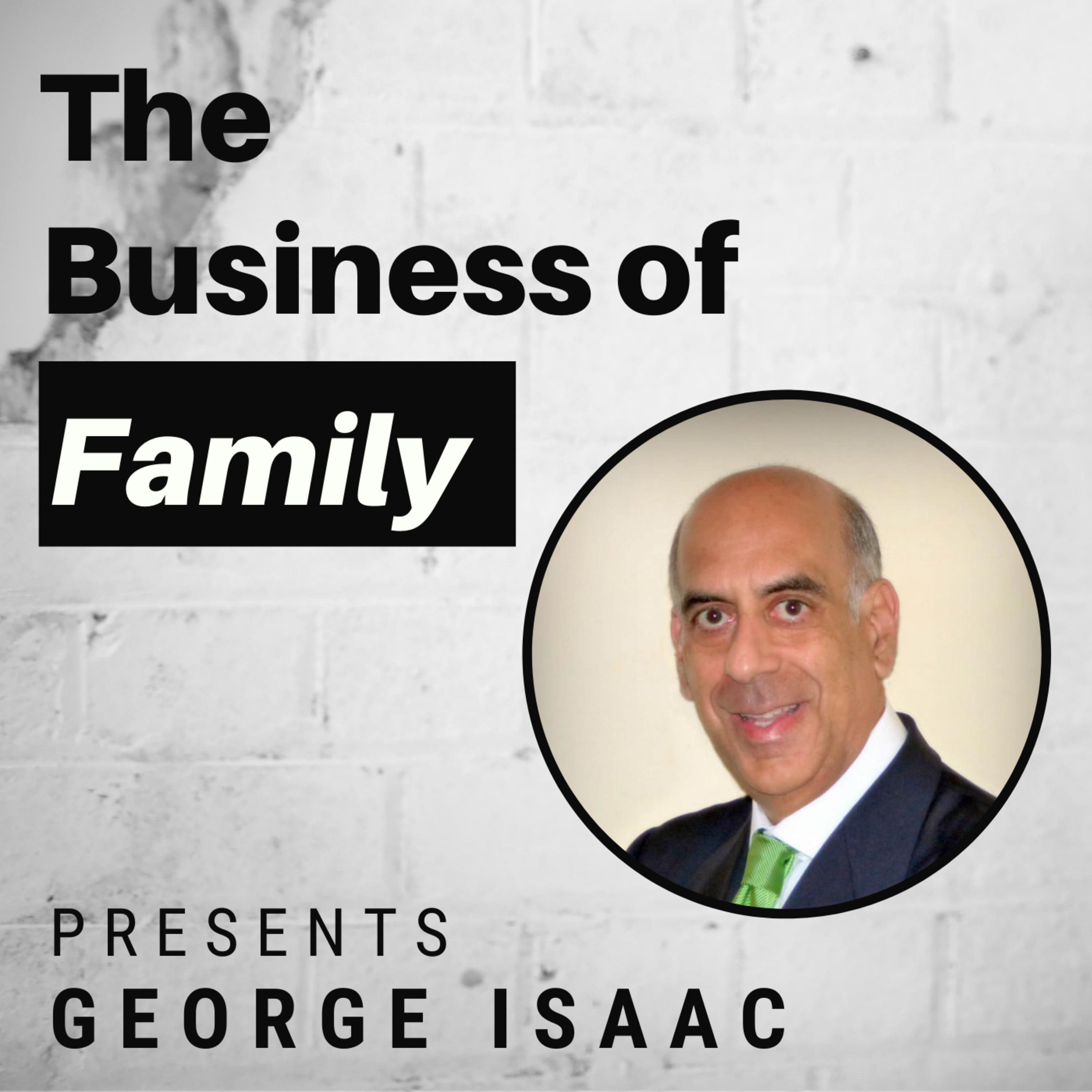
Episode 23 · Season 1
Family Business Consultant, Board Advisor & Prior CEO of Isaac Family Businesses
Key ideas from this conversation
The goal isn't keeping everyone in the business happily ever after. It's learning what each owner needs, and whether the business can meet it.
Sell a business making $5 million a year, and after tax and reinvestment the family may keep under a third of that income.
Cash that feels safe on the balance sheet can be the family's own equity earning three or four percent.
Read the full show notesBio, standout quotes and the episode timeline
George Isaac’s grandfather founded the first Isaac family businesses in 1899 in Bryan, Ohio, beginning a long history of serial entrepreneurship and the subsequent creation of several successful enterprises. A lot has changed since then, but the Isaac Group continues to thrive, now under board oversight and management by its third and fourth generation.
George grew up as a child of family business owners and has run several Isaac multigenerational family businesses as a CEO and board member. More recently, he is the founder and president of GAI Capital Ltd., a family business consulting firm and the author of a newly released book titled Your Business, Your Family, Your Legacy: Building a Multigenerational Family Business That Lasts
Standout Quotes:
- "I realized that some of the things I did in running our family business and what a lot of people are doing today are not best practices"
- "I used to think that the goal was to get everybody in the family to stay in the family business and figure out a way to make them live happily ever after... My goal now is to understand the real needs of each family member and see if they fit within what the family business is going to be about"
- "The majority can rule and figure out what they want to do but you need to deal with the minority issues... so that you can satisfy their needs"
- "The most important to me of the whole thing is just being certain that your ownership group is aligned"
- "There are times when you should sell your family business"
- "Shareholder returns are much different than business returns... Figuring out how you provide real-life shareholder returns is an important step that many of us don't recognize"
- "Money is not everything by any means"
Key Takeaways:
- Although George had gotten involved in the family business at a very early age and had planned to join fully after school, he decided to go out and get outside experience first.
- George notes that the Authoritarian leadership style of his father, although a good leader, made for a rather weak management team generally.
- The 2 conceptual parts to George's 9-step succession planning roadmap: Family Transition Planning and Business Transition Planning.
- George explains that formerly his goal would be to make everyone stay in the family business and be happy, but now he tries to understand the individual needs of each family member, to see if they fit into the family business as a whole.
- It is necessary to revisit the topic of people's needs and be sure the business is aligned with taking care of these needs because those needs change over time.
- The 2 Basic components of selling the family business: the financial side and the personal side.
- Headwinds that perpetuate a multi-generational family wealth: FIST ( Family units, Inflation, Spending rate, Taxes)
- George shares some insight from the book "Everybody matters", describing how attention to the little things can go a long way in making workers satisfied
- Think about what you want your legacy to be; are you aligning yourself with that legacy?
- Be Curious and Have Empathy
Episode Timeline:
- [00:45] A short overview of George's background and the Isaac family business
- [05:08] George is the 3rd generation of the family business
- [05:24] What sort of product lines is the business in?
- [06:18] How did your story evolve into the family advisory work?
- [09:40] About the A 9-step succession planning roadmap from George's book
- [17:12] George highlights implications to consider in selling a family business
- [23:33] The Family Business Wealth Evaporation Trap
- [33:01] F.I.S.T
- [36:47] Is it possible to maintain wealth at a reasonable level even though the family grows at a compound rate as the generations go on?
- [39:43] George shares his opinion about children inheriting wealth.
- [41:47] George recommends the book "Everybody Matters" by Bob Chapman
- [44:27] From George to his kids
Links:
- George Isaac - Management Consulting, Family Business Consulting, Corporate Board Membership : George Isaac is the founder and president of GAI Capital Ltd.
- Book: Your Business, Your Family, Your Legacy: Building a Multigenerational Family Business That Lasts - George A. Isaac : 5-star "Amazon's #1 New Release" Rated Book Whether you are an experienced family business or family office executive, board member, owner, or next-generation family member, George Isaac has written the definitive handbook on the challenges of managing a multi-generational family enterprise.
- Ten Critical Initiatives for Family Business Longevity - Tharawat Magazine : Your family business is your best vehicle for generating income, preserving wealth and serving the needs of your stakeholders. Yet, sustaining family enterprises for the next generation is a continuous challenge, with the majority not surviving.
- Family Business Pandemic Cash Flow Survival Strategies - Family Business Magazine
Read the transcript
This transcript was generated automatically and may contain errors, including in names. Listen to the episode for the exact words.
MikeWelcome to The Business of Family. I'm your host, Mike Boyd. Multigenerational wealth creation involves so much more than capital accumulation. The most successful families cultivate values, stories, knowledge and resources to pass on to the next generation, and they do it very intentionally. On this show I sit down with members of some of the world's most interesting business families to hear how they do it. To see where your own family stands, take the Business Family Diagnostic at businessoffamily.net.
George Isaac's grandfather founded the first Isaac family business in 1899 in Bryan, Ohio, beginning a long history of serial entrepreneurship and the subsequent creation of several successful enterprises. A lot has changed since then, but the Isaac group continues to thrive now under board oversight and management by its third and fourth generations. George grew up as a child of family business owners and has run several Isaac multi-generational family businesses as the CEO and board member.
More recently, he is the founder and president of GAI Capital, a family business consulting firm and the author of a newly released book titled Your Business, Your Family, Your Legacy. It's my great pleasure to welcome George to the show. Thanks for being here, George.
GeorgeOh, thanks, Mike. It's great to be here. It's always a treat to talk about family business issues. So I look forward to our conversation. It should be a great one.
MikeGeorge, I'd love to start with a bit of an overview of your background, please, and the Isaac family business and how you found your way into the business.
GeorgeWell, it wasn't too hard to find my way into the business because in this small town in Northwestern Ohio, I grew up on the block with my aunts and uncles and the family business was on the same block. So it was just down the road, down the street, on the sidewalk to see my aunts and uncles and my father in the family business.
So it started at a very early age, and the dinner conversations were typically about family business matters. And my dad was running the business, and so we were talking about business. It's a little scary or weird, but I remember in eighth grade talking about bonus depreciation and investment tax credits and tax planning. So we started at a pretty early age.
In latter years, like when I graduated from college in grad school, the plan, so to speak, and the program was I would come back and join the family business. I felt at the time that wasn't the best move, that we'd better get some outside experience, learn as much as I could. I was still in a court, you know, in this desire to be as smart as I possibly could with business issues.
So I chose a career in management consulting instead of joining the family business, much to the surprise of, I think, a lot of the members of the family, particularly my father. But after about 10 years, my father was at an age where he was thinking about partially retiring. And so my father was a great businessman and did a great job running our family's businesses, several of which he had started.
And, you know, he got different businesses going at different times, but he settled on a couple at the end. But he was also kind of an authoritarian leader. So when you have that kind of management style, he was brilliant and visionary and did a great job. You can imagine the management team wasn't very strong because he was pretty much calling all the shots and had a bunch of yes men.
So there was nobody that was really given the opportunity, including a couple of my cousins, to really develop the management experience that they needed to run the business. So they asked me. I chose not to, and so we suggested to get an outside president to run the company. We went through a formal search with a big search firm, and we hired a fellow.
And after about a year, it was a pretty tough transition. And it was interesting. I had two cousins back in the business. One called and said, this is exactly what we need. He's really great in discipline and it's going to be good for the company. The other cousin said, this guy's a total train wreck. He doesn't understand the relationships in the business, the long-lasting relationships.
He's really screwing things up. So that was, I went back and did my own interviews and kind of a year later, we decided that he isn't the right fit for our industry and how it works and has worked. And so they asked me to come back and what would it take. And so we put together a transition plan and went through a lot of details we can talk about later if you're interested.
And I decided to take a leave of absence from my partnership as a partner at Deloitte Consulting. They were kind enough to let me have a leave of absence with the impression I was going to go down and fix the family business and then come back and be a consultant again. And so, you know, six months later, they called me and I said, no, actually, I'm really still really working hard.
I'm really enjoying this. And they asked me if I want another six months. So no, I like running the company. So that's kind of how we did it. Part of it was just to pay respect and appreciation for the prior generation who worked hard and sacrificed to provide this business to my Gen 3.
MikeAnd I was just about to ask that. So that's your Gen 3, are you?
GeorgeYes, I'm Gen 3. We now have Gen 4. that's involved in oversight of the business, but it's clearly a multi-generational family business. We've sold one division. We have a remaining division. And so we're looking forward to kind of continuing that on for multiple generations.
MikeWhat sort of industries or product lines is the business in, George?
GeorgeThe current business, the remaining business is in real estate development and investments. The prior business that I was involved with was in metals, recycling and processing we sold to the major steel mills and foundries in the country and so it was a large scale you know railroad carloads worth of scrap metals being sold to steel mills foundries you know their first to make new steel and cast iron now over the years we were in a not we when my father was in a bunch of businesses from tire recapping to goodyear tire dealerships to um carly's seen even he was you know there was a real entrepreneurial spirit but they finally focused on these two remaining businesses that I was involved with.
MikeFantastic. I'm curious now, since that time, you've been involved in a number of public and private companies as both CEO and investor. How did your story evolve and ultimately lead to the family advisory work that you're involved with today?
GeorgeWell, a couple of things happened. One, I do like consulting and working with a variety of different companies and a variety of different issues. So I enjoyed being CEO. And that was a great experience of running some companies and kind of putting the test what I have learned through all my consulting years into actual implementation in our own business. But consulting was always a treasure for me. And one of the things I think I'm capable of doing is looking at things from different industries and different functional areas and figuring out how they might apply to other areas. And so I learned a lot by my career, you know, beyond I was in a public company, a senior executive and board member of a public company. We bought 25 companies and built
a billion dollar operating business through an industry consolidation. So I had exposure to capital markets and kind of the issues, some of the other issues other than we would have experience in the family business. And then I went on and did some private equity investing in other, different skills and paradigms to look at from a private equity investor.
And I realized that some of the things I did in running our family business and what a lot of people are doing today are not best practices when you look at some of the experiences I had in other industries. So I felt kind of uniquely qualified to try to share some thoughts that I learned from outside of the family business community to family businesses.
And we can talk about some of those later on. But that's kind of why I focused on it. And the other thing is I have a really strong passion to have family businesses survive. As you know, most of them don't make it next generation. And there's some real strong reasons, both from a financial as well as kind of family basis.
If it's a fairly good family business, your best option is to keep it alive. And too many of them are not being sold or being broken up.
MikeAnd I know you've got some very, I don't know if they're unique, but you've got some great insights on that in your book. So I'm definitely going to follow that thread a little bit later in this conversation. Before we get there, though, I'm curious, do you find that your clients find it beneficial that you can sit on both sides of the table in that you've got your own family business experience, as well as this broad consulting and public company experience as well? Does that allow you to empathize and understand family business issues more holistically?
GeorgeAbsolutely. I mean, I remember the conversations, even from childhood, what my cousins would say about their father and how he was involved in the business. And you get all the family dynamics at times a little colorful and certainly recognize the difference in perspectives that different family members have about their involvement, their parents' involvement in the business, what's important to them.
And walking the walk and then actually running the family business and kind of being in the middle of the family dynamics in addition to running the business, you know, you get the scars and the experience that I think is invaluable. And so, yeah, I can relate really well. And I use that a lot when I work with families.
And, you know, the experience I get from consulting also adds to that pile. But certainly having walked that walk, I think, puts me in a good position to really relate and share stories of what we did and, you know, so on and so forth. hopefully be a good consultant for them.
MikeSpeaking of which, in an earlier answer, you mentioned the transition plan you put in place for your own family business when you got involved. And in your book, you outline a nine-step succession planning roadmap. Why is it so sophisticated? Or what is the suggestion that you offer in the book to follow these nine steps? And what are the other crucial factors that's not just identifying the next leader or the next CEO and away you go?
Georgethat's that's an interesting question i mean it's a good question and it's it is more i think exhausting than the most most articles are written on succession planning there's probably a little bit of a natural caution on my part leaving as a young partner deloitte and giving that up to go join the family business i want to be real certain that this thing was going to work out the way i wanted it to work out which was you know it wasn't just a family picnic it was a running this thing like a business and what the authorization levels are, the board, the owners, and people's roles and who's going to work there.
And so I really spent a fair amount of time laying out the process before I was willing to sign on to the family business, having grown up on it and seen different situations where it could go multiple different ways. And so the nine steps, there's really two kind of conceptual parts to it. One is family transition planning, which is, I think, extremely important and unique to family businesses, obviously.
And then the other part is business transition planning, which too many family businesses, when they transition, kind of the next generation, the kids, when they take over, they kind of follow their father or mother's footsteps in terms of how they run the business. And it's really those issues of strategy and direction and culture and so on need to be visited regularly.
And certainly during a transition will be an important time. To go back to the first part, the family transition planning, the most important part is really getting the family members aligned with their goals, what their interests are. and I used to think that the goal was to get everybody in the family to stay in the family business and figure out a way to make them live happily ever after. That's not my goal anymore.
My goal now is to understand what the real needs, interests, desires, concerns, risk of each individual family member and see if they fit within what the family business is going to be about. So the majority can rule and figure out what they want to do, but you need to deal with the minority issues, minority owners, minority thoughts as well, so that you can satisfy their needs. For example, one of my clients that I worked with, one of the owners had 5% ownership in this relatively large, not relatively large, real estate business. People that were in charge as cousins did not want to do distributions. They wanted to keep the capital in the business to continue growing their real estate portfolio. They also had an aversion to debt, which is not
I'll deal for the capital structure of a real estate business. So they basically had no debt, excess cash. They really weren't doing distributions. The one family member that was having concerns, 95% of his net worth was in this family business, and he needed the money to live on. And he's 65 years old, and he's in a pickle.
And this is an example of what you don't want to have. He's very unhappy. There's not much he can do about it. He's causing some issues. It's tough to solve. And so had they thought through that and either had a different situation for him in terms of ownership or had a vehicle where they worked out in advance, he could sell a stock at a fair price to diversify his portfolio and have cash flow.
That problem could have been solved. So getting back to the family in alignment, it's really important to get all of us that are staying in the business aligned so there's not that kind of problem with direction and not meeting people's goals. If you do that, you're a good part of the way home. The only thing I'd add is that it's something that you need to revisit over time because people's needs literally change over time.
Conditions, situations change, whether it's college or lifestyle and interest or so on. So you need to revisit, are we still out of line? Are we taking care of people's needs? The big trick is being able to satisfy, on the whole, the people that are involved in the business. So the first couple of steps of the nine are really dealing with those things.
The third thing is dealing with the current generation in terms of what are they going to do and what do they think they're going to do? Are they going to come to the office and kind of stir up the pot and semi-try to run the business? Are they going to go away and play golf every day? Are they going to sit at home and be miserable because they'd have nothing to do?
They don't have purpose. So kind of working through the purpose in their estate plans and they have plenty of capital to live on. And when they pass away, is there liquidity for their estate or is that going to come back onto the company? So you really think through that so you don't end up having some problems down the road.
Then the fourth piece is governor's planning, which gets into family councils and boards of directors, but figuring out how you're going to have oversight of the business and the family and to deal with a variety of issues that come up. So that's kind of the quick nutshell on the family transition planning piece. Business transition planning, it started with strategic planning.
And that's what we did. We sat down and we came up, you know, first we came up with what kind of goals do we want to have in terms of growing the business and in terms of distributions. And we came from a conservative family and we kind of followed Gen 2 where we're not going to do distributions to the owners except for taxes.
It was a pass through entity. And so, you know, we're going to keep the capital in the business. And that helped us sort through who was going to be owners or not because some people wanted cash flow and diversification of assets versus just holding this closely held illiquid company. So we put together a strategic plan, how we're going to grow the business.
We did some risk assessment and basically concluded that we had a direction. Then we started thinking, what do we need in the way of organization? because the way we ran the business, the way I ran the business as the leader and the growth goals were much different than the prior generation. So we ended up doing organizational work and hiring a bunch of people and moving some people around, moving a few people out the door.
That didn't really fit anymore. And that covered kind of steps five, six, and seven. Steps eight and nine are looking at future leadership development programs. We didn't really deal with that in my family because we were young. We didn't have the next generation behind us. And that's something that we talk about when I work with a lot of families.
And the whole thing in terms of communication, how are we going to communicate this change to our management team, to our suppliers, to our customers? There's a lot of people that are quite concerned when the existing leadership is stepping down to see the new guy come in town and what's going to happen to them. And so that was a major part of our strategy is how we communicate that.
So in summary, there are several family transition issues and several business transition issues. I think the most important to me of the whole thing is just being certain your ownership group is aligned. I've seen too often where family dynamics through not necessarily problems within the family, but misaligned goals, creates all kinds of turmoil that impacts the business, not only in terms of the effectiveness of the management of the business, but also to help you make it last.
We end up having a business being sold because you can't take care of all the needs of the various constituents.
MikeSpeaking of the business being sold, one of the things I most enjoyed in your book was how you explored the pros and cons of selling a family business. And you highlight many of the other implications that a family must consider outside of just the potential financial windfall. Would you mind sharing some of those implications with us and what families need to weigh up when considering a potential transaction?
GeorgeSure. I think to kind of tie into the prior topic of succession planning, what's really disappointing is when you see a family business that doesn't have a succession plan that's viable, and the best option is to sell the business. And that's a terrible outcome where it could have been alleviated. So that kind of ties back into succession planning.
selling a family business in my mind there's two basic components one is the financial side and the other let's just say the family or personal side there are times when you should sell your family business i don't want to come off of that's always a bad option so at times that you know you'll get a ridiculously high multiple but you're at higher value than what the company really really ever be able to make it worth and so instead of working for free so to speak for the next five years you know you can cash out so there's some rare opportunities or if fundamentally the business risk profile of the business or the outlook that doesn't look good,
then you may want to sell your business. But if you do sell your business, the math is not very appealing. Let's just take a simple example. Hopefully, you can follow my thought process. But let's say your business makes $5 million in EBITDA, which is basically pre-tax cash flow. And let's say you can sell it for six times EBITDA. Then you can sell the business for $30 million, which sounds like a lot of money. It is a lot of money. But then typically, and it varies depending upon situations and so on, the basis of your stock, but you probably spend about a third of that goes out in taxes. So now you have $20 million. So you're already down
one third of your value from $30 million, you're down to $20 million to reinvest. And now you reinvest $20 million, and you were making $5 million a year in pre-tax cash flow. So to put that $20 million to generate $5 million, what do you need? 25% return. Well, I've been in the stock and bond investment business for a while, not business, but personally.
And I can tell you, if I get 7.5% perhaps right now in this market, I'd be delighted. So 7.5% leaves you in about $1.5 million cash flow as opposed to $5 million. So your cash flow is way down. Your net worth is way down. So it can be an expensive situation. Now, the counter argument is, well, I'm diversified, I'm liquid, and I agree.
And hopefully, we'll talk a little bit later about my family wealth evaporation trap material, which is kind of unique. And there are ways to deal with the liquidity and lack of diversification without selling your family business. So that's something that maybe we'll get into. The other side is then just the personal side. I mean, there's some other economics like perks.
You get expense accounts, company car, and so on and so forth, in addition to the compensation of the pre-tax earnings. So you lose your job quite often. And so all of a sudden, you don't have your place to hang your shingles. A good part of us in the family business world is we say, well, what do you do?
Well, I'm an owner of XYZ Company or I'm president of this company. I'm vice president of this company. And so your position in the community can change. All of a sudden, you may not be invited to be on board because you're no longer running a company. And so you're kind of not on the short list. you may not be the head of the family you know or part of that because the family's not as connected as it used to be because you're not seeing each other every day at work so they're and then it kind of gets into like the purpose and some are fine with you know playing golf every day or fishing, hunting, skiing
if that works that's just fine but a lot of people including myself that doesn't work and so I need purpose and part of what I'm doing here is it gives me purpose to consult and work with family businesses so you need to be certain that you're going to have a purpose with the family members. Otherwise, it can be a real tough transition on the family side when you sell your family business.
MikeGeorge, how many families do you think are actually prepared for that transition in that understanding the financials as you've just laid out in the example, understanding the hit to net worth and the hit to income? Do families really think that through or does an exit of the family business come with all of this emotional baggage or some form of crisis, perhaps when a patriarch passes or something like that, that it's not really front of mind. Because my assumption is that many families are just sleepwalking into a transaction like that.
GeorgeYeah, I think so. I think you're right. I mean, there's the taxation is a big deal. I mean, they started talking to me when I was in the eighth grade about taxes. So I kind of got early sensitivity to the impact of taxes on everything. So, but yeah, you think about selling the business for $30 million, everybody thinks, boy, that's great. We're loaded now. And they don't think about, they'll eventually think about the taxes because your accountants will work through that with you. But what I don't think they think about is the cash flow difference when you're making 7% or whatever versus your nice cash flow from the business. So it is a little bit of a surprise. And it's the,
my main contention is that we can get you cash out, even tax-free cash out if you're past humanity and allow you to diversify your portfolio, have liquidity, not have all your eggs in one basket without selling a family business. And so there's just a better way to do it than say I need it for liquidity or, you know, state tax purposes, or I need more money.
There's just smarter ways to address that. And I think I learned that more from, you know, outside of the family business world. So we can share stories later about, you know, I have not done everything that I would recommend today because I didn't know about it until I kind of literally through extremely sales.
MikeWell, I think that's why I enjoyed your book so much. It offered such practical insights as to things that you could do and worked examples that were really, really applicable. And I love the mathematics behind it as well, because it just really drives the message home. And the next thing, as you quite rightly mentioned, you mentioned the family business wealth evaporation trap, which is another key topic that you talk about. Is this an example of that in selling the business and having the hit to net worth? Or are you talking about other ways that family wealth evaporates?
GeorgeThat's certainly one of them. I think there's a few factors. But it's so many family businesses, if there's a wealth evaporating, if they don't even realize, it's not measured on the financial statements. So it's one of those things that if we don't bring it to people's attention, And it gets lost. And candidly, I wasn't aware of it myself.
We're a conservative financial family. And I go to these clients, you know, Grandpa didn't like debt, you know, or whatever. And we're a conservative financial family. And I said, well, that's great. I'm a conservative financial guy as well. And they said, yeah, we have no debt and we have $30 million in cash on our balance sheet. And I go, that's certainly being conservative.
But let me ask you a question. They said, you have $25 million in receivables and $15 million in inventory, $40 million of those assets. You think you can get bank financing for that, a working capital line? Oh, sure, we could. What do you think you'd have to pay for interest? Well, maybe 4%, 3.5%. Okay, so kind of what you're doing inadvertently is you're taking your family's precious equity capital and investing a 3% to 4% returning asset.
If I came in and offered you a deal like that, you'd throw me out of your office. all of a sudden they start thinking about treating the capital with the respect it needs and what's the right approach for capital structure and when you do that you have you know there are ways to get capital out of the business that can easily come back in with llc's in this particular case we ended up distributing 20 million dollars out of the business we left 10 million in god knows for why. We actually spent 20 of the 30, and then we borrowed 27 and a half, as I recall, to finance the working capital.
So we were able to move $47 million of this company, $100 million sales company, outside of the business. And now they have that to diversify. So it's no longer all captive in one entity at risk of potential loss, lawsuits, loss of customers, all kinds of problems, black swans that could happen like they are right today or back in 2008, or in my case, General Motors kind of almost went bankrupt. That was our largest customer. No fault of our own.
It would have been a terrible situation. So now all of a sudden you have liquidity, diversity, and a separate asset protected entity if it's done right. And you haven't harmed the business one bit. And in fact, if the business needs it back, you can lend it back or you can guarantee loans. I mean, there's lots of ways to maneuver around that. So that's just one example. And it's, you know, it's troubling when I go into a company and I ask about their portfolio, and they show me their nice stock and bond portfolio and a nice pie chart.
And I say, well, what about family business? Your stocks are worth $25 million in bonds, but that's our operating. That's not really our investment. I said, well, suppose we put that in that pie chart. All of a sudden, it's like, well, the business is worth $100 million. So now we're telling you that 80% of your net worth is tied up in one illiquid concentrated asset class. So we have those kinds of conversations. Another thing, in addition, so there's kind of the excessive risk that they're taking with their family's wealth, the management of their equity capital. So it's not really the ideal capital structure.
One thing that I made a mistake on was we were rapidly growing our business. We grew it sixfold over eight years. So we're really happy to have all these nice pie charts, or line charts, graph charts for our board meetings. And it was up and up and up. But we weren't distributing any of that wealth. So I was probably producing, here's our return on equity, and here's the valuation of our stock.
One of my cousins came in and said, that's all fine and daily, but I'm still eating the same hot dog for lunch every day. And it's kind of like we have this diamond in the family. It's going up in value every year, but there's no benefit. It's just a big diamond. And then when we die, we pay estate taxes and give it to the next generation.
So I realized that realization of wealth shareholder returns is much different than business returns. And so figuring out how you provide realized shareholder returns is an important step that many of us didn't recognize, and I certainly did. So that was another issue. So those are kind of, you know, a lot of the issues associated with family business wealth that are, you know, are easily remedied if you have the right mindset and done on a conservative basis.
And you have some time to over a period of five or six, seven years, you can pretty much accomplish anything. But it requires some rigorous analysis. So you understand the capital needs of your business, also understand the needs of your shareholders. And you end up, you know, being able to solve a lot of problems, hopefully avoid any family conflict as a result of illiquidity and so on.
MikeI love it. And I think that this is a conversation that should be had far more often in these family business circles. We often hear that families, very conservative companies are usually very light on debt, as you suggest. But I don't know if anyone holds up a mirror and reframes it for them to show them the opportunity for them to destroy that wealth if it's all in one basket with a black swan event or similar, as you suggest.
So I think it's a great point, George.
GeorgeWell, my favorite chart is in this particular case was the $47.5 million that we distributed. Over a generation, I call it a generation 25 years, if you could get a 2.5% return under $47.5 million, which was kind of like they borrowed the money at 3% and something's in the bank, or if you can invest it at a meager 5.5% return, where would you be in 25 years?
So 2.5% return versus 5.5% return, 3% differential. Well, in 25 years, the 47.5% became $88 million, which sounds pretty good, right? But the 5.5% return became $181 million. It was twice. So they left $93 million of wealth was lost in a generation as a result of mismanaging. It's not the word you'd want to use, but it really was mismanaging.
We're all trying to be good stewards and being conservative. But ironically, it's just the opposite in certain situations like this. Fantastic point.
MikeAnd I think a lot of families consider setting up a family office or maybe have done and feed the office with distributions from the family business. But if you look at those family businesses, they probably still are financing all of their own working capital or have large amounts of cash sitting on the balance sheet for safety reasons.
and the family office could probably be compounding the wealth of the family at a much faster rate if they implemented some of these strategies that you're talking about.
GeorgeSome of these businesses are still so risk averse. They'll say, well, that's making our company more risky. So what happens if we took this $47.5 million in this case and bought U.S. Treasury bonds in a separate LLC? And if you ever need it, we can put it back in. If I really increased your risk profile, I'd say I probably decreased.
Now I have some of this cash in its own asset protected entity. that you now have two buckets of baskets to have your wealth in. So it's a different paradigm, but it's one that I've so far been able to pretty much win money over to approach it at varying degrees of aggressiveness, but certainly start to will away at this.
It seems to be working pretty well.
MikeDo you think that's an emotional issue that people are very conservative about protecting the family business that is multi-generational? And so they're conservative in the way they manage the debt and equity around it. But what you're talking about is diversifying the family's wealth, not necessarily protecting the business, but protecting the family. Do you have some people push back on you and say, well, I don't want to put any debt on the business or I don't want to have working capital loans because XYZ company has been around 130 years and I don't want to risk it ending because that's my legacy.
That's the family story. That's the, as you say, the place where you hang your shingle and its reputation around town.
GeorgeWell, I think that's true. I think none of us, including myself, I didn't want to be the guy to lose money in the family business or have it go the wrong direction. There's a fair amount of pressure to be successful. And so that gets into the whole risk profile. You're playing the winner, playing not to lose. So there's a bigger issue that you're actually raising with that.
I think I have a good counter argument with the U.S. government bonds. It's not going anywhere. We're not giving it to the kids. They're not going to spoil themselves and buy Ferraris. It's going to be controlled and be able to go back in. It can be an uphill. It's also the darker side is that if I have a bunch of cash laying around the business, I'll never get in trouble.
It's like the warehouse. If I have twice as much warehouse space as I need, I'll always have plenty of product around, but I may not run really efficiently. And so I think that some of this is being protective of yourself so that your problems can be more camouflaged and slow a little less pressure to perform in different stories, different times.
MikeA bit of self-preservation rather than family preservation there. Yeah, for sure. You've got a great acronym to remember the major headwinds that erode family wealth the acronym is fist f-i-s-t would you mind sharing that with the audience as well please
Georgeyou know i'm an old consultant so what do we got to we got to come up with the acronym a two by two matrix or an acronym or some other model bubble charts to do all those things fist is it is clever i mean it comes up with fist the headwinds that perpetuating multi-generational wealth i summarize in four areas one is f is and fifths for the number of family units that are supported. So, you know, your grandpa has two kids and then those two kids have two kids. So all of a sudden, and we're living along, so you probably got a couple of generations tied into the family enterprise. So you can go from
grandpa with two to having each kid have, you know, his two kids would be three and then those can go to six. So all of a sudden you can have, you know, generation two and generation three involved in the business. There are a lot more mouths to feed. So that's, you know, when you think about the wealth per capita, that's a huge impact. And the question I was trying to sort through is, what does it take to perpetuate and maintain family wealth on a real basis?
How do you do this? Is that even feasible? And so this is kind of where my work began. Then the next thing I, as you might guess, is inflation. And you notice that inflation is never booked anywhere. I mean, no one ever books inflation. You get your financial investment statements from your firms and I'll show you got a 5% return this year. Well, what about inflation?
You know, what are we really growing, you know? And so that's kind of a hidden cost. I call it the silent killer. It erodes wealth over time. It's not measured. And I don't think it's unintentional, particularly in the investment. They don't report that. They don't report taxes. So it's all about after-tax income and real dollars. So those things are somehow absent from the investment world.
So that's something I wanted to measure. Then spending rate is something that is a critical balance. And you have a certain set of assets. How much can you spend and not have it deplete? And you want it to grow for future needs as well. So calculating spending as a percentage of assets on your management is an important metric.
And that's a good way to plan and forecast future cash flow distributions and help people understand why distributions are at such a level so that you're managing your family's wealth. And taxes, of course, is another killer. Income, capital gains, estate, gift. Now even in California, they're coming up with a wealth tax potentially. So, I mean, there's a tremendous amount of wealth consumed on that.
So when you do all those things, and I did some analyses in the book, over a course of 10 years, your wealth can go from whatever it was for grandpa per real dollars in wealth and cash flow distributions to the Gen 3, it drops to 15%. Now, a good part of that is the number of miles you're feeding.
But also, those are with spending rates of, I believe, 3%. It's in the book, but 3% spending rate, which is a reasonable spending rate, 70% returns. Inflation was around two and a half or three, I don't recall now, but right around that area. So it was reasonable assumptions. And the conclusion is, if you want to maintain your family wealth, you need to really do some very sophisticated estate planning.
You need to have some entrepreneurs, future wealth creators coming down to make that possible.
MikeAnd that was going to be my follow-on question. Families grow faster than businesses is an adage we hear a lot because of that family tree or pyramid multiplying as the generations go on. And using your measurement in real terms of wealth per person, is it possible to outrun the family tree? Is it possible to maintain wealth at a reasonable level, even though the family grows at what's almost a compound rate as the generations go on?
GeorgeYeah, I think it's pretty tough, Mike. And I think it's going to get tougher because I think, you know, there's this mentality that fair share taxes are somehow not being paid by the wealthy. So there's a desire to increase taxes on them. You know, one of the things that is, I find concerning is, I mean, it's one thing about taxing the billionaires and people that have really large amounts of wealth, but all these, a lot of these small businesses, small, medium-sized businesses, which hire, what, 65% of the employment in the country, they're passed through entities. So their tax rates are passed on to their individual tax returns. So when you start saying, I'm not going to tax anybody over $400,000. Well, what about
these small businesses that are making $400,000 or $500,000 hiring people or a million dollars a year? It really impacts the business community. And they're not that wealthy. It's a business that's hiring people. So it's a tough situation. But the challenge is, is you raise your next generation right and you try to see what can be done to protect as much as you can.
MikeDo you have an example of a family that's done it very well? Does it come down to just having wealth creators in each generation or at least in the second or third generation to really build on the wealth?
GeorgeYes, I think so. In our families, we've been able to... Our generation had a good run with increasing their wealth significantly over the prior generation. But I'm not saying that in a braggatory way. I mean, I think my father in that generation had a tougher job. They took something that was close to almost nothing, made it something, and they took risk, and risk that I would have never taken at the time.
And we took something that was small and made it bigger. And I take my hat off to that prior generation because they had a tougher program than I think we did.
MikeYeah. I always like to say that it's much harder to go from zero to one than it is from one to 10.
GeorgeYeah, precisely. And so I take my hat off to them. And I asked my father one time, I said, well, he built a plant on a 30-day purchase order that wasn't worth its weight in gold on the paper of it with our major company. And he borrowed money and built this plant. He goes, would you have done that? I said, God, no, I never would have done that. It was a single product plant for this customer.
And I said, there's no way. How can you take kind of risks like that? He goes, well, son, when you have nothing, you have nothing to lose.
MikeObviously paid off. Yeah.
GeorgeYeah, it did pay off.
MikeSo on that note, I mean, we've just been through this acronym of FIST that is all about wealth erosion in families. But I'm curious how you feel about children inheriting wealth. And if I can ask, do you have a plan for your own children?
GeorgeYeah. You know, the plan was when they were born, raise them a certain way. And I don't mean to be trite about that, but I think it's really important that as they're growing up, I mean, literally when they're youngsters, that they get the kind of value set that's appropriate. And that's, you know, fortunately, I'm a little older now.
My son is 35 and daughter and they're, you know, they're doing great and I have no concerns about them. So, but, you know, we're raised with a certain value set. Same thing when I was raised. My father grew up really poor and my aunts and uncles. So I would hear these stories about how tough things were. And I grew up kind of middle class, which was, you know, but I didn't grow up poor.
But hearing all those stories gave me this sense of empathy and understanding and appreciation for how much luckier I was. And that's carried with me through today. And I think I had tough jobs and I had the worst job in the General Motors Foundry than there was. I mean, I think my father must have gone over to the person agent and said, what's the worst job you have here?
I want my son to work here this summer. I was taking apart I wore an asbestos bid and I was taking apart hot red cast molds with a red hot iron poured inside of it with my asbestos bid and the job was so bad that I had to join a union. But I worked a half an hour and then I got a half an hour off every hour.
Which I kind of like because I was young and I was walking around the plant and so on We got to learn more and see stuff. But yeah, so it was hard work and we lived very moderately growing up. We're both in the YPO and Young Presidents Organization and people that have means, that's one of their probably biggest concerns is how do you not mess up the next generation?
I think it's very doable, but you're not going to give your kid a BMW and a Planet American Express car when he goes off to college, in my mind.
MikeYeah. George, beyond your own excellent book, which I've really thoroughly enjoyed pulling apart, are there any other great books or resources that you would suggest the audience looks into if they want to explore this topic further?
GeorgeI have one that's tangential to this. I like books that... The one thing I liked about my book was that it was concise and it wasn't 400 pages.
MikeYeah. That's what I liked about it too. Thank you.
Georgeand so um there's a book that really hit me recently a year ago my friend of mine bob chapman it's called everybody matters and he's on a mission to change the way the world treats people and their leadership the way leaders treat their people and it really talks about how you should be managing how you should be leading the day versus the way we were trained i mean a lot of people were trained that you know people systems equipment they're just you know It's going to optimize them.
And if it's people, it's people's lives. And one of the things that I did a long time ago was I ordered business cards for our truck drivers and office people. Because I went to a YPO seminar and this guy said, this is a neat thing to do. And I thought, sounds like a good idea. So for my truck drivers that were going out to industrial plants, I had a customer service with it.
Because they were our first line of contact with our supply customers. And so, you know, I bought a box of 500 or 250 cards, give it to them. Now, what do these guys do with the cards? You gave them to your wife, to your cousins, probably, you know, half a dozen of the customers, and then they had a box in their drawer.
But, you know, I thought, this makes sense. And so then one of my long-term drivers passed away, and I went to the funeral to see the wife. And I walk into the funeral parlor, and you got a big board with pictures, you know, all around it, and right in the middle of the board with, you know, kind of a pin stuck in it was his business card.
Wow. Like, oh my God. You know, my first reaction was, was how stupid was I? Didn't have to have done this like 20 years ago. I mean, it was just, I went to the wife and expressed my condolences. And she said, oh, George, you can't imagine how much that meant when he got that business card. It's, you know, it's those kinds of things here.
Just the little things. Yeah. Little things. Spending time with people, realizing that we spend, we have more time with them at work than their spouses and kids have with them. And if they don't have a pleasant experience at work, they're probably not going to be pleasant at night if they're in a family and they're stressed out. And so this book, I really like a lot. I think it's got a lot of stories in it, but he's on a mission and I'm more than glad to recommend that book.
That's fantastic.
MikeSo once again, Everybody Matters by Bob Chapman. Thank you. I'll find that and link that in the show notes as well. It's time now for our final question, George. And it's one that I ask every guest. Imagine that you're writing a letter to your children. What is one lesson or idea that you don't think many parents would mention, but you consider important to understand?
GeorgeWell, there's a couple of things. One is money is not everything by any means. And to think about what you want your legacy to be. We had a session where we're thinking about, what do you want written in your obituary? What do you want people to say about you? And then the next question is, are you doing the things that align yourself to have your obituary written the way you want it to be written?
And that can be pretty revealing, you know. And so trying to get them focused on who they are and how they're going to leave the world and what their contribution is going to be. That's kind of one thing. And the other thing is, you know, imagine is empathy. Have an empathy. Understanding people and, you know, they've been blessed with, you know, fortunate life.
But not everybody is in such a great situation, particularly around the world. And so have an empathy. And the last thing that I, this is kind of a personal bias, is I like to encourage curiosity. I think curiosity is probably one of the more important traits you can have because you learn so much by generally being curious and it makes you a better listener too.
If you're curious, you're trying to understand. So those are kind of some things that just come to mind. I don't know if that's what you're looking for.
MikeIt's fantastic. We're not looking for anything, but the lessons you would pass on and I can take a lot from that, George. So thank you for sharing them with us. And thank you for this wonderful conversation. I think you bring new depth and new insights with your book and also the perspective which you see family business with.
So I've thoroughly enjoyed this. Thank you again for joining us today.
GeorgeThank you. Thanks for having me. I've enjoyed the conversation as well.
MikeThanks, George. Thanks for listening to The Business of Family. You'll find the transcript and key ideas from this conversation at businessoffamily.net, along with the Business Family Diagnostic. It's free, and it shows you where your own family stands. And if someone in your family should hear this episode, please send it to them too. I'm Mike Boyd. Until next time, take care.
Keep listening
If this one landed, start here next.

Decision Making for Wealthy Families
Why running the business and owning it are different successions.

Preserving Families and Perpetuating Businesses
The question to ask before any tax or legal plan is drawn up.

Building Your Family Bank to Owning an NBA & NHL Team
Why a sale can be a reformat of the family's capital, not a loss.
The Business Family Diagnostic · Stewardship
A diamond the family can't spend.
The business grew sixfold in eight years and paid its owners almost nothing beyond tax. Do the adults in your family understand, in broad terms, how the family's wealth is invested and why?
“Our advisers work from one shared picture.”

Every family wishes someone had recorded the generation before.
I built Enduring Stories to do it for yours: a guided voice conversation, from home, that keeps your family's voices, values and history.
The newsletter
The most useful things in these conversations are the things families rarely say out loud.
I share them in my newsletter once a week. Sign up to receive the ideas directly and start building the foundations for your family today.