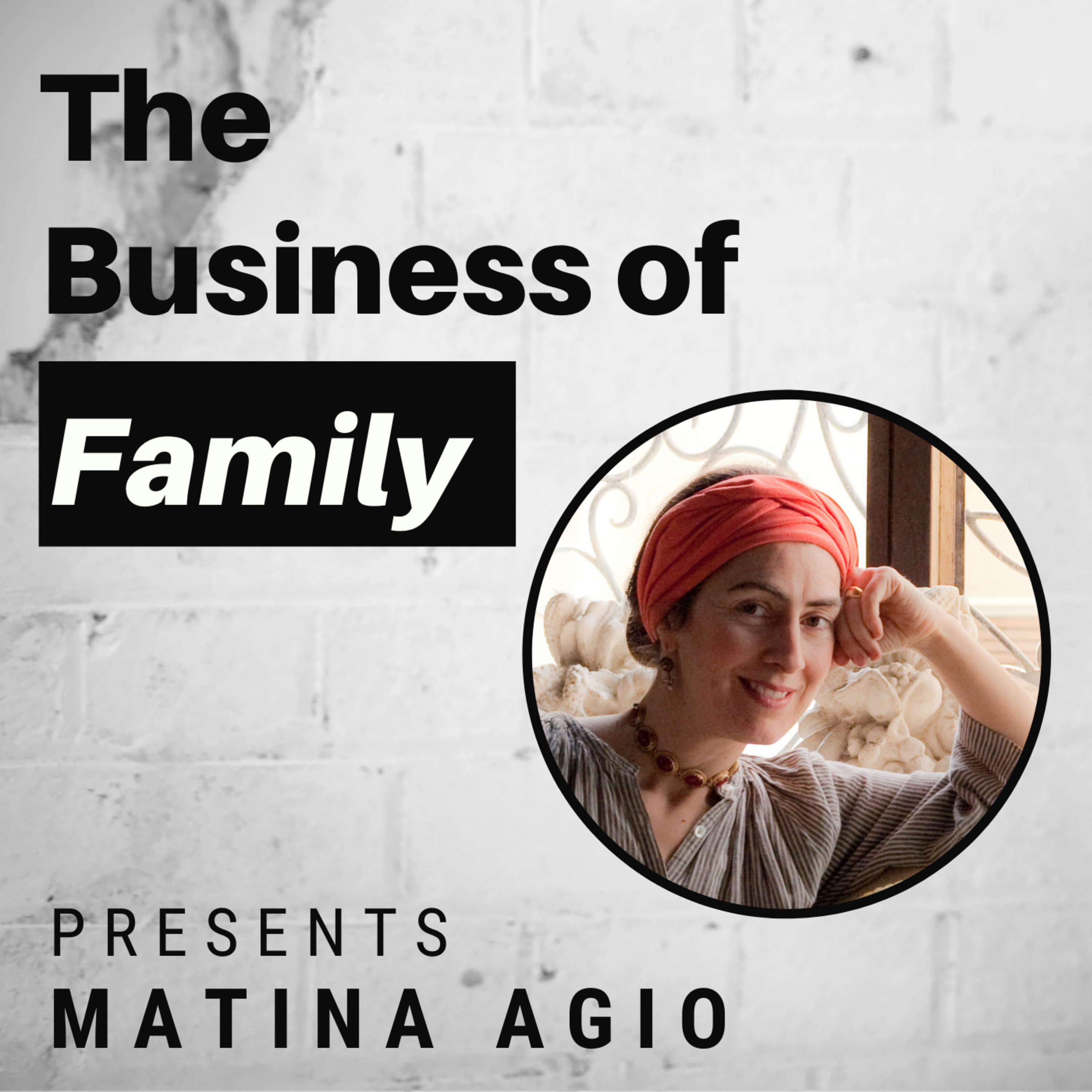
Episode 40 · Season 2
The Inheritance Muse
Key ideas from this conversation
We give our children things. We should give them stories with our things.
Two siblings agreed to sell the family estate, until one of them said, in the lawyer's office, that she couldn't.
Wealth dyslexia: owning a great deal and getting very little from it.
Read the full show notesBio, standout quotes and the episode timeline
Matina Agio is a personal inheritance consultant. Her work inspires a deeper perspective into inheritance - beyond the legal and financial. She provides niche counselling, facilitating her clients- often in midlife, to resolve inheritance-related dilemmas, manage their possessions and create a meaningful legacy.
Through her signature method - THE INHERITANCE MUSE METHOD™, she addresses both the tangible and intangible aspects of their inheritance, heritage & wealth. Matina’s clients include art collectors, historic home owners, affluent individuals and family office members around the world. Matina’s experience of living & working in England, France, Germany, Italy, US, Canada and Greece, allows her to address their varying backgrounds.
Standout Quotes:
- "For me, the main wealth of our inheritance lies in the intangible inheritance because it is that which is not vulnerable, and it is that which probably the most influential" - [Matina]
- "A bad experience may turn out to be a very wealthy experience, it depends on how we process that...sometimes we receive good gifts in bad packages" - [Matina]
- "Objects are storytellers, they contain memory" - [Matina]
- "We just give our kids things, but we should give them stories with our things" - [Matina]
- "The value of something to us is always what our experience of it is" - [Matina]
- "Our ownership is a symphony of things put together, and we as good conductors have to master that symphony... so we can have harmonious wealth" - [Matina]
- "It's not what happens to you but what you do with what happens to you" - [Matina]
- "There are people who own a lot of things and experience very little value and then there are people who have very little things and they experience a lot of value" - [Matina]
- "The legacy of someone and the effect that they have in your life can never be taken away... that's the most meaningful part of the wealth that you can give others" - [Matina]
- "Research shows that family wealth is almost never lost due to poor financial decisions, its almost always lost by a breakdown in relationships and communication with co-inheritors" - [Mike]
- "You cannot make decisions without understanding who you are because who you are will affect how that thing will play out in your life" - [Matina]
Key Takeaways:
- Matina describes an "Inheritance Muse" as someone who inspires others in relation to their inheritance. Inheritance can either be tangible or intangible. The intangible inheritance is more important because it is more influential and less vulnerable. It affects our beliefs, attitude towards life, abilities, and self-confidence.
- Since parents are not perfect, sometimes we get good gifts in bad packages, so to understand intangible inheritance, sometimes we have to open our minds and look at what is there and how we can manage it so it adds value to us.
- Describing how she started her work with inheritance, Matina shares her back story; although born in Athens, her family had to relocate to Canada following a political event that made the family unsafe. A key determining factor in her career was the heritage and culture her parents brought from Athens, which influenced her greatly.
- This spurred her on to study interior design and renovation of historic homes and eventually become a cultural entrepreneur. Following the death of her parents, she inherited the home in Athens and had to curate everything by herself and started to work on also curating the influence her parents had on her as part of the legacy for her children.
- Storytelling is the center of Matina's work; using the stories behind objects owned by clients to resolve issues. Parents need to tell stories about their things to their children because it is unlikely for a child to sell something that has a story to it.
- When navigating inheritance and trying to be a custodian of what has been left behind, employing the concept of "Gratitude" is highly efficacious, in that it helps to understand the value of these things. This gives a reason to own these things and helps us know what our relationship was like with those who left them behind.
- The Legacy Scale: This is a process to understand the personal value of any property to a person irrespective of the market value.
- 2 classes of Real Estate: Objective Real Estate is the first type and it includes properties that have value but no particular personal relationship. Assets such as family homes on the other hand make up the second type of Real Estate which is usually more complicated and may involve co-inheritance.
- There are 3 ways you can value something: First is the intrinsic value which is the value of that thing for itself without the market value. The second is the synergetic value which is the value of something in relation to the other properties owned by a person, or the impact it may have on other aspects of wealth. The last is the subjective value which is the question of "what does this mean to me?
- Matina shares that she only works with individuals and not groups, because with an individual, issues can be dealt with in-depth and with speed. Even if the inheritance involves other people, by working with one person you change the constellation because the most important thing for a person to understand is " "What do I want?". The goal is to empower the individual to see how the inheritance fits into his life purpose and what action needs to be taken.
- Matina describes the idea of "Life closure by design"; preferably the age of 50 is the ideal time to be more conscious about life closure, especially having light ownership and getting clarity on what will be left behind using "the Inheritance Muse method".
- For the younger generation who are about to receive, it is very important to create conversations with your parents on things they feel strongly about, their lives, and their values.
- When we have a relationship with something, the value of that thing is the value to us, not the monetary worth. Rather than keep that thing locked away, Matina advises people to use it in their lives in a more natural way.
- What we do with our inheritance has two aspects; the first is to optimize it and use it so we can create happiness for ourselves, the second is to preserve what we can so we can give it to the next generation with stories and history.
- The work of the Inheritance Muse is to help people understand where the real value is, in their assets. Matina explains a term called Wealth Dyslexia as the inability to grasp the scope and range of your wealth in a way that will give you value
- Regarding the sale of property with a history, Matina highlights that it may not be possible to keep everything but properties can be sold with the story which adds value to it. Selling a property can help the owner feel lighter and focus more on things that have particular value to them.
- Legacy is the effect that our lives have on other people's lives whether good or bad. Daily, we are curating our legacy, by who we are, what we do, and what we say. It's never too late to work on this.
- The awareness of the certainty of death is empowering as it should give the ability to live life more intentionally and assess the impact of our ideals in our lives.
- Inheritance is a gift given, we have to look at this and say, "what do I want with this?" It is important to look at it in a nonmonetary way, so we can know its effect on our lives. This is also covered in the "Inheritance Muse method". Understanding who you are is as simple as finding out where you are in your life and what you want.
- From Matina to her kids: Resilience is very important and also finding time to tune into your deeper voice within. You have a choice in every moment. We are free to choose how we see something and how we respond.
Episode Timeline:
- [00:46] Meet today's guest, "Matina Agio, a personal inheritance consultant.
- [01:39] Matina describes what it means to be an "Inheritance Muse".
- [03:35] What separates intangible inheritance from pure legacy?
- [06:24] How did you find yourself on this path?
- [16:52] How do you navigate inheritance?
- [18:56] Is Real Estate more difficult to manage than other items of value?
- [23:28] How often are you working with individual inheritors compared to co-inheritors?
- [26:31] How do people engage you, and when?
- [36:40] How do people go about deciding to let go of an asset with family history?
- [39:31] Matina's insight on 'Legacy'.
- [45:27] How should one approach inheritance?
- [48:11] Matina's letter to her kids
Links:
- Matina Agio : Matina Agio is a Greek-Canadian personal inheritance consultant. She has been involved with her heritage since childhood. Both her parents had a strong appreciation for Hellenic culture and values. Her father was a banker, earlier Greek-resistance fighter and advocate of Stoic philosophy. Her mother, a Swiss-trained artist was a characteristic aesthete & avid collector.
- How can the next generation turn pre-contemporary art into meaningful wealth - Simple : Article By Matina Agio
Read the transcript
This transcript was generated automatically and may contain errors, including in names. Listen to the episode for the exact words.
MikeWelcome to The Business of Family. I'm your host, Mike Boyd. Multigenerational wealth creation involves so much more than capital accumulation. The most successful families cultivate values, stories, knowledge and resources to pass on to the next generation, and they do it very intentionally. On this show I sit down with members of some of the world's most interesting business families to hear how they do it. To see where your own family stands, take the Business Family Diagnostic at businessoffamily.net.
Matina Agio is a personal inheritance consultant. Her work inspires a deeper perspective on inheritance beyond the legal and financial. She provides niche counseling, facilitating her clients, often in midlife, to resolve inheritance-related dilemmas, manage their possessions, and create a meaningful legacy. Through her signature Inheritance Muse method, she addresses both the tangible and intangible aspects of inheritance and wealth.
Matina's clients include art collectors, affluent individuals, and family office members around the world. I hope you enjoy this very interesting episode. Matina, thank you so much for joining the show. It's great to have you with us on the podcast this week, and I can't wait to learn more about your work.
MatinaThank you. I'm happy to be here, Mike.
MikeSo you are the inheritance muse. What does that mean? And what does your work actually entail? I'm fascinated by this.
MatinaAll right. So Inheritance Muse means someone who inspires others in relation to their inheritance. And when we talk about inheritance, we're talking about tangible and intangible inheritance. So those are the two sort of aspects of the work.
MikeOkay. So let's pull that apart. So intangible versus tangible. Obviously, when we think about inheritance, we're usually drawn to money or objects or real estate. Break it down for us. What are the intangible aspects of inheritance?
MatinaOkay, you're right. When we think of inheritance, we do think about these things. But for me, the main wealth of our inheritance lies in the intangible inheritance because it is that which is not vulnerable and it is that which is probably the most influential. For example, somebody's legacy is not always a tangible thing. It may also be an intangible thing. It has to do with the values they have. We inherit a lot of perspectives on life, experiences from our parents, values, as I said, storytelling, history. We inherit a lot of things from our parents from the day we are born. And this is a sort of ongoing flow of inheriting as we grow up and as we experience our life within our homes, our life within our families. And this
affects us in so many ways. It affects our assumptions about life, our beliefs, our attitudes towards life, our abilities to believe in ourselves or not. These things all come from that intangible inheritance.
MikeSo what separates intangible inheritance from just pure legacy? I mean, what makes it an actual inheritance? Does that mean it's cultivated and nurtured? Or does everybody have an intangible inheritance? Is it just a part of life?
MatinaSo intangible inheritance, I think everybody has it. We tend to judge sometimes what it is that that that is. For example, we may say, I have had a bad experience, but this is also part of what we receive. And a bad experience may turn out to be a very wealthy experience. It depends how we, you know, how we process that. So because, you know, our parents are not perfect people. Sometimes we receive good gifts and bad packages. So in order for us to understand our intangible inheritance, We have to open a little bit our mind and look at really what is there, what is valuable to us, and how can we manage it so that it has value to us.
MikeYou touch on an interesting aspect there, good things in bad packages. I'm not sure what you mean by that, but I'd love for you to elaborate because it makes me think about some of the tangible inheritances that we see pass through generational families and sometimes the guilt or obligation to maintain something that wasn't ours, but we inherited it and it was important to a predecessor.
and so we feel obligated to maintain it or to retain it. Is that what you're alluding to when you say good things in bad packages?
MatinaWell, the good things in bad packages are the experiences that we've had, mainly with our parents, let's say within our family. A typical example would be a father smoking and telling his child not to smoke. So the package is bad because you see this person smoking. but on the other hand the message is good like don't smoke like I did you know that sort of thing other times we have experiences which we consider negative often we judge our parents for many things very often and also I've also seen it in my work that sometimes people are reluctant to take over a family business or to take over an inheritance because of the difficulties in their
experience with the parent, let's say. But actually, what is actually being given is very good. It has value. And we have to be able to open that package, throw away the wrapping and look at really what we have. And that needs a certain amount of maturity for that. It's a process.
MikeSo the sorts of people that you work with, I'm fascinated by your work in general, but I'd like to understand how it came about. How did you find yourself on this path? and who are the types of clients or customers of the services that you offer that you deal with most often?
MatinaOkay, that's a two-part question. Try to answer the first part. I think when I describe this work, I cannot leave my parents out of this. And I'll explain why. Because everything that I have achieved in my life comes through the prism in which I saw my parents. So for me, my starting point is my life with my parents, what I've learned. And I'm spending the rest of my life, I think, valuing, optimizing and processing that experience that I had, and their influence and their legacy. So I don't know if you're interested in me going a little more detailed into my family history, my story.
MikeI'd love to hear it. Yeah, if you want to share, place?
MatinaWell, I think the beginning of my life was, I consider the beginning of my life, I was born in Athens, and around three years old, due to an unexpected event, political event in Greece, Greece was taken over by a dictatorship, which lasted a couple of years. During this time, my father was a banker, he was happily married with two young children, and he was on their blacklist basically and his life was in danger so one morning he left the country in a trench code and a thousand dollars and went to Montreal, Canada. What followed was that my mother sort of dismembered all the house and all her things. She gave things away, she sold them and she left with
us two, my sister and I, and two suitcases for Canada where their life was going to start over. So that was a major change in my life where suddenly I left one country and went to another country where I didn't speak the language, the environment was different. And I think that my parents adapted very well to this because my mother, for example, she studied in Switzerland.
So she knew about snow and she spoke French. She was fluent in French, so she adapted well in Montreal. and my father who was born in an Arcadian mountain village in the Peloponnese, also in his youth had joined the resistance movement during the Second World War. So he was a captain in the resistance movement. He had become a very flexible person.
He was a resilient person. He was also a stoic by his philosophy. So he was able to adapt to this life change quite quickly. So even though we started off where I remember we slept in cardboard boxes in this apartment, in this dark apartment, in the end we ended up with one of the affluent families in Montreal and he returned to his banking career in Canada and we ended up building our life from scratch.
scratch. And I admire my parents for this. And why I'm bringing the story now into this interview is because the thing is that what really was powerful for my parents was their heritage and their culture, their Hellenic culture. From this, they reaped their values, why they're there, how they're going to raise their children, their goals in life and their and their strength to, you know, go over any problems that they had. So this cultural heritage aspect was very influential in my life, because it affected so many aspects of my life with them.
And my mother also was a collector of, you know, Greek heritage things. And in those suitcases that she left with from Canada, from Athens, she had put in part of her collection. So she didn't put in diapers for us. She just arrived in Canada with these two suitcases. And in these suitcases was part of her collection, which was related to her culture. And so, you know, their strength, their philosophy, the way that they handled things really influenced me. And I became a proud person.
And I thought that ever in my life further, when I went on in my life, I realized that this influence was great on me. And I continued by studying interior design and renovation of historic homes and eventually became a cultural entrepreneur. What happened, though, in 2010, they both died about six months apart. Sorry, not six months, 60 days apart.
And this was a great shock, first of all, because of the loss. But secondly, because I inherited a historic home in Athens with all of my mother's collection, which I had to then curate all by myself. And I thought to myself, wouldn't it be nice if there were someone that could guide me through this whole inheritance process, which involved various things, which I had to figure out all by myself, of course.
It was quite immense. It was quite challenging. to do all that. But what was most interesting, Mike, was the process of curating our family's history in a way that the public could understand it because the home was open then to the public, but also so that I can understand it. And I realized right there and then, I am sitting on an immense treasure. And that's when I understood that from then and on, I am processing the life of these people, their influence on me, in other words, the legacy, and how that's going to play out in my life and, you know, and then, of course, to my inheritors and my children.
MikeIt's an extraordinary story. And, you know, this piece there at the end touches on something that I'm incredibly passionate about, which is storytelling within families, you know, to help legacies live on, to help pass values and heritage to the next generation and the next generation. And you're talking about curating the lives of people so that that story lives on within the family.
Is that how you view it as well? Am I on the right track there with the way that you're describing it? Is storytelling a strong thread in what you do?
MatinaIt's absolutely. It's actually the center of my work. With my clients, I get them to speak about the objects they own. And through the objects, we can resolve a lot of issues because the objects are storytellers. They contain memory. And I'm a minimalist by nature. I've followed a little bit under my father, who's a Stoic. But I'm also very aware of what objects carry inside of them and how they affect us.
I remember, for example, my mother who was collecting things all the time. She used to, for example, I remember she brought me Achilles and she said, Matina, drink from this. She put water. It was an ancient kylix, 2000 years old. And she put some, you know, water in it. And she said, drink from this, close your eyes and imagine how many people, who are the people who put their lips on this cup before you?
And it was an experience to understand how we are connected through the generations, through objects and the stories. And she tried to make me imagine who that could be. You know, who are those people that drank from this kylix? and that really connected me with that object and I have this object today in my own home because it has a story to tell and I just want to expand on that and say that you know this is a generation that is going to be inheriting a lot of things and we are also you know the younger generation the wealth transfer that is taking place not the this generation doesn't want a lot things. I think it's very important for parents to share stories about their things with their
children because it is very unlikely that a child is going to want to just immediately sell off something that has a story to it. And we just give our kids things, but we should give them stories with our things.
MikeYeah, I was going to follow that up actually because it's that sense of obligation I asked about earlier. Sometimes we receive things in an inheritance, whether it's an heirloom or otherwise, but the object maybe meant something to our parents or grandparents, but maybe doesn't mean as much to us if we don't know the story behind it. So are you working with clients in the present to try and get them to increase the storytelling around objects?
MatinaYou know, it's also that we receive the object, but we need to put our own history on it. I think, you know, like that advert, Patek Philippe, the watch that you never own that watch, you only hold it on for the next generation. Well, I believe that you need to add on your own to that watch. It's not just about holding something and giving it further. It's about adding your own legacy, your own, you know, reason for being into that object.
and as we inherit or as we receive it, there needs to be a reason for that object to be in our life. If there isn't a reason and we can identify with a reason, it is definitely better to let it go. And I work with clients to decide if they're going to keep things and let them go, especially when we're talking about a vast inheritance coming, whether it's property or things.
We go through that process. It's a process that we go through in order to understand what should stay and what should go. And believe me, that is not always an easy thing.
MikeNo, I can imagine that it's not. Can you elaborate for us a little bit on that process and how you walk people through that difficult journey? Oftentimes, I imagine it's at times of loss. So there's a lot of emotion around it. But then there's also this huge sense of responsibility for all of these new things, whether intangible or intangible.
Where do you start? How do you navigate inheritance?
MatinaWell, I think my key, how I did it for myself, is when you want to clean out somebody's house or you want to decide if you're going to keep things, my position is one of gratitude. Gratitude gives us a deeper insight to things, to what is received from our parents. Sometimes we're just too opinionated to be grateful, or other times the loss is too great.
But gratitude actually connects us with value. It connects us with the value that people gave us and the value of the things that they're leaving us behind. It gave me a lot of strength when I was clearing out our house from my mother's personal items and so on, my parents. The sense of gratefulness actually inspired me to go through those things.
I wasn't inspired in, I mean, I'm saying this word because it seems like weird to be inspired and grieving at the same time, but actually it empowered me and it gave me that sense of freedom to be able to appreciate what was given and to make a decision about the fate of these things. And this is something that I always tell my clients about. If you're going to be dealing with this sort of matter, you need to start from that position of gratefulness. And sometimes are not there. So we need to bring them there somehow. We need to bring them to at least the possibility of being grateful. Because if we are custodians, we are custodians of something that
is given to us. We need to be aware. We need to have a reason for owning these things and holding on to them. And we need to know exactly what our relationship is with those who left it for us.
MikeI love that terminology of custodian. We talk a lot about stewardship on this podcast. whether it's of businesses or wealth or family values, but things that are stewarded to the next generation. One thing that I wanted to jump to now was real estate, which you touched on earlier. How does it differ from smaller objects and heirlooms when inherited? Are they more difficult to manage or to decide whether or not to keep? Are they sometimes viewed as a financial asset rather than something important to the family's history?
How do you unwind real estate holdings?
MatinaWell, there's a process I take my clients through. I have what I call the legacy scale, which is something I created in order to facilitate the process. It's basically a process where we go through and see whether it's real estate or an object or anything in that matter. We go through a certain process to understand what is its real value to us because there is the market value we all understand that but the the value of something to us is always what our experience of it is because we don't experience money we experience something through the object or through the money okay so we need to really clarify what that relationship is with the out with the the real estate the estate or
you know something now i i classify real estate in two categories one is something that has let's say uh something where we have a an objective relationship with something that we own we receive from a great aunt or something some property that we didn't really have a relationship with but it might be a great asset and then things like family homes country homes homes which we grew up in, you know, estates where we spent our childhood. These are more complicated and often there's also co-inheritors. So unraveling that Ariadne's red, you know, ball of thread is not always as easy as the other ones we have objective opinions about in the property. So in this case,
the first thing we are going to ask is we're going to leave the market value for a minute and all the appraisals concerning and we're going to look at what is its value to you and i believe that there are three ways that we can value something the first thing is its intrinsic value something that it is for itself as the as the kantian philosophy would say something how is it for itself we need to understand what the value of that is without the market value just for itself the second thing is the synergetic value. It means the value of something in relation to the other things I own.
And why I'm saying this, because our ownership is a symphony of things put together. And we as good conductors have to master that symphony, letting all the organs of the orchestra play so we can have a harmonious wealth. We can have our wealth in harmony. Sometimes areas of our wealth, whether they're real estate or other things, they take up a lot of our energy and we sort of do not value the rest of it. So we need to find out what the position of that real estate could be in relation to other real estate and what the needs would be of that, for example, renovation or taxes or things like that. And then of course, there is a subjective value.
And there is probably the most interesting part of what does this really mean to me? Maybe I have no feelings for this. Maybe there are also memories involved that are unresolved. Sometimes, for example, I had an example of two siblings where there was a country estate to be dealt with. And even though they had agreed that we're going to sell this as soon as our father passes away, in the lawyer's office, it was suddenly declared that one of them doesn't want to sell. And the reason why she didn't want to sell is because she felt rooted in that house and she felt by selling this house something is being taken away from her something very substantial and she hadn't
processed that she wasn't ready to let it go so we had to find a resolution to that and sometimes it really depends on the relationship but we need to look at inheritance on the longer scale we need to look at our relationship with our co-inheritors on a longer term basis. And we need to look at this as an overview. And in situations of co-inheritors, some co-inheritors will be much more resilient in relation to what's going to happen and other ones are very stuck. So we need to take that into consideration.
MikeHow often are you working with an individual inheritor compared to co-inheritors because this notion of friction around co-inheritance and the need or perhaps the expectation to separate objects that are inherited, I think is a point that drives a lot of family disruption, at least that we see in the families that I interview. Usually it's a family business or some other asset that's been generated with the wealth over the years. And when siblings don't get along over how that should be divided. It often divides the family.
So I'm curious how often you're working with the family and how often you're working with an individual inheritor to try and understand and process all of this.
MatinaSo I work only with individuals. I do not work in groups. Why? Because I believe that working with the individual, we can really go deep on something and move fast within that issue. and the main work that I do is resolving issues and dilemmas concerning inheritance. What happens is though, even if the inheritance involves other people, by working with one person, you change the constellation.
Because the most important thing that we need to figure out for ourselves is what do I want? Because once you understand what you want and what the parameters you have to deal with, you've got two things very well done. because my father always used to say, it's not what happens to you, but what you do with what happens to you, which is a very stoic, part of stoic philosophy.
And that empowers the individual. I try to empower the individual so that he can see his course, his life purpose. How does the inheritance fit into this and what actions he will take? And sometimes the answer is no action, allowing time. Other times it's to fight through, to really push through something. It really depends on what the relationship is with that inheritance and where they are in their life.
Most of the time I'm working with people in their mid-age, which in itself is a very challenging time because a lot of things come into play. We are in a moment in our life where we are very often reviewing our life. Maybe even our existential angst kind of kicks in, a parent may be passing away at that point.
We want to review our life. So when an inheritance comes, it may also be a catalyst in order to look at some things in a deeper way. So we definitely do some deeper work, but I'm always trying to keep the focus on what are we going to do next, where the real value is, because that's what we want at the end of the day.
We want the real value.
MikeI think it's fascinating. It must just be so interesting understanding the dynamic of all of these families and the values and legacy wrapped up in heirlooms, objects, and intangibles that they pass on. I'm curious now to understand how people engage you and when, because I've never heard of someone doing the sort of work that you do, which is why I'm so fascinated. Do you only work with people when a loss has been suffered and all of a sudden an inheritance has come along? Or do you also work with people perhaps who are the current generation, the current owners who are curating a legacy in order to make the transition maybe after they pass or what have you easier on the next generation? Do you do any pre-work or is it
always post?
MatinaIt's both. Speaking of the post, I usually am not contacted right away. I'm contacted, let's say, a month or two later, sometimes a year or two later. Because, you know, as you know, an inheritance is not a one-off thing. There are many after effects, like when you throw a stone into a river, it has ripples. So practically speaking, when an inheritance happens, we i'm really called in a couple a couple of months after when things have sort of settled in and then people are wondering exactly what they're going to be doing after they receive information from their lawyers from their legal advisors and so on you know that's the one thing the second thing is i i like to i like this idea of life closure by design when you're about 50
for me is the ideal time to start closing down your life. And what I mean is that the remaining chapters of your life have to be much more conscious. In this conscious closure, I also put in the ownership because we want to feel light in our ownership. We want our ownership to work for us. We're not just accumulating things.
And in our 50s, we have that opportunity to review our life, to create a larger lightness of being so that we can then live our life to the fullest so we don't have any heaviness and clarity. We need to create clarity in our relationships, in our bank accounts, with our children. And it's a wonderful time to also look at, of course, what you're going to leave behind or not.
I always encourage people to start looking at these things and start asking the right questions. And I have a method for this. It's the Inheritance Muse method, which takes someone from the beginning to the end. So at the end of that, they have a very clear idea of what they want to take place. Concerning the younger generation who's looking now, who's about to receive, I think that it's very important to create conversations with your parents around what they feel strongly about, how they feel about their things, about their life, and to exchange ideas of your values with their values and to see because we are going to be the next generation and we are going to be
taking on that. And if these conversations can take place, this is very important and very valuable.
MikeHow often are you dealing with the likes of, you know, substantial art collections and, sophisticated holdings or assets compared with, say, a bowl or something that has attached history and stories that was meaningful to someone, but perhaps isn't of any particular financial value? Is it a mix of these things or do you spend a lot more time dealing with families that are inheriting country estates and art collections?
Matinaso the difference between those people and the ones that are inheriting the goal the simple goal is that they usually have advisors so they know the value of their things and i'm not there to tell them the value of their things their market value i'm there to tell them about their relationship with their things and the the real value the value that it is for them and how they can optimize their thing. So I do definitely work with collections. I even help people understand that there is a collection there and sometimes we curate it. I mean, what I do is I create a master plan for them and then with their, let's say their curator or other advisors that might
come into play, we might decide what is going to be sold, what is going to be kept and how this can turn into something more valuable than what it seems to be at the present moment. So I'm very well versed in collections. I've had the experience myself. And then of course, there is the simple bowl. That simple bowl could be handed down generations in your family. It could represent many things, chipped or unchipped, it doesn't matter.
What happens is that when we have a relationship with something, especially when it's been in our family, the value is the value to you. And it has nothing to do with market value. Many people also keep these things stored away. They don't bring them out. I'm always saying, use the china, use the silverware, put it in your life in a more natural way. Don't keep it in the shelf tied up behind glass or in the cupboards because it gives you another sense of your ownership and a connection with those before you. There was a lady that I was advising, she had inherited from her father before he died, and he had given them to her, a collection of
Coptic textiles, very colorful ones which she had put away, you know, because of the UV and so on. and she had put them away and after he died she had just kept them there for some years in the cupboards you know in the cupboard and i advise her to take them out and to uh to to frame them and to use them in her main dining room and this brought her a lot of joy because it made her reconnect with that moment when her father gave it to her she sees it every day she entertains guests enjoy the beautiful Coptic works. I'm really for as long as the things last, use them.
MikeI love that. I think that's a terrific example. And we've spoken to a few families before on the podcast who are generational in nature and intentional about curating and stewarding things for the next gen, some of which actually curate a family archive to preserve their history and to preserve their values and stories to pass down. But I think you're taking it to the next level in not just archiving meaningful, sentimental, or valuable objects, but also bringing them out and celebrating them and using them.
Maybe not consuming, but using them and celebrating them, I think is what you're saying, which really does more to keep the spirit alive.
MatinaAnd our spirit, our spirit alive. It's all about us. I mean, actually, the people who have passed away, they've passed away. What I noticed with my experience with my parents is there are things that I have kept because they're part of a collection and these need to stay together. So I preserve them. And then there's some objects which are closer to me and they have meaning, value to me.
And I like, even if it's just one thing, let's just say it's just one thing. that thing is a source of power for us and it's a source of memory and it's a part of our identity but the most important thing mike for me is what we do with our inheritance from now and on we have two possibilities we have the main one is that we optimize it and use it so we can create happiness for ourselves and our family and the second is we also have the role of preserving what we can so we can give it further to the next generation and always with stories and history, as I always say.
So it's a twofold thing. We need to enjoy. We're not just caretakers of it.
MikeAnd we're also not about being attached to material objects. It's not about necessarily celebrating the richness of it or the financial value attached to the collection of a particular artwork, but instead the meaning of it or the story of how it was acquired or why it was unique and interesting to your parents or predecessors?
MatinaYes. You know, the work, I think, of the Inheritance Muse, if I were to sum it in one sentence, I would say that it's basically helping people understand where the real value is in their assets and their estates and their objects. We want to understand where that value is, and we want to connect it with the raison d'etre, the beingness of the inheritor.
So we want things to have value for us. We want them to enrich our life. And we want to go where the value is. The value could be in memories. It could be in selling it and doing something else. It could be in sustaining it. It could be even in giving it further before you die, because it has value to your children now or a little bit later.
We have to understand where it is. There is a term which I point because I thought that this comes up so often. There are people who own a lot of things and experience very little value. And then there are other people who have very little things, very few things, and they experience a lot of value. Now, I always ask myself, where does this come from?
And the term that I coined is called wealth dyslexia. The wealth dyslexia is basically the inability to grasp the scope and the range of your wealth in a way that can give you value.
MikeIt's a great phrase. I like that a lot. You touched on selling and letting go. And I think we've talked a lot about the heirlooms that we keep and we bring out and we celebrate and we understand its rich history. But what about things that we're less attached to or maybe were important to our ancestors, but we just decide they're not important to us?
How do people go through that process of arriving at the conclusion that it's okay to let go, that it's okay to sell the old family home or the country estate or something that may have memories attached, but just isn't right for the inheritor with where they're at in their life?
MatinaThat's correct. That's very correct. This happens, I would say, 50% of the time. First of all, we can't keep everything. It's sometimes difficult to keep everything. What I think is important, first of all, once we reach that conclusion that we need to sell it, I think it's very important to sell it off with story so that the new owner receives that story.
It's the same thing like in archaeology. When there has been a plundering of a grave and things are taken from the grave and they're suddenly sold on the antiquities market, these antiquities are orphaned. They're orphaned. We do not know very much about them. And we can't get the sense of in which context these antiquities were in, whether it's a kylix or a pottery or anything of that nature.
So it's the same thing with the objects that we want to give on further. And we should happily be able to give them on further. And if we put a story to that and we share that story, either a little note which is attached with the object, this is very meaningful and it adds value to the piece to begin with.
The process of arriving to that conclusion of to sell it is a process, but it's also very, very, it makes us feel lighter and we're responsible and we can say, I do not want to have this. I want someone else to have it. I want someone else to enjoy it. And I get it further with its story, with its history and I let it go.
And I encourage people to let go of things so that they can just keep what is really meaningful to them.
MikeIt's a great insight. I love that. It makes me think I'm really grateful my parents have actually gifted to me throughout their lifetime some antique furniture, which they also inherited, their family furniture. and they wrote a little note to tell me the story of each piece, you know, and put it in the drawer or attached it somewhere underneath, just so that the story is attached and goes along with the piece so that I understand. And also, obviously, if I pass it to my children, the story stays alive with the object itself. And of course, for me, the story is more powerful than the object that I inherited.
MatinaIt's true. It's part of the legacy. It's a wonderful way. I would encourage anyone to do that. We can even start doing it from now. I mean, in our 50s, we should start writing little notes everywhere and attaching them inside, you know, things. I wanted just to touch upon what we call legacy, because, you know, we think about legacy often when we talk about inheritance.
And for me, a legacy is the effect that our lives have on other people's lives, okay whether in good or in bad sense but that's what it means to me and you at the beginning of your podcast on the titles you say something about curating our legacy and I believe that we are curating the legacy of others as we move it along but we're also daily curating our own legacy and I like this idea of people thinking in legacy terms because it's not something out there really it has to do with the influence we have in the lives of others and we can only do this by who we are what we say and what we do and this is probably the most powerful and the most
intangible part because you know things can be lost things can be broken uh things can be stolen but the legacy of someone and the effect that they had in your life can never be taken away and that's the most meaningful part of the wealth we can give others and are mostly our children and those around us. That is the meaningful well.
MikeCouldn't agree more. And exactly what I describe as curating a legacy as well. A lot of what we talk about on this podcast is intentionality and playing the long game or at least having a long-term view, considering our daily actions and what impact they have on those around us or will have over the long term or on the next generation, making decisions for the long term and being aware of our legacy.
I think it can have an enormous impact and just bringing that awareness to front of mind is incredibly powerful.
MatinaIt's never too late to start to become more conscious about how you affect the lives of others. It's never too late to create those bridges of communication with others so that they know why you're why, why you did things, who you are, what is meaningful to you, and also what is meaningful for them and how you are affecting them.
These things should happen before you pass away. And this affects so much how co-inheritors then will resolve their issues because wealth transfer is not always successful. But one of the reasons why it isn't successful, it has nothing to do with the logistics. It has to do with communication. communication on many levels. And who we are, what we think, how we're going to communicate to others, how we allow others to communicate between themselves, all of that is part of that inheritance which we leave behind.
MikeThat's right. From the research we've seen, family wealth is almost never lost due to poor financial decisions. It's almost always lost by a breakdown in relationships and communication with co-inheritors. So those that managed to last for many generations are doing a great job of keeping the knitting together and keeping the stories alive of their shared history. And this reminds me of the lightness that you talked about before, living with lightness, starting to close off your life, I think you said, as you arrive at the age of 50. I think that's a challenging idea. There's going to be people listening saying, 50, that's still young. I'm only halfway. Why would I close off my life? I want to
continue to live and grow. What have you got to say to that?
MatinaI have started doing this personally, and I advise also my clients to do this. It's actually quite exciting to be able to consciously curate the rest of your life as best as you can to manage your estates, to decide what kind of impact you want in the world before you go. Because one of the things that we keep forgetting is that one day we will go.
I mean, personally speaking, I'm like 55 now. I think at best in about 40 years, I hope to have a long life. I'll be under the earth and then I'm gone. And this feeling of being under the earth awakens me. It's what the Stoics said about, remember that each day can be your last. It's not a macabre thought, it's an empowering thought, because you understand that you are, you know, awake and aware of your destiny, because we all know we will pass away, but it's an idea that we want to leave in the future. We see this far off. But when you bring it closer, it empowers you. It makes you more clear, it makes you more authentic,
it allows your voice to come through it allows you to cut through the crap as i say because you know uh we spend a lot of our our life chasing ideals that we have uh trying to uh please others are working very hard to build things and then at some point we need to look and see where am i with the goals and the ideas that i had 20 years ago some people are still on automatic pilot and to look forward and see how do I want to shape this. And this is very empowering because we're all on our way out. And the grand finale is what I really think is the quintessence of all our life experience. And yes, I'd like this to be a sense of lightness of being, of life
purpose, of a legacy that's valuable to others and yourself. I want that. So I'm curating this now and I encourage other people to do it too.
MikeIt's fantastic. Great answer. I enjoyed that. Tell me now, the people in the audience who are perhaps approaching an inheritance or are in the process of dealing with an inheritance, what do you recommend? How should one approach inheritance?
MatinaOkay. First of all, inheritance is a gift given. It's not something that we created. It's being handed down to us. whatever its form, whatever way it comes down to us, whatever it is, we receive something and then suddenly it's in our hands or it's coming into our hands. We have to look at this and say, what do I want with this? It's very important that we look at it in non-monetary values because then we can really see what its effect is in our life. This requires something though.
It is the, in the inheritance muse method, it's the ethos part. It means who am I? Because I will be the decider about the things coming to me. I need to know who I am. You cannot make decisions without understanding who you are. Because the who you are will affect how that thing will then play out in your life.
Okay? And the who we are is not actually a very difficult question. I know it sounds very existential. but it's basically it has to do with where am I in my life and what do I want and sometimes if we are asked this direct question we can actually come up with more answers than we think it's not a very lofty question so I help people clarify who they are and what is on the way or what has arrived and we want to help them optimize that so that they can you know use it in the best way in their life. So we have to do a little bit of analysis, a little bit of self-searching,
and also look at the other practical aspects, the logos aspects, which I call, which are the practical aspects related with that inheritance, whether they're co-owners, inheritance tax, whatever the cost of holding on to something which you're going to receive. But the key here is also the third element of the method, which is the pathos element in terms of what is my relationship with this thing, you know? And so that process helps us get through and find those answers.
Sometimes it might even take one session. Sometimes it might take 12 sessions. It all depends on what's going on.
MikeIt's incredibly powerful and important work that you're doing. I think I've loved learning about this. Matina, it's now time for our final question. And as you may know, it's a question I ask all of the guests that come on the show. Imagine you're writing a letter to your children. What is one lesson or idea that you don't think many parents would mention, but you consider important to understand?
MatinaI think I would just repeat what my father told me. And I'm saying this because, as I said to you, he was a man who had grown to become resilient in his life. I believe that resilience is very, very important, as well as attuning to oneself, you know, to the deeper voice within. So these two aspects would be important. So I would say to them, as he said to me, it's not what happens to you, but what you do and what happens to you. And you have choice in every moment. This is something that we're not free as human beings, but we are free to choose how we're going to see something and how we're going to respond to it. So this would be the most valuable thing.
And the second thing that I would say, which is somehow connected is you need to find time to listen to what's happening within you. You need those quiet times and those times where you can really attune to your inner voice. And I would say that all through my life, my inner voice has been a very valuable guide. And in order to do that, we have to find quiet moments or moments where we can tune into that. We need to learn that language of what the inner voice is telling us.
MikeGreat lessons. Thank you so much for being here and sharing as candidly as you have. I've greatly enjoyed the stories. Thank you, Matina.
MatinaThank you too. Mike, it was a joy to speak to you. I wish you all the best.
MikeThank you. Thanks for listening to The Business of Family. You'll find the transcript and key ideas from this conversation at businessoffamily.net, along with the Business Family Diagnostic. It's free, and it shows you where your own family stands. And if someone in your family should hear this episode, please send it to them too. I'm Mike Boyd. Until next time, take care.
Keep listening
If this one landed, start here next.
Generational Real Estate Families with Lineage Asset Advisors
Property inherited together, and why doing nothing is a decision.
Family Wealth: Keeping It in the Family
Whether what a family passes on is a gift or only a transfer.
4th Generation Heir to B.Grimm, one of Thailand’s Oldest Business Institutions
A family rebuilding its archive one object at a time.
The Business Family Diagnostic · Story
Give them the story with the thing.
Matina says an heirloom without a story is easy to sell on impulse, and one with a story is hard to part with. Has your family's founding story been recorded somewhere beyond people's memories?
“The next generation could tell the story of how the family's wealth was made.”

Every family wishes someone had recorded the generation before.
I built Enduring Stories to do it for yours: a guided voice conversation, from home, that keeps your family's voices, values and history.
The newsletter
The most useful things in these conversations are the things families rarely say out loud.
I share them in my newsletter once a week. Sign up to receive the ideas directly and start building the foundations for your family today.