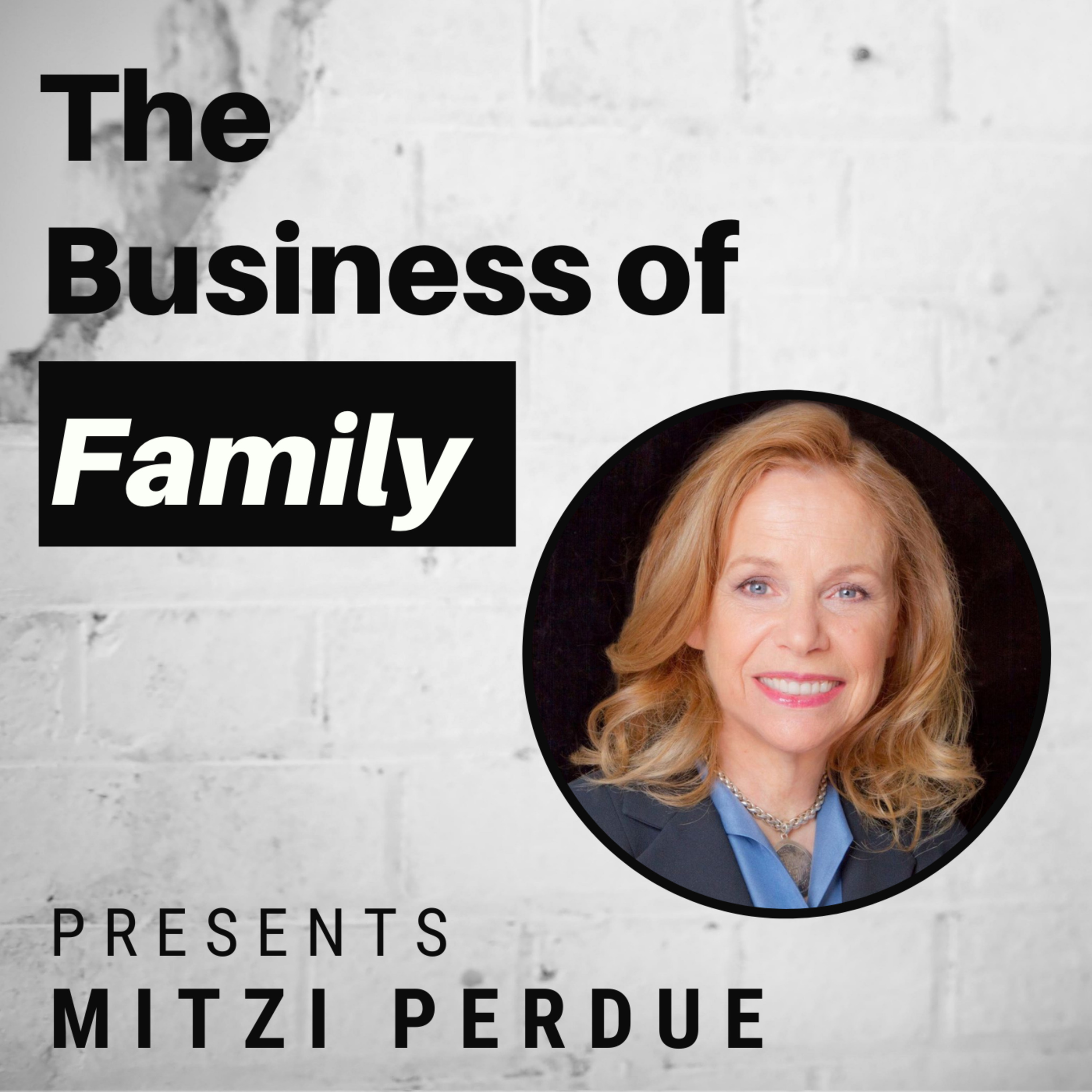
Episode 27 · Season 1
Matriarch of the Sheraton Hotels and Perdue Chicken Families
Key ideas from this conversation
A Service to the Family award, chosen by past winners, honours what people give the family rather than what they take.
Quarrel inside the family, never in public. It let her siblings disagree about selling the Sheraton chain and stay together.
Put money behind the reunion, because family ties fray without help.
Read the full show notesBio, standout quotes and the episode timeline
Mitzi Perdue is the daughter of one family business titan (her father founded the Sheraton Hotel Chain) and the widow of another, (her late husband was the family business poultry magnate, Frank Perdue), and she is also a businesswoman in her own right. She started the family wine grape business, now one of the larger suppliers of wine grapes in California.
Mitzi likes nothing better than to share insider tips for successful family businesses. Her family of origin (the one that started the Sheraton Hotels) began with the family business, Henderson Estate Company, in 1840, and her Perdue family started in 1920 in the poultry business. These two families have a combined tradition of 276 years of staying together as a family.
Standout Quotes:
- "The odds of a family business lasting 100 years are 1 in 1000" - [Mitzi]
- "The families who put a lot of effort into designing their cultures are the ones that survive, the ones that let things happen as they may, that rarely supports keeping the family business together over the generations" - [Mitzi]
- "70% of family businesses won't make it to the next generation, so if you want your family to last, put a lot of intentionality into letting the family members know from the youngest age that they're part of something bigger than themselves" - [Mitzi]
- "The biggest reason families don't last is family quarrels" - [Mitzi]
- "So a big piece of advice I'd have for every family is, deal with the problems, get them out, come to a resolution but don't go the press, don't go to adversarial lawyers" - [Mitzi]
- "We're measured by what you can give, not what you can get" - [Mitzi]
- "I don't think you can be happy if you're not part of something bigger than yourself...
- If you want to be happy, think what you can do for somebody else, if you really want to be miserable, think what's owed to you" - [Mitzi]
- "In general, your family will be better functioning the more it knows its stories" - [Mitzi]
- "If your children turn out right, nothing else matters, if your children turn out wrong, nothing else matters" - [Mitzi]
Key Takeaways:
- Mitzi is a part of two multi-generational business families, each of which has lasted for over 100years and over 5 generations.
- Mitzi explains that a lot of conscious effort was put into strengthening the families over the years, noting in particular one of the strategies being the "Service to the Family" award.
- Every single family that exists has a culture, but is it a culture that came about by accident or by design?
- It is critical to be intentional about designing and maintaining family culture as it plays a major role in the success of a family business over generations, rather than just allowing things to happen as they may.
- People need a lot of guidance to be steered away from selfishness, and that takes intentionality.
- Separating Ownership and Control helps create a perspective of the family as an entity bigger than any one person, and consequently gives a better understanding of the role of stewardship.
- Mitzi explains her innovative idea to inculcate the family values in family members, right from childhood.
- Noting the importance of knowing how to handle family quarrels, Mitzi strongly emphasizes avoiding the press or lawyers but rather encourages outspokenness within the family.
- Three ways that a family can intentionally stay together: Family Newsletters, Family Reunions, and Philanthropy.
- Mitzi highlights the positive effects of connecting with both present and past members of the family on the well-being, physically and mentally, of the family.
- As a personal preference, Mitzi would rather use books as a means to archive family history compared to other forms of technology, as it may be difficult to access the archive in the future if the technology used to archive it is outdated by that time.
- Mitzi recommends entering a new family with humility, observing them, noting what gains you points and what doesn't, also pointing out that while the two families had very different values, the values were very compatible.
- Mitzi's letter to her kids: Be generous, be kind, be honest, work hard but be a good steward.
Episode Timeline:
- [00:45] Introducing Mitzi Perdue, to discuss actionable advice on how her family has maintained their businesses and family dynamics for generations.
- [02:24] Mitzi shares the origin stories of both business families she is a part of.
- [04:42] What generation are you in each of these families and what generation are these families up to?
- [10:04] Every family has a culture.
- [13:18] About the family values and how they are inculcated with other members of the family.
- [25:49]How big was the business when it went from family control to external control?
- [33:58] How has the endowment grown to keep up with the growing size of the family?
- [35:30] The 'What It Means To Be Us' book.
- [38:31] Do you have a process or value system around how you keep records for the family?
- [52:46] How was the process of assimilating two different value systems upon joining another family and what differences did you observe?
- [57:11] Is there a constitution for the family?
- [01:00:39] A letter from Mitzi to her children.
Links:
- Mitzi Perdue : Mitzi Perdue is a Businesswoman, speaker, writer, Founder of the Sheraton Hotel chain
- International Hotels & Resorts | Sheraton Hotels & Resorts : Mitzi perdue's father founded the Sheraton Hotel Chain
- How to Communicate Values to Children : Book by Mitzi Perdue
- How to Make Your Family Business Last : Book by Mitzi Perdue
- How to Keep Your Family Connected: Templates, Techniques and Resources for Strengthening Your Legacy - Book by Mitzi Perdue
- Home Page | PERDUE® Chicken
- Frank Perdue - Wikipedia
- TOUGH MAN, TENDER CHICKEN: Business and Life Lessons From Frank Perdue - Book by Mitzi Perdue : This is the story of how Frank Perdue built his chicken and grain company from a father and son operation to an international company that today employs 19,000 people and sells to more than 100 countries.
Read the transcript
This transcript was generated automatically and may contain errors, including in names. Listen to the episode for the exact words.
MikeWelcome to The Business of Family. I'm your host, Mike Boyd. Multigenerational wealth creation involves so much more than capital accumulation. The most successful families cultivate values, stories, knowledge and resources to pass on to the next generation, and they do it very intentionally. On this show I sit down with members of some of the world's most interesting business families to hear how they do it. To see where your own family stands, take the Business Family Diagnostic at businessoffamily.net.
You are in for a delight of an episode today. This was so much fun to record and the stories absolutely floored me. You're going to enjoy this one. Mitzi Perdue is the daughter of one family business titan. Her father founded the Sheraton hotel chain and the widow of another. Her late husband was the family business poultry magnate, Frank Perdue. She is also a businesswoman in her own right. She started the family wine grape business, now one of the largest suppliers of wine grapes in California. Mitzi likes nothing better than to share insider tips for successful family businesses. Her family of origin, the one that started the Sheraton Hotels, began with the family business Henderson Estate Company in 1840. And her Perdue family started
in 1920 in the poultry business. These two families have a combined tradition of 276 years of staying together as a family. Mitzi joins us today to share actionable advice and some incredible storytelling about how her family have maintained their businesses and their family dynamics for generations. Mitzi, it's fantastic to have you on the show today. Thank you again for joining us.
MitziWhat a complete joy to be with you, especially since it's a subject so close to my heart.
MikeI can't wait to hear your stories. And you've got many of them, from what I understand. You are involved in and been a member of two separate substantial business families that are both generational. Can you tell us a little bit about them and the origin stories of both, if you don't mind?
MitziOh, I'd absolutely love to. I am in a somewhat unusual situation in that I'm part of two families that are each over 100 years old. The Henderson Estate Company began as a company that we know of, that we've got records for. I mean, it could have gone back even earlier, but 1840, and that makes us 181 years old. And I think we're still thriving. I think we're just a strong, loving, connected, values-driven family. The Perdue family began in 1920, and we're in the chicken industry in the United States, but we're also global. I mean, we sell chicken and grain all over the world. And we're in our 101st year. And I have a reason for you to be exceptionally
proud of those two statistics, that one's been in business 181 years and one 101 years. And that is, and I'll quickly share it with everybody, the odds of a family business lasting 100 years are one in a thousand. And I got that statistic. It's an estimate, you know, nobody can know for sure. But there's a man named Dennis Jaffe who's been studying family businesses for 40 years.
And he says that's his best estimate. And I figure if somebody who's studied a subject for 40 years gives an estimate, I'm inclined to take it seriously.
MikeAbsolutely. And Dennis has written some incredible books too, for those that are listening. I had an esteemed colleague of his on the podcast, Dr. Jim Grubman, some time ago, and they've done some excellent work together.
MitziSorry, Mike. I was just about to emphasize how much I agree with you that Dennis Jaffe's work is spectacular. I mean, he's my hero.
MikeIt sure is. And his latest book is one that I often gift to people, and it's called Borrowed from Your Grandchildren. And That's quite a comprehensive work of, I imagine, the research that he's done over that long career. And it's incredible. In terms of a formative text on the subject, he's done an incredible job.
MitziWell, I think then you and I are almost literally on the same page of who we admire.
MikeSo let's get back to your family stories. What generation are you in each of these families? and what generation are these family businesses up to? You know, they're obviously both over 100 years old, but how many people are involved and how many generations have they passed through?
MitziWell, in the case of the Purdue's, that's easy. It's five generations. And there are, let's see, one, two, three, four. There are five family members working in the Perdue company right now. So it's an active company that produces chickens and grain. The Henderson family is really quite different. And I find it a little hard to count the generations because there's so many mixtures.
But I think probably eighth generation is a pretty good guess of how many generations we are.
MikeThat's incredible, particularly in the United States.
MitziYeah, but we put a lot of effort into it. It didn't just drop in our laps. both families put extreme emphasis on doing whatever we possibly can to strengthen the family. And that includes such things, which, well, one that I would recommend absolutely anybody is, we have in both families, a service to the family award and the purpose of, yeah, and people compete for it. And it's a way of getting people to focus on what they can do for the family rather than just what benefits they can get out of it.
MikeIncredible. I'd love to hear more about it. How does it work?
MitziWell, are we friends and I can joke with you?
MikeTry and stop me. We're going to have a lot of fun, Mitzi, I can tell.
MitziOkay. The Service to the Family Award, it's probably 30 years old in the Henderson family and maybe five or six years old in the Perdue family. But the essence of it is both families have 70 to 80 members. And I'm the one who instituted the service, the family award in both families. And you win it for doing fabulous things for the family. And I'll give you some examples.
One of the first was somebody, not somebody, Roberta Henderson, digitized 10,000 family records.
MikeOh, wow.
MitziAnd I guess that was kind of the inspiration. I thought, somebody who's done something so spectacular deserves recognition. But then other things, actually, she was not the first. She happens to be the one that came first in my mind. But other ones that deserved recognition and have over the years, such things as the person who puts together the family reunion, he put together such a clever computer program in which we could track people's addresses and what time they were arriving and what their diet needs were and everything. And being a computer data genius, we thought this was so helpful. It made everything so smooth and automatic that he should get a service to the family award. But then they don't
just have to be immediate services to the family. Like one of them, there was a family member who was in a terrible bicycling accident, the result of which could have been him being a quadriplegic I mean, that was his diagnosis. He fought against that diagnosis with such extreme force of character that eventually he showed to the family a video of him skiing down a mountain after having, well, because of that experience, he was able to have a TED Talk.
And the TED Talk made us all so proud that we decided that since he embodied one of the family values of courage and tenacity, that he would get the Service to the Family Award just because he was so inspirational. and the way people win the Service to the Family Award, at least in the Henderson family, is there are seven judges and they're the seven previous winners of the Service to the Family Award and people make nominations to them, to the judges, and the previous award winners, they know that they've got a tradition to uphold and so they choose from the nominations and since they're usually quite a few, it's a real honor to win it.
And at our family reunion, we've just, well, this year we did it virtually, but we've had 130 family reunions. At the family reunion, the height of the great big family dinner is the person who wins and the seven previous winners are acknowledged. And it's a ceremony that you want to be proud of because it makes you proud of your family. It harks back to our traditions. It's just a wonderful thing that keeps us together.
MikeThat is such an incredible story and a great way of inspiring the next generations too, I would imagine, because it's a ceremony where you're not only recognizing and acknowledging those who embody the family values, but rewarding it as well. And having the whole family there witnessing such a ceremony every year must be really powerful in terms of of passing down the knowledge, passing down the value system to those that are just coming up and through the generations.
MitziWell, you know, Mike, I have a theory that actually it's not a theory, it's by now a belief that every single family that exists has a culture. But is it a culture that came about by accident or is it one by design? Is it by default or by design? And the theory goes like this. the families who put a lot of effort into designing their cultures are the ones that survive. The ones that just let things happen as they may, that rarely supports keeping a family business together over the generations. And I'm pretty sure that you, maybe most of our audience know that 70% of family businesses won't make it to the next generation. So if you want your family
to last, put a lot of intentionality into letting the family members know from the youngest age that they're part of something bigger than themselves, that they're stewards, that they have responsibility to something bigger than themselves. And I don't think people pick that up in general if they aren't taught. I mean, I think the, oh dear, here's, well, theories of me, of my life. I think people need a lot of guidance to be steered away from pure selfishness, and that takes intentionality.
MikeAbsolutely. We often talk about intentionality on this podcast, and I think also one of the things that helps people understand the concept of stewardship is actually believing in and understanding something bigger than themselves, as you say. And often that leads to, in a practical sense, separating ownership and control, separating ownership and governance so that someone who's inheriting great wealth or inheriting the family business actually sees it as an asset to build upon and steward in hopefully a better condition to the next generation rather than just inheriting wealth and enjoying it themselves.
MitziWell, since I grew up in a wealthy family and married into one in my life, and I'm 79 years old and proud of it. I've seen a lot of cases. How about, well, far too many of where people just thought, oh, wealth, spend, and I'll get my identity from going to the best stores and buying yachts and gambling and racehorses and things. And my observation is, I don't think that at the end of their lives, they can think back, I led a great life. I think the people who do at the end of their lives think, I led a great life, they can think that they contributed, that they were part of something bigger than themselves. And it's a coincidence, but both the Hendersons and
the Perdue's put a lot of effort on frugality. In both families, we tend to travel economy. We don't have yachts and racehorses. And I'm personally kind of proud that for 10 years, I went to China visiting the family there. And I would always go economy class, even though it's a 12-hour flight. But I'm really proud of that because I don't get my identity by spending money.
I get my identity, I hope, by service.
MikeThat's wonderful. Tell me more about the values of the family and how you live them and demonstrate them and inculcate them with other members of the family.
MitziAll right. Let me seize on the word inculcate, because that's something that I personally put a lot of effort into in both families. Technically, I'm the matriarch of the Perdue family because I'm the oldest woman by probably 10 years. And in the Henderson family, I am the assistant matriarch.
MikeI haven't heard that title before.
MitziWell, the family made it up because we're actually big on amazing titles. I mean, we think it's fun, but here's one of the ways of inculcating family values. I'm just going to give a concrete, somewhat recent example of something that I did in the Perdue family. I think many families have newsletters. We do in both families, but something that I, yeah, there may be somebody else who does this, but as far as I know, I invented it.
We have kid newsletters and the kid newsletters, they came about because I make a kind of between a hobby and a habit of studying persuasion and studying culture, particularly how you inculcate a culture. And it seems to me that absolutely everything that I've read and studied and heard convinces me, and I hope you, that get them when they're young is the way to go.
And so after I'd been writing the Perdue Family Newsletter for probably 20 years, maybe 15 years, it occurred to me, you know, if I believe that get them while they're young, counts, why not put the same kind of effort that I put into the family newsletters? And the family newsletters are about family values and what great-grandmother thought and so forth. Why not do that for the kids? And I'm going to give you an absolute concrete example of one way of inculcating the idea of frugality. One of the newsletters for the kids, and they're aimed between ages four and ages 12, one of the newsletters was a story of great-grandma, Mommy Dew.
And Mommy Dew, she was famous for really fabulous biscuits. You know, at all our Thanksgivings or other family get-togethers, she would bake her fabulous biscuits. But after she had baked them, she'd bake them on a baking sheet with aluminum foil. After the biscuits were done, she'd remove the biscuits, scrape the crumbs off, and then wash the aluminum foil, soap and water, dry it, and save it for the next baking time.
And the message there is, we are a frugal family, we don't waste, and we're environmental, we're really into recycling. Now, that story, you know, by itself, I think it's good, but I don't think it has, the story alone doesn't have the impact that I wanted it to have. So every newsletter, well, say for a year, will have not only a story, and it's only like 300 or 400 words long, and it's written in large font so the older children can read it, and for the younger ones, their grown-up reads it to them.
Every newsletter is accompanied with a treasure chest. And the treasure chest, it's roughly the size of a shoebox, but it's a nice box that looks like a treasure chest. and inside it are activities that will illustrate that month's story. So in this case, the children get costumes. The costume would be a chef's hat, a chef's smock, a baggie that's filled with the ingredients of Mommy Do's biscuits, and a great big sheet of aluminum foil.
Their job is, you know, all the activities are aimed to last roughly an hour, And in this case, they whip up the biscuits, and it will be a couple of biscuits, one to share with their grown-up. And they bake it, and then they actually go through cleaning off the aluminum foil and washing it, drying it, and saving it for another time.
And during that time, they're talking with their grown-up about how we are family that recycles, that doesn't waste, that we're frugal. And that's who we are.
MikeTalk about experiential learning and inculcating values. What a terrific example. Thank you for sharing that.
MitziOh, it's so fun inventing these. I just love it. In fact, I even wrote a book about it. It's called How to Teach Values to Their Children So They'll Love It. And it's on Amazon if anybody wants it.
MikePerfect. We'll ensure to link up to all of your books. You've written quite a few. Do you want to tell us about the others while we're at it?
MitziWell, another one is the How to Communicate Values to Your Children So They'll Love It. It's soft cover. It has 20 sample newsletters, but they're all written. I give the original newsletter, and then I give in a fill-in-the-blanks version where the reader, if they want to write about family values, they substitute whatever their family values are. And it also tells, for the treasure chest, it tells where to get the ingredients for the treasure chest.
And very often they're like Amazon, like the chef's toque for kids or the chef's smock for kids. You can buy those things on Amazon. So it tells where to get the ingredients and it gives templates. And I don't expect anybody to copy any of them exactly, but they're jumping off points. They're inspiration for values that you might want to teach your children.
MikeThat's just amazing.
MitziOkay. Another of the books is How to Make Your Family Business Last. And this, again, is based on Dennis Jaffe's research, but also my own observation, that families generally don't last. 70% don't last. And why don't they last? And you might guess it's because, oh, they made bad investments or the tax laws got them or civil unrest or something.
Well, yes, those happen, but only a small percentage of the time. The biggest reasons families don't last is family quarrels. So I think it's just essential to inoculate families right from the beginning, how to handle quarrels, because there doesn't exist a family that doesn't quarrel. But is it going to be a quarrel that blows the family apart?
Or is it one that in the end makes you even stronger, which can happen? And since I'm going to guess that you'd ask me how.
MikePlease, yes.
MitziOkay, I'll plunge in and give an example. In both families, we were taught just from infancy, and the next generations are taught this also, that it's really okay to quarrel. We want quarrels because we want people, if you've got something that hasn't been solved just in the normal source of the functioning family, please bring it up. And if you have to quarrel to do it, fine.
If you have to yell and scream, I mean, we'd prefer it didn't get to that. But if it does, yeah, do it. Because one of the things that really tears a family apart is when you don't deal with the grievance and it just gets free to in darkness, like a mushroom, maybe just to, which grows in, well, we all know what a mushroom grows in.
Does that reference work in all languages?
MikeYeah, that works all around the world.
MitziYes. Okay. We want the issues to be brought out and dealt with. So that's part one. Don't hold grudges. Don't keep things back. If something bothers you, and by the way, I think this works in a marriage as well as in a family, bring it out. But, and here's the part that is completely and 100% essential, don't take it public.
You can quarrel within the family, but the way this was expressed in the Henderson family is we're a family that doesn't wash our dirty linen in public. Yet we can have furious family quarrels going on. And I'll give you an example in a second. But although we quarrel among ourselves, it's a united front to the rest of the world. We do not wash our dirty linen in public.
And the way the Purdue's phrase it is, it's the covenant. And the covenant is, again, you can quarrel within the family, you don't take it public. And by taking it public, There are two aspects of taking it public that I want to emphasize. Don't take it to outside lawyers who are taking the parts of individual families and don't go to the press.
And why is that so important? Well, I have talked with numerous family business consultants who tell me that they will not take, that love to advise family businesses. but by the time it's gotten to, you know, that they have lawyers and it's, you know, their lawsuits, or by the time the press is involved, that's almost a bridge too far.
I've had one family business counselor, he's since gone to his great reward, but in his life, he said, I think I've had 5,000 clients. I've never known of a single case of one who, by the time you got either to suing each other or to arguing it out in the press, I've never known to get put back together again. It's just a bridge too far. So a big piece of advice I would have for every family is deal with the problems, get them out, come to a resolution, but don't go to the press, don't go to adversarial lawyers, but do. If the argument's getting out of hand, by all means, there are family business therapists, there are psychologists, get resources to deal with it,
But just the one thing you can't do is to take it public or to sue each other. And, oh, I was going to give you an example of how this played out in the Henderson family. You know, I was taught, I believe, even when I was in my high chair, a year and a half old or something, that we do not wash our dirty linen in public.
Well, this was put to, I think, a trial by fire because my father was the co-founder, along with my uncle, of the Sheraton hotel chain. on his death there was the question of do we sell the company or not and their five siblings and three of us thought don't even consider such a horrible monstrosity of an idea and two of us said you know there are economic reasons why this is essential for the good of the hotel chain for the good of the industry for your economic value and so the three who were against selling And I was one of the ones who was against selling.
I was thinking, yeah, this is our father's legacy. This is something that he started. Nobody will ever care about the employees as much as we do. You know, this is our identity. We don't want to sell. Well, when you've got an argument that involves identity, how about that's one of the hardest ones to resolve ever? I mean, because who you are and you're going to give it up?
Well, as you can imagine, the arguments were quite hot. But we didn't take it to the public. As far as the public knew, we just had a smooth transition. And we certainly didn't take it to lawyers. And we did decide to sell. The two who were in favor of selling, they both happened to have master's degrees in business administration.
And they were able to convince us that it was the right thing to do. But to ask somebody to give up her identity, you know, I'm a hotel nurse. I didn't want to do that. However, the decision was arrived at after much pain. And we're talking the late 1960s. The family is still together and going strong in 1921. I'm trying to say 2021. And I don't believe that would have happened if we had broken ranks and had lawyers represent us or squealed to the public, hey, this is what's really going on.
We didn't do that. The rewards of keeping to our traditions meant that we're still having family reunions 130 years from the start of them.
MikeThere's so much I want to follow up on here, Mitzi. So this was in the 60s that the transaction took place.
Mitzi1968.
MikeCan you give me a rough idea of how big was the business when it was sold, when it went from family control to external control. That decision, was it whether in terms of hotel size or number of people or dollars, whatever is the most appropriate metric?
MitziI can certainly share that with you. At the time of his death, father employed 20,000 people. And that was, by the way, starting from no employees initially. So no employees to 20,000. And the family owned or had a controlling share. We didn't, I mean, because it was a publicly traded company. But I think we had earned 30% of it.
And there were 400 hotels at the time of his death.
MikeEnormous. And quite a story, too. So I'm curious.
MitziBut you know something? Oh, well, you're in charge. Forgive me.
MikeNot at all. You're the star. Over to you.
MitziWell, no, I'm too enthusiastic and bad, Mitzi, because I should be polite and be a good guest.
MikeNot at all. Please go on.
MitziOkay. I was going to share something else that I really appreciate the Hendersons for, because as you can imagine, selling the hotel chain or selling the family part of that was what is currently termed a liquidity event. And I was 27 at the time. I know of other people who just went off the deep edge when suddenly they have all sorts of money.
Because my father died unexpectedly. He died at 70. It was a heart attack. We thought that he'd live forever. None of my brothers or sisters, nor I, bought racehorses and yachts and things. Now, since we had been brought up that you're measured by what you can give, not by what you can get, that we weren't big fans of huge status symbols, that life is made of service.
I think all of us led what to an outsider might look in general like a fairly middle-class life. And we didn't change. I mean, right now, I live in an apartment building where my neighbors are, let's see, one works in a local hospital. One is, I'm not sure quite the term for it, but she wants a job in the sheriff's department.
And she's, you know, probation isn't the right word, but what is it when you want a job and you haven't gotten it yet, but you're there like on trial?
MikeInterning.
MitziInterning. It's a step beyond that, because if she's good for like 90 days, she's got the job. But in other words, I'm not living in millionaire's row. And I'm happy as can be where I am because I feel that what gives my life meaning is what I was brought up to believe, which is surface. And I would much rather live infinitely below my means and have more money to support causes that I care about.
I mean, to me, that's happiness.
MikeThat's just wonderful. And exactly what I was going to ask, post-transaction, what did the family do and how did How did the family stay together when what I imagine is five siblings all got a share of the proceeds? Did the family start or invest in any other family businesses that were a shared passion or did the siblings go five different ways or was a family office set up or anything else that sort of kept the collective group together? How did that evolve from the 60s to today?
MitziOkay. We do have the Henderson Estate Company, which is the thing that started in 1840. It's still run by Henderson and we still invest together. So we do have a family business that keeps us together, but I don't think that's the biggest thing. I think our traditions are what keep us together. For example, and this is a tradition that any multi-generational family can copy, and I recommend it.
It's worked for both the Hendersons and the Perdue's. We have endowed family reunions. In 1880, so we're talking 131 years ago, in 1880, the descendants of the great patriarch, John Cleve Sims Henderson, his descendants decided to pool their resources to form the Henderson Estate Company, which would, among other things, fund the annual Henderson Estate Dinner. and that's gone on for 131 years although last year it was uh virtual but we're and it grew from a dinner to a weekend but the fact that yeah that this thing is i don't know it's a tradition that that is just so powerful in the case of the produce i told frank my late husband about what the hendersons do and what kept us together and he left the idea so in his will he endowed family
vacations. And it turns out that they're about every 18 months, but it's just a wonderful way. Let me tell you what happens, and I'm going to guess that you've observed this in your own life and that our audience has also. Say there's a founding father or mother of a company and it becomes big and successful and you're known in the community and you employ many people.
The family is just really, really, really, really important. The patriarch and the matriarch go to their great rewards. For the first two or three years, you miss them like crazy and you still have family holidays together, maybe family weddings, maybe funerals, whatever. The family's really pretty good for two or three years. But by five years, half the people aren't coming to the family holidays.
Maybe they'll come for a funeral. By 10 years, it's just dwindled to nothing. And the whole family, what was once a great, big, thriving, robust family, it's gone poof. And why does this happen? I think it happens because if you don't maintain and nurture the family ties, preferably through endowed vacations, the ties just fray. People get involved in their new families, the families they married into.
So if you don't want that to happen, then in a very intentional way, plan for people to stay together and know each other. And off the top of my head, it's occurring to me three ways that any family can do this. One is family newsletters, preferably like once a month where you let people know about how somebody's doing in his or her job or what the delivery of the child was like and why you named the child that.
or how you met the person that you're engaged to. You know, just family news that keeps you abreast and keeps you caring about each other. So family newsletters, family reunions, and let's see, what was the other? Oh yes, yes, the biggie, the very great big biggie, the biggest of all maybe, philanthropy. If a family is engaged in philanthropy together, that gives you so much identity.
That gives you the feeling you're on the side of the angels. that gives you a purpose in life because I don't think you can be happy if you're not part of something bigger than yourself. My late husband used to say, if you want to be happy, think what you can do for somebody else. You really want to be miserable, think what's owed to you.
So philanthropy, especially when it's worked on together, I think it's an engine for happiness.
MikeSure is. Just a wonderful lesson there as well. I wish that this was a three-hour recording, because there's so much here to unpack. Thank you so much for generously sharing. I would love to ask about the endowing of the family reunions or the family vacations. One thing that we learn in talking to people like Dennis Jaffe or other family business advisors is that families often grow faster than the businesses. As the generations go on and children have grandchildren and great-grandchildren, the family tree or the family pyramid starts to grow very, very quickly. And it can quite often outstrip the original wealth creation.
And so having families planned for that is very important. But it popped into my mind when you said that these reunions were endowed back in 1880, was it?
MitziYes.
MikeHow has the endowment grown to keep up with the growing size of the family? I assume it's actively invested in some meaningful way to ensure that there's still a robust endowment today to support the family, even though the family is quite possibly hundreds of members today?
MitziOkay. The answer to that is, I mentioned that we started out that it was an endowment for a really blowout dinner in New York. The reunions today, 131 years later, they are a weekend. However, the endowment does not pay for the travel and it doesn't pay for, Like if they have to stay at hotels, some stay at the big family house.
But the endowment doesn't cover everything. At the Perdue family, the endowment at the moment does cover everything. And to spare, because Frank, I guess Frank had in mind that it ought to be big in order to accommodate future growth. But I suppose that someday they'll have to follow the example of what we did in the Hendersons, which is the endowment covers part, but not everything.
MikeMakes lots of sense.
MitziBut on the other hand, I think it's up to the family leaders, the matriarch, the patriarch, or the assistant matriarch, whoever, to make those reunions so joyful, so important that people will do anything to come. And I created something, again, that I'd recommend to other families. It's called the What It Means to Be Us book.
MikeOh, interesting.
MitziYeah, I wish I could show it to you, but it's a coffee table-sized book. And in the case of the Hendersons, it's probably 70 pages long, maybe 80. And in it, I invited every member of the family who's like 12 or older to write a little essay on what it means to be us. And then I that becomes a page of a hardcover book.
And the essays, there's also included a photograph of the person, let's see, their birthday, and a favorite quote that they have. And the idea of this, and I had a professional graphics designer lay it out with beautiful photographs, and they get to choose photographs that they want on their page. But the end result is I get to see what 70 or so people feel about what it means to be part of this family. And over and over again, they choose what they say is that being part of this family is one of the most important parts of their lives.
It's a joy to see each other. It's a safety net if somebody's in trouble. It's a source of pride. It's a source of inspiration. And I love the What It Means to Be Us book because among its many virtues, we all get to know what each other thinks. And you wouldn't know that under normal circumstances, but I know what a 12-year-old thinks. The 12-year-old knows what I think. It's a huge way of keeping the family closer.
And it's just a wonderful thing when there's a newly married in to get a copy of the What It Means to Be Us book, because then they know ahead of time, they've seen pictures of all their relatives. And it's neat because we know each other's birthdays. I totally recommend to everybody to have a What It Means to Be Us book and maybe revise it every 10 years.
And if you're starting out small, great, then it's easy. If you're starting out because you're already 100 years old, do it anyway. Hire somebody to help you with it.
MikeThat's terrific. What a special project. I'm definitely going to borrow that myself and encourage others. I think what a perfect title for the book as well. I love that. Mitzi, I was going to ask you about how you document your family's history, exactly as you've just described. And earlier, you talked about another family member that won the award for digitizing 10,000 articles of history. I'm curious, do you have a philosophy, a process, a value system around how you keep records for the family? Are there specific systems or other processes that you use outside of the family newsletters and what it means to be us book?
MitziYes. In both families, we have archivists.
MikeReally?
MitziWell, they're family members who are like Roberta Henderson is the family archivist. And digitizing things simplifies that a whole lot because, you know, in the past, I was so worried. What if all these records burned up? Yeah. But we don't have to worry about that anymore. So in both families, materials are archived.
MikeThat's true. And what sort of materials do you archive for history's sake? What do you determine is important for the benefit of future generations to know? And how do you determine what is superfluous and maybe is too much to archive? I imagine that's a really difficult decision to make.
MitziI'm in favor of more rather than less. And let's see, in the United States, maybe she's famous worldwide, Marie Kondo. Marie Kondo is famous for simplifying your life and throwing things out. I'm the anti-Kondo. No, because we actually, in the Perdue family, there's a, well, we call it the museum, although that's sort of presumptuous. But there is an area where, and I'm going to try to guess, and I'll probably be wrong, but I'm going to guess it's maybe 40 feet by 40 feet, which has records from the earliest days.
It has the founding documents, it has diaries, it has handwritten notes. I mean, one thing that I saw recently that I just found unusually moving, I can't even quite explain it why it was so moving, but it was a valentine from probably 1938 that some classmate of my late husband's had given to him. And in school back then, you'd give each other valentines.
And, you know, to touch this physical object that from my late husband when he was maybe eight years old, I have a lot of difficulty even figuring out why it was so moving, but I promise you it was. So in the archives, there are even things like the Valentine's from 1938. And do you know what? I just misspoke.
I think it would have been 1928, not 1938.
MikeJust incredible. I love hearing these stories.
Mitziso but I guess the message that I'd give is Marie Kondo says if in doubt throw it out nope my mind is I don't care if you're in doubt keep it it may be extraordinarily precious to somebody far in the future oh like there there are drawings that from Frank as a kid there are poems that his father scrawled out and I think it increases your sense of identity and your connection with the past and who you are. And they're phenomenally powerful. Although I think it would take a philosopher to express why they're so powerful, but they are, they are.
MikeIt's just that fabric of family, isn't it? It's that feeling of being connected to such rich history and being able to see it, touch it, understand it, and know that you're a descendant of that history is pretty incredible, I think.
MitziWell, you know, another thing in the Henderson family, and I can't recommend this to every family because I don't think it would fit most families. However, if there's somebody in our audience who thinks, oh, this is great, yeah, please do it. We have a rule in the Henderson family that by age 60, you have to write an autobiography.
And we actually have, I haven't counted, but it looks, when I look at the shelf, it looks like hundreds. And so I get to read what an ancestor from like 1850 was writing. you know she had migraines and it's just so moving to me I don't have migraines anymore but there was a period in my life when I did so moving to realize that somebody from whom I am descended was struggling with the same thing that I did it's just amazing to hear voices from the past and you know I said that in both families we don't have yachts and racehorses boy I wouldn't trade the biggest yacht in the world for the ability to read what a woman to whom I am related back
200 years, what she looked at in life, what she wrestled with, what moral issues she was up against, how she felt on the grief of a child. Just amazing.
MikeIt certainly is.
MitziI think that I have a legacy much, much, much bigger than money in family identity.
MikeThere was even some recent research, well, I say recent, in the last 10 or 15 years out of Emory University that ties children understanding their family history and tales from their grandparents and great-grandparents to their level of resiliency as children, right? Because they understand that people that I am descended from have triumphed, have battled, have failed, have gotten back up again, and they feel a sense of, I can do that too, because I have a piece of that person in me. And I thought that research was just incredible.
MitziActually, I heard about the research. I was so blown away by how much it mirrored my life experience that I actually flew to Atlanta and met the author of it, Robyn Fivush, who heads the family narratives laboratory. And I endorse what she says more than I can express. She said that there's a pretty much direct correlation between how much you know your family's stories.
And it even goes beyond resilience. It goes, you're probably going to do better in school. You're probably going to be more resistant to drugs and alcoholism. I mean, no guarantee, but these are protective factors. You're probably not going to get in trouble with the law. You're likely to form a better marriage. I think we can say as a general rule, in the absence of some terrible medical problem, but in general, your family will be higher functioning the more it knows its stories. She even has a way of measuring how you get there.
She said, the big thing is spend time with your family. And she has research, and it happens to exactly mirror research done by Joseph Califano, former head of Health and Human Services like 50 years ago. But his recent research shows protective factors against substance abuse. And again, it completely dovetails with what Robyn Fivush says. And it is, if you have five or more meals together as a family in the course of a week, it's highly protective against substance abuse.
Not a guarantee, but it's sure, it tips the scales in your favor. On the other hand, if you have one or even fewer meals together in the course of a week, your odds of not being high-functioning as a family, including substance abuse, they skyrocket. And so if I could wave...
MikeIt makes sense, doesn't it?
MitziYeah, but if I could wave a magic wand and give people something that would really help in their life, in their family life, it would be spend time together. Spend more time. I mean, if you're five or more meals a week, okay, you probably got it covered. But if not, how about upping your game? And that can be a real sacrifice.
I know and I understand and I empathize, but do it. And I'll give you one great big reason why. and it comes from Jackie Kennedy Onassis. She said, if your children turn out right, nothing else matters. If your children turn out wrong, nothing else matters. So it's, yeah, whatever effort it takes to spend the time with your kids, do it.
MikeAnd it links back to, as you say, the endowment of the family reunions and bringing people together is just a demonstration of those values on a grander scale. It might be once a year, but it's demonstrating the value of bringing family together and sharing the stories and tales from prior generations and current generations too.
MitziBut I'm a huge believer in the newsletters because, again, I think it's hard to really love and cherish something that you're not up on. And newsletters help with that. I mean, they help a lot.
MikeIn my family, we write annual letters to our kids, and we also write annual letters of reflection of our own life and basically a year in review. And all of that is stored and archived for the benefit of the family and also for our benefit too, because even in the short number of years that I've been doing that project, being able to go back even two, three, five years and reading and understanding the headspace that I was in at the time, or my wife was in at the time, or what we were dealing with with kids. And it's just wonderful.
MitziWell, this gets back to Plato 2300 years ago in Athens. He said the unexamined life is not worth living. And by writing these letters summarizing the year, you're examining your life. I think it leads to a deeper life. But I also think in the case of a family, if you write about what's going on, but in the Perdue family, it's a goal as, in this case, I am the matriarch, not just the assistant matriarch, but as the matriarch, when I'm writing the newsletters, I'll write about things like an engagement and how it's going.
Like one of, oh, do I dare tell this story? Yeah, here goes. Now, one of us has been going with a woman whom we all love, and he was going to get married last year. And COVID-19 interfered with the whole thing. So I wrote a little bit of his words of the saga of, please let it happen this year.
And he told just little intimate things like he's wearing a wedding ring because he considers himself as committed as if he's already married. But anyway, just little things like that where everybody knows more about. Now, to protect his identity, I will call him Peter Smith. But Peter, we all now have sort of an investment of how Peter's romance with Alice, which is not her real name, how that romance is going. We all care, but we wouldn't care if we didn't know about it.
MikeI love it. So tell me, I've got a couple of follow-up questions. Do you do all of the newsletter writing or are there other family members involved as well?
MitziCurrently in both cases, I have a backup. If I'm hit by a truck, somebody who's ready to take over immediately. In the Perdue family, there's one who now and then will interview me or contribute an essay, but she's ready to be the matriarch. No, no, actually that's not her title. Her title, it's a great big gorgeous title, but what is it? I can't think of it, but it's like, I don't know, newsletter writer in training.
MikeI love the fun that you have with it. Another thing that I was going to ask was you mentioned the museum earlier. Where do you store such a thing? Is this something that you put in a warehouse somewhere and it's rarely accessed, or is it in a family home or a family vacation home or something like that where people can get access? How do you put on display, if at all, the family history?
MitziOkay, we have two answers to that because they're two families. In the case of the Perdue family, it is space in a local university, in the business school there. So there just plain is space, and there is a professional archivist, actually, who arranges all the company stuff. And it's nicely laid out so you walk in, and there are headphones where you can listen to what...
Frank Perdue, I'm going to assume that a lot of people wouldn't know who he was, but he was famous for being the first person in a large organization to be the face of the company. So Perdue Chicken was represented in many advertisements by Frank Perdue. So you can go there on headphones, listen to him speak. You can watch his videos, or you can read newsletters that he wrote before I took over.
MikeThat's wonderful. Tell me just a quick question there on the different types of multimedia in terms of history. Which is most impactful for you? You know, putting on the headphones and hearing his voice or watching a video, or do you reach for the newsletters first?
MitziI guess today I would reach for the newsletters first. However, I'm a little bit leery of how much technology that's just wonderful today will be great 50 years from now. And we know that books have lasted like many thousands of years. I'm not sure that a digital recording is going to be any good 20 years from now. I love the question because it's a question worth raising. What's going to last? So for example, I'm totally in favor of anybody who wants to have like a video of their life. Yeah, go for it.
But in the case when I had the decision to make the decision of what it means to be us, I wanted it to be something that was easily accessible and you didn't have to have equipment that might be outdated. I mean, just think, how old is Betamax? Is that like 30 years old?
MikeIt's before my time, that's for sure.
MitziOkay, there was a time when if you had Betamax, oh boy, you were just on the cutting edge. Now, whatever you had in Betamax, if you want to access it today, you have to go and spend a lot of money to get it transcribed. Are you going to do it? And I'm going to guess that 90% of the time, 99% of the time, you're too busy.
You've got other things to do. It doesn't happen. So I'm afraid that the amount of information that even though it can be upgraded year after year, I mean, once it's digital, it ought to be pretty easy to do. but will somebody do it? You don't know. And so I'm totally in favor of print for long lasting.
MikeBooks as a technology aren't going anywhere, are they?
MitziI hope not.
MikeI'd love to ask you, Mitzi, about comparing and contrasting the two families, not from a values perspective, but in terms of joining the Perdue family as you did marrying in, How was that in assimilating two different value systems and arriving at what is probably a new combined value system between yourself and Frank and what life you wanted to live?
And also, you know, one company was much younger than the other and one had greater history. How did you combine those and what differences did you observe between the two families?
MitziWell, the two families, let's see, one is older, and the Perdue family is an operating company. The Hendersons, we just invest together. So they're quite different. The values were so, so compatible. I mean, I wouldn't have married Frank if we didn't have compatible values. My approach to entering a new family was, I'm here to, well, here's an attitude that I recommend, and I hope I lived up to it.
I don't guarantee that I did. but to enter a new family with humility because they have their ways. And so I thought initially one of the approaches that I would take is just to observe almost like an anthropologist, what you win points for and what you lose points for. And fortunately, the Perdue attitudes were so similar that I actually, when Frank and I married and we'd known each other a very short time before we married. I felt there was no adjustment period. And I also thought that it was frankly amazing to me how certain family traits from the Hendersons, I could see their counterpart in the Perdue's. Like I have a sister who's extremely, extremely religious. I have a step
daughter who is extremely, extremely, extremely religious. I have one brother who was a little bit of a go-it-your-own-way. I mean, he's a deep, close part of the family, but he's the sort of person who he experimented for a year at Reed College to see if he could live on $5 a year in a coal chute living on potatoes.
MikeOh, wow.
MitziOkay, so this is a man who follows a different drummer. By the way, he may be among my favorite of the family members because he has so much character and personality, and he's really made a life for himself. Oh, he did go into business, by the way, quite successfully. He had a chain of Wendy's and a chain of Benihana's. And today he writes poetry and humorous essays. He's in his 80s.
MikeThe ones that follow a different path are often quite successful. It's just in a roundabout way they get there.
MitziWell, okay. But I mentioned the guy that we're calling Peter Smith, which is not his own, his real name. He follows his own approach. He's had various jobs, each of which, you know, were not traditional businessman jobs. I mean, like he was an extremely successful DJ, but I love it that, you know, in both families, there's room for both, you know, that they follow their different drummer, but they're still embraced in the family. Or, you know, another thing that both families had in one, in one of the families, one guy, he's a Harvard PhD. His IQ is 10 points higher than Einstein. On the other hand, there is a family member. It's not Down syndrome, but it's
the equivalent. Both families have genius. Help me figure out a polite way to say, not genius.
MikeOr maybe that does it. Maybe that's it.
MitziOkay. In both families, I would say that they're equally cherished. There's room for everybody, from genius to far from genius. I love a family that embraces everybody. And then another factor, which I think is, you know, I recommend to every family that possibly can do this. In the Perdue family, we range from a woman who is a professor of women's studies to a person who I think is as far to the right as you could get. And how come they don't all kill each other? Because there's an agreement that we're not going to change anybody's mind by arguing. So don't even bother. Don't do it.
MikePerfect. Perfect. And you refer to these agreements and these understandings and these rules within families. Is there a document? Is there a constitution or a charter or some sort of uniting document that the family is aware of and buys into?
MitziOkay. In the case of the Perdue's, absolutely. It's like we have a mission statement. We have the equivalent of a constitution. We have agreements on what decisions have to be by consensus, which ones can be by bloodlines, which ones can be by supermajority or majority, or some decisions can just be automatically made. And I love that because I think that forestalls a lot of arguments. If you know ahead of time the rules of the game, then I love that it's all spelled out. That's the Purdue's. And I recommend it. And we had a lot of help with that. Frank Perdue, I'm going to guess somewhere like in the mid 80s, recognized that the time to build the ark is before it's raining. And so he hired a guy, see if I can think of his
name, John Ward, who was a family business theoretician. He hired him to give us a roadmap of what we needed to do. And then we followed it. And I thought it was so brilliant to Frank to ask for expert opinion. And Frank, by the way, was always big on asking for expert opinion. He had the phrase, none of us is as smart as all of us. So he was happy to get expert opinion.
That's how the Purdue's handled this. The Hendersons were different. And I like to compare it to the way the Brits do it versus the Americans do it. The Americans have a constitution. It's spelled out. And it's the rules of the game. The Brits have a different approach. They go by precedent. So they don't have a constitution, but they certainly have a way of resolving problems.
And it's through, am I talking a thousand years of experience? Well, the Hendersons are closer to the Brits. We don't have a spelled out. I'm trying to think if we've got a spelled out anything.
MikeBut you have precedent because you have such history.
MitziBut we have infinite precedent because we've got all of those family books, all of those family records, how we do things. Yeah, both ways work. And the Hendersons in general, it's kind of amazing to me because I've seen how the Perdue's do it and I've seen how the Hendersons do it. And for the Hendersons, I would predict this wouldn't work, but somehow it always does.
We just sort of reach consensus.
MikeAmazing. And I love that you have the comparison between the two. You've experienced both and both are successful.
MitziYeah, to me, it's amazing. By the way, I have a master's in public administration. So how decisions are made and administered, it's of intellectual interest to me. and it's fascinating to me to see that two quite different systems can work.
MikeAbsolutely, it is. Mitzi, I hope we get the opportunity to do this again because we're out of time, but I can talk to you all day long.
MitziI want to have a temper tantrum because I wanted to be out of time. I've enjoyed talking with you so much.
MikeLikewise, but before we wrap up, please let me ask you our final question. It's a question that I ask every guest that comes on the show, which gives us a great basis of understanding and also comparison as the show builds and builds. The final question is, imagine you're writing a letter to your children. What is one lesson or idea that you don't think many parents would mention, but you consider important to understand?
MitziStewardship. I would impress on those who come after me that they're part of something bigger than themselves and that they've got a responsibility to future generations. and to conduct yourself accordingly. Be generous, be kind, be honest, work hard, but be a good steward.
MikePerfect lesson and a great way to finish. Mitzi Perdue, thank you so much for taking the time. I can't wait until next time.
MitziThank you. Oh, it's been a joy. Thank you.
MikeThanks for listening to The Business of Family. You'll find the transcript and key ideas from this conversation at businessoffamily.net, along with the Business Family Diagnostic. It's free, and it shows you where your own family stands. And if someone in your family should hear this episode, please send it to them too. I'm Mike Boyd. Until next time, take care.
Keep listening
If this one landed, start here next.

Avoiding the Entitlement Trap of Raising Children in Affluence
Rules, rituals and a family economy: what lasting institutions have.

Trusted Advisor to Legacy Families & Member of a 7th Generation Family Holding Company
A coming-of-age ritual in a seventh-generation family.

Appointing a Non-Family CEO & Selling a 5th Generation Business
A family office that brings 70 relatives together every 18 months.
The Business Family Diagnostic · Rhythms
An award for service to the family.
Mitzi's two families honour what people give the family, at the high point of the annual reunion. Does your family have traditions that bring the generations together regularly?
“We hold a structured family meeting at least once a year.”

Every family wishes someone had recorded the generation before.
I built Enduring Stories to do it for yours: a guided voice conversation, from home, that keeps your family's voices, values and history.
The newsletter
The most useful things in these conversations are the things families rarely say out loud.
I share them in my newsletter once a week. Sign up to receive the ideas directly and start building the foundations for your family today.