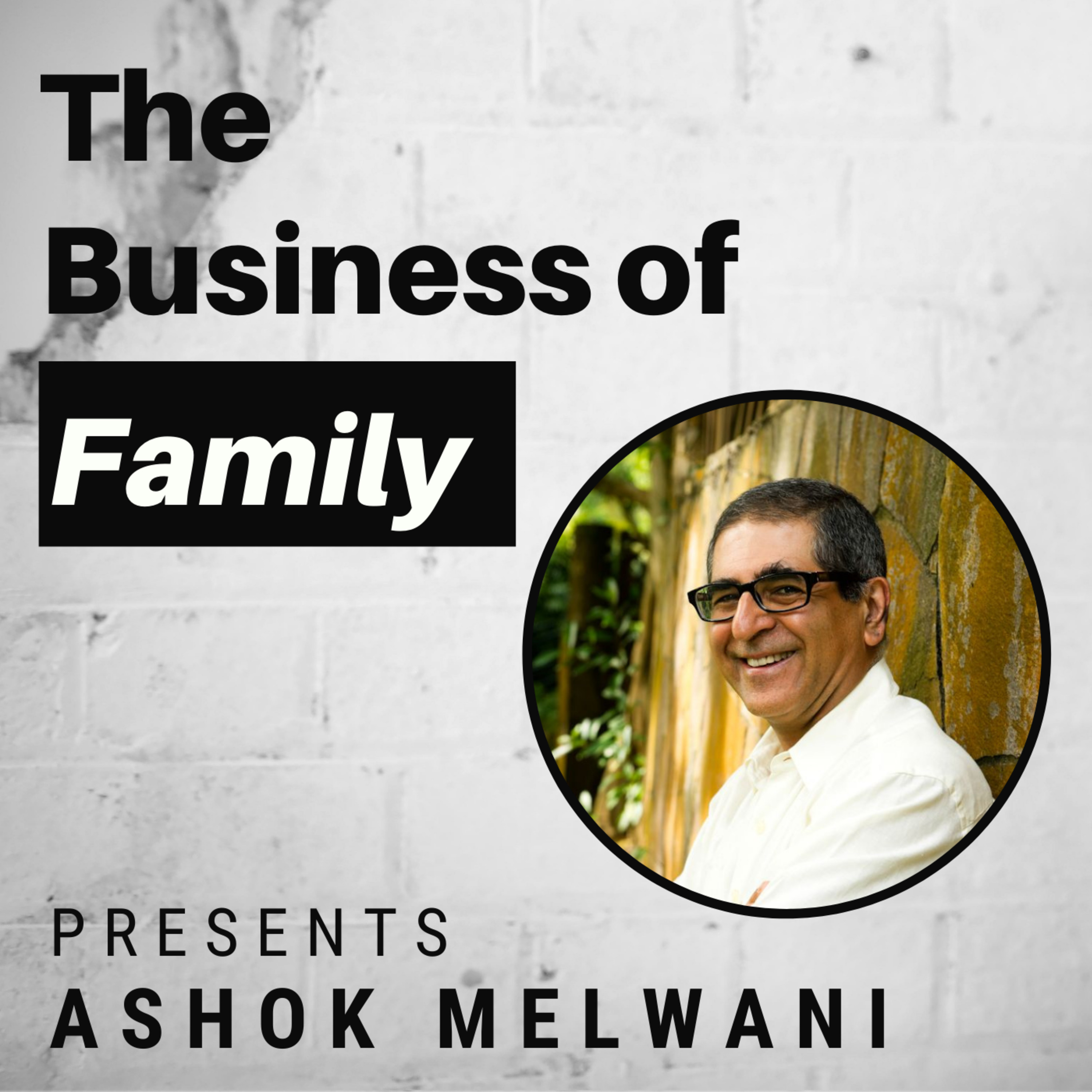
Episode 24 · Season 1
Negotiating an Exit From the 4th Generation Family Business
Key ideas from this conversation
At 38 he chose to leave with his father's blessing rather than as the black sheep, and waited more than a year to get it.
His father insisted on a clean break, with his share valued by a committee of three, just as the Asian financial crisis hit.
What he told his own children: parents can't give you resilience or self-esteem, only the room to earn them.
Read the full show notesBio, standout quotes and the episode timeline
Ashok Melwani started his career as a teenager, working in his family’s fashion retail stores during the school holidays. In 1982, he joined the business full-time, working his way up from brand manager to an executive director of the 4th generation Indian family business. He's a seasoned entrepreneur with decades of experience in retail, food & beverage and distribution, and now an executive coach.
Ashok is a guide to the road less travelled. His story is a fascinating journey of a struggle to leave the family business and ultimately forge his own path.
Standout Quotes:
- "My most disliked few words, 'You should know what to do'." - [Ashok]
- "If the CEO of a business is not passionate about a business, he has no business to be the CEO" - [Ashok]
- "If the family business is the only thing on your resume, it's not very worthwhile" - [Ashok]
- "Crowd brings crowd to a restaurant" - [Ashok]
- "Two things I and my wife can never give you as parents, we cannot give you resilience, it only comes from hardship... We cannot give you self esteem, it comes only from achieving your own goals and making a name for yourself" - [Ashok]
- "Everybody has a price at which they might do something which is borderline unethical, and the price depends a lot on your socio-emotional background" - [Ashok]
- "When one door closes, another door opens.. in order for that to be true, you have to do your part which is don't hang around too long when the door closes" - [Ashok]
Key Takeaways:
- Ashok shares that although he wasn't particularly excited to work in the family business, the incentives and knowledge gained made it a perfect introduction to the retail business.
- If the family business is the only thing on your resume, it's not very worthwhile, even if you were the MD.
- Ashok discloses that following the impact of the Asian financial crisis on his transition out of the family business, he had fallen into depression for close to a year.
- If you leave a family business, you don't want to have some small share in the business and start second-guessing whoever is left behind.
- Although he had a clean exit, there were effects on the family dynamics at the time, as some family members didn't understand why.
- Despite the many setbacks, looking back, there is no doubt that leaving the family business was the right step to take for Ashok.
- I have no respect for trust fund kids.
- You have a life outside and beyond the business, a lot of entrepreneurs are consumed by their business even when they should be spending time with family.
- Ashok admits that based on his experience with his family business, he was not encouraged to start another one involving his children
- After interacting with younger family business executive owners, a common notable point was that they were given time to work outside the family business before coming back.
- From Ashok to his kids: when one door closes, another door opens, don't wait around too long afterward.
Episode Timeline:
- [00:45] Introducing "Ashok Melwani"
- [01:52] Ashok narrates how he joined the family business
- [02:46] What sort of products was the business offering?
- [12:59] Your career with the family business, where did it reach, and what happened next?
- [31:28] Ashok explains he had a clean exit from the family business.
- [33:56] Would you say that leaving the family was the right decision for you?
- [35:00] How is the family business going today?
- [36:27] Did you ever try and nurture your children to work with you and create another family business?
- [38:24] Ashok's opinion on children inheriting wealth
- [40:35] A notable experience that helped shape his journey.
- [43:56] What advice would you give to a driven entrepreneur who aspires to be the founding generation of a multi-generational family business?
- [44:53] What's your take on generational businesses?
- [46:42] My next stage in life involves venturing into Leadership Coaching
- [47:31] Ashok's letter to his children
Links:
- SUMIDA CORPORATION : Melwani has been an Outside Director of Sumida Corp since April 2003
- INSAS BERHAD - Strength in Depth and Diversity : Ashok Melwani served as a Non-Executive Director of Insas Bhd since November 29, 2004
Read the transcript
This transcript was generated automatically and may contain errors, including in names. Listen to the episode for the exact words.
MikeWelcome to The Business of Family. I'm your host, Mike Boyd. Multigenerational wealth creation involves so much more than capital accumulation. The most successful families cultivate values, stories, knowledge and resources to pass on to the next generation, and they do it very intentionally. On this show I sit down with members of some of the world's most interesting business families to hear how they do it. To see where your own family stands, take the Business Family Diagnostic at businessoffamily.net.
I'm excited to share this conversation with Ashok Melwani. Ashok started his career as a teenager working in his family's fashion retail stores during the school holidays. In 1982, he joined the business full-time, working his way up from brand manager to executive director of the fourth generation Indian family business. He's a seasoned entrepreneur with decades of experience in retail, food and beverage and distribution, and now an executive coach. Ashok is a guide to the road less traveled. This story is a fascinating journey of a struggle to leave the family business and ultimately forge his own path. Ashok, it's fantastic to have you on the podcast with us.
Thank you again so much for joining us.
AshokMost welcome. Pleasure to be here.
MikeYou have such a wide and varied career journey to date. I can't wait to hear more about it. But I'd love to start first and foremost with your origin story and how you first joined your family business. If I'm not mistaken, you were the fourth generation born into a retail business family. Is that right?
AshokThat's correct. My great-grandfather came from India in 1883 and started out here. Actually, it started in Medan, Indonesia, and opened Singapore in 1906. So it was pretty much a given that the sons of the family joined the family business. And as such, I was only 14 when the first time I worked in the family shops during school holidays, and I sold shoes.
That was my first assignment. And then each year, I worked during the longer school vacation, and each time I learned a little bit more and sold more challenging items as well. And that went on for about six years until I went to the army.
MikeSo before we get further into your journey with the business, can you paint a picture for us of the business itself? Your great-grandfather, did you say, founded it originally. And a couple of generations in, it must be quite substantial. So what sort of lines was the business in and products were you offering?
AshokSo the business grew very strongly before World War II. But unfortunately, it was quite devastated by World War II because at that time, the family had business offices in Yokohama and Shanghai, in Medan, in Singapore. And Yokohama and Shanghai were lost irrevocably during the war and they never got to reopen because of the difficult turmoil and things like that. And my great-grandfather actually owned one square mile, 640 acres of downtown Medan, which got nationalized when Indonesia became independent in the 50s.
So the family was quite, or the business was very badly set back, as well as the partition of India and Pakistan in 1947, because the headquarters, so to speak, was in Sindh, which fell on the wrong side of the border. So we're Hindu, but our ancestral homeland is on the Muslim side of India, Pakistan. So again, everything there was lost, including the ancestral home.
So as a result, in the, I would say, early 1950s, after the war, when my father was there, it was literally down to the one store. And he and then my late brother in the 60s started to rebuild. So we had a family store called Melwani Silk Store, which then became Malwani's Men's Shop. And my brother was very inventive.
He actually got the agency for Levi's jeans, and that was a big kickstart to the expansion of the retail business. So he had a chain of denim retail stores, jean shops, which they used to call tops and bottoms before they eventually became one of the brand Levi's stores. So when I joined, there probably was around six or seven Melwani shops and maybe eight or nine tops and bottom stores, if I recall recently.
But my memory is murky of when I started working in the shop as a teenager versus when I actually joined the business because it kind of all merged.
MikeFascinating journey. And so when you first started working in the business during your school holidays, was this an aspirational opportunity? Was this something that you were destined to step into after your education that you're excited about from a succession perspective?
AshokSo frankly, no. I mean, it was just expected. So I was kind of told that instead of being home, chilling or lazing, I should work. And to be fair, they paid me quite well. So my father had this good system where if I wanted like a stereo, I wanted something tangible. Oh, very easy. Come and work in the shops.
I pay you $10 a day, which was a very good wage in those days, actually. It was an excellent wage. And now I know it was above the market wage for those days. For the 1970s, I was paid above market wage, but he kind of timed it. So I recall there was a stereo, which was about $300.
So if I worked $10 a day, six days a week, I could earn it in about five weeks. In that regard, it was quite a nice arrangement. And I definitely learned the business well from the bottom. It was great. And I met customers. And I, yeah, I think that that was, if I had to do it again, if to be in the retail business, that was the perfect introduction.
There's no two ways about it.
MikeSounds like you were nicely incentivized to pursue that. So after finishing schooling, you went off to national service in Singapore. And after that, did you return to the family business?
AshokSo actually, even the last three or four months of my national service where, you know in Singapore we kind of have a different mood when we're coming to the tail end you kind of manage to find a job where you might come out on weekends so actually I worked on Saturdays for the last six months I think and then when I was in the university the law so this is the first time where I actually kind of hit the the clear boundaries or you know out-of-bound markers to use the golf analogy like and when I was doing my A-levels it was oh why are you in a science class you need to be doing economics. And when it came time to apply for university, it was,
okay, you just make sure you're applying for business administration and nothing else. So that's when kind of the walls started closing in a little bit. Yeah.
MikeAnd if you don't mind me asking, where were those comments coming from?
AshokOriginating from my father delivered through my elder sister, because those were the days where the father didn't really talk so directly to the kids. And because I'm actually 10 years younger to my next sister. So there's quite a gap. So it was somehow they were the communicators. At that time, my sister was already working for my father. Yeah. So that's why she was the communicator. I forgot that part. She was the messenger.
Yeah. But they both worked only until they got married. So by the time I actually finished my national service, they were both married and no longer around. Yeah.
MikeAnd so did you then sort of adopt that path and study business administration or were you pining to?
AshokOh, yeah, absolutely. No, no. I mean, to be fair, I quite enjoyed business. And after growing up in a business, it actually came very easy and very naturally. So I actually managed to be in the top three of my cohort for every one of my three years that I was in the class. And people would say, oh, it's so easy for you, which actually it was, because a lot of it was so intuitive.
You know, it was not, there wasn't a part like maybe from business math or something which had to be studied. But things like policy, strategy, marketing, they were very easy for me.
MikeAnd so tell me about the journey that you then went on in the family business. Were you on track pursuing the CEO role? Was it a family succession journey or were you still finding your own way in life?
AshokGreat question. So they didn't really have a good plan for how to bring me in. I mean, they thought that they already had done the right thing when they made me work in the shops as a teenager. So when I came in, it was, okay, just sit here next to my brother and see what you learn. So actually the first six months were terrible because I got no job satisfaction. I wasn't given anything tangible with accountability or measurable outcomes. It was probably just like, okay, follow to meetings and take notes and see what happens. So I was getting a bit bored and anxious. So there was a sickly brand called Loewe in the family business. And I said, okay,
If it's not doing well, why don't you let me have a chance to take that on? So that was the first tangible responsibility that I got. So by then, the family had actually diversified into monobrand stores. And there was a German fashion brand by the name of Etienne Aigner, which was actually doing very well for us. It was a strong brand of the 1980s.
It's not so strong nowadays, but in the 1980s, it was very strong. and there was a sort of a big dissatisfaction by the principals with our management because there'd been too many changes of personnel so I thought that was an ideal combination of me thinking it was an ideal opportunity as well as the principal telling my my family that okay you have a son in the business why don't why don't we train him because he's not going anywhere I mean like he's not going to resign so which I did so actually then I went to Germany and trained like went around the leather factories, understood the tanning process and things like that, and became the brand manager of this brand. And I have to say I did well, actually. I exceeded my
own expectations and the business turned around and we had very strong years through... I joined in 82, became brand manager maybe in 84. So 84 to 80, it was probably my best years in terms of my accomplishments, the business growing very strongly. And at that time, feeling quite comfortable with the business and the principals being very happy with my performance.
So yeah, 84 to 88 were kind of my best years in the family business. Then it was, okay, we can't just leave you here. You need to now be responsible for more. So then in becoming responsible for more and becoming an executive director of the whole company, that's when new challenges came in, like politics with the old staff and stuff like that, which made it less enjoyable because I was no longer just managing my own little turf, but the whole plot where sometimes it would kind of enroach into other people's territory, my brother's territory. Yeah, that became a lot harder, actually.
Right. So it wasn't just old stuff. It sounds like there was a little bit of family dynamics issues at play there as well. Yeah. Yeah. Unfortunately. And sort of the very Indian, you should know what to do, rather than being told explicitly, well, you know, okay, this is how you handle the situation. Oh, you should know what to do. My most disliked few words, you should know what to do.
And in what context, Ashok? So is that simply you didn't know what to do and you weren't provided the guidance? Or was it more an underlying tone of sort of towing the line and doing what the family wants you to do? As I said, I'm actually a half generation behind my siblings. So I'm not the most well-versed in the culture of our community.
So for example, there was an incident which involved an overseas business partner where basically he attended our... So he's our partner in Indonesia, but he was not a partner in Singapore. And he happened to come along for the annual staff night of the Singapore company. And allegedly, I did not give him sufficient face. it's like oh you know i mean okay if you want me to give a lot more face you should have told me right because culturally it didn't occur to me i mean he's here to me he's a guest here so you know okay he's got the vip table but did you really want me to introduce him or like make him safer
you know why would i do that unless the higher-ups gave me a clear hey you need to give him face but he was very upset and actually that kind of triggered a bit of a chasm between me and my brother that lasted many years.
MikeSorry to hear that. So tell me, what role was your brother playing? What role were you playing? Were you both in charge of separate divisions within the business or was one person CEO?
AshokNo, so he was clearly my boss because he was much older to me, 18 years older. But at the same time, it was sort of like, okay, you do, but if you want to do something new and different, check with me and dad, right? Come to the board. But the thing is, he also had his own business separate from the joint business. So that means he wasn't in our office all the time. And it was, there was a lot of frustration and like, okay, we'll meet every Monday, but some Mondays he wouldn't be there. And then dad would say, okay, wait for him to come before we decide this. So it just got finally very challenging actually.
MikeAnd so how did that ultimately play out your career with the family business? Where did it reach and what happened next?
AshokI did become MD of that one separate company. So I was running it fully. And to be fair, he didn't really interfere in that because he had the whole Levi's business distribution that he was running. That was a separate company. So I was running the upmarket monobrand shops. So I was responsible for maybe about 30 stores. So a couple of things happened.
I mean, one was that basically the economics of the market changed, labor, rents all went up. And it actually made no sense in my mind It started to be very clear that it made no sense to have two separate accounting entities with different shareholding, different registered offers, and different sets of back of house like warehouse and admin and accounting.
When the market clearly meant that rationally, we should have one back of house and then spread those costs across the shops. So I started agitating to combine the two businesses and make it one back of house, which to me was economically very good. But that's when the turf started to come in. So there was hesitation that, well, you know, okay, if we do that, then my Ashok's share of the joint business has to be lower because I'm not a shareholder of the other company. So it's got a bit complicated.
But at the same time, that's similar to the time where I attended this one particular YPO event and the resource said this line. And probably my memory of the line may not be 100%, but effectively it was, if the CEO of a business is not passionate about the business, he has no business to be the CEO, full stop.
I mean, that was the summation which rang heavily in my brain. And I shared it with my wife. And that started the path of dialogue with my father that, you know, I need to leave. and my words to my dad were, I was about 38. I said, I don't want to wake up age 50 and wish I'd done something else with my life and I have to try.
So he said, what are you going to do? I said, I have no idea. I got kind of a good input from my forum, my YPO forum that Singapore is a small place. So if I leave the family business, I don't leave the family and make sure I don't leave it as a black sheep. So I did not do anything to initiate departure without the blessing of the family, which took a bit of time.
so that it took more than a year from the time I first had the conversation and then it was like, okay, you can go. I said, oh, you know, really? He said, yeah. I said, yeah. When can I go now? I said, no, but I haven't planned about what I was going to do. So I asked for six months notice and I got six months notice. But the big challenge was I got that six months in September 97.
January 98 was the Asian financial crisis, the trigger. And March 31st, which was set as my last date was already well into the crash of the Asian financial crash. So thinking that I would be able to leave the company with some cash and then figure out what I was going to do became, well, okay, I gave up all my shares in the business. I got some property which was underwater in terms of owing more loan than the reduced value at the time, no tenant, so negative cash. And I took the shares of our Malaysian joint venture when the ringgit valued, when the ringgit was 2.54 to a US dollar in October 98. And suddenly the ringgit was like at 5.2 to the US dollar. So it was very
traumatic. Actually, I was quite depressed and I had a year of kind of really feeling lost and depressed.
MikeIt sounds like an incredible transition period where you thought you'd planned for it and then the rug was pulled out from underneath you sort of halfway through.
AshokWell, the thing is, I never planned for it because I didn't plan what I was going to do. It was a push and not a pull I need to leave, but I don't know where I'm going to go. And I'll figure it out once I'm out. But then I didn't dream the landscape would change irreversibly, or not irreversibly, sorry, would change so dramatically.
So I tried to get a job in retail. The nearest thing I got to a decent offer was to run 7-Eleven in Malaysia. But my children at that time were 10 and 6. And I did not want to take them away from their grandparents. Because I grew up with no grandparents. And I felt like my wife grew up with knowing her grandparents and she felt that it's a big loss if the children don't know their grandparents.
So moving them was not a great idea. And in terms of getting a job in Singapore, whoever I went to talk to, I was viewed with great suspicion. Like, okay, you've just left this family business. Why are you here? And what's your credential? Oh, you have no experience other than running a family business? Well, that doesn't say very much.
So that's when I learned very dramatically that if the family business is the only thing on your resume, you could have been the MD, but it makes no difference. I mean, it's not very worthwhile.
MikeInteresting. Okay. So how did you go on from there? Did you ultimately choose an entrepreneurial path because you couldn't find employment that suited you or was it just a matter of trying lots of different things?
AshokSo short answer, yes. I mean, I couldn't find employment and combined with a hefty chunk of luck and serendipity, that I happened to have been a 25% investor in this Italian restaurant. Oh, sorry, in this entertainment business, which the partner said, oh, why don't we open a restaurant? And the restaurant opened Christmas Eve 97. So in May 98, it was about two months from bankruptcy because we had signed the lease in July 97 pre-crash.
I mean, all the expenses would get up the hard way. But I thought the business was actually quite solid. And so my father gave me nice advice. He said, if you really believe in that business, Then put some money in and instead of 25%, become a major shareholder and see what you can do. So I did that.
I dug the dregs of my cash and put it in there, increased my share from 25 to about 66. And I retrenched. I went to the staff and I said, okay, anyone earning over $3,000, this is in the 90s, so it was decent in those days. I'm really sorry, but you're retrenched. Nothing personal. You're out. Everybody below them, you're promoted with no increase in pay.
And I have two months of payroll in my savings account. And that's it. We single swim together.
MikeThis is your personal savings account?
AshokYeah, yeah, yeah. So then I cut a deal with Pacific Internet in those days that for every new subscriber, we'd give a free Pepsi and a pizza because I had great faith that if they tried my pizza, they'd come back. And in return, I got like three color ads in the newspaper. I got 300 taxis with the pizza going around on the roof.
and 6,000 people came to try our pizza for free, but they didn't often come alone. I mean, they might come with a spouse or a family and buy something else, or at least buy a dessert or something. And they liked our food and they came back. So it took about four months to kind of turn around, but we did.
And then I went to the landlord and I renegotiated our overdues, rent outstanding. And I said, basically, I'm okay to let the company wind up if you're not willing to come to a more relevant market rate post-crash. If you still think that the price is pre-crash, then let's just wind up the business. So that was a tough negotiation, but they caved in a little bit and we compromised and they let me pay the arrears in 10 installments and things like that.
So that's how we survived. And then from there, life changed. But I still had the SARS crisis to deal with, which was another interesting. So we had, after the 98, just getting on our feet. 9-11 America was still a bit of a hit because our restaurant was in a hotel and reliant on tourists. SARS was a major disaster.
So it wasn't until about 2005, actually, that kind of things got to a decent keel. So five years of struggle.
MikeSounds like a true startup adventure.
AshokWell, I mean, I wouldn't trade it for the world because having grown up in a family business, which had a lot of establishment and support and the secretary and money, to feel this pressure firsthand is quite priceless, actually.
MikeI want to go back to the free pizza.
AshokSure.
MikeHow did you, I mean, was it luck or did you have a sophisticated plan around how many pizzas you could afford to give away, the cost of customer acquisition? Was there a great big spreadsheet driving this or was it, I need customers, we're going to do this deal and sort of hope that we can fund it as we go?
AshokOkay. So it was actually seat of the pants. There was no spreadsheet. It was, for me, I was super clear that crowd brings crowd to a restaurant. So people go to an empty restaurant, oh, this must be bad. people say, oh, crowded restaurant. Oh, this must be good. So crowd bring crowd was kind of like what I told my staff that at all costs, we had a terrace facing the orchard road. And I said, at all costs, the terrace has to look full. Okay. So I didn't really think that hard about how many we could give for free. And I was very sure that, okay, you know, in Asian culture, dining alone is not so common, right? So you either dine with the family or dine with a friend or a group of friends.
So I figured that, okay, chances were pretty good that for this one free pizza, very few people would come and just have the one pizza and the Pepsi. I mean, I thought a few dollars here and there must trickle in. So I didn't really quote it or anything like that. And they did. Yeah, they did.
MikeSo post 2005, you get through these group of crises and the Modesto's restaurant continues. So tell me about the Modesto story and where you went from there.
AshokOkay, so we had the first one at the Orchard Rendezvous Hotel. And in fact, the SARS crisis gave us our second location because the operator at that particular hotel went bankrupt overnight because of SARS. And the landlord offered us a sweet deal to take over that space and cater breakfast to their guests. So we had the second location in December 2003 at the Elizabeth Hotel.
And 2006, we got offered a nice space in Vivo City, which the first two years actually were terrible because at that time it was like nowhere. But when the casino opened on the island, it picked up a hell of a lot. I think that was 08, 09 roughly when Genting opened in Sentosa and then that restaurant boomed.
But it boomed to a point where the landlord, of course, raised the rent like 150% and then we had the space stolen out from under our nose. That's another story. Yeah, so that's where kind of that journey went. And meantime, so because I landed there at Modesto's without a big plan saying that this is going to be my whole and soul business.
And I had already my Malaysian business as part of my settlement from the family. So Modesto's was never my one full-time job. It was probably like 10 days a month. And then I would be flying to Malaysia quite often. So I also then at that time started, took a share of the Dome franchise in UAE, Dubai, Abu Dhabi.
as one of my side journeys. I was in my international forum, YPO forum in 2000. And I made a remark, my exact words were, you know, I'm so frustrated. I'm so underemployed. And one of my forum mates said, oh, great, you're underemployed. You know, I need all the help I can get. Can you join my advisory board?
Because I've actually, the story is, quote unquote, I've just bought this company in Chicago and the CEO is an Indian guy, Ashok. Okay, he's born in America. He's very American, but he's also Indian. I'm sure you will understand him better than me. Can you come and help me? Come and help me to get this company assimilated, so to speak.
And so I flew to Chicago with the CEO of the Japanese company and kind of became the, what is the word? Like a go between a commissar between the American, the new acquisition and the Japanese parent company, translating what the Japanese CEO was wanting to the American CEO and translating his sort of reluctance and his wishes as how to best acclimatize to the Japanese organization.
So many late night calls with Chicago, trying to explain things. And that started my longer term association with this company, Sumida, where three years I was an advisor. And then actually in 2003, I became a duly elected independent non-executive director, which I was for 10 years. And that was actually a huge, wonderful journey for me because I went to all these big plants in tiny places like Timisoara in Romania, Guadalajara, Mexico. And yeah, it was fantastic. I learned about solar batteries. I learned a lot of things. I went to the BMW or Mercedes plant and learned all about the keyless technology that was coming up because Sumida supplied a big chunk of the components for keyless ignition. So I learned a lot and it was priceless.
But because although it was a listed company, it was family controlled. And one of my more unusual experiences was at that time, there were three brothers, but the CEO was kind of like the big driver, like the very fairly Western educated Japanese guy who really wanted his company to be global. That's why he bought not only the American company, later on, he bought a German company as well. And he wanted an international board. When I first attended the board meeting, it was primarily in Japanese and translated for us. By the time I retired, the board composition was very International and meetings were in English. And he kind of decided that his brothers weren't really great assets to the company. So one of them, he was okay to let go until he retired. But for the
other one, he felt that he was a bit lost. So he flew him down to spend a day with me. And upon kind of my giving this brother my point of view, decided that he would quit the company and go to grad school in California. And then he went back to Japan and bought a chain of pet shops. He was very happy. So I was encouraged to help him with this transition. He needed to find his new journey as well.
MikeSo it sounds like a difficult conversation was outsourced to you with the brother. Is that right?
AshokExactly. Yeah, exactly.
MikeInteresting. And so all this time, you've got a business in Malaysia, you've got the Italian restaurant in Singapore, you're on the board of a company in Japan that's acquiring a business in Chicago and Germany. I mean, it's such a global perspective.
AshokIt was really fascinating. It was fun. It was a lot of fun.
MikeAnd so where does it go from there?
AshokSo all good things come to an end. By becoming an independent director, there was a limit to my tenure. So I retired. But at that, I mean, I didn't really want to go back to just running the restaurant because it was kind of run by the management team. And in fact, many people would ask my management and my chef later on in life or in this journey that how did you stay so long with one boss?
because that's not very common in Singapore. And basically they all said the same thing. He left us alone to do our jobs. So I set the parameters, like for example, for the pizza. Okay, chef, you can't change the brand of the cheese because that's one of our key ingredients. So you can do many things, but you're not allowed to change our cheese supply no matter what's the price.
So they just identified a few key points that as long as they stuck to that, they didn't really need to worry about me. And of course, customers had to be happy that that was very important as well. So I then kind of sought out like, okay, I was still keen to get a replacement role as an independent.
So again, Serendipity, another YPO in Indonesia, owned a small chain of sporting retail stores, which was not doing well. I mean, he's a huge shoe manufacturer, like top five worldwide for Adidas and Nike, which is building their shoes and selling to them. But on his own, he owned a brand called Specs in Indonesia, which kind of was football boots for the lower income market.
And he had a vision of modernizing Indonesian retail, but the business was bleeding. So I said, okay, if you just pay for my ticket, I'll come down and spend a few days and give you a third point of view, which he liked. And I did. So then he made me his independent chair for that company for three years.
And I helped get it. I'm very happy to say I got it to cash flow breakeven and cash flow positive. and at that point they hired an expat from Bata in from Holland so they couldn't afford to have two because for me they had to pay FAN and cost as well so at that time I retired and at that time at that point I didn't really start looking for any other independent thing because I thought okay I was coming to 60 maybe it's time to take things a bit easy but that's when I made one big mistake I could have sold Modesto's at that time and got some money out I said oh I don't want to retire I
don't want to be so free I can play golf every day and not feel like I have work to do. And I didn't sell. And that was a mistake because up to that point, we were doing quite well. Then we had some really bad years. In Singapore, basically, the cost structure just turned the corner. Foreign worker levies went through the roof, rentals went sky high. And those last four years cost me a fair bit of money. But then as things would happen, I managed to again turn it around, got it back positive just around July 2019, I got it positive. So I enjoyed just six months of some loan repayment for all those losses. And then boom, we got COVID. And COVID was, for our particular restaurant
model, COVID was a Darwinian extinction event because both my branches had large spaces, 5,000 feet, 150 guests, but Western food, not Chinese food, which is easier. Like if you're serving one dish for 10. But if you hear 10 people get 10 dishes coming out, there's a lot of labor involved, which you can't, as much as the government would say you need to cut it down, but it was very difficult to cut down. So I realized that this was the end game.
MikeAnd you were attached to hotels too, weren't you?
AshokYeah, that's right. We catered the breakfast at both the hotels. So I resolved to exit gracefully. It took me a while to decide what was my definition of graceful. And my definition was, do my best to help my staff get a job, make sure I can pay them till their last day and make sure I can pay all the suppliers.
And I achieved that goal. And in July, I closed the business.
MikeWell, congratulations on doing it in an admirable way. And I'm sorry for the loss after. How many years was it actually in Modesto's, your journey?
Ashok23, 23. So it was actually very emotional to close the business. It was so much part of the family because it was also our second kitchen. Like, you know, okay, we're alone tonight. Let's go to a restaurant and have a pizza and then sit on the terrace and watch life pass by. It was very much part of our lives, yeah.
MikeSo lots of memories. And to bring it back to family, I'm curious, you mentioned earlier the settlement agreement that you had with the family and the Malaysian business was part of that. Was that... So when you departed the family business, did you know that it was a permanent departure while you tried to find your other path? And was it an effective...
All of the corporate structure was settled in a way that you no longer had any interest or you had some remaining interest? What did that look like?
AshokNo. So my father was very clear that if you're leaving, you better leave and have a very clean cut. So basically there was a committee of three, my father and two outsiders who did the valuation. So I didn't argue with it. And then they decided what would be my share of the assets. But unfortunately, as I said, it was valued October 98. I mean, that's just luck. Nobody could have foreseen that coming. So it was, yeah, the door was closed, slammed shut. And he was right. I mean, if you leave, you don't want to have some small share and then start second guessing whoever's left behind. Yeah. Anyway.
MikeSo that was a clean break or a clean cut.
AshokIt took me 10 years to ask my father one day. I said, you know, are you okay now with me? Are you okay with my leaving the family business? And he just looked at me and he said, you know, 10 years have passed. What's the point of asking that question? I think it took a little bit longer to be okay with me, maybe about 15.
And now he's fine. But I mean, now it's 20, 23 years.
MikePretty tough to leave a family business in an Indian family, is it right?
AshokVery complicated because you don't leave the family. So you're still in the extended family. An extended family is a big part of the Indian culture.
MikeYes. And what was the... So even though there was a clean cut from a business perspective, what was the family relationship like with everybody else aside from your father? I mean, was it difficult and frosty there in the beginning? Or were some members understanding of your pursuit of your own path?
AshokNo, they didn't quite. Well, apart from one person. So the majority really didn't understand why I left because my brother was very respected. And so I did not want to say anything. Although before he passed away, one day he called me to his office and said, you know, I'm sorry, I was so mean to you. And I said, well, that's okay.
But that was just a conversation between us. It was not related to anybody else in the family. So the one exception is my niece, who a few years, not a few years, a few months after I left, went to my father and said, you know, if Uncle Ashok can leave, I can leave too. I want to do philanthropy full time.
I don't want to be in the family business. So she left as well. So I got like a double like map for not only leaving, but leading somebody else astray. Yeah, you know. So my sisters, no, they didn't understand. I mean, it took a long time because, as I said, for that generation, there was so much of you should know what to do and this is expected of you.
So when you decide to do something for yourself, then it's not well understood. Like, why? Why do you need to do it for yourself?
MikeSo would you say that it was the right decision to make for you?
Ashok100, 10, 150, 200 percent. No shadow of doubt. For me, very right. Because I went on to do some fun things in my life. I mean, like I said, the journey with Sumida, hitting the first thing on my bucket list of climbing a mountain above 10,000 feet because I was born in Singapore and never saw anything above Bukit Timah Hill.
And I don't know why I had this dream of climbing a mountain, but I climbed Kinabalu and then got to the top and realized, actually, I'm quite scared of heights. That was enough. Oh, no, no. Actually, I climbed five mountains after that. But yeah, so, you know, those are things I never would have done if I'd stayed in the family business because the time pressure would have been very different.
And the accountability to family members to be in the office on these very long business trips to Europe and America where we sourced our garments, I wouldn't have had that chance. The guy who took over my job landed up, I mean, I know that he would be in the office till 9pm on a Friday night very often.
MikeCan you tell me how the family business, the one that you left, is going today? Does it still operate as a retail network of shops? Is there a fifth generation or a sixth generation involved?
AshokNo. So basically, after my brother passed away, my sister-in-law and my nieces were not very keen on the business. So eventually, they allowed the MD who replaced me, he is not a family member, they allowed him to buy them out. And the business is there till today, but I believe that COVID has hit him pretty hard. I don't know. I don't ask, but I believe it's pretty badly hit.
But I think, again, my restaurant was the wrong model for a pivot. I mean, it's not that all restaurants are doing badly. Some restaurants are doing fantastically, but they tend to be the Club Street and Telok Ayer, one shop house, 40-seater, open bar. I mean, it's a very different model with a different vibe. Retail was already going to struggle because of online discount warehouses. I mean, the whole online shopping thing has really hit retail. So COVID, again, was just the Darwinian extinction event. It was already going to be a challenge anyway.
Yeah. So in fact, whether I'd stayed there or been here, I would still have been out of a job.
MikeAnd it sounds like your experience with family businesses has really shaped your journey, for better or for worse. I'm curious what values you brought with you or has shaped you since with your own children. When you were running Modesto's and other business interests with your own nuclear family, did you ever try and nurture your own children into that to work with you and create another family business?
AshokNo. So I was so scarred and so shaken by my experience that I went to the other extreme of the continuum and put up a wall. And it was like, okay, if you're interested to run the restaurant business, fine. Go and work outside for a few years. Come back, tell me your idea. Maybe we'll put some seed capital and you can start something new, but you're not going to come into this business.
So which initially my kids were like, what's wrong with Papa? I mean, they see other family members or friends in similar situations, getting helping hands and going to the business. But for me, I was very keen that they should follow their dream, not my dream. Anyway, now there's no business anyway. So it's good they didn't come because otherwise they would have this headache of closing.
Although to be fair, they could have pivoted. They may have had a different journey, but that's their book to write, not mine.
MikeIndeed. And so they did pursue their own paths. Did they find other passions or did any end up back in business?
AshokNo. So the first is a writer and he's pursuing his passion and he writes fiction. And to cover his expenses while he writes fiction, he writes digital copy for websites and branding. So he's based in New York. The second was a lawyer doing very well in London, like in the big five, Clifford Chance, paid very well, mergers and acquisitions. And sorry, not mergers. He was in the, what's it called? Capital markets, like bond issues and underwriting and things like that.
But decided that he would like to try something else before he got stuck in a very narrow funnel. So he's now in grad school at NYU Stern doing business. But his timing also is challenging for him. But anyway, let's see where his road takes him.
MikeAbsolutely. And so I was going to ask, and I don't know how relevant this question is, but do you have an opinion on children inheriting wealth?
AshokOh, before I forget, I should not be misogynistic. My daughter, actually, she had the biggest F&B slant of them all because she went to Caudre Blanc for six months in London. But her passion is to be a Pilates teacher and she's doing a great job. So hopefully one day she might open her own studio or something. But for the time being, she's thriving as a Pilates teacher.
So I'm very happy that she, again, did not come anywhere near my business. Back to your question. I missed it. Sorry, you said.
MikeSorry, just a question about inheriting wealth. I was curious how you feel about that. We speak to a lot of generational families, and they're often grasping with this challenge of, we've got great wealth to enable children on their path, but at the same time, we don't want to spoil them and ruin their work ethic and things like that. I'm just curious, your take.
AshokIt's a huge challenge. I had a joke when I was still in the family business, and at that time, I earned more than when I left. We had children who had the turn left syndrome on the aircraft, Like when you board the aircraft, you turn left instead of right. You know, and I said, this is not the common way for many people.
And how do we manage it? So I hope we've done a decent job. Anyway, we made it very clear to my young adults that we pay for university. And after that, they're on their own. That, okay, the family does have a safety net. I mean, you're not from a poor family. So, okay, if you really try and fail, if you really try, and then if you fail, there's some safety net for you if you come back home.
but in the meantime you know try to build your own because two things i can never give you as a parent or my wife and i cannot give you number one we cannot give you resilience it only comes from hardship number two we cannot give you self-esteem it comes from only from achieving your own goals and making a name for yourself so if you think that you're going to be a trust fund kid then i'm going to disinherit this on you i have no respect for trust fund kids and don't ever have that attitude and actually thank god i mean maybe we did something right which i don't know exactly, but none of them have a trust fund kid attitude, which is great.
MikeIt sounds like they're all happy, healthy, and on their own journeys, which is wonderful as well with some great values behind them. Now, I was going to ask about failure. I often like to ask whether or not you have a favorite failure that helps shape your journey. Obviously, we've just heard about the ups and downs with your businesses already. Would you say they're the favorite failure or does something else stand out in your journey?
AshokSure. So one of the favorite failures, a funny way of calling it, but let's say a tuition well invested on me by my family was for a long story, skipped a long story of how we did it. But basically, we invested in a eyewear distribution company in Germany. And because it was a management buyout and we kind of bought the vision of the Gershaw Sura who sold us a very nice dream.
but reality turned out to be quite different and we lost quite a lot of money for those days i think maybe three million dollars back in the 90s was was a fair amount of money but i feel that i got a lot of tuition from that about starting business in another culture starting business in another language starting business with a different work ethic of the employees of and the whole communication i mean the whole languaging the way a german speaks english is very different from the way a Singaporean speaks English and an Italian speaks English. So in fact, I would say that's one of my best talents, frankly speaking, that I translate English to English. At the Japanese
company, during a board meeting, we had German, we had American, we had Japanese, Hong Kong, myself. And sometimes the German director would tell the Japanese CEO or something, and he'd look puzzled. And I say, I think what he's telling you is this. Is this right, Ulrich? Is this what you're telling Shiki? Yes, exactly. That's exactly what I'm saying.
And I could do that very regularly. So I feel I got well-schooled in international business and culture thanks to some of that expensive failures. And I learned another lesson, which is a bit harsh. So I don't know how to say it in a nice way. But basically, if I can put it in a way, everybody has a price at which they might do something which is borderline unethical.
And the price depends a lot on your socioeconomic background. And I'll just say my own example. So if you tell me that, you know, would I do something borderline unethical and I'd earn $5 million? No, for sure. $100 million, Ashok, would you do it? I honestly don't know the answer because I'm not saying that it's not a... We're not talking about a crime. We're talking about borderline unethical. I don't know what is my... It's not $5 million. Where between $5 and $100, I don't know. For someone from a less well-off background, that price might be $50,000. That price might be $100,000, might be $500,000. And I learned that lesson that actually, you have to be careful that from a more well-off background, you have to keep an eye open on
some, let's say, corruption possibilities.
MikeAnd was that particularly in the context of international business dealings, cross-cultures and diverse backgrounds?
AshokYes. And in places, for example, like Italy, where at that time, the sort of thing was not uncommon or Indonesia in particular, which was... Yes. Sorry, that's another whole lesson if you talk about expensive failures. But learning to do business in Indonesia was a whole different lesson. And we had some interesting, not only failures, but also learning of the value of patience.
And in Singapore, we tend to want to do things in a hurry. And some cultures, you just don't do that. Yes. Yeah.
MikeNot everything operates with Singapore efficiency.
AshokNo, not at all. Yeah.
MikeI'm curious what advice you would give to a driven entrepreneur who aspires to be the founding generation of a multi-generational family, or if you would even give any advice to someone that wants to be the founding generation based on your experience.
AshokSure. So, I mean, my answer may not be the answer to the question that you would like me to answer, but basically, number one, I would tell them that you have a life outside and beyond the business. don't eat sleep drink and dream only of the business even when you're with your family because one day that business will not mean the same thing to you that it does today so that's number one because that's that's what i learned when i left the business that although it was such a huge part of my family when i left the business i realized the business is is the business but it's not me it's not it doesn't define me and i think a lot of entrepreneurs
and particularly startup owners or first-time owners are very absorbed and consumed by that business.
MikeAnd what's your take on the generational businesses? You've gone from one extreme to the other or one end of the continuum to the other in your own experience in putting up a wall to your own children. Is that still your perspective? Do you think that others should try and encourage their children to take other paths? Or do you think that generational business makes sense in some contexts?
AshokSo I've spoken to a lot of new family, sorry, younger family business executive owners. And one thing that's evolved very well, I must say, is that the common thing that I've heard is from all of them that they were given time to work outside before coming back. For some of them, they had the choice to come back. Others didn't have a choice. I mean, they were still told, okay, dad's getting old and you have to do this, you have to come back.
But at least they had the journey outside to sharpen their own saw and give them a different lens when they come back. So if you, I mean, I can see the value of having a trusted family member take over. I've seen firsthand the challenges of the succession because I didn't mention, I actually was called in to mediate between father and son for my first cousin and his son.
And kind of, I helped them find, well, actually over there, the solution was very interesting. It wasn't that it was my idea because, you know, in YPO, we don't want to give advice. We just illuminate options and you must choose. But definitely they realized that they were much better off renting out the building to a third party than to operate it themselves.
MikeInteresting. Yeah, yeah. Interesting. And by the sounds of it and knowing you personally, you have that natural knack of finding your way into facilitation or coaching roles, helping people to communicate or translate, as you say, understand each other and find the right outcome. It's a real skill set of yours, I think.
AshokYeah, so I mean, I was asked to do this more than once at a time where it wasn't sort of my main thought. But now, my next stage of life, I have very recently decided that I do want to be a leadership coach, but I haven't quite exactly figured out the right target audience. So that's my step now, whether I want to do entrepreneurial coaching only or leadership coaching, including by gun CEOs, to be seen.
But I think I have 40 years of business experience across many cultures, and that's pretty relevant. And that's something I can also offer different help and perspective.
MikeAbsolutely. I think you've got a vast amount of wisdom there to share. And also, as I said, that ability to coach, facilitate, and guide is a rare skill set, which is fantastic.
AshokThanks.
MikeAshok, it's now time for our final question. And it's a question that we ask every guest. Imagine that you're writing a letter to your children. What is one lesson or idea that you don't think many would mention, but you consider important to understand?
AshokSo there's a maxim or a saying that, oh, when one door closes, another door opens. So what I would want to tell my children is that in order for that to be true, right, you have to do your part, which is don't hang around too long when the door closes. I had two times in my life where we made the mistake of hanging around when the door closed, which became so expensive.
One of them was in the family business when we dealt with a very major Italian brand who decided, as most of the brands eventually did, they decided they would like to do their own business in Asia. And they started opening their own companies and shrooms. And we sort of tried to replace the brand with a very similar Italian supply, but it was very expensive.
And it took a lot of effort. I mean, the reason those guys went on their own is because they had a very strong brand, right? And it was a fallacy to think that you can, just because you know the market and you know the pipeline and you know the customers, that you can overnight bring in something to sell to the existing customer, but without that cache of that bread.
So that was one. The other was in the restaurant business. So I mentioned that Vivo, the landlord jacked up the rent more than 150%. And when it went up the second time, they raised it by 75. I counter-offered 50%. 50%. And they didn't come back to me and they just actually rented it to Jamie Oliver's Italian kitchen, which I think they wanted anyway. They wanted to get like a sort of celebrity brand name to that space. But I made the mistake of getting a replacement space in the same mall, but not in as good a location. So instead of level one, I was on level three. Oh, that was so bad. I mean, we lost so much money in that location. And the problem is in a restaurant, your fixed cost is so
high by the time you renovate, build the kitchen, the exhaust, our two and a half ton pizza oven. So we put in so much money and we lost it all. It was really a waste. And I was a bit blind to see that the location, even though the rent was half the rental of the ground floor, but the reason it was half was because the traffic and the visibility was just not there. I wish I had just let the door remain closed rather than try to pry it open and keep it open a bit longer.
Very expensive lesson.
MikeA wonderful lesson. Thank you for sharing these stories with us, Ashok. It's been wonderful. You've been very transparent, which I so appreciate. And I know others listening to this really value learning from your experience. So, thanks again for making the time.
AshokYou're most welcome.
MikeThank you. Thanks for listening to The Business of Family. You'll find the transcript and key ideas from this conversation at businessoffamily.net, along with the Business Family Diagnostic. It's free, and it shows you where your own family stands. And if someone in your family should hear this episode, please send it to them too. I'm Mike Boyd. Until next time, take care.
Keep listening
If this one landed, start here next.
From Billionaire's Son to Losing it All and Starting Over
A Malaysian family rebuilt after the same 1998 crisis.

Separating the Family Conglomerate After 111 Years
An Indian family that went separate ways and stayed family.
4th Generation Heir to B.Grimm, one of Thailand’s Oldest Business Institutions
A fourth-generation Asian family business, seen from the inside.
The Business Family Diagnostic · Rising gen
Not everyone born into the business wants to run it.
Ashok worked out he didn't love fashion enough to run a fashion company, and found a way out that kept the family whole. Does your family have a path for the one who wants to go their own way?
“The next generation has a clear path to understanding what it will own, whatever role each person chooses.”

Every family wishes someone had recorded the generation before.
I built Enduring Stories to do it for yours: a guided voice conversation, from home, that keeps your family's voices, values and history.
The newsletter
The most useful things in these conversations are the things families rarely say out loud.
I share them in my newsletter once a week. Sign up to receive the ideas directly and start building the foundations for your family today.