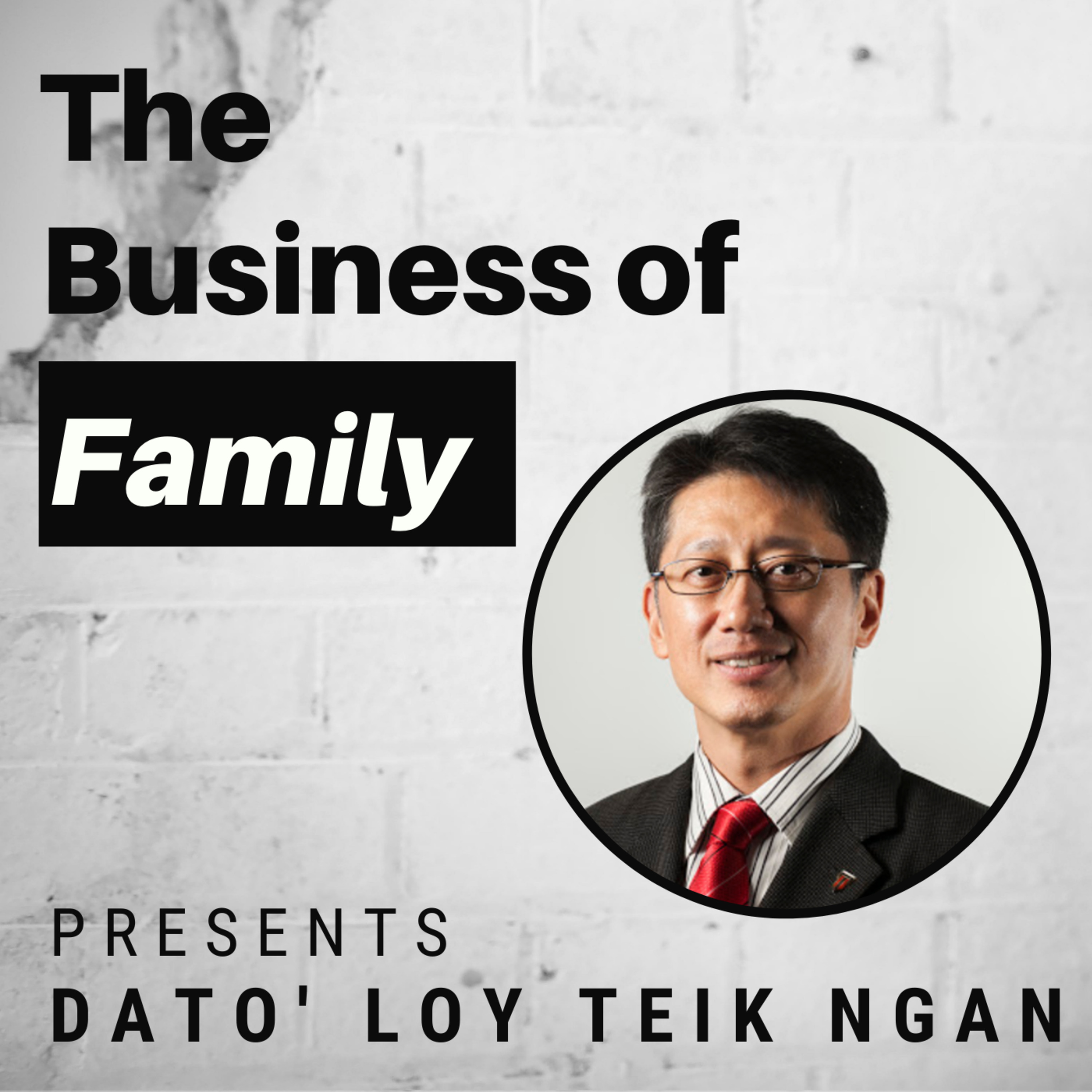
Episode 17 · Season 1
From Billionaire's Son to Losing it All and Starting Over
Key ideas from this conversation
The bank could bankrupt him or lend him more. He asked for more, and it took fourteen years to settle the family's debts.
Four houses in one compound and a Living Together Committee: everything inside your walls is yours, everything outside is shared.
"Do you want to be rich, or do you want to be king?" The adviser's question that moved him out of running the business.
Read the full show notesBio, standout quotes and the episode timeline
Dato’ Loy Teik Ngan, the eldest son of a well-known entrepreneur who built one of the largest business conglomerates in Malaysia, Teik Ngan took over the rein of his family company upon his father’s demise. Within a year, the sprawling business empire that took 35 years to build, collapsed under the weight of huge debts amidst the 1998 Asian financial crisis.
14 years passed before all personal liabilities of his family from the days of the financial crisis were eventually settled. In the process, he built a new family business, in education. The Taylor’s Education Group is today the largest private education group in Malaysia. Focused on premium education, Taylor’s K-12 schools & higher education institutions are widely recognised as the top education institutions in their respective categories. Taylor’s institutions operate in Malaysia, Singapore & Vietnam.
The struggles during the tough financial period of his life shaped Teik Ngan’s stewardship views for family business. Appreciating unity, his family has introduced concepts and activities that promote collaborative conversations & strengthen relationships. He is dedicated to the development & transition of his family’s next generation of 13.
Teik Ngan’s family are active members of the Family Business Network Asia & he is the current President of the Board.
Standout Quotes:
- "We had to learn how to live together; we had to form a Living Together Committee"
- "One thing that normally goes wrong when families end up in dispute is lack of proper communication"
- "The family unit is important and sometimes we are subservient to the larger family"
- "We try to always emphasize that the family comes before the business, the business allows us the blessing to be able to have the lifestyle that we have, but we have to work together as a family first"
- "Do you want to be Rich or do you want to be King?"
- "I would encourage my kids to understand the context in why they do what they do... What is it all for? Wealth is fleeting; wealth is something that we cannot take with us when we die"
Key Takeaways:
- Dato’ informed the bank he was indebted to, that they could either push him into bankruptcy or loan him more money to rebuild and pay back the company debts.
- A living together committee had to be formed to help the large family live in one compound.
- Knowing that lack of communication was a common cause of family disputes prompted the introduction of Forums to build positive communication.
- Dato’ shares that the most important thing that has been done as leader of the family business in recent times is Annual Vacations.
- The difference between "Family Business" and "Business family" is that in 'Family Business', the family comes before the business.
- Guided by the shared family values, one of which is "Achievement and Learning", Dato’ explains how the next generation is encouraged to follow their passion even when it may be outside the family business.
- The concept of a "Personal Portfolio" in creating an education plan for the family
- The difference between being rich and being a king is that a king has ultimate authority, loyal subjects and lots he has to look after but being rich is just going for performance, the best point is somewhere between both
- Dato’ explains the concept of the "Deathwalk", an exercise involving walking into our death, looking back at our current age, and giving ourselves the advice we would.
Episode Timeline:
- [00:45] Introducing Dato’ Loy and 'The Taylor's Education group'
- [01:55] Dato’ narrates the events surrounding his transition into his father's company, which was is debt before the overwhelming challenges brought about by the Asian financial crisis
- [06:58] Dato’ admits he was ill-prepared for the scale of complexity involved in the business, worsened by the lack of adequate resources to surmount the crisis at the time.
- [08:39] From a collapsed family business to a thriving one
- [13:41] Dato’ describes in detail the current size and scale of the family business
- [14:46] How did these experiences shape your views towards stewardship of the family business?
- [20:46] The living together committee
- [23:24] Dato’ explains the different strategies employed to keep the family harmony
- [29:21] Differentiating between "Family Business" and "Business family"
- [33:31] Are you actively planning and anticipating succession with the next generation?
- [35:12] The concept of a "Personal Portfolio" in creating an education plan for the family
- [40:49] In the last 5 years, what new belief, behavior, or habit has most improved your family business?
- [43:22] Dato's letter to his kids: 'the Deathwalk'
Links:
- Taylor's Education Group : The Taylor’s Education Group is today the largest private education group in Malaysia. Focused on premium education
- Loy Teik Ngan - Family Business Network Asia : Teik Ngan’s family are active members of the Family Business Network Asia & he sits on its board
Read the transcript
This transcript was generated automatically and may contain errors, including in names. Listen to the episode for the exact words.
MikeWelcome to The Business of Family. I'm your host, Mike Boyd. Multigenerational wealth creation involves so much more than capital accumulation. The most successful families cultivate values, stories, knowledge and resources to pass on to the next generation, and they do it very intentionally. On this show I sit down with members of some of the world's most interesting business families to hear how they do it. To see where your own family stands, take the Business Family Diagnostic at businessoffamily.net.
Dato Loy is the eldest son of a well-known entrepreneur who built one of the largest business conglomerates in Malaysia. Dato took over the reins of his family company upon his father's demise. Within a year, the sprawling business empire that took 35 years to build collapsed under the weight of huge debts amidst the 1998 Asian financial crisis. 14 years passed before all personal liabilities of his family from the days of the crisis were eventually settled.
In the process, he built a new family business in education. The Taylors Education Group is today the largest private education group in Malaysia. Listen on to learn how the struggles during the tough financial period of his life shaped Dato Loy's stewardship views for family business today. Dato, it's fantastic to have you with us on the show. Thank you again for making time to join us today.
LoyIt's a pleasure to be here, Mike.
MikeIt sounds like you've weathered some very difficult times yet gone on to build a successful family enterprise. Can you take us back to the late 90s when you first took control of your late father's conglomerate and describe what it was like making the transition to leadership? What business lines were the family involved in at the time and how did it all come unraveled with the Asian financial crisis?
LoyI had started work upon graduating from university in my father's company, but I had left at about 26 years old. And by the time I came back into his business again, it was because he was ill. He passed away two years subsequently. Coming back into the family business was something which I had been raised to expect and something which I considered a privilege and an honor to do so. And I had come back into the business knowing that he was very, very ill. And this was time to come back and learn more about the business for an eventual takeover. When he eventually passed away, less than two years after I came back. It was a baptism of fire that confronted me because it was at a period of
time when there was great economic crisis. The Asian contagion was upon us, late 90s, and there was a political fight in Malaysia too. And that made for a very potent brew of economic downturn, especially for Malaysia. And so it was with this backdrop that I assumed the Asian contagion affected Malaysia because the ringgit dropped by about half to the US dollars in just over a period of a few months.
My father had taken on quite a lot of debt, a few hundred million of debt in US dollars, which he did not hedge for. When the currency depreciation happened, we were unable to service the debt. Business was down. We were unable to pay salaries. It was a large company. It was a large group actually built over 35 years with about 28,000 staff in 1997.
MikeWow. So it was a pretty substantial conglomerate in Malaysia and beyond by the sounds of it.
LoyYes, with many lines of business from finance to manufacturing to automobiles, construction, development, overseas operations in plantations and all kinds of things. Basically, it's probably easier to ask what we were not in. We were very diverse and difficult to manage and very complex. So upon assuming it, there was, first of all, difficulty in understanding and grasping with the size and diversity of the business.
Secondly, to handle the financial turmoil that was afflicting us with lack of cash. And then there was a political crisis that meant that the stock market was affected and a lot of funds had pulled out their investments in Malaysia. My father's company was a public-listed company, And so the shares fell dramatically. In order to control his business, he had taken on debts and pledged the public listed company shares against his borrowings. And when the shares fell, there were margin calls to top up, loans to service. So it was a very, very difficult time.
MikeSounds like a big mess by the sounds of it. So how did you deal with this? How did you ultimately navigate out of it? Were you able to successfully recover the business and find a way to deal with the debt? Or did you have to declare bankruptcy or other means?
LoyIt was difficult in that I had to, I am the eldest in my generation. And it was led basically to me and my second brother to navigate us through this because we were the only two that were working. We had to handle family financial problems because we discovered that not only was the company heavily in debt and without cash flow, the family private company, which had borrowed money to capitalise the public company in order to maintain control, was also in debt and without any income streams.
Most of them were just investment holding companies whose main purpose was to control the public listed company. My father, as a typical Chinese businessman, Patriot had put all his children of adult age and their spouse as directors. And when those companies took on loans, the bank had insisted that all the directors, meaning my siblings and I and my wife and my mother too, would stand in personally to guarantee those loans.
So we had to handle personal financial debt. And my brother and I, we also had to handle the company's problems. So it was very, very difficult. And to be honest, I was ill prepared for it. The company was much, much larger than anything I had done on my own. I did not have the network and the connections which my father had among the business community and the bankers.
let alone the complexity of the business. I was ill prepared. In a matter of months, I realized that we would not be able to withstand the pressure because we were just not able to make ends meet. And so on the advice of my advisors, I implemented a scheme of an arrangement, basically a standstill in order for us to come up with a proposal to all our creditors.
That turned out to be the river of no return. that I had stepped into at that time.
MikeAnd so under the scheme of arrangement, did you try to turn around some of the business units or were you looking for other sources of cash or was it simply a pause to then try and negotiate with creditors a cents on the dollar style arrangement?
LoyIt was a standstill, a pause so that we can try to figure out proposals which bankers and the creditors could accept. It would include disposals of assets and companies, anything that we can sell to raise cash. It also included issuing shares to our creditors and asking them to take a haircut of the amount of money that we owe to them.
So it was a combination of things and it took many years before it was finally accepted.
MikeAnd so fast forward now, did the family ultimately work its way out of those personal guarantees and out from under the debt? How did you ultimately go on to get involved in the business that you're in today?
LoyWell, my father's company, which he spent 35 years building, was lost. We lost everything. In fact, we even lost our family home in Kuala Lumpur. We found that the cars that we were driving in were company cars. and so we lost the company, didn't belong to us anymore. And so we were left with very, very little. One moment I was the son of a billionaire and the next moment we didn't even have a house, no cars.
MikeGosh, that's quite a change.
LoyWithin a period of less than a year. Yeah, it was very difficult. Very difficult. So my father's company, the business empire, they built trouble and there was no way out. We couldn't service our debt. And all I could do was to bid for time to try to figure out what to do. My first thought was about our own financial health, family's financial health, knowing very well that we didn't have much money and just looking for a way out.
So most of my time was spent on defending legal suits, either of the companies or of my families. and we spent quite a lot of money doing that. We had to eventually stop because we were running out of money. And it was three years past when an opportunity came. Without the help of bankers and people, I would say that we would never have been able to get out of a financial situation.
Three years after my father passed away, there was orderly disposal of assets and properties. One of the companies that was sold had minority shareholders in it. And the minority shareholders of this education group wanted to sell. And this company was managed. This was part of the group that was managed by my brother. And the shareholder came to my brother and said, would you like to buy?
It was a minority stake. So my brother came to me and said, you know, this is small enough for us to acquire. Can you arrange for us to buy? I said, we don't have the money. He said, well, you know, the shares pledged to the bank. And maybe we can just take over his loan. Can you go and talk to the banker?
I said, I would try. And I went to see the bank. I told the banker that we could no longer defend all the legal suits. And so we had to stop. And he could do anything he liked. He could bankrupt us with whatever little left. We're just going to try to find our way through. And wasting money on legal suits was not going to dig us out of this hole, this large hole.
Then I said, if you will help me, I will pay you back everything and with interest. Of course, he was interested. He then said, what can I do? I said, could you lend me some more money, please? you can you can either tip me into bankruptcy or lend me more money he almost fell off his chair he said what i said yeah i said if you won't help me there is no way out i will never be able to pay you back but if you can lend me some money i have some proposal for you i said there's a small piece of property which i can buy but i don't have the money to build
and develop. If you can offer me some money for bridging loan to build and to provide end financing for the apartments that I will build to sell, I will assign all the proceeds, all the profits from there to you. A few months later, the minority partners of the education group came to my brother and he said he wanted to sell too. And so I went back to him again and I said, look, there's this other business and it's a minority stake, but the shares are pledged with you.
Could we take over the loan, please? Pretty please. He said, I can't do that. You have to come up with a little bit of money. And so during that process, we sold off our family home in Penang, our last asset of any means. And we applied it to making this comeback, investing in a small property that we developed and investing in a minority stake in the Taylor's Education Group. Yeah. And that was the beginning of the comeback. Without the help, without this breakthrough, I doubt we would ever have been able to make this comeback.
MikeIt's an incredible comeback story. And just for the benefit of the audience that maybe isn't familiar with Taylor's education group today. Can you give us a sense of the size and scale that you've built it to since first acquiring that minority stake?
LoyWe are now the largest private education group in Malaysia by revenue. We have six international schools and two universities and a college, and we operate in Malaysia, Singapore, and Vietnam. We operate as a premium education group, which means we have chosen to focus on the top end, the premier end of private education instead of the mass market.
MikeWow. And how many years have passed in that growth journey for tailors to go from where you started to where you are now?
LoyWe completed the purchase of the minority stake first in 2002. So it's 18 years already since then.
MikeAnd has the family increased its interest from a minority piece over those years?
LoyYes, over the years, other shareholders sold. So today we own 100% of it.
MikeAmazing. Quite the comeback. Congratulations. I'm curious now, as you became the patriarch of your family, you survived a crisis to successfully rebuild again. How did these experiences shape your views towards stewardship of the family businesses?
LoyThis is an interesting question because of the word you use called patriarch. And being the eldest of my generation, I've been raised to always look after my siblings. And so when my father passed away, I had assumed a position as if I was a father, but I'm never going to be a father of my siblings. I'm always going to be the elder brother.
And this is interesting because it has resulted in me in acting in ways which I may not have if I considered myself just a brother. And being a father-like, taking on a father-like responsibility means that very often I put myself last in the scheme of things. and when I worked through all our personal guarantees, I made sure that I was the last person to be out of the guarantees.
We live in a compound of four homes and everybody got a house. I like to say that everybody ended up with a house except me and I ended up with a one-floor flat on top of the house. It's in as well, the main house. And so I have not really focused on myself. All my thoughts and all my actions have always been to the family.
And very often there's a confusion when I talk about family because very often when I talk about my family, I'm referring to the 21 family members, which includes all my nephews and nieces and my siblings and their sisters-in-law. and I have now learned to differentiate them when I'm talking to people. I can't still find the right term for it.
I would say, okay, that's my wider family and that's my immediate family and it's still pretty confusing. I wonder if that makes sense.
MikeAnd so I wanted to ask you about these living arrangements because we had spoken about that previously. Can you tell us how the family compound came about? because earlier in the story, you told us that you sold the last remaining family home in Penang to finance the recovery. Obviously, a number of years later, you have pulled off a comeback and now there's a family compound and you're all living together. 21 of you, I believe, living together. How did that happen and what's it like living with your family group?
LoyYes, that's right. After my father passed away, the family wanted to give some gratuity, not the first, sorry. After my father passed away, the board of directors gave him, or my mother, gratuity for his contribution. And they basically said, look, you know, we really don't have the cash, but, you know, we have this land which you guys are living in, the house.
We're going to give you the house, but it comes with the loans and you have to look after the loans yourself. Okay. So this became the family house. My father had built a large house on this land and we were all supposed to live in it. When my third brother, who was in the US, wanted to come back, the house wasn't big enough and I wanted to renovate the house for him.
And it was a major renovation, so we had to move out into this small development which I made. I kept a few units for ourselves. And when the house was all designed, I had a family meeting to show everyone the design and the layout of the meeting and everyone had contributed to the design. And I noticed that my wife wasn't really excited about this.
So I said, you know, you don't look really happy about moving back to the house. Why? And she said, well, it's because it's not my house. So that kind of shocked me. What do you mean? It's not your house. It's my house. So it's your house. So our kids were there and I turned around and asked them, you know, what do you think?
We're going to move back into the old house. What do you think? They said, yeah, yeah, yeah. We really miss that old house. We want to go back. So I was like, why do you see? It's your children's house. Why is it not your house? And she said, well, because the mother is going to be there and it's always going to be the mother-in-law's house.
This was a family meeting where everyone was present and all the other sisters-in-laws were nodding their head in agreement because we had moved out to do this development and some people were staying in an apartment, some people were staying in a semi-D, but it's all within the same compound. And every one of the sisters-in-law had something which they could call their own house and they could live the way they wanted.
And I then understood that we need to be us and me at the same time. And we had to design living a combination that we could have both these parts of us and myself together. And so we eventually tore the big house down and built four houses in the same compound. and the four houses reflected how each family wanted to live, but they have a common theme and a design.
Yeah.
MikeFascinating. And so there's four houses in the one compound and is there common areas that are shared or areas that you come together as a family?
LoySo downstairs of my house is the common area, is a common ground. We have a large dining area. We have a bar, we have a living room and two days in a week, Everybody comes over to eat. And so it's pretty festive twice a week in the evenings when everybody comes over. But the houses are like, you know, 10 meters away.
It's really very close by. All the same compound. We had to learn how to live together. We had to form a living together committee, which we meet from time to time, so that we could have some simple rules of how to engage with one another and rules that allow us to function as a community, as well as enable us to have our own independence.
And each child has a representative in that Living Together Committee.
MikeAnd so what sort of things have the committee dealt with? And this is fascinating, by the way, you know, this is certainly family governance at a whole nother level. What sort of things did the Living Together Committee deal with in a practical sense?
Loywe decided that everything within your house is independently yours to deal with anything outside the wall of your home it's common area so the common areas would be the swimming pool the gardens the gymnasium the ground floor of my house the rooftop of my house too so they're going to walk through my apartment to get to the roof to the rooftop all those areas were common areas we were We are very lucky to be able and very fortunate to be able to share a home of four people because it means we can share security and things like that.
But it also comes with some complexity because unless we know who is coming to the house, we would be surprised to see strangers walking around. And sometimes they are in the swimming pool. They could be friends of kids coming over to play. And so we had to set up a system that informs each other if there are going to be guests coming into the house.
We share finances in the common areas. And so we have a budget for expenditure for the year that we all have to agree to. And we have some very simple rules like, you know, which days of the week you come over, but it's by no compulsion. There will always be food on those days and you can come over whenever you like.
We try to keep the family together with little celebrations. When families celebrate birthdays, they will send out a message. Wherever it's free and around, come over for a little dinner or come over for a cake-cutting ceremony and sing some song and appear in a recorded video for posterity. So these were some of the simple things that we do.
And then the Living Together Committee also receives complaints, receives a list of things that doesn't work. The fan is not working. The aircon in the gym is not working. All those things.
MikeAmazing. And how do you ultimately deal with issues when they arise? I imagine living and working together and stewarding assets together would be challenging at times. How do you keep the family harmony?
LoyMany years ago, my brother, my third brother shared with us this new thing to me at that time called family business. He had studied and got his PhD in family business, and he thought that it would be good to introduce this to the family. And that was the first time I heard it. That's probably maybe 20 years ago now.
And we learned that the thing that normally goes wrong when families ends up in dispute was a lack of proper communication. And so we had put quite a lot of effort in structures and processes for communicating. About eight years ago, we introduced the concept of forum, same idea for forum in YPO and in Family Business Network Asia.
We call it Compass. And we started these forums in my generation, for my generation, and also for my children's generation. And this concept of positive and communication, learning how to handle conflicts and clearing issues with one another has enabled us to bring things out and discuss it in a very matured and grounded fashion. And that has been most helpful, especially when it came to things that we could not agree with.
MikeIt's incredible. And did you have any difficulty in introducing a forum structure to family? Was it something that everyone was already familiar with? Or did you just simply experiment with it, teach the methods and see how people adopted it?
LoyI was a bit concerned at first. I really love the forum process. So I've been a forum member for almost 24 years in YPO, and my wife is also in her own forum. And so the two of us know the forum process well. How we approach it was with the help of two coaches from YPO who took my family for a retreat.
Our first retreat ended up with a commitment to learn and to design a better process for how we would interact with one another. So we started off among ourselves first. Eventually, we introduced it to the next generation. It started off with six people for the next generation, three of my kids and nephew, my niece, and my younger sister was closer to the age of the next generation.
So they have been in their forum for almost eight years now. They took to it actually quite easily because the forum process is a very honoring, respectful process that requires us to listen properly and to assume positive intentions. So there was no problem adopting it.
MikeSpeaking of family retreats, I'm curious what other traditions or activities you utilize to lead and govern the family group. Are there other rituals in place or things you do like the Living Together Committee that help you operate the business of family?
LoyYes. Probably the most important thing that I think we have done in the past 10 years is annual vacations. The annual vacations become like a platform for learning as well as for bonding. How we structure this is like this. We form a committee first. The committee elected by the 21 member larger Loy family and anyone can volunteer themselves for election. The committee will then put forward a plan and a budget for approval. And in the process, it's a very fertile ground for learning, especially for very young people. When I was chairman of this committee, elected as chairman a few years ago, the youngest person in my committee was only seven years old.
MikeWow.
LoyYeah, and he had volunteered himself, put himself up for election on his own. And he turned out to be the most excited person in my committee. His main role was to report to his family what was going to happen. And we had to slow down, help him with his spelling and make him take his notes. But he would come and remind me the day before the meeting, you know, we have a meeting tomorrow.
I said, yes, I know. Thanks for reminding me. So what did he learn? I think people like him growing up will learn that, look, we make decisions together. Everybody have a voice. But once a decision is made, we all keep to it and follow it. Every family also has a voice in their representative. And although he was only seven years old, we treated him with respect as if he was a family, as if he was a full functioning committee member.
And everyone has a role to play, to contribute, no matter how large or how small. they were all welcome. So these are little things that are actually very fundamental and important in a family. The fact that we have a voice, the knowledge that all our voices are important, that we make decisions together, that sometimes we don't get our way and life is not fair. It's not always fair because we don't get our way, but the family unit is important and sometimes we are subservient to the larger family. And we are all loved and we are all family. You know, when I was learning about family business in the initial days, my brother asked me this question. He said,
do you know the difference between family business and business family? And I said, I think they're the same. One plus two equals three and two plus one equals three is the same thing, right? He said, no, there's a distinct difference. And I said, what? He says, in family business, the family comes before the business. And it was something which I've never, ever forgotten.
And in the family activities that we hold, we try to always emphasize that the family comes before the business. The business allows us the blessing to be able to have the lifestyle that we have, but we have to work together as a family first and not the business first.
MikeI think it's an incredible platform that you've put together. And I really enjoy that story about how you describe it being a learning platform, particularly for the younger generation. Now that that structure has been in place for some time, is it almost a rite of passage? Do you try and encourage all of the younger generation members to put their hand up to participate in a committee of some sort so that they have that learning experience as they're growing up?
Or is it an entirely voluntary process?
LoyWe do try to, and we always ask for volunteers. And it's kind of like serving for the family. and we want to get it to the point where people feel that it's a privilege to contribute to their family. There's a lot of things that we can learn in the process. Organising family events like the annual family retreat is one thing.
Participating in creating the values of our family. Reviewing the constitutions that we had written and signed off many years ago and updating it. All this allows for family members to feel that they belong, that the voice is heard, that their inputs are important. The next generation, a lot of them are now old enough to understand and so we can begin to identify for them some of the things that we have done.
For example, I share this story quite frequently. When my wife was the chair of the family retreat, my youngest child, my son, who was 12 years old at that time, was also in the committee. and normally each committee members will propose a place to go to and they had to go into the internet to find out because they got to stand up and pitch the presentation of why we should be going to this place or that place and then they had to take a boat and then come to the family, the bigger family to tell us.
Well, my son wanted to go to the Maldives, right? And he did all his work on the internet and everything else. And when it came to the budget, He said it was going to be so much. And my wife said, sorry, we don't have the budget for that. Our budget is only this. He said, oh, why? Ask Dad to change the budget.
Get a bigger budget. So from a very young age, he learned you don't change the budget. A budget is a budget. You live within your budget. So that's a really important lesson for families of privilege to learn that we have to stay within certain boundaries. be budget or be in the constraints of how we act within the family or want to behave.
These are lessons of upbringing. And if the kids are brought up in a wholesome environment like that, hopefully when they become adults, when they have to deal with business issues and shareholdings and money, they would have the right values to be able to explore and discuss and examine and debate these issues. which can be very contentious.
MikeI think it's an amazing formative education that you're providing them. And speaking of next gen, I'm curious about succession within this family group. You've got businesses, you've got a family constitution, multiple interests by the sound of things. Are you actively planning and anticipating succession with the next generation? Is it something that's contemplated in the constitution or even within individual businesses? Or is that something that you haven't yet explored?
LoySo if I have my choice, I would, as any father would, want their children and my children to take over my business. But I know that that is not necessarily the best thing for them or the right thing to do. And for this, I have to be guided by our shared values in the family, one of which is achievement and learning. And achievement and learning calls us to respect and to encourage each other to go with their passion in the areas of expertise or in the areas which they really want to excel in. And that might not be within the family business. And so led by this value, we are always encouraging our family members to go
where they feel they can do really well in and where their interests can lead them. And so helping the next generation discover themselves is of a greater importance to me than preparing them to take over the business because they might not be any interest in the education business. They might be more interested in artificial intelligence or, you know, be a great artist or musician.
And we really have to encourage that. In fact, I was talking to my brother earlier this year, just before COVID hit, and we were going to come up with an education plan for our family. And we were going to call it the Loy Family College. And he had proposed that we come up with a portfolio. And a portfolio is not just formal education.
The portfolio also includes anything that you learn that is of value. Things you learn from your forum, things we learn from the exercises that we do in our retreats, the community service that you have been part of and what you have gained from there. Everything then becomes part of a personal portfolio. Unfortunately, with the upheavals of COVID-19, this has been pushed back.
MikeAnd so a personal portfolio, is this in the view of an individual having a portfolio of education interests which are perhaps funded or considered for funding from the family? Or do you consider the portfolio a group of education assets for the family, almost like a knowledge library?
LoyYes. So this is part of the discussions that we were having. We haven't got it approved yet because once we have it done, we have to present it to the family and probably get everybody's engagement to co-curate it because those who curate will commit. And what we're thinking of is that there's one part called formal education. You go to university, you get a degree or you get a master's or PhD.
Those are formal education. and we've got to encourage people who are able to study and want to do so. There's another part of education that is post-formal education. And these are the areas that companies spend a lot of money on. You know, they spend money on leadership skills, communication skills that we talk about in forum. These are life skills which can be a continuous part of our lifelong learning.
And there are other skills too, other aspects of education that serves our emotion, things like values, vision, purpose in life, that serves our emotional well-being that we want to encourage as well. So these are the three parts of education that we hope will form the portfolio. And what we were thinking of was that it's not necessary for family members to manage the family business, but one day there will be shareholders and there are things that we want shareholders to know because you could be a good shareholder or a bad shareholder.
For example, a good shareholder should be able to read financial statements. So for a member of a family that has, let's say, studied art or music and they have never encountered a financial statement before, but they are going to be a shareholder, then we can put in some education for financial literacy that will serve them well as a shareholder.
Is this idea that formal education by itself is not adequate? Does there are some other skills that they might need and to identify what those skills are and put it into the Loy family college curriculum that everybody can participate in and then the other things to it?
MikeJust incredible. I love the concept of building your own Loy Family College and I want to participate. I hope you start accepting outside students soon. Well, maybe I'll apply at Taylor's.
LoyYeah, no, I think you can come and teach.
MikeVery kind of you. Now, look, shifting to the wealth side of things now, if you don't mind me asking, I'm curious how family wealth is accumulated and distributed. it. Are there currently many individual shareholders within the family or is there a holding company or a family office structure in place that manages on behalf of the group? And I guess control is another aspect that I'd be curious to understand if you don't mind sharing.
LoyWell, there is a holding company that we are all shareholders of, but it's a private company. And it's good in the sense that the family controls the business through this private company. There's always pros and cons in every situation. The cons is that because it's a private company, people can monetize their asset. But that's how it is.
And every family, every sibling really knows what amount of shares they have.
MikeAnd does that pass down to children at a certain age? Will the shareholding base effectively continue to grow as the family tree grows?
LoyThis is where I was mentioning about the word that you use, patriarch. And I come to a realization, in fact, only recently, only this year, that I had to stop acting as if I was my sibling's father and that there's no need to do so anymore. And this realization has given me a shift in my thinking that I do not need to make these decisions for the other families anymore, that those other families can make their own decisions.
And therefore, I should step away from being more of a father-like figure and allow the wealth to be distributed to the family so that the family can make decisions on their own wealth.
MikeGreat realization. Interesting. In the last five years or so, what new belief, behavior, or habit has most improved your family business or the way in which you steward your family enterprise?
LoyI was very involved in operations. And it was about five years ago now that I engaged a group of advisors to advise me and help me think about the business. In one of the final meetings and sharing, one of them asked me the question, he said, do you want to be rich or do you want to be king? And I had not understood what it was. And so I said, what do you mean, king or rich?
And he said, you know, the difference between being rich and being a king is this, a king has ultimate authority, but a king also has loyal subjects and lords that he has to look after. Whereas if you want to be rich, you are just going for performance. So the answer is never this or that. It's always something somewhere in between.
But that question sent me to thinking that as a business, the business has to be run by professionals, by the best people we could afford, and they may not be family members. And so over the years, I have shifted and now I'm no longer in operations. I'm happy to say that we have groups of professionals who are running the business very well. And in fact, they are doing a much better job. So that's a big shift from a family own, control, and manage business to one that the family only directs through me, that's supposed to be operated by me. So that's one big shift. I have two individuals of the next generation, my nephew and my daughter, who are working in the business. But they work on the
investment side and they report to other people. And I think my family is experiencing that the business can do well if we have it well governed, if we hire good people. And so we now have a freedom to explore, to do other things. In fact, to even venture into other businesses on our own or to pursue our own interest. So that has been a big fundamental shift for me.
MikeIt's terrific. Thank you for sharing that. Imagine that you're writing a letter now to your children. What is one lesson or idea that you don't think many parents would mention, but you consider important to understand?
LoyI would encourage my kids to understand the context and why they do what they do. And the idea I have would be to ask them to do an exercise called the death walk. In forums, it's very common to do the life walk, but there's also another exercise called the death walk. In the death walk, we walk into our death.
And in that exercise, we then turn around and look back and give ourselves at our current age the advice we would. That puts a lot of things into context because it forces us to focus on the question of what is it all for? Wealth is fleeting. wealth is something that we cannot take with us when we die.
What I want to do is to ensure that future generations of my family can live harmoniously and never quarrel over their wealth. And if they can write a letter to themselves in old age to what they are today, it might help them put into context why they do the things that they do. I don't know whether that's logical for you.
MikeIt sure is. It's incredibly powerful. And having had the experience of a life walk and not having heard of a death walk, I think it's a fantastic analogy and a difficult exercise, but a worthwhile one. So thank you for sharing that. I think it's a great learning for us all, a great learning for your children, and a great way to finish this wonderful conversation.
So, Dato Loy, thank you again for making the time, for being here today, for sharing as transparently as you have done. I've found this incredibly valuable and I'm incredibly grateful.
LoyThank you. Thanks for the opportunity to talk to you.
MikeMy pleasure.
LoyThank you.
MikeThanks for listening to The Business of Family. You'll find the transcript and key ideas from this conversation at businessoffamily.net, along with the Business Family Diagnostic. It's free, and it shows you where your own family stands. And if someone in your family should hear this episode, please send it to them too. I'm Mike Boyd. Until next time, take care.
Keep listening
If this one landed, start here next.

Family Politics, Consolidating Power, Going Public & Taking Private
Four generations of a Singapore family business, from family politics to taking it private.

Negotiating an Exit From the 4th Generation Family Business
Leaving a fourth-generation family business in the same 1998 crisis.

Second Generation Vietnamese-American Business Woman
A father and daughter in Vietnam handing over and staying close.
The Business Family Diagnostic · Relationships
A family that lost everything learned to live together on purpose.
A Living Together Committee. Forums for the hard conversations. A family holiday planned by an elected committee. Would your family say difficult topics get raised, or avoided?
“When there is a falling out, the people involved are able to repair it.”

Every family wishes someone had recorded the generation before.
I built Enduring Stories to do it for yours: a guided voice conversation, from home, that keeps your family's voices, values and history.
The newsletter
The most useful things in these conversations are the things families rarely say out loud.
I share them in my newsletter once a week. Sign up to receive the ideas directly and start building the foundations for your family today.