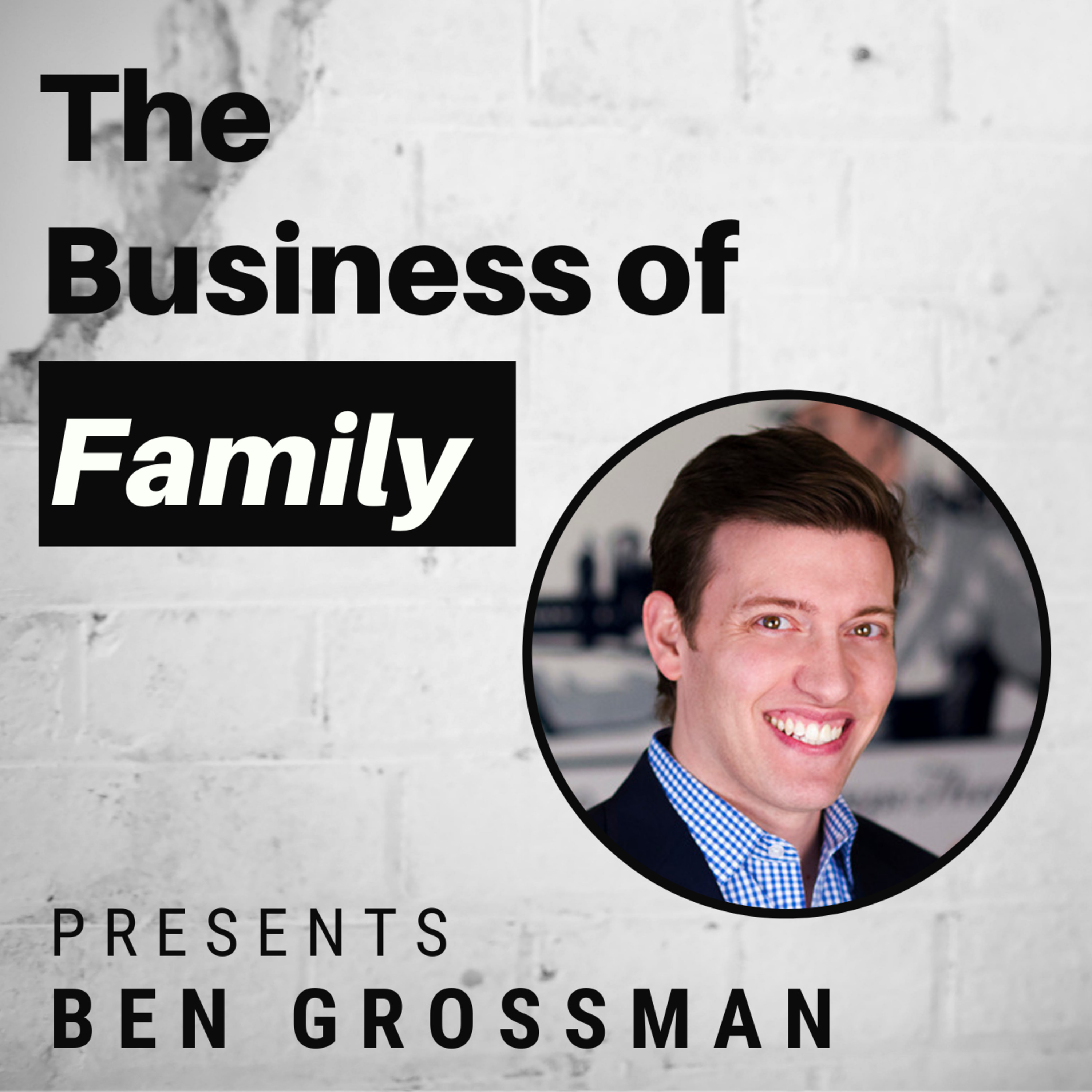
Episode 36 · Season 1
Co-President Siblings Stewarding a 111 Year Old Family Business
Key ideas from this conversation
Taking over from their father, Ben and David asked every colleague for a confidential start, stop, continue review of the company.
The four things the founder wanted from life, told to his grandson over lunch, still guide the family.
Nothing in business is worth risking the family, a lesson their father taught with newspaper clippings of another family's split.
Read the full show notesBio, standout quotes and the episode timeline
Grossman Marketing Group was founded as Massachusetts Envelope Company in 1910 by Maxwell Grossman, whose lifelong dream was to own his own business.
Now, 111 years since its founding, Ben Grossman, along with his brother, David, are the 4th generation of family leadership. Today, the company is a full-service resource helping clients with a broad range of traditional and digital marketing needs.
Ben Grossman holds a BA from Princeton University and an MBA from Columbia Business School. Prior to Columbia, Ben worked as a strategy consultant to Fortune 500 clients, as well as started and sold a sportswear and marketing firm.
Ben is also deeply involved in sustainability and how it relates to business, and writes and speaks frequently on the topic.
Standout Quotes:
- "Our prices make friends and our service keeps them" - [Ben]
- "What he was really saying was that life is made up 3 things; Family, Career, and Community, and education has always been of critical importance to our family" - [Ben]
- "Find a way to generate revenue as soon as possible because numbers speak for themselves and no one will ever question your existence at the organization if you generate sales and gross profit" - [Ben]
- "Learn the business, understand exactly what's going on in the business, so when you speak up you know what you're talking about, and you're right!" - [Ben]
- "What our grandfather and our father tried to impart in us is that although business is incredibly important, nothing in business is important enough to ever risk jeopardizing your family relationships" - [Ben]
- "That sort of value of just 'try and treat people the way you'd want your family to be treated' has been passed down from generation to generation" - [Ben]
- "Regardless of how successful you are, or your family's been over the years, you need to recognize that markets can change and you must always remain responsive to customers' needs" - [Ben]
- "Ultimately, we have to be willing to evolve because if we don't evolve, we will get left behind" - [Ben]
- "Always do right, this will gratify some people and astonish the rest" - [Ben]
Key Takeaways:
- The company has always had a service-driven culture and this has kept the business going for over 110 years.
- Ben explains that the company had initially started as an envelope company and had also bought up different companies during its growth, with the investment in promotional products being the most notable that boosted growth.
- Following his education, Ben had decided to step out and gain some experience although he was passionate about finally going back to join the family business.
- Ben explains that based on lessons from his great grandfather, Life is made up of 3 things, Family, Career, and Community. Education has always been of critical importance to the family.
- The "Start, Stop, Continue" Review Method: Ben had asked workers to review the company's methods to identify processes that needed to be implemented, stopped, or continued for better productivity.
- Ben shares that following political engagements, his father moved on from the family business and is fully engaged in public service. He adds that working harmoniously with his brother is aided by the understanding that every win is for the company and not the individual, and also their roles tend to be complementary to each other.
- Understanding that it was necessary to establish credibility by generating profits immediately after joining the family business, Ben reached out to some prospects and started to achieve his goal within a month.
- One of the critical values imparted by their grandfather was the understanding that business should never jeopardize family relationships.
- Another key value learned was the importance of treating colleagues the way family would be treated in a workplace.
- You need to be willing to adapt to ever-changing business environments and conditions. Ben remembers how the family had always focused on the customer, and that what differentiated their company was the incredible customer service.
- Highlighting the involvements of different family members in service to the community, Ben explains that service to the community is one of the values that have been passed down each generation beginning from the Founder.
- Considering the future, the most meaningful investment made in recent times has been expanding into e-commerce.
- Ben shares he would give his children the same advice he got from his grandparents regarding joining the business, and this is to do what their heart wants to do, follow their career path, and not be constrained to join the business based on the financial implications.
- From Ben to his kids: Always do right, this will gratify some people and astonish the rest
Episode Timeline:
- [00:45] Introducing today's guest Ben Grossman, and Grossman Marketing Group, the Massachusetts envelope company.
- [01:36] The history of the Grossman family business.
- [07:01] Ben narrates how he and his brother joined the business.
- [11:48] As brothers, how do you get along and what roles do you each play today in the business?
- [21:50] A listening tour: Using the "Start, Stop, Continue" Review Method.
- [25:32] Do you have any apparent failures that have set you up for later success?
- [32:11] Ben describes the family history of service to the community.
- [37:54] Has the family been intentional about documenting its history?
- [39:26] How do you pivot and evolve a marketing group like yours into the 21st century and beyond?
- [43:39] Are you nurturing your children to be the 5th generation of the business or leaving it to them to find their path?
- [48:31] A letter to Ben's Kids.
Links:
- Business isn’t just about profit – reflections from four generations in business - Ben Grossman
- my great grandfather’s dollar-a-year check from the US Government
- Letter the company sent out when he left to serve FDR and my grandfather left to serve in the Army
- Letter my brother and I sent out when our father left the company to serve as Treasurer of Massachusetts 70 years after our great grandfather left for public service
- Grossman Marketing – a century of excellence : Grossman Marketing Group was founded as Massachusetts Envelope Company in 1910 by Maxwell Grossman
- Ben Grossman : Ben Grossman is the co-leader of his family’s 4th-generation family business, Grossman Marketing Group, where he enjoys focusing on acquisitions and sustainability projects, among other things
- SwagCycle: : SwagCycle is a startup focused on responsibly managing the lifecycle of branded merchandise. When companies rebrand or get acquired, many often dispose of their obsolete branded merchandise. Leveraging SwagCycle proprietary network of partners, SwagCycle make this problem go away by helping companies repurpose and recycle unwanted branded items in a responsible, ethical, and affordable way.
Read the transcript
This transcript was generated automatically and may contain errors, including in names. Listen to the episode for the exact words.
MikeWelcome to The Business of Family. I'm your host, Mike Boyd. Multigenerational wealth creation involves so much more than capital accumulation. The most successful families cultivate values, stories, knowledge and resources to pass on to the next generation, and they do it very intentionally. On this show I sit down with members of some of the world's most interesting business families to hear how they do it. To see where your own family stands, take the Business Family Diagnostic at businessoffamily.net.
Grossman Marketing Group was founded as Massachusetts Envelope Company in 1910 by Maxwell Grossman, whose lifelong dream was to own his own business. Now, 111 years since its founding, Ben Grossman, along with his brother David, are the fourth generation of family leadership. Today, the company is a full-service resource helping clients with a broad range of traditional and digital marketing needs.
This is a broad ranging and fascinating discussion. And I particularly love the emphasis on service both within the business and to the community. I hope you enjoy this conversation with Ben Grossman. Ben, thank you so much for being here. It is fantastic to have you with us this week.
BenMike, thank you so much for having me. It's an honor.
MikeYou have a fantastic fourth generation business story to tell. Can we go all the way back to the beginning, please, and understand how the business was founded and where it began, I believe, in 1910, was it?
BenThat's right. So my great-grandfather, Maxwell Grossman, he was the second youngest of nine children. He was an immigrant from Eastern Europe, and he came over from Eastern Europe in the turn of the 20th century. he left school at an early age to help support his family like a lot of like a lot of immigrants did at the time and he first worked as shining shoes in the east boston ferry docks and then he got a job as a delivery boy for an envelope company in boston and he started doing some selling for them and he realized that he had some talent at sales and he convinced a supplier to give him some credit and as a teenager, he started Massachusetts Envelope Company in 1910.
MikeHow does it go from there? I mean, an envelope company in 1910, and here we are well over 100 years later. What were some of the key milestones or key evolutions of the business as other generations ultimately joined it and it scaled into what it is today?
BenSure. So thankfully, we have evolved. Otherwise, I don't think we'd be in business anymore. His two sons, Jerry, who was my great uncle, and Edgar, who was my grandfather, joined Max and the business in the mid to late 1930s. And for the first 50 to 60 years of the business's existence, it was an envelope printing and distribution company in Massachusetts and the surrounding area.
And it was a successful business. It survived the Great Depression. It survived World War II. And it evolved with the times. And the company was always built on service. And they had a saying back then. It said, our prices make friends and our service keeps them. And from the beginning, the company's been a service-driven culture. And that's really what's kept the business going and what's gotten us to today. And we still try to stay true to that message of having a service-driven culture. My dad, Steve, joined the business in the late 60s out of Harvard Business School, spent a few years at the business, felt like it was a little crowded at the time. Some of his
cousins were in the business, and he felt like he needed to get some outside experience. He left the business and went to Goldman Sachs and trained under people like Bob Rubin and other luminaries at the firm and spent several years there, rose to vice president. And he had an opportunity in the mid-1970s to come back to the business and buy his great uncle, sorry, his uncle, my great uncle, Jerry, out because Jerry wanted to move into full-time public service.
So my dad came back in 1975 as 50-50 partners with his father, my grandfather. And they oversaw a period of pretty rapid expansion. They acquired a number of companies in Connecticut to expand into the New York area. They started buying other related businesses, forms businesses, and commercial printing businesses, and then eventually a graphic design agency to try to print all the items that went inside the envelope and then design the entire package.
And then by that point, in the early 2000s, my brother, David, older brother, David had joined the business. And the business decided to invest in promotional products, branded merchandise. And that's really what's unleashed the vast majority of our growth to today. But it's been a natural evolution, listening to our customers, understanding what they want from the business, what their pain points are, how Mass Envelope and now Grossman Marketing could address those pain points by offering them service, quality, value at all times.
And that's sort of how the business has evolved from its Envelope origins to more of an integrated marketing services and e-commerce business today.
MikeI love hearing those evolutions. One thing I want to touch on there or follow up on was the ownership change with your great uncle, Jerry. You mentioned that your father originally left because it felt a bit crowded and there was cousins and other family members involved in the business. Is it safe to assume that those cousins were Jerry's children? And so when he was bought out, did that sort of arm of the family ultimately no longer work in the business and and that streamlined the family business?
BenThat's exactly right. So at this stage, it was third generation and the ownership structure was my grandfather, Edgar, and my father, Steve. And then ultimately, it's come down through Steve's line of the business to me and my brother, David.
MikeSo I'd love to hear more about how yourself and David joined the business. Was that a predetermined path? Or did you go and explore other options first in terms of career opportunities? How did you find your way back? Or how did each of you find your way back into the business?
BenSure. So David went to Princeton, worked in marketing and development in New York City. and in 2000, during the tech bubble, he was working for a tech startup in New York City. And my dad called him and said, David, what do you think about joining the business? And my brother said, what business are you talking about? And he said, no, come on, the business, our business.
And my brother said, I really haven't given it any thought. and he said, well, maybe you could think about it and consider it. My brother was, I believe, engaged at the time or about to be engaged. And he talked it over with his now wife, Mary Jo. They decided to take a trip up to Boston and give it a shot.
And that was 20 years ago. I believe my brother joined in 2000, 2001. And he's been in the business ever since. I took a slightly different path. So I also went to Princeton. I worked in strategy consulting in New York City, and then I went to business school at Columbia. And while I was at Columbia, I was really interested in exposing myself to fields that I have some passion for, investment management, venture capital, startups. I did an internship for a venture capital firm in New York. I did my summer internship. I was a summer associate at Goldman Sachs. I was lucky enough to get an offer to go back full-time. I explored some other startup
projects as well. But ultimately, I was most passionate about joining our business, which at the time was 95, 96 years old. The company was going through a period of rapid change. The industry was evolving quite a bit. And I thought that joining the business and coming to work with my dad and my brother, and then of course, other family members as well.
My grandmother, Shirley, has remained involved in the business even to this day. And my two aunts, Mary Ellen and Amy, are also involved in the business. I was really excited about the prospect of being the second member of the fourth generation to join the business with the goal of playing a leadership role in the company. And so I joined the business in 2006.
And I'll just be marking my 15-year anniversary at the company later this spring.
MikeThat's fantastic. It's quite a story. One thing that stands out for me there is the world-class education that you've all had. I'm hearing Harvard, Princeton, Columbia, opportunities at Goldman and others. Was that very intentional? Was that something that the family set out to achieve and held in high regard? Was education a big focus or a value of the family?
BenAbsolutely. I mean, my dad has recounted several times when he was in high school, the last time he saw his grandfather, Max, so the founder of the company. The last time he saw his grandfather, Alai, was his senior year in high school. They were having lunch. This was in the winter of 1963. He died that June. And he said to my dad something to the effect of, Stephen, there were only four things I ever wanted to do with my life. I wanted to have a healthy family, educate my children, own my own business, and give something back to the community.
And my dad has remarked on that conversation that that was really the most important conversation he ever had in his life, because what he was really saying was that life was made up of three things, family, career, and community. And education has always been of critical importance to our family. Our great-grandfather was not an educated man. I mentioned that he left school at an early age to help support his family.
He was the second youngest of nine children. but the rest of our family, we've been incredibly fortunate to have had incredible educations and been given every opportunity to explore different paths. But ultimately, the path that my brother and I were most interested in was joining the company.
MikeThat's fantastic. Thank you for sharing that because there's a similar story about education in my own family. And it all starts with someone who didn't have it and set out wanting it for their children and grandchildren. And I think that's really how true generational wealth or true generational values in education is created. So I enjoy conversations like that. Tell me about joining the business. Your older brother was already in there for four or five years by the sounds of it when you came along.
And you've been there for 15 years. You've both no doubt worked your way up over that period of time. How do you get along as brothers working in the family business, both fourth gen? And is your father still involved? What roles do you each play today?
BenSure. So our father, although he retains an ownership stake in the business, he moved on from the business a little bit more than 10 years ago. So we've had a really a four generation involvement in our family with public service and political activism. Our father ran for, in 2010, he ran for state treasurer of Massachusetts and was elected and was sworn in in January of 2011. And so he moved on from the business in 2011 and he served a term as treasurer, ran unsuccessfully for governor in 2014.
And he partnered with Michael Porter from Harvard Business School to build out a national nonprofit initiative for competitive inner city, which is focused on helping inner city entrepreneurs get access to management training and capital. For me and my brother, we're in the business together, the two of us, and we have worked our way up in different ways.
But ultimately, it's really important to us that our interests are aligned and that there There really is not any sibling rivalry. For us, we want the same things. David and I want to grow the business. We want to have work-life balance. When David achieves success, I don't feel smaller for his success. I feel bigger. It makes me feel incredibly happy because it's a win for our enterprise. It's a win for us. And likewise, when I have a win, it makes David feel great.
We never feel smaller from the other sibling's success. We feel good about it. Some people have a hard time believing that. But if you met us, you'd understand. We're very different people. My brother oversees more of the creative elements of our business. I oversee more of the strategic, analytical elements of our business, M&A, strategic investments, etc. We both ultimately have our hands in business development and sales because it's a sales-driven culture. But we focus on different things and complement each other really well.
MikeThat's fantastic. So would you say that you were always naturally different in that you have complementary skill sets and work well together in the business? Or is that something that you've chosen to cultivate in order to add the right value in the way the business needs it?
BenSure. David is naturally more touchy-feely, more operates from the gut. And I think things through maybe a little too much and a little bit more analytical, but it works out really well. I mean, we do balance each other out. But yeah, I think we've always been different. I mean, my brother and I, we look different, we speak differently, but our values are the same.
We care about our family. We care about building a good business. We care about having our colleagues' backs and building an environment where people feel comfortable, where people feel safe, where people feel respected, and where people feel like they can be their best selves. And so, although we are different in many ways, we share the same values, and that has enabled us to have such a strong business partnership.
MikeAnd how about when you ultimately joined the business as the owner's son or as the leader's son, did you feel like you had to come in and prove yourself? Did you have to win hearts and minds in terms of other employees in the business and show them the way that you could add value to the business?
BenGreat question. Absolutely. So I actually did a project in the spring semester of my second year in business school. The class, it was taught by a professor, Frank Flynn, who's, I believe, now at Stanford. And the class was called Power and Influence. And the project, The final project, we were tasked with interviewing people in organizations that we were going into to learn how we could build strong relationships and build influence in those organizations.
So for folks who were going into investment banking at J.P. Morgan, they were supposed to interview alumni who went to J.P. Morgan and understand the organization and how it worked and what were best practices to build relationships there. For me, I actually, for my project, I interviewed my brother, David, and I interviewed several other alums of the business school who went into their family businesses.
and one of the key lessons I learned, even though I think my goal was to focus a little more on corporate strategy, I'd done some of that in other jobs that I'd had before. One of the lessons that I was given by someone was find a way to generate revenue as soon as possible because numbers speak for themselves and no one will ever question your existence at the organization if you generate sales and gross profit. The folks in the Salesforce won't question your existence.
But just as importantly, the folks inside the organization will see that you are working hard and generating sales, generating gross profit, which is what is required to cover expenses. And that alum who I spoke with said that if you do that, people will see that you're working to protect their jobs. And that, as much as anything, will help you establish your credibility early on.
So what I did when I joined the business, I came to the business with a list of prospects that I thought I could reach out to from my various networks. And I was fortunate to pretty much in the first month, start generating sales. And I've always been proud of the fact that I've never cost the company a penny from the day I walked in the door.
MikeThat's fantastic. And so has anybody questioned your existence? I think that's an interesting phrase. As you came in and proved yourself so early, did that then allow it to be an easier on-ramp into the family business and working with other colleagues that had perhaps been there for many years prior to your joining?
BenSo of course, people knew me. There were a number of people in the organization who had been there since I was a child, might have even been there since before I was born. So they remembered me as a child. And I've prioritized early on learning the business cold. Someone else I spoke with gave me some advice, said, learn the business, understand exactly what's going on in the business. So when you speak up, you know what you're talking about. And you're right. Because it would be easy to be written off as the owner's son with the education who comes in thinking he knows what he's talking about when he really doesn't.
And so I tried my very best to learn the business cold and establish my credibility through knowledge. A book I bought and read before I started, there's a book called The First 90 days. And it was about getting into a job and best practices to achieve early success. And again, it just came down to basic fundamentals. Listen to people, find ways to add value, find ways to solve problems, and remain humble. Another alum I spoke with said it's really important. I mean, I try to remain naturally humble where possible, but I think it's easy sometimes to lose sight of how you comport yourself. And an alum I spoke with from Columbia gave me the lesson of just being really cognizant of how I carried myself coming into the company,
what I wore, how I spoke, just remaining humble at all times. Because again, you come into a family business as a member of any generation, but coming in as a fourth generation with my last name on the building, I was really focused on just trying to build a relationship, showing people respect and learning so that I could add value as quickly as possible.
MikeAnd I understand you and your brother almost did a listening tour of sorts. You were learning the business cold and you were coming in trying to win the respect and know what you were talking about. how did you go about that? How did you demonstrate that you were listening and build rapport with everyone that you spoke with?
BenSure. So I think that what you're alluding to is when our dad was elected state treasurer and was sworn in and moved on. And our dad had been involved in hiring virtually every single person in the organization, had done so much to build the organization and bring it into the modern day. And what my brother and I wanted to do was work hard in our own way to foster an environment where different viewpoints are welcome.
Because we knew that if we didn't get people to speak up about what they thought about the business, we might not be able to innovate. We might not be able to think as creatively as we wanted to because our only vantage point in the business is sort of what we see. We don't see what everyone else sees.
So we actually decided to go on somewhat of a listening tour. There's an HR review process that some people use called Start, Stop, Continue, where you work to review someone in a company and you review them on what they should start doing to improve, what they should stop doing, and what they should continue doing to reinforce positive behavior.
And what David and I decided to do was flip that on its head and ask every colleague at the company to do a start-stop-continue review of Grossman Marketing Group. So what we actually did was a few months into our tenure as co-presidents after our dad had been sworn in as state treasurer, we sent out a memo to every employee where we basically wrote to them that over the next few weeks, we wanted to schedule in-depth one-on-one meetings with every single colleague.
And what we said in the email, we said, whether you've been here one year or almost 40 years, you are each intimately involved with who we are, what we do, and how we do it. And therefore, each have unique perspective to bring to bear on these important strategic decisions. And we explained what the start, stop, continue review process is.
So for example, start, we wanted people to highlight processes or procedures that they'd like to see us implement, good business practices that they've observed from clients or suppliers, or completely new business lines that they thought we should enter. So stop. What we meant by that is we asked them to highlight ineffective or inefficient processes or procedures or bad business practices that the company did and continue.
And we sort of joked in the email, we said with 101 years in the business, now it's 111. And we said, with 101 years in the business, there have to be some things that we do well that help to differentiate us from the competition, exclamation point. And we explained that each conversation would be 100% confidential. It would just be that colleague and the two of us in a room.
And we explained that once we had conducted all the meetings, we would use their observations, comments, suggestions to help us craft a business plan for the company as we moved into what was then our 102nd year and beyond. And what was just something that we drew from that is that some of the most beneficial ideas that came from people were from some folks you sometimes would least expect it. Folks who worked in the warehouse or who ran a press or drove a truck, folks who see a different part of the business than we see every day and have incredibly valuable insight to bring, but maybe hadn't been engaged in that way before. And some of these folks came
in with four or five pages of notes, handwritten, that they clearly had spent many hours thinking about. And we took so many actions, both kind of granular as well as larger and longer range strategic planning from those conversations. And well, A, we wanted to take those conversations to improve our company, but we also wanted to send the message to our colleagues that we cared what they had to say, that we were listening, we were open to improvement, and that they all had a place at the table.
MikeThat's a terrific story. I love hearing very practical examples like that of how you've been able to come into a business and listen carefully, then take action, and ultimately make a difference. And a great way for new leaders to build confidence, I think, in an organization as well. So I'm curious if there's anything that hasn't gone so well.
Do you have any favorite failures or apparent failures over the years that have helped shape you or teach you some lessons, whether it be in leadership or business, that have actually set you up for later success?
BenSure. So for us, again, our main priority in the company is what we've learned from those who came before us, what were things about values around the critical need for mutually respectful family relationships. Our grandfather and father used to tell us cautionary tales about business issues and turf wars ripping apart a family. One example I remember, I was pretty young, probably under 10 years old. And there was a pretty famous story of a family splitting apart. It was the Berkowitz family who owned Legal Sea Foods, which was a prominent restaurant chain here in the Boston area. And what ended up happening in that business was the patriarch of the family basically pitted his two sons against one another to run the company.
And it ended up destroying the relationship. One of the sons was essentially tossed out of the business and the family split apart. And what our grandfather and our father tried to impart into us is that although business was incredibly important, nothing in business was important enough to ever risk jeopardizing your family relationships. And I can remember sitting with our dad when this story was breaking and being covered in the Boston Globe and our dad ripping the articles out from the Globe and sitting down with my older brother and I explaining what had happened and why that could never happen in our family and why it should never happen in our family.
And we're really lucky that the values that our grandparents kind of taught us about the importance of family have held true in our company since then. I think another value that has been really important and imparted upon us is the importance of treating colleagues in a way that we'd want, like how we'd want family members to be treated in a workplace.
ultimately we're a service-based organization and we depend on our colleagues to deliver every day and our our dad used to say that the most important asset in our company walks uh in and out of the door uh every single day our people and we've you know a a story that my dad had had had told us over the years was of a colleague who came to our dad. She was a valued member of the team. And more than 30 years ago at this point, she and her husband were planning to adopt a child.
And she came to my father and said, Steve, I hate to do this, but I have to tender my resignation. And my dad said, why would you possibly be resigning? You're such a valuable member of the team. And she told him, well, I'm adopting a child. And the adoption agency says I have to take six months off to be at home with the child for bonding. And I won't be able to do my job for six months. And my dad said, without even checking with our grandfather, who he was running the business with at the time, because he knew they'd be on the same page, he said something like, not only am I not accepting your resignation, and not only will your job be here six months from now,
but we're going to pay you 100 cents on the dollar for the six months that you are out. But there's been countless stories like that during our grandfather's time and the time that our father ran the business. And my brother and I have tried to continue that type of support of our colleagues because ultimately, we want people to know that if they have a situation in their lives, the health situation or family situation, we have their back.
And the last thing they need to worry about is their paycheck. And that sort of value of just trying to treat people the way you'd want your family to be treated has been passed down from generation to generation. And it's something that we try very hard to live up to. It's hard because it certainly costs money to do. And people have said to us and have said to our dad before, how can you afford to do this?
And sort of the answer to that is how can you afford not to? How can you afford not to invest in your colleagues?
MikeI love that. It's an extraordinary story. And the sort of story that you typically only hear in family-owned and run businesses that are taking the long-term view and investing that way as well. You talked about some of the other values and lessons that have been passed down throughout the generations. I wonder if there's any more that you want to share with us that have maybe helped shape your journey so far.
BenSure. One of the core values is just never, ever taking anything for granted, that you need to be willing to adapt to ever-changing business environments and conditions. Regardless of how successful you are or your family has been over the years, you need to recognize that markets can change and you must always remain responsive to customer needs. What I remember growing up was that my dad and grandfather and our grandmother and our aunts always talked about the customer and what differentiated the company was their incredible customer service.
It's sort of like how now Zappos doesn't say they're a shoe company, they say they're a service company. And that's really been a hallmark of this organization from its founding. And I remember having them pull us aside and give us lessons on serving the customer, dealing with a situation, a problem if it arose on a weekend, or on a Friday night, or whenever it happened.
And it was all about servicing customers and keeping them happy. And I don't know if I mentioned this to you already, but we have on our wall in one of our conference rooms an enlarged copy of a direct mail piece from the 1930s, where the slogan on the bottom is, quote, our prices make friends, our service keeps them.
And that value of having a service-driven culture at all times and having a relentless focus on the customer, we try to stick to that today.
MikeYou're talking about service within the business quite a lot, but I understand the family is also big on service to the community. Is that a value that's passed down from generations or does it just so happen that there's been multiple members of the family that have been in public service and contributed in other ways?
BenSure. No, it's a great question. As I mentioned that the last time our father saw his grandfather, our great-grandfather alive, he explained to our dad that he'd only wanted to do four things, have a healthy family, educate his children, own his own business, and give something back to the community. And the concept of never forgetting about the community in which you live, because ultimately, healthy communities, you have to invest back in them. When, as I I mentioned to you earlier, our dad moved on from the company 10 years ago when he was elected to public office in Massachusetts, and he's remained engaged in public service full-time. He's deeply passionate about economic justice, especially for those who have tougher access to it. And
the lessons of public service have been passed down. One of our favorite sort of mementos in our company is a letter that the company sent out the day after Pearl Harbor. So Pearl Harbor was December 7th, 1941. And my brother and I came across a letter in the company archives that was dated December 8th, 1941. And the start of the letter says, Dear American, we are proud of the company we keep. It is a pleasure and privilege to announce at this time that our president and general manager, who at the time was my great-grandfather, Max, has been appointed by the president of the United States to serve full-time in Washington in the office of price
administration at a dollar a year. Our treasurer, Edgar Grossman, my grandfather, will also serve his country by joining the armed forces of the nation on January 1. And the letter ends, quote, our company will serve you as we are serving our country. And when our father, Steve, was sworn in as state treasurer of Massachusetts, my brother and I decided to send a letter to everyone in our database, all of our customers, all of our suppliers, all of our business partners, and anyone who'd ever been associated or affiliated with our business.
and we sent a cover letter and we attached a copy of that letter from 1941. And we started the letter, we said, dear friend, as we were in 1941, we're still proud of the company we keep. And we explained the context about our great-grandfather moving on to become a dollar a year man under President Franklin Roosevelt and the Office of Price Administration. And we explained the commitment to public service and about how our father was, we were quite proud of him about how he was moving on to be state treasurer and proud that he was overwhelmingly supported both across party lines, which is a nice change these days. And at the end of the letter, we wrote the following,
as Max Grossman did 70 years ago, our father is leaving the company in our hands, those of his two sons. We pledge to you as brothers and partners that we will continue to service your needs as we have for over 100 years, while doing our part for our community, both locally and nationally. Thank you for your business and for the trust you have placed in our organization for so many years. Sincerely yours, David and Ben Grossman. That commitment to public service is a four-generation commitment going back to our great-grandfather, moving on from the business. And he never came back to the business. He left. And what he did in the Office of Price Administration is he worked for the economist John Kenneth Galbraith. And our
great-grandfather was responsible for paper rationing across the country, leveraging some of his expertise from the industry. And a number of business leaders from across the country, that's how they could serve because they were too old to serve abroad. But they wanted to be able to take their skills. And he eventually, and he continued to serve in a number of different capacities for another more than 20 years until he passed away in 1963. But then, you know, our grandfather and his brother, Jerry, who was incredibly active in public service, nuclear disarmament was one of the causes of his life. My grandmother, quite active in the community.
our dad Steve as I've talked about our two aunts Amy and Mary Ellen our mother who I haven't talked about yet Barbara who is a professor at Tufts University and has been quite active in a number of incredibly meaningful organizations and has taught us so much about how to you know serve your community through education how to serve the community in other capacities as well and then it's been passed down to my brother and I, and we try our best. It's hard to balance the business and we have young families and trying to be active in the community. But we also know that it's our responsibility to invest back into the community that's given us so much.
MikeI think it's an extraordinary contribution that your family have made and continue to make. and you seem to know your history so well and in so much detail. Has the family been quite intentional about passing down its stories or documenting its history in a specific way that helps the fourth generation and what will ultimately be the fifth generation understand its roots and understand its values and where it's come from?
BenSure. So I think a lot of what has been passed down, has been more kind of verbal stories. I mean, we do have a number of really quite meaningful mementos from the company archives. It's been really enlightening to see some of the ways that the company used to market itself in the 20s and 30s. Our great-grandfather was not an educated man, but he just was naturally a fantastic salesperson and marketer.
And some of the pieces of direct mail that they sent out back then were quite innovative. Our favorite one is a mailing that was from the 1930s that we came across an advertisement for what was then Massachusetts Envelope Company that they sent out during the Great Depression. And it shows a worker, a factory worker, shaking hands with what looked like a businessman in a tie.
and what the slogan, it said, sales mean jobs. And at the end of the day, that says everything. Without sales, without revenue, without our team's constant hard work, we won't succeed and be able to ensure the livelihood of dozens and dozens of families who are connected to our company.
MikeI'd love to turn now to the future. You're the young generation, the fourth generation taking the helm of the business. Where are you driving it now to continue this amazing story, 111 years so far? What's next? How do you pivot and evolve a marketing group like yours into this 21st century and beyond?
BenSure. No, it's a great question. I'd say the most meaningful investment that we've made during the time that I've been at the company, other than in our people, of course, has been in expanding into ecosystem. We invested in a company back in 2008 that was a real leader in e-commerce services for larger companies. And that investment has helped to supercharge our growth. And it also helped to teach us how M&A, small, medium-sized business acquisition, if done right, can help us grow.
And during the time that my brother and I have been at the company, we've now made seven acquisitions in full and two other strategic investments. Some have added to our capabilities in e-commerce. Some have gotten us into other regions. Some have been acquihires bringing on talent. And some have been situations where owners wanted to take a little money off the table and take a step back, remain engaged.
Some wanted to retire. One of those first acquisitions we made, I had a lunch introduction with the owner. And I sat with her and she looked me in the eye and said, Ben, there are two things that matter to me to find a potential partner. I want to protect my people and I want to protect my legacy. And I looked at her across the table.
I'd already reviewed the financials. And I looked at her across the table and said, you have my word that if you partner with us, both will be protected. And the transaction was quite successful. And again, the way in which we approach all of those M&A conversations, it's kind of similar to how we try to run our business, how we aspire to be in terms of being good listeners, keeping our promises, doing the work, sticking to the work. And it's almost like chopping wood every day and sticking to it. And no two deals are alike. Every situation is a little bit different. Every priority of a prospective seller is different. But ultimately, the values that we try to bring, just of looking after our colleagues and trying to innovate and
providing a good home for people and trying to be listeners to people. It's created an environment where we've seen a number of amazing opportunities present themselves. And we've started to see quite a bit more deal flow in the space because of the reputation. We're a pretty open book about it. When we meet with a prospective seller, we offer to connect them, if they'd like, with any one of the folks that we've done a transaction with. We don't have to be on that conversation.
They can have a one-to-one conversation to hear what their experience was like working with us. And you can immediately see when we say that, that they relax more, that they feel like we're being transparent with them, and that we have nothing to hide because we don't. And ultimately, between making strategic investments, acquisitions, looking at ways that we can continue to add value to our clients in ancillary businesses that we operate in. Like I said, e-commerce has been a fantastic growth area for our business. And we expect it only to continue to be more and more of a part of our business. Ultimately, we have to be willing to evolve because if we don't evolve, we will get left behind.
MikeAnd do you anticipate that there's going to be a fifth generation in the family business? Are you nurturing your children to consider it as a career opportunity, or are you leaving that up to them to find their own path?
BenWe don't know. It's a fourth generation business. Right now, my brother, Dave, and I run it. We have a younger brother, Josh, who is the best student among us. He has had amazing opportunities. He has this fantastic career. He hasn't been interested in joining the business. So most likely, it's going to be my brother and I over time in the company.
In theory, there could be a fifth generation. It's a little hard to know. Our grandfather, Edgar, of blessed memory, and our grandmother, Shirley, who we're so fortunate is alive and well and doing great. they had a philosophy where they said to their kids, the business is always going to be here as an opportunity. If you want to come into the business and want to work hard, the business opportunity is there. But you should go do what your heart tells you to do.
You should follow whatever your career path is and whatever you do, as long as it's something meaningful and productive. Sort of like, mom and I will be supportive. That's sort of a quote from our grandfather, Edgar. And I think my brother and I plan to tell our children the same, the same way that we were told by our parents, follow our passions in life to not let financial implications dictate what you do in your life. I mean, it's no coincidence that both my brother and I chose to come back into the business as we viewed it as an opportunity to be entrepreneurial, while also building on a multi-generational family legacy. And we know we're the great
beneficiaries of some visionary business people who gave us this platform. And we've tried to harness that to build on that legacy. So ultimately, we subscribe to that same philosophy that our grandparents had, that you should follow your passion and do what you want to do. And if that is to go into research or to be a teacher or to go into music or law or something else, that's wonderful. We just want our kids to be happy and healthy. And ultimately, if my daughter Madeline or my son Jack eventually join me somehow working, that would be the honor of a lifetime and a privilege. But I'm certainly not going to put pressure on them to do that. I want
them to follow their passion.
MikeGreat answer. I'm curious from a family governance perspective, Are the values that are passed down all channeled in terms of the company values and what you stand for in the contribution to community? Or are they also documented in a family constitution or a charter or any sort of formal documents that bring together the business of family?
BenWe don't have any formal documents like that. It's mainly just sort of what we're taught. I mean, pre-COVID, we came together. We had a number of family gatherings over the years where we've tried to learn. And those who've come before us have tried to teach us the right values. And we give so much credit to our parents for the values they've taught us and for our grandparents and even earlier and our aunts and uncles.
Without the lessons that they've taught us, which we've tried our best to internalize, we wouldn't have been able to get this far. But there is not a sort of formal family constitution. I'll tell you what I try to do with my kids is when my daughter was just born, I set up an email address that she now knows exists, but she knows does not have access to it. And I created a similar one for my son when he was born. And my wife and I have tried to, when we remember to do it and when we have the time, send them letters, which hopefully when they're older and mature enough to appreciate them, we'll give them access to and share.
Again, it's not really business related. It's more just how much we love them and the joy of being their parents and some of the meaningful experiences that we've had.
MikeThat's beautiful. I love that. And we do a similar activity every year. I think it's incredibly powerful, even as a tool of reflection, not just the message that you're sending to children.
BenAbsolutely.
MikeOn that note, Ben, it's time for our final question. And it's one that you will have heard me ask all of the previous guests. Imagine you're writing a letter to your children. What is one lesson or idea that you don't think many parents would mention, but you consider important to understand?
BenSo there's a Mark Twain quote, which my parents have shared with us before. The quote is, always do right. This will gratify some people and astonish the rest. And running the company during the last decade that's been bookended by the great recession and the global pandemic, I've realized the importance of adaptability and resilience. My brother and I have learned that, but not to the exclusion of one's empathy and humanity.
you know we understand to the core of who we are you know that we're responsible for the lives and livelihoods of so many so you know that that that quote of always do right this will gratify some people and astonish the rest it's really simple it's sort of like the golden rule i mean you want treat people the way you want to be treated but you know at the if you if you do right it's the best you can do and results will kind of speak for themselves and it'll all sort of work out over time.
MikeIt's a great lesson. Ben, thank you again for being here and sharing your incredible story. You're building on such a legacy and I can't wait to see where it goes next. Thanks again.
BenThank you so much, Mike. It's been an absolute pleasure getting the chance to speak with you today.
MikeTo find more episodes of the Business of Family podcast, go to businessoffamily.net. Thanks for listening to The Business of Family. You'll find the transcript and key ideas from this conversation at businessoffamily.net, along with the Business Family Diagnostic. It's free, and it shows you where your own family stands. And if someone in your family should hear this episode, please send it to them too. I'm Mike Boyd. Until next time, take care.
Keep listening
If this one landed, start here next.
My Ceiling is Your Floor - 2nd Gen Leader of Canadian Health Business
Two very different brothers keeping the relationship ahead of the business.
The First Woman & 4th Generation Charlestein to Lead Premier Dental
Another fourth-generation leader of a century-old family company.
4th Generation Inheritor, Coach & Author of Disruptive Successor
The Business Family Diagnostic · Relationships
When David wins, Ben feels bigger.
Two brothers running a 111-year-old company with no written agreement, only a story their father told them again and again. When there's a falling out in your family, can the people involved repair it?
“Difficult topics get raised and discussed rather than avoided.”

Every family wishes someone had recorded the generation before.
I built Enduring Stories to do it for yours: a guided voice conversation, from home, that keeps your family's voices, values and history.
The newsletter
The most useful things in these conversations are the things families rarely say out loud.
I share them in my newsletter once a week. Sign up to receive the ideas directly and start building the foundations for your family today.