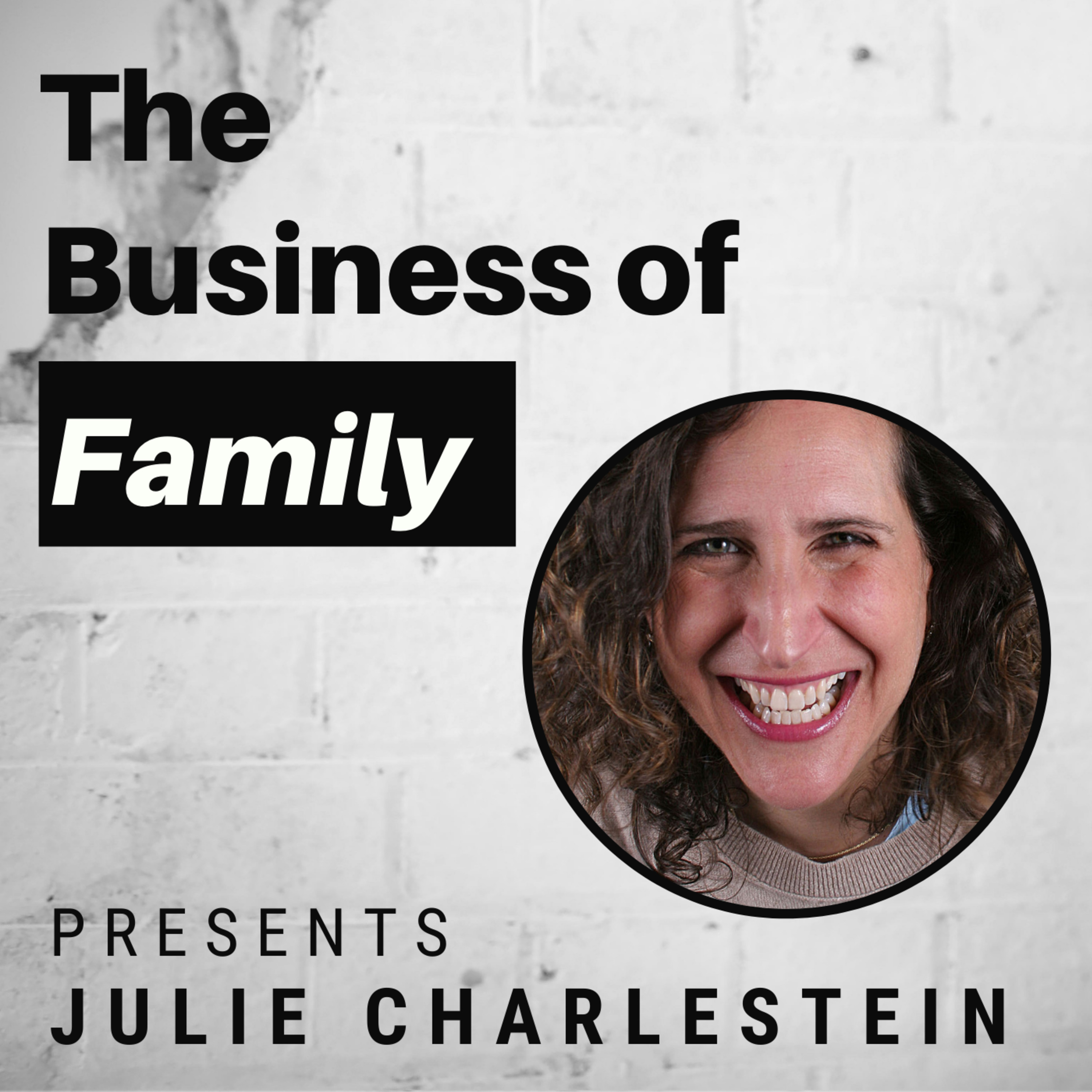
Episode 33 · Season 1
The First Woman & 4th Generation Charlestein to Lead Premier Dental
Key ideas from this conversation
Nobody expected her to join. She worked outside, studied the company like an outsider would, and was ready to say no.
A clean handover: ownership and leadership moved together, in writing, and her father is involved only when she asks.
Remember who you are, and the dollar is round: family values short enough to repeat in a meeting.
Read the full show notesBio, standout quotes and the episode timeline
Julie Charlestein is a fourth-generation CEO and president of Premier Dental, a global dental development and manufacturing company serving the worldwide oral health professional market since 1913.
Julie is the first woman and the fourth generation of the Charlestein family to lead the company. Since accepting the position as CEO, Julie has implemented changes to adapt to the times, and advanced its product line to advance Premier's market impact.
The Charlestein family have adopted an interesting ownership and control structure for Premier which Julie has kindly agreed to discuss with us today.
Standout Quotes:
- "Even though I had proved myself and worked in the company for 15 years before I became CEO...people were still looking at me like did I deserve to be there?" - [Julie]
- "The way that the transitions are the easiest is when everything is written down" - [Julie]
- "Giving one person control, I think, removes a lot of the family bickering" - [Mike]
- "Remember who you are" - [Julie]
- "The dollar is Round" - [Julie]
- "I think giving the next generation members the opportunity to opt-in, rather than have an expectation, often creates the greatest want" - [Mike]
- To start a revolution, the only solution, evolve" - [Julie]
- "Don't let perfect get in the way of good" - [Julie]
- "Science doesn't always sell" - [Mike]
- "Family is family and that's where you should be connected" - [Julie]
Key Takeaways:
- The company was started by Julie's grandfather while working for his boss as a Dental Instrument Sharpener and has transitioned from the marketing of dental consumables for other brands to focus on their brand.
- Joining the family had never been an expectation by the family or part of Julie's plan, but it was looked upon as a thing of pride for the family.
- Julie explains that when it came time to join, she took conscious effort to familiarize herself with the general goals and ideals of the family business
- Highlighting factors like her young looks and family background, Julie describes the impression she got when she joined the family business, who thought she didn't deserve to be there. and after working hard, she proved them wrong.
- The transition of the business from her father to her was seamless, and void of the typical situation where the prior generation holds on to the business even after completing the transition process in writing. Julie also notes the critical role of ensuring all processes involving transition are penned down in legal documents.
- While getting together as a family is pivotal for a family business and is being inculcated, there is room for improvement.
- Julie's Family Value: "Remember who you are", you need to have a sense of who you represent including your family, your community, the company.
- Another family value from Julie: "The dollar is Round"; this means you can have money now and it can just as easily roll away from you, then roll back towards you.
- Describing the evolution of the business under her, Julie explains her goal to make the company more data-driven and consumer-led, through branding, marketing, digitization, and social media.
- One key lesson from a significant failure while running the family business was that "Science doesn't always win", as the scientific
- superiority of a product does not guarantee sales. This was realized following the creation of a multipurpose dental product, which seemed like it could do everything, but the product only ended up confusing consumers due to a lack of specificity in function. This experience had a strong impact on the parameters surrounding any development within the company.
- From Julie to her kids: Remember who you are, The dollar is Round, Respect, and Family ties.
Episode Timeline:
- [00:45] Meet today's guest, Julie Charlestein, a 4th generation CEO.
- [01:33] The backstory of Premier Dental Family Business.
- [09:24] Growing up, was joining the family business always an expectation?
- [14:18] Julie describes the transition of the business from her father to herself.
- [24:12] Does the family get together regularly for a family meeting or family council?
- [25:23] Are there any key values passed down through the generations that still hold today?
- [26:48] Do you do anything intentionally to document the history of the family?
- [28:06] Is there a 5th generation already involved or interested in the business?
- [29:36] The Evolution of the family business under Julie.
- [32:54] Julie describes one of her most significant failures.
- [37:21] Is there potentially another chapter for you beyond your journey with the family business?
- [38:06] Julie's letter to her kids
Links:
- Premier Dental Product Company : Premier Dental Products Company is a global dental manufacturing business that creates, develops and manufactures innovative consumables for oral health professionals worldwide.
Read the transcript
This transcript was generated automatically and may contain errors, including in names. Listen to the episode for the exact words.
MikeWelcome to The Business of Family. I'm your host, Mike Boyd. Multigenerational wealth creation involves so much more than capital accumulation. The most successful families cultivate values, stories, knowledge and resources to pass on to the next generation, and they do it very intentionally. On this show I sit down with members of some of the world's most interesting business families to hear how they do it. To see where your own family stands, take the Business Family Diagnostic at businessoffamily.net.
Julie Charlestein is a fourth generation CEO and president of Premier Dental, a global dental development and manufacturing company serving the worldwide oral health professional market since 1913. Julie is the first woman and the fourth generation of the Charlestein family to lead the company. The Charlestein family have adopted an interesting ownership and control structure for Premier, which Julie has kindly agreed to discuss with us today.
Julie, it's wonderful to have you with us on the show today. Thank you again for making the time to join us.
JulieHi, Mike. Thank you so much. I'm really excited to be here. I appreciate your having me.
MikeNot at all. I'm looking forward to hearing more of your story. I understand your family business dates back to 1913 in the dental market. Can you share a little bit about the business and how it all came to be, please?
JulieYes, that is correct. I love talking about Premier Dental, which is our business. We are Premier Dental. We develop, manufacture, and distribute innovative consumables for the oral health professional around the world. So things that your dentist and hygienist are using in your mouth, materials and instrumentation and things along those lines. And the way it started now 107 years ago, 108, was my great-grandfather, Julius Charlestein worked as a dental instrument sharpener. And he would walk to and from work, and he passed dental offices. So he asked his boss, I passed these offices, can I sell the instruments? And he said yes. And from there, the business was born.
MikeIncredible. And you're fourth generation, is that right?
JulieI am the fourth generation named for him, which is why my name is Julie.
MikeOh, wonderful.
JulieYes, yes. It was Julius and then his son, who was my grandfather, then my father, now me.
MikeExcellent. Can you share a little bit about the transitions that have taken place or how the business has grown from the founding gen right through to you now in the fourth generation? I imagine G2 and G3 have grown up tremendously. What did that story look like?
JulieWell, as you can imagine, having to go through, not having to go through, having the privilege to go through all of these generations. There have definitely been lots of machinations, lots of different evolutions. So what started with Julius then became, Premier became essentially an agency. So if there were other dental companies that needed representation, we would sell their products under their brands. Then the next phase was really essentially becoming a branded house.
So we were not doing developing, we were doing essentially private label, but we would be selling things only under the premier brand. And that carried on for a very long time. And at one point, we were approached by a German company, also a family business. At the time, we were the leader and actually still are, which is unbelievable, in impression trays.
so you know when you go to the dentist and you need a crown they put some impression material in what looks like this little tray and they put it in your mouth and you bite down on it now that's there's definitely a lot of digital dentistry that's happening and that's getting replaced by imaging but believe it or not still around the world the the tray is is the primary way that those impressions are taken so we were and and are the leader in those trays and this german company had an impression material that they wanted to launch.
So we actually created a joint venture with them and it worked very well because they essentially became our R&D arm and we became their sales and marketing arm. And that grew both of our companies and they as a family wanted to divest. So they sold their company to what is now 3M Oral Care. That was essentially the foundation of 3M's dental business.
and then we it was a very i was not in the business at the time but there was a very difficult decision to ascertain are we going to stay in this business because with that divestiture we were losing essentially half of the business losing all of our r&d but we decided well my family decided thankfully yes we are going to to continue on we have a few very core products that we will continue to sell and focus on and we'll kind of go back to where we were in terms of if there are good products that we feel confident in, that we can put our name on, we will sell. And that's what we did and grew the business back. And a little bit after that
is when I came into the business.
MikeIt's incredible. I love hearing these stories about businesses that I would otherwise never even think about that exist. And I mean, no offense by that, but if you're in the world of dental, I'm sure this all...
JulieNot something you think about every day. What is my dentist in my mouth?
MikeExactly. Exactly. So can I clarify now, Premier Dental as it is today, is it primarily focused as a sales and marketing business acting as an agency or are you manufacturing your own products as well? Where did that evolution end up? Are you sort of doing a bit of both these days or have you focused on the highest value return of your time and expertise?
JulieWell, we really have kind of changed drastically. When I said before, okay, we had said, all right, we will bring products on and those are what we will sell. And a few years after that is when I came into the business. and I came in as a product manager and worked in that role and had the opportunity to learn a lot of areas in the business. And an opportunity arose for a development project in a product line called Prophy paste, which is for those of you, when you go to the dentist, the hygienist at the end of your appointment polishes your teeth with that kind of special toothpaste. And that's what makes your smile so nice and bright and makes you feel clean and fresh. So we had recognized a need in
the space. And at the time, this is actually kind of a funny story, Lifesavers candies, the cream savers were very popular. And we said, you know what? We can make a prophy paste. I don't know if you remember it, but the cream savers were actually swirled. So the candy had multiple colors in it. And we said, you know what? We can do that. Let's do that with a partner because we've already are making prophy paste with this partner. It's just a matter of tweaking a few things.
We focus grouped it with hygienists and they were like, there is no way I would buy this. You're telling me to put candy on my patient's teeth. We're like, no, no, no. It just looks like candy and tastes like candy. We're not telling you to put candy on your teeth. We're like, all right, that clearly bombed. What are we going to do here? So we contacted in the United States, there's an agency called NIST, the National Institute of Standards and Technologies.
And there is a dental arm there whose sole purpose is to commercialize technologies. So our head of R&D said he knew of this technology that they were working on, maybe we could get it for prophy paste so we called them it's an even longer story than this and they said yes so that kind of from there was born that we really started de novo development because this wasn't just taking you know an existing prophy paste and putting different colors in it so from there that really showed us and we quickly became number two in in the marketplace and still hold that position today. That showed us, okay, we can really do this development in conjunction with
where the strong suit had been before sales and marketing and really elevate the company and the brand and its relevance in the marketplace. So from then, we then started to really focus on development being part of the business. We would develop things on our own, develop things from patents that we have found, develop things with partners, and then they would either be manufactured by us or manufactured by the partner that we had developed something with or just manufactured by third-party manufacturers.
MikeI love it. So it's really quite multifaceted. I'm interested in going back a step. You talked about getting into this development project early on when you joined the business as a product manager. But growing up, was joining the family business always an expectation? Was it something that was talked about around the dinner table? I mean, I'm tying back the fact that you're named after your great-grandfather, Julius. Was this sort of a thread that was expected in the family or did you have a different path before joining the business?
JulieI think that we were unique as far as my experience with other family businesses and that it was not an expectation to join the business. We certainly were all aware of the business. It was a sense of pride, but there was never an expectation that this would be your career path. So I really never had any intention of doing the business. My undergraduate degree was in political science and Judaic language and literature, both very useful career paths. And I worked in those arenas.
And then I kind of wasn't sure what I wanted to do. So I worked part-time at Premier. And at that point decided to go and get my graduate degree in business to see kind of, you know, is this really what I want to do? So I did. And then I worked outside of the company because I said, look, if I'm going to do this, I need to not just have experience outside, but to be able to be valued and not, obviously it's nepotism, but to not only be seen as that in that light, I should, you know, be working outside. So I worked outside in actually the telecommunications industry.
And, you know, two years into that or so, my father started calling and asking, what are you doing? And I said, well, what are you, what are you offering? So at that point, I started doing research actually on Premier on our company to get a sense of what it was, how it was viewed, get a sense of family business in general, family business within the dental industry. And then I decided to come on. And again, as a product manager initially, and then I worked my way up into different positions. I was responsible for the product management team, then for business development, then I became president, and then I became CEO.
MikeAmazing journey. Congratulations on how far you've come. I think that's a fascinating little tidbit there that you shared that you effectively did diligence on your own family business before joining. Was there ever a chance that you were going to say no if you didn't like the outcome of your research? Or was it more just preparation before joining?
JulieNo, there was definitely a chance that I would say no. Because like I said before, it was never an expectation. So I wasn't doing this for that purpose. I was doing it really to kind of find out, is this something that interests me and that I would be able to do because of the dynamics and everything like that. So yeah, I was fully prepared to say no, not with any animus, but just, okay, I decided this is not what I'm going to do. But I made the other decision and I'm glad that I did.
MikeAnd I understand you're the first female CEO as well. Was that an easy transition or were there stigmas within the business or within the wider industry around women in leadership?
JulieNo, actually, that was not an issue. I think that if there was any issue it all. Internally, it was, even though I had proved myself and had worked in the company for 15 years before I became CEO, there was still a sense, and I don't know if this really existed within the organization or if it was just in my head, that people were still looking at me like, did I deserve to be there? It had nothing to do with my gender. It had more to do with my family.
I think outside of the industry and maybe, I mean, outside of the company and maybe inside the company as well, this might sound a little crazy, but I look younger than I am. So people thought that I was very young as I was moving up. So that was, I don't think it was a stigma. I think it was just kind of, I don't know, some people actually thought it was funny. Like, what are you doing here?
kind of a thing.
MikeAnd did, so did you take that on and sort of set out to prove yourself along the way and, and sort of quiet any, any thoughts that people may have about how you got to the role that you're in?
JulieNo, absolutely. I think that most people that, that find themselves fortunate enough to be in this position, um, well, I would hope do the same thing. You know, I needed to, to prove to the company, to the industry, to myself that I deserve to be there. So I worked more than everyone else. I networked more than everyone else.
And that really garnered respect for me, both inside and outside of the company.
MikeYeah, fantastic. I want to turn back to the business of family now, which is the topic of the day. How did you find coming into the business originally as a product manager and ultimately over 15 years, working your way up to CEO. How was that working with your father, who I assume was the CEO at the time when you joined? What did the transition look like? And what were the conversations around that? Was it a natural succession process or were there ups and downs that you had to figure out along the way?
JulieThere were definitely, there were different points of transition. And sometimes there was open communication. Sometimes there was not just a matter of kind of my father's personality and mine that are very different. The ultimate transition when I became CEO, you hear a lot of times that the prior generation, even though they've agreed to make the next generation CEO and there are legal documents in place and everything like that, that they still do not really let go. That was not the case at all with my father. He handled the transition very well. Getting to that point, there were certainly challenges along the way.
But once we reached that point, I was very, very appreciative and very thankful and also very nervous because of what we had seen before that it would be more challenging. But it was not. He was really very gracious and generous in that transition.
MikeThat's interesting. And you certainly don't hear that too often. So, I'm curious what that looked like in reality. You said he handled it very well. What does that mean? Did he just sort of say, here's the keys to the front door and walk out one day? Or what did that transition look like?
JulieHe definitely didn't do that. But there were no issues in terms of decision making. At that point, every single decision was mine. There didn't need to be any consultation. there didn't need to be, you know, I didn't need to listen to his opinion. I mean, obviously, I want to be respectful. But, you know, if we had very strong differences of opinion, it really didn't matter, because I was going to be the final arbiter. And it was not contentious.
MikeYou don't hear that too often. It's fantastic. So can I ask, how did that? How did that come to be that your father basically gives up complete control. Was there a change in ownership as well, or is this just a change in control event in terms of day-to-day decision-making? What did he go on to do next?
JulieThere was a change of ownership. And I think the reason was probably just kind of mentally and emotionally within himself that we knew that this was coming. it took a lot to get to that point so i think he was comfortable resigned with to the fact that this was how it how it was going to be um it was kind of another one of those inflection points and um i don't know if it was because there was a change in ownership i think it was that coupled with the fact that he just had a really a change in in mindset now there were certainly times even And since then, he has not left the business.
He's chairman of the board. He certainly knows what's going on in the business. But there are no decisions that he is involved in unless I want him to be involved. There certainly have been times since then where he has felt very strongly about something that I have felt differently about. But again, at the end of the day, I have the power to choose.
MikeThat's terrific. Certainly a lot of multi-generational families that I speak to struggle the most with decision rights. Even if roles change, even if titles change, sometimes the prior generation really has a lot of trouble letting go of making key decisions or expressing their opinions. So I think you've done very, very well there.
JulieOh, he expresses his opinion. Make no mistake about that. it's just what I choose to do.
MikeI love that. I love that. You mentioned that there was a transition of ownership or a change of ownership at the same time as well. Was that sort of planned succession or inheritance down the family line or was that some other change of ownership, if you don't mind me asking?
JulieNo, no. That was all within the family. The family still owns the business 100%. And it was part of the succession plan and part of kind of my trajectory. Once I became president, that's kind of when the discussion started in terms of what would it look like when my father stepped back. So a few years into my presidency, he said, you know, this is what I want to do. So we started working on it at that point.
MikeSo who owns the business when you transitioned to president and then ultimately CEO? Because it's already gone through three generations prior to you in the fourth. Was there a wider family group that had shareholding in the business or did your father own 100% of the business?
JulieAt different times, as we were talking about in terms of the trajectory and the evolutionary phases, there was another arm of the company. Not an arm of the company, excuse me, an arm of ownership. My great-grandfather had three children. The business was essentially my grandfather and then his two sisters. Now in, you know, the twenties or whatever, women did not own things.
So my grandfather owned the majority of it. And you know, it's interesting, an interesting, funny story. The story goes that my grandfather was, he served overseas in World War II. And at that point was when my great grandfather was looking at the succession planning. and he spoke to my grandmother, his daughter-in-law, and was saying, you know, he'll probably do something along the lines with giving my grandfather a little bit more, but pretty much even then with his sisters. And my grandmother said, no, you're not.
This is your son and he's going to get it. And he agreed. My grandmother was an incredible woman.
MikeIt sounds like it. So he didn't ultimately pass to his sisters at all? Is that what you're saying?
JulieTo a lesser degree. And then over the years, very amicably, those cousins sold their shares to our part of the family. All of these things, again, as I'm sure you speak to so many family businesses, the way that the transitions are the easiest is when everything is written down, when everything is formalized legally. And that's what makes the transitions easier and takes the emotion out of it. Not completely, there's always going to be some emotion, but it definitely helps it.
MikeYes. So tell me about this final transition of ownership from your father. Did you effectively buy the business from him or was there a some sort of gift involved, if you don't mind me asking. What does that look like in terms of formally transitioning the ownership at the same time as transitioning leadership?
JulieThey were both done at the same time, both documented at the same time. It was not gifted. They were share purchases and it went from him to what I call G4.
MikeInteresting. I'm curious if the family then meets as an ownership group or as a family group in relation to the company or talking about the stewardship of the legacy and what the company is and what it stands for. Does G4 or other generations, G3, G2, does anyone get together on a regular basis for a family meeting or a family council or anything along those lines?
JulieI would say that that's definitely something we could improve on. There are meetings not as involved or deep as some other enterprises that I'm familiar with. And I think that kind of goes back to the fact that it never was like that. It was always like we have this business and there aren't any expectations for anyone to go into it. And kind of everyone knew who was in charge. So I have started really with my generation to once a year get together, really to just have fun together to enjoy our relationship and give an overview of the business. But that's the level that it should be. I would like to do it more often.
MikeExcellent. And what about family history or family values? Are there any key values that were passed down throughout the generations that still hold true today or something that's meaningful to you from prior generations?
JulieWell, my grandfather had many sayings that we, his name was Morton and we call them Mortonisms. So those are certainly very much alive and well, not just within our family, but within the company overall. His big one was remember who you are, which is obviously, you know, you need to have a sense of not just who you are, but who you represent, your family, where you come from, your community, that you're a representation of Premier.
When I was little, I always used to think, you know, stranger danger, remember who you are, like Julie Charlestein, 1005 Valley Road. Obviously, you know, as I got older, I recognized the value of that statement. And then also another important one is the dollar is round, which means essentially that you can have money one day and just as easily it can roll away from you and then roll back towards you.
So we really operate under that value at Premier with a lot of fiscal responsibility and conservatism.
MikeExcellent. And that's something that you've carried down from generation to generation. I love that.
JulieYes.
MikeDo you do anything intentionally to document the history of the family? Getting to G4 is already a huge accomplishment. How do you keep things like these Mortonisms or other parts of the family history that are important to the spirit of the organization and the family itself? How do you keep that alive as you get further and further into this 100 plus year journey?
JulieA lot of it has to do with communication and almost like an oral history and cultural immersion. So whenever, not every time, but most of the time when I communicate with the organization, I do make reference to my grandfather, to these values. And so people just know them. It's indoctrinated. We also have, you know, at certain milestones, we would put together. One thing that I can think of was my grandfather's 90th birthday or his 95th birthday. And we put together a history to date of what had gone on in the business up until those points. So we do have things like that, but most of it is really through oration.
MikeAnd you said earlier that there was never really a strong expectation that you joined the family business, but obviously you were aware of it growing up as a possibility. What does it look like today for the next generation? Is there a fifth generation in the making that could potentially get involved in the business? Is anyone already interested or already in the business?
JulieThe G5 are younger. My children are the oldest. I have an 18-year-old and a 15-year-old, and we handle it in the same way. They have their own career goals that are unique to them that are not the business, and we will see where their journeys lead them.
MikeAnd I think, just from my perspective, I think giving a next generation members the opportunity to opt in rather than have the expectation often creates the greatest want or the greatest desire to join rather than feeling like they're being forced to join.
JulieYes, absolutely. And they all recognize, they're all very aware of it. They're very proud of it. They see the value in it. And we just reinforce it in little ways. You know, if they see, look, they see me working, they see me working a lot, especially with COVID and all the challenges there. And they recognize that those sacrifices, those challenges are what allow them to, you know, have a wonderful life and tremendous opportunities. And they recognize the value of it having come from the family.
MikeYeah, I think that's pretty special. And to have that recognition of where it's come from is important too. You mentioned the work that you're doing and the sacrifices that you've made. I want to come back to the business itself now and understand how it's evolved under your leadership. I think you said that you'd been in the CEO role about five years. Is that right?
What changes have you made in terms of evolving the business? How has it changed compared to the leadership when it was under your father?
JulieSure. When I became CEO, my original notion was, how different is everything going to be? I've basically been leading the company for the past few years as president. I don't really see how this is going to be much different. Well, the minute I became CEO that day, really everything changed. It was a recognition really of the totality of the responsibility and the expectation and the pressure. And again, not negative. I said sacrifices. This is such a gift and such a blessing. And I absolutely lead a charmed life. So I'm not sacrificing anything. I work very hard, but so should we all. So I don't really look at it in that way. But having been in the business,
for 15 years prior to the role of CEO, I did have a very solid understanding of the company, of our strengths, of areas that needed improvement. And my greatest thing was I wanted us to become much more data-driven, data-driven and consumer-led. And that started actually through branding. So the first parts of the organization that I looked at was marketing in terms of branding, in terms of digitization, in terms of systems, in terms of really social media.
Then that was followed by completely reconfiguring sales. Again, very data-driven. I hired a new head of sales who has never sold anything in her entire life. But she was a strategic data analyst and had worked at Amerisource Bergen, which is where I specifically wanted to try and find someone from. And so that really has changed the face of how we work from a sales structure.
Then after that, and what's happening now is much more on the operations side in terms of automation and systemization and interconnectivity. And that's kind of this next evolutionary phase. There's a Gatorade commercial that I love, which is probably about over 10 years old or so now. And the phrase in there is, to start a revolution, the only solution evolve. And we always say that in order to stay in business for all of this time successfully, there constantly needs to be these little mini revolutions that allow for the evolution. So that's what we're always trying to do.
MikeTerrific examples. And I love hearing stories about next gens coming into the business and bringing with it some modernization and innovation and hearing how you're using data, I think is really inspiring. What about the other side of it, Julia? Any favorite failures, any failures along the journey that have later set you up for success with the lessons you've learn from them or anything that stands out for you along those lines?
JulieI've definitely fucked up before, Mike, that's for sure. Am I allowed to say that?
MikeYou can. You can. I want to know your favorite one.
JulieSo we had one of the biggest failures was actually what led to one of the changes that I didn't talk about in terms of R&D. We now have a very, very robust R&D structure in terms of process and how we take technologies from ideation to commercialization. That was not something that we had before. And incredibly, we were able to launch world-leading brands essentially by having like three or four conversations with people internally, and that was it.
Until we didn't. so we had this really really phenomenal technology it was a remineralizing technology essentially it was the the platform technology for the prophy paste that i told you about and we were able to to build on that um for another product um a gel and a toothpaste and this technology really did everything it made your teeth stronger it desensitized um it reduced tooth sensitivity it increased moisture in your mouth. It did kind of everything. And that's how we launched it.
And it was really not well received because we did not do the research in terms of exactly what the dentists were looking for in terms of this type of product and this type of technology. Essentially, we put everything amazing in it and people didn't get it. It was too much. and that taught me a couple of things. Number one, and this is going to sound horrible, but science doesn't always win. And that is very hard to understand when you're working in a medical device industry. The notion would always be our science is the best. Of course, everyone is going to buy this because look at these studies. It is so much better than everybody else's.
Well, that's just not true. I mean, obviously the science is true, but it does not always translate into superior sales. So that was the first thing. And that really helped to guide as we launch products going forward. I'm sure you've heard the expression, don't let perfect get in the way of good. And that changed our thinking a lot in terms of, okay, well, this technology has to be the best, we would often take a look and say, okay, what exactly does the market want that is amazing but isn't going to take us then so much more time to launch, make it so much more expensive, and really something that isn't desired? So having that failed experience with that product changed the entire process of how
we take things from, again, ideation to commercialization. It goes through many steps with people throughout the entire organization, all stakeholders, much more research, regulatory things along those lines. And then also, again, really helps to set parameters around the development itself.
MikeTerrific lessons. And often we learn the most from those challenges along the way. I love that science doesn't always win or science doesn't always sell, you can say as well.
JulieYes. I like that better.
MikeYou can use that one for free, no charge.
JulieThank you.
MikeI'm curious, coming back to this as a family business, fourth generation, when you were joining the business or contemplating joining the business and then succeeding to leadership. Was there ever a thought process around this being the final destination in your career? Does that thought enter your mind that you've worked outside the business now when you finally come into the family business? Is that a decision that's relatively forever? Or is there potentially another chapter for you as well beyond your journey with the family business one day?
JulieI think probably when I joined, I don't know that I really looked that far ahead. Certainly, as I became more ingrained and learned more in the business and grew to love it, I determined, yes, this is where I want my career to be. I do not believe that my journey is over, but my journey will change within the organization and within what I am doing.
So I will not have a career path outside of Premier, but my role in Premier will change.
MikeGreat answer. Julie, it's time for our final question. And this is a question that I ask every guest that comes on the show. Imagine you're writing a letter to your children. What is one lesson or idea that you don't think many parents would mention, but you consider important to understand?
JulieI think that I would go back to those Mortonisms, which are remember who you are, the dollar is round, respect, and family ties. The respect ties into, you know, it's obviously a very large term, but respect for yourself, respect for your family, respect for your spouse, respect for your business, respect for your employees. With that comes humility.
So those are the four adages that are specific to our family in language, but not in meaning.
MikeAnd the fourth one, family ties?
JulieYes.
MikeWhat does that mean to you?
JulieThat was actually my grandmother's, which is family is family. And that's where you should be connected.
MikeIt's a great place to finish. Julie, thank you so much for sharing as transparently as you have and the wonderful journey that you're on with Premier Dental. It's been a pleasure hosting you.
JulieThank you. Thank you, Mike. I really, really enjoyed it. I had a great time.
MikeThanks for listening to The Business of Family. You'll find the transcript and key ideas from this conversation at businessoffamily.net, along with the Business Family Diagnostic. It's free, and it shows you where your own family stands. And if someone in your family should hear this episode, please send it to them too. I'm Mike Boyd. Until next time, take care.
Keep listening
If this one landed, start here next.
Co-President Siblings Stewarding a 111 Year Old Family Business
Fourth-generation brothers leading a company founded in 1910.

Second Generation Vietnamese-American Business Woman
A daughter taking over from her father, and how they stayed close.
4th Generation Heir to B.Grimm, one of Thailand’s Oldest Business Institutions
A fourth-generation woman being prepared to lead B.Grimm in Thailand.
The Business Family Diagnostic · Story
The dollar is round.
Julie's grandfather left sayings short enough to repeat in a meeting, and the company still uses them. Could the next generation in your family tell the story of how its wealth was made?
“The founding story and its lessons are recorded somewhere beyond people's memories.”

Every family wishes someone had recorded the generation before.
I built Enduring Stories to do it for yours: a guided voice conversation, from home, that keeps your family's voices, values and history.
The newsletter
The most useful things in these conversations are the things families rarely say out loud.
I share them in my newsletter once a week. Sign up to receive the ideas directly and start building the foundations for your family today.