Episode 8 · Season 1
4th Generation Filipino Pioneering Innovation in Logistics & Agriculture
Key ideas from this conversation
There's nothing wrong with shifting ownership. Buyouts of relatives, decided openly and written down, kept the business whole.
A line from the family charter: we do not compete against the wealth creation of past generations.
The archive's job is to stay factually accurate, even when the facts don't flatter the family.
Read the full show notesBio, standout quotes and the episode timeline
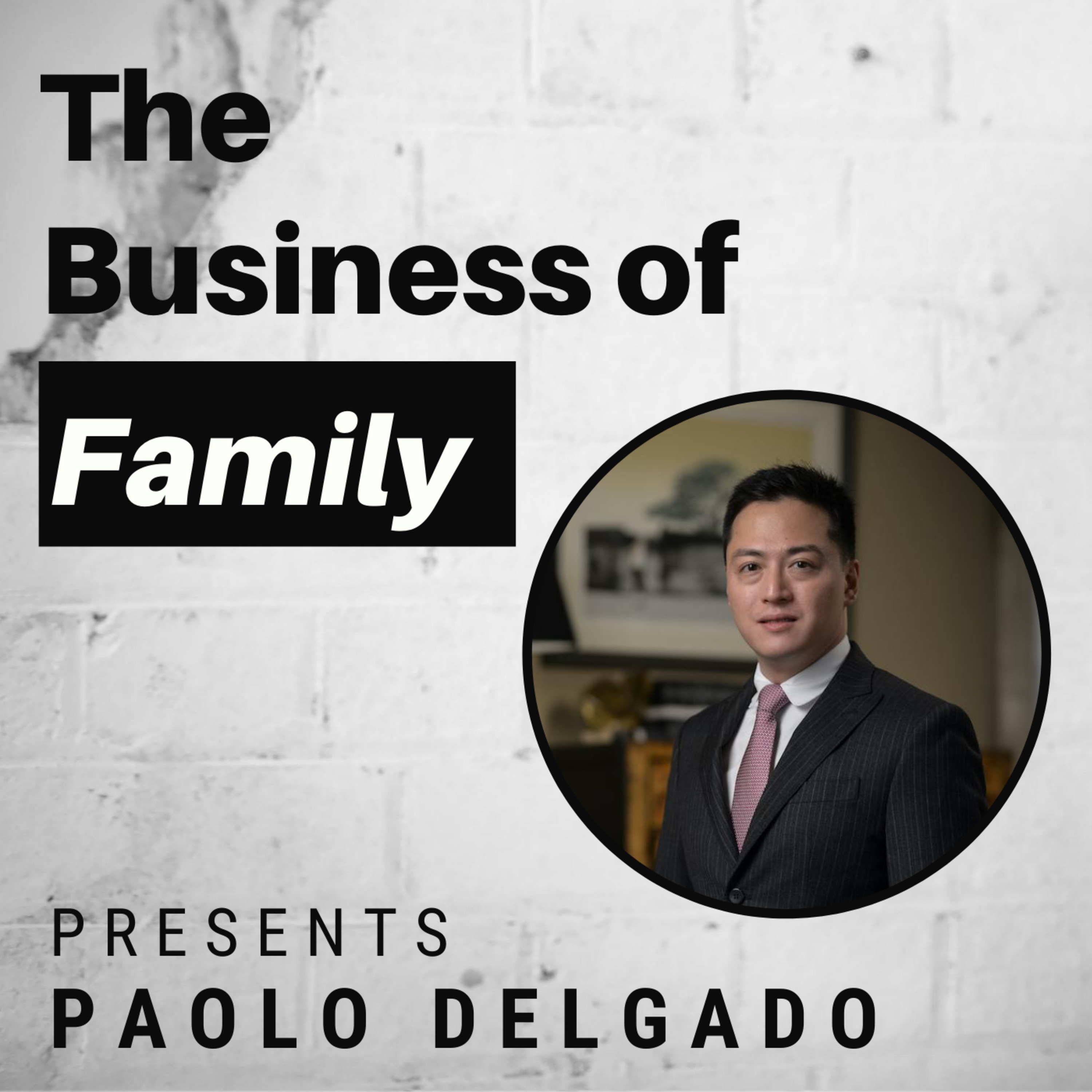
Paolo Delgado is the current managing director of the Delgado Brothers Group (Delbros). As the fourth and newest generation of the Delgado Family, Paolo manages the company that has made a name for itself across generations as being the pioneer in the logistics industry. The Delbros Group has a drive and passion to bring innovation and modernisation with hopes of growth and betterment of the Philippines and to the Filipino people.
Presently, the DelBros Group consist of over twenty subsidiaries and have member companies both locally and internationally ranging in the industries of logistics and transport, technology, and food production.
Standout Quotes
- "We live now in a very globalized world where technology has really reached a point in which it can alter our ways of life. From AI, vertical farming, etc. There has been a real desire to shift out of traditional businesses and to use our traditional businesses in more digitally-savy manners." – Paolo Delgado [5:29]
- "We all believe that the company is in our care for a portion of our lives. During this portion, it's our responsibility to help it thrive and to make sure that it can successfully transition to the next generation. It's not something that we look at to sell, not something we consider 'ours' other than that period of time that we are responsible for it. We have created a very clear understanding on the kind of stewards that we want to be." – Paolo Delgado [7:42]
- "Active stewardship is something that is constantly mentioned in our family meetings. Family representatives in our companies need to very clearly outline parameters for the different management teams that align the actives of the company with the family's approach." – Paolo Delgado [8:09]
- "Documenting the history and the legacy of the family is important in understanding what and who came before us. It reenforces that our strength comes from unity and that we keep our businesses and our family true to their core values. It's knowing that the company and the family need to be challenged and disrupted to avoid stagnation." – Paolo Delgado [17:04]
- "We do a regular pruning. Family businesses I think are looked at as something that should be run and should take care of all of the family members. In our experience, there is nothing wrong with shifting ownership. That usually means buying out family members that are not as interested in the business or perhaps can't contribute as well to the business as others… It has made making decisions easier, it’s allowed us to continue a family business that might have been under threat much sooner.” – Paolo Delgado [27:03]
- "Respect, shared values, the understanding that fairness is not being equal. We want to be fair, not necessarily equal. That nobody owes you anything and that you work for it. That you take a long-term perspective and strategy that decisions at least in the family organization needs to be made over generations rather than five or ten years that you would normally see an organization." – Paolo Delgado [36:39]
- "For me, what's most important for my wife and I, is that our children grow up being happy with the person they have become. My wife and I talk a lot about what we want for our children but ultimately much like the family business we believe we are stewards for them for a portion of our lives. Ultimately they go off and live their own lives and start their own families." – Paolo Delgado [40:59]
Key Takeaways
- Becoming and demonstrating organizational value to remain sustainable in the long term
- Paolo Delgado’s challenging and rewarding entrance into the family business
- The lessons and challenges from the past generations can be the basis for policy and reforms in the family organization of the future
- Some insights from a logistics background on the passion and visions for the future of agriculture
- Three key agreements included in the charter for DelBros Group
- Allowing the family charter to be open to improvements in the future generations
- The sensitive topic of removing family members as a strategy for extending the life of the family organization as a whole
- What Paolo sees as requirements for a successful and harmonious family partnership
- Why fair isn't always equal in the family business
Episode Timeline
- [1:58] The origin story for the Delgado Brothers Group
- [4:27] What DelBros Group current is today
- [7:31] Leadership focus on future success in generational transitions
- [9:04] Paolo’s challenging but rewarding start in the family business
- [16:27] Placing value on the documentation of family history
- [19:17] DelBros Group Investments into the future of agriculture
- [24:06] Personalized but business centered family gatherings
- [25:20] Three agreements included in the Delgado family charter
- [27:58] Why pruning in a family organization can extend the longevity of the business
- [30:41] Clarification on Delgado family opportunities in wealth creation
- [32:24] Paolo’s thoughts on the next generation talent for the family business
- [36:33] Requirements for successful and harmonious family partnerships
- [38:30] The difference between fairness and equality
- [40:59] Paolo’s focus on leading his children to personal happiness and fulfillment
Links:
- Delbros Group : With over 70 years of experience spanning four generations of leadership.
- Delgado Stewardship : Delgado Stewardship: 4 Generations of Delgado leadership
- Delbros ARCHIVES : The Delgado family has a long history with the Philippines and the world: from Generals and entrepreneurs, to statesmen and religious champions.
- Vertical Farming & Agriculture : In a move to revolutionize the process of its food production drive, Delbros introduced the first ever autonomous and vertical aeroponic farms in the Philippines through GOOD GREENS & CO.
Read the transcript
This transcript was generated automatically and may contain errors, including in names. Listen to the episode for the exact words.
MikeWelcome to The Business of Family. I'm your host, Mike Boyd. Multigenerational wealth creation involves so much more than capital accumulation. The most successful families cultivate values, stories, knowledge and resources to pass on to the next generation, and they do it very intentionally. On this show I sit down with members of some of the world's most interesting business families to hear how they do it. To see where your own family stands, take the Business Family Diagnostic at businessoffamily.net.
Our guest this week is Paolo Delgado. Paolo is the fourth and newest generation of the Delgado family to manage the company and is the current managing director. The Delgado Brothers, or the Delbros Group, has made a name for itself across generations as a pioneer in the logistics industry. The company's drive and passion to bring innovation and modernization has brought many firsts into the Philippines, contributing to the growth and betterment of the Filipino people.
Presently, the Delbros group consists of over 20 subsidiaries and member companies, both locally and internationally, with the three main industries in logistics and transport, technology, and food production. I spent a couple of years living in the Philippines, and I'm truly inspired to see the work that the Delgado family is doing to improve their local community and that of the Filipino people.
Paolo, it is fantastic to have you with us on the podcast. Thank you so much for joining us today.
PaoloThank you for inviting me, Mike. I'm quite passionate about the topic of family business, and I hope I can share something of value with you today.
MikeI'm sure you will. Looking at your story, I'm really excited for what you're going to share today. Let's start with a brief introduction of the Delgado Brothers Group, its origin story, and how each of the four generations have come to be involved in the business.
PaoloWell, back in 1940s, right after World War II, Manila was the second most devastated Allied capital of the war. It was in complete ruins. My grandfather took a loan from his mother with the support of his father and repurposed military equipment to deliver fuel to ships in the harbor. This eventually expanded into logistics and services around the port.
But when they were doing well, my grandfather asked his two brothers to join him. And this is the start of the Delgado brothers. Back in the 50s now, they won the bid for the Port of Manila, and that expanded into ship ownership, management, gas distribution, manning, trucking, warehousing. I mean, a real complete transportation package. We ventured into tourism in the 60s, and I think at this point, we would consider ourselves at the peak of our company.
And there were eight family members spanning three generations working in the business. My great-grandfather at the time was the chairman, my grandfather president, and everyone else in some form of direct management. I'm not sure how familiar you are with the Philippines, but in the 70s, the country came under the dictatorship of Ferdinand Marcos and was slowly losing its footing from being one of the premier countries in Asia to what eventually became a laggard in the Tigers of Asia.
Our family and a few others took a stand and that period of time nearly killed the company. It was in this period that the first pruning happened, which I'd love to talk about in more detail a bit later, where my grandfather bought out his brothers. There were differences in values and the first real transition of leadership happened.
Now, at this point, it's the 80s. We continued our expansions, still primarily in logistics. We were the largest or are the largest fully integrated transport company. and another pruning happened at this point. You know, the country was up and down because of the People's Power Revolution, the dictatorship being overthrown, eventually the Asian financial crisis, which hurt us quite badly.
So there was a lot of turmoil, both in the country and therefore the company and with our family. So after the Asian crisis, which we didn't quite come out of well, we hit the 2008 global crisis and that's when I joined the family business.
MikeIt's an incredible story. And there's a whole lot there that I want to ask more questions about. But let's now get a snapshot of what the Delbros group is today. What are the current business lines and what investments in innovation are you making to remain sustainable for subsequent generations?
PaoloWell, when I joined management in 2008, we were 90% logistics. Now, I would say we're about 50%, 2,000 or so personnel, 16 companies in transport, logistics, food production, technology, and investments. We're the largest port-related equipment fleet with over 3,000 trucks, trailers, generators plowing the country. We have a JV with United Parcel Service for express deliveries. We have mechanized agriculture all across the country.
These are these large harvesting machines in a, you know, primarily traditional agriculture sort of industry. We have investments in agritech and fintech, which is where the vertical farms come in, and a spattering of different family foundations that are connected with the group. I would say that, you know, while I did start off in logistics, we live now in a very globalized world where technology has really reached a point where it can alter our ways of life, right?
From AI, vertical farming, CRISPR, etc. So there's been a real desire to shift out of traditional businesses and to use our traditional businesses in more digitally, I guess, savvy manners. So, for example, we've driven, obviously, we've worked on e-commerce in our delivery system, but we've been doing tests with drone deliveries, automation. Farming has become a large focus and passion of the company.
Blockchain has been pushed through the different companies, some with more success than others, obviously. And we continue to look for investments in AI and food production, as well as tying in with a newly developed research development and technology center that's been set up within the group to share the resources across the different companies. So, you know, while we are logistics in a way, we're trying to use what we know in logistics in new fields to change the landscape of the family business.
MikeIt's an incredible amount of investment in innovation and diversification by the sounds of it. I mean, talk about buzzwords here in all of the latest digital and technology facing innovations, which is really exciting. I can't wait to hear more about it.
PaoloYou know, it's exactly as it sounds, right? So it is a lot of buzzwords and that was done on purpose. So, you know, in the investment arm, their job is to go out and invest in technologies and companies that are in their nascency. with the sole purpose of learning. So I wouldn't call it, it's both a little bit of diversification for the companies we focus on, but a lot of learning.
And we hope that at some point in the next few years, it'll be a bit clearer how we can actually enter these industries as a group.
MikeOh, I like that as a value. You're becoming or demonstrating your value in being a learning organization, which is extremely powerful in remaining sustainable for the longterm. How does the Delgado family think about stewardship and the responsibility of each generation to contribute to the family enterprise?
PaoloI guess I would say that we all believe that the company is in our care for a portion of our lives. And during this portion, it's our responsibility to help it thrive and to make sure that it can successfully transition to the next generation. It's not something that we look at to sell. It's not something that we consider ours other than that period of time that we're responsible for it.
It has created a very clear stand on the kind of stewards that we want to be. So active stewardship is something that's constantly mentioned in our family meetings. And, you know, what's a quick way of explaining that? You know, family representatives in our companies need to very clearly outline parameters for the different management teams that align the activities of the company with the family's approach.
Board governance is expected from family members and board education, obviously. Their constant, their focus is to balance the short-term against long-term mindsets that you often find within companies. We take very clear records of how we vote and how the meetings are conducted and provide regular updates to the family. So it's a concerted effort to be active shareholders, I think, and to know the lines between where you're just a shareholder and where you're management.
And all of that under the mindset that you're a steward for a tenure. and afterwards you need to pass it on.
MikeHow did you find your way into the family business? I think you mentioned it was 2008 around the global financial crisis. Were you always destined to join the business? Was it a birthright because it's passed to the oldest son or something like that? Or was it a considered choice that you made with the current family leaders about joining the business at that time?
PaoloWell, I grew up with a family business or we grew up with a family business very much in our lives. But early on, my parents made it clear that we could follow our passions. And if the family business was not in our interest, the family would still be there to support you. So, you know, I got shipped off at a young age to high school in the US and I went to Babson College and studied entrepreneurship.
I love business. I did a short stint in banking, then left for Beijing to start a company. And, you know, like any 20 year old, right? I worked very long hours. I partied very long hours. I traveled, I gained experience at work and at life. And generally life was great, right? I couldn't be happier. But while I was finding myself, as I mentioned, you know, the 97 crisis hit us quite hard.
And while I was in school abroad and in China, the company was correcting itself. But in many ways, it was the global income, I would say, that was covering up for the many shortfalls that we had on local operations. So when the 2008 crisis hit us and all the cash flow started to dry up, we found all the holes in the different organizations that needed plugging up.
So I'm off in China enjoying life and my mom makes a call. And it turns out that that's it. You know, he was president and chairman. We're hit with this crisis. And at the height of all of this, she wanted to focus on my dad. So both of them could no longer really come back to work right as this was hitting the different companies.
So it was a pretty brutal lesson. I got on a flight and I came back to the Philippines. I learned the company as quickly as I could. I had been a board director for a few years in different companies, but that's very different from being operational. I met with all of the stakeholders that we had obligations to, one by one negotiated all of that, fended off predatory partners, correctly balanced personnel, closed sold assets in the companies, put the family on a diet.
all of this while learning the business. So it was a real trial by fire. And in retrospect, I think this period tested my mettle and allowed me to gain confidence in myself, provided me the lessons I needed to learn and possibly avoided what might have been a very long, drawn out succession with my father. So today, I'd say the biggest challenge for me, having been there for the last 12 years, is to not make the company about me. So I come in and I'm left front and center. But now it's time to make it about the institution, to respect the institution, both for the employees and for the family members. And just a bit of trivia here for us.
Ironically, this is exactly what happened to my father. He came in as a young auditor in the early 80s in Delbros at the time. And the dictator had taken away large swaths of our business. And my grandfather decided to take off. He was not himself. So my dad went through all of this. and many years later we found out it was the beginning of Parkinson's for my grandfather.
So my dad went through exactly the same sort of scenarios myself. I laugh with him now. I said, couldn't you have put some tips for me or something? Did we need to repeat history exactly the same way?
MikeAmazing. And it sounds like an incredibly challenging personal time as well as a crisis in the business brought you in, as you say, trial by fire. I mean, And what a stressful but challenging and growth environment to learn the business so rapidly. I imagine you had no other choice but to just get in and fight fires every day.
PaoloWell, ultimately, I had to choose to come back. And I think perhaps that was more of the Asian culture in us where you feel that family first, right? I could have stayed in China, stayed a professional, but I felt that I needed to do my part.
MikeOn that note, and you mentioned the institution, not making it about yourself, but the institution. One thing that I noticed in researching Delbros was the incredible clarity that you have of who you are, what you represent, and your reason for being. How did the family arrive at this set of vision, mission, and brand to guide the Delbros group?
PaoloAs a family, I would say we're a very patriotic family. I mean, I guess, depending on which way you're looking at it, either patriotic or revolutionary, right? We had General Martin Delgado, my great-great-granduncle, who fought for the country's freedom from the Spanish. Then Senator Francisco Delgado fought for independence from the Americans. And this is all being hammered to us in the family, right, through family stories and pictures and books and all of that.
My grandfather fought in World War II for the Philippines, and the family fought the evil dictator of the Philippines. So I think there's definitely a concerted effort from older generations to kind of brainwash the next set, right? So my siblings and I were raised believing that the company and the family resources owed a lot to our country.
And we needed to make it needed to be used to make the country a better place. So, you know, growing up, the dinner table conversation was about the responsibility that you have if you're privileged and being educated, that it shouldn't be about you, that you needed to work hard to be of service to something bigger than oneself. And that would have been well and good if it was primarily stories. But when I look back, my dad, he never had a Mercedes in his life, right? And he's worn a Casio all his life. And there were times in school, especially boarding school, where I wondered maybe we weren't really that well off, right? But I joined the family business. I poured through the minutes and the
financial records. And I see that, you know, he dutifully yearly contributed large sums of our profits into programs and organizations and the foundations that impacted the public in a better way. So it was a life decision of his to live a certain way. And my mom, she had a full-time job, but she was always home for dinner and she still worked, you know, on the foundation on the side and on the weekends. And today it's my sister that's carrying that mantle with her on the different foundations. So it's really how they've chosen to lead their lives and how the family chooses to treat the business and what we get from the business. And I think that's what makes
a difference because you can talk about it, but when you see your parents doing it and setting the example, it's a lot easier to follow. I guess now my challenge has been, how do I take this and distill it into the family charter and the company mission? Through the years, these different, Obviously, these different passions and ways of nation building have changed, but it's that idea that we can use resources to fuel your own passions for as long as it's used in a manner that uplifts the country, the world, or people in general.
MikeIt's an incredibly inspiring and admirable mission, the way your family has chosen to live and lead for the benefit of the Philippines. I think that's just incredible. One thing that we like to explore on this podcast is the value of documenting family history, which you've just mentioned, capturing family stories and the value of meaningful keepsakes. When I read about the Delbros archives, I was inspired to see you take things to the next level. Can you tell us a little bit about the archives and their importance to your family, please?
PaoloSure. Well, first, let me clarify. So our family business, one of them is warehousing. So I think it makes storing an archive a lot easier when you're one of the first companies is in warehousing. I don't recommend it for anyone that doesn't have the space. But documenting the history and the legacy of the family is important in understanding what and who came before us. It reinforces that our strength comes from unity and that we keep our businesses and our family true to their core values. It's knowing that the company and the family need to be challenged and disrupted to avoid stagnation. That keeps me inspired to keep up the work for the archives because the lessons and challenges from the past become the basis for
policy and reforms in the family organization of the future and possibly the company, right? So our archives are materials relevant to the story of the family and the business, working papers of family members. We have the first container that came into the country. We We have letters from business partners and dignitaries. And we have a lot of fun stuff, right?
So old trucks, boat engines, fuel pumps from our old gas stations, and art, antiques, and classic cars. Now, the last three is really more of an asset class. It's just we've decided to put them under the family archives to kind of separate it from either corporate assets or family assets. I think that's really why we keep it going.
We want something for the family to rally around and to remember and to sort of keep us in check when we're veering away from what our values are. And it's not always been easy. Like, you know, within our own family, I've seen quite a bit of revisionist history, right? So maintaining the archives has called me out and has had me called out on several occasions about records that may or may not record family members or family companies in positive light.
I mean, like any organization, we've got good and bad things said about us. And our job in the archives is to keep it as factually accurate as possible. So no, it's not been all fun and games. It is very much like a large warehouse full of junk that's being slowly digitized. But we do think in the future, we'll be able to turn this into something a bit more for the family.
MikeIt's fantastic and incredibly inspiring. and I hope that one day I can use a family archive as an excuse to collect lots of beautiful old cars as well. So looking to the future now, I was really impressed to see all of these pioneering investments that you're making into agricultural innovation specifically and the vertical farming solutions. Can you tell us a little bit about your vision for the future of agriculture and your investments that you've made into this space?
PaoloOh, awesome. I'm very passionate about this stuff. So let's look at the world. Our population is at 7.5 billion. We're expected to hit 9.7 by 2050, a large majority of which is in Asia, Southeast Asia to be specific. 80% of the world's arable land is already utilized. And if you look at the trends of cities, they're becoming megacities.
So rather than us going out into uninhabited areas, we're now centralizing and growing to these massive cities Cities that are chock full of people and very dense, right? Consumer preferences want everything on demand. How is this going to work for how we get our food? If you think about what's been happening now in logistics through this COVID environment, we realize that we don't really have any resilience in our global supply chains.
Two, three months of a lockdown has really made a mess of how we're moving food around the world. You know, countries that are not as infrastructure ready as the US, China or Europe. And being in the family business of logistics, you know, we've spent so much resources with trucks and cold storage facilities and refrigerator gensets. And it's not enough.
You know, there's just bringing it from remote places to the cities and having produce sent to packaging locations and back. And it just won't work the way it is. So a few years back, we looked at food production. And what we found was we wanted to get into mechanized harvesting and agriculture. So we brought these big machines and we thought this is what was going to change it.
A few years later, we realized that that still wasn't enough. So we looked at something 20 or 30 years down the line at the time. And that's vertical farming. And these are multi-story towers. Our largest tower is about five stories now. It's mostly automated. We haven't quite figured out how to harvest, how to automate the harvest part.
But the growing, the seeding, mineral distribution, the temperature controls are all automated. And it's our goal to bring these into the cities so that they're grown within the communities that they're going to serve, ordered through phone programs or picked up by the consumer. You remove the need of logistics. In many ways, it will hurt our logistics business.
But we think this is the future. And it's not the only future in food production. There's lab-grown meat, there's 3D printed food, there's enzymes that are now used in our food sources that are more easy to source from seaweed than they are from wherever we get our protein. And I think this is the future we're looking at as a company because it utilizes everything we've learned through logistics and is combining it with a sunrise industry.
And yes, it could terminate some of our older businesses like the cold chain business. But I think tech's gotten to the point where you can't avoid it, right? You're looking at the future and the old system just won't work no matter how much you've already invested in it. And it's time to change.
MikeI think it's an incredible idea and an absolute need. As I said earlier, I spent some time living in Manila. and certainly the logistics. Take my hat off to you because it's an incredibly difficult mega city to navigate on a day-to-day basis, let alone with trucks and heavy industry and produce. And it's an enormous population that's growing and urbanizing at an incredible rate.
So the challenges are real. And it really sounds like you've got quite a passion for this vertical farming and the future of agriculture. Is this something that you introduced to the family business?
PaoloYes. Well, myself and the management team. So when we, through our style of learning industries, what we did was we had a fund. We decided we wanted to travel. So we went and visited the most advanced farms in London and the US and Shanghai. And then we came back and we turned it into a business, right? And yes, I'm very passionate about it because I feel that the technology is getting to the point where it's very viable.
So you're seeing this shift towards automation that's really taken 20 years, right? And solar power, which has taken 40 years to get to where it is now. And it's happening. And it's fascinating because it's happening at a time where I'm young. The family business has the right resources. So it's something that we can capitalize on. It gets me up to go to work every day, if I can share that.
MikeThat's as good a reason as any. I think that's fantastic. So turning back to the family enterprise now, I'm curious how the family itself operates. This concept that we talk about the business of family, do you hold family meetings? I think you mentioned a family charter on a couple of occasions. Can you tell us a little bit about the formal structures that you run around operating the family, please?
PaoloOkay. We do hold family meetings. It's a bit more of a challenge because two of our family members are based in the Philippines and the other two are based abroad. But we try and it's sort of more personalized. So when we do our charter meetings, it's usually right before dinner with the folks. And we do that maybe once a month or once every two months.
And then we have our family trips. So it's pretty standard. It's formal. Don't take me wrong. We've got the minutes and the timing. We use a lot of YPO terms when dealing with confidentiality, finding you if you're late, that sort of thing. But it's got that family feel to it, right? So it's around dinner or it's around something that a family member has prepared. I wrote down maybe three things from our charter that I wanted to share, which I thought would add a little bit of granularity. If you don't mind, I'll read it now.
MikePlease, it'd be great.
PaoloOne is, we believe in ethical conduct, that ethical conduct enhances brand reputation and our long-term business resilience. Excellence and fairness in our family and thus the company are not mutually exclusive. We will strive to keep the business and our profits true to our family values. That's one. Another would be that we do not compete against the wealth creation of past generations.
Opportunities and wealth generation come in cycles. We need to keep the family and the business in a state of preparedness to capitalize on these cycles. And the last, and I find this amusing, We are cognizant of our privilege. We were born into this family, not through merit, but because of the lottery of birth. We are humbled by and aware of the responsibility of our privilege. And it's incumbent upon us to be accountable for it being or for it contributing members to the family who can be a value to society. And by leaving the Philippines and our immediate community better than we found it.
And so, you know, those three are just examples of what's in our charter, but it's very personal. It was clearly written in a family meeting where you had, you know, 10 other people arguing about how it should come out. And I think that's okay. It's guided us. I think a lot of people stress out too much about the way to write their charter when just writing it is really the first step.
And over time, and as different members join and leave the family, it sort of gets sharpened. And it connects better with us because I can hear my sister in this value, or I can hear my grandmother's sayings in these values. So it makes it more palatable when they're used to help structure and organize the family. And I'd also like to add that we do a regular pruning.
So, you know, family businesses, I think, are looked at as something that should be run and should take care of all the family members. And in our experience, there's nothing wrong with shifting ownership. And that usually means buying out family members that are not as interested in the business or perhaps can't contribute as well to the business as others.
So we're a direct result of two prunings. The company is almost 99% under my father. And it's made making decisions easier. And it's allowed us to continue a family business that might have been under threat much sooner. and it's not a very popular term in these family business discussions because it means removing family members but i don't see why that can't be one of the strategies used to extend the life of a family organization
Mikei think it's an incredibly powerful tool if used effectively can you tell us you mentioned there was two previous pruning events how did they come about to arrive with most of the ownership resting with your father today
Paolointerestingly they were both values driven. So the first was under my grandfather during that challenge with a dictator where we really saw a large portion of our businesses just taken away. And there was just a shift in how we wanted to operate as a family entity and as a company. So in that scenario, my grandfather ended up buying out his brothers and centralizing it under his family. It happened again in the 90s, in the generation of my father now, and more because, again, there was a shift in values. So it's great having charters, right? And there were just family members that wanted to go on a different path. And we knew that staying in the same organization would just
lead to further conflict and or possibly an organization that not all family members felt that they were aligned with anymore. So the hard decisions were made and they're certainly not cheap and very complicated, but it worked out for us. And I would not be surprised if we need to do this again, perhaps in the generation of my children.
MikeIt's fascinating. And would you say that the family members have arrived at a mutual understanding that pruning was the most effective path? Or was it a contentious issue where one party wanted control because they were invested in the future of the business and perhaps had to convince the other parties to allow them to be bought out?
PaoloThey both happened internally. So they were decided on because the family members felt that it was time rather than maybe other situations where family members end up fighting and carving up portions of the business for each other. So I think that helped because it was a conscious strategic decision. And obviously, when the company doesn't do well, then the family that out feels great. When the company does exceptionally well, even if it might have been 10 or 20 years of hard work later, then obviously there's still feelings that perhaps it was the wrong decision.
And that's to be expected. I think at the end of the day, so long as you document the discussions well and that it's done with trust and openness, that the family can separate itself from decisions made in the business.
MikeThat's excellent. And I appreciate you sharing that. I think that there'll be a lot of value from people listening to this and understanding that this stuff is complicated, but pruning does occur and done properly and documented properly. It can be quite effective to maintaining a multi-generational business.
PaoloAbsolutely.
MikeOne more follow-up, if you don't mind, just on that. You mentioned a non-compete with wealth creation of past generations. What exactly does that mean? Does that mean that you're not entering business lines that prior generations made wealth out of? Or does that mean family members that have since exited the business and gone to create other forms of wealth, you choose not to compete with that?
PaoloIt's actually a bit more simple than that, I suppose. So in one of our meetings, we realized that a lot of poor decisions were made because certain family members felt they needed to make as large a business or generate as big an income as some other family member, right? And so they started to take risks and decisions that may not have been the most prudent if they didn't have all this weight from previous generations. So it's really just a reminder to us that ultimately we're looking at it hopefully for another 75 or 100 years, right?
if not longer. So sometimes keeping the company at a state where it is ready to capitalize on the next cycle is every bit as important and as relevant as capitalizing on a cycle, if that makes sense.
MikeGot it. Yes, I misunderstood that the first time around, but it's removing the weight from the shoulders or that guilt that you need to do something and do something big today, which perhaps might end up being the wrong choice and leave you unprepared for when the real opportunity comes along.
PaoloRight. And it happens quite frequently, you'll be surprised, across at least our history and the family. So for us, it was a very important part to put into our charter.
MikeYeah, it's a terrific value. How are you thinking about developing next generation talent to join the family business? Is there an expectation or a birthright that family members join the business? And I guess as a follow-up to that, will Delbros ever be led by a non-family member executive?
PaoloWe've had four non-family presidents of the group in the past. So it has happened before. And we have a lot of professional management across the different individual companies. I think there will always be a head of family, at least for us internally, and usually the older, most wise individual of the family. So that won't change. But at least in the management of our companies, we would always strive to find the best person suited, whether internal to the family or externally.
I personally would like to be off the main operating companies in my 50s. The world's an exciting place. And do I really want to be operational for the rest of my life? I think to do that, I've set aside maybe three things I need to focus on. Obviously, the estate work to have this happen in terms of ownership, shareholdings and that sort of thing.
separating the archives, which was an interesting discussion earlier, because I feel that the archives being under the family or under the organization are not as effective as if they were their own separate museum or library with its own standalone sort of trust, right? And family wealth and the separation of our family wealth with the family business. Right now, we still derive a lot of our income from the family business.
And for us really to make that shift where we're very, I guess, impartial or have the ability to be very impartial, we need to separate the wealth so that it's standalone away from the business in a manner that can still benefit and still incentivize family members to stay on top of the organization, but perhaps allow us to make decisions that are quite separate and impartial.
So I do wonder, personally, will these changes still allow us to maintain the passion, the deep relationships that family members bring to an organization, the burden of history, the desire to excel? Can you make this separation and still maintain that? Can we turn the family into something that pioneers things for the company? And maybe that's the family responsibility, but not necessarily to run the family.
And can it be that legacy about change and improvement in the country? So there's a lot of things that I'm thinking about. But ultimately, I think there will come a point where the family will be quite separated from the business and yet still a big influence on the business. And I'd be very happy that can happen under my tenure.
MikeI think you've got great clarity of thought around that. One thing I'd like to follow up on is separating the wealth, your family wealth, from the family business. I've seen families before that have allowed members to partner with the main family enterprise, perhaps in a JV on a new enterprise, perhaps a sibling wants to go out, flex an entrepreneurial muscle and have a go at starting something new and the family co-invests or some sort of mechanism like that. Do you see that as a path to separating family wealth within your family or is it a completely different structure that you have in mind?
PaoloWell, we've got a pretty strict charter with regards to family members engaged in companies that either work with a family business or compete with a family business. So for example, when I was in China and I set up my organization within, so I came back in 2008 and by 2011, I had already sold the company to the family business and moved the shares over to my siblings. And, you know, it was just unexpected. And it happened very soon after the transition because it's frowned upon in the family to let these things lie, right? So no, we wouldn't necessarily be JVing. We could invest through one of the family funds.
We could have a family member lead a company, but the ownership would still need to be with a family group.
MikeWhat do you consider are the requirements for a successful and harmonious family partnership?
PaoloRespect, shared values, the understanding that fairness is not being equal, right? So we want to be fair, not necessarily equal. That nobody owes you anything and that you work for it. That you take a long-term perspective and strategy that decisions, at least in the family organization, needs to be made over generations rather than five or 10 years that you would normally see in organizations. Again, independent wealth from the family business.
It's just a touchy subject for me anyway, because I noticed that no matter how good your charter may be and how good your intentions, when your lifestyle or perceived lifestyle in some way or form benefits from family dividends or family performance, it does affect how you make decisions. And you can have all the mechanisms, but ultimately, it doesn't turn out to be in the best interest.
It can not turn out to be in the best interest of the family business. So I feel strongly about creating an independent wealth, especially with the younger generations earlier, and to do it in a manner that doesn't destroy them. So how do they learn how to handle money and responsibility before they enter or before they really are responsible for the family business, but not take away their passion and their hunger and their desire to excel?
And I don't have the answer. We've not figured that one out yet. And it's been sitting on our to-do list on the charter.
MikeOh, when you do figure it out, please come back on and tell us all because I think that's a key consideration for a lot of families of wealth. And another thing that we explore often on the podcast is how do you raise motivated and enterprising children of wealth and not have it destroy their values and motivations. So it is another touchy subject, another difficult one. And I love to learn about how families pass values down to the next generation, particularly around that.
One thing that you mentioned there as well was fairness, not equality. Would you mind elaborating on that? I think that is a terrific example.
PaoloIt's the concept that some people in the family organization may require more than others. And if you're a family, it's like a marriage, right? You give and take and it's about compromise. And the challenge is, I guess, in family organizations, it's a lot more complex than just an individual household or basic company, right? I mean, this is a company which affects all your households with all the emotions and the baggage and the past history that come with it.
So it's something that we've really pushed hard. We've not been perfect at it, but it means that there are going to be cases where perhaps family members are given a bit more leniency than others. Obviously, the easy one is some family members require more financial assistance than others. That's easier than other topics. So does that help? I mean, I'm not sure if I'm being very clear.
It's not an easy value to explain.
MikeYeah, absolutely. It's helpful. And I think what you're saying in simple terms, please correct me if I'm misunderstanding, is that perhaps between siblings, not everyone gets exactly the same percentage of everything. But overall, what everyone gets is considered fair for their circumstance and what the family agrees is fair for the circumstance. Is that a reasonable interpretation?
PaoloI mean, yes, in a way, yes. But I think it's deeper than that, right? So it covers, let's say, family members that handled business poorly. and maybe tanked an organization and yet have voting shares in others? And how do you manage relationships like that? Or family members that possibly are unable to financially stay afloat on their own and require some form of additional assistance from their parents. So there's a lot more to it than that. But yes, in basic terms, you've nailed it in that way.
MikeAn incredibly complicated topic, I imagine. Now, I'm conscious of your time and really appreciate all that you've shared. I could probably ask a hundred more questions, but it's time for our final question. And this is a question that we ask all of our guests who come on the podcast. Imagine that you're writing a letter to your children. What is one lesson or idea that you don't think many parents would mention, but you consider important to understand?
PaoloFor me, what's most important for my wife and I is that our children grow up being happy with the persons that they have become. And my wife and I talk a lot about what we want for our children, but ultimately, much like the family business, we believe that we're stewards for them for a portion of our lives. And ultimately they go off and live their own lives and start their own families. I want to know that they're happy with who they are, that they can look at themselves in the mirror and that they're proud of what they've become and the lives they've led. And And that's probably the most important to me, right?
So I don't know whether it was a Star Wars movie or a book I read, but we are the bones our children grind their teeth on. And I believe that. If my children are not interested in the business, then I will at least train them to be active, effective shareholders. And I look back at myself. And if I was not given the chance by my parents to make the decisions during that period of transition, I would not have been as committed or driven to do what I'm doing in the company now.
And the work I do now is very much out of passion and love for the family and the business and myself. I'm happy with who I am. And God, it'd be great if my kids could feel the same way.
MikeIncredibly powerful lesson. Paolo, this has been fantastic. I think your family is incredibly inspiring. I love all of the impact work that you're doing to make the Philippines and your local communities a better place. and all of this work that you do around stewardship and family business, charters and values. There's so much that we can learn from you.
So I so appreciate you coming on to share some of it with us. And I know that others will be incredibly grateful to listen to this as well. So thank you so much for being with us.
PaoloWell, thank you for having me in your podcast, Mike. I was able to reflect on family, our business, and my place in all of this as I prepared for this talk. And I've got to tell you, it was a much needed break from all this COVID-related pressure. So it's great to know someone so passionate about family business and keep up the great work.
MikeThank you so much. I hope we can do it again sometime.
PaoloAbsolutely.
MikeThanks for listening to The Business of Family. You'll find the transcript and key ideas from this conversation at businessoffamily.net, along with the Business Family Diagnostic. It's free, and it shows you where your own family stands. And if someone in your family should hear this episode, please send it to them too. I'm Mike Boyd. Until next time, take care.
Keep listening
If this one landed, start here next.
4th Generation Heir to B.Grimm, one of Thailand’s Oldest Business Institutions
Ownership that narrowed at each handover in a Thai family business.
Family Politics, Consolidating Power, Going Public & Taking Private
Consolidating a fragmented family shareholding in Singapore.
Scaling a Third Generation Ecuadorian Retailer & Credit Provider
A third-generation family business in an emerging market.
The Business Family Diagnostic · Governance
We do not compete with the wealth our ancestors created.
The Delgado charter was argued over by ten people in a family meeting, and it sharpens as members join and leave. Has your family reviewed a written constitution or charter in the last two years?
“We have an agreed way to make family decisions that affect everyone.”

Every family wishes someone had recorded the generation before.
I built Enduring Stories to do it for yours: a guided voice conversation, from home, that keeps your family's voices, values and history.
The newsletter
The most useful things in these conversations are the things families rarely say out loud.
I share them in my newsletter once a week. Sign up to receive the ideas directly and start building the foundations for your family today.