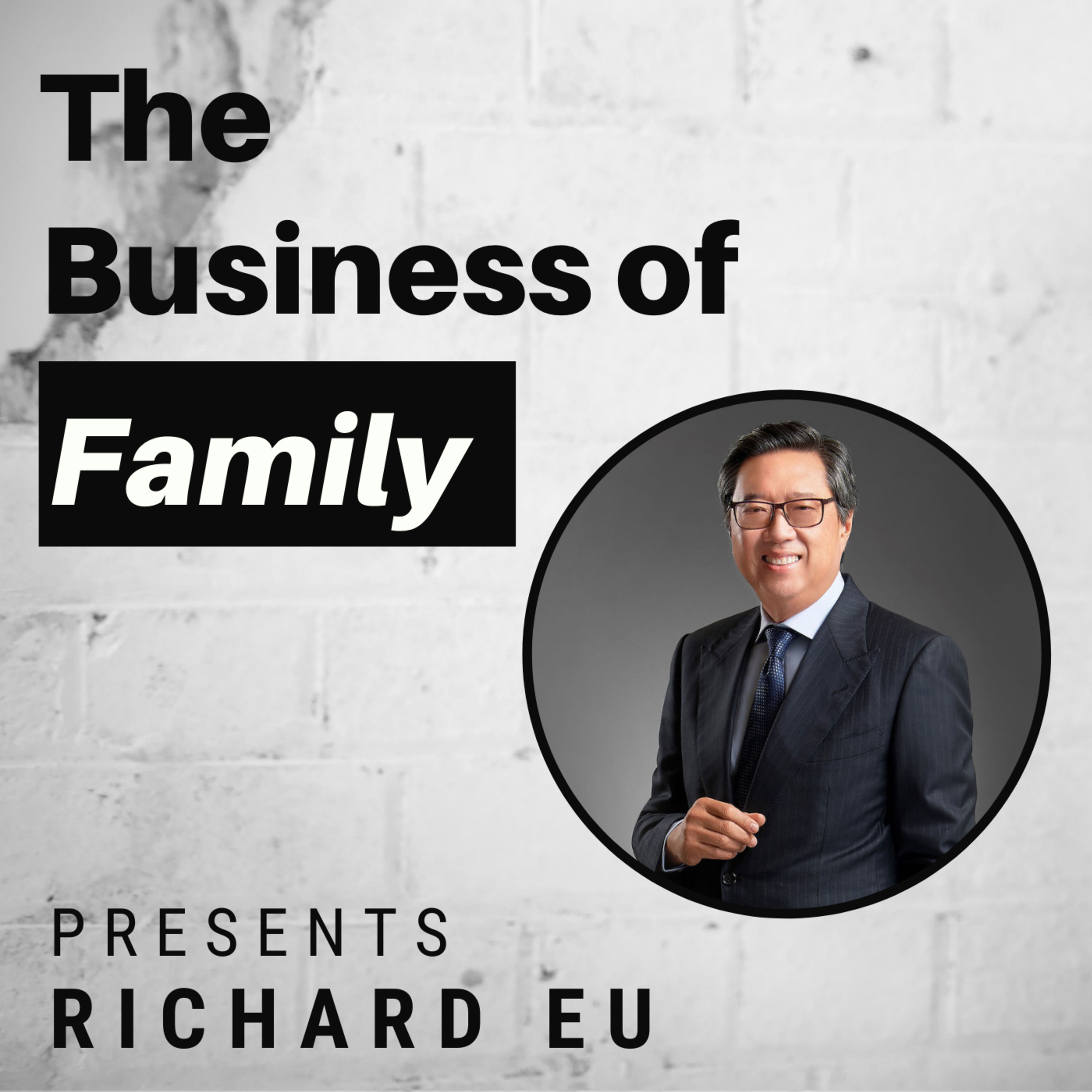
Episode 15 · Season 1
Family Politics, Consolidating Power, Going Public & Taking Private
Key ideas from this conversation
With the business split among 13 sons, the older uncles dominated by blocking most of the ideas, and the company stood still.
When business ties with some relatives broke down, he kept the social ties and kept turning up to family gatherings.
How many parents talk with their children about the time when they are no longer here?
Read the full show notesBio, standout quotes and the episode timeline
Richard Eu is a fourth-generation Eu. His grandfather was tycoon and philanthropist Eu Tong Sen who remains a legend in Singapore for the vast commercial empire he built across Southeast Asia in the early 1900’s. Tong Seng had 11 wives with whom he had 24 children, setting the stage for a complex and conflicted period of succession following his death in 1941.
One of the family's last remaining businesses, Eu Yan Sang, a network of Traditional Chinese Medicine dispensaries, was founded by Richard Eu's great-grandfather Eu Kong and the family's fifth generation are still in the business today. This is a gripping story of family politics, loss of control, re-consolidation, an IPO, and ultimately privatisation of the family firm once again.
Standout Quotes:
- “My father told me when I was still studying that I would not expect to be able to work in any of the family businesses after graduation because of the family politics” – Richard Eu
- “If you want to institutionalize the business, it cannot be in family hands forever” – Richard Eu
- “When an institution buys into a business like ours, to a large extent they also buy into the culture that's been set up there by the family and they should be crazy just to lose it” – Richard Eu
Key Takeaways:
- If you want to institutionalize the business, it cannot be in family hands forever
- One of the problems that we had from the 3rd generation was that nobody called the shots, yet because they were individuals they didn't think like as institutions, they just thought about their situations
- When an institution buys into a business, what they should do is preserve the culture and manage it in a modern and efficient way without trying to kill the original culture
- It's not just about financial ratios or balance sheet, you have to bring in the heart
- Good communication helps build trust in the family business
- From Richard to his kids: when I’m dead and gone, they should look at themselves and see if they are on the path that we set off to follow as a family
Episode Timeline:
- [00:44] A brief introduction to Richard Eu, who shares a detailed history of the multi-generational family business
- [08:11] Richard joined the business at 42, although his father did not expect he would be able to work with any of the businesses because of the family politics involving his uncles
- [16:52] About the TCM family business "Eu Yan Sang", with more emphasis on the challenges posed by politics affecting the family business.
- [34:16] Despite all the challenges, the family business experienced consistent growth almost every year.
- [38:16] Richard describes one of the problems that began from the 3rd generation
- [41:57] How two members of the 5th generation joined the family business
- [46:56] Do you have any favorite failure that set you up for success in the family business?
- [50:38] A major learning point for Richard; Communication
- [52:22] From Richard to his kids
Links:
- Richard Eu Profile | Endeavor Malaysia Mentors : Richard Eu was appointed to the board as Chairman of the EYSI board on 1st of October 2017.
- Eu Yan Sang International - Official Online Store : A network of Traditional Chinese Medicine dispensaries, was founded by Richard Eu's great-grandfather Eu Kong
- Eu Yan Sang: Healing a Family and Business | INSEAD Case Study : This case and teaching note explore one of Singapore's early entrepreneurs and the family business empire he created.
Read the transcript
This transcript was generated automatically and may contain errors, including in names. Listen to the episode for the exact words.
MikeWelcome to The Business of Family. I'm your host, Mike Boyd. Multigenerational wealth creation involves so much more than capital accumulation. The most successful families cultivate values, stories, knowledge and resources to pass on to the next generation, and they do it very intentionally. On this show I sit down with members of some of the world's most interesting business families to hear how they do it. To see where your own family stands, take the Business Family Diagnostic at businessoffamily.net.
Richard Eu is a fourth generation Yu. His grandfather was tycoon and philanthropist Eu Tong Sen, who remains a legend in Singapore for the vast commercial empire he built across Southeast Asia in the early 1900s. Tong Sen had 11 wives with whom he had 24 children, setting the stage for a complex and conflicted period of succession following his death in 1941. One of the family's last remaining businesses, Eu Yan Sang, a network of traditional Chinese medicine dispensaries, was founded by Richard Yu's great-grandfather, Eu Kong, and the family's fifth generation are still in the business today. This is a gripping story of family politics, loss of control, reconsolidation, an IPO, and ultimately privatization of the family firm once again. It is my great pleasure to welcome Richard Eu to the show.
Richard, thank you so much for being here to share your story today.
RichardThanks for inviting me, Mike.
MikeI'm really looking forward to this one. Now, you're the fourth generation Yu family member to lead Eu Yan Sang business. However, the family's ownership and succession story hasn't always been smooth. Can you please share with us the origin story of the business and a brief history of its stewardship from founding through until the third generation?
RichardSure. The business was actually founded in 1879 by my great-grandfather. His name was Eu Kong. He had emigrated from southern China as a teenager and worked around northern Malaya at the time, eventually becoming a tin miner in the town of Gopeng, which is in the state of Perak, in what is now Malaysia. In those days, the workers, the coolies in the tin mines had no access to any kind of healthcare.
And it was like just prospecting in the fields. So at the same time, the authorities, when they granted a license, they call them revenue farms. When they granted a license for tin mining, they usually forced the miners to also take on revenue farms for opium as well. And so the workers were given access to opium and was kind of used as an all-purpose cure-all, I suppose you can call it, because there was no health care.
And so many of the coolies got addicted to opium. And my great-grandfather thought that this was not good because they wanted to try and make enough money to send back home. So he was trying to figure out what was the best thing for the workers. And he decided that he would import medicinal herbs from China. And so he started a shop called Yan Sang in Gopeng, and he brought in herbs from China, which he then dispensed to his workers.
And eventually they were also sold to the locals. And that was the origins of the shop, Yan Sang. My great-grandfather passed away when he was in his late 30s, and the business was inherited by my grandfather, who was then a young teenager. So it was kept under some sort of trusteeship until he was old enough to take charge of the businesses that was left by his father.
And my grandfather, Eu Tong Sen, continued with tin mining and also with the Yan Sang shop. He later on renamed it as Eu Yan Sang. And as his tin mining business prospered, so he also opened branches in the towns wherever he had an office. So from Gopeng went to Kampar, Ipoh, and then down south to KL, Seremban, and eventually ending in Singapore in 1910.
And then the business then expanded into southern China, the Eu Yan Sang business, because it also provided remittance services for the coolies to send the money back. So Hong Kong and Guangzhou branches were set up. And Eu Yan Sang at that time, this would be in the 1910s, 1920s, was very active in remittances. And a lot of money was sent back from Malaya back to southern China.
Fast forward, my grandfather lived in Hong Kong until he died in 1941. and the business was then inherited by my father and my uncles. So my father had 12 brothers. There were 13 sons. They inherited the entire business empire of my grandfather and they only could take charge of it after the war, by which time the authorities also retrospectively passed the state duty laws.
and a lot of the estate duty had to be paid from the late 40s onwards. And a lot of businesses that were held by my grandfather, a lot of businesses and assets had to be sold at very low prices just to pay the death duties. Fortunately, the Eu Yan Sang business was kept. Eventually, some of the other businesses were also kept, but they were either sold or the tin mines basically ran out.
So by the end of the 1980s, this was the only business that was left from my grandfather's day. I wanted to try and have a go at managing the business, but because of family politics, it was very difficult to do so. I'd been working for many years by that time, but my one uncle retired at the age of 70, who was at that time an executive director of Eu Yan Sang.
and I put my hand up to say, okay, give me a chance to run this. But unfortunately, some of the other uncles were not happy with that. And so there was a sellout. We lost the business. But I had already joined it and after a couple of years, I had a chance to do a buyout. So very briefly, that was a story up to the early 90s.
I joined in 1989 and I became the managing director of the business in the early 90s.
MikeSo a couple of follow-ups on that, Richard, if you don't mind. You mentioned, I think, there were 13 sons. I assume that there were also daughters who did not inherit anything. Is that right?
RichardYeah. So my grandfather had 24 children, 13 sons and 11 daughters. He had a total of 11 wives, but of the 11 wives, only seven had children. Some of the wives that didn't have any sons were also kind of left on the wayside, as it were. The business was passed on to my father and uncles, and they were shared fairly equally amongst the 13 of them.
Whilst the girls didn't get a share of the business, but they were all given a sum of money as dowry. So when they got married, there was a dowry that went along with it, and that was about it.
MikeInteresting. And what age were you when you joined the business? And I guess I'd also like to ask, was that always a predetermined path that you were going to join the family business? Or had you considered your own pursuits as well?
RichardNo, I joined the business when I was 42 years old. I had graduated from my early 20s and I worked for about 18 years before I joined the business. My father told me when I was still studying that I would not expect to be able to work in any of the family businesses after graduation because of the family politics.
Basically, the uncles, all 13 of them sat on the board and they did not allow the next generation to get involved in the business at all. So I was able to accompany my father to some of the board meetings for various companies and also for the estate matters. So my grandfather's estate took 50 years to wind up.
My couple was a buy brand, yeah. And so there were still meetings of the estate right through to the 70s and early 80s. So it was just very tiresome. Yeah, so anyway, the long story short, because my uncle retired as an executive director, my father asked the other independent directors, the non-family directors for the company, if I was able to join and they said, okay. So that's what I did.
MikeTerrific. Richard, 13 sons or your father and his uncles, what was it like when they were trying to operate the business with a board full of siblings? Did things operate smoothly at that time or were there already some factions forming and family politics at that level?
RichardYeah, I think nothing ran smoothly. I think there were factions amongst the different brothers who came from different mothers. So there were several groups. There was also a difference between the older uncles and the younger ones. And I think the younger uncles actually were more entrepreneurial, but they were frustrated by the older brothers because the older brothers just were not, didn't buy into their ideas.
So most of my uncles actually pursued their own career paths. And some of them were very successful in their own right as entrepreneurs. The older uncles tended to dominate, but they dominated by basically blocking most of the ideas. And so all the businesses were run by non-family, either persons or management companies, especially the for example the tin mines and the rubber estates were run by independent companies whilst the the union song was run by uncle who was as i said was executive director this was the singapore malaysia business which in fact was listed in 1973 or so it was listed on the singapore exchange then but it was a very small company and actually it never really grew
It remained about the same size all the way through until I joined the business.
MikeSo let's talk about when you joined the business. You went through a period of trying to consolidate the fragmented shareholding group under your control so that you could ultimately get something done. Was this still when the family had individual shareholding across 13 sons or was this when the business was listed?
RichardWell, by the time I joined, because it was listed, some uncles had sold. And my father and another uncle had tried to consolidate by buying some of their brothers out. And so they, between the two of them, had about just, I think, 15% or so of the company. And then unfortunately, that uncle passed away rather suddenly. And so my father, so the shares split back between him and my father.
So my father kept the shares, and at that time, we had about maybe 7% or so of the company. And we were probably the single largest shareholder. And so it was very fragmented, and we couldn't get the other uncles to sell back to us. And in fact, what happened was that when I joined, there was a group of uncles that engineered the sale of their block to a third party.
MikeWas that related to your joining or was it just happened around the same time?
RichardIt related to my joining. I think they did not want to see me there.
MikeWow. Okay. So they engineered the sale of their block and how much would that have represented of the shareholding?
RichardAt the end, they actually managed to sell about 50%. The buyer was able to dislodge a block from a third party who held it outside, a non-family party that held a big block of shares as well. Together, they had over 50%. And that was what was sold to Lum Chang Holdings, which was the buyer.
MikeAnd so this other firm gains control of your family business. You effectively lost control. Where does it go from here? Do you stay in the business or do you leave? I was general manager.
RichardI'd been with the business for about four months at a time. But Lum Chang was very good. They said, look, we're not really interested in the TCM business. What we wanted was the listing. And when the time comes, we want to dispose of this business. We'll give you first right of refusal on it. And so it was a blessing in disguise because at that point, the control of the company being in just one hand i could just and it was a commercial sort of organization i could deal with them on rational grounds you know and so when the time came they they said this is the price you know can you match it and i said sure i'll try and i did
and that's how i managed to do the first buyout
Mikeso they gained control of the business and they were largely looking for it because of the listing you said is so they were effectively backdoor listing their business were they using your
Richardyou know in a way they were already a listed company it was a construction company they wanted to have a second company it was a property development business okay and yuansang holdings as it was then known at the time it was very clean there was no debt, there was cash, there was real estate, and so on. And in terms of the assets that was in the company, it was pretty solid. So they converted everything into cash, including the operating business. And then they used the cash to buy other assets and turn it into a development company.
MikeInteresting. Okay.
RichardIt was good for them. It was what they wanted anyway.
MikeAnd so when you engineered the first buyout, how did you do it? Where did you find the cash? and did the entity remain listed and they just sold you the operating business in traditional Chinese medicine?
RichardCorrect. So they kept the listing. They sold the subsidiaries which were directly involved with the Chinese medicine business. And the price was, I think it was 21 million. And I managed to get leverage on half of it because part of the assets included real estate. Right. So I rounded up a couple of cousins and we put up the equity plus a bank loan for about half of the amount.
That's how we did the first buyout.
MikeAnd so when you say rounded up a couple of cousins, we're no longer talking about your father's brothers, but these are your cousins at the fourth generation.
RichardYeah, the children of my uncles who actually, they were not part of the group that sold us out. So these uncles, the children of these uncles were the ones who were my father's full brothers. In other words, they shared a mother. Plus one more cousin who was the eldest son of my eldest uncle. My eldest uncle had passed away in the 1950s.
And so this cousin was the eldest cousin in our generation. And I wanted to get him involved. as the eldest in the generation. And he very kindly agreed, and he came in as the chairman of the company. He passed away about 13 years ago now.
MikeGosh, sorry to hear that.
RichardYeah, yeah. He was 80 when he passed away. He was much older than us. Yeah.
MikeSo let's pause here for a moment, and maybe you can tell us just a little bit about the TCM business or the Eu Yan Sang business. For the benefit of the audience, if someone's outside of Asia are listening to this, they're not familiar with the business. Can you give us a sense of when you privatized the business, when you took back control of the business, what was its footprint? Where did it operate? And what were the main lines that it was operating in?
RichardSo Eu Yan Sang is basically a kind of old-fashioned apothecary. We call them medical halls in this part of the world. And they started by dispensing loose herbs, which were then put together as prescriptions by Chinese physicians. So when a Chinese physician sees a patient, he would write out a prescription. The patient would come to our shop and we'll have it fulfilled by our staff putting these herbs together per dosage.
So each dose might contain upwards of, I don't know, can be five, ten herbs at least. And then the patient would take it home and decoct it into a soup and drink that. So this is how medicine was taken. Over time, some of these more classical formulations for certain ailments would then be made into pills or powders and be sold as such.
so without having to have a prescription you could actually go to the store and you could buy these more standardized products in the form of the traditional pills so some places they call them tea pills, they're very small pills, they look like ball bearings or they could come in a big ball which is basically herbs which are bound together by honey and then you mix it with hot water and then you drink it as a soup And so that's the traditional way of dispensing.
And so over time, we created our own proprietary products and also these classical products, which were made it to take a form. And a brand was eventually created. So all this started happening, particularly from the end of the Second World War. We had a very good general manager in Hong Kong. Hong Kong was a separate part of the business at that time.
But the general manager had some oversight over Singapore and Malaysia. And so they created products using our brand and selling through our shops. So the shops in those days were very traditional. There were six stores in Malaysia, one in Singapore, and two in Hong Kong. But Hong Kong was not part of the business that I took over.
So the footprint was very small in that sense. each of the stores in Malaysia were located in the towns in the western part of West Malaysia. And one of them actually, the original store in Gopeng closed down in the 70s because there was nobody living there anymore. The tin mines had worked out. So when I took over, Singapore was about almost half the business, the one store.
And then, or maybe, you know, about 40% of the business in Malaysia comprised the rest. and some of them were very small. So we decided that the way to expand was to open more stores. My uncles had resisted opening stores because they felt that any new stores would cannibalize the existing ones. But Singapore particularly had changed so much over the years.
I mean, one store in Chinatown isn't going to be able to cope with the entire population. So I started opening in different locations. And especially after the buyout from Lum Chang, I had a free hand to open whatever stores we felt was good. And so we expanded very quickly from the mid-90s onwards. And then the second wave of expansion happened after the consolidation of the Hong Kong business in 1997.
So that was the second buyout.
MikeSo before we get into the second buyout, because I think this is interesting, after you achieved the first buyout and consolidated, you had some cousins from your generation involved in the business. Was that the end of the politics? Were you free from the family factions? Could you then run fast or were there still further speed bumps ahead?
RichardYeah. So I guess, again, I could run fast in Singapore and Malaysia because we had total control. But the politics hadn't ended because my uncles, the ones that had sold us, were still running Hong Kong.
MikeRight. So the ones that had sold the block against you effectively were the owners in Hong Kong still?
RichardWell, we were all owners, but they were the ones more in charge in Hong Kong. Okay. So what happened then was that once we were separated from Lum Chang, the uncles had actually, Hong Kong had listed the Hong Kong business separately. The Hong Kong business was a little bit bigger than Singapore and Malaysia combined. And they had listed it, but the listing did not disclose that the trademarks of Hong Kong were actually held by Singapore.
MikeAnd it was the same brand? It was Yu Yang saying?
RichardYeah, actually, what had happened was that in the early 80s, before I got involved in writing the business, I actually made a recommendation to the then board in Singapore to start registering trademarks. And Hong Kong at that time was still a proprietorship. They had not corporatized it from my grandfather's estate. It was held in his personal name when he passed away.
So where Singapore and Malaysia were then corporatized in the 50s, Hong Kong had not been corporatized. And so they could not hold the trademarks. We would have had to be in the name of the trustees. And so we said, okay, Hong Kong itself didn't have the trademarks. Let's register the Eu Yan Sang trademark worldwide. Right. Yeah. Anyway, so when the uncles realized that they actually didn't have that trademark for Hong Kong, they sued us for it.
MikeGosh, so after finally getting back control of the business and buying it out, you ended up back in court fighting over trademarks with the family again?
RichardActually, they did have some trademarks, but these were logos that they had trademarked and not so much the brand name. So what we did was create a brand name which was registrable. So, yeah, so anyway, long story short, the action that they took upset some of the other public shareholders in the Hong Kong company. And because the shareholding was fragmented, my cousins and I were able to consolidate a controlling interest in Hong Kong.
And so then we then made a general offer to buy out everybody in Hong Kong. That was the second buyout.
MikeThis is the second buyout. And did you do this in the public markets? you were just soaking up shares in the public markets whenever you had the opportunity?
RichardWhat happened was that between the cousins that were in the Singapore Malaysia business and one of the other cousins, we had enough shares together with us some purchase in the public market to get over 50%.
MikeAnd achieved that. I assume some of the uncles, were they still displeased with that or were they welcoming?
RichardI don't think they were very pleased, But they exceeded and they agreed to sell. So at that time, the second buyout, the numbers were bigger. So I had to get the help of an outside, what we call a private equity fund today. In those days, they called themselves venture capital. But it was effectively a PE fund that helped to finance us.
MikeAnd the PE fund, were they comfortable in backing what was largely a family-owned and controlled firm? because I imagine, you know, I talked to a lot of family-owned firms today and partnering with PE is challenging at times because of the differing time horizons. PE often wants to return their fund within five years or something similar and the family is looking to own it forever. So, I'm curious if you had to come to terms around that. Were the PE partner only there as a bridge for a period of time or were they in it for capital?
RichardYeah, I think it was understood from the beginning that what their time horizon, well it would have been three to five years basically and we were quite all all the cousins that were the owners at the time had worked for non-family businesses so we kind of understood the kind of culture that was needed and the expectations of the PE you know so it was we had no problems I think we we had a good understanding of and it was because we had been listed anyway previously we always manage the company with on the basis of of a list list code so the corporate governance was still very much as if they were it was very clean yeah yeah
clean so we never had that kind of problem
Mikeyep and after they accepted the general offer did that delist the business in hong kong and did you end up with a an overall private entity
Richardcorrect that's exactly what happened so we formed a holding company to hold both the singapore and hong kong entities, which eventually got restructured into what it is today.
MikeSo the private equity partner that you had for that transaction to help with the general offer in Hong Kong, were they just in the business for a short number of years? How did that play out? Are they still a shareholder today?
RichardWe completed the transaction in 97 and there was a big dot com boom and bust right after that. It was actually right after the completion of the deal, the Asian financial crisis happened.
MikeGreat timing.
RichardYeah, yeah. I remember that first year. That was pretty scary. There was a window in the year 2000 when the market sort of recovered a little bit, and we managed to do an IPO at that point in time, and the PE fund got out. They couldn't continue because of what was happening in the markets. They couldn't raise the second fund.
So they decided to just liquidate everything and call it quits.
MikeThis is a truly complex story, as it is for most family firms, but there's usually not this much public activity, which fascinates me. So you just mentioned...
RichardA lot of information is quite easy for me to talk about it.
MikeYes. Yeah. And in the early 2000s, you're saying that the consolidated business IPO'd once again. So this is effectively the third time that there's a public entity involved.
RichardCorrect.
MikeOkay.
RichardSo that was the third buyout because just prior to IPO, basically, I had to arrange to buy out the shares of the fund before listing. Otherwise, they would have been, they would have to hold the shares under a moratorium.
MikeThey would have been locked up.
RichardYes, we locked up. So again, we had more leverage and did the third buyout.
MikeSo in terms of liquidating the PE, did you simply use bank debt and leverage to do that or did you have to bring in another external shareholder to replace them before the election?
RichardNo, we didn't have to. Well, the external shareholder was the public because the IPO paid for some of that and some of it was bank debt and so on.
MikeSo let's go back to the early 2000s. You just IPO'd the company, in effect, bringing it in some way, shape, or form to the public markets for the third time. What was the motivation for that? Was that the PE company pushing you to say, we need a way to liquidate? Or was that your own motivation to run a well-governed public entity?
RichardNo, I think it was the first was to pay off the PE, basically. I'm fairly indifferent about having a public company. on the basis that the family is located on a long-term basis, being publicly listed is nice to have. And it's in a sense that it kind of gives some sort of value to the shareholdings. And if any of the cousins wanted to monetize, there was a basis for them to do so.
And effectively, that's what happened later on. But there's a price to the company. If it's wholly private, then it's harder to figure out what is the so-called market value, right?
MikeAnd I imagine it provides some confidence to family members too because it ensures there's robust reporting and governance structures in place to meet the expectations of a public market.
RichardYeah. I think the other thing that was beneficial was that actually it's a profile. As a public company, you get a higher profile. It's easier to get your name out in the media, as it were. So that helped to some extent, I think. As a consumer goods company, I think it does give some confidence to consumers that we are a public company.
MikeAbsolutely.
RichardYes. So I think that helped at that point in time for the company.
MikeAnd let's come back to this issue of ownership and control. So you took the business public again, but did the family still have a controlling stake in it despite it being publicly listed? or were you fragmented again into a minority position?
RichardThe family as a group held close to 70%, 60-something percent of the company at the end, after the IPO. But within the family group, there was no dominant majority. So no one single family member or family members group had 50% of the company. I think we all had, my cousin and I, between us, we had about 20-something percent each.
So that was the two largest shareholders within the family group.
MikeAnd when you say the family groups or the shareholding across the groups, we're no longer talking about the 13 sons and all of those various children. This is the pruned family tree, the consolidated version.
RichardYeah, four cousins.
MikeFour cousins, okay.
RichardYeah, but four cousins represented four family groups. You understand? Because I represented my own immediate family, two of my siblings, and similarly with the other cousins.
MikeAnd so that group of four, were you cooperative or were there also family politics to...
RichardNo, no, we were totally cooperative.
MikeAnd did you ever interface with the third generation again? Were they welcomed back into the business at any point or did you have a clean slate to move forward?
RichardI think that what's funny in a way is that at a social level, everything remained the same. So we still would have some social gatherings where we meet the uncles and we just act as if nothing happened.
MikeWow.
RichardBut we just didn't do business with them.
MikeAnd that worked? That was okay?
RichardThat was okay. I mean, still, some of the other uncles were kind of on the fence, although they were part of the selling group. I never went and asked them, why the hell did you do this? In a way, I just accepted whatever the decision was and just move on.
MikeSo let's continue. You IPO'd the business. It's now in the public markets, early 2000s. Was this another period of growth for the business?
RichardYeah, huge growth from 1997 onwards. Once we got the Hong Kong business, everything was under one roof. and I was then able to start the group-wide rebranding exercise. And so the name and logo and everything else that you see today stemmed from that time. So it took us about two years to work out the brand, the new logo, which we launched in 1999 for our 120th anniversary, and redesigned the stores, redesigned the packaging.
That was a very major thing for us. having to persuade some of the team members that we needed to do this took a bit of doing, I think. But at the time, once they saw some initial success, especially the stores, because we were retailers and we started to open stores all over the place. Between 1993, 1994 to 1997, only Singapore and Malaysia had an expansion in stores.
But after 1997, Hong Kong also started to expand. So we had a huge growth where we were opening 20, 30 stores a year sort of thing.
MikeWow, that's significant growth.
RichardYeah, yeah, yeah. So that part was right up to the IPO and beyond the IPO in 2000. I think that probably the period from 1997 for about 10 years was a very good period of growth for us. And it was steady. In spite of the Asian financial crisis, in spite of the dot-com bust, in spite of 9-11, in spite of SARS, and in spite of the global financial crisis, we had positive growth every year.
MikeThat's incredible. There's not too many businesses that could say that in this region throughout all of those years. That's a great track record.
RichardThe only time we didn't grow was the last few years when we hit the headwinds in Hong Kong, starting with the Occupy Central movement. And even then, Hong Kong was flat. The other countries grew, so net-net, we still had some growth. But only until now, with COVID-19, that we have seen negative growth. Yeah. That's because physically we had no stores.
Couldn't open. Yeah. Yeah, yeah.
MikeSo from the early 2000 IPO through until today, there's been another change in ownership and control by the sounds of it because the business is no longer publicly listed. How did that come about?
RichardI suppose by about 2015 or so, 2015, 2016, my cousin was an equally large shareholder. He wanted to exit. So I didn't have enough cash to buy him out. I had to find a way to find a buyer for him. So we spoke to some, we went through a process of talking to different institutions and we decided that we would settle on this two company called Tower and the other was Temasek.
And so they came in and they said that if we're going to buy out your cousin, we might as well do a privatization as well.
MikeInteresting. So the motivation here was to buy out your cousin who also held a large minority so that you didn't lose control because he could have just sold on the public markets, I imagine, but you didn't want him to do that.
RichardYeah, he could have done that. if I didn't find a buyer to take him out.
MikeRight. Okay. So he wanted to sell, he sold a large minority block or a significant minority block, and you brought in two institutional shareholders to help finance that. Now, this is interesting again, because it brings me back to the question of the timeline of external shareholders willing to invest their funds. Was there another conversation around the three to five or five to seven year fund period again with these shareholders?
Or are they more a permanent hold style of a shareholder this time?
RichardNo, I think once you have institution shareholders, in fact, any shareholders, it's very hard to say this is forever. And I think we understood that. You know, I think, although in the case of these particular institutions, they were not as short-term, perhaps as some others, when we went through the process, we found that there were some PE funds, which up front would tell you that they want to get out within a certain period of time, and so on.
And you can see it was going to be quite difficult for us to sort of play along with that kind of timeline. But if you really need to take a longer term view, but with the understanding that they will be getting out at some stage, I mean, you just have to accept that. And then we have to see how best we could manage after that with the new shareholders.
MikeAnd with that transaction, did the family lose control or did you maintain a majority between you?
RichardIt was a group who lost control. so there's no single major shareholder today so you know everyone's a everyone's a minority basically but that's okay yeah because i i mean the thinking there is that if you want to really institutionalize the business it cannot be in family hands forever because of the the same problem unless you have a different structure it was just in the family owned it and nobody else the family itself could adjust the shareholdings such that there is some control.
I think one of the problems that we had from the third generation was that there's nobody called the shots. And yet, because they were individuals, they didn't think as institutions. They just thought purely about their own situation. Whilst the institutions, someone like Temasek or someone, would have to think in different terms, especially governance and long-term strategies.
MikeAnd so what does that mean for the family now? Is there a fifth generation that is planning to or has joined the business? And do your institutional shareholders have any sort of veto rights over that or are they just happy to be along for the ride and continue to let the family largely control what has been a successful business for a great number of years?
RichardNo, I think it's not about management, control by the family, but there are two fifth-generation members in the business already today. And hopefully they have some part to play going forward in terms of the leadership of the company. I think that when an institution buys into a business like ours, to a large extent, they also buy into the culture that's been set up there by the family and actually be crazy just to lose it.
I think what you want to try and do is trying to preserve the culture, but manage it in as modern and efficient way as possible without trying to kill the original culture. It's a very hard balance. It's not easy. It's something which I think all of us learn and there will be stumbling blocks.
MikeAnd I was going to ask how you manage or how you balance the family's needs with those of your institutional shareholders. Does it largely behave still like a public company in that it's fragmented now, it's well-governed, there's reports, and is that how it's treated? Or is there still at times a little bit of tension between this is a family firm or it's an institutionalized firm?
RichardNo, I think we have to be very careful to say that we're no longer a family business. It's not run by the family. in fact we always had professional managers anyway all the way back from my grandfather's time my grandfather never ran the business anyway and he had non-family managers running it and that went all the way through to my uncle's time and even to my time my cousin and I we were two cousins who were active in management and everybody else was non-family so the growth of the business really was because we had very good people running the business who were non-families.
But I think they saw themselves almost as family. In the family business, I think you have to get total buy-in from the whole company. They have to agree with your vision mission and this is what we're trying to achieve with the business. So I think it's a little bit different to a sort of a big corporate MNC type where they say all these things, but in reality, there's a lot of politics within these companies.
But I mean, I'm not saying there's no politics at all, but I think with the family-run business at that time, if you have a strong enough leadership, then you can avoid some of these politics. When my uncles were running it, they were not really, they didn't see those terms. That's why the business remains small because that's all they could manage.
MikeYeah, that's an interesting perspective. So again, on the fifth generation, you said there's two members already in the business. Was that something that was encouraged across the family? Were they onboarded intentionally and nurtured into the business? Or did they just grow up around it and ultimately choose that as a path that they found interesting individually?
RichardI think it's that because one is my son and one is a niece. I think they're interested in the business itself. Yep. So both of them worked for other people for several years before joining the business. And they have specific skills that they could bring to the business. So you have the skills, you have the interest. And the way, yes, you do imbue some of that.
I think it's very important. When we talk about differentiations and all that, branding, a lot of it goes back to how we see the heritage, how we see our culture, how do we differentiate from competitors. These are very non-tangible factors. It's not just about balance sheet. It's not just about financial ratios and things like that. you have to bring in the heart so we hope that going forward where we are the stewards of this company going going in future with would understand that
Mikeabsolutely it brings the real substance to the business and i'm sure the the fifth generation grew up around it and bring some of that history and culture with them no doubt so they'll play an important role in stewarding the business as well
Richardyeah that's the way i saw it i mean that's basically that's where i keep it i know nothing about traditional chinese medicine my background is very very different i still don't know anything you know i just ask questions um
Mikehow long have you been in the business now
Richard30 years
Mikewell you still got time to figure it out i'm sure
Richardyeah you learn a little bit along the way
Mikeyeah so i'd be curious to turn to the personal side when we talk about family governance now I'm curious whether or not your immediate family or even the group of four of you, whether or not there's a constitution or a charter or any sort of frequency of family meetings that you subscribe to to try and manage the business of family, given the complexity that you've been through over all of these years.
RichardYeah, I think we're talking at two levels. One is at the company level, the family members at the company level, where we were four cousins, basically. So we don't have a constitution, just have some understanding between us. And we would have meetings between the four, not company meetings, we're just like shareholder meetings, if you like. And this continued even after my cousin passed away.
so we went I think at one stage we had an outside facilitator who helped put together a meeting once a year and we sort of review what's been happening and the relationship between the three of us at that time of course that's no longer valid because my cousin sold out and the other cousin is really not active at all in the business at all so but at these the other level of course is my own immediate family uh so we are still shareholders and i have shareholders who are my siblings as well as my children would eventually well some of them are already shareholders so they would teach them how to deal with all this
Mikeand is that something that you're you're currently teaching them or that you have on the agenda we
RichardWe do this all the time. No, we have some regular discussions. And because my son's in the business anyway, so he has input. So with my siblings, it's just a regular update. We don't have a constitution as such. But just an understanding that there is a sort of, I suppose you call it, right of first refusal if they ever want to sell their shares.
MikeRight. That's a common understanding between you, is it?
RichardYeah, yeah, yeah. There's nothing written, no.
MikeIs that enough? Can I ask that question?
RichardI think there's enough trust for that to happen, unlike what happened with my father's generation.
MikeAnd is that just the closeness of the relationships you think that makes the difference, that you've always worked cooperatively with each other and largely seen things the same way, that you feel that you would be given first right of refusal if somebody wanted to sell down?
RichardYeah, I don't think there's an issue about that.
MikeThat's terrific. All right. So this has been a long and winding story, which I am deeply fascinated about. So I really appreciate you sharing it with us. One thing I wanted to ask briefly about is failure. Is there anything that you subscribe to a failure that actually set you up for later success? Is there a favorite failure along this journey that helped shape the story that's ultimately played out?
RichardI think we're kind of lucky in the sense that our failures in the business came later rather than earlier. If we had failed in terms of our retail expansion, we have continued growing the way we did. We were lucky in the sense that when we were actively opening stores, we didn't see any major sort of failure in terms of store locations or whatever issues that are related to a retail business.
So that part of it was okay, but then we started to get more ambitious and try different things in terms of diversifying the business, if you like, or expanding it. And that's where the failures came in. So we've had quite a lot of failures on the business side. And we've learned, we try to learn from failure. It's never about the idea.
The idea is always sound, I think. But it's partly timing, and execution. So I suppose the one thing that we learned from one failure was the clinic business. So we have quite a decent, it's not very big, but it's a small, profitable clinic business today. And we actually saw open clinics. We started a clinic business in Australia first.
That was the first time we tried a clinic business and we thought the clinic business would work in Australia because we had a vision of an integrative clinic model. Unfortunately, it did not succeed in Australia, and we sold the clinics, partly because we couldn't get the scale going. But that led us to rework the clinic model in Singapore with pure TCM clinics.
And that's now over 15 years. It's still going okay. So we learned what we did wrong in Australia, and we applied it here.
MikeHow do you differentiate clinic to the pharmacy model? Is it the same thing or is it different?
RichardDifferent. The retail stores is a pure retail store. So unlike some of our traditional competitors, whereby the retail store is managed or owned by a TCM physician who has a clinic at the back of it sort of thing, we separated, we never had physicians because the TCM physicians were the ones that were sending customers to us because we carried the full range of herbs.
which most of the smaller medical halls would not be able to. But our clinic, we felt that there was a gap in the market to have a professionally run TCM clinic which capture non-traditional users of TCM. And that's what we did. So I think we opened up the market in that sense. So our clinics are run just like any other medical clinic.
So it's not a retail store at all. We would help them in medical centers and things like that. or standalone, but they are not a store. They are a pure clinic.
MikeAnd they've since been proven to be successful in Singapore?
RichardYes, yes.
MikeFantastic.
RichardThat's about failure. And many others, you know, we tried different types of retail concepts and so on. I think largely we apply some of the things that you learn from the failure into your existing business.
MikeAre there any learnings on the family side that you would reflect on after all that you've been through with various factions?
RichardYeah, I think because I observed the way that my father's generation interacted, and I think that there's, I suppose, not enough real communication between them because there was a big gap in age and so on. So I think if only they could have learned to trust each other and talk to each other. I think the family business today would be very different.
So I try to avoid that with my children. So we try to get everybody to communicate. So from a fairly young age, we've had family forums. So we have a forum sort of meeting every year with my own immediate family from the time that the children were teenagers.
MikeExcellent. And what sort of things do you cover in an annual family forum?
RichardYeah, basically I also review the past 12 months and the next 12 months. And now that my son is also a YPO and my daughter is in YNG, they're both in forums. They kind of understand all this. So I have two more sons who are not in forums. They're not out of YNG, but they're getting the idea because they've been through this process for quite a long time now.
MikeAnd that means that each individual is contributing to these family forums. It's not you standing up at the front of the room and giving a recount of the past year.
RichardNo, no, no. It's not what it's supposed to be. So you try to try and dive a bit deeper. And sometimes it's hard. It gets very emotional.
MikeWhile you're talking about your kids, that actually leads us to our final question. And it's one that we explore with all of our guests. Imagine that you're writing a letter to your children. What is one lesson or idea that you don't think many parents would mention, but you consider important to understand?
RichardI wonder how many parents really talk about the time that they are no longer around. Because especially with Asians, death is kind of a taboo subject. So my letter to my children would be, I suppose, about the time that I am no longer here. And we have to face the reality of that. of that so what is it that you would like to see perhaps what sort of guidance can you give them when I'm no longer around a lot of times I talk about Asian parents maybe all parents like to tell the children what they should be doing but I think I would look at the other way and say look you know when I'm
dead and gone they should look at themselves and see have they followed the path that we walked together and following the same direction rather than just going off in a totally different direction from what we set out to do as a family. So I think trying to get a, when we're still around, we try and get them to follow the path and hopefully that when we're not around that they will still continue on that path.
And so I think that the thing that we don't talk about is when we're not here. Maybe nowadays, more people are willing to talk about that, But certainly, my father is still alive. So I think he's 97 years old. So I think at some stage, he has to face that reality as well. But certainly, it's not a subject that his generation was willing to talk about.
MikeYeah, I think it's a powerful lesson. It's a challenging topic, but one that can be very powerful if it's handled well. So I like that. I think that's a great one to mention. And in answering the question, it's certainly not something that many people have mentioned before. So I appreciate you sharing that with us, Richard. And this has been a wonderful conversation.
It's taken me some time to try and wrap my head around the journey that your family and your business has been on. But it's a fascinating one. And I'm really grateful that you've taken the time to share it with us today. Thank you again.
RichardIt was my pleasure, Mike. Thank you very much. Some memories have come flooding back when I talk. it's obviously not every day you think about these things
Mikeum it's been great to relive some of those memories with you and hopefully we can help preserve them for you in this audience thanks richard
Richardthanks a lot
Miketo find more episodes of the business of family podcast go to business of family.net Thanks for listening to The Business of Family. You'll find the transcript and key ideas from this conversation at businessoffamily.net, along with the Business Family Diagnostic. It's free, and it shows you where your own family stands. And if someone in your family should hear this episode, please send it to them too. I'm Mike Boyd. Until next time, take care.
Keep listening
If this one landed, start here next.
From Billionaire's Son to Losing it All and Starting Over
A Malaysian family that rebuilt and learned to live together on purpose.
4th Generation Steward of Dhampur Sugar Mills
An Indian family that split off to end the squabbling.
Separating the Family Conglomerate After 111 Years
A 111-year-old Indian group that separated and stayed family.
The Business Family Diagnostic · Governance
Thirteen uncles, and nobody called the shots.
Richard's grandfather left the business to his sons in roughly equal shares, with no way to decide. When your family disagrees about the family enterprise, is there an agreed way to settle it?
“We have an agreed way to make family decisions that affect everyone.”

Every family wishes someone had recorded the generation before.
I built Enduring Stories to do it for yours: a guided voice conversation, from home, that keeps your family's voices, values and history.
The newsletter
The most useful things in these conversations are the things families rarely say out loud.
I share them in my newsletter once a week. Sign up to receive the ideas directly and start building the foundations for your family today.