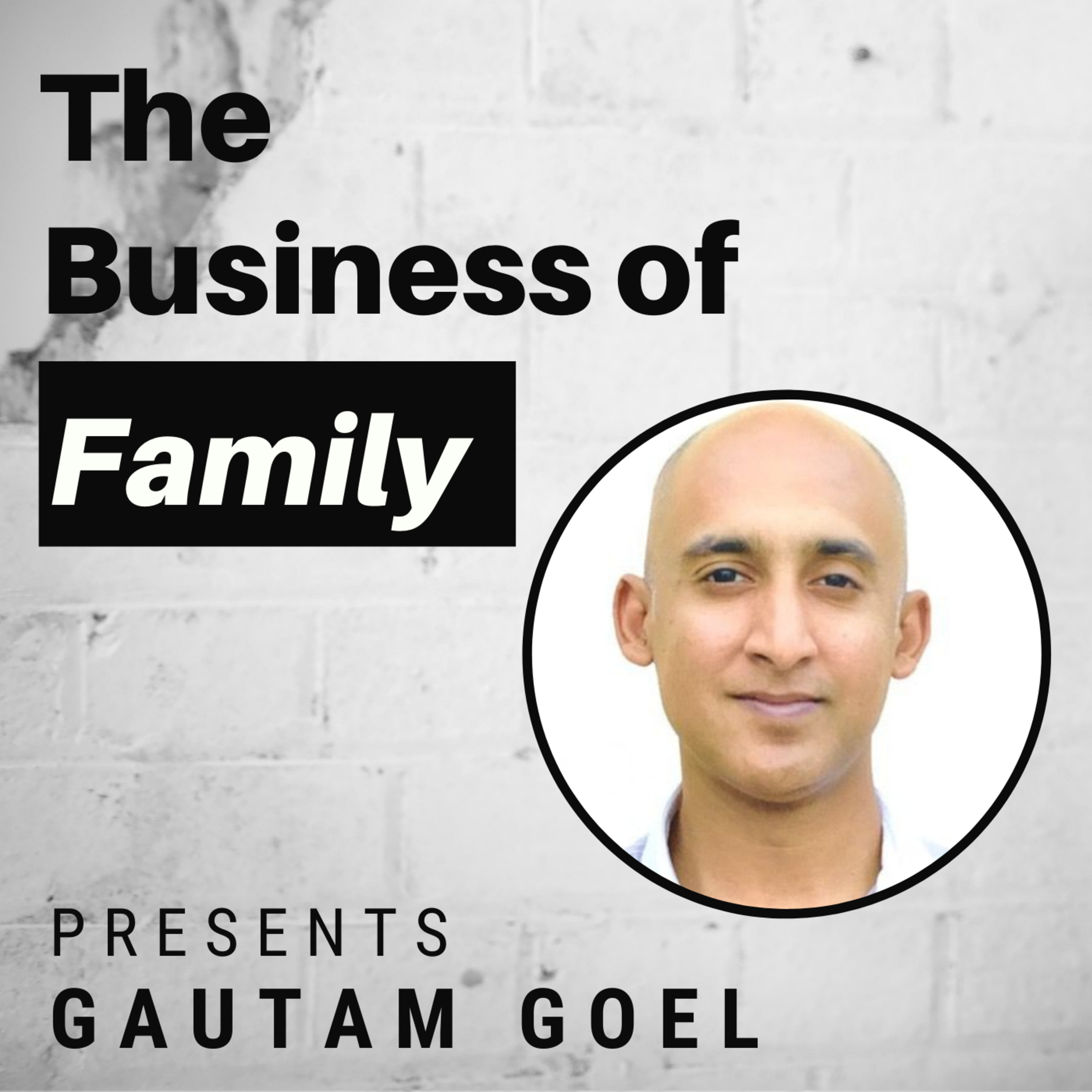
Episode 22 · Season 1
4th Generation Steward of Dhampur Sugar Mills
Key ideas from this conversation
His father took the smaller mill and let the better one go, not for legacy but to stop the squabbling.
If you want to join, you have to be capable and fight for your position. He tells his three daughters the same.
Accept good fortune gracefully, and accept how much of it there is.
Read the full show notesBio, standout quotes and the episode timeline
Gautam Goel is the fourth generation Managing Director of Dhampur International Pte Ltd, the parent company and Dhampur International Pte Ltd.
Founded in India in 1933 by Gautam’s great grandfather, he along with fellow members of the current generation continue to steward the family and business legacy today.
Listen on to hear how the business was intentionally split off from a wider family group to resolve in-fighting, how they’ve professionalised the business and what challenges they face when contemplating the 5th generation’s involvement.
Standout Quotes:
- My dad used to tell me "if you want to join the work, you have to make sure you are capable, I won't yield an inch if I don't think you are capable and you have to fight for your position, I am not going to give it to you" - [Gautam Goel]
- "I don't believe in the saying Look before you leap because very often you don't leap, only when you leap do you realize what your capabilities are" - [Gautam Goel]
- "Do unto others as you would have them do unto you" - [Gautam Goel]
- "Don't be fixated on results, put in your best, do your effort and leave the results" - [Gautam Goel]
Key Takeaways:
- Gautam encouraged his daughters to go to college, explaining that going straight to work makes you grow up fast and there is no need to rush the experience when you can enjoy it.
- When trying different things, it is important not to move too fast from one to another because you might not give each your full attention
- Business can't be a democracy, one person has to make the decisions
- Gautam explains that to be in this industry in India, you cannot solely be profit-oriented, you need to have a mindset to do good for your community.
- Not encouraging recklessness, but as long as you have common sense, it's good to be adventurous and make some mistakes to figure things out.
- Don't be fixated on results, results are not in your control, your effort is
Episode Timeline:
- [00:45] About Gautam Goel and the history of his family business.
- [14:27] How did you end up joining the family business?
- [20:21] Gautam describes the natural process of his succession noting how this affects decision making in the business
- [24:51] What does the business look like today, from where it started?
- [34:32] Is there a next-generation that is interested in joining the family business, and what challenges do you foresee?
- [40:32] Integrating the idea of outside leadership in the family business
- [42:22] Are there structures or plans in place regarding family governance?
- [43:44] Gautam's thoughts on children inheriting wealth
- [45:46] Are you taking any steps to document the history of the family business?
- [46:21] Gautam's letter to his kids
Links:
- Welcome To Dhampur Sugar Mills Ltd : Gautam Goel is the fourth generation Managing Director of Dhampur International Pte. Ltd
Read the transcript
This transcript was generated automatically and may contain errors, including in names. Listen to the episode for the exact words.
MikeWelcome to The Business of Family. I'm your host, Mike Boyd. Multigenerational wealth creation involves so much more than capital accumulation. The most successful families cultivate values, stories, knowledge and resources to pass on to the next generation, and they do it very intentionally. On this show I sit down with members of some of the world's most interesting business families to hear how they do it. To see where your own family stands, take the Business Family Diagnostic at businessoffamily.net.
Gautam Goel is the fourth generation managing director of Dhampur Sugar Mills, the parent company and Dhampur International. Founded in India in 1933 by Gautam's great-grandfather, he, along with fellow members of the current generation, continue to steward the family and the business legacy today. Listen on to hear how the business was intentionally split off from a wider family group to resolve infighting, how they've professionalized the business and what challenges they face when contemplating the fifth generation's involvement.
Gautam, thank you so much for being here today. I'm looking forward to hearing more of your story.
GautamThank you for having me, Mike.
MikeI'd like to start the story back in 1933 when India was still under British rule and your great-grandfather caught a break in founding the company. Would you mind sharing with us that story and how the business evolved through the second and third generations, please?
GautamNo, this is... We don't really have any records per se, but this is the story which has been narrated down the generation. And I really didn't have the opportunity to meet my grandfather. So, this is all my father... He did meet his grandfather and the stories he heard during his childhood. So my great-grandfather was, he was the one who started the company. He was a self-made man. He used to work for a contractor in India in a hometown called Bareilly, which is in Uttar Pradesh in the northern part of India. He used to work as an accountant for this contractor there. And this was also the period, he was an enterprising, sort of very hardworking,
enterprising sort of person and he was looking after his entire family and from what i've been given to believe they were pretty much quite poor as in you know they probably live in one sort of cottage or a sort of thing where they were like loads of people 10 12 people sort of sharing a room and probably the big task was putting a sort of proper meal on everybody's plate for the day so now this was also the time when there's a lot of railway construction and railway lines being laid in India. So the British were, you know, part of their governance and their ruling.
They spent a lot of money and they believed in creating a lot of infrastructure. So this rail network, which is also now pretty much the backbone of mass sort of transportation in India. So a lot of this work was going on at that time. And in those days, these sleepers to be laid, you know, between the railway tracks were all made from wood. So there was an opportunity there and there was this gentleman there some British person who was in charge of all this contracting work and in the railway lines he noticed the entrepreneurial zeal in my great grandfather I think he motivated him to start off branch out on his own and now he then apparently
the story goes my great grandfather figured the best way to source wood would be in Nepal which is sort of a couple of hundred kilometers north of where we were staying, maybe four or five hundred kilometers north. And he had to get permission from the king of Nepal. He managed to get that. It was supposed to be a really rough place to be.
I mean, it was pretty much you had to camp in the forest and cut the trees and lock them and bring the sleepers down. So that's what he did apparently. And he came back and he supplied those railway sleepers to the Indian railways under the British. And that was his first big break. and he made the starting capital, seed capital from there.
And he then, you know, this was also the period when the British government was encouraging some Indian entrepreneurs to set up sugar manufacturing units all across India, especially the northern part of India and some western and southern part of India. They identified as areas where sugarcane could be cultivated. So that motivated my great-grandfather to set up two sugar mills.
one was in our hometown of Bareilly and the other was in this place called Dhampur, which is where our company's current name sort of comes in from. Why he chose Dhampur, I have no idea. I don't know why the Dhampur came into being, but it's not too far from Bareilly. It's about 120 kilometers. Then he started, he set up these two sugar mills and he was apparently, I mean, he had a very, he didn't live too long.
From what I'm given to understand, he sort of died when he was in mid forties. So if one was to just sketch back and sort of try and see what he achieved during his short duration, you know, probably must have achieved everything in about 10 to 12, 15 years at best. And bear in mind to set up a mill over there was also, you know, we still have a relic, an old mill engine, which was all imported from Liverpool.
It is still displayed there. So I'm sure, you know, to set up a manufacturing unit over there would probably have taken a couple of years. And then, of course, he decided to live life king size. You know, he constructed these big, huge homes for himself and his brothers. He was very fond of buying land and donating land.
So there have been places where we've gone and we've heard stories about my great-grandfather had come here. And he bought this piece of land and donated it to this sort of charitable organization or a quasi-religious charitable organization. So, I mean, that was his life. He sort of lived life in size and then he passed away when he was in mid-40s.
MikeWow. So it sounds like he had a very big impact in a short amount of time and enjoyed it along the way.
GautamYeah, I mean, it seems to be quite a remarkable human being from what you hear.
MikeAnd tell me how it passed then from your great-grandfather to the second and third generation.
GautamSo I think, you know, in those days in India, so in lots of other parts of the world, especially in India, there was the whole concept of joint family and he being the eldest brother, I mean, maybe didn't come from any great business background or tradition. There wasn't any great sort of well-drafted, well-documented succession planning. So from what I'm given to understand, he decided that whatever businesses he created, the shareholding is split between his family, between himself and his siblings.
And there were, I think, three siblings that he had, three factions of siblings. There were two or three factions of siblings that he had. sorry, there were two major factions, two other siblings that he had, and they all got sort of equal stake in the company. Why he chose to do that, again, we really don't have any idea about that. So when he passed away, now my granddad and my great-grandfather had two sons, and he had a couple of, I mean, a few daughters. And again, in those days, it was quite a chauvinistic society.
The women weren't really supposed to be participating in business. The agenda was to get them married and they went off to their respective husband's homes and that was it yeah and the sort of the son sort of took over the legacy and the family business so my great grandfather had two sons one of them the younger one didn't live too long apparently he had polio or something and he passed away so he only had one surviving son which was my grandfather so his share automatically went to my grandfather and his siblings they had quite a few surviving male And so they, of course, had a greater number of people who were managing their share.
Then there was a period of sort of a downturn in the industry where they were wanting to sell out one of the units. And the story goes again that, you know, when the option came to sell out, when there was getting a price to sell out, my great grandmother told my, so my grandfather had a lot of regard, love and respect for his mother.
and her mother also had a tremendous amount of love and respect for her son. You hear stories that whatever food would come in the house, if there were fruits or any such thing, she would take away the best sort of choicest fruits and keep them aside for the son. Anyway, so when they were looking to disinvest in one of the units because they were having some financial troubles, she convinced my grandfather that, why would you want to sell out something which your father has created?
I mean, the story goes that she basically told him, listen, the world will, it's your choice. I mean, if you want to sell out, I won't stop you. But the world will say your father created two factories and you ended up selling one. Why would you end up doing that? So my grandfather, sort of that impacted him tremendously.
And he didn't really have any capital at that time, but he went to his, the other factions and he said, listen, I'll buy out your 50%, some stake, and I don't want to sell out. through some means he managed to raise some capital to buy them out to buy out some of their stake and we ended up getting 50 of the company and the other two factions at 25 each now why he didn't buy why he didn't sort of look at a situation where he could have bought one of the mills out and this kind of arrangement again god knows you know maybe they didn't want to sell out a mill to him there were some deferred payment clauses maybe that's why they believe they should
do something to that effect. So I'm not too sure exactly why this transpired. But eventually, from having one third stake each, we had 50% and the other two factions at 25% each.
MikeInteresting. And this was the second generation, your grandfather was the second generation.
GautamYeah, my grandfather was the second generation. And then of course, my grandfather himself was quite a sort of a theory sort of a gentleman. And he was sort of enjoyed love to live life king size, as they would say, very short tempered. And you know, but great at i mean he was really good at public relations he was good at financial and account controls and legal matters but he really was not the kind of person who would want to give an inch now when they started so they somehow they came to an arrangement because we had two mills at that time and since our family had 50 percent shareholding the arrangement they decided between themselves was every four years they would the management of the mills would switch i mean so
you had Bareilly and Dhampur as the two sugar mills.
MikeYep.
GautamSo for four years, our family would manage one mill and the other families would decide to, would sort of manage the other mill sort of two years each. And then they would swap how corporate governance and what kind of structures were in place. I mean, it sounds very chaotic to me. It's very interesting. So obviously this had to lead to some form of trouble and chaos.
Business can't sort of work in this manner. And they started having some business difficulties And then they started discussing about splitting the business. And that's when if all sides were wanting to get the best deal and nobody was really wanting to close, they kept on fighting. They continued to fight and they continued to squabble with no concrete result coming out.
And my grandfather basically, my grandfather had five children, two daughters and three sons. So my father is the eldest son of my grandfather. he's preceded by his sort of daughter, his sister, his elder sister, then it's my father. And his two other brothers, one of them sort of passed away in a car accident before he sort of got married and he didn't have any children. But post his college, he had already joined work. So at that stage, my grandfather was diabetic and, you know, again, he had a sort of a very excessive lifestyle and his health wasn't doing too well. So my father, who was in college in pursuing engineering, chemical engineering, was asked to come back.
At the age of about 18, he came back and started working with my grandfather in the family business. I think they worked for about five to six years together. My dad was, I think, 23 or 24 when my grandfather passed away. And during this time, they were, of course, having these family troubles and squabbles. And my dad keeps on telling me, he kept on telling his dad, listen, why don't we just settle and let's take Dhampur, which is...
Everybody wanted Bareilly. Maybe it made their life... more convenient to have a factory next to where they were living. It was a slightly bigger plant, maybe a little better plant. But my dad saw more potential in Dhampur. So he kept on trying. My dad was kind of an operations guy on the shop floor. So he sort of saw the potential in Dhampur.
And he thought it was a more intelligent thing to look. If everybody wants, but really give it to them, but take the unit with more potential and go off. You'll be your own master without all these problems. But my grandfather would not want to. He said, I will not take what he considered to be a lesser leader.
So they couldn't come to an agreement. And then after my grandfather passed away, pretty much soon after that, my dad sort of was at the helm of his side of the family. And he said, listen, they're split. He decided to give them Bareilly and take over Dhampur. And then that's where he started sort of working independently in Dhampur.
MikeAnd so when that occurred, that was an intentional pruning event, for lack of a better phrase, to narrow the family tree back to your clan. The other two were in the second sugar mill and you consolidated just into one that your family had entire control over.
GautamExactly, yeah. Now, I guess the reason my dad tells me the only reason he did that, he wasn't really thinking of pruning and long-term, he was not really, he just felt this is the only way going forward, otherwise everything will get ruined. He still had a good relationship with his other siblings and his other cousins from the other clans, but purely for work reasons and he thought this is just a better way to be.
I don't think it came into his mind that this is for legacy reasons or any other reason. It was purely at that point of time, he just thought this is the best way to operate. Otherwise, everything is going to go down the drain.
MikeYeah. A great simplification for all involved by the sounds of it. Yeah. Now, let's fast forward. That was your father that consolidated. How did you end up joining the family business? Was that something that you were always destined to pursue or did you have other plans in mind? What was your story in connecting to all of this?
GautamIt was interesting. My father, you know, we'll have to go back a little bit because I went to, my father was sort of, you know, he's been a fairly dynamic sort of a guy. He's been very entrepreneurial. He's bet it all and he's come out on top, but he's sort of taken a lot of risks, more than his fair share of risks.
But a fairly hardworking and a little different kind of a person, not really motivated by money and wealth, but with the idea of trying out new things and creating new things. And he's got a great sense of, I would say, service to the community in him. But he's been fairly, you know, he's not been a very hands-on dad during my growing up years.
You know, he's pretty much been involved with work and he's worked really hard. So somehow he's created an image for himself in the organization, in the company, and within the areas where we operate. I mean, to give you a story about him, he ended up donating one of his kidneys to a complete stranger.
MikeOh, wow.
GautamAnd this was when I was in grade seven. I was in a boarding, and my mom came to me and said, Dad donated his kidney. I said, what? He didn't tell anybody at home. And we asked him, what drove you to it? and he saw an ad in the paper and he said, fine, let me do it.
And he investigated that would a person survive with a kidney. He said he could have a normal life and he ended up donating his kidney.
MikeAmazing.
GautamJust to a complete stranger. He's become really close friends with one of the doctors who was in charge of genetic matching of the kidney. The doctor friend of my dad keeps on telling me, saying the story he tells me is when this person who he donated the kidney to came to him. and he said so you managed to find a donor outside the family you had to pay money he said no the gentleman just came him came up by himself said i want to donate my kidney if you wanted and he offered to pay for the operation expenses he said if need be so my dad got this sort of unique mindset in a way and what a great human being now with sort of uh but he was all so when i was
growing up you know whether i whenever whenever i came home from my boarding or even when i was studying and he was around we always saw him and he was okay maybe he was the person ahead of his time he didn't really believe in a structured office he would at the factory we would have a home inside the compound there'd probably be meetings happening inside the factory and inside the home the drawing room was like a community office like you would have an open plan conference room that was our drawing room you know so he's pretty much came got exposed to the day-to-day work from a very early age but i had no real idea whether i'd want to join work i'd want to do
something else i went to this the boarding school i went to had a very strong army background for a short while maybe a couple of years i toyed with the idea of maybe trying to join the army join the air force that didn't last too long and but yeah there was no career planning there was no structured way of you know i mean we guys didn't really have in our general i guess when we were especially in india there wasn't any great structure to all these things you know some of things just happen naturally. My dad used to tell me, he said, you know, if you want to join work, you have to make sure you are capable. I won't yield an angel. I don't think you are capable,
and you will have to fight for your position. I'm not going to give it to you easily. I love my work, but if you're capable and you're good, you will have all the opportunities. And he's the kind of person who didn't even believe in too much of structured education and college education. So, post my 12th, he was sort of, I thought I would go to America and pursue an engineering and degree and my dad was listen just join work it's just you know he had to come back after one year of college and he felt you can learn everything on the job and with all the books you have available internet was still not there in those days
so google hadn't been invented or thought of by the this i'm talking about early 1990s you know and he told me why don't you join work i thought i'll do a pick a gap here and join work but we During this time, we had set up a mill in an eastern part of Uttar Pradesh, which was a little bit of a distance from where other operations were.
By now, we had about four sugar mills, and one of them was in partnership. And this one was in eastern Uttar Pradesh. Nobody was really going there to that extent. So just by default, I started going up and looking after that mill, and my dad gave me the independence. He didn't even give me the idea to go there.
Just because nobody was going there, I started going there, and started looking after the mill. and that gap here, one year became two, then two became three and that was the end of college. And the rest is history, as they say. Yeah, so then this is also, I mean, I would just drift off a little bit of topic, you know, when my daughters ask me that, you know, that you can go to college, do you think it's a good idea to go to college?
And I always tell them, I say, you know, if you want to, I say either you're pursuing something which is really intense, like a medical degree or some sort of high-end scientific degree where college will be really worthwhile. But I would still advise you to go to college purely because enjoy your youth a couple of years longer.
Why do you want to grow up? When you come to work, you just grow up very quickly.
MikeThat's true.
GautamSo life expectancy has increased. People don't think they are old when they are 60. You have people who are looking to be presidents and all at 75, 80. So it's a different world now. I said, why would you want to just join work or something, grow up, enjoy your youth some more, go out. but yeah make a meaningful time out of it don't just go out and do nothing but just make a meet learn something get the exposure and so anyway so that was the end of my college and I had the freedom to experiment and try out different things my dad did always he believed in that he believed in trying out new things and being innovative and so he did give me that freedom and I was fairly
aggressive at work and I would try out different things I'd made enough mistakes I always had my that sort of that support me there but overall i ended up sort of you know my graph and my ended up delivering a lot of quick results and i ended up sort of every year my performance and the unit i was managing was only going up so then i got the opportunity the unit that we had in a partnership with a with some distance of some distant cousins the people who then i managed i got the chance to look after that i orchestrated buying over the shares and expanded that unit so i kept on you know work i used to work really hard pay hard work hard but and continue to be aggressive at work and
made my first share of mistakes but overall i still came out on top and kept on getting more and more responsibilities and i guess this was also the phase where my dad was not so motivated in managing things very hands-on and he saw me doing a decent job so he like kept on yielding more sort of authority and power to me.
Till the time when, of course, we used to have our fights also, when I would disagree with the units and the things he would do. We would have some sort of fairly explosive fights, but eventually we'd make up. So we sort of figured out our own balance with enough sort of disagreements in between. And I guess slowly as a period of time passed, I sort of started looking after, took on more and more of his role.
And by the end of it, I sort of ended up having more authority than he did. And that is still something we continue to fight about. There's still times. Nowadays, my dad tells me, why should you have your final say? And I tell him that that's the way it is. A business can't be a democracy. There has to be one person.
One person has to make a decision now. You had your time, now it's my time. But we continue to have those arguments even now.
MikeAnd so it sounds like that was almost a natural evolution. Again, it wasn't a passing of the baton or a succession plan as such. It sounds like it's happened over time and gradually. Is that right?
GautamYeah. I mean, there was no structure to it. Till date, I mean, it's only now our generation, we are trying to put some structures in place. Otherwise, there's really been no structure in the way we, whether it came into our sort of personal family governance or even corporate governance to that matter. You know, everything was very, very hands-on and managed, very people-centric.
Yeah. Classic way of sort of, you know, family.
MikeFamily business.
GautamSo businesses, especially where one generation, the way they managed, they decided to keep it in a very people-centric manner.
MikeI'm really interested to get into that a bit further. But before we do, I want to touch on this growth trajectory that you talked about. You were managing these business units. Everything was on the up and up. But I'm curious about some of the failures, if you don't mind. I always think it's interesting to ask about a favorite failure or an apparent failure that maybe then set you up for later success.
Does anything stand out in your mind as something that shaped the journey?
GautamLots of failures, Mike, but I don't know if it's a favorite failure per se, but lots of failures, lots of – because I used to keep on trying different things, so there have been many such sort of things which haven't taken off. Over the years, it's not something which – a favorite failure, I'd have very difficult – I mean, there have been so many years, I don't know where to begin.
But, yeah, one thing I do realize, and this is a lesson I learned very early on, I set up a small CO2 unit and a small oxalic acid chemical unit. My dad noticed that he said, you know, Gautam, what I noticed is you're moving on too fast from one thing to another and you're not giving it your full attention.
If you've taken on the responsibility, if you're struggling, you've got to still give it your best. It can't be that you move from one to the other in such a quick, rapid manner. That sort of became a good guiding point to me. Then there were others recently, very, very recently, a couple of years ago, I think four or five years ago, I had this idea of setting up this rural online distribution business.
But I was sitting in Singapore and tried to set that up. And I realized I spent a couple of years there, spent a decent amount of capital there, but eventually decided it's not going to work. I didn't think because it was a bad idea, purely because of executing. Me sitting in Singapore with zero exposure to that online and semi-online space, trying to manage something in India where I'm not even traveling and all these things.
So I closed that part of the business and a couple of other unrelated things which I had got into.
MikeInteresting.
GautamYou do keep on deciding that what is the right way to do things.
MikeYeah. And you do have to keep exploring and trying different ideas, otherwise you don't grow. Yeah. So I'm curious how that evolved now. What does the business or the group look like today? So it started from what sounded like one mil that your father consolidated. Today, it's a much bigger business. For the benefit of the audience that maybe isn't familiar, can you just give us a rough idea of the size, the geography, the core product lines that you support today?
GautamSo, yeah. So, from one mill, we today have five sugar mills now, of course, and we have a fairly decent presence in renewable energy, biomass-based renewable energy. Sugarcane is excellent. after you extract the juice from sugarcane, it becomes an excellent fuel. And it's a very efficient crop. Sugarcane is a one-year crop roughly in India. It's a very, very efficient crop when it comes to photosynthesis and absorbing CO2 and fixing it and becoming sugar and sugarcane.
And there is no real waste product in the sugarcane, you know, because the juice, you get sugar, you get molasses, which makes alcohol, you get biofertilizer, you get power, biomass-based paper. So there really is no great, either any major effluent or sort of a discarded product from a sugar cane. Now, so we had one mill with my dad.
And during my dad's time, he expanded the business. You know, that one mill, he eventually got an opportunity to get into a partnership with these cousins of ours. He got into that partnership. He bought one more. Then he set up two more mills. They became five mills. We set up one distillery in our Dhampur unit and we also got into co-generation in a smaller manner.
By the time I came into work, we were also having some financial difficulties, but we continued to grow. So I continued to expand the business, expand the mills, expand some capacities and all these things. And there was a time when the unit, which I was very instrumental in managing and growing, the one in East UP, which I used to look very, which I was managing very hands-on.
they got a fantastic acquisition somebody wanted to buy that unit out at a great price and we was financially stretched at that time so managed to sell that unit even though my dad wasn't very happy about it he said i would make him good profit but you know i said we're getting really good price effectively and this is just help the overall group's balance sheet and become stronger so sold that but ended up utilizing that capital to grow further we set up another mill closer to where we were to have a more consolidated space for all material movement and all these things.
So the product line pretty much remains, core product line remains the same as there's sugar, there is ethanol, there is renewable power. But in sugar, then we decided into getting into more better quality sugar, sort of marketed in a different manner. Some of the sugar, renewable energy business at that time in India, there was a lot of potential.
So I grew the renewable energy business sort of very aggressively. We became one of the largest renewable energy suppliers in our biomass space. So, Dhampur are really very efficient and big capacities there. Then government came out with some ethanol policies. So, go the ethanol side of the business now and that's a major focus area.
MikeSo, I'm curious how you go from a sugar business to renewable power. There's a huge amount of IP there, I imagine, that has to be acquired in understanding a new industry or are you simply reselling the waste product or the ethanol that comes out of it? Are you actually manufacturing and selling power yourself, or are you a supplier to that industry?
GautamNo, we are manufacturing it ourselves. But there's not that much of an IP, Mike, because the sugar industry per se, world over, there are some big sugar-producing countries. And for some reason, there is a lot of knowledge flow that happens in some way or the other within the country and across the globe. Australia is a fairly decent-sized sugar producer.
Brazil, of course, is the big boy. India is a big one. Then you have South Africa. You have this biomass and using this sugarcane residue to produce electricity. We always produce electricity and steam for our own internal requirements using the sugarcane residue.
MikeInteresting.
GautamThat is inherent to the sugar manufacturing process. Now, it's a very energy-intensive process. You have your own homegrown fuel, so why would you do anything else? The idea to set up a more efficient power-generating part of the Instead of just, you know, you have your fuel. So rather than setting up a power generating system, which has an X efficiency, which can meet out your own requirement, you set up a power generating unit, which has two X efficiency.
So you generate that additional X, which you can sell to the grid. Now, you need two things for that. You need the grid or the government policies, which allow you to do that. And the technology and this work was already being done very successfully in Reunion and some other parts of the world. and we know there was this time when this global warming and everything else and renewable energy became a big push yeah and in india they had they were facing power shortages so government of india and state governments also decided to encourage this again we took the lead my dad took the lead you know there was a time when we were the first people to start this in india our company
has pretty much as a single company as a we probably have the maximum number of new ideas and technologies that we have introduced to the country. But the industry is such where one person does some good job, other people will. So more knowledge doesn't get – it's a very open industry in that manner, and there is no great – it's more a matter of how good and how efficiently you're able to do what you're doing.
That differentiates a successful player and not a very successful player.
MikeVery interesting. So it's more the operational capability than the know-how.
GautamYeah. I mean, of course, somebody who does have some great know-how could get an advantage for a couple of years, but then the others catch up very quickly.
MikeI'm curious as a large employer in India working directly with sugarcane farmers and producers, you play an important role in the community, I imagine. How do you feel about the responsibility that you carry for those who rely on the continued success of your business?
GautamYeah, that's a big one, you know, because we are probably the largest now, the largest agri-industry in India. And the way we are structured, you know, in India, We don't have any big landholders and big plantations. There are many, many small farmers. Now, to give you an idea, each factory of ours, we have five units of different sizes.
So anything between 50,000 to 75,000 farmers supply cane to us.
MikeWow.
GautamAnd we deal with them directly. There is no middleman involved. So by dealing with them directly, we have their land records on our system. We know how much cane they've planted. We give them a schedule at which they'll have to supply. and we give them a token when they're supposed to bring their cane. When the cane is weighed, we send money to the bank account directly, electronically in about 14 days.
So it's a very comprehensive and a very, very vast operation on that side. And what we've seen, you know, because what is the advantage of sugarcane as compared to a lot of other crops? It's a very hardy crop. And because there is a structure there, you know, of course, in government, because it has such a big rural impact for the farmers.
The government also steps in in India. It's not a completely free industry. They do decide what is the price that one has to pay to a farmer. And it's in their motivation for political reasons to try to make sure that the farmers get the highest possible price, which is the price which doesn't make the industry unviable, but they don't want the industry making excessive profit.
They would rather that money went to the farmer. So once again, operations become a key in success over here. So that is the kind of outreach that we have. And what I have seen in any new mill that we put up or any expansion that we do, I mean, you see that the rural economy and the rural dynamics just change drastically when the sugar factory comes up and does a good job because people get visibility to their income, they get stability of cash flow, they get regular uptake.
And you suddenly start noticing, you know, the kind of people suddenly start having some fast roofs and, you know, kachya, what you would call these old cottages. Some of them still live in these sort of cottages which were sort of not with bricks or strong structures. Suddenly the kind of housing changes, more schools come up, you see more motorcycles on the road, you see tractors.
So, I mean, it makes a big impact on the rural economy. So, it is a responsibility which we do take very seriously and we should take very seriously.
MikeIt's terrific. It must be special seeing that impact that you can have as a business owner, but also a participant in that community to see how you're shaping it.
GautamYeah. I mean, that's what, you know, what to me, I always find it very fascinating because, you know, I think it's our industry is one of the few industries where it's still, you know, old world meets new world, you know, where you have the farmers and a lot of them doing conventional agricultural practices. Some of them even now bring the cane with bullock carts and all.
It's only reducing, but there is still a very, very small percentage which would do that but yeah you do have the old meets the new you know and and you have these mills which are ultra modern with automation and now you have thermodynamics chemical engineering you name it all there you know fermentation biotechnology all coming into place so it's all a very very
Mikeand renewable power out the other side
Gautamyeah so it's a very interesting space to be in in that manner if you enjoy that kind of a mindset yeah fascinating to be in this industry in india you can't be a pure profits under your driving motive. You have to have some form of a mindset to do good to your community.
MikeI like that a lot. I'm curious now, as a family business, you're the fourth generation to steward this business. Is there a next generation that's interested in joining? And if so, what challenges do you foresee may need to be overcome to ensure the family harmony continues?
GautamSo, yeah. So now, you know, my dad was the eldest son and he has one surviving brother. And so they were both managing the business. Now they are both sort of in a, even though they are chairman and vice chairman respectively, but they are sort of, they've taken a backseat in the day-to-day operations and they would like to oversee things and give advice, but not be very, they're not that active in work.
I mean, they come to office regularly, but they all have the other interests, like my Dad runs some schools and other things in the rural community. So now there are two of us now, me and my cousin, who are the managing directors of the company. And I have three daughters. The eldest one has just started college. My cousin, who's also my age, has a daughter and a son.
I don't think the daughter is really interested in this business to a great extent. But the son, as of now, shows interest. He seems to be wanting to come into the family business. My daughter took a gap year from school after school and before she was going to college. And she did spend some time in a Dhampur unit to understand the business.
And as of now, she just said that she would like to come and join the family business. For the other two, the jury is still out. I tell them, you know, the choice is your choice whether you want to come and join the business or not. I agree with what my dad told me. But I won't force you to come.
But if you do decide to come, your capability will be very instrumental in seeing whether you get into a leadership role. obviously if you aspire to come and if you are capable and i think you are you know your growth will be a lot faster than a average you know than anybody else who you would hire then you would pretty much you know then you would look at you as somebody who would potentially take on a leadership position in the future so you would be groomed in a way from that so it's not a pure i wouldn't call it a very pure 100 professional outlook i mean there would be an element of legacy and these things but i'm clear that it has to be they have to be capable for the
obvious reasons, like I mentioned, there is such a big responsibility that we carry towards the community that if leadership is not capable, then it could really drive the business to the ground, which is something that is not what is desired in any circumstances, and more so when you have this kind of big responsibility over your shoulder.
MikeSo two questions on that. One, I assume that daughters are welcome in the succession plan now, unlike previous generations? And two, how do you measure capability?
GautamYeah, daughters are welcome in a way. I don't even know the daughters would not have been welcome before. I don't think during my dad's time, I don't think there was a rule that they were not welcome, but they just grew up in a way thinking that they're going to get married and moving on. That was the social structure that time.
MikeJust wasn't the norm.
GautamJust wasn't the norm. and I don't think now, I mean, for me, I really didn't even think twice about it. I mean, and it was always nothing. I mean, it was always given that if my daughters, if I had three daughters, I mean, it wasn't at any point. And at any point of time, it was never that I have to have a son.
There was no real driving motive there. And I don't know whether to, how to address that question about the daughters being welcome or not being welcome.
MikeI probably could have phrased it better, but only to say it's transformed with modern society. It's wonderful.
GautamAnd now we've seen enough of these cases in India, so I don't think a lot of these kids don't even feel in any way that they shouldn't. Like they question, they say, how come my sisters haven't chosen to be in the family business? And I really say, I mean, it's not that. They just didn't think themselves to be going down that path.
And on the capability side,
MikeIs that something that will you encourage children to work for others first before coming into your business? Or do you want them to come into your business and just prove themselves in their capability and operating a unit or a piece of a unit and prove themselves over time in terms of capability?
GautamI think I don't have any fixed ideas there, Mike, but I do engage with my daughters. and the eldest one does seem to think that after she finishes the college, she would like to concentrate on. Then she'll decide whether she wants to do something else or she would like to go back to pursue education a little bit more.
She's not too sure. But because of her gap year, she found that very exciting. So I think as of now, she does think that post-college, she would want to come into work. My second daughter, who is in grade 12 now and looking to get into college in the coming year itself in 2021, she believes she would like to probably work for some time before she came in.
But she also has a great sense of giving back to the community. All three of them have. All three of them, by virtue of, I guess, being in Singapore, by virtue of whatever they saw at home, they do have a great sense of giving back to the community. And my second, the middle daughter has that in a great, that zeal for her is even greater than the others.
so i would imagine in whichever part of the if she does decide to join the family with this business she will be very very interested in the social aspect of things and what contributions she could do i don't think she's looking to be in the social service as a profession but that will be a big motivating factor for her now again you know i guess it's very difficult to put us it's not that we are such a large firm that you know we have to have of these structures in place.
I mean, I'm trying to professionalize things and I would like to imagine succeeding in some manner, but we're still sort of an average, medium-sized corporate by Indian standards. And so I don't think it's really required for us that they do get an experience somewhere else. If they choose to, I mean, that's going to be a decision they'll have to make.
MikeExcellent.
GautamAnd capability, if they join work and I'm still around, then I guess it's going to be an element of a lot of subjectivity with enough objectivity thrown in.
MikeI'm curious, you mentioned leadership roles and the potential for children to work their way up to one if they're capable. That leads me to wonder about outside leadership. Have you ever had a non-family member, managing director or CEO? Is that a consideration in the family firm?
GautamSo, yeah, I mean, now between what Gaurav and me had been talking and we had been trying to, so we have a COO, we sort of, you know, so we are looking really seriously at all these things now. on what is going to be our individual roles. Obviously, I don't think as time progresses and we are at a particular stage of our lives where we realize maybe we don't want to be so hands-on and maybe it might be more efficient for getting people who are more capable of being hands-on, who have more focused interest in just the day-to-day operations than what we could probably have at this stage of our life.
So now we do have a COO who's been a person who's come up from within the system. We are looking to get an external CFO. So all these things are already happening. But also, I guess there is an element of the industry per se in India, and this is a rural-based industry. The climate in India has also changed in a fairly drastic manner over the last decade, decade and a half, where both sides from the people who have been managing businesses have been looking to professionalize, especially the bigger – it started out with the top companies and then it's been percolating downwards.
MikeYep.
GautamAnd there are a lot of capable people out there who want to be given a free reign and who don't want people looking over their shoulder on a day-to-day basis. Of course, they are happy working within the defined guidelines and boundary, but they don't want somebody to tell them how to do their job. Communication systems have improved, so I guess we already embarked down that path.
MikeGood to hear. Okay. Turning now to family governance, I'm curious whether you have any formal documents or procedures in place to govern family meetings, decisions, succession plans, or wealth management. Is this an area of interest or something that you're likely to pursue?
GautamAlready in the process now, first is the bigger picture between Gaurav's side of the family and the other side, between our side, our shareholding, and what our roles in the company will be. And the next question we have to ask ourselves and define is, what will be the role of generation, the next generation comes in? Do we keep the same company or do we decide to go our separate ways?
As of now, we really haven't addressed these questions. We have to figure out what is best for the business and for the families concerned. then, of course, comes the part of our own individual wealth management from whatever monies we get as shareholders and salaries that we get. That's a very, very personal matter because we decide for our family but we decide for his family.
And there isn't really, I mean, again, it's not like a very structure. I've not had the need to put in too much of structure there, but yes, it's there in my mind now that Generation Next will be coming in, There are three of them there. We'll have to put some sort of greater structures and governance over there than what I inherited.
MikeAnd do you have a particular opinion about children or adult children inheriting wealth?
GautamYou know, it's, again, there is nothing wrong in it. I don't think there's anything to feel guilty about. It's what you do with it, you know. I mean, honestly, I firmly believe it's, I won't say there's a lot of good luck in where we are. We have to accept good fortune gracefully, but we have to accept there's a lot of good fortune in where we are.
We are lucky in many, many ways. And whatever I would say, whether I worked hard or whatever I did, but there was a lot of good luck thrown in to be in a position where you're in a good position, really in a good position when you compare yourself to the majority of the world, especially in the kind of places where we come to India when we see it.
We have to be grateful for that. But I don't feel guilty about it in any way. I do believe we have to have a sense of giving back to the society and to the community, which is what we should continue to do. And I'm happy my children feel the same way. Now, beyond that, do I believe, I mean, do I go down to what Warren Buffett and all have decided to say, giving away a pledge where they're going to give away 90% of their wealth?
I don't think we're down there yet. But what I'm really happy to note, I think my children have the same sense of community and giving away to really contribute to the society, which I think is a good way to be. It makes you a happier and more content human being. So I guess these thoughts will also evolve as we grow older and as time passes on.
MikeAbsolutely. You are seeing different models evolve all over the world. And you'll figure out what sort of, which combination, what fits for you better. It's all about where it's directed. You can do a lot of good with it, can't you?
GautamYeah.
MikeI'm curious to ask now about your family history and whether or not you take any steps to try and document the history or the heritage of your family. You've just told us some wonderful stories about the prior generations. Are you doing anything to document the journey as you go or are there any keepsakes or mementos that are important to your family history?
GautamWell, nothing so far, but it's an idea that after hearing from you, I think it's an idea worth thinking about.
MikeThis might be the catalyst for that. Maybe the podcast is the first way of documenting the stories.
GautamIt becomes a good way to do something. It could be a good sort of starting point.
MikeI'm glad to hear it. Look, it's time for our final question now, and it's a question that I ask everybody that comes on the podcast. Imagine you're writing a letter to your children. What is one lesson or idea that you don't think many would mention, but you consider important to understand?
GautamI don't know if it's one idea, but I think there are three key driving points. I don't know, three key, very, very three key sayings or philosophies, you might want to call them. It's a very vague term that have given me a lot of, I would say the three key principles I would imagine. The first one was when I was in school, I got this letter from my dad.
It was basically, he copied an article from Reader's Digest about this one individual. And he highlighted this particular portion where this successful entrepreneur had said, I don't believe in the saying, look before you leap, because very often you don't leave. And only when you leave do you realize what your capabilities are. So I think it's a very interesting take.
I mean, obviously, you've got to have the right balance. You can't say, I'm going to take. Your risk versus reward perception has to be there to some extent. So I mean, let's take it in that perspective. I'm not advocating being overly reckless and jumping from a parachute but as long as you have that common sense it's good to be a little adventurous and figure out and make some mistakes
Mikeand that's all right I like that
Gautamthe other saying which I think the boarding school I went to was a Protestant school we had chapel every day for five days a week but one saying from the Bible which always sort of stuck with me it's like you know do unto others as you would have been do unto you so that sort of is a very I think it becomes a very good guiding mantra in my personal life I would not want to and the third thing which is a saying from a very from a Hindu religious sort of quasi-religious philosophical text the Gita where it says you know basically don't be fixated on the results put in your best do your effort and leave the result
results are not in your control the effort is and let your higher being sort of take care of the results. But again, you've got to look at them with a certain amount of common sense. You can't say, I want to push a wall, a brick wall, because that's useless. You can put on all the effort and there won't be any result.
MikeBut still some wonderful guiding philosophies.
GautamSo yeah, so that's the three things which I think come to my mind when you ask this question.
MikeIt's wonderful. And I think even just listening to the stories today, you can hear some of those philosophies and values being borne out in the way that you run the business and the way that you present yourself and the impact that you have on such a large community. So congratulations. And thank you once again for sharing your story with us today.
GautamThank you, Mike. Thank you for having me. And great to catch up with you. Great to meet you.
MikeLikewise. Thank you very much.
GautamTake care. Bye.
MikeThanks for listening to The Business of Family. You'll find the transcript and key ideas from this conversation at businessoffamily.net, along with the Business Family Diagnostic. It's free, and it shows you where your own family stands. And if someone in your family should hear this episode, please send it to them too. I'm Mike Boyd. Until next time, take care.
Keep listening
If this one landed, start here next.
Separating the Family Conglomerate After 111 Years
Another Indian family that chose to separate and stay family.
Family Politics, Consolidating Power, Going Public & Taking Private
Family politics and consolidating ownership in a Singapore family business.
Negotiating an Exit From the 4th Generation Family Business
Negotiating a way out of a fourth-generation Indian family business.
The Business Family Diagnostic · Ownership
Sometimes the wise move is the smaller mill.
Gautam's father split off from the wider family to end the rotating management, and kept good relations with the other branches. Is there an agreed process in your family for someone who wants to sell their share?
“Each adult owner knows what they own.”

Every family wishes someone had recorded the generation before.
I built Enduring Stories to do it for yours: a guided voice conversation, from home, that keeps your family's voices, values and history.
The newsletter
The most useful things in these conversations are the things families rarely say out loud.
I share them in my newsletter once a week. Sign up to receive the ideas directly and start building the foundations for your family today.