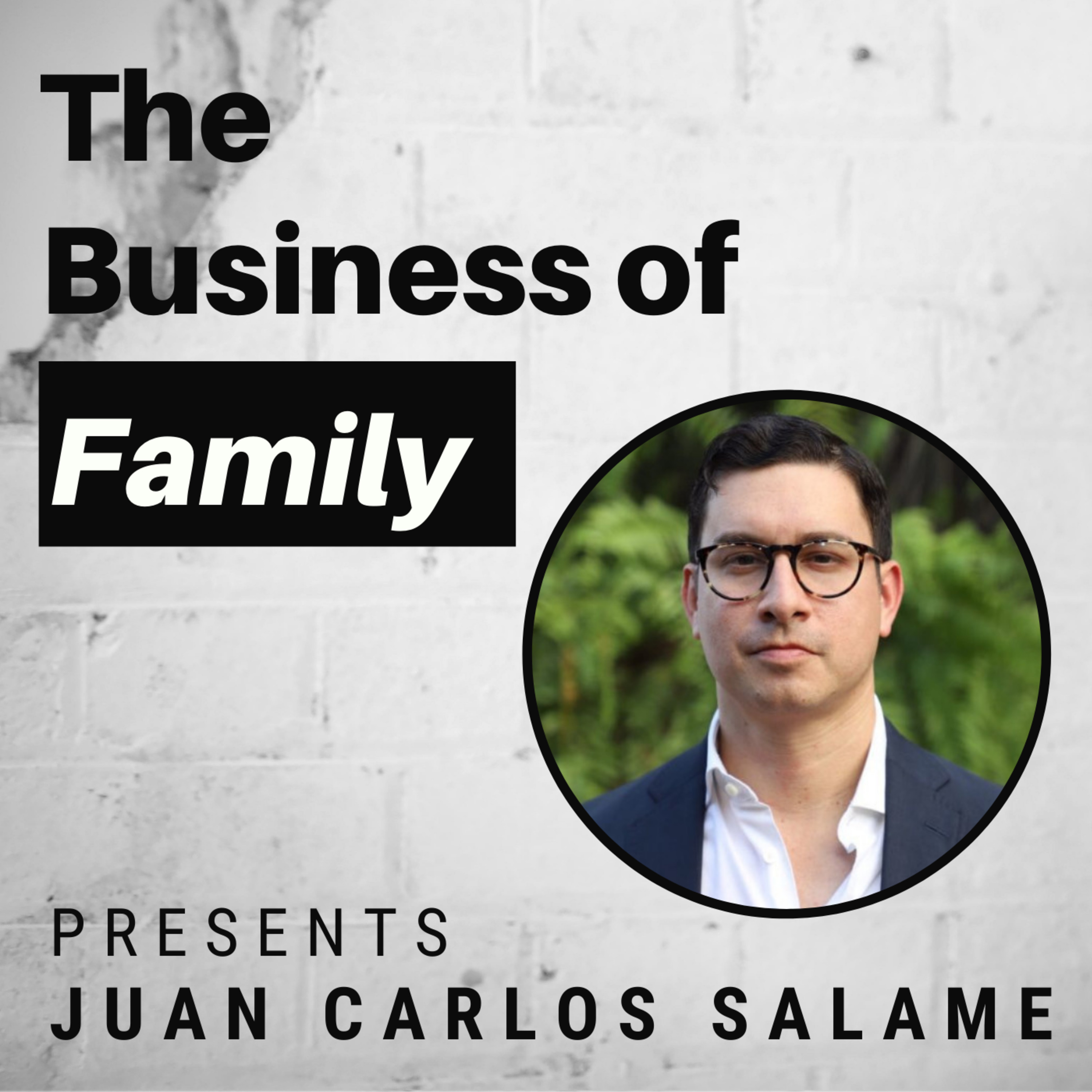
Episode 31 · Season 1
Scaling a Third Generation Ecuadorian Retailer & Credit Provider
Key ideas from this conversation
His two conditions: a board member who understood family dynamics, and reporting to the board instead of his father.
Every Tuesday the brothers have breakfast with their mother to talk family, and they meet their father weekly to talk business.
Starting a business of your own first is like three MBAs in one.
Read the full show notesBio, standout quotes and the episode timeline
Juan Carlos Salame’s family business began in Guayaquil in 1944. Domingo Salame, his grandfather, began selling at the local market prepaid vouchers so his customers could buy products at different local stores and, then, pay Mr. Salame in installments.
A revolutionary idea that many decades later evolved to what we know today as credit cards. He later put in place a retail shop to sell the products himself. This business was transitioned to his son in the late 70s. A couple of stores have grown into a corporation with over 70 stores in Ecuador and a strong ecommerce presence.
The business model focuses on financing products to a population, many of whom, do not have a credit history yet. Juan Carlos and his brother have taken over the business in the last few years putting in place top technological systems and curating an innovative culture.
Standout Quotes:
- "Be respectful of everyone regardless of their position, their role, or what they do with their lives" - [Juan]
- "Be very low profile...with your life, with your business, Humility in that sense" - [Juan]
- "I would seriously encourage anyone to look for a mentor in the early stage who will help guide them through the different opportunities that they would face in their lives" - [Juan]
- "I would encourage anyone in their twenties or early thirties to form their own business, especially if they want to be like a CEO... they have to quickly learn and fail on a smaller scale" - [Juan]
- "Founding your own business is like 3 MBAs in one" - [Juan]
Key Takeaways:
- Juan describes the original business model which is still in play today. His grandfather had started selling coupons which allowed customers to buy products from other stores now and pay back in installments to him. He later opened his store to sell those products, in effect, he was a credit provider.
- The business model is targeted at customers who don't get credit from their banks or lack a credit history to support them getting it.
- The biggest aspect of the business is now e-commerce, especially following the lockdown in the pandemic
- Describing that he was not forced into the family business, there was always some level of expectation that he would join the business, and he had already started getting involved at an early age. However he had left to get an MBA in the US, and decided to start his business rather than return to the family business, but after a few years, his father called him back. He stayed for a while and quitted since his working relationship with his father was poor.
- Juan shares that he finally went back to the family business with conditions given; the first was to have a board member to sort out rifts when they come up, the second was not reporting directly to his father.
- The most challenging aspect of the business they had to change, upon joining the family again, was the culture of the company in order to attract new talent. Some managers also had to leave, as there was a need to work with people who were more aligned with the goals of the company.
- Discussing his process of implementing change, Juan shares that his first step is to work with the people already in the company, if this fails, he then persuades the workers to make the necessary changes, and if that also fails, he would find someone else who can work with him.
- History did repeat itself as Juan's father also had issues with his father regarding joining in and transitioning into the family business.
- A key source of his knowledge was starting his own business, and also putting in the effort to be exposed to different industries by participating on their boards.
- Investing in time with the kids has become a top priority on the list of worthwhile investments?
- The family decided to assemble a book 2 years ago, which would tell the story of the family business and the family as well as the future of the business.
- Key lessons from Juan's journey: Be very strategic in how you go about implementing change. Being intentional about communication in the workplace and within the family is also very necessary as part of a family business.
- From Juan to his kids: Look for something that you want to do in life, something you enjoy, and something that adds value to the world. Juan would also encourage his kid to put the best effort into anything worth doing, find a mentor, and within the early twenties start a business because the knowledge gained is like 3 MBAs in one.
Episode Timeline:
- [00:45] About today's guest "Juan Carlos Salame"
- [01:56] Juan narrates the origin of the family business.
- [08:26] How did you come to join the Family business?
- [18:32] What changes have you been able to implement since you and your brother joined in?
- [21:36] Juan shares his approach to making drastic changes in a company.
- [27:52] Is there a multi-generational family plan in place for your children?
- [30:11] Have there been any transition issues since the business started?
- [31:41] How have you learned and grown on your journey?
- [35:08] What is the most worthwhile investment you have ever made?
- [36:09] Highlighting Values instilled in Juan which he passes on to his children.
- [37:05] Does your family invest in anything intentionally to try and document its history?
- [38:24] Juan shares lessons from his growth process
- [41:41] What would you say is your legacy?
- [43:01] Juan's letter to his kids
Links:
Read the transcript
This transcript was generated automatically and may contain errors, including in names. Listen to the episode for the exact words.
MikeWelcome to The Business of Family. I'm your host, Mike Boyd. Multigenerational wealth creation involves so much more than capital accumulation. The most successful families cultivate values, stories, knowledge and resources to pass on to the next generation, and they do it very intentionally. On this show I sit down with members of some of the world's most interesting business families to hear how they do it. To see where your own family stands, take the Business Family Diagnostic at businessoffamily.net.
Juan Carlos Salame's family business began in Ecuador in 1944. Domingo Salame, his grandfather, began selling prepaid vouchers at the local market so his customers could buy products at different stores and then later pay Mr. Salame in installments. A revolutionary idea that many decades later evolved into what we know today as credit cards. He later put in place a retail shop to sell the products himself. And over the next generation and into the third generation, the business has grown into a corporation with over 70 stores in Ecuador and a strong e-commerce presence. The business model focuses on financing products to a population, many of whom do not have a credit history. Juan Carlos and his brother have taken over
the family business in the last few years, putting in place technology systems and curating and innovative culture. Juan Carlos, it is fantastic to have you with us on the show this week. Thank you so much for joining.
JuanThank you for having me, Matt.
MikeI love your story. We've had a pre-conversation to understand this and I can't wait to share with the audience. Can you take us back to where your family business started? I believe it was your grandfather and help us understand the origins of where this very interesting family business story begins?
JuanSure. Well, yes, it was my grandfather in Ecuador back in 1944. He began selling some coupons, which allow the customers to pay installments while they buy in cash in different stores in the city. Then he realized that there was an opportunity to go and import those products himself. So he opened a store to sell those products in installments, which grew in the next years. Then my father took over the business in the late 70s. And he was the one who made it grow from like one or two stores to around 70. And obviously, expanded the portfolio of products.
MikeSo in the very beginning, these coupons, they were effectively a coupon to buy a multitude of different products across various stores. Was he effectively acting as some sort of provider of credit?
JuanYes, that was it. We're talking mid-40s, so the whole idea of credit was not widely used and it was very innovative for the time.
MikeAnd so what sort of goods were people using this credit for or the coupons for? And then you talk about getting into retail stores. What sort of goods did the family get into and ultimately build a network of stores around?
JuanFor what I have seen from the old pictures that are now hanging on the headquarters, and it's very interesting to see, you know, the products that people used to buy, it was mostly furniture, some, you know, lighting fixings, and then enable to consumer electronics. Let's say like from the 70s, 80s and 90s, then it was mostly TVs and white goods, appliances.
And now we're doing a bunch of stuff, everything relying on the credit.
MikeInteresting. Okay. So how the business started around the coupon model is still what's in operation today or something similar. Is that what you're saying?
JuanYes. We provide our own credit. We assess the credit from the customers and then we collect. And we're targeting those customers that probably the bank system don't give them credit. probably because or they are not trade worthy or they don't have a great history to support them so that's how we assess their chances of paying us back and and we give out the credit like we fulfill a space in the market that do not exist we and we have other you know competition in the market that it's doing a similar job
Mikeinteresting interesting so these are effectively customers who don't have access to a credit card, have likely never had one, but need to buy a white good, which is an otherwise lumpy purchase that they wouldn't have the cash for. Is that a fair assessment?
JuanExactly. Yeah, that's it.
MikeInteresting. Okay. And so your father then expanded this business over a period of years to, did you say a footprint of 70 stores today?
JuanYeah. We reached a couple of years ago around 70 stores, ranging from physical stores that sell the consumer electronics and the white goods. Then we also had a branch that sells only motorcycles. A few years ago, we got into the business of assembling and selling motorcycles. So we have some specialized stores that sell motorcycles. Nowadays, our biggest channel is actually e-commerce.
which is doing pretty well. Especially after last year that people were looking for other options of buying their things because they didn't want to go out to the shopping malls or the street.
MikeAbsolutely. So did the share of business for e-commerce expand rapidly last year? Did you have to close stores in Ecuador?
JuanYes. Yes, e-commerce was actually my first job in 2003 when I came back to the business. So it's very close to my heart. And we were very innovative locally in our e-commerce sales, in the e-commerce channel first selling to the people who were living outside Ecuador. They were buying through their webpage. They were buying stuff for their family here in the country, in Ecuador.
but nowadays we're selling you know for people who are living here in the different cities of the country and yes last year we were actually already selling pretty well but last year around may and june when many stores we had our stores closed for two months because of the government restrictions and for many people the the only options they had was you know buying online And luckily, we were prepared for that and we did pretty well.
And most of them have kept that way of buying.
MikeFantastic. Well, I'm glad you had that as a backup option because I can imagine retail would have been pretty difficult in those shutdowns. I want to get into how you got into the business. But before I do, I'm curious about the motorcycles. Can we take a step back there? I want to understand how the family went from white goods and appliances and other sort of home furnishings to motorcycles.
It seems like a strange departure. Is there a story behind that?
JuanWell, it kind of makes sense. Probably it's true that it's our biggest ticket item right now. But it's part of what the family needs for their home. You live in Asia, you see how people probably cannot afford to buy a car and they buy a motorcycle. and here in Latin America, it's pretty similar. So they cannot pay cash because it's a big ticket item, but they can pay installments.
So we provide our own credit and they buy the motorcycles. So if you go to one of our stores, you would see the motorcycles right next to the TVs and the white boots and the cell phones.
MikeVery interesting. And it makes perfect sense. Perfect sense. All right. So help me understand your third generation And I think you mentioned your brother in the business as well. How did you come to join the family business? Was that a predetermined path? Were you always going to join or was there an expectation? How did it actually come to fruition?
JuanYou could say there was an expectation. We were never forced to come to the business. But from an early age, I think how it happens with several family businesses, You go and do small tasks with your father and you begin experimenting the whole family business environment. And in our case, I would say it was pretty much the same.
I studied business from an early age. My brother did too. So after I graduated from the US for studying business, I came back to Créditos Economicos, which is the name of the company in 2003. free and and there i had the chance to work in different areas being e-commerce the first one then i i switched to uh to the call center i switched to our credit card which is the one that that gives credit i also did some logistics like i was able to be exposed to different areas of the business which i i found to be very very fun and and and which has helped me a lot And then after four years of working with my father, I decided to apply for an MBA.
MikeOkay. And so you studied in the US, then you applied for an MBA. Was that back in the US as well?
JuanYes. I wanted to go back to the US. This time I went to the Kellogg School in Evanston. I was newly married at the time and had a small child. So it was a very interesting experience to be, you know, I totally switched a change of life, of lifestyle, you know, being a student with a small kid and a wife.
So that was that took us like two years. And I didn't want to go back to the family business at that time. So I applied for a job in Chicago and I worked for another year doing telecom in Chicago. and after a couple of cold winters, my wife and I decided that we wanted to come back to the country, to Ecuador.
So at that point, again, because my work relationship with my father was not the best when I applied to Kellogg, I didn't want to go back to the family business and I wanted to do something different. I have always liked entrepreneurship. I have always liked the e-commerce side of it. So doing some research, I found out that there was a new business model doing pretty well in worldwide, actually, which was the coupon selling through e-commerce.
Probably the most renowned brand was Groupon at that time. There was no one doing that in Ecuador. So I was able to get some funding from friends and family and brought that business back to the city here in Ecuador, which did pretty well. The first couple of years, we expanded from my city, Guayaquil, to Quito. And it was funny because after a couple of years, my father actually called me back to return to the business.
MikeTo the family business.
JuanYes, exactly. I was happy doing what I was doing. obviously was not easy managing your own business. And that's something from where I have learned a lot. I was doing everything from sales, marketing, taxes, accounting, you name it. Especially in our countries, being an entrepreneur is not easy, right? You have to fight with a lot of obstacles.
So my father called me back to the business. I accepted. I went to manage the supply chain side of the business, which for me was new. Again, a great learning opportunity. But after approximately a year of working with him, I decided to better prioritize the family relationship over the work relationship and I quit it.
MikeOh, interesting. So let me jump in because this is interesting. you had previously left to go and study in the US because it was already not sitting well, but your father still asked you to come back. So you were still on reasonable terms by the sounds of it. And did he ask you to come back because he needed help or because he was looking to transition? What were the circumstances around that? And obviously your headspace going from running your startup to transitioning back into the family business?
JuanYes, I think it was a little bit of bold. We knew that at the end of the story, I would end up working at the family business. It was just my brother and I, and we like it. It's not that we didn't want to work there. It's just that our relationship was not the best, and it was smarter to go on.
It was not the right time, you could say, but we were still trying, right? At that time, we had a board in place that supposedly would help us to go and fix anything that needed to be fixed to go back and work together. But my father was still very active. And probably part of my personality is always to also be very active and be outspoken to what I thought needed to change or not.
And that's where we butt heads a lot. So at the end of the day, we said, well, probably it's not the right time yet. And at that point, I went back to my e-commerce startup that I didn't close because I thought there was a chance that things wouldn't work okay. So I said goodbye for a second time and came back to my e-commerce startup.
It was 2015, I believe.
MikeWow. Okay. And I love that, just going back a moment, I love that you started an e-commerce business selling coupons online after your grandfather started selling coupons in 1944. There's a nice similarity there.
JuanYeah.
MikeSo what happened? You go back and ran the startup. I mean, I'm talking to you today as the third gen leader or one of the leaders of your family business. So do you go back a third time? How does this story play out?
JuanYeah. Yeah, so there was a third opportunity. After a couple of years, after that episode, there was a consulting company that came to the business to do like an overall assessment. And part of that assessment was, you know, like the org chart and transitioning. And they realized that there were a few areas of the business that needed help and needed like a strong leadership.
One of those was actually the motorcycle assembly plant. another one was e-commerce which i had a lot of experience already another one was the uh wholesale you know the repairing installments of of the of what we sold and there was a new one that was focused on selling insurance on our goods so they said you know what there's an opportunity for you to come back for the third time and and i said it probably was the right time again, but now with the previous experience, I was able to talk over with my father, with the board, and ask for a couple of, I wouldn't say requirements, but some conditions that I thought it would increase our chances of being successful, right?
One was having a new board member who should have experience on family basis and how to deal with these issues. The second one was not to report directly to my father, but to look for, to report to the board. Right? It was not easy, but at the end of the day, we decided to take the chance and it had worked pretty well.
MikeSo your father didn't step back when you joined the business. You came in and were working alongside him in a couple of those key areas in the business, but you were still reporting effectively around him directly to the board. Is that right?
JuanYes, that's right. Like we have been talking about transitioning like for the last 10 years, but it has never materialized. Probably in the last three, four years, we have, you know, landed a very concrete plan for transitioning together with the board member, which I told you we were going to look for, who would facilitate all these, you know, relationship dynamics.
So nowadays, my father is still involved in the business, but in the very macro way. My brother and I are in charge of the day-to-day operations. My brother is more focused on the commercial side of the business, marketing, sales, and I'm more on the back office, let's say, side of the business, which entails the finance and the accounting and technology and logistics, etc.
Mikeand can i ask about the relationship that you have with your brother because this conversation started with a strange relationship with your father because it sounds like the two of you were very similar what's it like working with your brother
Juanit's it's great we are we are different we are very different we i think we complement each other on a very effective way he's uh i would say he's more he has more of a diplomatic personality dealing with with stuff i'm more like more direct with my communication and, you know, when talking to people. So, but at the end of the day, we have different leadership styles, but we complement each other very well.
MikeFantastic. And what would you say are the biggest changes that have been made since you and your brother have taken the large majority of the leadership within the business? I know your father's still there, but what changes have you been able to implement? And I guess as a follow-up question to that, what has been difficult to change?
JuanSo let's say first, on the people side, we knew that we had to make a transition or a change in the culture, right? You know, my father had been working with very loyal managers for a long time. But I think that that repeats itself a lot in different family businesses and that needed to be changed. We needed to change the culture.
We needed to attract new talent. And as I said, I was very interested in entrepreneurship. So we were able to implement a lot of intrapreneurship projects within the company. A lot of people had to leave. A lot of more antique managers were leaving and we were incorporating new talent, right? More interested or more aligned with what we wanted to transfer the company into.
Actually, also like bringing experience from different industries, which would diversify the way, the different perspective on how we approach the different problems. So one was that, the culture? Now we have a very different culture from what we had probably five or six years ago in a good way. Second, in terms of the industry itself, retail, it's very dynamic and it's changing on a daily basis.
So we were able with this team to go and adapt and expand into new channels, into new ways of doing things. I would consider ourselves to be locally leaders in how we approach retail and our vision of how retail should work in the future in our country. And what has been difficult to change? Let's see, the culture has its good side and the bad side.
Let's say we're still very aligned with our original values and we don't want to change that. because those were actually the same values that my grandfather put in front when he was setting the cupid installments in the market in 1944. So we have been very loyal to that. But again, we think that some people, especially people who have been with the business for a long time, are sometimes stuck with the old ways of doing things.
And that's a natural process that we have to change. And that's fine. We know that that change is nothing that's going to take place from one day to another, and it takes years. But I think we're in the right path.
MikeAs I listen to you tell this story, I can imagine there's a lot of next-gen members of family businesses listening to this right now that probably are looking for the courage to make similar sorts of innovative changes from their perspective in their own family businesses. Did you get in there and make some drastic changes quickly with your brother?
Or was this all very gradual and taking people on the journey? Because I hear what you're saying about some staff members that had been there a long time needed to move on because they couldn't adapt to the culture. And then others have obviously held on and transitioned with you. Any advice for people listening that are maybe going to follow a similar path from what you learned in doing that yourself?
Juanwell how to do it is probably something that i have gained with experience being a more mature professional right you know i'm i'm as i told you i'm very direct you know what i want to make changes for yesterday and at the beginning that probably didn't play well and on my on my previous stays in the company and and that's something i i realized i needed to change to be probably a a little bit more strategic to how I approach, you know, a change.
So at first, I try to work with the people we have right now. My first intention is not to come to go into some area and make changes right away or, you know, turn people. I hope and I do my best to make things work with what we have and leverage the experience they have. If that doesn't work, well, I look for how to persuade them to make the changes themselves.
If not, I look for someone who would. So I try to take several steps and probably something that I would have liked to transform in a couple of months. Now I know that it might take a year or so, but it's better for the company. It's better for the culture overall. And that sends a message to the whole company because they know that we are in a different path than we were a few years ago.
And so everyone has to adapt. have to adapt to the new ways of doing business. And they know that if they don't feel comfortable dealing with that change, there are other places probably for them.
MikeYeah, excellent answer. So that's how the business has evolved and transitioned. I'm curious to go back now to the board. You mentioned that one of your conditions was a new board member that was familiar with family business or perhaps a family business consultant. Has that board member actually guided the family in getting some real structure in place from a governance perspective or helped the business transition?
What role have they played and what have you managed to achieve in the last few years?
JuanGoing back a little bit before that, we already had a protocol, right? Probably that family protocol is 15 years old, right? It's right there and someday we'll have to revise it, but that was our first step many, many years ago. Then we decided to put in place a board, right? And we have had a board, a very good board with external executives for the last 10 years, I believe.
But at the beginning, that board didn't have necessarily a focus or didn't incorporate a perspective on how to deal with family issues, right? It was more of a financial, you know, strategic board.
MikeAnd this is the operating companies board?
JuanYeah.
MikeThis is the actual, it's not a family board, it's a company board?
JuanNo, it's a company board. We meet every month. So when we brought this person who's an MBA professor, who specializes in management and gives out family business classes, so he knows a lot. First, we worked together with him on a plan, on a transition plan. And he was in between, let's say, my father as a chairman of the board and my brother and I.
So he was in between as a bridge to mediate on how to get into a consensus. And once we landed a plan, a transition plan, and the conditions we needed to comply, to advance to different steps in the plan, he was at the board where there was making sure that that plan happened. And that was probably one of the best decisions we made.
And the plan that was supposed to take three years, now it's been like five years. But the good thing is that we are advancing. And I think that, I believe that for 2021, probably that plan is going to be over. And we will have, you know, landed every point in that plan.
MikeThat's fantastic to hear. What sort of things came up in discussing transition? Because it's a broad topic. You know, having this person in the middle to mediate conversations is obviously very helpful. Did that concern things like remuneration for each of the members or titles within the business, areas of responsibility, your father letting go or transitioning? You know, and please only answer anything that you're comfortable with.
I'm just curious the types of conversations that you've had and had to go through as a family in order to come as far as you have in the last five years?
JuanI think it was more of a matter of when we were ready or when we were not ready to go and advance in that plan. I believe that happens again in different families, but the father believes that the children are always the children and they are not ready to take on new challenges, right? And that's fine. And that's how I guess people usually think, and probably I'm going to be thinking the same about my kids in in a few years.
So we had to somehow convince our father and the board overall that we were ready to take on a new, new challenges and new responsibilities. And for us, luckily the results have happened and, and that has helped us to go and go on with, with the different stages of the plan. Right. Because if we would have gone into, let's say a new, a new responsibility, a new position, and we had failed, probably, you know, that would have taken more time. But I think my brother and I have done a good job tackling every step of the plan and making sure that everyone feels comfortable in where we are now.
MikeYou mentioned your children. I'm curious, is there a multi-generational plan in place, whether it's mentioned in that family protocol or otherwise just assumed? Do you hope that your children join the business one day?
JuanI sure hope that my children and my nephews join the business one day. It's up to them. We have the protocol, but as I told you, the protocol is 15 years ago. If he's in years old, we made it 15 years ago, approximately. So I know that's a pending task that I have with my brother probably in a few years to to update, revise and update the plan to see if it still applies to where we are now, right?
As a family, but we have something written and I think that's, that's the first step.
MikeYou're more than halfway in getting that far. So it's a great starting point. Can I ask even just from memory, I know it's a long time ago, but what sort of things did you include in the family protocol? Is that values and vision statements or is it more specific tangible items about ownership and control?
JuanI think it has all of the things you mentioned, right? It begins with the values and the context of the family, of what we want to keep on regardless of who's owning or leading the family. Then it talks about the board. At that time, we didn't have a board, so it made clear some rules of how should the board work, what decisions it can make and which decisions it cannot make.
And then probably the most important part of the family protocol is how to manage the inclusion of new family members into the business, how to manage the inclusion of political family members into the business, right? Which can, at some point, if you don't have that on paper, it can open up fights or uncomfortable conversations. So we have already something in place in that sense of how to deal with changes.
And if someone wants to work with a family business, what are the requirements that that person needs to comply? And that's what I remember from that document that it's available right now.
MikeYou've done well.
JuanThank you.
MikeI'm curious whether or not there's been any interesting transitions in the past. So did the business pass naturally from your grandfather to your father or were there issues around succession there that they had to explore at the second generation as well?
JuanFunny, but like history repeats itself. When my father transitioned into the business in the late 70s, he was not getting along with my grandfather. But the reason why he went into the business was because my grandfather was having some medical issues. so the doctor told him that he couldn't go undergo stress anymore so again he talked he talked with my father and they decided to go on with that transition so and at that point i believe was 1979 my father took over the business almost completely and and that's different from what we're doing right now because the good part of of how we're working with with The transition now is that we're still exposed to my father and learning from what he does.
It was not as abrupt as it was between my grandfather and my father three decades ago.
MikeIt's an interesting point. I was going to ask you how you have gained your knowledge and experience. Obviously, you've had a wonderful education at Kellogg and the opportunity to study in the US. but every family business is unique in the way it operates and in the relationships that are involved. How have you learned and grown on your journey?
JuanFrom different sources, right? Obviously, the academic part is an important one. You have to begin somewhere. I would say there's two that I value the most. Probably the one that I value the most was beginning my own business, founding a startup. Being exposed to obstacles and solving them yourself, that's something I hold very close to my heart. And I think that that has been a great learning opportunity.
And that's something I would recommend. I'm going to recommend to my children and to whoever plans to go and give the business to their children. And the second one, I try to be exposed to different industries through different boards. I actively participate in different boards nowadays. So it's not only a great network opportunity, but also a great way to be exposed to high-rank executives and learn from how different people think and how those people approach problems in a different way as probably you or your family would go about it.
MikeYou mentioned your startup. I don't think we finished that story. So you had founded the company, then left to go back to the family business, but kept it running on the side, ultimately transitioned back to the startup, and then back to the family business. So where is it in all of this?
Juanthe last time I went back to my family business the third time I still had as you said the startup running on the site probably for a year more but my time at that point was very devoted to the family business I didn't have the time or the resources to reinvest in the startup and it was since it was a technology startup you know that they they're constantly needing resources and money to keep up the pace of the changes that needed to be made. So I had to be honest with myself and say, you know what, now I think I'm 100% committed to the family business.
I don't have the time to devote to the startup. So I decided to close it.
MikeIt sounds like there was a lot of transferable knowledge, experience and skills from e-commerce that you brought straight into the family business as well.
JuanSure. One of those first areas that I had to manage on my third return to the business was e-commerce. And it was very useful from what I had learned from the contacts. I was able to collect from my previous experience to apply them to the e-commerce site. Let's use that as an example. I went into e-commerce. I had to change the whole team.
I had to rehire pretty much everyone, change the processes. At the beginning, my father did not agree with that. But I had to say, well, it's up to me. Trust me. I know it's the best for the business. He trusted the people who were before. I had to go and change pretty much everything, invest in redesigning the page, getting new products, redesigning the strategy of the e-commerce.
and now it's our number one channel. If it were a story, it would be the number one, right? So it's doing pretty well.
MikeIncredible. Well done. Well done. I was going to ask, what's the most worthwhile investment you've ever made, whether it was financial or an investment of time or energy? It sounds like that one might be up there in terms of something that worked out well.
JuanYeah, that worked pretty well too. But I would say I'd rather talk about something I'm trying to invest right now, which is time with my children. I, you know, from my experience, I acknowledge that probably that's one of the things that have the better return. Not only if you're going to go to the family business with your children, but just to have a sane family relationship.
So although I'm very busy nowadays, I try to devote some time during the weekday, especially in the weekends with my children and talk to them, communicate, see what's going on with their lives. And I know that's going to have a great payoff in the next years.
MikeYeah, that's a beautiful answer. Thank you for sharing that. I'm curious if there was any values or lessons or traditions that your parents instilled in you that you're now find valuable and passing on to your children?
JuanI would say to be respectful of everyone, regardless of their position, their role, what they do with their lives. That would be one. Second would be to be very low profile, profile with your life, with your business, humility in that sense. I think that's what we would consider like part of the family values, right? And that's something I try to also teach my kids.
MikeAnd what about family keepsakes or history? You know, I love speaking to families that are generational about how they keep the stories alive, how they pass the storytelling down from generation to generation. Does your family invest in anything intentionally to try and document its history?
JuanWe didn't used to do that very actively. However, now the company, it's today 77 years old, right? And when we were going to be 75 two years ago, we decided to assemble a book, a book that would tell the story of the family business, tell the story of the family, and speak about what we would envision in the future of the business.
So that was a great opportunity to get together with my family. My grandmother was still alive back then. She used to be the wife of Domingo, the person who founded the business. So together with her, with my aunt, we collected pictures about the family, about the business. Some of them made it to the book. So that was a nice opportunity to live again the story of the business together with my late grandmother.
on.
MikeIncredible. I'm so glad that you captured those stories when you had the opportunity to. I'm curious on this transition that you've been through in and out of the family business and then ultimately sort of taking a punt and really transforming different areas within it. What belief or behavior have you changed or most improved over the last, say, five years? Have you had a complete change of perspective or something that you've learned the most in going through this growth yourself?
JuanOne was, as I mentioned, to be very strategic about how you go about change. When you go out of college, you have a lot of energy and you want to make changes in a very drastic manner. Now you realize that probably that's not the best way and you go through a step-by-step, more strategic manner of trying to build up to that change.
That is one. The other one, I think it's communication, having a transparent, direct communication with efforts, with your people, with your employees, how things are going with the business. Last year with the COVID situation, we had constant communication with everyone, so they would know how we were doing, how we were approaching the different issues. We had to fire many people because we had our stores closed.
So I think that was a good idea to have constant interaction and communication with employees. And in that same sense, great communication with your family. For instance, we have to institute it with my mother and my father weekly meetings. With my mother, we meet with her every, we have breakfast with her every Tuesday, my brother and I just to talk about, you know, family matters. And with my father we have a weekly meeting as well with my brother and to talk about the business issues and so he can be updated on how we're dealing with the different things that come up in Créditos Economicos. So having that constant and direct communication, I think, keeps us very sane and very open to what we are facing
with the business and the family.
MikeThat's a fantastic idea. I love the concept of the weekly meetings. Did that come out of necessity or by experimentation, or did someone just have an idea one day and you started?
JuanIn the case of my mother, well, you know, mothers like to be close to their children. So a couple of years ago, she said, you know what, guys, come over and have breakfast with me and let's talk about things. And that's how we are doing it. In the case of my father, before last year, he used to go to the office more often. So we would have meetings on a more constant manner. But after the COVID, he's not going to physically to the office as often.
So he said, hey, I need to know about things. I need to please tell me how things are going. So that's how we came up with just going to his house and talking about keeping him updated and discussing any issues that would have come up in that week with him.
MikeThat's excellent. Now, this is a big, broad question. I hope you don't mind me asking it. But what would you say is your legacy?
JuanI would like to say what I would like to be what my legacy to be because I think I'm still working on that and again my my grandfather founded the business my father grew it you know a hundredfold and now number one I think with my brother we we have the responsibility to to keep it alive right first to to grow it even bigger but more than that I think we have the responsibility to diversify the business, to diversify the corporation, looking for new business opportunities, new industries that may be aligned to what we're doing now or probably something totally different.
So we are having constant conversations with my father on, well, what would be the next step, the natural step for our business? Because we import goods and we finance goods. That's not like in a country like the one we live in that has different changes. and you need to be diversified and try to mitigate the risk of the country itself.
So that's how we are trying to approach our next years into the future.
MikeNow, Juan Carlos, it's time for our final question. And you may have heard that I've asked this question to every guest that's been on the show. Imagine you're writing a letter to your children. What is one lesson or idea that you don't think many parents would mention, but you consider important to understand?
JuanSure. Well, I would say, you know, I have my older kid is 13 years old, so I'm on a learning mode every day. First, I tell him to look for what he wants to do in life, something that he would enjoy, number one, and second, something that would add value to the world, right? So if he can find something that will comply with those two requirements, that would be great for him and would make him happy.
I'm not forcing him to go back to the family business. if he in the future finds that's the right spot for him, I would be more than happy, but that's not what I'm forcing him to do. And also to make the best effort in what he's doing, to try to be the best in what he's doing. It can be the studies, it can be sports, it can be work in the future, but always try to do his best, right?
That would make me happy. And I think that as a father, that would fulfill my duty. That in terms of the kids and his or her first years. And as they go into the professional years, I would seriously encourage anyone to look for a mentor at an early stage. That would help them to guide through the different opportunities that they would face in their lives.
And then, again, as I previously said, I would encourage anyone to probably in their 20s or early 30s to fund their own business, especially if they want to be a CEO and they'll have to quickly learn about different areas and fail on a smaller scale. founding your own business, it's like three MBAs in one. So that's something I would encourage anyone to do if they plan to someday be probably a CEO of a bigger company.
MikeAbsolutely. And some terrific lessons there. Thank you so much for generously sharing your story as transparently as you have. I'm sure it's going to be incredibly valuable to everyone listening. Thanks again for being here.
JuanNo, thank you, Mike, for the opportunity. It's been a pleasure.
MikeThanks for listening to The Business of Family. You'll find the transcript and key ideas from this conversation at businessoffamily.net, along with the Business Family Diagnostic. It's free, and it shows you where your own family stands. And if someone in your family should hear this episode, please send it to them too. I'm Mike Boyd. Until next time, take care.
Keep listening
If this one landed, start here next.
4th Generation Filipino Pioneering Innovation in Logistics & Agriculture
A fourth-generation Filipino family business finding its next chapter.

Second Generation Vietnamese-American Business Woman
A father and daughter who used a coach to make the handover work.
My Ceiling is Your Floor - 2nd Gen Leader of Canadian Health Business
Brothers taking over from their father, and keeping the relationship first.
The Business Family Diagnostic · Succession
Two conditions before coming back.
Juan Carlos asked for a board member who understood family dynamics, and to report to the board rather than his father. Has your family agreed how the next leader will be chosen when the time comes?
“The current leader has a plan for their own next chapter.”
Every family wishes someone had recorded the generation before.
I built Enduring Stories to do it for yours: a guided voice conversation, from home, that keeps your family's voices, values and history.
The newsletter
The most useful things in these conversations are the things families rarely say out loud.
I share them in my newsletter once a week. Sign up to receive the ideas directly and start building the foundations for your family today.